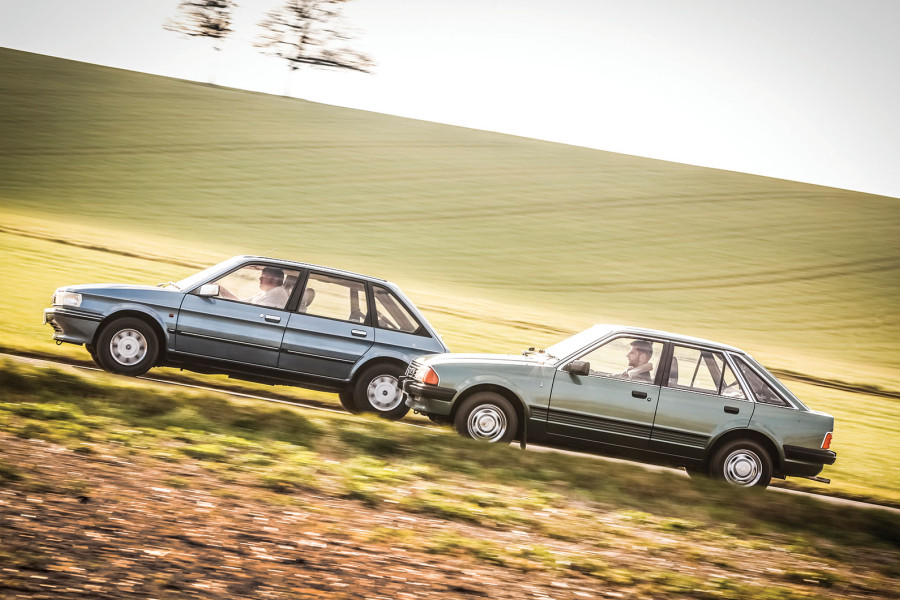
Unlike modern cars, these two are at least easy to tell apart.
The Hereford, with its ‘Flying A’ hood mascot, upright grille and bustle tail, is more obviously British and even has an ‘Austin of England’ script on either side of its hood, in case you were in any doubt.
The Standard Vanguard, on the other hand, with its tall, domed roof and bullnose hood, is a less compromising shape.
Walter Belgrove was unhappy with the short wheelbase – the body falls away so abruptly at the rear that it could, in profile, be one of Dr Kamm’s experimental 1930s BMWs. The effect, particularly to modern eyes, is bizarre.
The Austin A70 Hereford’s body-colored dashboard
You are struck by how small both cars’ brake and indicator lights look on their big, rounded rear ends.
The Austin has the larger trunk, but, oddly, the lid is bottom-hinged.
Inside, what once looked like decadence appears bleak today, with flat, unsupportive seats, plain door cards and modest instruments on unyielding metal dashboards.
These must be among the first British cars to have column changes and bench front seats so they could seat six at a pinch.
Headroom is generous, too, so everyone could wear a hat.
The Austin is set up for left- or right-hand drive by dint of having its circular 90mph speedo, rectangular minor gages and Bakelite switchgear in the center; equally, the Standard’s instrument pack could be swapped easily to the left for export.
The Austin A70 Hereford’s rear cabin is the more accommodating of the two cars here
Both cars have separate starter buttons and oil-pressure gages, along with trafficator switches on the steering wheel’s center boss. The Austin is roomier in the back.
Looking out over the high scuttles and rounded hoods of both these classic cars, you notice how tiny their windshield wipers are.
The Standard kept its distinctive split windshield until the coming of the Phase 2 in 1953.
The driving positions in the Standard Vanguard and the Austin Hereford are pretty much ‘one size fits all’, with floor-hinged pedals and no backrest adjustment.
The transmission humps in both cars are prominent, and you must sit close to the big steering wheels to exert the necessary leverage when parking – the Standard has the tighter turning circle, but lower gearing.
The Austin A70 Hereford’s central speedometer facilitates the conversion to left-hand drive
That said, despite their bulky appearances, neither the A70 nor Vanguard was hefty to handle by the standards of the day; today, the cars largely impress thanks to a general sense of spaciousness that is combined with a comfortable, lolloping ride on soft dampers and tall, skinny tires.
The Austin rolls less than the Standard and nods its prow more under braking. Both cars are set up to understeer moderately but persistently.
The short-wheelbase Vanguard feels the least happy of the two being thrown about, and its brakes are less reassuring.
Torquey engines and low overall gearing keep the gearchanging to a minimum, and you can routinely pull away in second in each.
The Austin A70 Hereford has simple chrome embellishments
Bottom is ‘crash’ in the A70, and third would have taken you to almost 60mph in the cars’ prime, but you drive around in top for most purposes, and only when pulling away from low speeds do you notice this is a ‘four’ rather than a ‘six’.
The A70 was considered reasonably brisk in its day, capable of 70mph cruising, 30-50mph in 9 secs and able to take a 1-in-20 hill at 65mph in top.
With some justification, The Autocar called the A70 a ‘goer’.
The Vanguard is similarly sweet-sounding, with lusty mid-range pull that suits its gearing: the idea is that you get into top and stay there as long as possible.
The Austin’s 2199cc ‘four’ musters a modest 68bhp, but it’s gutsy and flexible enough once you’re on the move
It has the niftier gearchange, whereas you can sometimes get a bit lost in the Austin Hereford’s sloppy linkage.
In some ways the success of the Standard Vanguard is a reflection of the lack of plausible rivals at that time.
That would change dramatically in 1950 when Ford introduced the first Zephyr, with its lightweight monocoque body, MacPherson-strut front suspension and short-stroke straight-six.
BMC countered the success of the Ford fairly effectively with its monocoque Cambridge and Westminster (from the mid-’50s on), but the monocoque Vanguards never recaptured the earlier models’ success.
The Austin A70 Hereford better contains its body roll in corners
Neither of these cars set the heather alight even when they were new, yet they have too much period charm to be dismissed today as ‘gray porridge’.
Let’s call them austerity sedans: Festival of Britain cars that epitomize a time somewhere between Sir Stafford Cripps’ ‘export or die’ and the Suez Crisis – that now very distant, pre-highway era of smog, steam trains and capital punishment, when few men stepped outside without a hat, everyone smoked, foul language was confined to the bar of the local public house and rationing was still an everyday British reality.
The Standard Vanguard and Austin A70 Hereford were rugged and fit for purpose at the very least in the context of their era.
Images: Jack Harrison
Thanks to: Great British Car Journey
Factfiles
Standard Vanguard Phase 1A
- Sold/number built 1948-’52/184,799 (all Phase 1s)
- Construction steel body and separate chassis
- Engine all-iron, ohv 2088cc ‘four’, single Solex carburetor
- Max power 68bhp @ 4200rpm
- Max torque 108lb ft @ 2000rpm
- Transmission three-speed manual with overdrive, RWD
- Suspension: front independent, by wishbones, coil springs rear live axle, semi-elliptic leaf springs; anti-roll bar, lever-arm dampers f/r
- Steering cam and roller
- Brakes drums
- Length 13ft 7in (4140mm)
- Width 5ft 8½in (1740mm)
- Height 5ft 3¼in (1607mm)
- Wheelbase 7ft 10in (2388mm)
- Weight 2800lb (1270kg)
- 0-60mph 24 secs
- Top speed 81mph
- Mpg 26
- Price new £630
- Price now £7000*
Austin A70 Hereford
- Sold/number built 1950-’54/48,640 (saloons)
- Construction steel body and separate chassis
- Engine all-iron, ohv 2199cc ‘four’, single Zenith carburetor
- Max power 68bhp @ 3800rpm
- Max torque 116lb ft @ 1700rpm
- Transmission four-speed manual, RWD
- Suspension: front independent, by wishbones, coil springs rear live axle, semi-elliptic leaf springs; lever-arm dampers f/r
- Steering cam and peg
- Brakes drums
- Length 13ft 11½in (4255mm)
- Width 5ft 9⅔in (4818mm)
- Height 5ft 5⅔in (1668mm)
- Wheelbase 8ft 3in (2515mm)
- Weight 2825lb (1281kg)
- 0-60mph 21 secs
- Top speed 81mph
- Mpg 22
- Price new £668
- Price now £7000*
*Prices correct at date of original publication
We hope you enjoyed reading. Please click the ‘Follow’ button for more super stories from Classic & Sports Car.
Martin Buckley
Senior Contributor, Classic & Sports Car