
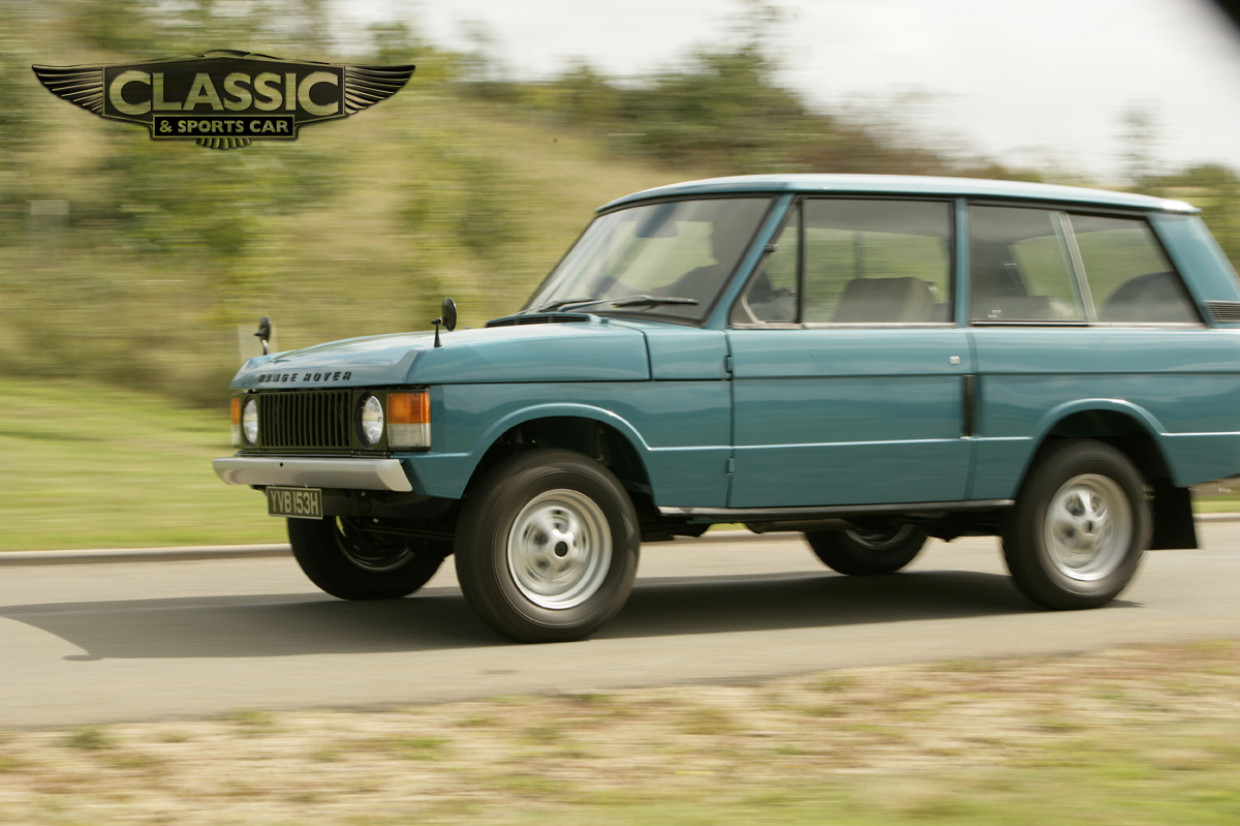
The first production Range Rover is back on the road; Simon Charlesworth gets an exclusive preview and meets its descendants.
Unable to resist rarities and curios, I crane my neck and gawp because these exhibits have a particular relevance. We’re at the British Motor Industry Heritage Trust to see the recently restored first production Range Rover, YVB 153H, and the vehicles at the Trust’s Gaydon Heritage Centre chronicle the story behind Britain’s first luxury 4x4. Amid a large Land-Rover display, there’s a Tickford Station Wagon – one of less than 650 examples built of Solihull’s ill-fated first attempt at building a more civilised off-roader. Nearby, looking slightly sorry for itself in solitude, there’s the 1957 Road Rover prototype – the Range Rover’s twice-removed cousin. Seeing these vehicles together makes you realise the belief that Rover’s Wilks brothers had in the concept of a utilitarian station wagon. If only they could get the details right.

Following the failure of the Tickford, and subsequently the two aborted generations of Road Rovers, everything fell into place in the mid-’60s. Unlike the Road Rovers, the new ‘Interim Station Wagon’ (later to become the 100 Station Wagon) would be a Land-Rover New Vehicles Project (NVP) rather than the work of Rover’s car arm. The new concept would feature permanent four-wheel drive, low-rated coil springs and long suspension travel for optimum off-road capability, plus a box-section steel chassis and aluminium body panels. When it came to power units, the old 2.25-litre Land-Rover engine and the Rover P5’s 3-litre were evaluated, but the recently acquired, Buick-sourced 3.5-litre V8 arrived at Solihull just in time. It proved ideal for a machine that combined rugged off-road ability with P6 saloon comfort.

Joining Land-Rover’s Gordon Bashford on the new project was Charles Spencer ‘Spen’ King. Indeed, it is reasonable to suggest that without King the Range Rover might not have become such a success. Not only did he have significant input on the car’s engineering, but also its styling. Rover stylist David Bache wanted to emphasise the road-friendly nature of the project by moving away from traditional Land-Rover lines towards contemporary road car design. Plausible though the idea arguably was, some of the exploratory concepts weren’t quite so well resolved. Because time was at a premium and the Styling department was busy with other projects, without Bache’s knowledge King and Bashford ‘borrowed’ designer Geoff Compton for two hours to come up with a simple-bodied mule for testing. Yet it looked so right that when the Rover board saw the mule, it insisted the car should be developed by Bache for production.

“It was only arm-twisting later on that persuaded Bache to tidy up King and Bashford’s body,” recalls Range Rover project engineer Geoff Miller. “The first two prototypes were designed for functionality rather than style and were called ‘clinker-built’ because King had been inspired by boat building.” The flanks of the original mock-up featured two horizontal creases, referred to by King as a “waterfall section”, which created a pair of unfortunate parallel shadows. “One of the clever things Bache did was to change the lower crease above the sill to an outward step,” says Miller, “turning the lower shadow into a highlight. It made a big difference to the appearance of the vehicle.”