Austin Kimberley X6: Australia’s Landcrab

| 2 Jun 2025
Classic & Sports Car – Austin Kimberley X6: Australia’s Landcrab

That’s not an Austin 1800.

But it’s on the beach in Newcastle, so it must be some sort of Landcrab model, right?

Yes, but it’s the Australian take: an Austin X6 Kimberley, the higher-specification version of the two models that took over from the much-loved Australian Austin 1800 range, which included pick-up trucks.

Classic & Sports Car – Austin Kimberley X6: Australia’s Landcrab

The Kimberley X6 has a wider track than the British-built Austin 1800

The Austin was the end product of an increasing Australianisation of the industry, where rules surrounding local content meant that manufacturers could no longer ship Completely Knocked Down kits to be built in the region; they had to ensure manufacture of component parts took place there as well.

Times had changed since the Sydney Harbour Bridge was built, taking Middlesbrough contractor Dorman Long six years to erect.

Back home, Dorman Long managed to build the Tyne Bridge in only two years and finish it first, even though the Sydney crossing was started earlier.

The Australians got their own back with the Austin Kimberley, being the first to use the straight-six lengthened Maxi motor, designated E6, and pitching it into a market appreciative of its virtues.

Local content was high, including the generic 1800 doors – made in Australia, but with anti-burst door handles: BL UK didn’t introduce these on its big front-drivers until the wedge Princess range of 1975.

Australian magazine Wheels proclaimed ‘Austins hit the button’ in its front-cover banner headline at the X6’s launch, but this bespoke contender soon had teething problems that conspired to drag down its auspicious arrival and prevent the estimated 30,000 sales per year.

Classic & Sports Car – Austin Kimberley X6: Australia’s Landcrab

The Austin Kimberley X6’s 2227cc ‘six’ makes 115bhp

The Austin X6 Kimberley and Tasman finally went on sale late in 1970, and clocked up just over 15,000 sold in a sub-three-year production run.

Upon its launch in November 1970, 1062 buyers took delivery, but volumes had slipped disastrously by the time the MkII was released, with only 4367 made during the whole of 1972.

At its peak, sales of the Mk1 had topped 900 per month, but they sank to only 250 per month once its reputation had become tarnished.

By December ’72, when production ceased, all the remaining cars were marked with ‘Dec 72’ on their compliance plates, even though they were still on the books for sale when the Leyland P76 was launched to replace the X6 in June 1973.

The last indictment of this brave Austin came from the previously enthusiastic Wheels, which, on testing the X6 MkII, concluded: ‘By average standards it’s an excellent car.’

Classic & Sports Car – Austin Kimberley X6: Australia’s Landcrab

This rare, Australian-market Austin Kimberley X6 found its way to the UK

The Austin Kimberley did have many good features. Its internal space was huge compared with its front-engined, rear-driven rivals.

The handling was commended and the ride revered. But, strewth mate, it wasn’t tough enough or gutsy enough to win the approval of those discerning Australian motorists.

They were notoriously hard on their vehicles, needing simplicity, ruggedness and good load-carrying capacity.

They were used to Ford and Holden engines with huge torque; they were used to toughness in a tough environment.

In a market where the Aussie Charger was still a current model, the Tasman and Kimberley faced a brutal test.

That they failed was, ironically, almost a result of British Leyland Australia (BLA) trying to make the car tough enough for the local conditions.

A water-bypass pipe fitted to subsequent Austin and Morris 2200 models was not present on the Kimberley and Tasman, which had an extra engine brace mounted to the blanked-off boss instead.

Classic & Sports Car – Austin Kimberley X6: Australia’s Landcrab

The Austin Kimberley X6’s Australianised dashboard has anti-glare lenses on the dials

The cars soon suffered overheating problems, with the heads blowing their gaskets and warping at the end furthest from the water pump. 

BLA worked to stem the faults. In mid-1972 it introduced the MkII, which overheated less, and Kimberleys were reduced to a single carburettor, like the Tasman.

This X6 Austin Kimberley MkII has been in the hands of Eddy Saint since 11 May 1979.

He was working Down Under and wanted to own a local car.

“It had to be Australian,” he recalls, “but one that I could take home and still get spares for easily.” 

So was the X6 Kimberley really the only car that fitted the bill? “Oh aye,” he continues. “I thought that even if I needed to rebuild the brakes from scratch, I could convert it from the Australian PBRs to the system from the Austin 1800.”

Classic & Sports Car – Austin Kimberley X6: Australia’s Landcrab

These handbooks and leaflets came with the Austin Kimberley X6 when owner Eddy bought the car in Glenelg, Australia, in 1979

“But I did come unstuck with the wheels: I shotblasted and repainted a set of rims from an 1800,” he continues, “but when I fitted them, I discovered the Australian wheels had greater offset, which is why the X6 was marketed as having a wider track than the model it replaced. The British wheels just looked too narrow.

“I did put in a heated rear ’screen, though – the Australian spec never offered one, but it was easy enough to get from a rotten 1800.”

The car came from the Tom Jones Car Corral in Glenelg, and the astute Eddy chipped 10% off the AU$2200 asking price: “I think he was glad to get rid of it really,” he adds.

The car would likely have had a short life as a taxi: operators liked the comfort, space and good fuel economy (about 25mpg) – virtues that still appeal today.

The space astounds when you first sit in the Kimberley: the wide, flat floor stretches like the Great Victoria Desert, and the sand-coloured interior adds to the effect.

The dashboard is faced with two conical instruments, the better to reduce glare, and the speedometer is marked in both mph and kph, with a handy conversion notice for distance prominent: ‘10 miles = 16 kilometres’.

Classic & Sports Car – Austin Kimberley X6: Australia’s Landcrab

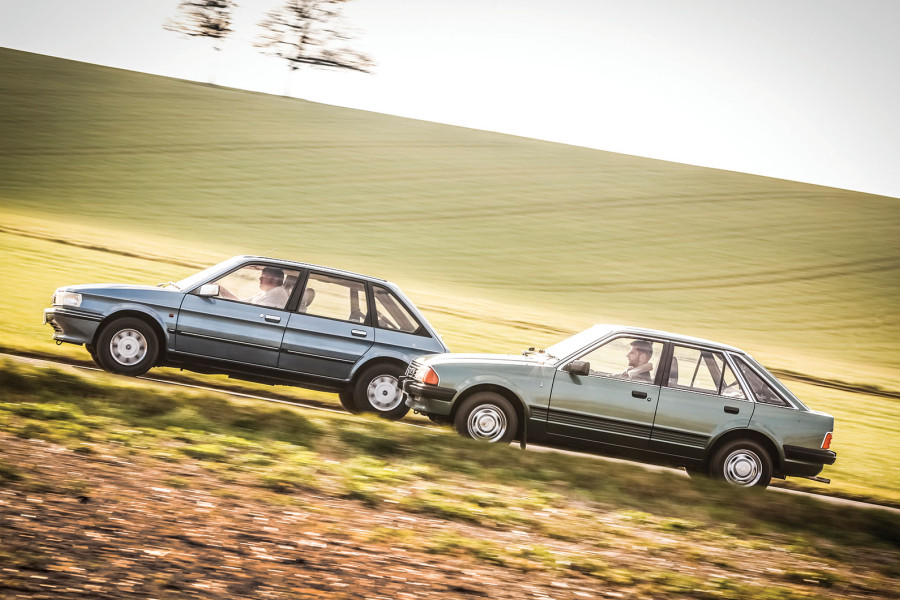
The Austin Kimberley X6 was designed for Australia, but it’s well suited to British roads

The E6 engine spins freely and fires with a smooth, whiny tone, just like a big Maxi, which it really is.

The cable gear selection is easy to use and the exhaust more throaty than you might expect – there’s a straight-six urgency as the revs climb, but subdued and dampened, as if the carburetion and exhaust conspire to hold back the car’s performance.

On the move the Austin Kimberley X6 gets on with it, although above 55mph it sounds busier than you’d like, a product of the low overall gearing.

The steering, through the large, thin-rimmed wheel – so Austin – is precise and controlled, and as you head the car into a series of bends it plants itself further into the road, with no body roll, inspiring confidence no matter the conditions.

Wet roads or loose sandy surfaces hold no fears for the Kimberley pilot: it gradually builds up understeer, and the limiting factor isn’t grip – it’s the driver’s movement on the wide seat that ultimately prevents heroic behaviour in the bends.

It’ll be your friend if you’ve got to swerve to avoid a ’roo, and it can be hustled along.

Classic & Sports Car – Austin Kimberley X6: Australia’s Landcrab

The Austin Kimberley X6’s reverse lights are built into the rear indicators

The ride cushions the occupants and the whole car is a relaxed cruiser, save that rather intrusively low top gear.

It feels so at home on modern UK roads, it’s hard to believe it was produced so long ago to sell in an Antipodean market.

Eddy has taken steps to combat the hot running, so there is an electric fan to cool the rad and an Australian Davies Craig electric water pump in addition to the mechanical one. 

Eddy’s Australian friends – Barb and Bas Hodgson, and Faye and Mick Godfrey – have all helped to keep this car, so unloved in its home country, functioning in the UK.

Eddy adds: “The rear lenses were fading, and they found me a brand-new pair still in the BLA packaging – incredible!”

The tail-lights are to Aussie spec, with reverse lights built into the rear indicators, so a Kimberley backs up with its twin amber lights ablaze.

Even the towbar on this particular car conforms to the Australian norm: the bracket is fitted with a hole for the towball to bolt through.

Years ago, every small outback garage used to hire out trailers, but there were so many accidents because of the variety of tow-hitch sizes that garages would rent you the trailer and its coupling.

Classic & Sports Car – Austin Kimberley X6: Australia’s Landcrab

The Austin Kimberley X6 was born out of Australian rules that stopped Completely Knocked Down kits from abroad

Eddy’s car stands alone as probably the only X6 in the northern hemisphere.

It draws crowds wherever it goes, and Eddy does nothing to discourage them by towing a trailer carrying his Australian Ariel Square Four ’bike for display.

Yet, at an Australian Austin rally in 1999, there were 90 cars in attendance, only two of which were Kimberleys; they’re often offered for free in their home market.

The Austin Kimberley X6 was the right car, in the wrong place at the wrong time.

Images: Tony Baker

This was first in our January 2005 magazine; all information was correct at the date of original publication


The Austin Kimberley X6 for the British market


The Austin Kimberley X6 nearly made it to the UK in the form of the Vanden Plas Princess, which would have been a replacement for the 4 Litre R, had British Leyland management not canned it.

A prototype was styled and produced in-house at Longbridge during 1970, and first registered for road use in 1971.

Interior appointments were in keeping with the upmarket image, comprising cows and trees in a manner more Jaguar than Nullarbor.

In the same way the X6 was the car the MkIII Landcrab should have been, the Vanden Plas X6 was the car the Austin 3 Litre missed being: that model retained a rear-drive layout whereas this car was front-drive, flat-floored and space-efficient.

It’s perhaps the most desirable Landcrab in the world, Austineered to perfection.


Factfile

Classic & Sports Car – Austin Kimberley X6: Australia’s Landcrab

Austin Kimberley X6

  • Construction steel monocoque
  • Engine iron-block, alloy-head, sohc 2227cc straight-six, twin SU carburettors; compression ratio 8.6:1
  • Max power 115bhp @ 5500rpm
  • Max torque 118lb ft @ 3500rpm
  • Transmission four-speed manual mounted below crankshaft, with cable shift, FWD
  • Suspension independent, at front by double wishbones rear trailing arms; Hydrolastic displacers at each corner, interconnected front to rear, rear displacers rated lighter than front
  • Steering rack and pinion
  • Brakes PBR dual-circuit 10½in (267mm) discs front, 9in (229mm) drums rear, with servo
  • Length 14ft 6½in (4433mm)
  • Width 5ft 6⅗in (1692mm)
  • Height 4ft 9¼in (1454mm)
  • Wheelbase 9ft ⅛in (2746mm)
  • Weight 2613lb (1185kg) 
  • 0-60mph 11.9 secs (est) 
  • Top speed 101mph (est)
  • Mpg n/a
  • Price new n/a

Enjoy more of the world’s best classic car content every month when you subscribe to C&SC – get our latest deals here


READ MORE

Leyland P76: a great Briton Down Under

Chrysler Valiant Charger: an Australian odyssey

Austin 3 Litre vs Wolseley Six: affordable luxury