MGB GT V8 vs Triumph Stag: in-house rivals

| 24 Nov 2025
Classic & Sports Car – MGB GT V8 vs Triumph Stag: in-house rivals

This is where things really started to heat up in British Leyland’s battle of the brands, because the Triumph Stag is the reason why the V8-engined MGB came only in GT form.

Despite Ken Costello’s conversions – and, many years later, Rover Group’s RV8 – proving otherwise, British Leyland claimed that the MGB’s bodyshell was not structurally able to handle the output of the Rover V8.

Former Abingdon staff, meanwhile, will also attest just as strongly that BL held no such tests.

Classic & Sports Car – MGB GT V8 vs Triumph Stag: in-house rivals

The Triumph Stag’s cabin is charming, but the driving position is compromised

Tutting over with, and the Triumph Stag has become infamous for its reliability issues from new – yet another of many promising BL cars that turned sour in the transition from motor-show pin-up to driveway reality, in this case due to overheating issues with its new 3-litre engine.

Today, however, that is now ancient history thanks to the efforts of Stag enthusiasts.

Transport yourself back to the early 1970s, and the Triumph would have been the car with the bigger showroom appeal.

Classic & Sports Car – MGB GT V8 vs Triumph Stag: in-house rivals

The Triumph Stag’s stylish five-spoke wheels

Although both have Italian DNA in their styling, the Triumph was fresh, while the MGB GT V8 was a variation on a theme first unveiled in 1965; its soft-top (with optional hardtop) would have further increased market desirability.

It was a feature that was denied the MG, unless you paid Lenham to convert your BGT V8 into an ungainly 2+2 drop-top – and precious few did.

Sitting behind the wheel of Derek Athey’s 1972 Stag (registered in 1977), it is clear that, true to past form, Triumph provided a peculiar driving position.

Classic & Sports Car – MGB GT V8 vs Triumph Stag: in-house rivals

Issues with the Triumph Stag’s all-alloy V8 are now largely solved

The steering column is quite upright, but the pedals are drastically offset to the right.

Not so in Graham Brown’s 1974 MGB GT V8, which is far straighter, and more laid-back and GT-like – although the later, more padded MGB seats do poach some headroom.

Running both in enclosed form, the MG does a better job of piping its warbling V8 to your appreciative ears.

This comes as a surprise, because a roofless Stag supplies its driver and all those around it with a deliciously rich score – but then, the removable hardtop suffers with more wind noise than the fixed-head MG.

Classic & Sports Car – MGB GT V8 vs Triumph Stag: in-house rivals

The MGB GT V8 has a comfy interior, although this car has some non-standard touches

Over our smoothly surfaced test route, it really is hard to separate the ride and handling of these GTs – despite the Stag’s independent rear and the MG’s manual steering.

So minute are the differences that, in the end, you do wonder: is the Stag’s ride more accomplished? Does the BGT V8 have a slightly sportier edge?

Boasting a smaller steering wheel than would have been standard, this Stag’s helm is in a different league from other examples I’ve driven.

Before, the steering has been so over-assisted and numb that when roll transferred load from the inside wheel, the resultant lightening of the PAS would lead to more lock being involuntarily wound on.

Classic & Sports Car – MGB GT V8 vs Triumph Stag: in-house rivals

The MGB GT V8’s wheels also appeared on the special-edition Jubilee

Not good, but such is not the case with this car: in terms of gearing and weight at speed, it is incredibly close to the MG, only lacking in ultimate feel.

As you’d expect, the MG’s larger 3528cc V8 is more effortless with its delivery of 193lb ft. There is no sudden burst of power: it just fires you along with boundless energy.

At a mere 2000rpm, the BGT V8 can cruise at 70mph, with 90mph at just over 3000rpm; visits beyond 4000rpm are necessary only for the mechanical sadist.

Classic & Sports Car – MGB GT V8 vs Triumph Stag: in-house rivals

The MGB GT V8’s robust engine majors on torque

In the Triumph, the 170lb ft powerplant has a definite moment of glory around 3-3500rpm before building to its peak power at 5500rpm.

It must be said, however, that the long, meaty throw of the Stag’s gearbox does seem at odds with the rest of the car’s control surfaces – so I would certainly concur with Derek’s comment that the Triumph is better suited to its optional three-speed automatic.


And the winner is…

Classic & Sports Car – MGB GT V8 vs Triumph Stag: in-house rivals

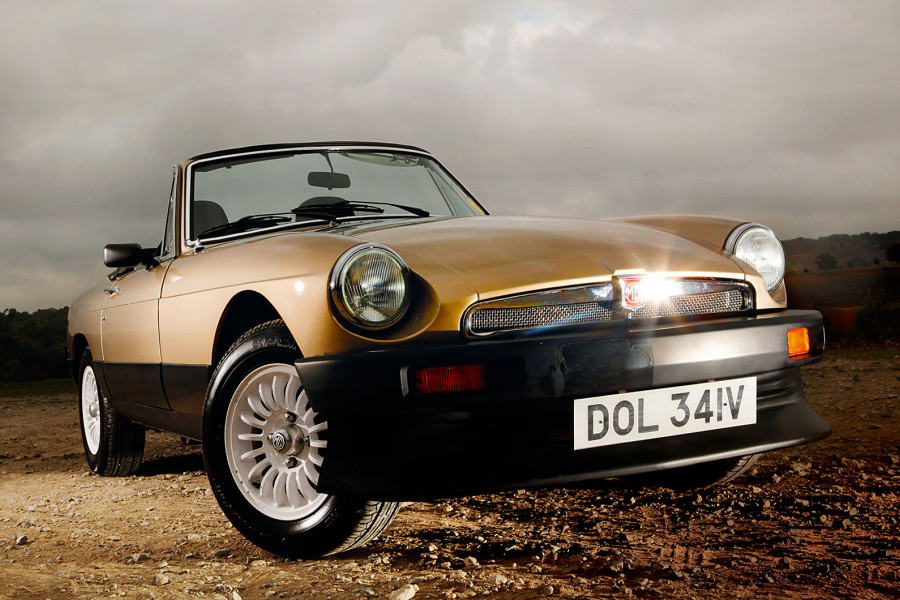
The MGB GT V8’s discreet badging

In the end, this is an incredibly close contest, but it comes down to ergonomics.

To relish a long-legged GT, it is best to be comfortable, and for that I need a straightforward driving position.

I realise that this is a very personal choice, but it is the MGB GT V8 that better fits me.

Images: Tony Baker

Thanks to: the Stag Owners ClubMG Car Club V8 Register

This was first in our July 2013 magazine; all information was correct at the date of original publication


Factfiles

Classic & Sports Car – MGB GT V8 vs Triumph Stag: in-house rivals

MGB GT V8

  • Sold/number built 1973-’76/2591
  • Construction steel monocoque
  • Engine all-alloy, ohv 3528cc V8, twin SU carburettors
  • Max power 137bhp @ 5000rpm
  • Max torque 193lb ft @ 2900rpm
  • Transmission four-speed manual with overdrive, RWD 
  • Suspension: front independent, by wishbones, coil springs, anti-roll bar rear live axle, semi-elliptic leaf springs; lever-arm dampers f/r
  • Steering rack and pinion 
  • Brakes discs front, drums rear, with servo 
  • Length 12ft 11in (3929mm)
  • Width 5ft (1524mm)
  • Height 4ft 3in (1295mm) 
  • Wheelbase 7ft 7in (2311mm) 
  • Weight 2418lb (1097kg) 
  • 0-60mph 8.6 secs 
  • Top speed 125mph
  • Mpg 20
  • Price new £2293

Classic & Sports Car – MGB GT V8 vs Triumph Stag: in-house rivals

Triumph Stag

  • Sold/number built 1970-’77/25,939
  • Construction steel monocoque
  • Engine all-alloy, sohc-per-bank 2997cc V8, twin Zenith-Stromberg carburettors
  • Max power 145bhp @ 5500rpm
  • Max torque 170lb ft @ 3500rpm
  • Transmission four-speed manual with overdrive, RWD 
  • Suspension independent, at front by MacPherson struts, anti-roll bar rear semi-trailing arms, coil springs, telescopics
  • Steering power-assisted rack and pinion
  • Brakes discs front, drums rear, with servo 
  • Length 14ft 6in (4420mm)
  • Width 5ft 4in (1626mm)
  • Height 4ft 2in (1270mm) 
  • Wheelbase 8ft 4in (2540mm) 
  • Weight 2807lb (1273kg) 
  • 0-60mph 9.5 secs 
  • Top speed 118mph
  • Mpg 20
  • Price new £2399

We hope you enjoyed reading. Please click the ‘Follow’ button for more super stories from Classic & Sports Car.