Buyer’s guide: Sunbeam Alpine

| 19 Jun 2025
Classic & Sports Car – Buyer’s guide: Sunbeam Alpine

Why you’d want a Sunbeam Alpine

The Sunbeam Alpine was a very effective package from the off.

More comfortable than its main rival, the MGA, it boasted good aerodynamics and just enough transatlantic style to appear modern, but still understated.

It had a small back seat, wind-up windows and an effective soft-top that tucked away out of sight below neat metal panels.

The running gear, uprated from the Sunbeam Rapier, was well-tried, with wishbone front suspension and disc front brakes (their first use on a Rootes Group car).

The monocoque body was immensely stiff, thanks to substantial cruciform chassis legs built into the Hillman Husky-derived floorpan.

Bolted-in tubular members linked the inner wheelarches to the front bulkhead: a belt-and-braces approach that made the Alpine very refined for a sports car.

It was a little heavy for competition, but that didn’t stop it winning the Index of Thermal Efficiency at Le Mans in ’61.

On test, the refinement, comfort and good handling impressed most, with well-chosen gear ratios when overdrive was specified. ‘The prescription for putting pleasure back into motoring,’ said The Motor.

Optional overdrive on third and top gave six speeds; other options were an attractive curved aluminium hardtop, a heater, tonneau cover and wire wheels.

Classic & Sports Car – Buyer’s guide: Sunbeam Alpine

The Sunbeam Alpine Series II boosted handling, refinement and power – and was immortalised by James Bond in Dr No. Performance was unchanged, but increased flexibility and a quieter exhaust were appreciated.

The Series III had multi-adjustable reclining seats, complemented by a telescopic steering column and movable pedals.

A bigger boot was created by putting twin fuel tanks in the wings and mounting the spare wheel vertically.

Fixed quarterlights improved window sealing and larger inlet valves helped compensate for extra weight.

The new GT, with a removable hardtop but no soft-top, had a cast-iron exhaust manifold and a big air cleaner to reduce engine noise; this different spec was dropped for the Series IV.

Cut-back fins were introduced by Touring Superleggera on Alpines it assembled in Turin: they would follow on UK cars with the Series IV, which brought a gutless automatic option aimed at the US market.

It was quietly dropped for the Series V, whose 1725cc engine clawed back a little of the MGB’s pace advantage.

Images: James Mann


Sunbeam Alpine: what to look for

Classic & Sports Car – Buyer’s guide: Sunbeam Alpine

Trouble spots

Please see above for what to check for when looking at Sunbeam Alpine classic cars for sale.

Classic & Sports Car – Buyer’s guide: Sunbeam Alpine

Engine

The alloy-head Rootes ‘four’ is a viceless unit that’s easy to maintain and gives lusty performance.

The lack of an air-filter box meant intake noise that Rootes suppressed for the Series III GT, but its poor performance was criticised more than the noise: even the Series V would have open pancakes.

Classic & Sports Car – Buyer’s guide: Sunbeam Alpine

Gearbox

Gear and axle ratios vary between Series and overdrive/non-overdrive models.

Watch for clutch slip, weak synchros, gearbox noise and jumping out of gear.

Classic & Sports Car – Buyer’s guide: Sunbeam Alpine

Soft-tops

Soft-tops on Sunbeam Alpines should fit well and tuck away out of sight, but are never easy to raise and lower.

GTs didn’t originally have a hood, though they can be retrofitted.

Classic & Sports Car – Buyer’s guide: Sunbeam Alpine

Suspension and brakes

Frequent greasing was needed up to 1964: check for wear in the top and bottom balljoints.

Brakes can seize if little used – inspect for neglect, rust and damage.

Classic & Sports Car – Buyer’s guide: Sunbeam Alpine

Radiator

Early cars had a crossflow radiator with separate header tank, SIIIs-on had a vertical-flow rad.

Corrosion can silt them up: look out for overheating and gasket failure.


Sunbeam Alpine: before you buy

Classic & Sports Car – Buyer’s guide: Sunbeam Alpine

Performance changed little through Sunbeam Alpine production, the weakest being the Series IV automatic and Series III GT.

Engine swaps and performance tuning are common, and can redress the balance, but check a less-powerful unit hasn’t been fitted from a Sunbeam Rapier or a Hillman saloon – some have.

The Series II and V are the most desirable in standard spec; a tuned Holbay motor with twin Webers is the most desirable period upgrade.

The aluminium cylinder head means no worries with unleaded, but internal corrosion can blow gaskets and wreck the head if not inhibited: if it’s failing, budget for some skilled aluminium welding.

Classic & Sports Car – Buyer’s guide: Sunbeam Alpine

Test drive the car with the hood up or hardtop on because you are much more likely to hear unwanted noise from the engine, transmission or suspension with the roof on.

You’ll need to drive at least 10 miles for overheating issues to show up: keep the engine running for a while when you stop.

An overdrive makes a big difference for motorway driving. Gear ratios swapped around during production, and transmissions often get changed, too, so make sure that the car you’re viewing has a good combination of gearbox and axle ratios, or budget to swap parts again.

The all-synchro Series V ’box with overdrive is the nicest; beware cars with a switch for an overdrive but nothing on the transmission!

The steering box wasn’t the most precise, but check for excessive wear or stiffness (usually indicating over-adjustment to try to hide wear).


Sunbeam Alpine price guide

Restoration/average/show

  • All models: £1500-5000/6-10,000/12-16,000


Prices correct at date of original publication


Sunbeam Alpine history

1959 Alpine launched with 1500 engine

1960 Various detail improvements before Series II launched in October: 1600, 80bhp, wider rear springs, stronger clutch and rear dampers, detachable hood cant rails

1961 Type A Harrington coupé from March (100 made), Type B Harrington Le Mans in October (96bhp, 250 made); Alpine wins the Index of Thermal Efficiency at Le Mans; Touring agrees to assemble Alpines in Milan

1962 Type C Harrington (sub-100 made)

1963 SIII launched at Geneva: 82bhp, fuel tanks in wings, vertical spare, close-ratio ’box, quarterlights, improved hood, seats, brakes, suspension; GT hardtop option with 75bhp, wood dash and wheel, no soft-top

1964 Series IV: all 82bhp, cropped fins, rubber-tipped overriders, single-bar grille

1965 Series V: 1725cc, 92.5bhp, five-bearing crank, Strombergs, improved seats/hood

1968 Alpine production ends


The owner’s view

Classic & Sports Car – Buyer’s guide: Sunbeam Alpine

“I originally wanted to buy an MGC,” admits Ed Ellert, “but when I tried one it was too heavy. I had decided on an MGB when a red SII Alpine came up for sale in the village where I lived, fitted with the 1725 engine: I bought it in 2006 and haven’t looked back since.

“I was editor of the Sunbeam Alpine Owners’ Club magazine for years, and in 2016 went to look at this Series II in Lake Blue, the rare James Bond colour. I immediately wanted to buy it – I increased my mortgage to get it.

“It was restored a long time ago, probably during the 1970s – I have pictures of it sitting on oil drums during the restoration, but they did a good job and it has lasted well.

“When Top Gear wanted to use an Alpine for a James Bond special, they used my car – Paddy McGuinness drove it.

“I also have a very rare Moonfleet speedboat, which is fitted with the Series II Alpine’s 1600 engine.”


Also consider

Classic & Sports Car – Buyer’s guide: Sunbeam Alpine

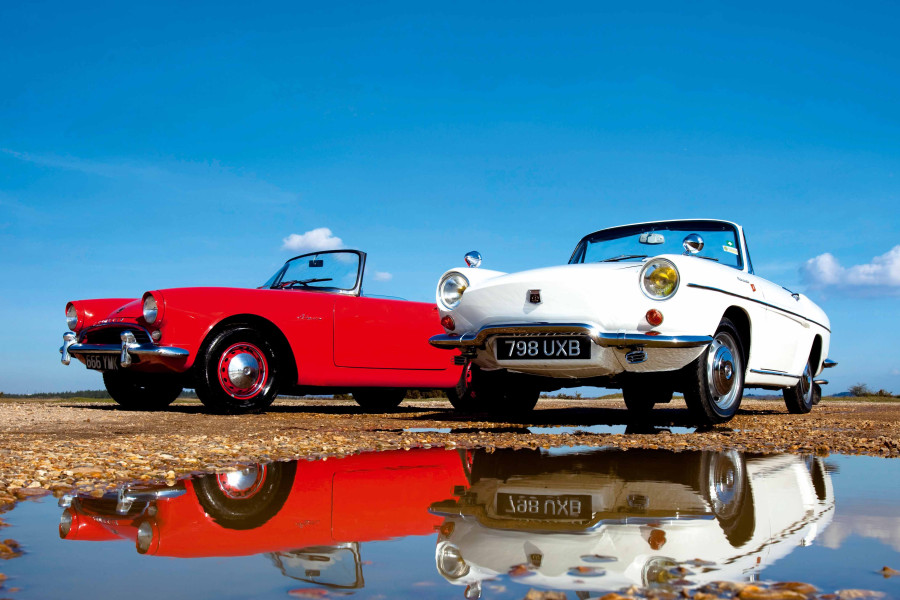
The MGA (left) and Triumph TR3A are alternative buys

MGA

The Alpine’s main opposition in its early days is now much costlier. Separate-chassis construction and cramped, especially in closed form, and only the expensive Twin Cam was much faster.

Sold 1955-’62 • No. built 101,082 • Price now £12-30,000*


TRIUMPH TR3A

With detachable sidescreens, separate chassis and a throaty 2- or 2.1-litre ‘four’, the last of the sidescreen TRs was rather agricultural beside an Alpine. Fun and fast, but spartan and tiring.

Sold 1957-’62 • No. built 58,309 • Price now £9-27,000*

*Prices correct at date of original publication


Sunbeam Alpine: the Classic & Sports Car verdict

Classic & Sports Car – Buyer’s guide: Sunbeam Alpine

Rootes deliberately pitched the Sunbeam Alpine as more of a tourer than a sports car, making it a very enjoyable all-rounder that would not tire its driver on a Continental trip. The Motor dubbed it the ‘business man’s express’.

Prices vary more according to specification, originality and condition than between models. Hold out for the spec and condition you want: they are out there, and are currently great value.


FOR 

  • Affordable and very usable as standard
  • Easily uprated
  • Very well supported by the club and specialists


AGAINST

  • Complex box-sections are costly to repair properly, and often hidden
  • Many cars have been modified
  • Trim parts are hard to find

Sunbeam Alpine specifications

  • Sold/number built 1959-’68/69,251
  • Construction steel monocoque, optional aluminium (SI-II) or steel (SIII-V) hardtop
  • Engine iron-block, alloy-head, ohv 1494/1592/1725cc ‘four’; twin Zenith, single twin-choke Solex or twin Stromberg carbs
  • Max power 78bhp @ 5300rpm to 92.5bhp @ 5500rpm
  • Max torque 89.5lb ft @ 3400rpm to 103lb ft @ 3700rpm
  • Transmission four-speed manual, RWD; all synchro from late ’64, optional overdrive, optional three-speed auto on Series IV
  • Suspension: front independent, by wishbones, coils, telescopic dampers, anti-roll bar rear live axle, leaf springs, lever-arm dampers (telescopics from SIII)
  • Steering recirculating ball
  • Brakes discs front, drums rear (with servo from SIII)
  • Length 12ft 11½in-13ft ½in (3950-3975mm)
  • Width 5ft ½-1½in (1537-1562mm)
  • Height 4ft 3¾-4½in (1315-1335mm)
  • Wheelbase 7ft 2in (2185mm)
  • Weight 2184-2229lb (993-1013kg)
  • 0-60mph 18-13 secs
  • Top speed 93-100mph
  • Mpg 22-35
  • Price new £852/913 (Sports/GT, 1964)

READ MORE

All Classic & Sports Car buyer’s guides

Celebrating the cars and more of Thomas Harrington & Sons

Sunbeam Alpine: driving the original James Bond car