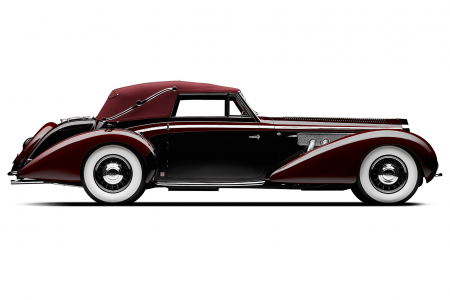
Delage 2LCV V12: a racer’s dozen

| 30 Jan 2026
Classic & Sports Car – Delage 2LCV V12: a racer’s dozen

The Tardis awaits and you can flash back to any Grand Prix. Which one is a tough call, but 3 August 1924 would be my choice.

Racing again on part of the magnificent 1914 Lyon-Givors road circuit, an epic contest played out at the premier French event between Alfa Romeo P2, Bugatti Type 35 (on its debut), Fiat 805, Miller, Sunbeam and the fabulous Delage V12.

Five drivers and three marques led at various times over the 503 miles and seven hours. 

Amazingly, just one minute separated Giuseppe Campari’s Alfa from Albert Divo’s Delage at the finish.

Classic & Sports Car – Delage 2LCV V12: a racer’s dozen

The Delage 2LCV V12’s engine originally produced 120bhp, but British specialist Sean Danaher has squeezed 140bhp from the 2-litre unit

All of the greats competed on that hot, dusty day, but not one Enzo Ferrari who was entered to drive the fourth Alfa P2.

Story has it that he was taken ill during practice and went back to Italy by train before the race, but rumours suggest he was totally intimidated by the speed of engineer Vittorio Jano’s freshly designed P2 challenger.

Practice would certainly have introduced him to the exotic new French contender, the Delage 2LCV and its jewel-like 2-litre V12 motor.

With its strident exhaust roar, this engine-turned beauty is believed to have had a lasting impression on the enterprising 26-year-old test driver and, when Gioacchino Colombo started drawing up the first Ferrari V12 two decades later, it was the 2-litre 120bhp Delage that inspired him.

Oh, to have leant up against the chestnut paling and watched those fast-revving Delages of René Thomas and Robert Benoist blasting through the Piège de la Mort, down to the pits and the Sept Chemins hairpin.

Running unsupercharged, the Delage team performed superbly against the new, blown twin-cam Alfa Romeo ‘six’.

Classic & Sports Car – Delage 2LCV V12: a racer’s dozen

The Delage 2LCV V12’s twin rev counters; the engine comes on song around 3000rpm

Frustratingly, Grand Prix racing during the 1920s never again had such an impressive grid as on that glorious day near Lyon.

In various forms, with and without superchargers, those innovative Delage V12s contested the final years of the 2-litre formula, winning at San Sebastian and at Montlhéry on that dark day of Antonio Ascari’s fatal Alfa crash.

For decades, all that remained of these V12 Grand Prix firsts was a silent exhibit in the Biscaretti museum and various never-ending restorations of the few surviving cars.

There appeared little hope that the Delage’s savage bark would be heard again in Europe.

Then in 2003 came news of a Delage 2LCV V12 on a dyno at Sean Danaher’s Suffolk workshop, and later of successful test runs of the restored car at a local airfield.

In summer 2004, the woods around the Goodwood Festival of Speed’s Cathedral paddock resounded to this marvellous V12’s roar.

Coincidentally, in the same enclosure, its chief rival the Alfa Romeo P2 remained a silent exhibit.

For restorer Sean it was the climax of a tough five-year project as he shared driving duties of the Gallic challenger.

Classic & Sports Car – Delage 2LCV V12: a racer’s dozen

The winning Delage V12 team at the 1925 San Sebastian Grand Prix in Spain

“For an unblown 1924 design, the performance is mindblowing,” he says. “Compared to this a Type 35 feels very ordinary. The engine loves to rev and really comes on cam at about 3000rpm.

“Because it is so responsive, the transmission, with its heavy gears, is a challenge.”

Two mysterious buttons on the steering wheel hint at how incompatible the advanced motor and vintage five-speed ’box were: “With a multi-plate clutch and fast-idling engine, the ignition kill switch was used to aid clean changes. They used a similar idea on racing motorcycles in the ’20s.”

A flat-spot just off idle, due to the old-fashioned twin-choke Zenith carburettor, makes the Delage tricky to get rolling as the revs bog down just when you think it’s pulling away.

But once the engine pulls cleanly, the performance is sensational.

Busy needles on the twin rev counters reveal the V12’s eager, responsive character as the car surges down Suffolk lanes. Early aviation-style dials weren’t used to high revs, so back-up gauges were required.

The low seating position and smooth, nicely geared steering both underline the Delage’s advanced character. Only that laboured, awkward ’box spoils its appeal.

Classic & Sports Car – Delage 2LCV V12: a racer’s dozen

The Delage 2LCV V12’s driving position is low, emphasising the car’s modern feel

Pedal pressure for the Perrot brakes is reduced thanks to servo assistance, with the unit mounted off the left side of the gearbox.

“The feel is good and you don’t have to break the back of the seat to make them work,” says Sean, who drove the 2LCV 200 miles on French back-roads during a Delage rally.

“The handling is brilliant, with high grip and beautiful balance. It works best on fast corners, but I imagine that it would have been hard work on the Targa Florio in 1926. A Bugatti Type 35B would be better for the nip-and-tuck Sicilian mountain roads.”

The advent of the new 1½-litre formula in 1926 meant the old 2-litre V12s were obsolete and, after the fiasco of a Sicilian sortie where Count Masetti suffered a fatal race crash, Delage was keen to sell them.

One eventually appeared at Brooklands as the Jameson Special, but under the bonnet the V12 had been replaced by an experimental 1100cc supercharged two-stroke.

This fine-looking Special proved a disaster, regularly non-starting before Charles Martin fitted the Delage chassis with four 350cc JAP engines. Parts of this car survive with Julian Majzub.

Classic & Sports Car – Delage 2LCV V12: a racer’s dozen

Note the Delage’s staggered seats – the driver was solo, however the regulations demanded two seats

Another two team cars were sold to South America, where they were successful in the hands of local ace César Milone.

Predictably, the exotic V12s ended up being discarded and replaced by American iron. And one Delage chassis continued racing into the 1940s before it was abandoned in a barn in Santiago, Chile.

Thankfully, when local enthusiast Herman Collyer discovered the worn-out old racing car, he appreciated its early history and saved the entire contents of the barn including the broken spares.

Eventually the remains were advertised in Hemmings Motor News through Marc Berlet and, after several bids to secure the Delage’s release from South America, the crates of parts were eventually acquired by Bob Sutherland in Denver.

The challenging project commenced in the early ’80s, with the chassis coming to England and Delage guru Nigel Arnold-Forster, who 
had already restored the Bequet Delage, a 1923 Delage/Hispano hybrid.

The rebuild of the broken, worn-out V12 engine was entrusted to Californian Steele Therkelson.

Classic & Sports Car – Delage 2LCV V12: a racer’s dozen

The Delage 2LCV V12’s Perrot brakes are assisted by a servo mounted on the gearbox

The Delage, presented in its earlier 1923 guise with dazzling engine-turned bodywork, finally made its debut at the 1989 Monterey Historic Races.

When it ran cleanly, the V12 rasped sharply through its single exhaust pipe as it dived down the famous Corkscrew.

After Sutherland sadly succumbed to cancer, his collection was auctioned by Christie’s in 2000, but the Delage had already been sought out by a European collector with a vision to get the famous racer right.

Not happy with the way the 2LCV had been rebuilt, he sent the car to Sean for investigation.

“With no disrespect to Bob [Sutherland], we felt, after much research, that the car was all wrong,” explains Sean. “It should to our minds be rebuilt to represent the last unsupercharged form, as it competed in 1925.”

While Sean took on the mechanical work, the new body, featuring a multi-louvred bonnet, shorter tail and signature twin exhausts, was entrusted to Competition Fabrications.

Classic & Sports Car – Delage 2LCV V12: a racer’s dozen

The Delage continued to compete successfully in South America in the late 1920s

Thanks to an amazing collection of historic photos from the 1925 San Sebastian GP – where the Delages dominated the field – found in Spain, the body details are now highly authentic.

“We scaled them up to get the accurate proportions and then made the templates,” Sean adds.

The shaped aluminium was then engine-turned to recreate the Delage’s distinctive, scale-like finish: “Unlike the Bugatti style, it doesn’t overlap. This makes it easier to repair because you don’t need to start again.”

The body was then sprayed with a blue lacquer so the effect was still visible through the colour. Matching the beautiful finish are the myriad exquisite details, from the bonnet catches to the copper cockpit edge and drilled brackets.

As with the fabulous engine, these chassis were a labour of love, with long hours of toolroom talent.

The V12 proved a major challenge once Sean and Andrew Kirby started assessing its true condition. It soon became clear that it had been messed about with.

Classic & Sports Car – Delage 2LCV V12: a racer’s dozen

‘The woods around the Goodwood Festival of Speed’s Cathedral paddock resounded to this marvellous V12’s roar’

“The repairs were multi-layered because it had clearly been blown up several times,” says Sean. “We wanted the car to run properly and the only way was to strip it right down.” 

A new one-piece billet crank was made by Crosthwaite & Gardiner before Andrew started the meticulous reassembly.

With 23 spur gears driving the twin camshafts at the front of the 60° banks and more than 90 roller bearings throughout – not to mention the army of castellated hex-head nuts holding down the 24 cam finger plates – you can imagine this baffling mechanical jigsaw laid out on the workbench. 

“This was the most complex engine of its era, and very labour intensive. It’s the grandfather of the modern Grand Prix engine,” enthuses Sean, who has now rebuilt all of the significant 1920s racing units other than the Alfa Romeo P2.

“It’s very light. The pistons are tiny, about two inches in diameter, so, due to the low reciprocating weight, the frictions are low. All of the sections are super-light. It’s very modern in thinking.”

Classic & Sports Car – Delage 2LCV V12: a racer’s dozen

This Delage’s fuel-filler cap is concealed in the rear bodywork

Once Andrew had completed the rebuild, it was time to prove the V12’s power on the dyno: “For an unblown 2-litre, the results were staggering.

“We got 140bhp at 5500rpm, which matched the supercharged Sunbeams and Alfa Romeos. The factory produced 120bhp, but time was always against them and they never really developed its full potential.”

The single Zenith twin-choke carburettor – the first on a racing car – proved straightforward to tune and even the old jetting from Argentina was close: “It’s a stunning piece of work, particularly when you think that the 1950 Ferrari V12 was holding 140bhp.

“If you put a Weber and modern ignition on this, it would give 180bhp. That’s colossal.”

This later 2LCV features an engine friction damper in the front crossmember. The 10in-diameter disc cleverly relieves the stress in the lightweight-section crankcase, which caused the early V12s to fail and prompted designer Charles Planchon’s sacking.

“In the first cars, the engine was bolted solidly to the frame,” says Sean. “As a result, the crank flexed and disturbed the alignment of the roller bearings with terminal results.”

Classic & Sports Car – Delage 2LCV V12: a racer’s dozen

The Delage 2LCV V12’s gorgeous lines

When René Thomas stopped on lap eight of the 1923 French Grand Prix at Tours, the patron insisted to the press that his retirement was due to a holed petrol tank.

Back at the workshop the V12 looked a mess, with the block punctured by rods. Albert Lory, a young engineer from Moteurs Salmson, took over development as Planchon, Delage’s cousin, collected his cards.

Appropriately, after five years’ work, the restored 2LCV was presented on the Delage Club stand at Rétromobile in Paris, not far from the old Courbevoie works on the Seine where it had been built.

Ancestors of both Delage and ace Benoist turned out for the unveiling.

Back in 1924 its exhaust had sounded ‘exactly like the roar of a lion at feeding time’ wrote The Motor in its French GP report.

At last, thanks to the talents of English specialists, another legendary racer has returned to life.

Now, Alfa Romeo: how about letting Sean sort out the museum’s P2, so we can see and hear these two great rivals back together?

Images: James Mann

Thanks to: Sean and Laura Danaher

This was first in our October 2007 magazine; all information was correct at the date of original publication


Factfile

Classic & Sports Car – Delage 2LCV V12: a racer’s dozen

Delage 2LCV V12

  • Sold/number built 1923/four
  • Construction steel chassis, aluminium body
  • Engine all-alloy, dohc-per-bank 1984cc V12, twin-choke Zenith carburettor
  • Max power 120bhp @ 6000rpm
  • Max torque n/a
  • Transmission five-speed manual, RWD
  • Suspension: front three-piece hollow axle rear live axle; semi-elliptic leaf springs, friction dampers f/r
  • Steering worm and sector
  • Brakes drums, with servo
  • Length 11ft 1¾in (3395mm)
  • Width n/a
  • Height 3ft 7in (1092mm)
  • Wheelbase 8ft 7in (2616mm)
  • Weight 1764lb (800kg)
  • 0-60mph 7 secs
  • Top speed 120mph
  • Mpg n/a
  • Price new n/a

Enjoy more of the world’s best classic car content every month when you subscribe to C&SC – get our latest deals here


READ MORE

Talbot-Lago T150 CSS ‘waterdrop’ coupé: beauty, and a beast

Hudson ‘Bestium’ special: Domingo Bucci’s hometown hero

Simplicity is elegance: Hispano-Suiza J12 by Vanvooren