Citroën 2CV Sahara 4x4: mountain goat

| 25 May 2026
Classic & Sports Car – Citroën 2CV Sahara 4x4: mountain goat

‘He who does more can also do less,’ stated Citroën’s press release as it revealed the 2CV Sahara in 1958. 

It was meant as a comment on making easier work of tough jobs thanks to greater capability, but the reality was that the firm had become so obsessed with a specific use-case – transporting oil workers in French North Africa – that it had gone slightly mad in the process, creating one of the most overspecialised and compromised cars ever made.

The only twin-combustion-engined car sold openly to the public, the Sahara is French automotive eccentricity at its absolute best.

Classic & Sports Car – Citroën 2CV Sahara 4x4: mountain goat

The twin-engined Citroën 2CV Sahara 4x4 has separate ignitions

You start up a four-wheel-drive 2CV by first turning on the rear and then front engines, via separate ignition keys.

Under the dashboard are two levers, the smaller of which moves between two positions to engage the rear axle or not.

The idea was you could run the car with just the front engine to save fuel during low-speed driving on paved surfaces.

Intended for remote, desert environments, the two motors were arranged to play back-up for each other, too – the car can run with rear-wheel power only by using a hook-rod provided in the toolkit to disengage the front clutch – though this requires lifting the bonnet.

Classic & Sports Car – Citroën 2CV Sahara 4x4: mountain goat

The Citroën 2CV 4x4’s unique, floor-mounted gearlever and the control to engage 4WD

The other lever is the gearshift, somewhat confusingly for those familiar with the regular Deux Chevaux’s dash-mounted, umbrella-handle shifter. 

Topped with an unmarked gearknob, the usual shift-pattern diagram of the 2CV remains next to the instrument cluster unaltered and is entirely correct, despite the change in the gearstick’s location in the car.

Unlike some of the twin-engined Mini Moke prototypes, for example, the two transmissions are controlled by the same lever.

Classic & Sports Car – Citroën 2CV Sahara 4x4: mountain goat

The ambitious Citroën 2CV 4x4 was an eccentricity too far, too soon

It’s an absolute cacophony of noise with the two engines running in the uninsulated interior.

Unlike a normal 2CV, the Sahara does have a rear bulkhead, but it nonetheless feels as if you’re sharing the cabin with a pair of clattering air-cooled motors. 

Once under way, there’s no means of synchronising the units other than the natural effect of the two axles rotating at the same speed, so at start-up, in neutral, they offer conflicting idles that bounce around the cabin in a discordant rhythm.

The upside, though, is that no trick diff is needed to meter the power from front to back on rough surfaces – the engines can run each axle at different speeds with some freedom.

Classic & Sports Car – Citroën 2CV Sahara 4x4: mountain goat

The Citroën 2CV 4x4’s front-mounted 425cc flat-twin with oil-bath air filter

This might just be the most difficult car you could possibly hand to a learner driver.

It has two clutches, with two distinct biting points.

Engage first through the surprisingly tight gearshift, release the standard handbrake, lift off the heavy clutch pedal (which is now hydraulically actuated) and the Citroën begins to set off, but it’s not until a couple of millimetres further back on the pedal that the second engine is engaged.

If you’ve loaded enough throttle to progress under one motor, but not both, you’ll stall one of them.

Classic & Sports Car – Citroën 2CV Sahara 4x4: mountain goat

The Citroën 2CV 4x4’s rear engine sits about face

My instructions from the Sahara’s caretaker at the Nationales Automuseum is that it’s best to come to a stop before turning the stalled unit back on and attempting to set off again, though presumably the car is capable of bump-starting itself.

Fine control, such as exactly positioning the car for a photo – to pull an example out of nowhere – is an invitation for embarrassment.

Still, if you’re just looking to set off and build speed, it’s not that difficult to get the hang of and, with two of the standard 2CV’s 425cc flat-twin engines providing 13.5bhp each, this was the most powerful ‘tin snail’ offered until 1970’s 29bhp 2CV6 with its (single) 602cc unit, and the first to crack 60mph.

Classic & Sports Car – Citroën 2CV Sahara 4x4: mountain goat

The 2CV 4x4’s wider tyres rob the twin-engined car of Citroën’s familiar light handling

The four-wheel-drive conversion added about 240kg, almost a 50% increase on a standard model, so it’s a game of diminishing returns – it’s still a slow car, with no official 0-60mph time given (it’s well over 30 secs).

Due to the unchanged, short gearing, it might not ascend hills very quickly, but it can make it up the sort of slopes that a typical 2CV would struggle to surmount and would even outperform many conventional off-roaders.

Fully loaded, Citroën boasted, the Sahara could pull itself up a 45% gradient, even on sand.

Rare museum piece that this 1966 example is – fewer than 100 are thought to remain – it doesn’t undergo full off-road testing any more, though its extra torque is palpable, even if the horsepower feels largely lost to the extra weight.

Classic & Sports Car – Citroën 2CV Sahara 4x4: mountain goat

The Citroën’s sparse interior is mostly standard 2CV

On steep hills, surfaced or not, it feels unstoppable, its thin rubber grabbing at the ground with real bite.

Though still skinny, at 150mm wide, those tyres, borrowed from the ID/DS19, are much wider than a standard 2CV’s, deliberately so, to allow the car to run safely at as little as 9.5psi on soft ground.

It doesn’t have quite the same light and chuckable feel as a standard 2CV, the wider tyres making the steering noticeably heavier, while the rear engine ties down the back of the car.

It still rolls plenty, of course, it just has that bit more inertia preventing the typical Citroën ability to slalom through a set of corners, leaning from side to side, with just a light grip on the steering wheel.

Classic & Sports Car – Citroën 2CV Sahara 4x4: mountain goat

The Citroën 2CV 4x4’s bonnet pressing holds the spare wheel

Roll back the roof, open the front ventilation flap and flip up the side windows, however, and there’s no denying that this is one of the most fun ways of tackling the rough stuff.

It’s light, bouncy and cheerful where a Land-Rover would be heavy, crashing and ponderous – and no faster.

The Sahara is still as comfortable as a normal 2CV, the independent springing by leading and trailing arms requiring no modification to facilitate an extra driven axle.

The springs are slightly stiffened to make up for the extra weight and provide greater ground clearance, but undulations and large bumps remain completely ignored.

Classic & Sports Car – Citroën 2CV Sahara 4x4: mountain goat

The Citroën’s ride height is level front to rear

Rather than the slight nose-down posture of a typical, unladen 2CV, the four-wheel-drive version sits parallel to the road at rest, making room for sump-guards at both the front and back.

Unsurprisingly, the all-round inboard brakes don’t struggle to tame the car’s 27bhp, and it stops well.

The most charming adaptations to the Sahara, however, are many of the incidental workarounds that come from mounting two engines in the same car.

The spare wheel, for instance, lost its place in the boot, so a new bonnet – the first on a tin snail without those charismatic ripples – was created with a cradle for the spare.

Classic & Sports Car – Citroën 2CV Sahara 4x4: mountain goat

The Citroën 2CV 4x4’s rear engine is kept cool by louvres on the C-pillars

It kept this panel and the original 2CV front end when the rest of the model range moved to a larger item that incorporated the front grille in 1961.

Likewise, the Sahara never gained the six-light bodyshell when it arrived in 1965 because the C-pillar was required for a series of louvres that pointed both forward and backward, to draw in cool air and expel heat respectively.

It did follow the standard car in gaining an updated dashboard in 1962 and front-hinged doors in 1965, however.

Classic & Sports Car – Citroën 2CV Sahara 4x4: mountain goat

The Citroën 2CV 4x4’s fuel tanks are located under each front seat, with immediate danger to unchecked shins

Best of all are the two filler caps.

The rear engine having robbed the usual fuel-tank spot, each flat-twin is fed by its own 15-litre reservoir under the front seats, separated by the car’s central stiffening spine.

Prototype Saharas were refuelled by opening the door and sticking the nozzle into the interior, complete with likely fuel spills, but production models instead poke their filler necks through holes in the front doors.

Opening a front door then invites this set-up to bash you in the shins from underneath the hammock-like front seats.

Classic & Sports Car – Citroën 2CV Sahara 4x4: mountain goat

The Citroën 2CV 4x4 was the most powerful ‘tin snail’ until the 2CV6 arrived

Other Sahara adjustments include the shaved rear arches, preventing the bodywork from bottoming out in deep sand, while the tubular bumpers both sit further out and are deliberately designed to help in picking the car up should it get stuck.

The Solex carburettors have modified float chambers, too, allowing proper fuelling up steep inclines, but also to run without accelerator pumps: even when the rear engine is off, its throttle is still being actuated by the pedal and the dead motor would otherwise be flooded with petrol.

The Sahara’s unique back panel is the most obvious identifier of all, and its fanned vent reveals the layout of the rear engine with the gearbox ahead of it in the chassis – a mirror image of the front, essentially, requiring the crownwheel of the final drive to be swapped to the other side of the drive pinion so that the gearbox’s rotation is reversed.

Classic & Sports Car – Citroën 2CV Sahara 4x4: mountain goat

The Citroën 2CV 4x4 still rolls in corners, despite slightly firmer springs

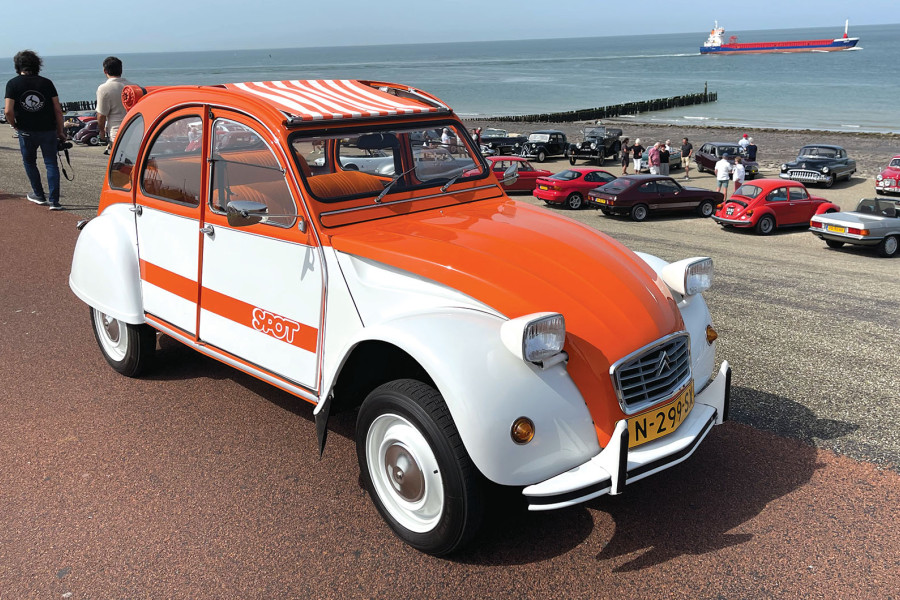
The Sahara name was replaced with 2CV 4x4 in 1962 as Algeria gained its independence and the company attempted to unpigeonhole the model, sales already having been disappointing.

The greatest thing working against the Citroën was not decolonisation, however, but that, with similar, long-travel suspension and front-wheel-drive traction, a regular 2CV was already a good car for all but extreme off-road use.

More fuel efficient, easier to look after and half the price, it was the basic Deux Chevaux, along with competitors such as the Renault 4, that the limited new-car markets of Africa wanted.

This was reflected in the names that did populate the order sheets of the 694 2CV 4x4s built: European institutions, such as the Spanish Guardia Civil and the Swiss post office, ended up buying most of them.

Classic & Sports Car – Citroën 2CV Sahara 4x4: mountain goat

‘Roll back the car’s roof and flip up the side windows, and this is one of the most fun ways of tackling the rough stuff’

As is ever the curse of innovators, Citroën’s good idea was just too early, too expensive and ahead of the technical reality.

Available in the UK only in left-hand drive at a massive £913 in 1963, it was more expensive than a Land-Rover Series IIA 88in, while even among penalised foreign imports it was trading at the same price as a Peugeot 403.

It only got more expensive, too, leaving French price lists in 1967 at near-parity with an entry-level Citroën ID19.

Classic & Sports Car – Citroën 2CV Sahara 4x4: mountain goat

‘Citroën boasted the Sahara could climb a 45% gradient, outperforming many conventional off-roaders’

A four-wheel-drive economy car would be a commercial success less than two decades after the Sahara: 1983’s Fiat Panda 4x4. So, too, the Subaru Justy that followed it a year later.

Both offered what the 2CV 4x4 did, though they were far less compromised, cheaper cars that used simplified and shrunk four-wheel-drive systems, rather than featuring two engines.

Further vindication of Citroën’s concept has, surprisingly, come in the electric age.

Twin-motor, four-wheel-drive cars now abound, powering their axles independently with no connection other than software and the road surface.

Even the next Fiat Panda 4x4, now produced by the same company as Citroën, is rumoured to achieve its four-wheel drive by combining a front-mounted petrol engine with an electrified rear motor.

History doesn’t repeat itself – no one but pre-merger Citroën could have come up with the brilliant lunacy of the 2CV 4x4 – but it certainly rhymes.

Images: Max Edleston

Thanks to: Nationales Automuseum: The Loh Collection


Factfile

Classic & Sports Car – Citroën 2CV Sahara 4x4: mountain goat

Citroën 2CV 4x4 

  • Sold/number built 1960-’67/694
  • Construction steel chassis and body
  • Engines two iron-block, alloy-head, ohv 425cc flat-twins, each with a single Solex carburettor
  • Max power 27bhp @ 4000rpm
  • Max torque 17lb ft @ 2000rpm
  • Transmission paired four-speed manuals, 4WD
  • Suspension independent, at front by leading arms, friction dampers rear trailing arms, telescopic dampers; horizontal, interlinked coil springs, inertia dampers f/r
  • Steering rack and pinion
  • Brakes drums
  • Length 12ft 5in (3785mm)
  • Width 4ft 10in (1480mm)
  • Height 5ft 3in (1600mm)
  • Wheelbase 7ft 9in (2375mm)
  • Weight 1620lb (735kg)
  • 0-60mph n/a
  • Top speed 62mph
  • Mpg 31
  • Price new £913 (1963)
  • Price now £50-130,000*

*Prices correct at date of original publication


Enjoy more of the world’s best classic car content every month when you subscribe to C&SC – get our latest deals here


READ MORE

1948’s game changers: Citroën 2CV

Future classic: Fiat Panda Cross 4x4

Camel Trophy: when the going gets tough