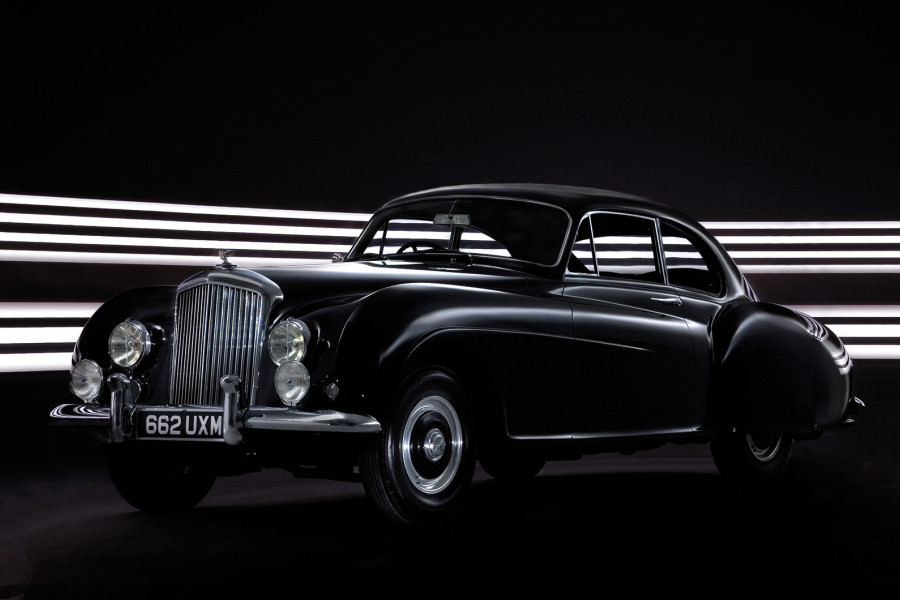
Nonetheless, this Schutte-flavoured Speed Six is an imposing automobile from the outside, and one that would have announced the importance of its first owner long before she stepped from its opulent rear cabin.
The Bentley Speed Six’s Autovac draws fuel from the rear-mounted tank
The design of that interior is typical of (mainly) chauffeur-driven cars from the era, and thereafter, with back-seat passengers sitting well aft of the rear side windows, ensconced on a sumptuously padded, cloth-trimmed rear bench.
A sliding glass partition separates chauffeur from employer, with an intercom device clipped to the inside of the C-pillar for communication.
There are two occasional jump-seats, which fold down from within the central partition, and the floor is plainly carpeted, affording abundant legroom.
A clock is perched high on the partition, with small courtesy lights, chrome window-winders and a small recess containing two vials of perfume (now empty), the only other ornamentation.
The Bentley’s ‘B’-stamped oil filler; the big sump holds five gallons
The chauffeur’s quarters, as you would expect, are far busier.
A 20in Bluemel’s steering wheel with four sprung spokes dominates the driving area, its three stainless-steel levers for advance/retard, fuel mixture and hand throttle sprouting from the large hub.
The mahogany dash houses six clocks, for oil pressure, coolant temperature, revs (to 4000rpm), charge, time and speed (to 120mph).
Randomly positioned knobs and buttons for lights, ignition and what-have-you mingle with the instruments, and the thermometer-style fuel gauge for the Bentley’s 25-gallon tank is positioned directly before the driver.
The Bentley Speed Six’s switchgear is set into a mahogany dashboard
The view ahead is daunting, such is the length of the bonnet, ending with a rather beautiful – but non-standard – flying ‘B’ mascot atop the radiator cap, its wings spread to the side rather than flowing behind.
Rotate the knurled knob past ‘mag’ and ‘coil’, retard the ignition, adjust the fuel mixture and thumb the large starter button, and the Bentley Speed Six fires first time, quickly settling to an almost imperceptible hum; you really do have to check the dials to make sure you haven’t stalled during low-speed manoeuvres.
With a ‘normal’ pedal layout there’s no need to acclimatise, although the regular H-pattern, four-speed ’shift next to my right knee caught me out after I tried to replicate the reverse-H selection in a more familiar (to me) Vauxhall 30-98.
The Bentley Speed Six’s stylish clock is fitted to the partition that separates driver and passengers
Either way, the gearchange is heavy and deliberate, as you would expect, but will shift cleanly between ratios providing you leave enough time for the engine revs to drop as you double-declutch.
You change up early – 2000rpm or slightly less feels optimum, given the straight-six’s copious torque – and before you know it this pre-war leviathan is gliding smartly down the road with an oil-tanker’s gait.
It’s quite unnerving initially, because the hush of the engine and your high driving position insulate you from how hard the chassis is really working.
The view through the Schutte-bodied Bentley Speed Six’s glass partition
The steering is relentlessly hefty, but because you sit so close to the wheel (chauffeur comfort was sacrificed to maximise the rear legroom), it at least means you can put your weight behind it through tighter corners.
You need to check your speed carefully on the approach to bends, too: even at low velocities, the car’s bus-like wheelbase and sheer mass have its whitewalls scrabbling for grip and (I’m told) protesting audibly to bystanders, although cocooned inside you’re never aware.
But synchronise with this Speed Six limo’s natural rhythm and it is a delight to drive, despite the car being intended for the broad thoroughfares of 1930s New York City, rather than the sinuous B-roads of rural Essex.
This Bentley Speed Six’s long-wheelbase chassis was strengthened from new
All of the main controls – throttle, clutch, gears and steering – have a well-oiled and beautifully engineered feel to them.
And the brakes are superb for a car of this vintage: hugely powerful and progressive, and it is clear to see why reinforcing the front axle’s location was so critical, given the loads imposed upon it.
Sitting in glorious isolation at the rear of this Schutte-bodied Bentley Speed Six, though, I daresay its first owner wouldn’t have troubled herself with such technicalities.
Yet Ruth Vanderbilt Twombly clearly did appreciate a quality automobile, and one that allowed her to pursue her charitable activities with the style and panache befitting her family’s heritage.
Thanks to: Fiskens, where the Bentley is for sale; Stewart Parkes, Parkes Restorations; Clare Hay
Images: Jack Harrison
Factfile
Bentley Speed Six
- Sold/number built 1930/one (by Schutte)
- Construction aluminium body, separate steel lattice chassis
- Engine iron monobloc, Elektron crankcase, ohc 6597cc ‘six’, with four valves per cylinder and twin SU HVG5 carburettors
- Max power 180bhp @ 3500rpm
- Max torque n/a
- Transmission four-speed manual, RWD
- Suspension: front semi-elliptic leaf springs, friction dampers rear live axle, semi-elliptic leaf springs, hydraulic dampers
- Steering worm and sector
- Brakes self-wrapping drums, with Dewandre-pattern servo
- Length 16ft 7in (4380mm, chassis)
- Width 5ft 8½in (1740mm, chassis)
- Height n/a
- Wheelbase 12ft 8½in (3300mm)
- Weight n/a
- 0-60mph n/a
- Top speed 90mph (est)
- Mpg n/a
- Price new £1450 (chassis only)
- Price now £800-900,000*
*Price correct at date of original publication
Enjoy more of the world’s best classic car content every month when you subscribe to C&SC – get our latest deals here
READ MORE
Meet the unique Rolls-Royce Phantom II Continental that thinks it’s a hot rod
Bentley S2 Continental: a unique chop and change
Bentley 4¼-litre Vanden Plas: national velvet
Simon Hucknall
Simon Hucknall is a senior contributor to Classic & Sports Car