Humber Super Snipe MkIII: desert survivor driven

| 29 Apr 2026
Classic & Sports Car – Humber Super Snipe MkIII: an Englishman abroad
They say in the motor trade that there is a bottom for every seat, but flogging the big sidevalve Humber saloons to Americans must have been a pretty thankless task in 1950, even for an export-minded company such as the Rootes Group.

Cadillac, after all, was already doing tailfins, ‘Dagmar’ bumpers and overhead-valve V8s when Rootes first showed its latest Humber Super Snipe MkIII at the New York show that year.

The event, an all-British extravaganza to boost exports, highlighted the Jaguar XK120, Austin Atlantic and even the Ford Prefect as dollar-earners.

Some 4000 orders were taken, but I’m willing to wager that the big Humbers did not figure highly in that total.

Classic & Sports Car – Humber Super Snipe MkIII: an Englishman abroad
This patinated Humber Super Snipe MkIII has spent its life Stateside

In the 1930s, the Rootes brothers travelled widely across the United States and were enamoured of the American way of designing, building and selling motor cars; the Super Snipe was in effect an English reimagining of a generic mid-to-late 1930s American vehicle. 

Thus, for local buyers – spoilt for choice when it came to new, post-war Detroit designs – it would have had novelty value at best.

Still, the Super Snipe had at least one particular feature that was no longer to be found on domestic vehicles, and which endeared it to a 5ft 3in-tall woman of a certain age from Massachusetts who visited that very motor show: running boards.

Reintroduced on the 1948 Super Snipes, this retrograde feature made ingress and exit easier, doubtless helped by the fact that the Humber’s floorboards were level with the door bottoms.

Classic & Sports Car – Humber Super Snipe MkIII: an Englishman abroad
The Humber Super Snipe MkIII’s bench seats can accommodate up to six

Fast-forward some 75 years and the large, green left-hooker Humber is alive and well, residing – still unrestored – in the Californian desert.

Apart from some later-vintage paint on the wings, it really is original: patches of surface rust and a very scruffy front seat bear testimony to its age rather than the mere 25,000 miles that have passed beneath its wheels.

It could be the only such Super Snipe in American captivity, although I’m happy to be contradicted: nothing would surprise me when it comes to the oddities, from all corners of the world, that made their respective ways to the United States in the 1950s.

Current owner Martin Wass, an Englishman who set up home in America 40 years ago, took the Humber into protective custody last year.

Classic & Sports Car – Humber Super Snipe MkIII: an Englishman abroad
This Humber Super Snipe’s traditional running boards clinched the original sale

“I found it on eBay being advertised by the chauffeur’s family,” he explains. “The little old lady who bought it did so because she couldn’t find an American car with running boards.

“She lived the winters in Florida and the rest of the time in Massachusetts. The chauffeur drove her around in it during the summer months, so it only has 25,000 miles on it.

“He maintained the car, and she left it to him when she died. He then drove it for some years until he passed away, after which it was stuck in the back of a barn. I saw it advertised for $5000 and thought ‘I’ll have that’.”

Classic & Sports Car – Humber Super Snipe MkIII: an Englishman abroad
The unrestored Humber Super Snipe MkIII’s large steering wheel and tired seat cover

The car didn’t run, but it didn’t take much work to get it going: “All I did was change the fuel and it was fine!”

The desert smallholding near Palm Springs on which the Humber now lives is in effect a care home and sanctuary for distressed, sun-bleached Rovers and Jaguars of the 1960s and ’70s, although Martin can often be seen driving a giant, 8.2-litre Cadillac.

The Humber has since attended some local British-car shows.

Martin says: “It only has a bit of surface rust on the body, and it drives like it should – although I do need to do the brakes. It was quite a find and I’m very happy with it. 

“I don’t think they sold many in left-hand drive: it just wasn’t very comparable with American cars of the era. It must have been odd to see it on American roads back in those days.”

Classic & Sports Car – Humber Super Snipe MkIII: an Englishman abroad

This 3987lb (1808kg) Humber saloon was a luxurious choice

In Britain, Super Snipes were much more evident and really a staple of the luxury-car landscape, if not quite in the Daimler class then very much an Austin Sheerline/Princess rival.

From 1945-’48, the big Humbers were much as they had been pre-war. They had been new models in 1938, with looks heavily inspired by contemporary Studebaker designs.

Humbers remained in production throughout WW2 for the military and earned a reputation for rugged reliability.

Famously, Field Marshal Montgomery was most satisfied with the service given by his ‘Old Faithful’ Super Snipe open tourer.

Classic & Sports Car – Humber Super Snipe MkIII: an Englishman abroad

The Humber Super Snipe MkIII’s torquey ‘six’ goes well

Publicity-savvy Rootes was not shy of using the goodwill generated by these excellent wartime cars as a promotional tool – or quietly pointing out that its flagship limousines took their place in The Royal Mews.

For 1948, the 2.7-litre Snipe was dropped.

Now, as the 4.1-litre, 100bhp MkII Super Snipe, it was given a Loewy Studio facelift that amounted to a revised front-grille treatment, headlights faired into the pontoon front wings and a larger rear window.

Classic & Sports Car – Humber Super Snipe MkIII: an Englishman abroad

This Humber Super Snipe MkIII’s chrome has aged well

The technical cocktail remained unchanged.

Power came from a low-compression, 4086cc sidevalve straight-six engine that was fitted with an aluminium cylinder head and which was able to accelerate this near-4000lb saloon from 5mph to more than 80mph in top gear without pinking – even running on the meagre low-octane ‘pool’ petrol of the day – and cruise along quite happily at 70mph.

It consumed fuel at the rate of 15 miles to every gallon (a bit hard on the ration book, that), but this would have been considered a fair exchange for the sort of top-gear flexibility that was, in those days, a more cogent measure of performance than 0-60mph times.

Classic & Sports Car – Humber Super Snipe MkIII: an Englishman abroad

“I don’t think they sold many in left-hand drive. It must have been odd to see it on American roads in those days”

Underneath was a cross-braced, box-section chassis with ‘Evenkeel’ independent front suspension, designed in part by Alec Issigonis in the mid-1930s when he worked for Humber in what was his first proper industry job.

A four-speed manual ’box with column change – ‘fingertip synchromatic’ in Rootes jargon – was standardised.

The rear axle, like the front one, was cart-sprung, while the brakes were hydraulic Lockheed drums, with twin leading shoes up front.

Now a double bench-seater (with room for six), the MkII had a wider track and Burman variable-ratio steering.

Classic & Sports Car – Humber Super Snipe MkIII: an Englishman abroad

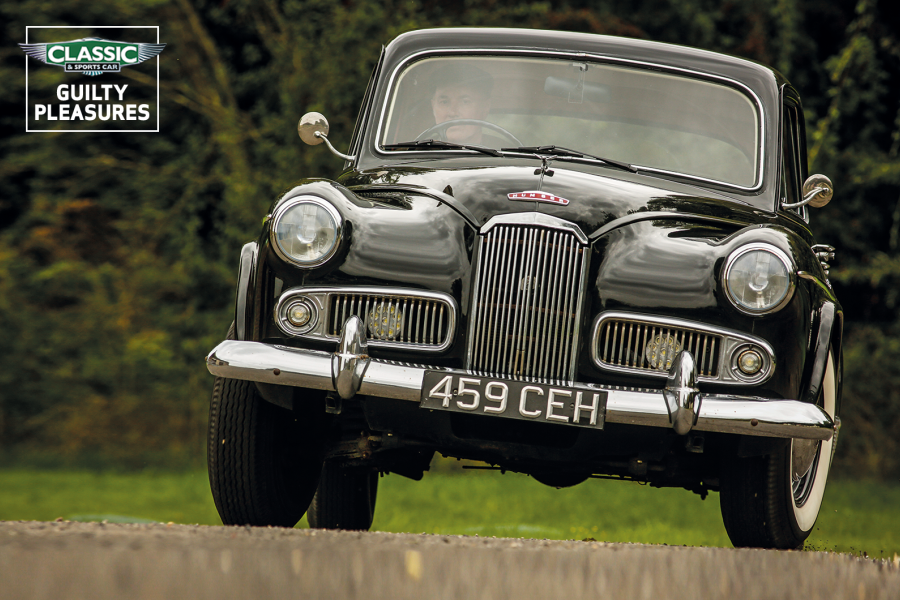
The MkIII Humber Super Snipe retained the MkII grille

The Super Snipe was excellent value: Rootes priced it below £1000, thus avoiding the 66.6% Purchase Tax on luxury goods.

That said, Tickford’s handsome drophead version was pitched well above this and is consequently rare – only 125 are thought to have been built.

Tickford and Castle Bodies also did a handful of wooden-panelled shooting brakes.

The Super Snipe MkIIs were popular with the Metropolitan Police, and they were even pressed into service as box-bodied, rubber-winged newspaper delivery vans.

Classic & Sports Car – Humber Super Snipe MkIII: an Englishman abroad

The Humber Super Snipe’s Art Deco-style bonnet crest is missing its beak

The BBC used a Pullman version as a mobile recording studio for outside broadcasts, and Tickford built a set of Pullman cabriolets for the royal tour of New Zealand, which ended up being cancelled after King George was taken ill.

They were unlikely competition cars, yet Maurice Gatsonides came surprisingly close to winning the Rallye Monte-Carlo in a MkII Super Snipe in 1950.

That was also the year of the Super Snipe MkIII, featuring new bumpers (now with overriders), along with a Panhard rod on the rear axle and notched spats over the back wheels.

Classic & Sports Car – Humber Super Snipe MkIII: an Englishman abroad

This Humber Super Snipe remains impressively original, its preservation today aided by California’s desert climate

To ensconce yourself in the Humber’s well-padded interior, look out along its alligator bonnet and feel the warmth from its (standard) heater, as its 4.1-litre engine whisked you through the traffic after a long day at the office, must have been a comforting feeling for the bank managers, civil servants, factory owners and politicians who drove – or rode in the back of – these near-ultimate Rootesmobiles.

Near ultimate? At the very top of the Rootes food chain, for those who preferred to be driven rather than drive themselves, were the Pullman and Imperial limousines.

On a 10ft 11in wheelbase, they had seating for up to nine people with the fold-down ‘occasionals’ deployed.

Classic & Sports Car – Humber Super Snipe MkIII: an Englishman abroad

The Humber Super Snipe’s large boot fits a full-size spare, with plenty of room still available

The Pullman was the one with the division and West of England cloth rear seats, but you could option a Touring Limousine version of the owner-driver Super Snipe with a power-operated glass divider – ideal for those who had a driver for weekday business use, but wanted to drive themselves at weekends.

At well over six feet wide, the Super Snipe is still quite an imposing vehicle, but that means there is generous rear legroom and a boot that is bigger than you might think – the brochure suggested that ‘golfing motorists will find its full-width proportions especially convenient’.

The front doors are ‘suicide’, as was still the convention with late ’40s and early ’50s cars, and you slide on to a plush red sofa that adjusts for legroom, behind a large cream wheel.

Classic & Sports Car – Humber Super Snipe MkIII: an Englishman abroad

This Humber Super Snipe MkIII’s wings have been repainted at some point

The rear-seat leather and the wood have survived well; the dash features individual controls for left- and right-hand wipers (a very pre-war touch), and black-on-cream instruments to match the steering wheel.

Press the pushbutton starter (aided by the automatic choke) and the engine, shared with Commer commercials of its day, is quiet and gentle.

High revs are pointless, as is the ‘crash’ bottom gear most of the time, because torque is so abundant. On the flat it is natural to sigh away in second gear and go straight into top.

The column lever moves easily and fairly precisely, and the Humber is soon lolloping along in its easy stride with the giant bonnet taking up most of the view through the narrow ’screen.

Classic & Sports Car – Humber Super Snipe MkIII: an Englishman abroad

The Humber Super Snipe MkIII’s heater was fitted as standard

On the straights you weave the steering like a bad actor in a film noir thriller; not even a memo from the Ministry could persuade the front end to turn in briskly on command – the understeering Humber makes you feel like the paid help as you feed between locks.

The 1948-’52 Humber Super Snipe was a reassuringly traditional car in a brave new world of nationalised railways and free healthcare under Clement Attlee’s Labour administration.

An era when test pilots such as John Derry, who broke the sound barrier in 1948, were the new heroes of the jet age.

Classic & Sports Car – Humber Super Snipe MkIII: an Englishman abroad

The Humber Super Snipe’s easy-to-read speedometer

The Super Snipe’s role in life was to be an important car for important people.

These machines looked their best in gleaming black, usually about to decant a homburg-hat-wearing politician outside Number 10. 

Humber would maintain its position as the default-choice government car until the demise of the ‘Series’ Super Snipes and Imperials in 1967. 

By then the ‘Mark’ (as opposed to the ‘Series’) Humbers were already a rapidly fading memory from a considerably more formal world.

Images: Pawel Litwinski


Factfile

Classic & Sports Car – Humber Super Snipe MkIII: an Englishman abroad

Humber Super Snipe MkIII 

  • Sold/number built 1950-’52/8703
  • Construction steel chassis, steel body
  • Engine iron-block, alloy-head, sidevalve 4086cc ‘six’, single Stromberg carburettor
  • Max power 100bhp @ 3400rpm
  • Max torque 197lb ft @ 1200rpm
  • Transmission four-speed manual, RWD
  • Suspension: front independent, by upper wishbones, transverse leaf spring rear live axle, semi-elliptic leaf springs, Panhard rod, anti-roll bar; lever-arm dampers f/r
  • Steering variable-ratio recirculating ball
  • Brakes drums
  • Length 15ft 10¾in (4845mm)
  • Width 6ft 2¾in (1899mm)
  • Height 5ft 5¾in (1670mm)
  • Wheelbase 9ft 9½in (2985mm)
  • Weight 3987lb (1808kg)
  • 0-60mph 21.2 secs
  • Top speed 84mph
  • Mpg 16-18
  • Price new £1208 (including Purchase Tax)
  • Price now £5-15,000*

*Price correct at date of original publication


Enjoy more of the world’s best classic car content every month when you subscribe to C&SC – get our latest deals here


READ MORE

Keeping up appearances: Ford vs Vauxhall vs Hillman vs Singer vs Humber vs Riley

Rover P5B: yes, Prime Minister

Austin Sheerline vs Vanden Plas Princess: the Longbridge Daimlers