Then there are all those tactile joys connected with the way the big, black steering wheel slides back through your fingers, the well-oiled throttle response and the precise action of every lever and switch in an instrument nacelle that was unique to the Park Ward.
The Bentley S3 Continental’s cabin is a delightful place to be
And what of the Flying Spur? Only 68 of these S3s were built in right-hand drive (as the Park Ward design began to dominate Continental sales), yet there is no doubt that with the quad headlights this is a ravishingly handsome car.
The rear doors blend perfectly into a shape that is much less formal than the Standard Steel Cloud III/S3 saloon and, at 4500lb, there was no weight penalty over the two-door Continental; the original R-type had tipped the scales at 3739lb.
The extra bulk is accounted for in huge seats, power windows and all kinds of other unseen refinements to make the S3 quieter and even more civilised.
You feel drawn to try the rear seats, only to find how small are the door openings and how cramped the rear quarters.
The advent of the Rolls-Royce Silver Shadow and Bentley T-series cars caused a rationalisation of the range.
Bentley revived the Continental name in 1984 on the old Corniche drophead
Crewe was so bound up in developing and satisfying a seemingly insatiable demand for this radically new monocoque-bodied, fully independent saloon that thoughts of a two-door variant didn’t get beyond Mulliner Park Ward’s elegant 1966 coupé and drophead variants, which had no real performance aspirations.
Priced at £8024 – a surprisingly modest £1500 premium over the Standard Steel – the last of the S3 Continentals was delivered as late as 1967.
The Continental name then disappeared for nearly 20 years, and anyone who wanted a faster, more exclusive variant had to be satisfied with either a Bentley Corniche (as the two-door coupé and drophead Shadow/T1 were renamed in 1971) or the 1975 Rolls-Royce Camargue.
Until the 1980s, Rolls-Royce became by far the dominant brand. It was only with the introduction of various turbocharged versions of the Mulsanne saloon that Bentley became fashionable again, and the time looked ripe to resurrect the Continental.
This Bentley Continental’s comfortable interior has more electronic toys, but still feels special
In the end, the badge first reappeared on 405 examples of the former Bentley Corniche drophead built from 1984 onwards.
They featured redesigned seats and dashboard, alloy wheels and fuel injection.
Amazingly, this drophead body style – originally designed by the quietly masterful John Blatchley in the mid-1960s – remained in production through to 1993, the late American-market cars having the turbocharged engine.
Even if you don’t like the big bumpers and the front spoiler, it is hard not to warm to this wonderfully relaxing car, with its marvellous split-level air-conditioning and silent hydraulic hood operation.
It is quite rapid enough in a straight line without being spectacular, and it has handling that borders on the realms of agile compared with earlier Rolls-Royce Silver Shadow-based offerings.
‘The Bentley Continental R’s turbocharged performance is immense: 0-60mph takes only 6.6 secs and the top speed is an electronically governed 145mph’
Around town, the big tyres twang into bumps and set the not-very-stiff body a-shaking, but this feels a small price to pay for the sense of wellbeing this car exudes.
These are the last of the coachbuilt Rolls-Royce and Bentley models. And they now look old enough for people not to hate you.
The Bentley Continental R coupé was not only the car that linked the pre- and post-VW eras at Crewe, but also the first Continental to recapture the flavour of the 1950s and ’60s models, with its handsome, all-new styling by John Heffernan and Ken Greenly that was developed in the wind tunnel.
As with the last of the Corniche/Continental Convertibles, its body was built in Crewe rather than at Mulliner Park Ward in London, using panels supplied by Park Sheet Metal of Coventry – a sad reminder of the demise of the West London coachbuilding industry that had previously been so integral to the Continental story.
This latest Continental R really replaced the Camargue as the ultimate owner/driver coupé, and was priced at a humongous £170,000 in 1991.
The Bentley Continental R got a central gearlever in the revised cabin
The shape, with its doors cutting into the roof and its integrated bumpers, has aged extremely well – certainly much better than the same design duo’s now strangely hideous Aston Martin Virage – and if you could afford the fuel bills it would make an interesting way to spend a surprisingly affordable sum on a usable modern classic.
Apart from the central gear selector – which was a first on an automatic Bentley – the feel of the interior is reassuringly familiar and patrician in its use of veneers and leather, but this is also the first of the Continentals that you feel you are sitting ‘in’ rather than ‘on’.
There is a ‘Sport’ button on the lever that sharpens up the gearchanges, but, either way, the turbocharged performance is immense: 0-60mph takes only 6.6 secs and the top speed is an electronically governed 145mph.
You can consume conspicuously in near silence, the 6.75-litre V8 emitting the occasional well-bred rumble.
The firm ride feels like an acceptable compromise for the way in which this huge car conducts itself: it has perfect manners, be it in either town or country.
The Bentley Continental R’s 6.75-litre V8
It is difficult to believe that the Volkswagen-era Bentley Continental GT was launched as long ago as 2003, representing a less expensive route into Bentley ownership.
And is an unusual find among modern cars in that it is smaller than you think it is, rather than much bigger: it’s incredibly wide and squat on massive 20in alloy wheels, but not particularly long.
It was launched as a 6-litre W12-engined car based on the Volkswagen Phaeton.
Since then, the unloved VW saloon has turned out to be a much rarer vehicle based on the evidence of how many you see on the road; the Continental GT, by way of contrast, has been a great success.
The fact that it is made to mass-production standards – it is hand-finished rather than handbuilt – has never been any secret, and has certainly been no hindrance to sales.
It is a near-200mph supercoupé and a world-class product that quickly spawned a convertible (known as the GTC) along with countless limited editions and has since evolved into subsequent generations.
The Bentley GT V8 S convertible is hugely capable
Remarkably little money buys one of the early Continental GT coupés today, and that makes them a highly tempting proposition as one of the great modern cars of recent times.
For the purposes of this story, however, Jack Barclay sent us the very latest, 95% recyclable Bentley GT V8 S convertible.
This version has a mere 528bhp from its 4-litre V8 in an attempt to extract better economy – it claims 26mpg – and rein in the flab, although it still weighs in at an outrageous 2½ tons.
Inside, you are slung low behind a thick and acutely angled windscreen frame, taking in one of today’s better-looking dashboards finished in Piano Black.
The chrome eyeball vents with their signature ‘organ stop’ controls are a pleasing nod to tradition – but what Bentley Continental of yesteryear ever featured drilled, boy-racer-style aluminium brake and throttle pedals?
Charting the evolution of Bentley’s sporting favourite
Even if it is hard to make the physiological link between this modern ‘bling’ statement and the classic Continentals of many decades previously, nobody could deny the excellence of the current incarnation as a means of getting to places distinctively and very rapidly.
There is power and four-wheel-drive grip here way beyond that which you could ever sensibly exploit on the road, the chassis doesn’t wobble for want of a roof and the hood is so free from old-fashioned annoyances (such as wind noise) that you sort of wonder why anyone would consider opting for the coupé.
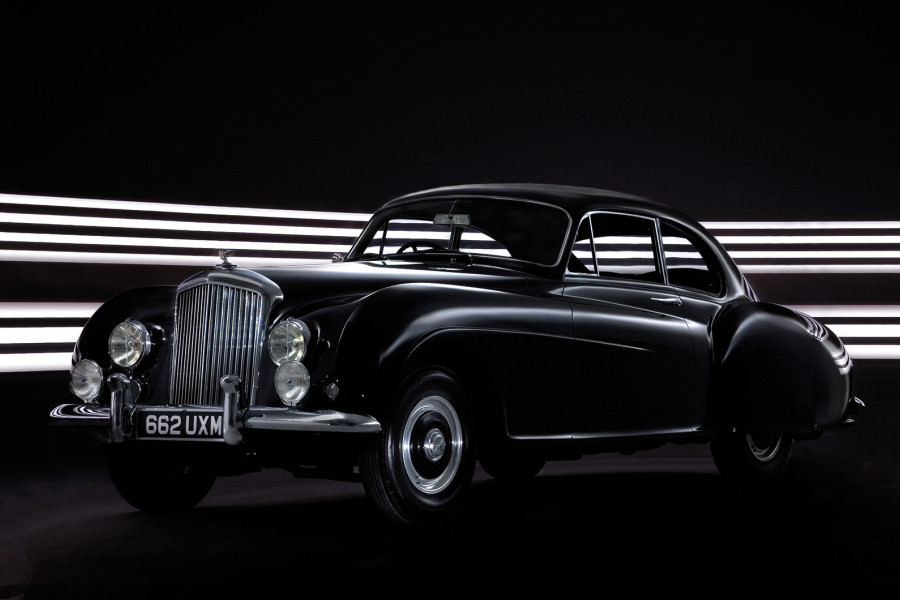
The 2014 Bentley Continental GT is amazing in so many ways, but if it has to work hard to make its point in a noisy landscape of high-speed luxury coupés, the 1952-’55 Bentley R-type Continental had the field all to itself – and perhaps even invented the genre of the personal luxury coupé.
I can’t think of another vehicle that, in its time, was as effortlessly superior to every other car around it as the first of the Bentley Continentals.
The world was a very different place in 1952, of course, and later examples of the Continental breed shown here had a more difficult job than the original, today one of the gold-standard classic cars of the post-war era.
Images: James Mann
Thanks to: Frank Dale & Stepsons for the R-type, S1, S2, S3 Flying Spur and Continental R; Graeme Hunt for the S3 MPW Coupé; Jack Barclay for the V8 S; Syon Park
This was first in our January 2014 magazine; all information was correct at the date of original publication
Enjoy more of the world’s best classic car content every month when you subscribe to C&SC – get our latest deals here
READ MORE
Bentley S2 Continental Mulliner coupé restoration: a class of its own
Bentley T-series reborn: out of the Shadow
Your classic: Bentley R-type
Martin Buckley
Senior Contributor, Classic & Sports Car