Hansa 1100: right car, wrong time?

| 20 Feb 2026
Classic & Sports Car – Hansa 1100: right car, wrong time?

The Hansa 1100 was well ahead of the game. 

It had a water-cooled 1093cc aluminium flat-four. It had front-wheel drive. It had rack steering and an all-synchromesh gearbox.

In comparison, a Ford Taunus 12M – rear-wheel drive, of course – had a sidevalve in-line engine, a three-speed gearbox and steering by worm and roller.

“To have front-wheel drive and a flat-four back in the late 1950s was quite something,” says owner Jacques Paquereau of his 1959-season Hansa 1100, thought to be the only survivor in France.
Classic & Sports Car – Hansa 1100: right car, wrong time?

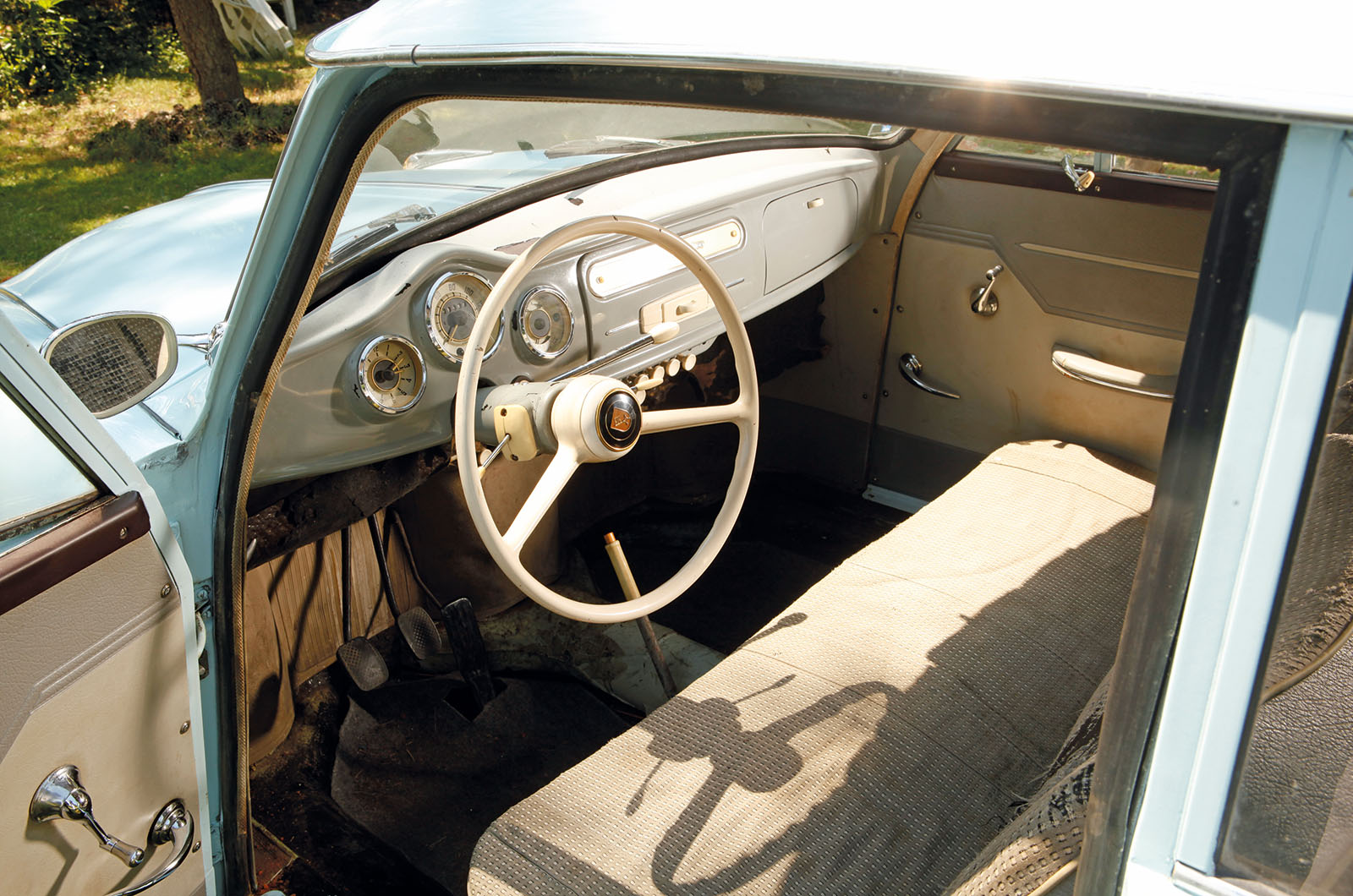
The Hansa 1100’s cabin is spacious up front, with a painted plastic dashboard

Back in 1957, when it was launched as the Goliath 1100, the modestly sized German saloon certainly appears to have had a near-irresistible specification.

After all, it would be 1961 before Lancia came out with its front-wheel-drive flat-four Flavia. It would then be a further five years before Subaru adopted the same configuration.

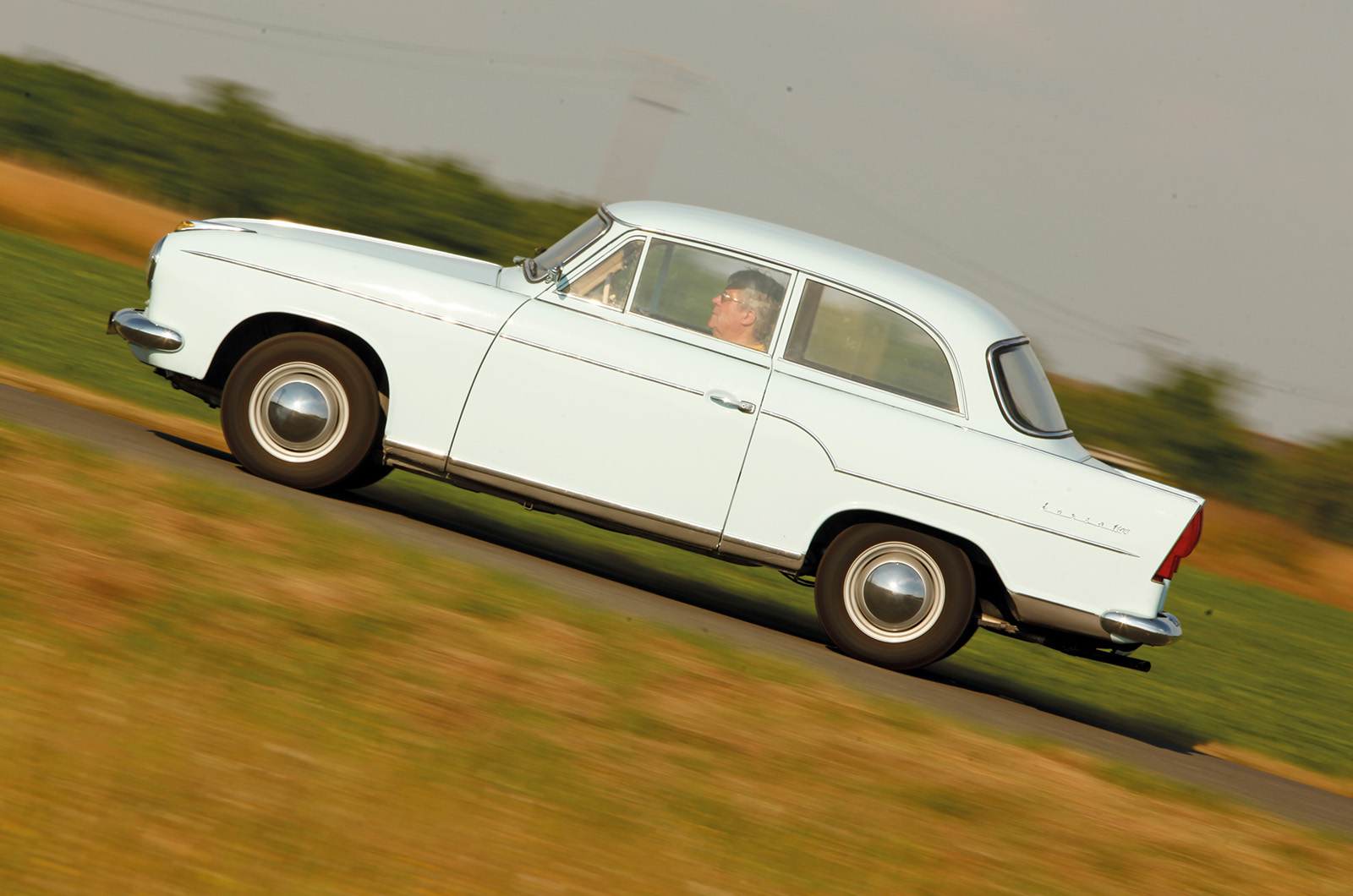
Walk around Jacques’ car and you cannot help thinking that it looks a bit porky and old-fashioned for 1959, the year in which Pininfarina’s sharp-edged new look started to arrive across Europe.
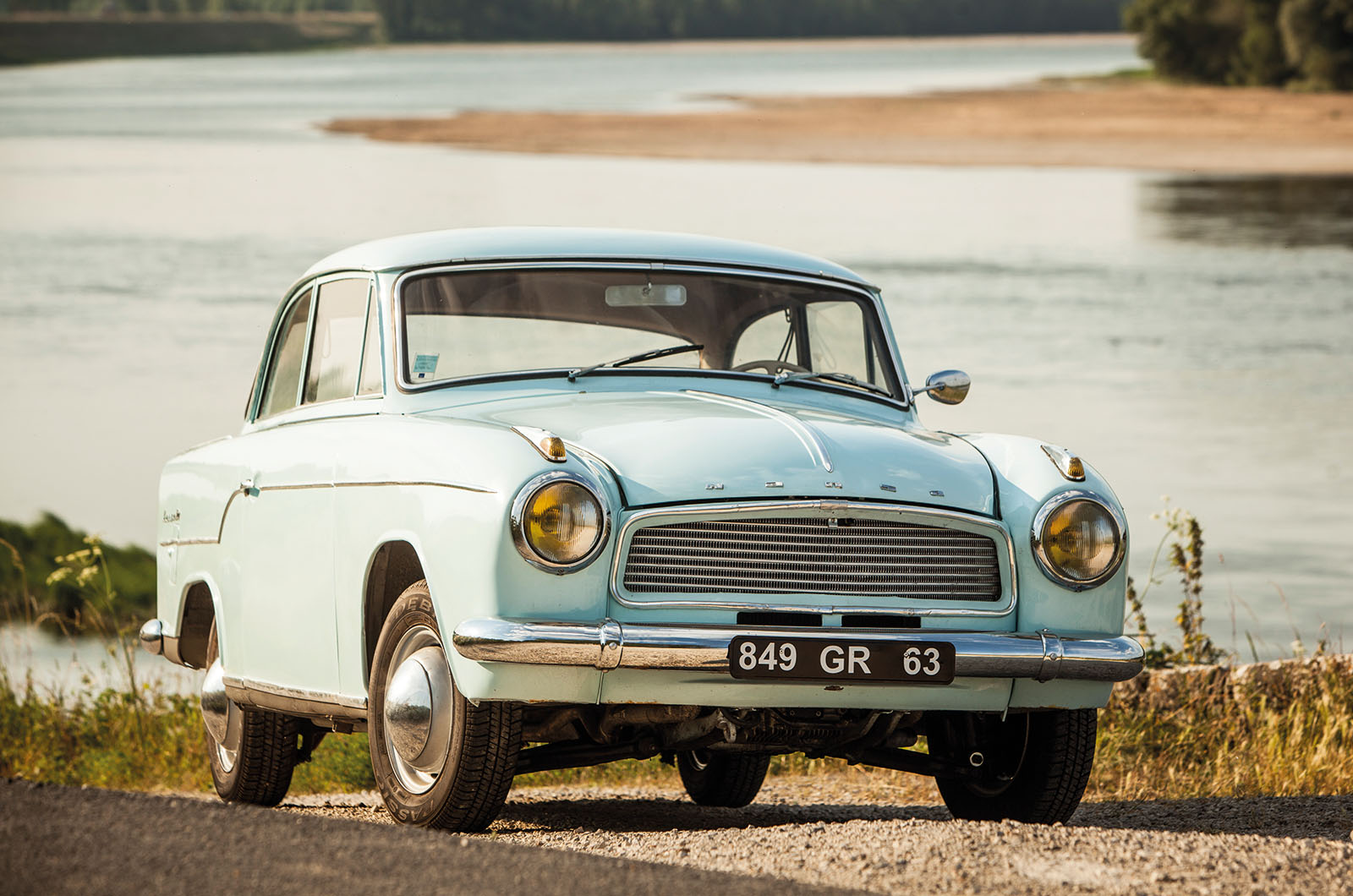
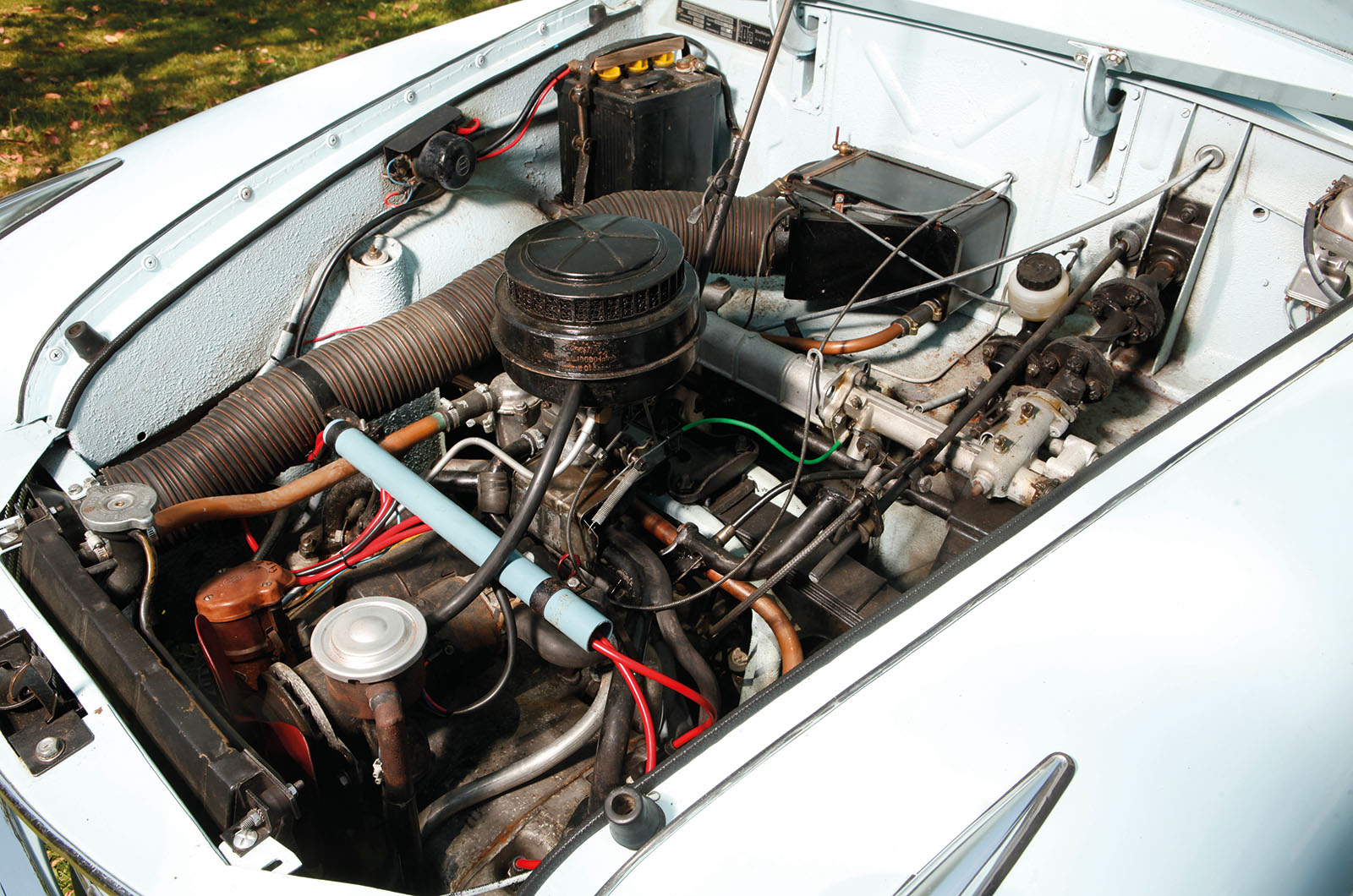
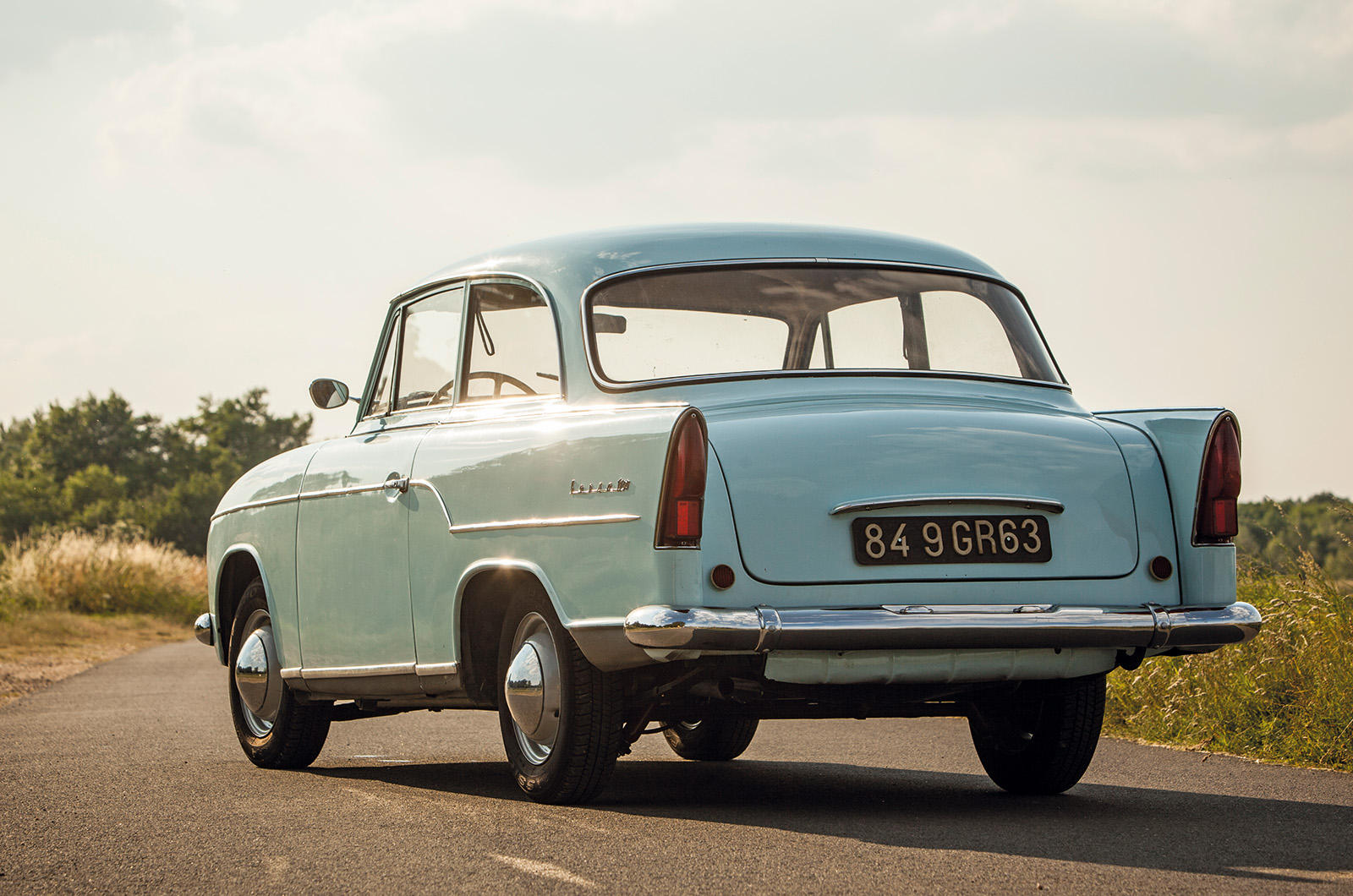
Still, it’s adequately glassy, the cabin is roomy and there’s a huge boot, with the fuel tank cunningly wrapped around the spare wheel.

The interior, in two-tone vinyl with grey polka-dot cloth seats, isn’t a bad place to be.

You sit low, behind a big white wheel, facing cream dials with black lettering and gold detailing – all very 1950s Germany.

The diagonally split front seatback is a thoughtful feature and the quality touch of ball-bearing rollers for the sliders ensures that the seat goes back and forward easily.

On the other hand, there are penny-pinching omissions – no tripmeter, parcel shelf or storage pockets – and a certain crudeness about the way body panels, such as the bootlid, are constructed.

The Hansa drives well, though. The 40bhp flat-four is throaty at low revs, but it smooths out and you can cruise happily, albeit a little noisily, at 55-60mph.

The engine delivers enough torque for you to hang on to the higher ratios, and gearchanging is gratifyingly pleasurable.

Classic & Sports Car – Hansa 1100: right car, wrong time?

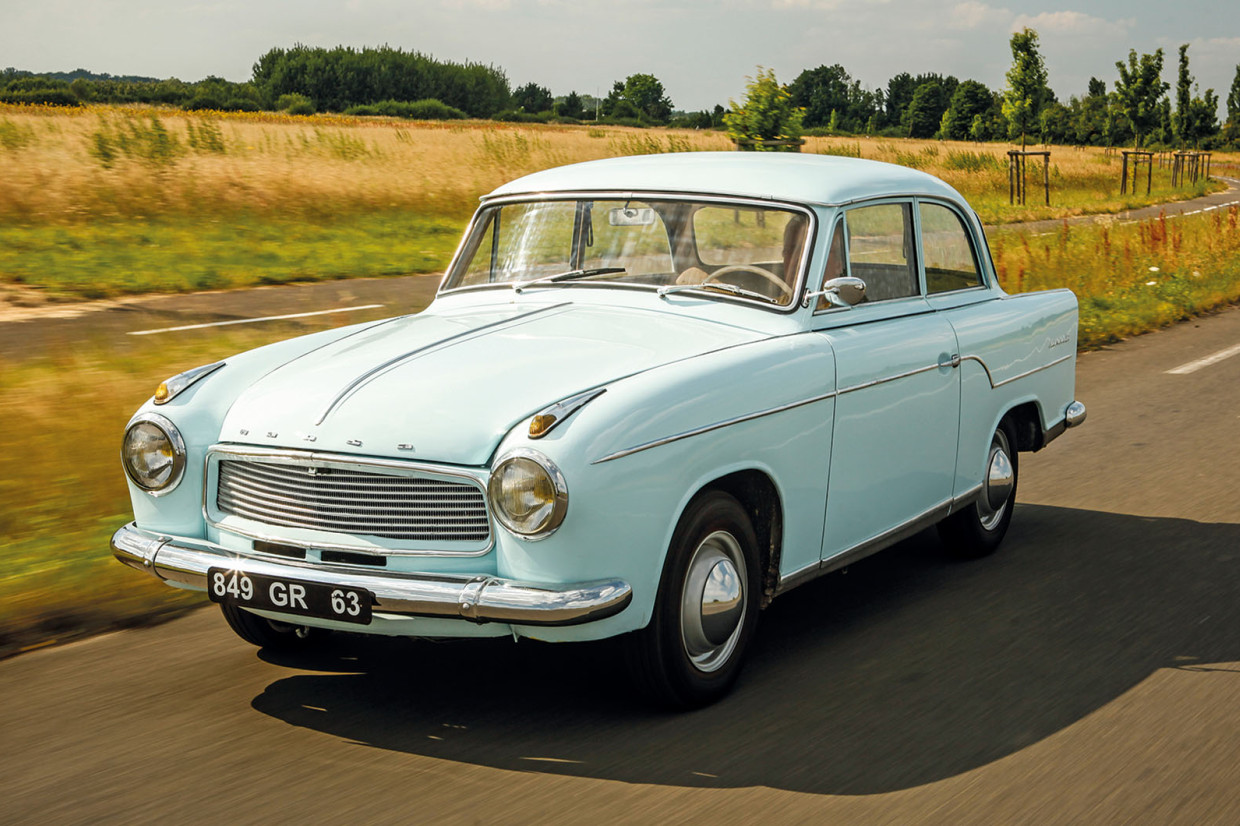
The Hansa 1100’s front end is similar to its larger, Borgward-badged Isabella sibling

Mated to a sweet clutch, the dash-operated lever has an easy and well-oiled action, with just the right amount of travel.

The steering uses a high-mounted rack with long relay shafts and two fabric universal joints.

It impresses equally, being both fluid and precise, and having no lost motion, yet never becomes heavy; doubtless that all-alloy engine keeps the mass at the front end lower than it otherwise might be. 

The brakes, meanwhile, have a medium travel at the pedal and stop the car effectively.

At the front there’s a transverse leaf spring forming the upper arms and broad-based lower wishbones allied to long-stroke shock absorbers.

At the rear you will find a dead axle on leaf springs, with angled telescopics. Chassis behaviour is the mixed bag you might expect, but it’s certainly no disgrace.

Adhesion seems good, but at the price of a fair bit of lean in bends: punt the Hansa through a roundabout and it will certainly roll.

A generally gentle and under-damped ride turns lively on rough roads, to the point of a turbulent restlessness.

Who’s to say, though, that the current dampers – Simca 1100 rears at the front and Aronde units at the back – might not be the best for the job?

At least the Hansa has proper telescopics at both ends, which is more than can be said for many British models of the same period.

Classic & Sports Car – Hansa 1100: right car, wrong time?

Hansa’s combination of flat-four and front-wheel drive predated Lancia’s Flavia by four years and the Citroën GS and Alfasud by more than a decade

Jacques, who bought the car for its distant technical kinship with his front-wheel-drive flat-four Hotchkiss-Grégoire, sums up the Hansa succinctly: “It is a car that deserved to have a bit more attention lavished on it.

“It’s a bit basic in the way it’s made. It’s a mixture of the good and the less good. It’s not a fabulous thing, but it’s got character.”

That touches on the crux of the matter: at the same time as it was advanced, the 1100 was in some ways amateur and outdated – and that speaks loudly about its industrial history.

The key point here is that fewer than 43,000 examples of the 1100 were produced across roughly five model years – an average of just 8500 a year.

Add in its two-stroke ancestors, with just over 44,000 built in six years, and you come to 87,000 cars, or an annual average of fewer than 8000 vehicles.

Meanwhile, Ford Germany turned out some 435,000 Taunus 12Ms over the 1952-’62 period, amounting to an annual average of 39,500 cars.

You don’t need to be a statistical genius to realise that, when it came to parting with their money, the Germans made quite a good fist of resisting the Hansa’s supposed attractions.

It had all made perfect sense when Carl Borgward announced the Hansa’s predecessor, the Goliath GP700, in March 1950.

Front-drive and with a transverse twin-cylinder unit, the 688cc Goliath neatly bridged the gap between his Lloyd runaround and mid-sized Borgward Hansa 1500.

With its roomy, pontoon-form unitary body, it was in essence a modernised DKW, which was no great surprise given that the boss of Goliath was an ex-DKW man.

Classic & Sports Car – Hansa 1100: right car, wrong time?

The Hansa 1100 acquits itself well on the road

The only snag was that the 24bhp vertical twin was not really up to hauling along a car that was appreciably heavier than a Volkswagen Beetle – as well as rather more expensive.

In a pioneering move, fuel injection was offered in 1953, along with an all-sychromesh gearbox; the carb-fed car continued, with a hike to 25.5bhp against the injected GP700E’s 29bhp.

A better answer came with the arrival in 1955 of the 886cc GP900, which developed 40bhp in injected GP900E form.

The two 900s – and the non-injected GP700 – continued until February 1957, when they were replaced by the flat-four Goliath GP1100.

The body was largely unchanged, bar a new full-width front grille, but in mitigation it had been improved over the years, relative to the original.

Indeed, with the larger rear window introduced in 1953 and the fin-like tail-lights and more squared-off windscreen that arrived in 1955, it had ended up looking not unlike a junior Borgward Isabella.

With its modern four-stroke engine, here was a car more likely to find its way on to German shopping lists, or so Borgward hoped, even if quoted power was no higher than that of the injected 900cc two-stroke.

During the course of 1957 a twin-carb engine became available, and sales increased – with just shy of 15,000 GP1100s being built over 17 months.

But in a booming German marketplace that was still chicken-feed. This relative failure was attributed to the obvious links with the old two-stroke model, to an image-devaluing association with Goliath’s utilitarian three-wheel delivery vans and – not least – to looks that were then regarded as frumpy.

Accordingly the cars were rebadged as the Hansa 1100 for 1959 and given a further restyle, with a stepped chrome side strip and integral rear fins. Yet it was all to no avail. In the 1959 model year, just 11,176 Hansas would be made.

Classic & Sports Car – Hansa 1100: right car, wrong time?

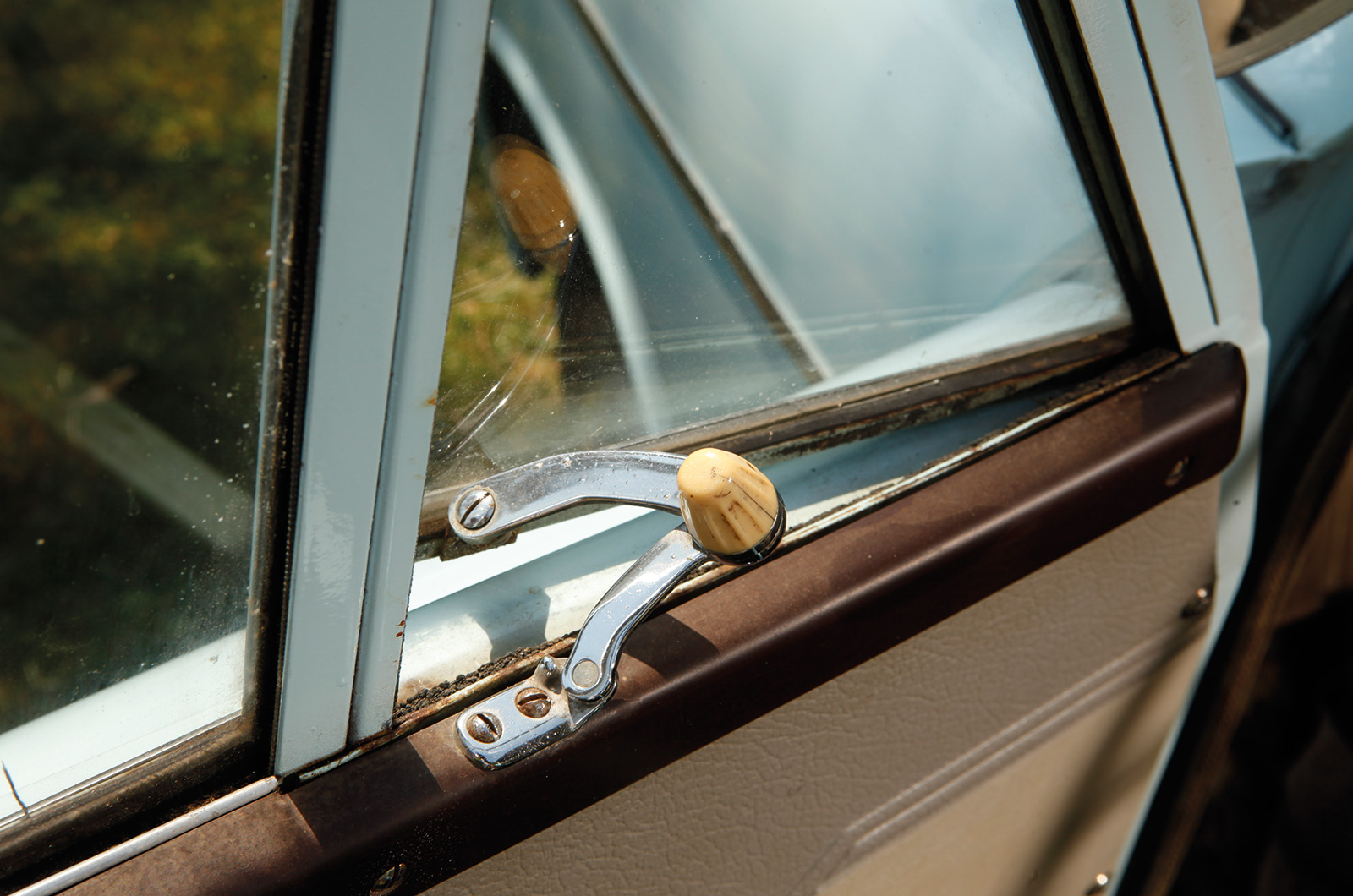
The Hansa 1100’s neat catch for the quaterlights

By then Borgward had other fish to fry. He had been spooked by the sharply styled DKW 600 prototype, unveiled at the 1957 Frankfurt motor show ahead of entering production in ’59 as the Junior.

In less than two years he had rushed a bigger Lloyd to market, to compete with the DKW. The 900cc Arabella was accompanied by a massive investment in new production facilities.

But the Hansa continued, receiving a new dashboard plus deeper front and rear glass for 1960, along with a revised interior, a wider track and modified cylinder heads on the standard 40bhp engine.

Manufacture lasted until the collapse of Borgward in 1961, by which time a further 16,500 or so had been made.

It is quite likely, however, that output exceeded demand, and that many of the later cars joined the unsold Arabellas cluttering the fields around Borgward’s Bremen works.

What had gone wrong? The likely answer is inevitably entwined with explanations of why the Borgward empire eventually crashed and burned.

Carl Borgward offered a huge range of vehicles, from the Lloyds up to heavy trucks, but in reality only the small Lloyd and the Isabella sold in decent numbers. 

Making so many unrelated models in numbers that were never adequate enough to amortise his production costs was a slow road to financial incineration. Smoking a fat cigar and talking big does not make you a success.

When Borgward introduced the Lloyd in 1950, it fulfilled a market need as a war-ravaged Germany rebuilt itself.

This sector continued to be important, with the Germans switching from motorcycles to cheap cars as the decade progressed.

Classic & Sports Car – Hansa 1100: right car, wrong time?

The Hansa 1100 has a big boot; the release for the simple, single-skin lid is behind the rear seat

Meanwhile, higher up, a market opened for a sub-Mercedes quality saloon that would appeal to the newly prosperous upper managers of the German economic miracle.

This sector had not existed at the time of the Hansa 1500 and 1800, which had accordingly not sold well.

In between the Lloyd and the Isabella there was a market, but it was catered for by Ford and Opel, which built mid-sized, mid-priced cars for middle Germany.

The two-stroke Goliath and the later flat-four models offered too little, for roughly the same money.

In 1955 a 1.5-litre Opel Olympia Rekord cost DM6150, barely more than the DM5750 asked for a Goliath 900E; spool forward to 1958 and Borgward asked DM6805 for the Hansa 1100 Luxus when a 1700cc Ford Taunus 17M DL, with its ritzy ersatz-American styling, cost just DM385 more.

The Goliath and the Hansa were cars you might conceivably trade up to from a Lloyd, notwithstanding their high prices. 

But first you had to have attained that economic position – and perhaps not enough Germans had reached that point by the late 1950s, let alone earlier.

I would suggest that the German market was only ready for the sort of car the Goliath represented in about 1960.

You could argue that Borgward had recognised this with the Arabella, which was basically what a modernised Hansa 1100 might have been.

Alas, it didn’t sell. Inadequately developed, it was overpriced, leaked like a sieve and had transmission problems. Its main achievement, other than to lose money for the firm, was to make the Hansa look like a warmed-over relic from 1950.

Arguably Borgward would have been better off not bothering with the Goliath/Hansa and concentrating on an ever-better and ultimately restyled Lloyd, ahead of launching a sorted Arabella at the end of the decade.

Instead, he allowed the Lloyd and Isabella to grow old without being replaced and pig-headedly introduced the ill-developed Arabella, just 
as he was investing heavily in that baroque monstrosity, the P100 saloon.

He deserved to go to the wall because he wasn’t making enough of the cars people wanted, when they wanted them and at a price they were willing to pay.

The Hansa 1100 was part of that unedifying industrial picture. And that’s a shame.

Images: Tony Baker

This was first in our May 2017 magazine; all information was correct at the date of original publication


READ MORE

BMW 2600L vs Borgward P100: Munich meets Bremen

Some diamonds aren’t forever: Borgward Hansa 2400 Pullman

DKW 3=6 Monza: record car hits the road