Bucking the trend
In terms of model years, though not of production, 2026 is the 60th anniversary of the Bronco, Ford’s first recreational, four-wheel-drive vehicle.
For nearly half of its history, the Bronco was a model no one could buy (or, if so, only secondhand) because Ford wasn’t building it, the original line having come to an end in 1996.
Since then, however, revisiting past glories has become a habit among many automobile manufacturers, and in the 2020s several new Broncos of various types have been launched, with the result that customer choice is now wider than it ever was in the 20th century.
Summarising all this in a single gallery is not easy, but we’re going to take a shot at it all the same.
The predecessors
Although the original Bronco was quite unlike anything Ford had previously offered to private buyers, the company did have quite a lot of experience with small, rugged off-roaders.
It was involved in the Jeep project during the Second World War, and although this is generally associated with the now defunct Willys, Ford built more than 282,000 examples of its very similar model, which was known as the GPW.
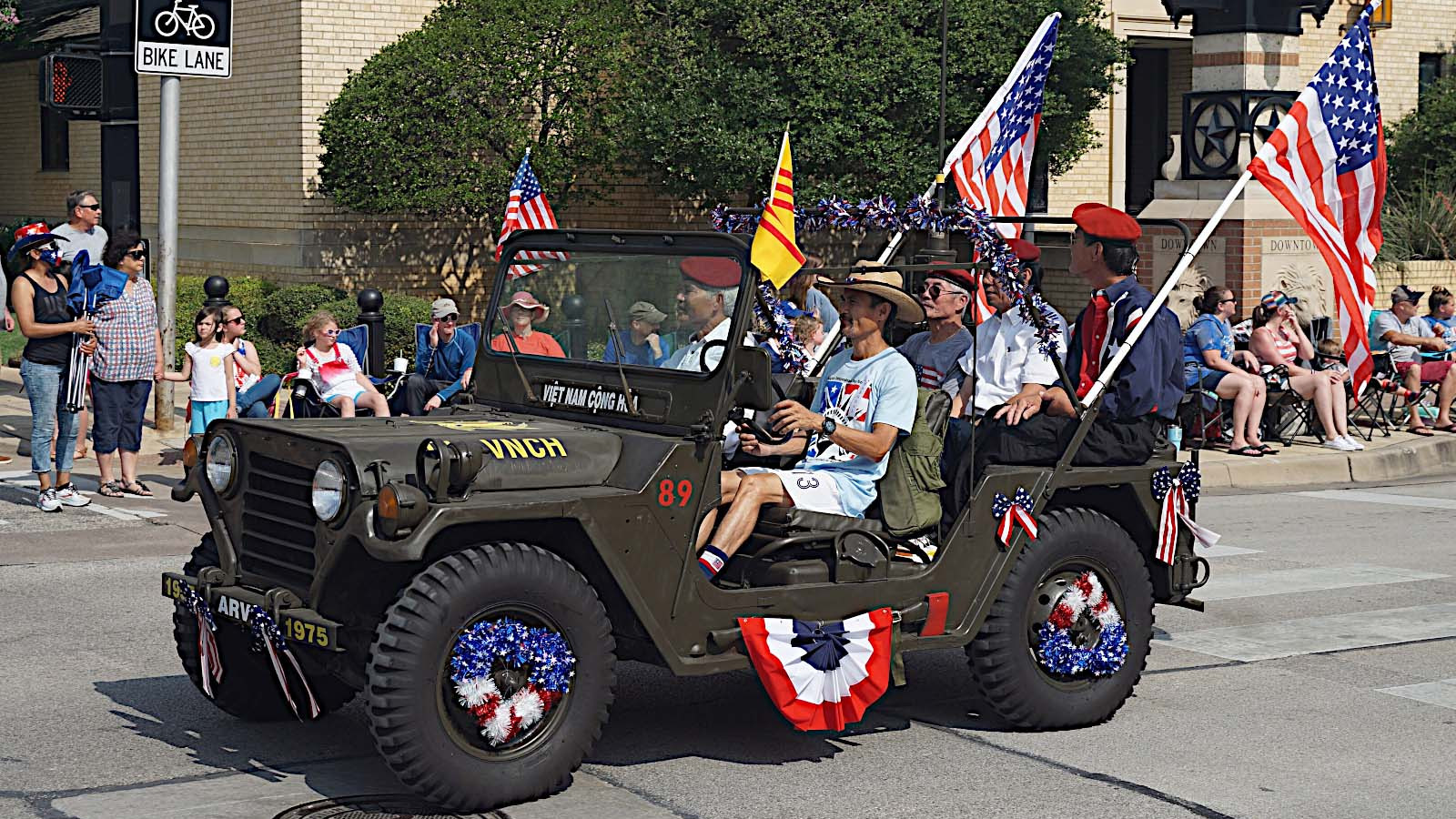
Of the two marques, only Willys developed a civilian version of the Jeep for post-war use, but Ford later came up with another military vehicle officially known as the M151 (pictured), but commonly referred to as the Mutt.
The first Bronco
The Ford Bronco was introduced in August 1965 as a ’66 model, and as a rival to the already well-established Jeep CJ-5 and International Scout.
In its debut year, it was offered only with a 2.8-litre version of the Thriftpower straight-six engine, which had been fitted to the Falcon for several years and was even available in low-cost versions of the Ford Mustang.
As used in the Bronco, it produced 105 horsepower gross (89 net) and was mated to a three-speed manual gearbox.
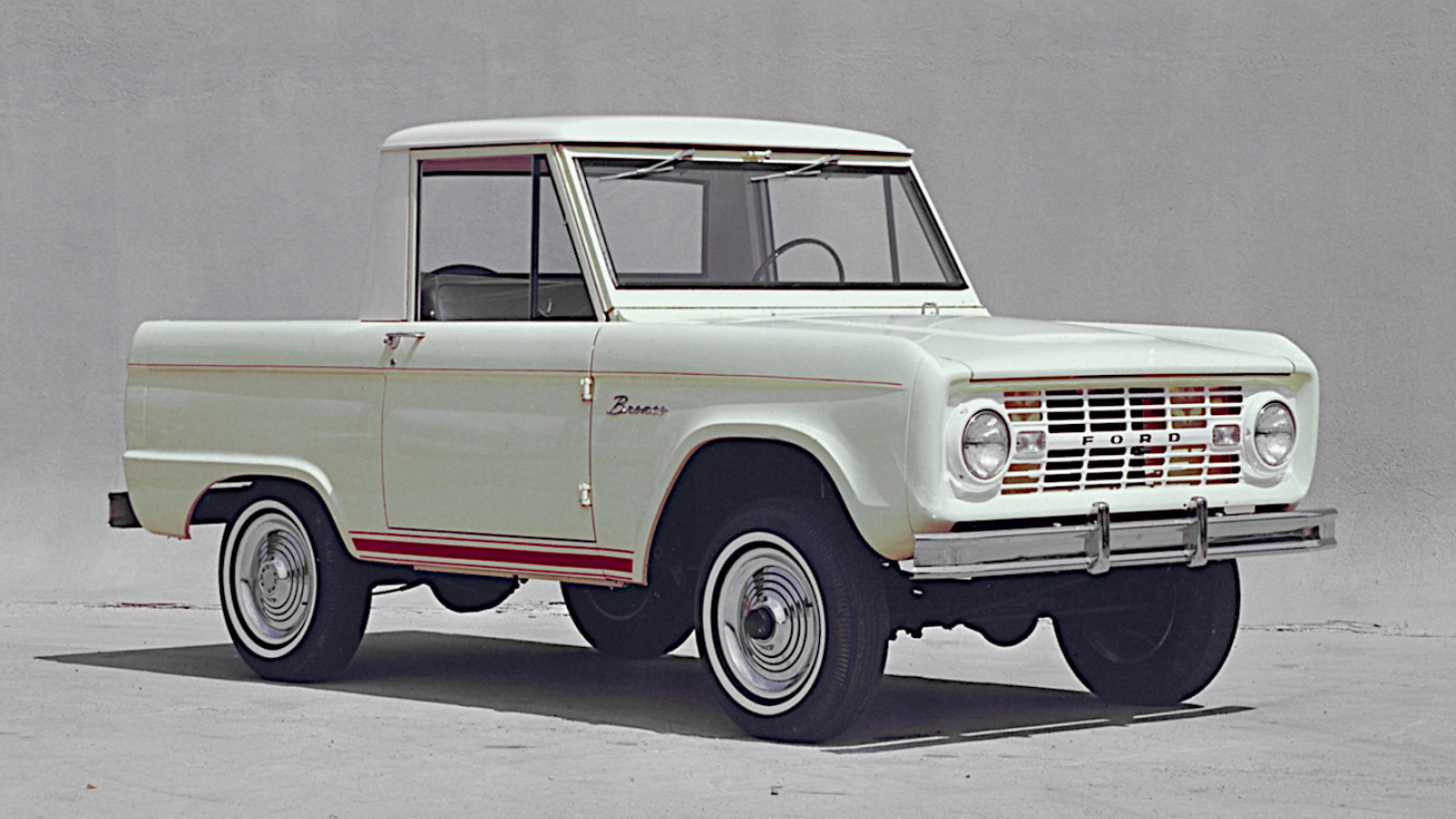
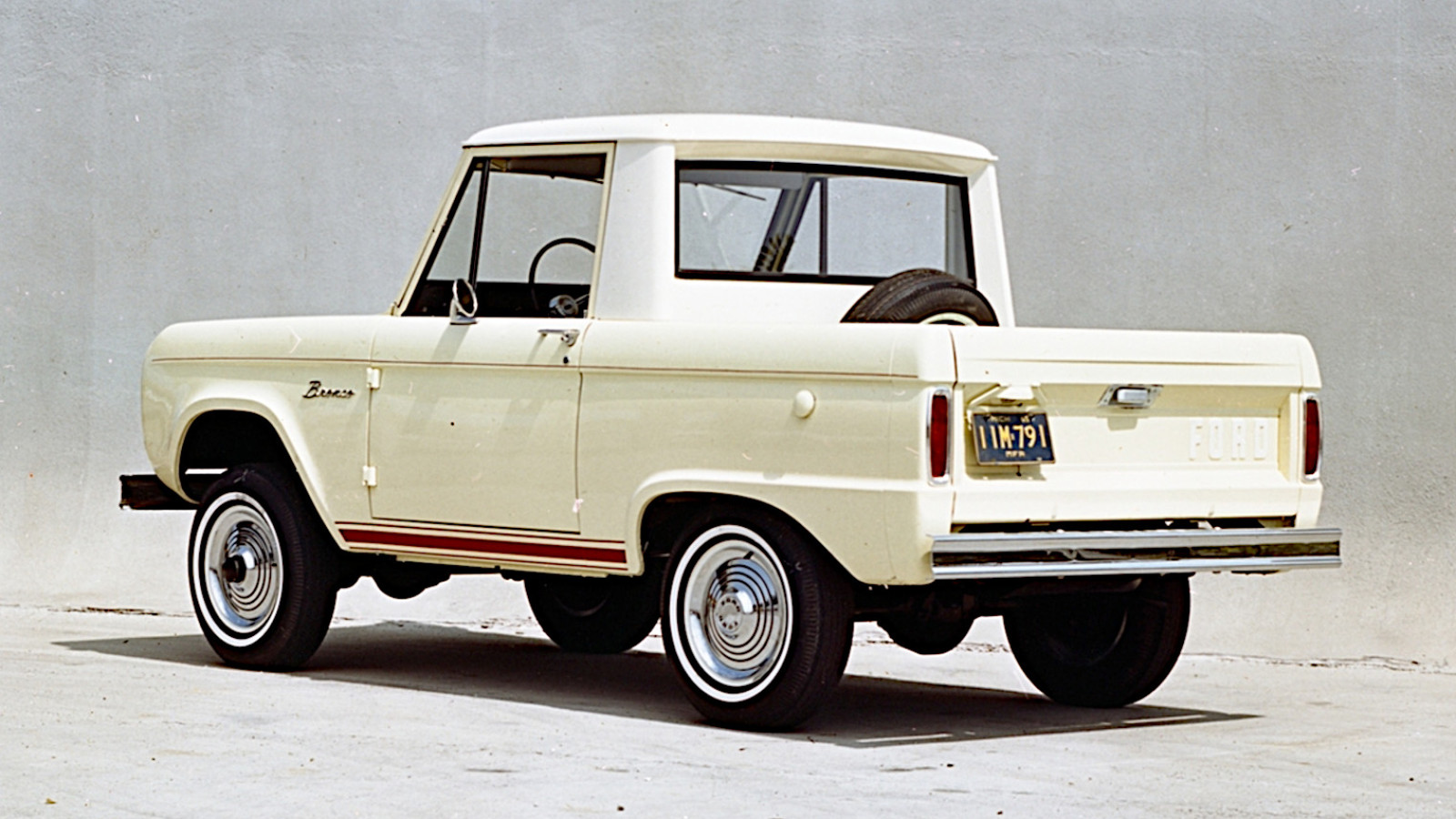
The choice of body style was wider. Ford offered the Roadster, which had no roof or doors, the Sports Utility (pictured), which did, and the Wagon, whose roof extended to the extreme rear of the vehicle instead of stopping at the end of the passenger compartment and leaving the cargo area open, as in the Sports Utility.
An alternative engine
In March 1966, Ford introduced to the Bronco range a small-block V8 known informally as the Windsor, after the engine plant in a town of that name which, though located in Canada, is less than 20 miles from Ford’s global headquarters in Dearborn, Michigan, in the USA.
In this application, the V8 had a capacity of 4.7 litres and produced 200 horsepower gross (150 net), greatly exceeding the output of the Thriftpower ‘six’.
Once again, the only available gearbox was a three-speed manual, though the first and second ratios in the V8 models were higher.
According to acknowledged Bronco expert Todd Zuercher, total production for the 1966 model year was 23,776, a figure that would be exceeded in the first generation only by the 25,824 units manufactured in 1974.
Ford Bronco Dune Duster
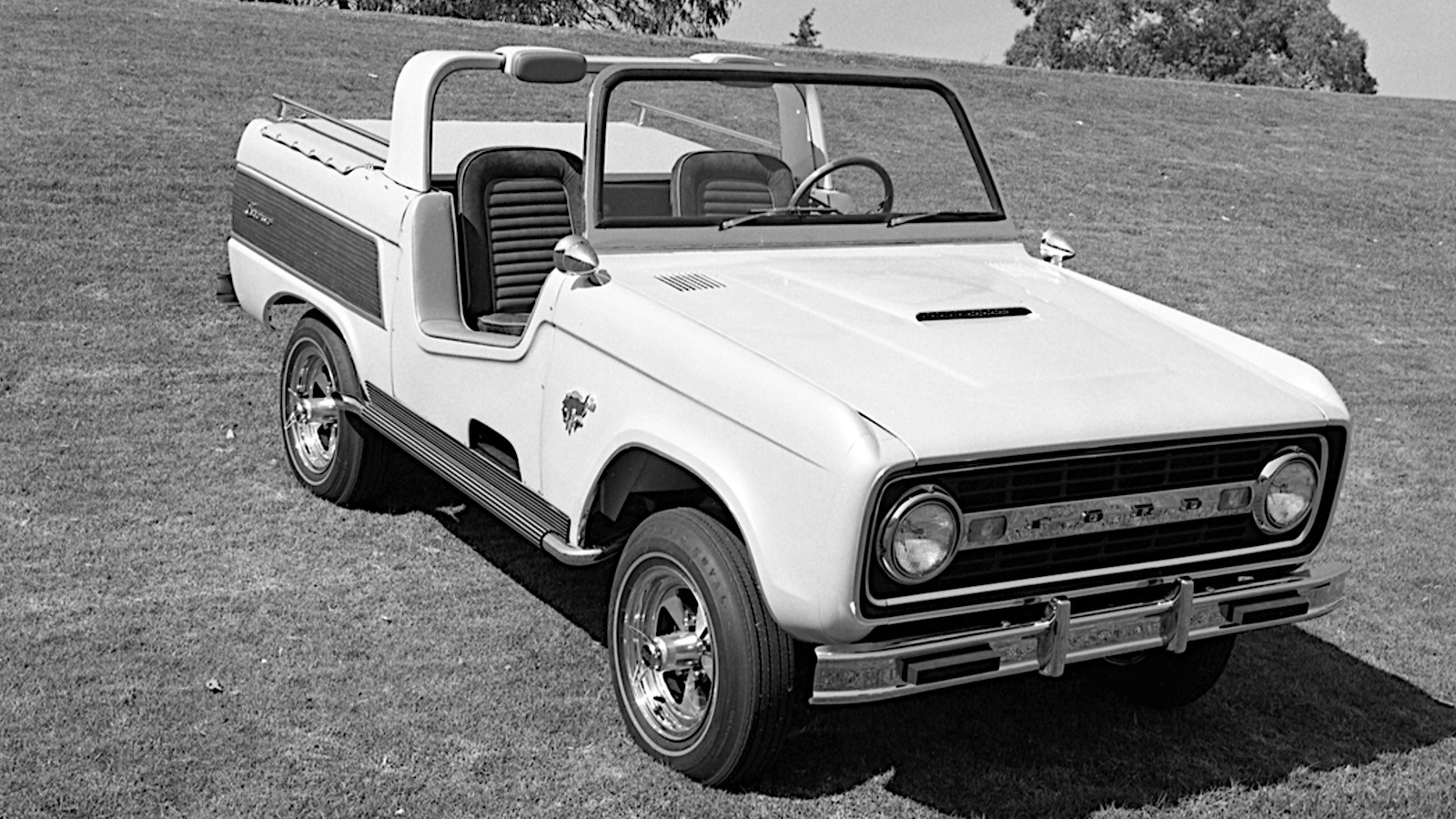
As part of its efforts to promote the Bronco in the earliest days, Ford created a special version of the Roadster called the Dune Duster.
Much of the work was done by Barris Kustom, whose founder, George Barris, was also responsible for many other remarkable vehicles including the Batmobile used in the 1960s TV series and the Munster Koach.
The many modifications included a hood scoop, chrome exhaust pipes, walnut appliqués on the rear side panels, Golden Saddle Pearl paintwork, machined alloy wheels with knock-off hubs and a rollbar with integral headrests.
Nothing like the Bronco Dune Duster was ever sold to the public, but the concept appeared at important motor shows for several years, starting in 1966.
Ford Bronco Sport Package
During the first generation, Ford created several packages to broaden the appeal of its Bronco.
The process began in 1967 with the Sport Package, which was applied to the Wagon and what was now known as the Pickup (formerly the Sports Utility), though not to the entry-level Roadster.
It was entirely cosmetic, and consisted of arm rests, a chrome horn ring, chrome bumpers, a vinyl front floor mat, vinyl-covered door trim panels, a ‘Sport Bronco’ logo, plus a great deal of interior and exterior bright metal.
Some of these items were also available as accessories on non-Sport Broncos, as were a hand throttle, a radio, skid plates, an 11.5-gallon auxiliary fuel tank and many other delights.
Ford Bronco Explorer and Ranger Packages
Two more packages were introduced during the early 1970s.
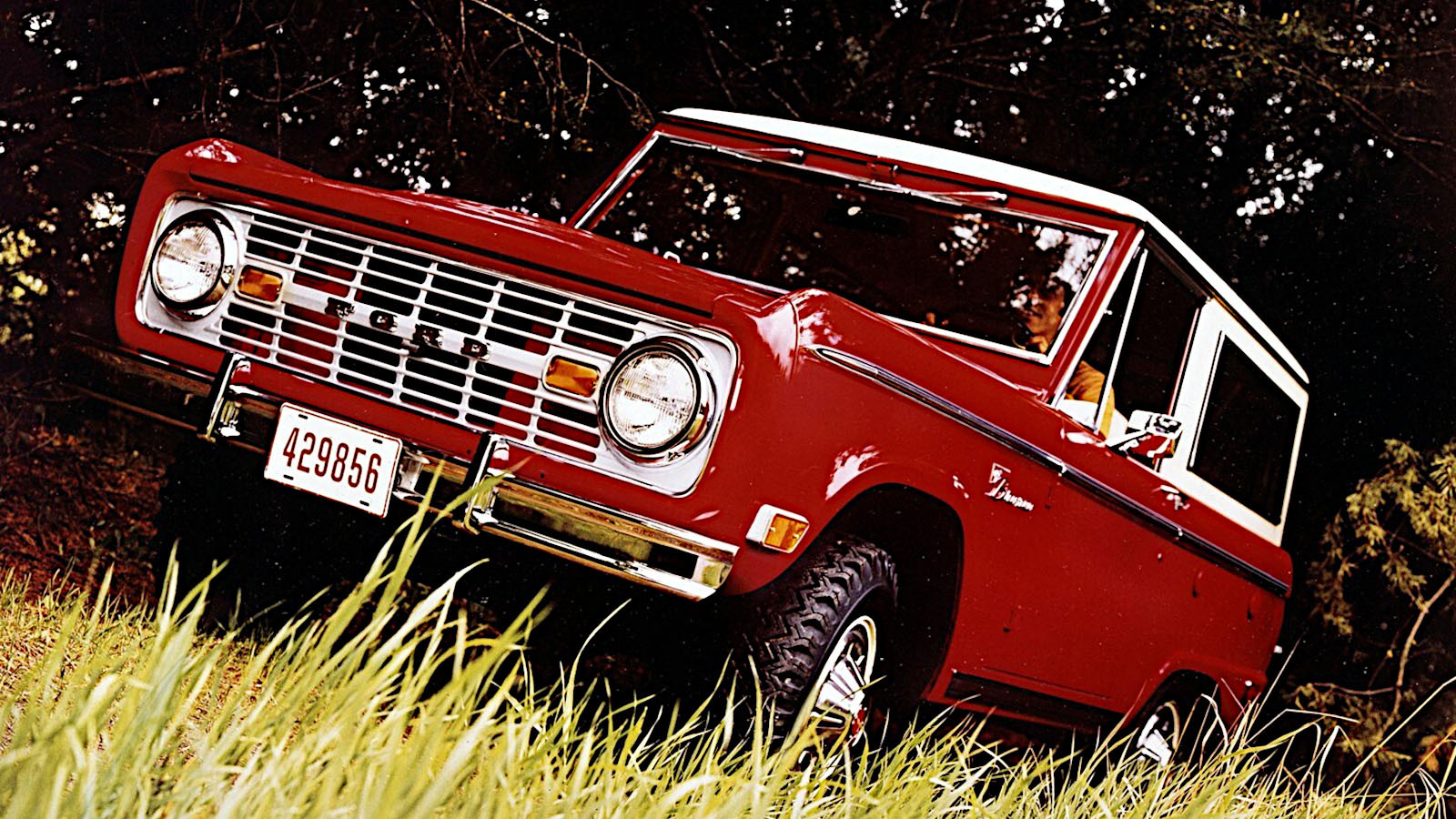
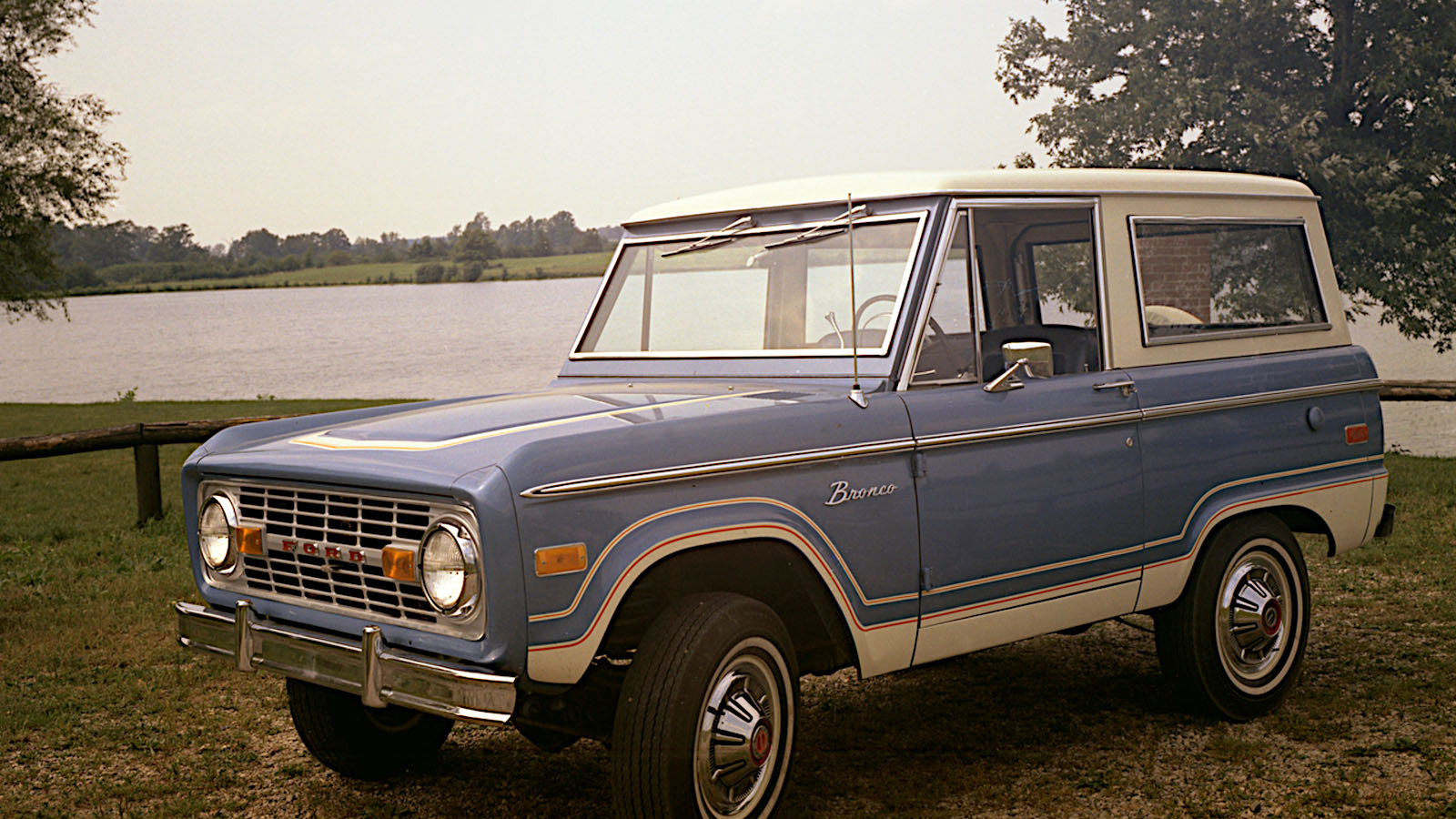
In Ford’s words, the Ranger Package (pictured) ‘infused Bronco with a luxury vibe’ and ‘conveyed a premium feel’, though these goals were achieved by very simple means, such as giving the vehicle a spare-wheel cover (with Bronco Ranger branding and a bucking horse logo), providing houndstooth vinyl seat upholstery and colour-keying the carpets, vinyl trim panels and instrument panel paint.
The Ford Bronco’s ‘more budget-conscious’ Explorer Package consisted of elements from the Sport and Ranger Packages, along with unique Explorer branding on the glovebox and spare-wheel cover.
Later developments
The Roadster was perhaps a little too basic, even for buyers who simply wanted an inexpensive workhorse, and did not appear in the brochure for 1968.
In the same year, the 4.7-litre V8 engine was rated at 195 gross horsepower, five less than before, but in 1969 it was replaced by a 4.9-litre version of the same unit (with a lower compression than the 4.7 originally had) which was quoted as producing 200 gross horsepower, or just over 150 net.
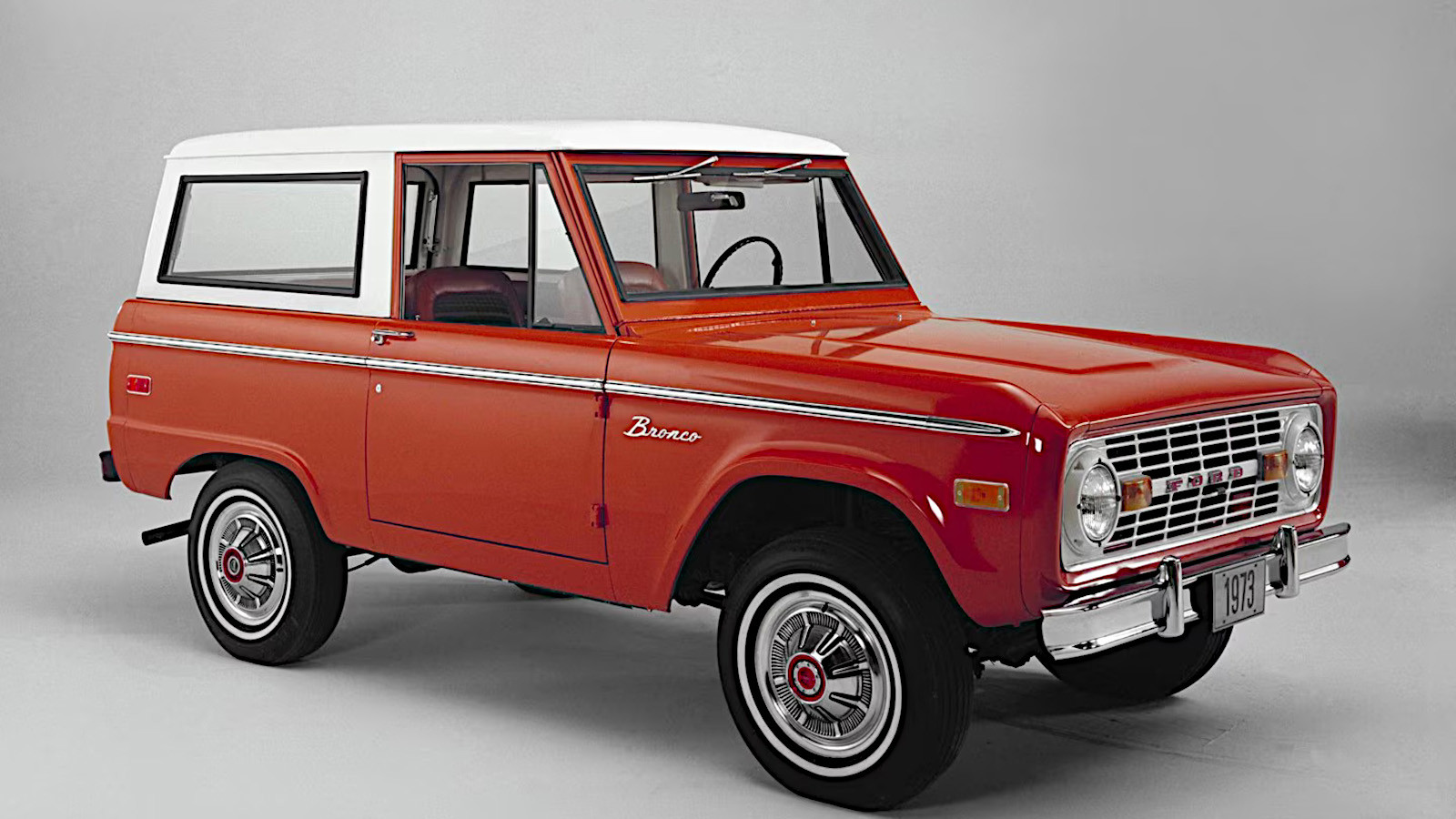
In 1973, the model year of the Bronco Wagon pictured here, the capacity of the Thriftpower ‘six’ was raised from 2.8 litres to 3.3 (both the bore and the stroke having been increased), while a three-speed automatic gearbox became an optional alternative to the manual in models with the V8 engine.
End of chapter one
The rapid decline in the popularity of the first-generation Ford Bronco is demonstrated by the fact that, having built 25,824 examples in 1974, only 13,125 left the factory the following year.
Production rallied slightly in 1976 and 1977, but it was clear that a new Bronco would be needed very soon.
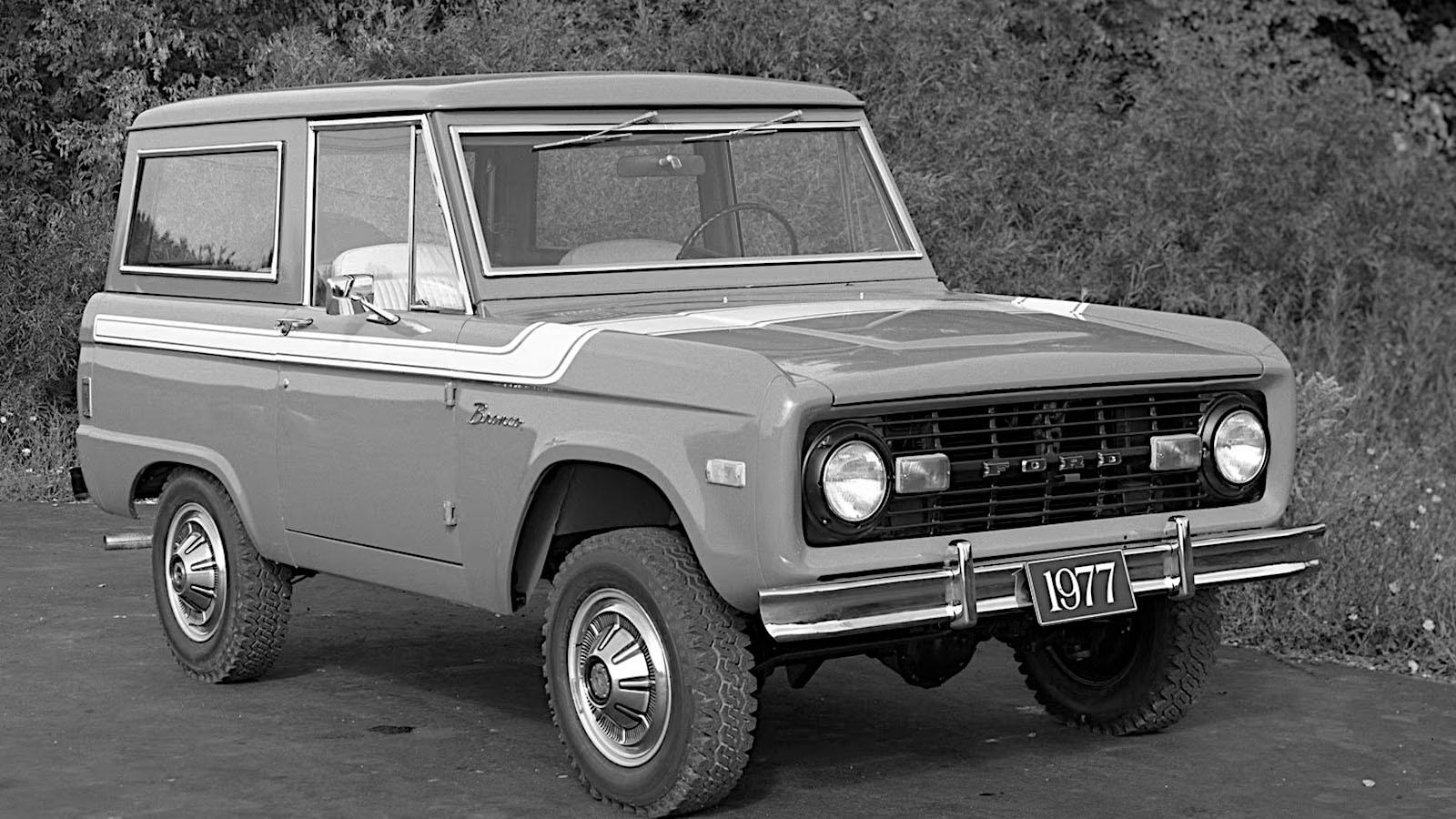
In an attempt to recapture some interest in the old model, Ford brought out the Special Décor Package (pictured), which was once again mechanically identical to the standard model.
A blacked-out grille and headlight rings, a body-coloured top, and a contrasting stripe running across the bonnet and along each side gave some sense of modernity to a vehicle which was now clearly a thing of the past.
First of the big Broncos
In one of the most startling turnarounds in motoring history, the Bronco nameplate was applied in consecutive years to two almost unrecognisably different vehicles.
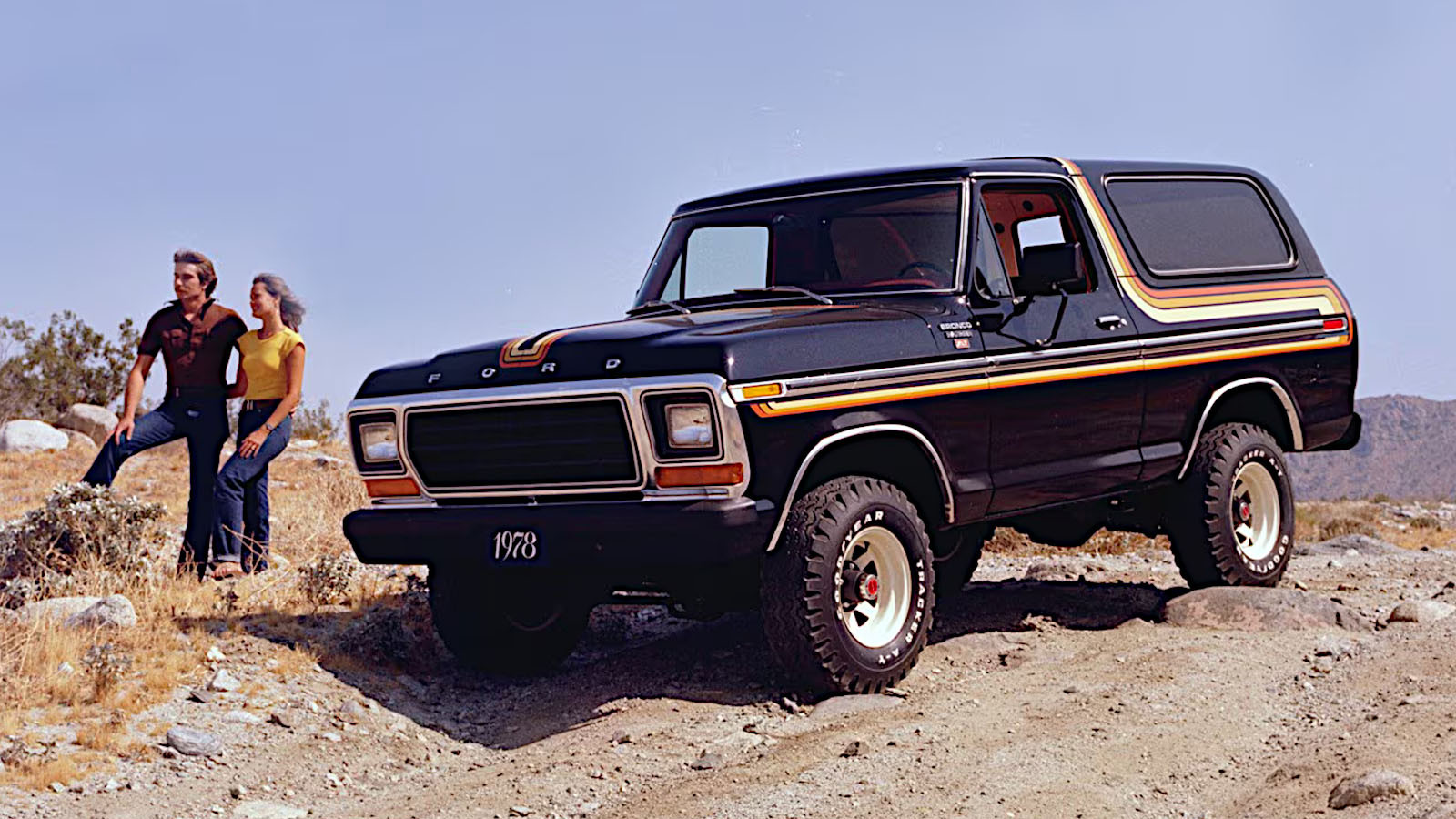
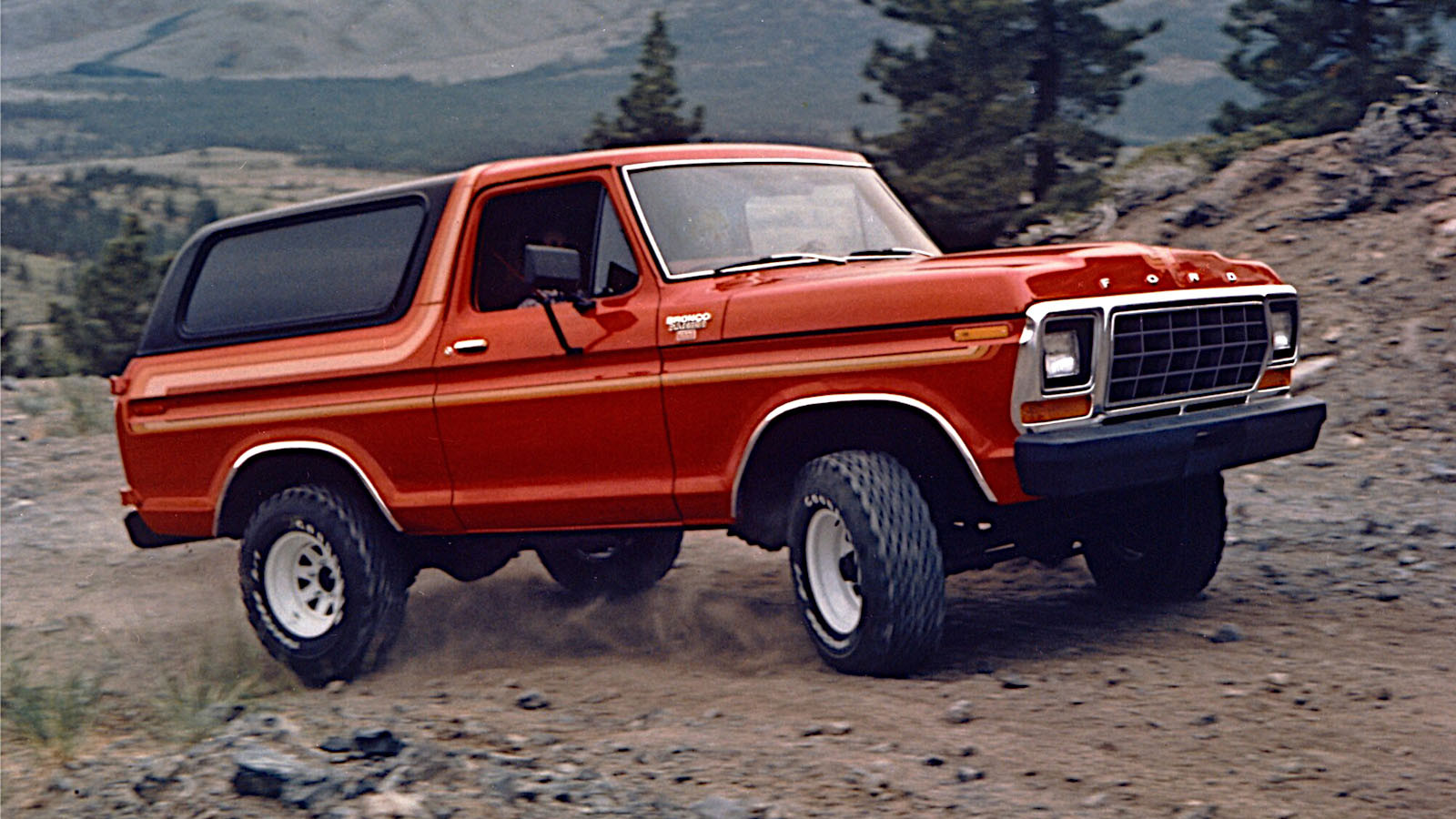
The 1978 Bronco still had two doors and four-wheel drive, but it was larger in every dimension (including being 28.2in (716mm) longer), although with slightly reduced approach, departure and breakover angles.
Based on the F-Series truck, it also had much larger engines, namely the standard 5.8-litre and optional 6.6-litre versions of the small-block V8 widely (though not officially) known as the Cleveland, which was designed after the Windsor but had a shorter production life.
Ford Bronco: second generation
This Ford Bronco was the first to be available with more than three forward gears.
The standard ’box was a four-speed manual, though a three-speed automatic was also available as an extra-cost option.
Another option was the Handling Package, which included a rear anti-roll bar (a front bar was standard) and no fewer than six shock absorbers, four of them controlling the front wheels.
In another break from the past, all Ford Broncos of this generation had the same body (though only the Ranger XLT had rectangular headlights, the more basic Custom having round ones), but customers who ordered the Free Wheeling Package could brighten their vehicles’ appearance by ordering tricolour striping in orange/tan/cream or blue/white/green, depending on the base colour of their vehicle.
Ford Bronco: third generation
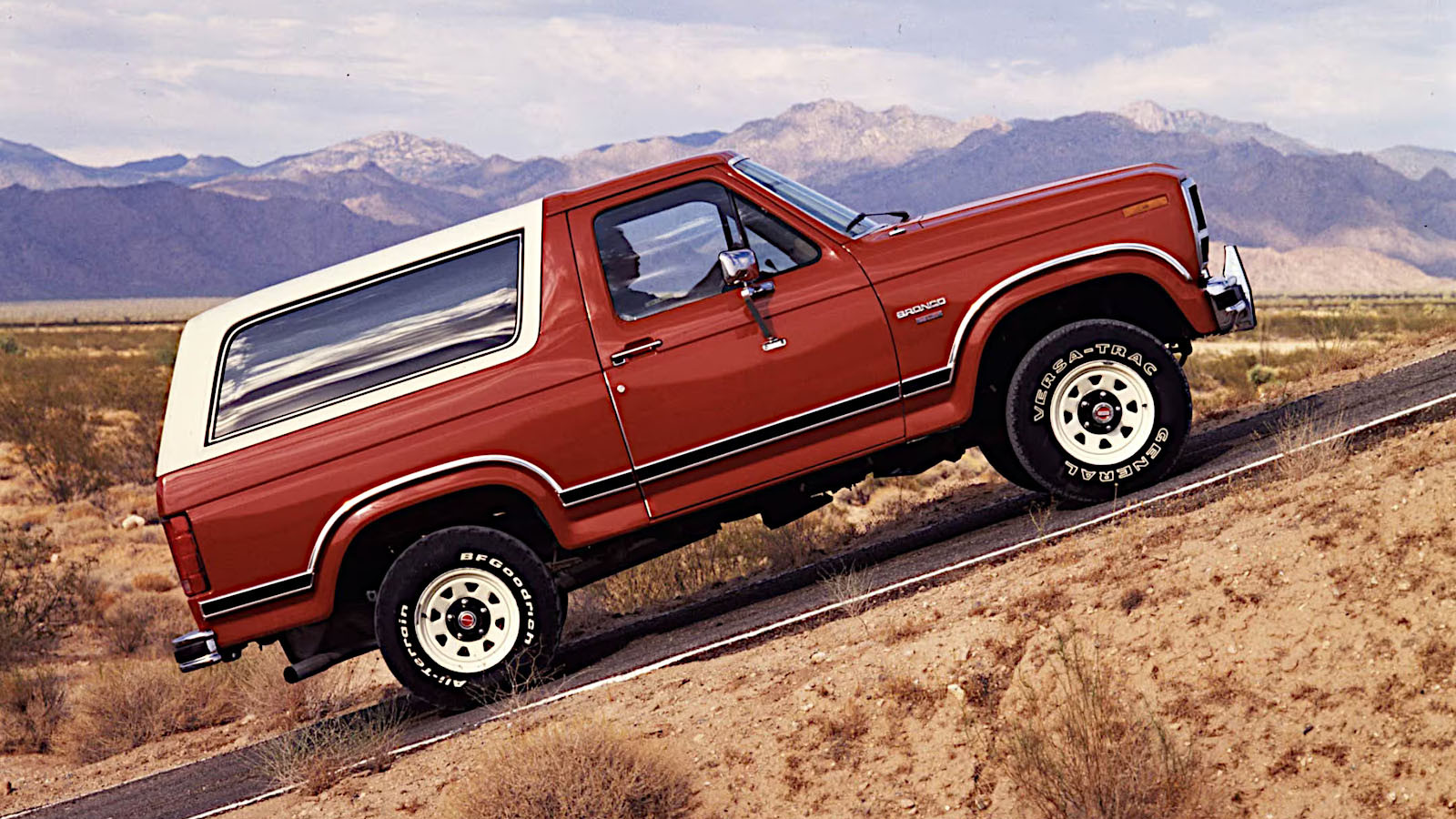
The second Ford Bronco lasted for only two years before being replaced by the third in 1980.
Though still much larger than the original model, this one was slightly smaller (2.7in/69mm shorter, 1.1in/28mm narrower) and around 500lb (c227kg) lighter than its immediate predecessor, and also more refined thanks to its Twin-Traction Beam, a fancy name for independent front suspension which replaced the previous solid axle.
The straight-six engine returned to the range, now in 4.9-litre form, though customers who found this insufficient could opt for the similarly sized Windsor V8 or the 5.8-litre Cleveland V8, the 6.6 having been dropped from the range.
Even the 5.8 didn’t last long, and in 1982 it was replaced by another V8 of the same capacity from the Windsor family.
Ford Bronco variations
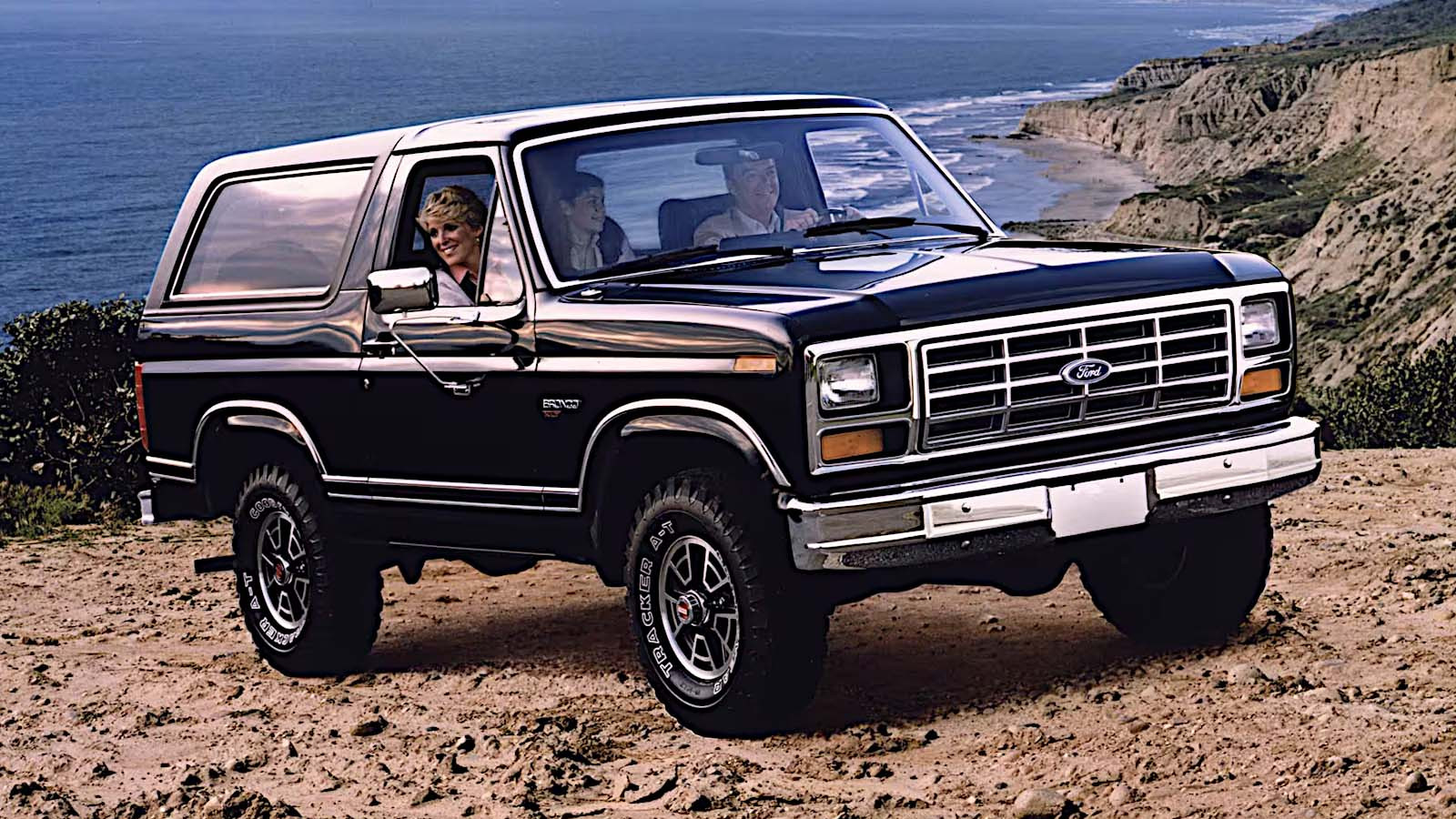
The most upmarket variant of the third-generation Ford Bronco was the Ranger XLT, which featured chrome accents, plush carpeting, colour-keyed upholstery and a steering wheel wrapped in simulated leather.
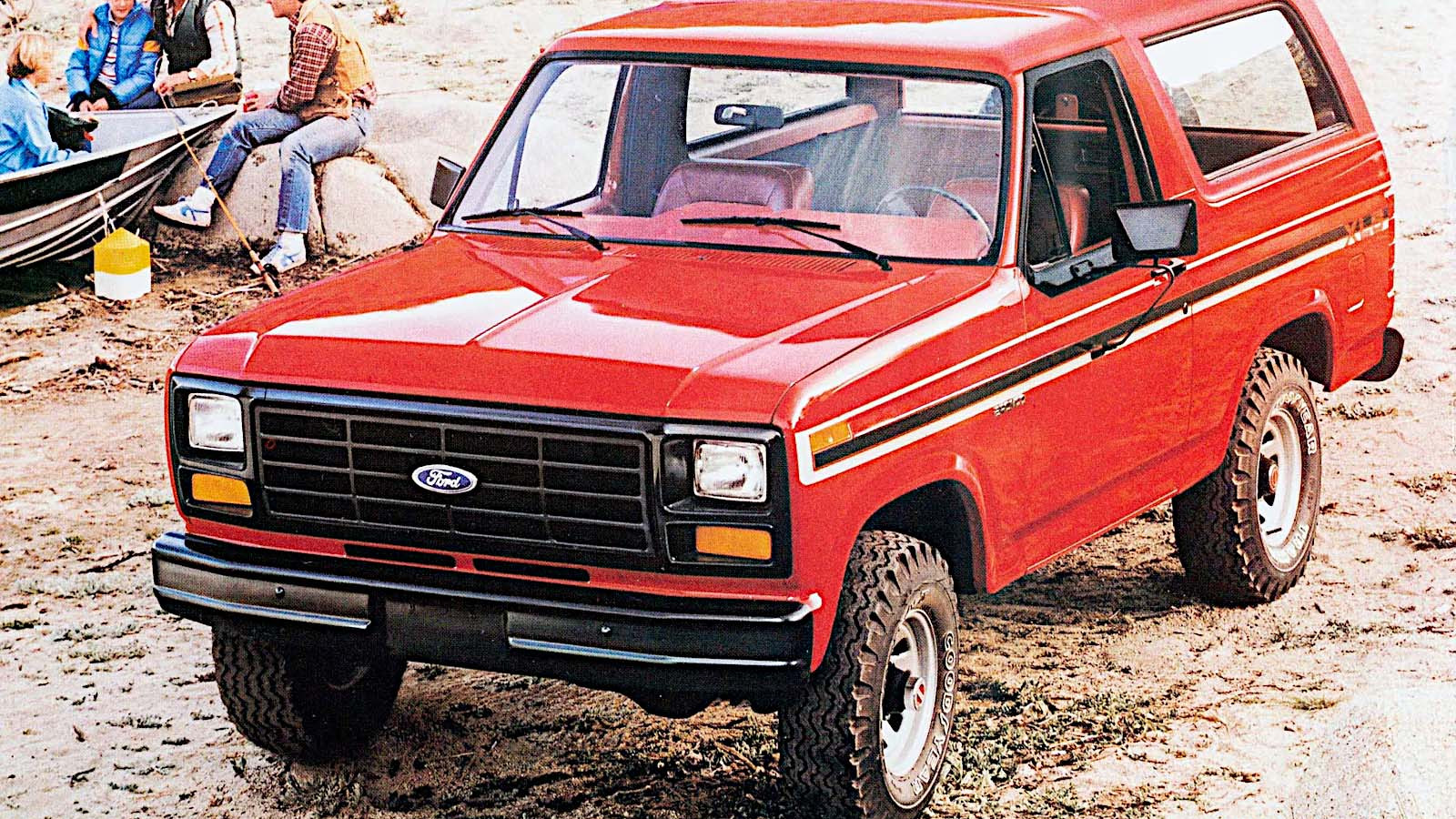
The ‘youth-oriented’ XLS Package (pictured), offered only briefly, went the other way, with a completely black and chromeless front grille and light surrounds.
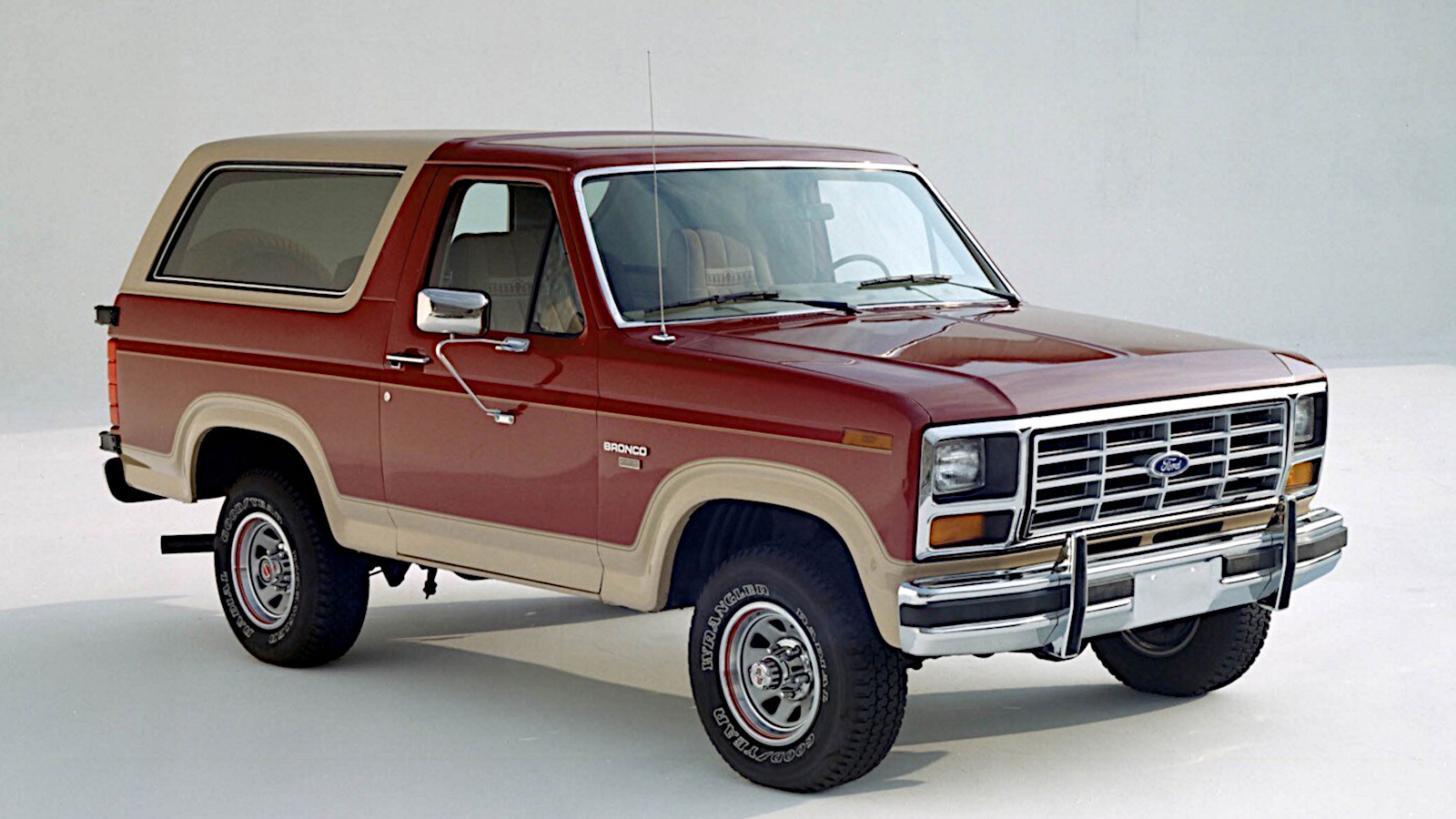
The Free-Wheeling Package, with its tri-coloured stripes, was carried over from the second generation, and in 1985 Ford introduced the first of what would become several Eddie Bauer Packages, named after the clothing company, which featured two-tone paint, velour upholstery, silver-painted steel wheels and a set of Eddie Bauer-branded luggage.
Technical changes
During the 1984 model year, the 5.8-litre V8 engine became available with a higher compression ratio and a four-barrel Holley carburettor (rather than the two-barrel carb it was originally fitted with), resulting in a power increase which meant well over double the output of the previously discussed net figure for the original, six-cylinder Bronco.
By 1986, the final year of the third generation, this was the only 5.8 buyers could have, the two-barrel version having been dropped.
In 1984, electronic engine control became standard on the 4.9-litre ‘six’ and the 5.8-litre V8 and, the following year (the first in which Ford offered a four-speed automatic for the Bronco), the 4.9-litre V8 switched from a carburettor to electronic fuel injection.
Ford Bronco II
The Bronco name was first applied to two vehicles being produced simultaneously in 1983.
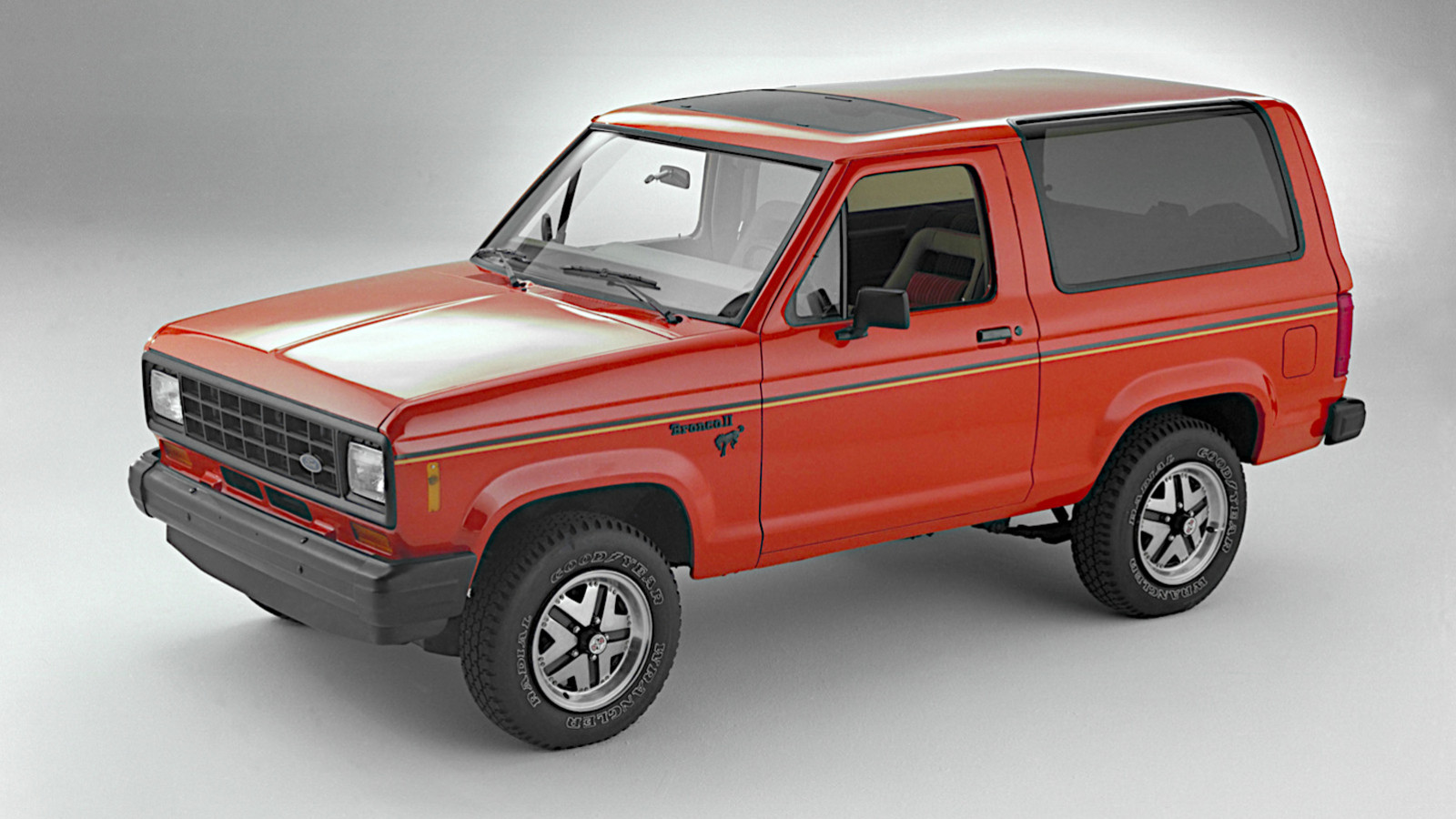
The Ford Bronco II was not closely related to the third-generation Bronco, but to the Ford Ranger pick-up truck, though it was considerably shorter.
At launch, the only available engine was a 2.8-litre V6 with electronic management and a carburettor, while four-wheel drive and a four-speed manual gearbox were standard, with a five-speed manual and a three-speed automatic available as options.
The Bronco II’s height was almost identical to its overall width, and significantly greater than the distance between the tyre tread centres on each axle, and this no doubt contributed to an unfortunate reputation for falling over sideways during moments of stress.
Ford Bronco II developments
The 2.8 V6 was replaced in 1986 by a fuel-injected 2.9 of the same layout and, also in 1986, Ford introduced a rear-wheel-drive version, with lighter front springs and heavier rears to account for the change in weight distribution.
The choice of transmissions changed several times, and eventually settled down to a five-speed manual or a four-speed automatic, both with overdrive top gears.
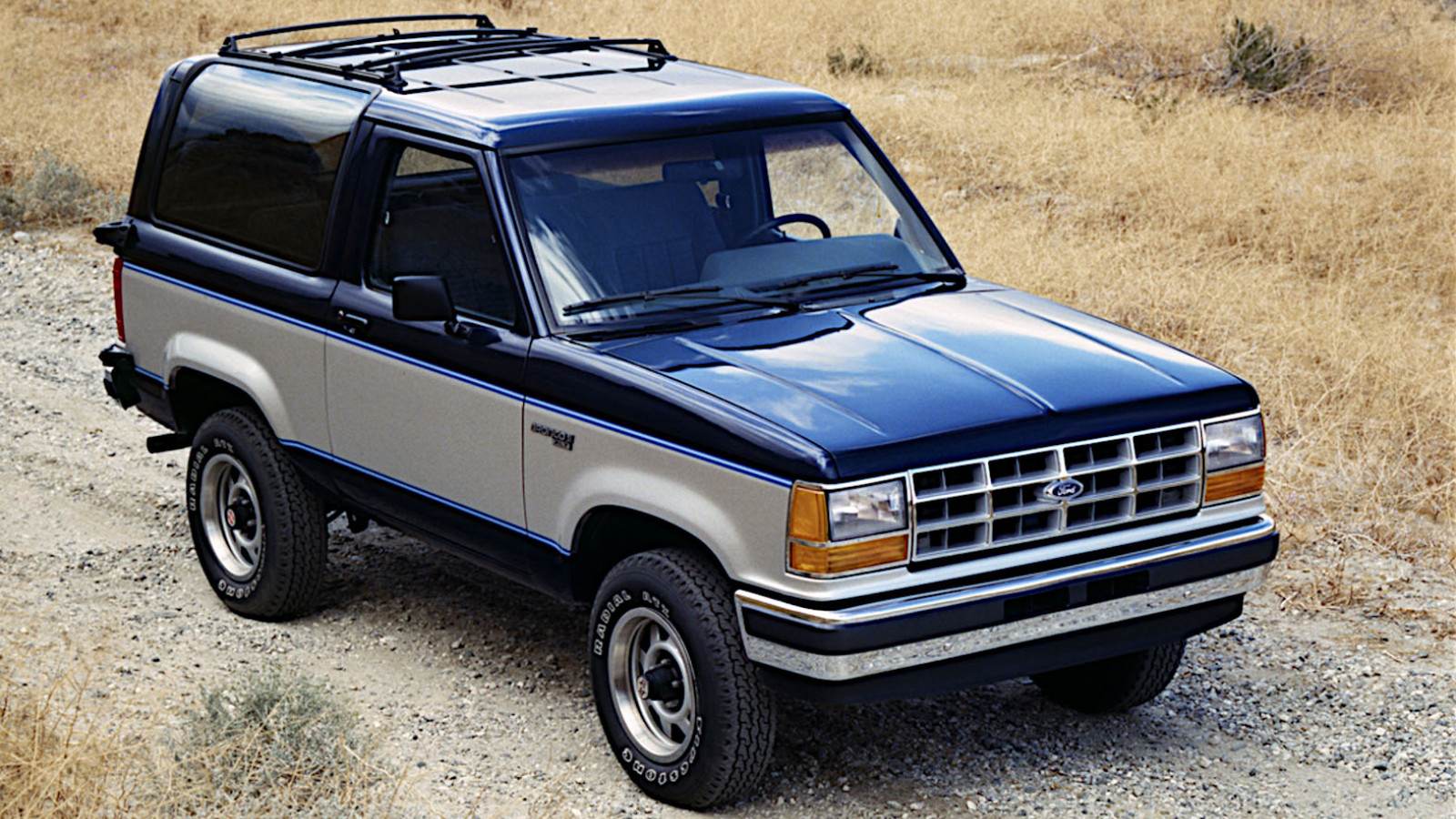
As pictured here, the front-end appearance was revised considerably in 1989, giving the impression that Ford Bronco IIs of that year and the following one were part of a new generation, though strictly speaking this wasn’t the case.
The new look didn’t last long, because the Bronco II was replaced for 1991 by Ford’s first-generation Explorer.
Ford Bronco: fourth generation
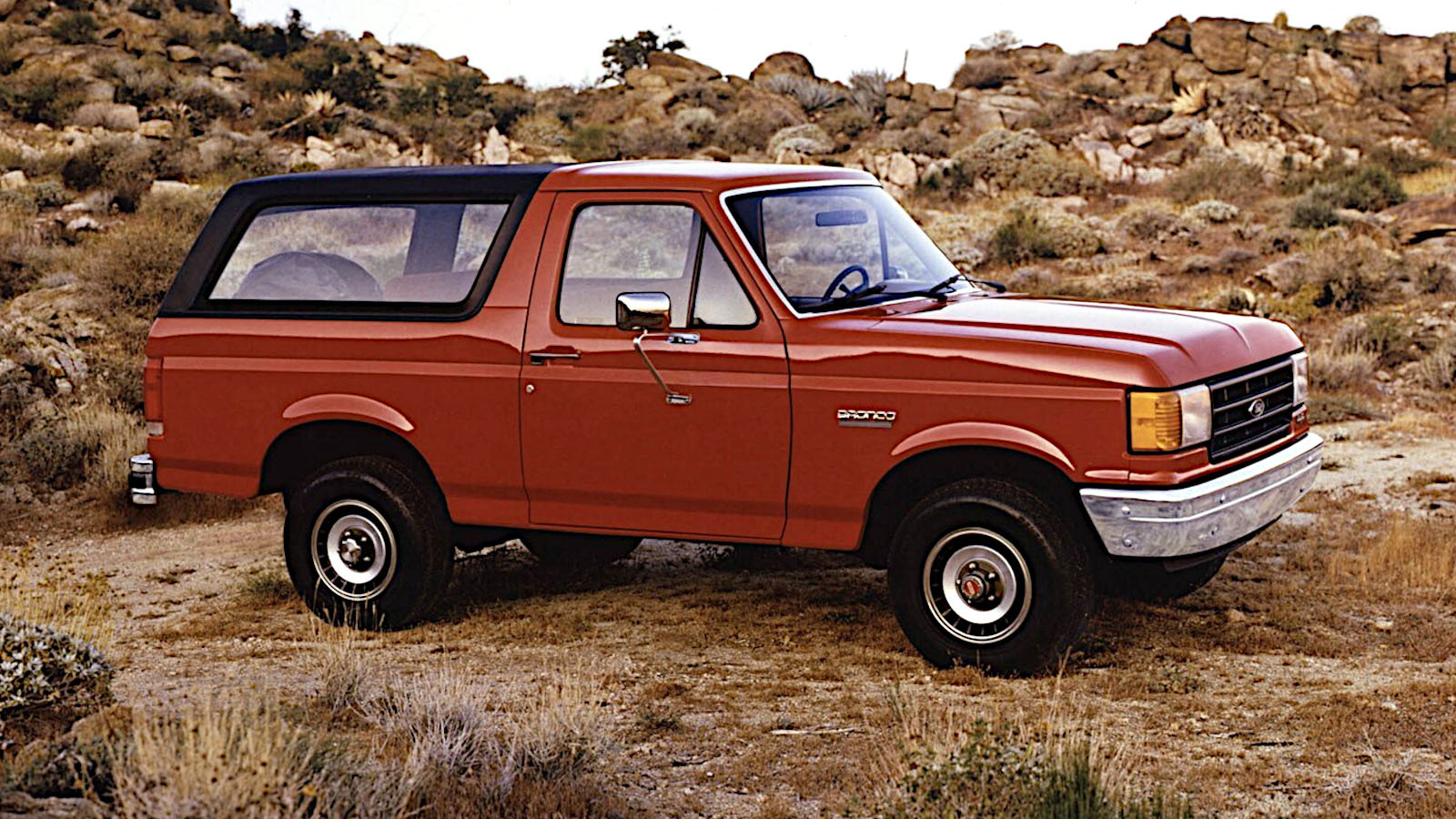
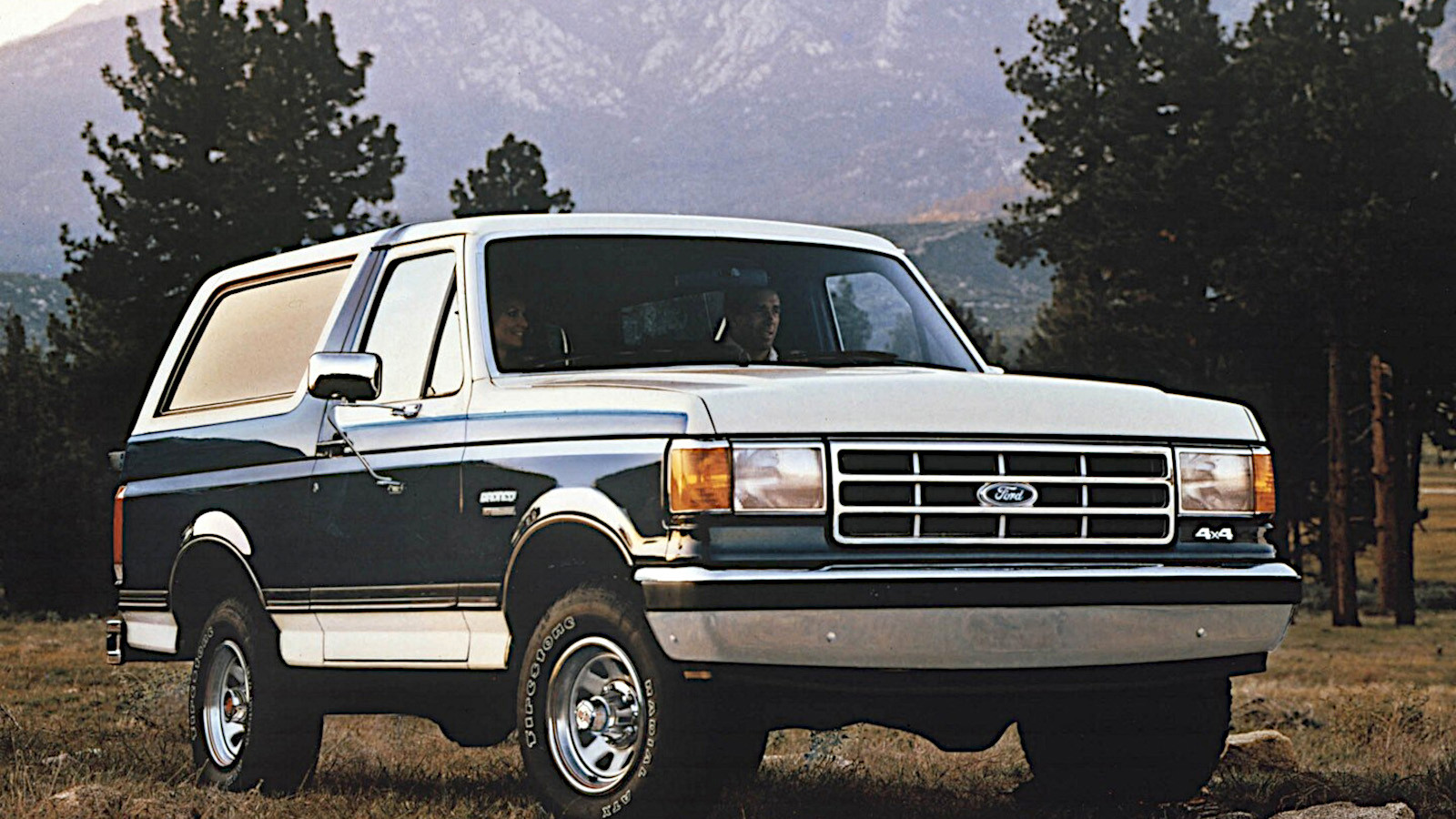
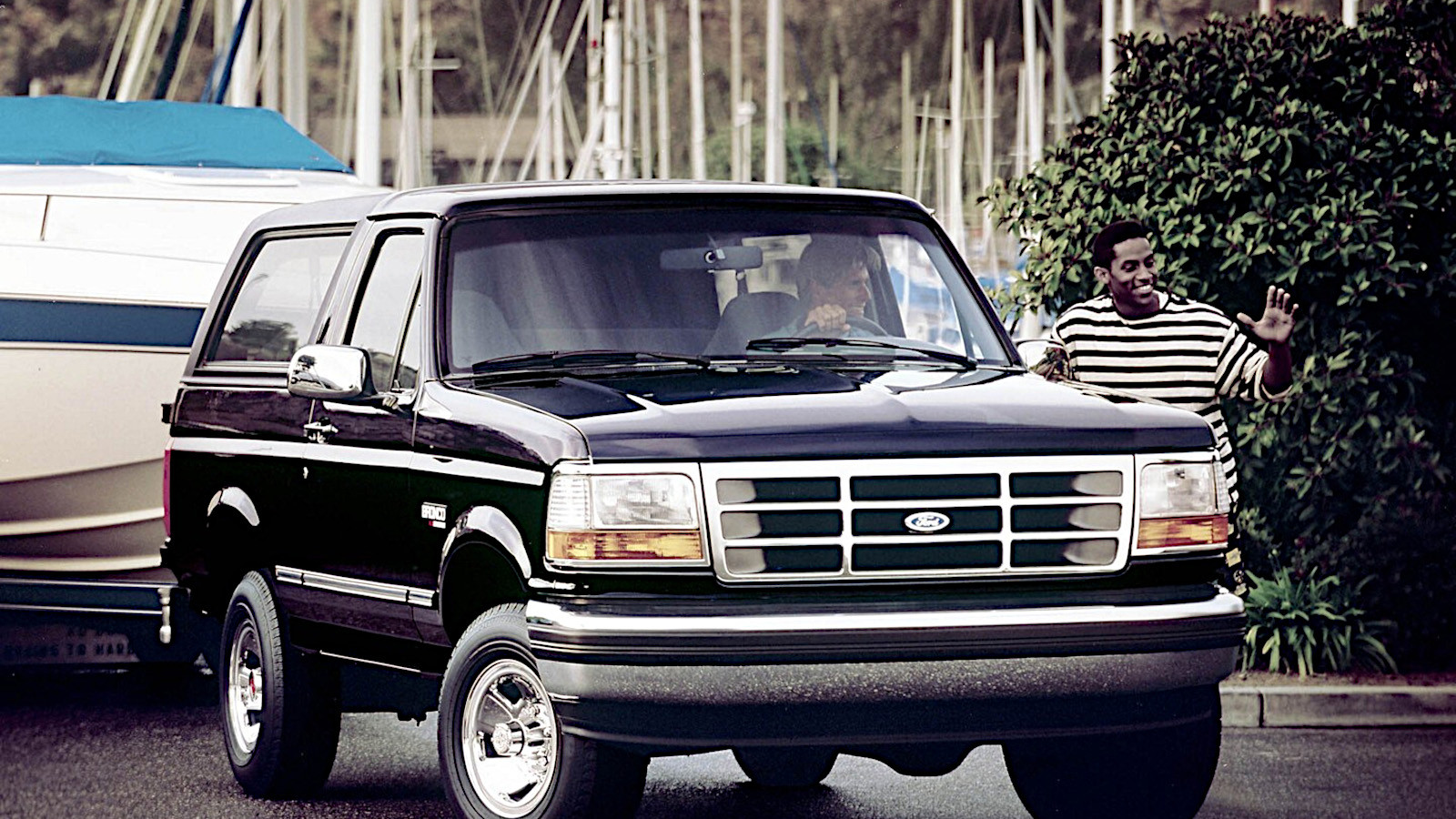
Like the contemporary F-Series truck, the fourth-generation Ford Bronco, introduced in 1987, was notable for its more rounded front end – a result, the brochure boldly claimed, of ‘Ford’s advanced airflow management techniques’.
The engine line-up was the same as before, consisting of a 4.9-litre straight-six, and 4.9- and 5.8-litre V8s, the smaller ‘eight’ branded, with a little exaggeration, as a 5.0.
Multiple-port fuel injection became standard across the range, as did anti-lock braking, though the latter operated only on the rear wheels.
Reading from the bottom up, the trim levels were known as Custom, XLT and Eddie Bauer, the last of these with the usual two-tone paintwork (though this was also an option on other versions) but without the straight-six engine.
Minor changes
The fourth-generation Ford Bronco stayed on the market until the 1991 model year, and in that time the mechanical specification was largely left unchanged.
The choice of engines was consistent throughout the run, though the number of ratios in the standard manual transmission was increased from four to five, while the automatic gearbox remained a four-speeder throughout.
While the Custom was most suitable for off-road enthusiasts, the XLT established itself as the most popular Bronco, customers apparently being swayed in its direction by the leather-covered, tilting steering wheel, extra insulation, rear cargo light and colour-keyed rear quarter trim panel, cloth headliner, carpets and Captain’s Chairs.
Late special editions
Two editions of the fourth Ford Bronco were produced only in 1991, the model’s final year.
The Silver Anniversary Edition, named to commemorate a quarter of a century of the nameplate, had Currant Red paintwork and, for the first time in Bronco history, leather upholstery, plus a Silver Anniversary bag, jacket and keys.
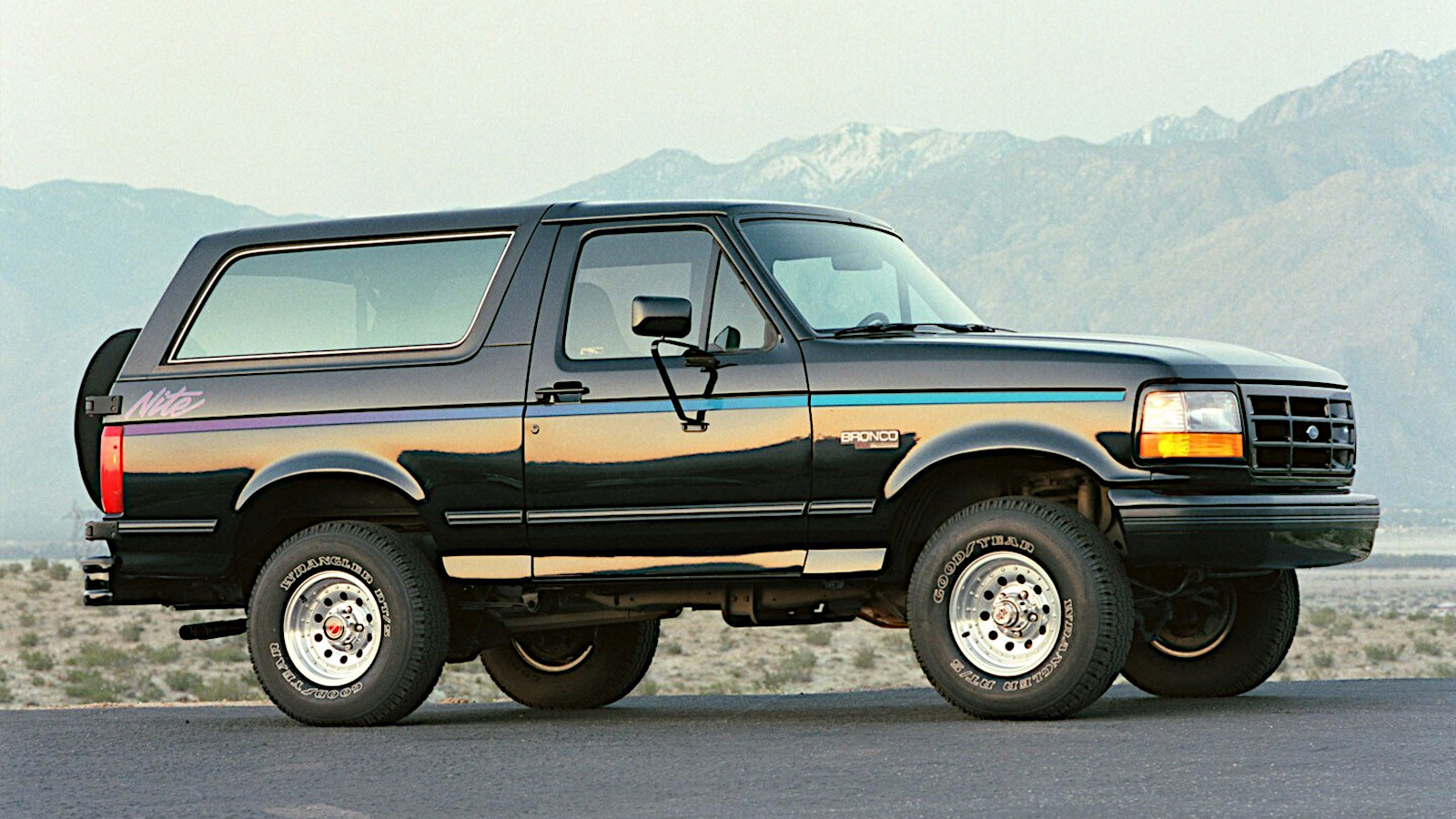
The Nite Edition was based on the XLT and, as the name suggests, was painted black, with either Azalea Pink or, as pictured here, Aegean Blue side stripes.
If the stripes were pink, the interior was red, while if they were blue, the interior was either Crystal Blue or Dark Charcoal.
Only 383 Nite Editions were built, making this one of the rarest of all Ford Broncos.
Ford Bronco: fifth generation
Another redesign marked the beginning of the fifth generation in 1992, though once again the engine choice remained the same.
In addition to the usual Custom, Eddie Bauer and XLT (now known as XLT Lariat), there was briefly a fourth trim level called XLT Lariat Nite, but this was discontinued in 1993, the same year that the straight-six engine was deleted.
1993 did, however, see four-wheel, anti-lock braking become available for the first time, and in a further safety move, a steering-wheel-mounted airbag was added in 1994.
Right from the start of this generation, the completely redesigned interior featured three-point rear seatbelts and, in the case of more expensive versions, leather upholstery.
The XLT Sport
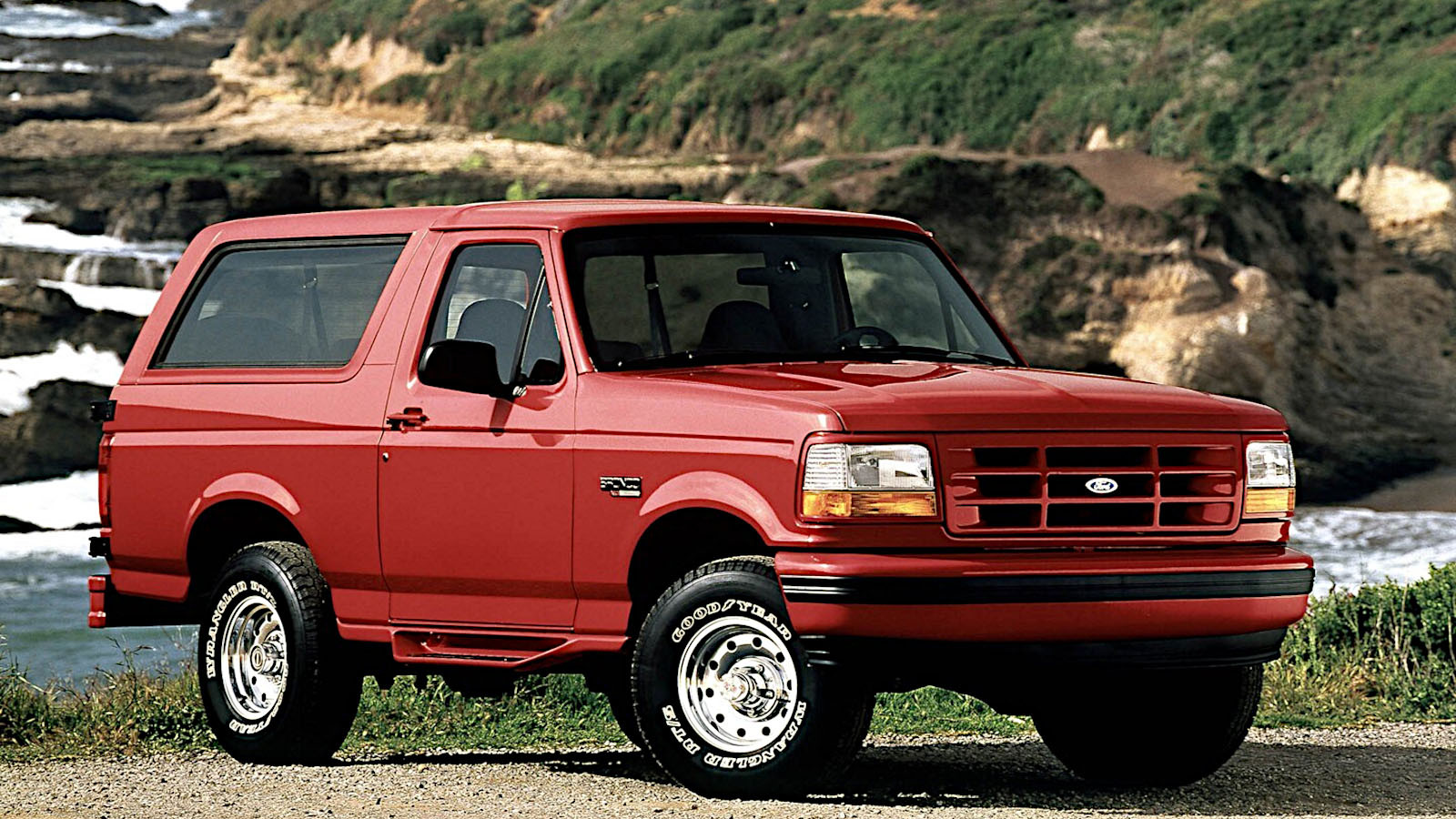
In 1995 and 1996, Ford produced a mechanically similar but visually different variant of the fifth Bronco called the XLT Sport.
It was the only one whose grille was finished not in chrome but in the same colour as the body, either Bright Red Clearcoat, as pictured here, or Oxford White Clearcoat.
Whichever colour was chosen, it was also applied to the bumpers and cab steps, giving a mostly monochromatic look interrupted only by the black bumper trims, side trims and door mirrors.
Other than that, the XLT Sport was essentially the same as the mid-range XLT, which as usual sat lower in the range than the Eddie Bauer but above the entry-level model, now badged as XL rather than Custom.
The successor
The fifth Bronco disappeared from the price list in the 1997 model year, and Ford replaced it with something very different.
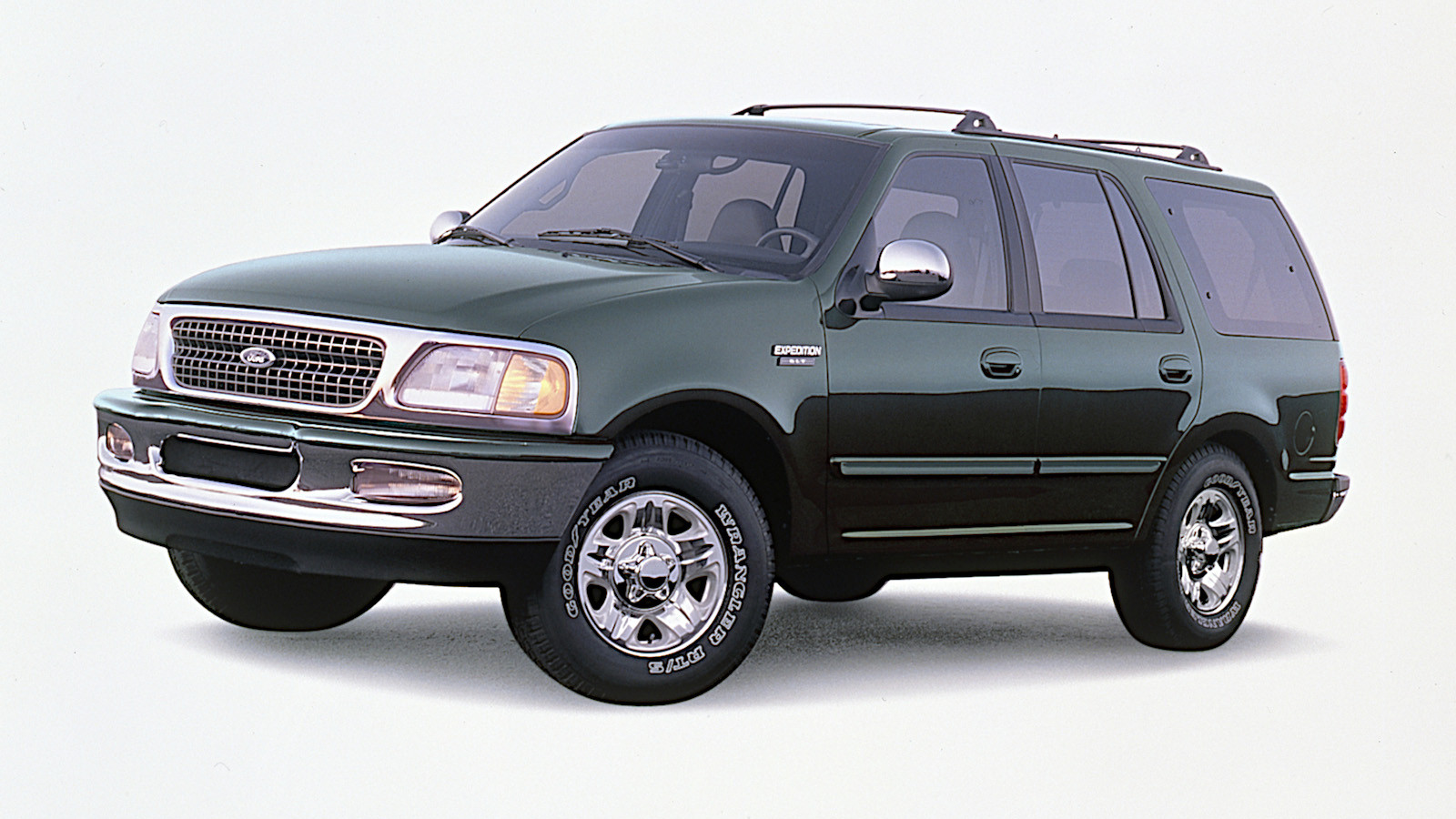
While the trim-level names sounded familiar (XLT and Eddie Bauer), the new vehicle had four side doors – two more than most previous Broncos and four more than the long-ago Roadster – and was powered not by the classic V8 engines, but by 4.6- and 5.4-litre units from the overhead-camshaft Modular family.
Perhaps because it represented such a major change, Ford abandoned the Bronco name and instead made this the first of several models badged as Expedition.
Ford Bronco history had come to what must have seemed at the time like a permanent end – and it would be a quarter of a century before it restarted.
Ford Bronco concept
The first sign that the Bronco nameplate might at some point make a comeback was revealed in 2004.
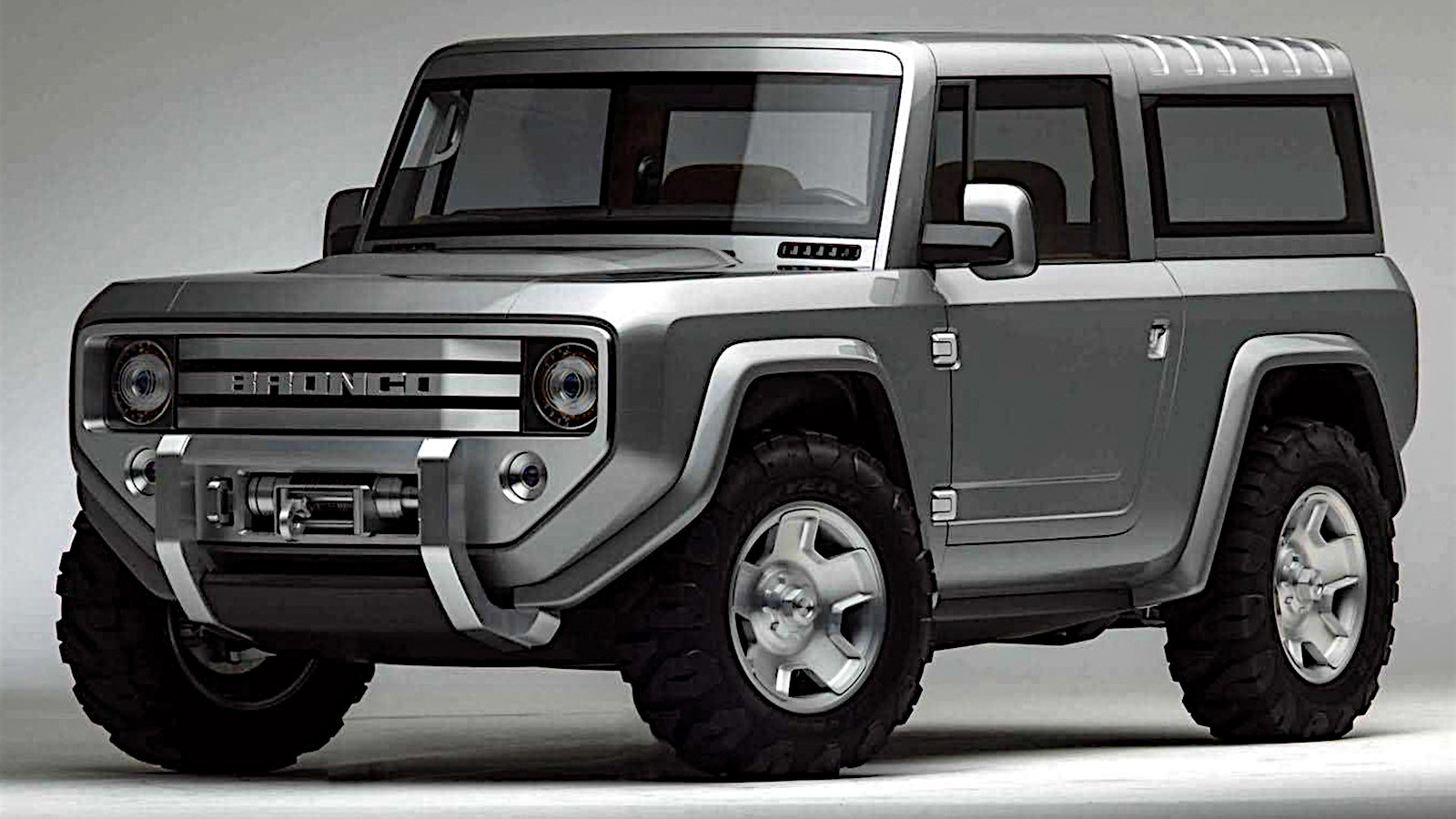
In that year, Ford made public a non-functional, retro-styled concept car whose design clearly recalled that of the first-generation Bronco.
This seemed to be just a blip in motoring history, but by a strange turn of events the concept returned, and found a much wider audience, 14 years after it was built.
It featured in the 2018 film Rampage, in which it helped characters played by Dwayne ‘The Rock’ Johnson and Naomie Harris in their ultimately successful attempt to calm down George, a genetically modified and temporarily very unsociable gorilla.
Ford Bronco Sport
Once the Expedition had entered its fourth generation, the model it had notionally replaced made a comeback after 25 years.
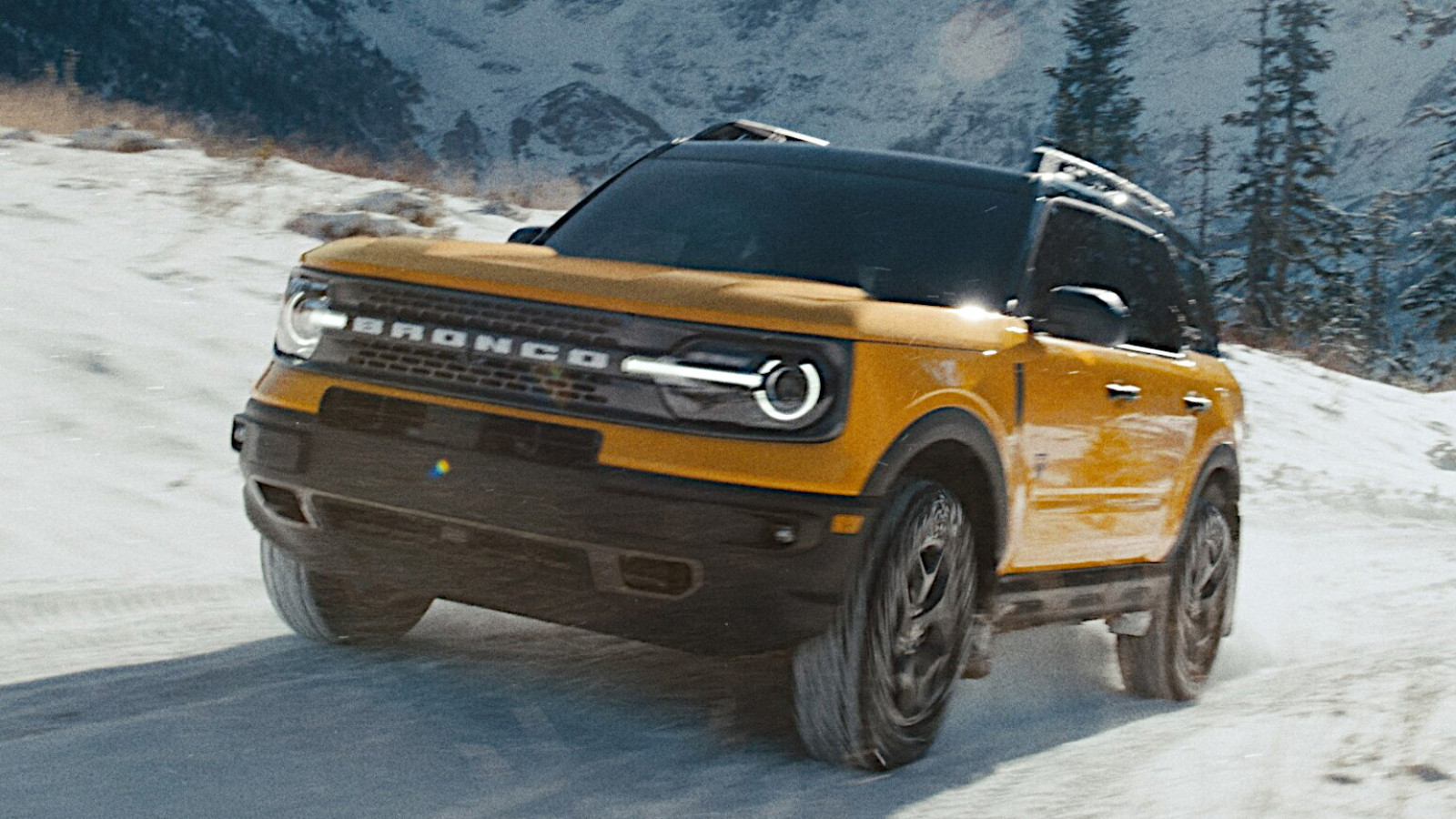
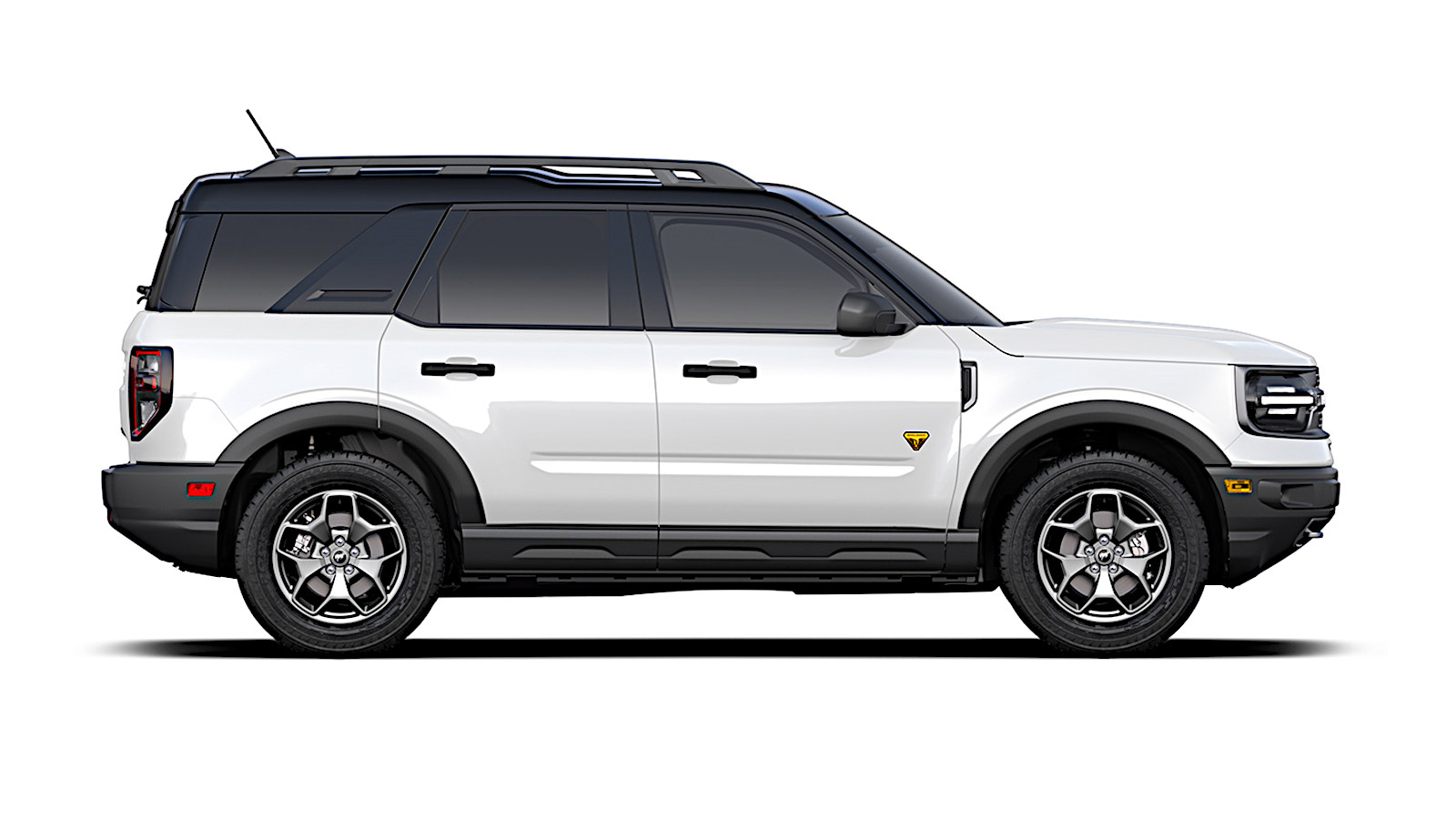
Named Bronco Sport, to distinguish it from another vehicle which would become available a few months later, it went on sale in late 2020 – solidly into the 2021 model year in North American motor industry terms.
Defined by Ford as a small SUV, the Bronco Sport was offered in the base, Big Bend and Outer Banks trim levels, with a 1.5-litre, turbocharged, petrol-fuelled EcoBoost engine which produced 181bhp and was mated to an eight-speed automatic transmission.
Collectively known as G.O.A.T. (which stood not for ‘greatest of all time’, as it often does, but ‘goes over all terrain’), there were five driving modes called Normal, Eco, Sport, Slippery and Sand.
Ford Bronco Sport Badlands
Standing slightly apart from other Bronco Sports, the Badlands had a 2-litre EcoBoost engine producing 245bhp (again paired with an eight-speed auto) and had more of an off-road focus.
Mud/Ruts and Rock Crawl were added to the existing five G.O.A.T. modes, metal bash plates (not available even as options on other 2021 Sports) were standard, there was a full-size rather than mini spare tyre, and the model featured a twin-clutch rear drive unit and off-road suspension.
As a result of the last of these, the Badlands ran about an inch higher than its stablemates and had correspondingly greater ground clearance.
More significantly, it also had a somewhat better departure angle (32.8 degrees rather than 30.4, according to the brochure) and a considerably more generous approach angle (30.0 degrees as opposed to 21.7).
Ford Bronco: sixth generation
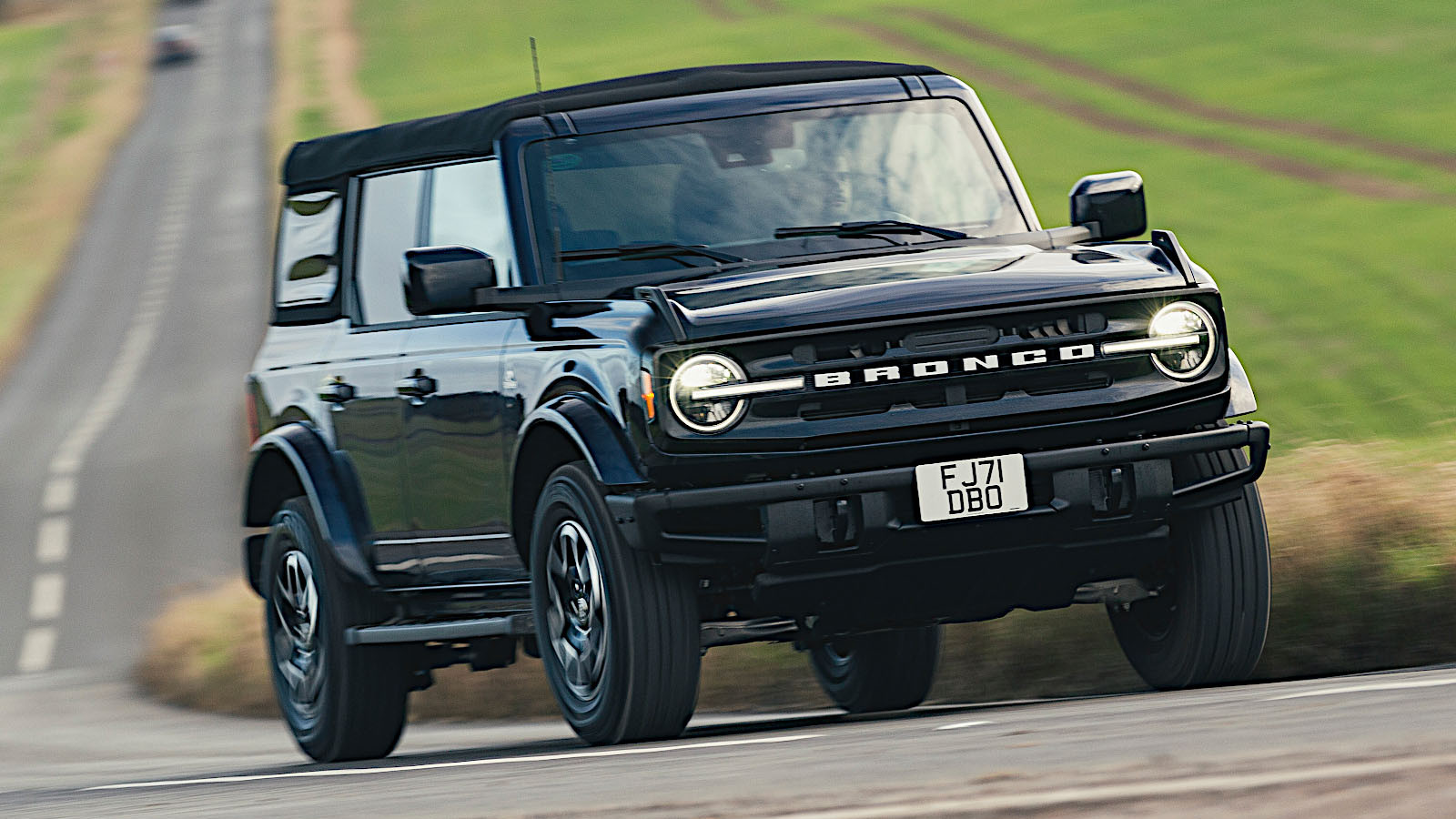
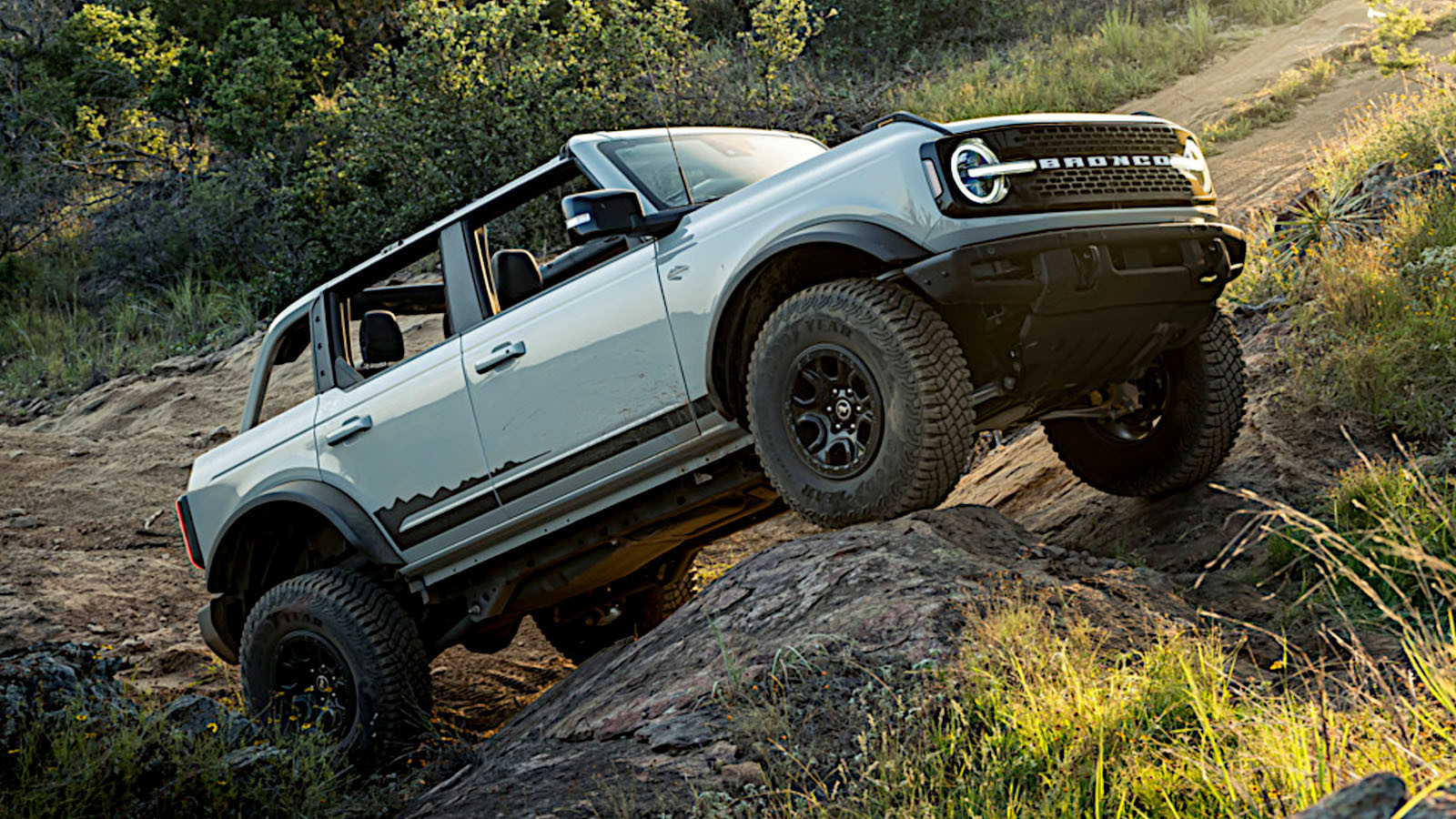
The sixth-generation ‘real’ Ford Bronco’s launch was delayed because of issues relating to the COVID-19 pandemic, and finally took place in the summer of 2021.
More than the Bronco Sport, it had a slight visual connection with the first-generation Bronco thanks to its round headlights, though in a break from tradition it was available not only with the usual two passenger doors but also, if required (and as pictured here), four.
The standard engine, as fitted to the base, Big Bend, Black Diamond, Outer Banks and Badlands versions, was a 300bhp 2.3-litre EcoBoost with a seven-speed manual transmission, but optional on all of these, and standard on the Wildtrak, was a 330bhp, 2.7-litre, twin-turbocharged V6, which required a 10-speed automatic gearbox.
Ford Bronco modes
The G.O.A.T. mode menu was more complex in the Bronco than in the Bronco Sport, with each of the five trim levels being provided with its own set.
There could be anything from five to seven, and they always included Normal, Eco, Slippery and Sand, with Sport also available for the base, Big Bend and Outer Banks.
Sport was excluded, however, from the Badlands, which had more off-road-specific suspension including Bilstein position-sensitive shock absorbers, along with a locking front differential.
Sport returned further up the range in the Wildtrak, which had the same dampers and differential as those just mentioned, and had the Baja mode fitted to the Badlands, but not the Rock Crawl facility included with the Badlands or Outer Banks.
Ford Bronco Raptor
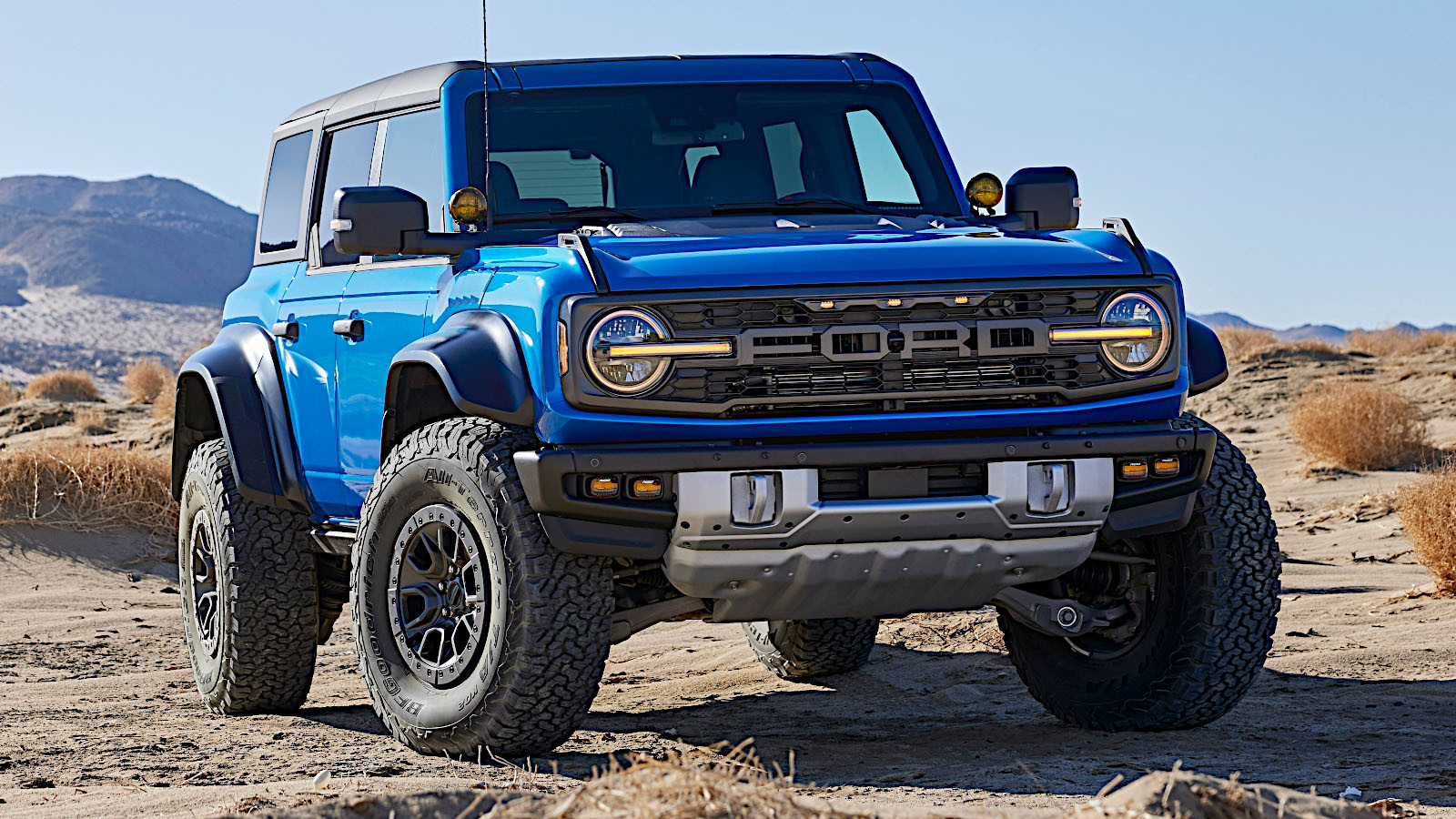
As of 2026, the model’s 60th-anniversary year, the highest-performance Ford Bronco so far made available to the public is the Raptor.
Introduced in 2022, it’s powered by yet another EcoBoost-branded engine, in this case a 3-litre V6 producing 418bhp and driving through the 10-speed automatic transmission also fitted either optionally or as standard on other Broncos.
In August 2024, Ford announced a performance upgrade for the engine which could retrospectively be applied to any Bronco Raptor.
As well as providing improved throttle response and what Ford called an ‘optimized shift schedule’, the upgrade raised the power output, while maximum torque increased from 440 to 536lb ft.
Heritage and Stroppe Editions
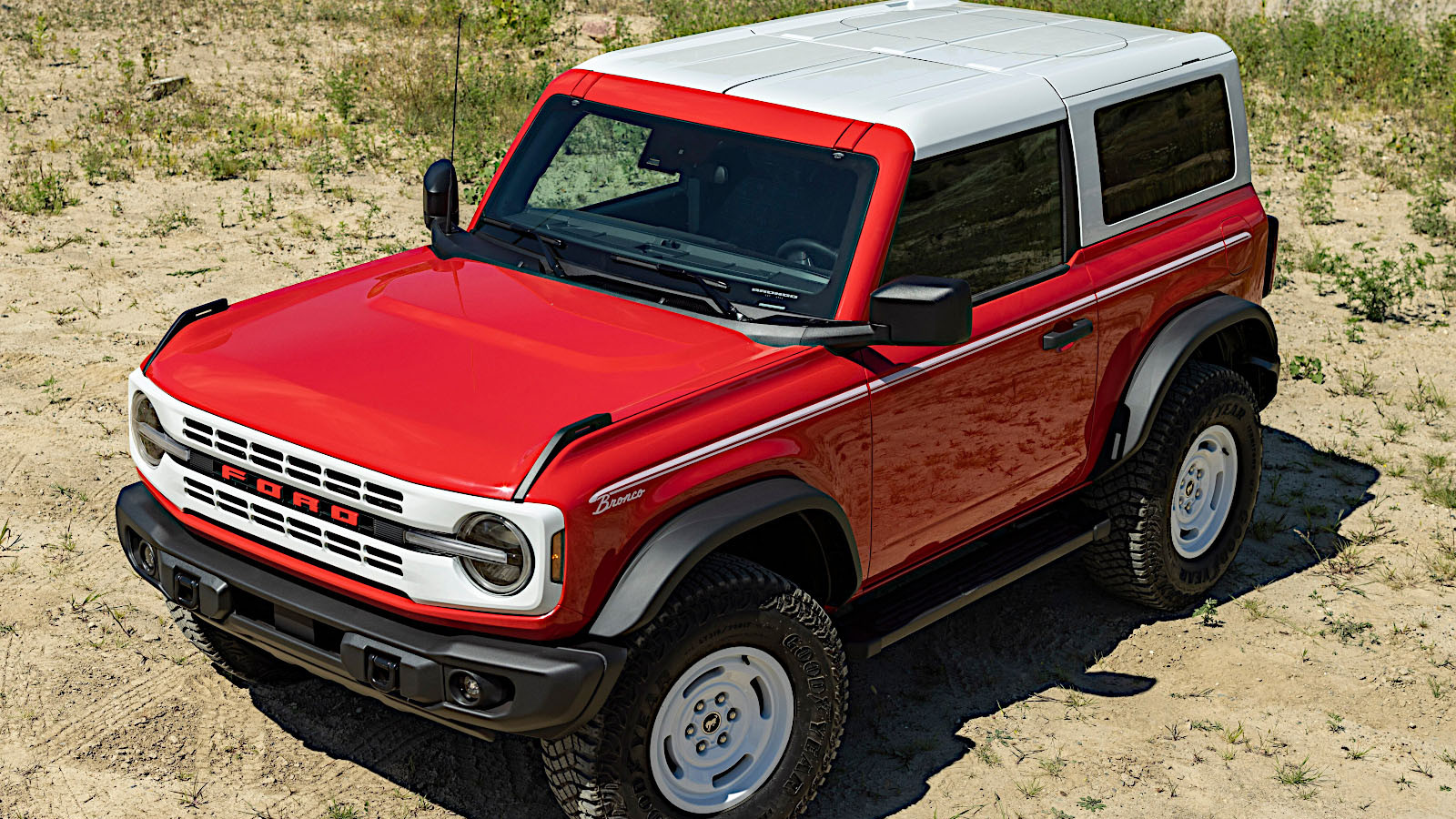
Heritage Editions of both Ford’s full-size Bronco (pictured) and the Bronco Sport were introduced in 2023.
Fully modern in all other respects, they were distinguished by their retro-style paint colours (Race Red here, though yellow and a very light pastel blue were also offered) and by their similarly old-fashioned wheel designs.
In 2025, the range was widened once again by the launch of the 2.7-litre, two-door Stroppe Edition, a name which will mean more to you the more you know about the history of American off-road racing.
Among other achievements, Bill Stroppe successfully converted very early Broncos for that form of motorsport, gaining valuable publicity for the vehicle. He was inducted into the Motorsports Hall of Fame in 2025.
Ford Bronco New Energy
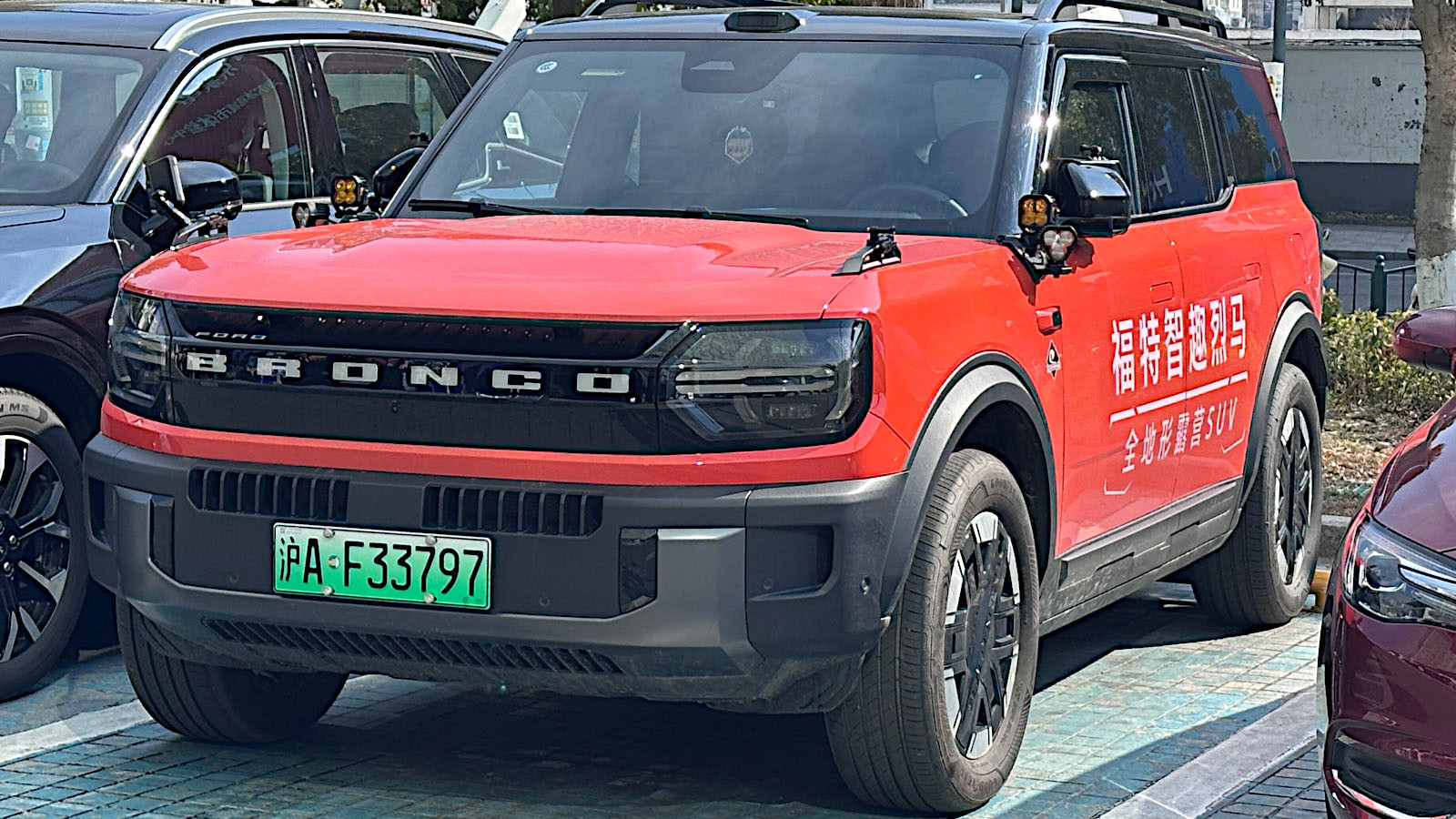
In the 21st century, it was almost inevitable that the subject of an all-electric Ford Bronco would come up sooner or later, and perhaps equally inevitable that such a vehicle would be built in China.
The Bronco New Energy, which brings the total number of Bronco models on sale to three for the first time, is a joint effort between Ford and its Chinese partner, Jiangling Motors, and is slightly larger than the regular Bronco.
Of the two available powertrains, both have electric motors, while one also has a 1.5-litre, petrol engine which serves as a range extender.
In January 2026, Ford CEO Jim Farley was quoted as saying that there were “currently no plans” for the New Energy to be imported to North America, though he added that electrified Broncos (both hybrid and range-extended) would be introduced at some point in the future.