MG Midget racer: small victories

| 2 Dec 2025
Classic & Sports Car – MG Midget racer: small victories

The MG Midget had the great fortune of being launched in 1961 – because that was the same year in which Stuart Turner joined the British Motor Corporation as competition manager.

The former professional rally navigator ushered in the car maker’s golden era of motorsport by focusing on the most competitive models in the conglomerate’s portfolio, and he resisted much of the politics that led to each marque competing for its own publicity.

At first that meant the Austin-Healey 3000 and Mini Cooper ‘S’, but Turner realised that he also had a potential small-capacity category winner in the new MG Midget.
Classic & Sports Car – MG Midget racer: small victories

The Abingdon competition department prepared this MG Midget for Stateside competition

The little MG did just that straight away, taking class honours in the 1961 RAC Rally and the following year’s Rallye Monte-Carlo, while the two streamlined fastback ‘Jacobs’ Midgets did similar in national and international GT races from 1962-’65.

That final year proved the most successful, with class wins at the Sebring 12 Hours and Nürburgring 1000km, and a close second in class on the Targa Florio in the hands of Paddy Hopkirk.
With those results, Turner realised he had the opportunity to win the 1300cc GT1-B class in the World Championship of Makes for MG if he could notch up a strong enough result at the Bridgehampton Double 500 in Suffolk County, New York, in July.

Classic & Sports Car – MG Midget racer: small victories

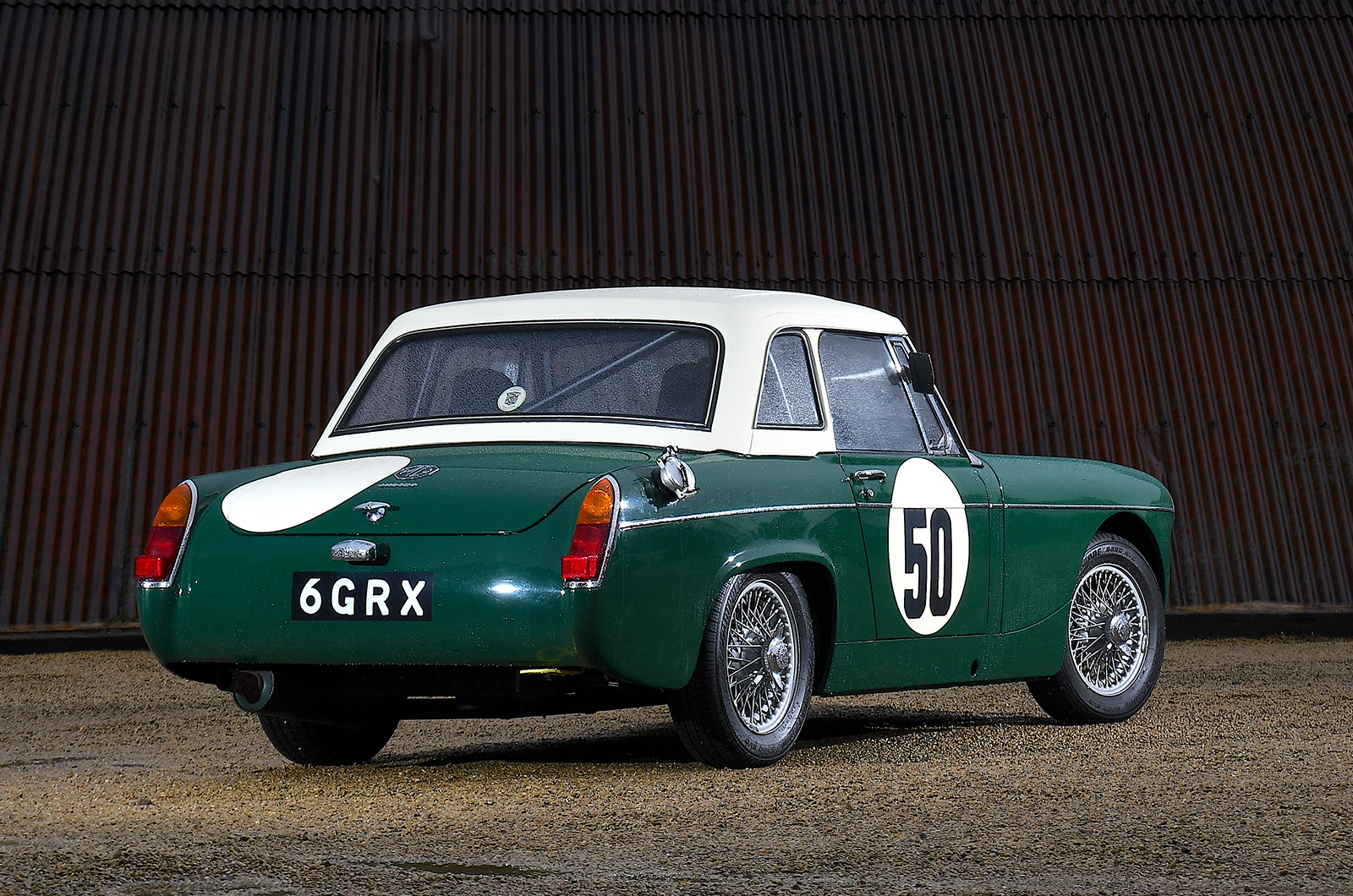
This ex-works MG Midget was raced with a white hardtop

Unlike at Sebring earlier in the year, however, MG didn’t have the budget to send the Jacobs cars.

Instead, BMC’s American distributor for the Midget stumped up the cash, looking to publicise the soon-to-launch 1275cc version.

It was a one-way ticket, though: Turner didn’t want to lose the Jacobs fastbacks, and the Bridgehampton cars needed to look standard for maximum publicity value anyway, so a new pair of racers was required.

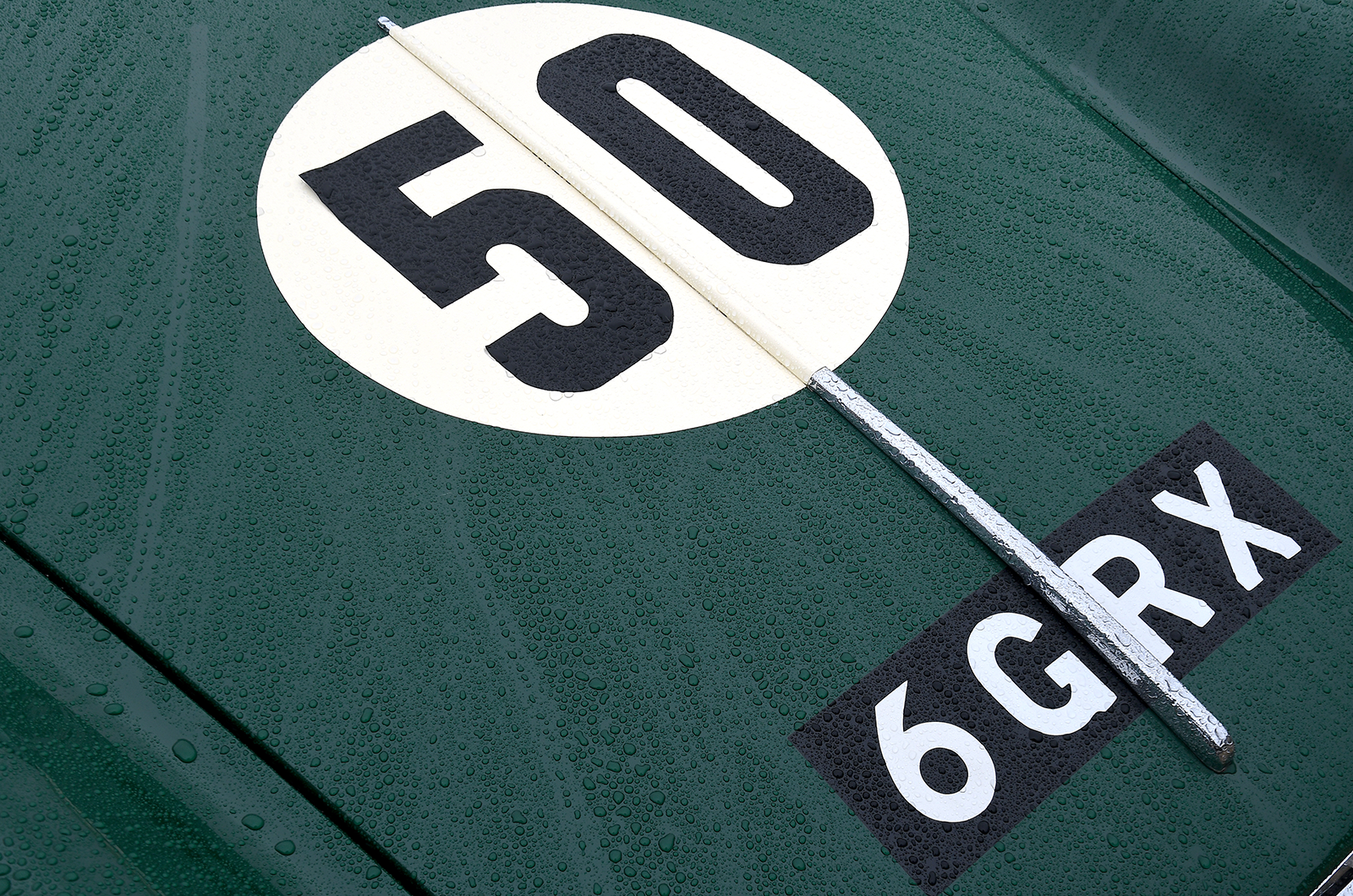
That’s where 6 GRX enters the fray.

It was one of two cars hooked straight off the production line in May 1965 and quickly set upon by the Abingdon competition department.

Classic & Sports Car – MG Midget racer: small victories

‘Flying Finns’ Rauno Aaltonen and Timo Mäkinen raced for MG in the 1965 Bridgehampton Double 500 – Aaltonen finished first in class in 6 GRX

The goal was to save weight without changing the styling, so lightweight aluminium bonnets, bootlids, doors and front wings were hand-fabricated for the two cars.

Attaching the new front wings was done crudely: the steel outer panels were simply cut away and aluminium replacements pop-riveted on to what was left.

Load-bearing bodywork, such as the scuttle and sills, remained in factory steel, as did the rear wings.

Just these two Midgets are known to have been partially bodied by the works department in this way.

It worked, and the Midget was rapid.

If it weren’t for the bonnet straps, racing fuel filler and deleted bumpers, only the roundels would tell it apart from any other Midget – until you lift the bonnet.

Classic & Sports Car – MG Midget racer: small victories

The MG Midget’s racing fuel-filler cap hints at 6 GRX’s competition roots

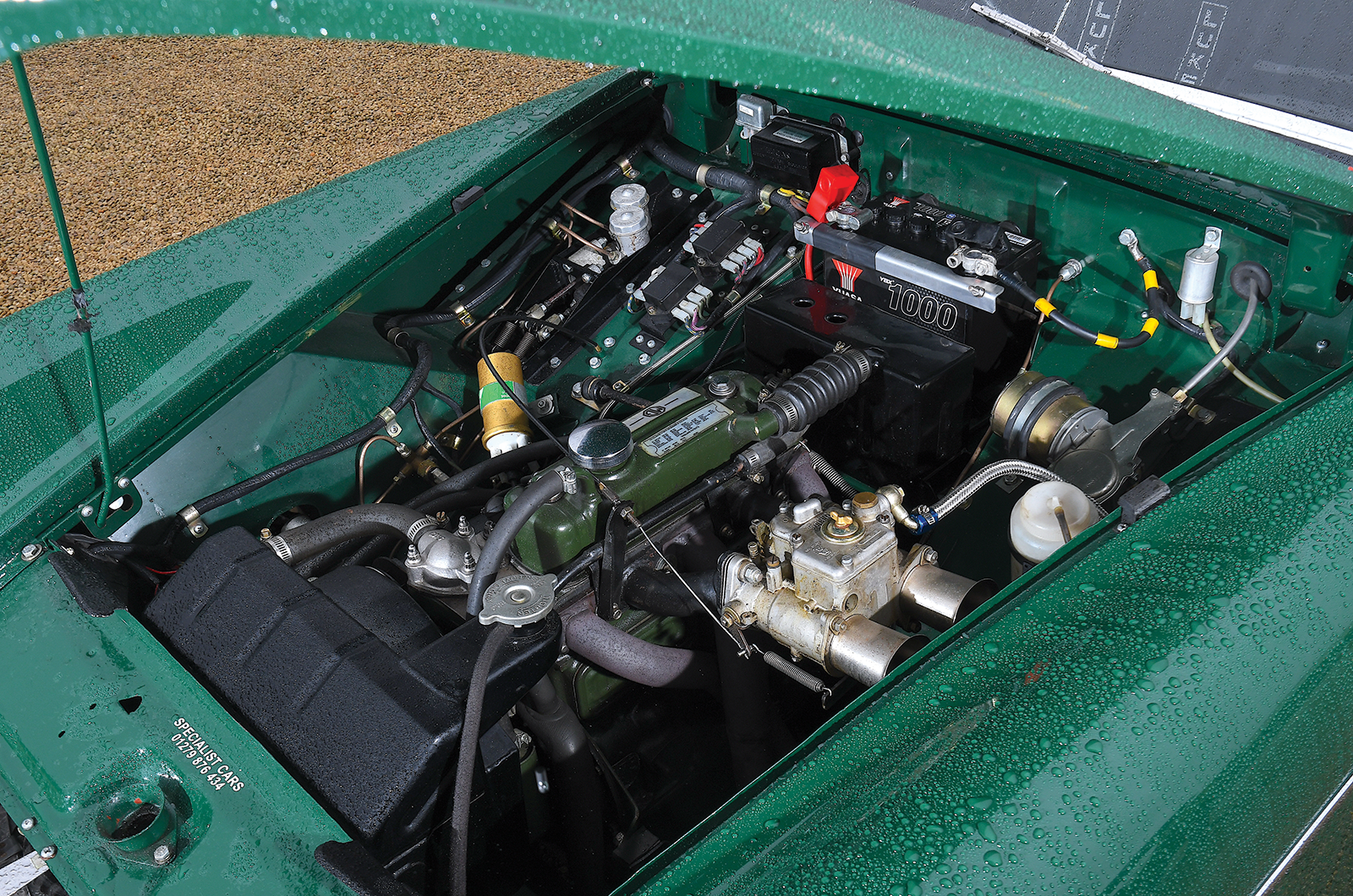
Abingdon had been fitting Midgets with the 1275cc Mini Cooper ‘S’ engine (always bored out to 1293cc) as soon as the model was homologated in 1964, long before the public could order the MG with this unit from dealers.

A twin-choke Weber dominates the engine bay, almost as wide as the engine itself if you include its two trumpets.

In period, power would have been around 100bhp, fed by a double-sized fuel tank fixed in the boot.

Today, the Swiftune-rebuilt A-series is producing an undisclosed – but undoubtedly even higher – power figure.

Its aggressive cam gives a lumpy idle that requires the occasional stab of throttle to clear the engine’s throat if it sits idle for any length of time.

The clutch is similarly bellicose: binary and heavily sprung.

Classic & Sports Car – MG Midget racer: small victories

The MG Midget racer’s 1275cc lump is bored to 1293cc and fed by a huge twin-choke Weber carburettor

There’s no creeping out of junctions in this car; instead, the torque quickly grabs the rear wheels, forcing a chirrup of tyres on anything but a wet surface.

Gear whine soon fills the cabin thanks to an absence of insulation, while the short ratios have the revs rising insatiably.

You’ve got to get above 3000rpm to move the car properly with this peaky ‘four’.

Once where the engine wants to be, however, the throttle response is punchy up to the 8000rpm redline.

At around 600kg (with more than 100kg shaved from a standard Midget) and extra power on tap, this works MG bursts forward with prods of the accelerator.

First and second are dispatched so quickly that your gearchanging ability is the only limiting factor in a 0-60mph sprint.

Classic & Sports Car – MG Midget racer: small victories

‘The MG is as chuckable and unintimidating as a car can be while you’re sharing the cabin with a screaming gearbox’

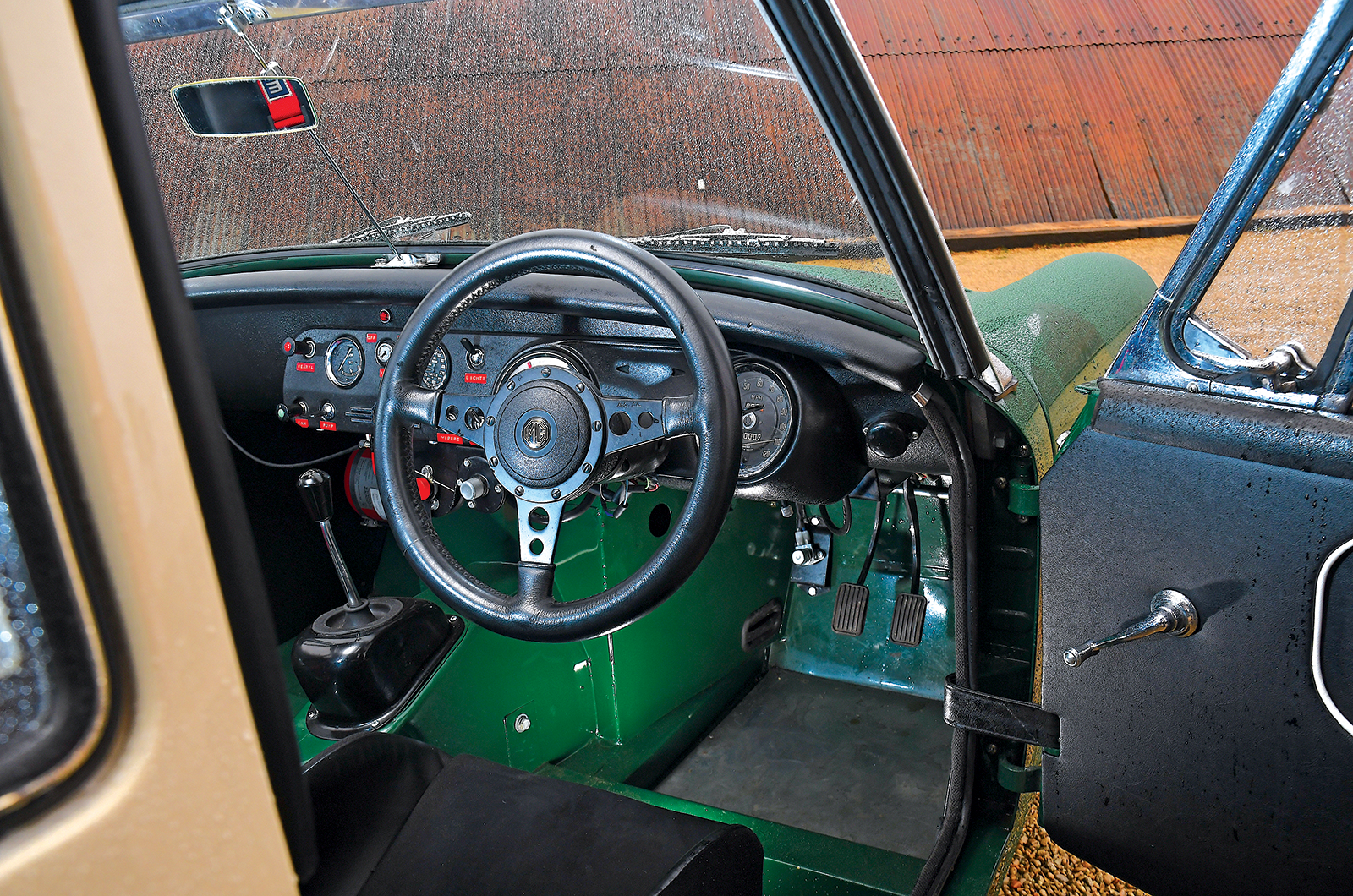
Inside, the little Midget’s high scuttle and window line are accentuated by the low bucket seats, making for a rather dark cockpit when sealed by the hardtop with which it raced.

Many drivers find themselves scraping the roof and staring directly at the top of the windscreen in a standard car, but not so this one.

The dashboard is painted black and Dymo labelled, but it’s the carpetless floors, with rubber only in the driver’s footwell and painted metal everywhere else, that make it feel most unfamiliar.

The gearshift lays bare the MG’s Austin-Healey ancestry with that bulbous, black housing – always covered by a gaiter in the Midget but exposed in the old ‘Frogeye’.

Classic & Sports Car – MG Midget racer: small victories

The ex-works MG Midget’s painted-metal cabin amplifies the raucousness

This one retains the model’s trademark friendly handling, though.

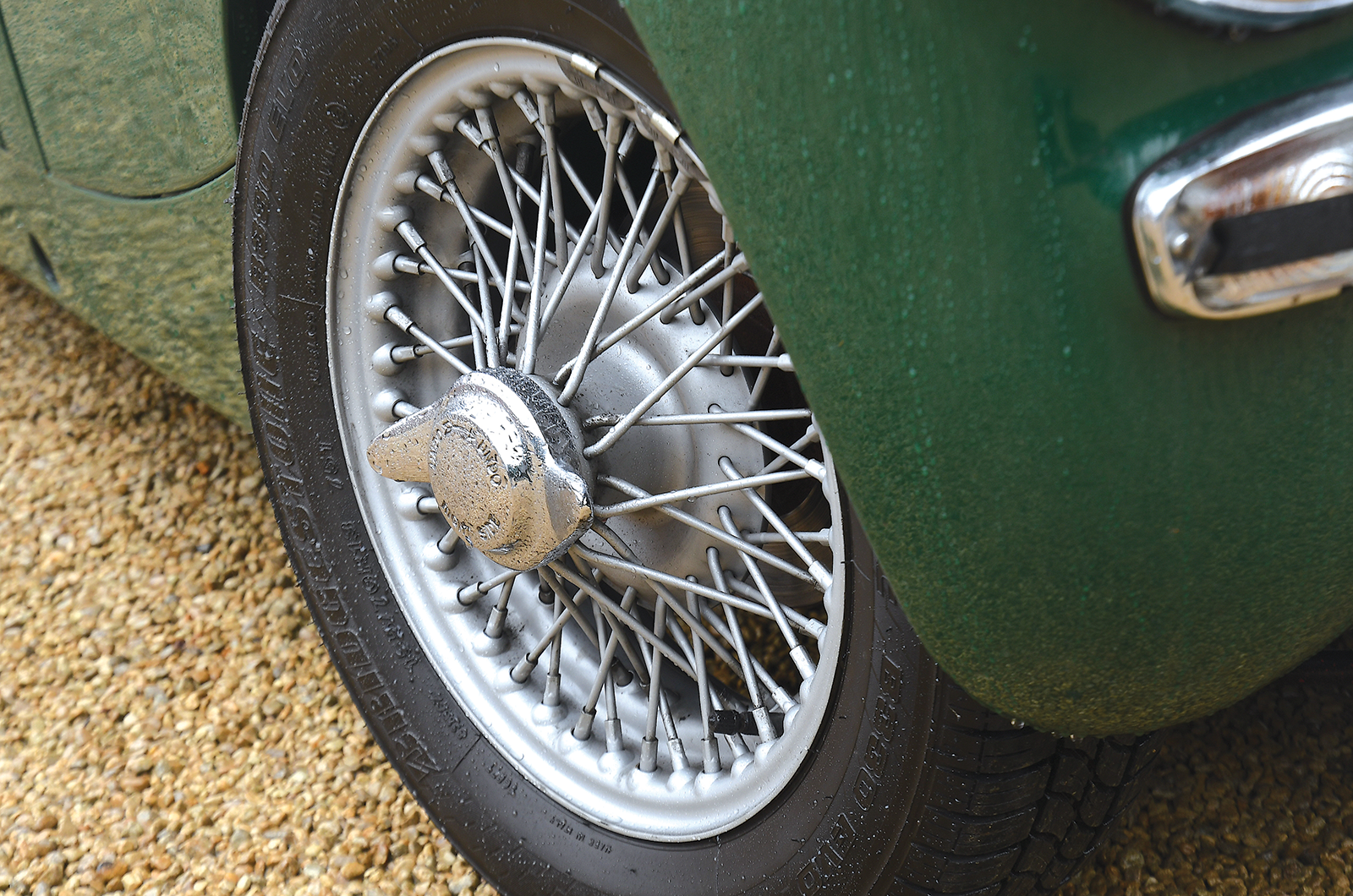
It raced on 5in-wide wheels, hence the slightly rolled rear arches, but today it’s back on standard 13 x 4.5in rims, which keep the steering reasonably light and the car feeling agile.

The works department tweaked the suspension, but it isn’t clear exactly how.

I suspect shorter, firmer springs, to stop the car riding too high with the weight loss, because it does feel rough over poor surfaces.

The unpadded seats and the lack of sound-deadening material might be making the ride seem worse than it is, however.

Nonetheless, the Midget feels as chuckable and unintimidating as a car can be while you’re sharing the cabin with a screaming gearbox.

Classic & Sports Car – MG Midget racer: small victories

The MG Midget raced on 5in-wide wheels, but now it wears 4½in items

You’ve got to grab the Moto-Lita wheel tightly not to be thrown off course on bumpy back-roads, but the MG offers decent grip, aided by a super-low centre of gravity, and corners in a controlled, neutral manner.

Short overhangs and a tiny wheelbase allow the Midget to react quickly to steering inputs, and it stops urgently – perhaps a bit too strongly, because it’s very easy to lock the wheels on wet Tarmac.

Rainy conditions make things a bit more lively, of course.

The rear wheels will spin when setting off if you lean hard on the throttle, but even as the windscreen fogs up and the wipers do only half a job of clearing away the rain, it isn’t scary.

It isn’t difficult to modulate the accelerator, thanks to a long-travel pedal, and it is a neutral handler.

Classic & Sports Car – MG Midget racer: small victories

The MG Midget racer’s workmanlike dashboard labelling

At Bridgehampton the MG Midgets were fitted with Detroit Locker differentials that provide greater straight-line traction by locking up under power, but it takes skill to avoid a slide from a poorly timed lift of the right foot.

Thankfully, the car is back on a standard differential today – the way its rear axle skips over poor surfaces could be ruinous if it still had the locking diff fitted.

On the smooth Tarmac of Bridgehampton that wasn’t an issue, of course – even less so because Turner called on the other innovation from his time as competition manager for the Stateside race: ‘Flying Finns’ Rauno Aaltonen and Timo Mäkinen.

Classic & Sports Car – MG Midget racer: small victories

Finnish rally ace Rauno Aaltonen on his way to class victory at Bridgehampton. He was supposed to share with a US teammate, but drove the whole race himself © Saunders Archive

Both the MG Midgets entered did well.

Aaltonen was a particular fan of the undulating hills of the Bridgehampton race track, which was unlike most of the pancake-flat American circuits – something that probably gave the two rally-driving Scandinavians an advantage.

The plan was for them to share their Midgets with an American co-driver each, but both completed all 110 laps and 500km themselves, leaving some to suggest that they thought the local drivers were too slow.

Mäkinen led the class for most of the race but was forced to pit with an engine issue, gifting Aaltonen and 6 GRX first in class and sixth overall – ahead of Porsche 904 GTSs, Lotus 23Bs and Lotus Elan 26Rs from the more powerful classes.

Classic & Sports Car – MG Midget racer: small victories

Rauno Aaltonen finished sixth overall at Bridgehampton, this MG’s first and last major works event © Saunders Archive

Paddy Hopkirk recorded an impressive fourth in the MGB also in attendance, but with Mäkinen in the second Midget dropping back, it wasn’t enough to wrest the championship title from Abarth.

It was these two lightweights’ only racing outing for BMC, and the last major works event for the Midget.

The MGs didn’t follow their drivers aboard the flight back to Europe, but stayed Stateside for some publicity work before the Aaltonen car was sold to former Shelby American driver Ray Cuomo.

He had seen the car at Bridgehampton, having taken sixth in the other event of the weekend in an AC Cobra (the second race that made up the Double 500).

He drove with it at the ’65 Nassau Speed Week in The Bahamas and on into the early 1970s at Daytona and Sebring, after which its trail goes cold.

Classic & Sports Car – MG Midget racer: small victories

The MG Midget is agile and neutral, but it can feel lively in the wet

Only a registration in California in 1979 gives any clue about what the car was up to: presumably it became someone’s weekend toy, but it also spent many years in storage before coming up for sale with a West Coast dealer in 2000.

It was brought back to the UK that same year, and while it was surrounded by rumours of period competition history, mentions of Sebring obscured its identity as a works Bridgehampton Midget.

MG collector Dave Saunders was one of the few who had an inkling of what it was, so he bought the car in 2003 and set about a restoration.

Many of the old Abingdon team members were still alive and verified 6 GRX’s identity upon Saunders’ invitation, and the Californian climate had been typically kind to it.

Classic & Sports Car – MG Midget racer: small victories

‘First and second are dispatched so quickly that your gearchanging ability is the only limiting factor in a 0-60mph sprint’

Stan Chalmers, who had wired the car in 1965, recognised his own handiwork in the loom and built an exact replacement for it, while Den Green identified the seat as one originally moulded to Finn Rauno Aaltonen’s torso.

The MG Midget still had its original rollcage, too, notably thicker than was normal for Abingdon competition cars, in order to satisfy the more strict American scrutineers.

The restoration revealed three layers of paint reflecting the sports car’s history: the worn red from its time on the road and in storage; Ray Cuomo’s Shelby-inspired blue; and the original British Racing Green.

Classic & Sports Car – MG Midget racer: small victories

Since restoration, 6 GRX has enjoyed a resurgent competition career

Only the floor and bottom corners of the steel rear wings needed major repair, and, perhaps surprisingly, even the original works brake calipers had survived.

Saunders replaced the Midget’s combined brake/clutch master cylinder with separate systems, mindful that the early set-up was prone to boiling its fluid.

The MG’s engine was rebuilt by Swiftune in Kent, and Saunders embarked on the Midget’s second racing career.

Countless meets in the Masters Historic Racing series took this little MG across the UK and Europe, including a fantastic first-in-class finish at Circuit Paul Ricard in France, in 2008.

Classic & Sports Car – MG Midget racer: small victories

The competition modifications to this MG Midget are more than just skin deep

Mäkinen’s car remains missing, making this the only extant example of a works Midget that, beyond the circles of the MG Car Club where Saunders was well known, has long flown under the radar.

Had its exploits been in an event better known to UK enthusiasts, a Rallye Monte-Carlo perhaps, this class-winning works car might have been more famous.

Thankfully, due to the outstanding luck that had preserved it so well, it found its way back to those who recognised it.

Having enjoyed only a single works outing, 6 GRX is back in rude health and making up for lost time in its roaring, gear-whining, fuel-gargling retirement.

Images: John Bradshaw

Thanks to: The Classic Motor Hub


We hope you enjoyed reading. Please click the ‘Follow’ button for more super stories from Classic & Sports Car.