
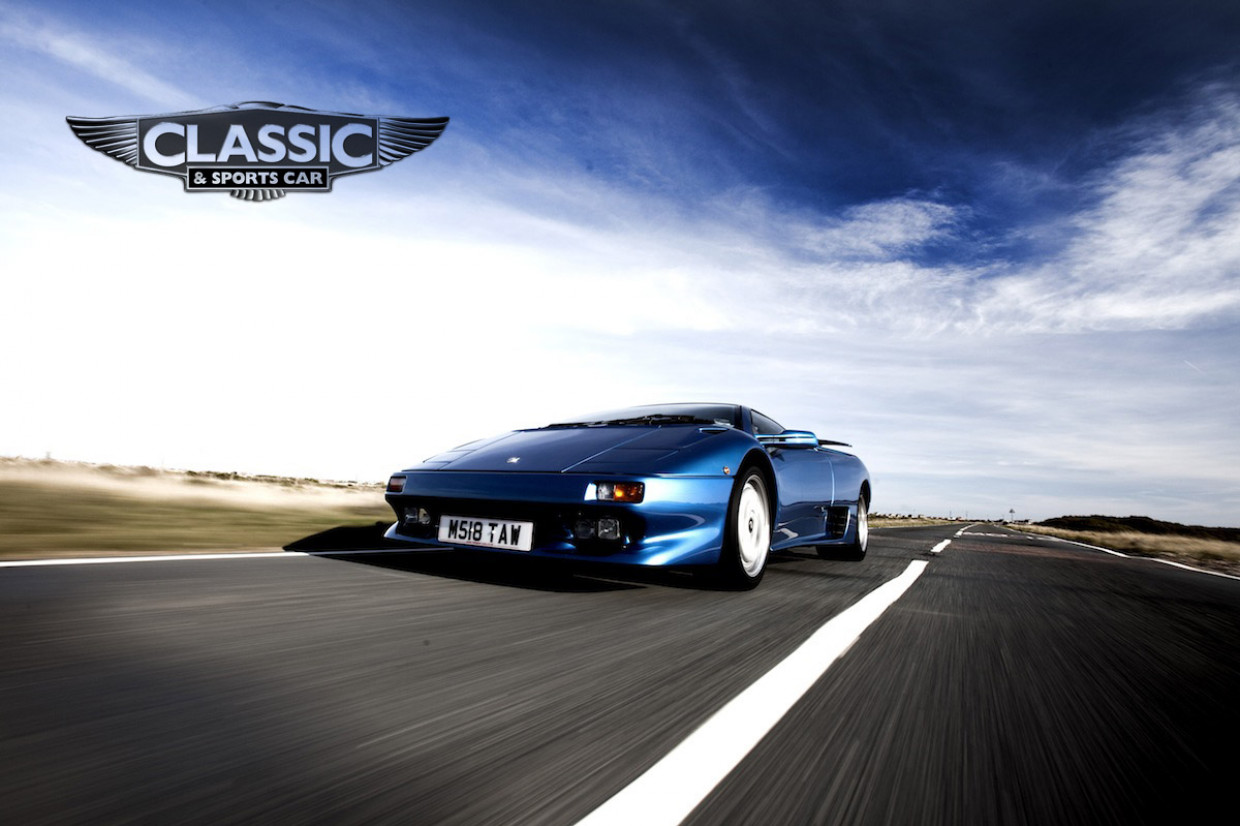
How do you reinvent a legend? That was the near-impossible question asked of Sant’Agata staff as Countach production entered its second decade in 1984. The shockwave Ferruccio’s second supercar had sent through the automotive world was still resonating, despite the fact that Lamborghini’s compatriots over at Maranello had already created machines to trump it in the form of the Testarossa and the epic 288GTO.
By 1990 the answer was ready, and the gloriously un-PC Diablo roared out in a blaze of bhp and 200mph bluster. This was to be the last full-fat Lamborghini, unfettered by practicality considerations or nannying electronics. Yet two decades on it hangs in a strange period of stasis, hiding behind the twin shadows of the Countach and the mighty Murciélago, the first fruit of Audi’s takeover of Lamborghini in 1998.

Let’s get back to the design brief for tipo 132. Task one, give it a silly name that sounds exotic, dramatic and a bit naughty – check: diablo (Spanish for the Prince of Darkness and, in Lambo tradition, purloined from a fighting bull) conjures just the right combination of power and insanity. Task two, comply with emissions and safety legislation to make the Diablo a ‘world car’ – a Lambo first. A composite-reinforced square-tube steel chassis (weighing just 66lb) and a design that paid attention to the latest Federal regs took care of safety, while the V12’s reputation as a rolling smog-factory was reduced by the addition of a three-way catalytic converter and a new Weber-Marelli injection system replacing the Countach’s sextet of gurgling carbs. The engine was an evolution of the out-going car’s proven quattrovalvole (four valves per cylinder) unit, packing a capacity boost from 5.2 to 5.7 litres to raise power from 455 to 492bhp. That was plenty to whip daddy’s performance figures, despite a 361lb weight disadvantage.


 With 428lb ft of peak torque thundering in at 5200rpm, the engine does need revs to give its best and a fast standing start is a clutch-burning, leg-aching chore. But roll it off the line, let the needle pass 3000rpm and within seconds the horizon is behind you. Use all 7000rpm and second will take you to 98mph, third to 136. And it seems appropriate to make a point of those pauses. While most transmissions provide subtle punctuation to the prose of acceleration, dipping the heavy clutch and manhandling the Diablo’s obstinate five-speeder adds a full stop and a paragraph break between each outrageous surge. But the story it tells in between is so compelling, so utterly absorbing that you can’t help but read on as numbers that ought to terrify tumble beneath the needle’s inexorable climb. Well into three figures, the car feels barely stressed and Lamborghini’s 202mph claims start to look realistic. Hell, they are: Autocar’s David Vivian and performance driving instructor John Lyon managed a genuine 201.4mph in a stock rear-drive Diablo just like this – albeit without the drag-inducing rear wing – on the unrestricted A31 autobahn near Essen in 1993.

