Numerous hot versions of the Fiat 850 Coupé – based around the original power unit – were created, including the OT, OTS (a slightly hotter 68bhp OT), OTR (with radial cylinder head and 74bhp) and OTSS (a homologated OTS racer).
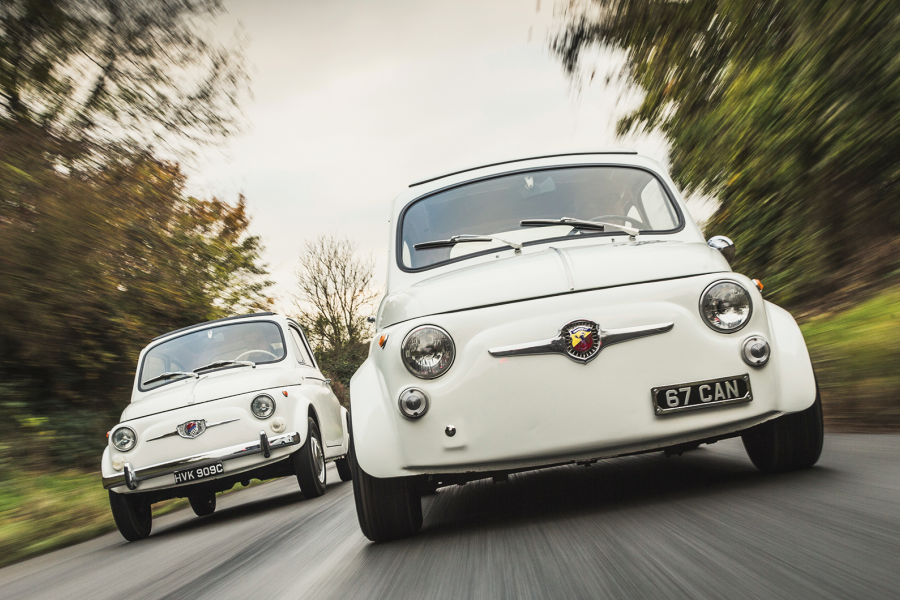
The featured car is a Fiat-Abarth OT 1000. Coming from the 595SS and 750GT Zagato, this feels like a relatively grown-up machine.
The cabin is positively spacious in comparison and you sit high, with an excellent view of the road.
It is similar in appearance to the stock Fiat 850 Coupé and sports a clean, distinctive design, instantly recognisable by its lack of a radiator grille.
Campagnolo alloys and that Abarth favourite, the chequerboard roof, complement it.
The Fiat-Abarth OT 1000 has a relatively spacious cabin
The 850 block is fitted with a longer-stroke steel crankshaft that yields 982cc and a power output of 62bhp.
Nail the throttle and it starts to sing beautifully: there’s a throaty roar from the sports exhausts, joined by an enjoyable snarl from the Weber DIC carburettor.
The gearbox has a satisfyingly mechanical shift and ensures that changes are accomplished seamlessly.
On paper, at least, it will climb heartily to 155kph (96mph).
The Fiat-Abarth OT 1000’s 62bhp 982cc ‘four’
In period, Abarth models were all about the headline figures: cubic capacity, bhp, torque, weight and top speed.
Combined with record-breaking, these are the numbers that sold the cars.
All products therefore remained in a constant state of development, none more so than the exceptional OTs.
Further models included the Fiat-Abarth OT 2000 Coupé – a 2-litre, 185bhp screamer capable of 240kph (150mph) – and a 124-engined OT 1300.
These were to be the last complete Abarth-modified models to carry the Fiat badge as Carlo instead focused once again on custom cars and his own engines, until his firm’s incorporation into the Turin giant.
Fiat 124 Abarth Stradale
The Fiat 124 looks aggressive in Abarth Stradale form
Fiat immediately put the company to work, and the 124 Abarth Rally, unveiled in October 1972, was the first car to be produced as a result of the union.
Its construction signalled the initial phase of Fiat’s all-out effort to win the World Rally Championship.
Only 1013 examples were produced, in both roadgoing Stradale and competition Corsa forms.
At first glance, the 124 appears much smaller than its standard Spider sibling.
The Fiat 124 Abarth Stradale’s four-cylinder engine is an all-alloy, twin-cam unit
In reality, the dimensions haven’t changed. All that it has lost are its chrome bumpers, replaced here by rubber overriders.
This, combined with the extra air intakes, liberates designer Tom Tjaarda’s underlying bodywork and accentuates the car’s perfetto lines.
Inside, the centre console and wooden dashboard have been discarded (with aluminium panels in place of the latter), as have the rear seats and any suggestion of sound deadening.
A glassfibre hardtop has been fitted instead of the fabric soft-top, with a wide plastic window affording an excellent field of vision.
The Fiat 124 Abarth Stradale’s cabin has no creature comforts
Aluminium door skins, sills and rear quarter panels, a glassfibre boot and bonnet, and lightweight magnesium alloys add up to a substantial 200kg weight saving.
The twin-cam engine is relatively standard, other than being blueprinted and having an improved manifold and a pair of 44IDF Webers.
The Fiat 124 Abarth Stradale is good for 128bhp, although an Abarth Corse racing kit took that up to 170bhp.
The power delivery is smooth and the engine thrives on revs, hurtling its way towards the redline in every gear.
‘The rear seats have been discarded, as has any suggestion of sound deadening’
Designed by ex-Ferrari man Aurelio Lampredi, it was produced in numerous forms for 45 years, serving a huge number of marques and models.
The bodyshell is largely seam-welded rather than spot-welded, and the addition of a roll-over bar enhances the structural integrity.
The handling is superb thanks to independent rear suspension – a variation on a MacPherson-strut system – that really inspires confidence and enables the car to be thrown into corners.
Also, the resulting decrease in unsprung weight over the standard car means added traction.
Aluminium replaces wood on the Fiat 124 Abarth Stradale’s dashboard
On the limit, however, it does demonstrate a certain lack of poise, and it has a tendency to lift a wheel under really hard cornering.
The works competition cars achieved three victories at World Rally Championship level, but could only manage second place overall in the 1973 standings behind the A110 Berlinettes of Alpine-Renault.
By 1976, it would be the turn of the Fiat 131 Abarth to take up the WRC fight.
Fiat 131 Abarth Stradale
The Fiat 131 Abarth Stradale brought rally success
Fiat’s purchase of Lancia put paid to the latter’s phenomenal Stratos rally car.
While undeniably attractive to everyday people, expensive exotica might just as well have existed on a different planet.
What the company craved was a rally winner based on a mass-market model.
Abarth’s Corso Marche factory ditched its 2-litre Fiat X1/9 concept and transferred its attentions to the traditional front-engined/rear-drive set-up of the 131 Mirafiori.
The Fiat 131 Abarth Stradale’s relatively sober interior
Production took place at Carrozerria Bertone, lasting just a year and with 406 built.
The finished article cost three times the price of a standard car.
The two-door bodies were modified, painted and trimmed at Bertone’s Grugliasco plant, and tipped the scales at a healthy 980kg. Sitting here on the asphalt, the result is brutal.
If the 124 provides a visual link to the preceding decades, the 131 is definitively of its time in profile.
The Fiat 131 Abarth Stradale makes do with a single carburettor on its Fiat 124-based engine
Those massive wheelarches, and the various intakes, scoops and spoilers, lend a purposeful air.
On the move, this is heightened by the 131’s ‘rear-down’ stance.
The twin-cam engine is an evolution of the final 16-valve 124 unit, but Abarth took the strange decision to strangle it with a single Weber 34ADF carburettor.
While it is similarly rev-happy, the torque available isn’t as forceful, but the 138bhp that it produces is enough to dispatch the 0-60mph sprint in 8.2 secs, and the gearbox is a bulletproof joy.
The Fiat 131 Abarth Stradale’s extreme bodywork consists of wings, vents and flared wheelarches
The suspension is a development of the Fiat 124 Abarth’s fully independent set-up, but the weight distribution feels much improved.
“It is a wonderfully balanced car,” confirms Tony.
When pressed hard, the 131 remains firmly planted, communicating every nuance through the rack-and-pinion steering.
“It’s great fun to drive, all powerslides and opposite lock,” Tony adds. “They proved an excellent match for the equally sideways Ford Escorts.”
Extra gauges in the Fiat 131 Abarth Stradale’s cabin, alongside the famous scorpion badge
Out in the rally world, the Group 4 machines – with Kugelfischer fuel injection and up to 230bhp – immediately excelled, initially on Tarmac with its premium on handling, and then on other surfaces.
In 1976 the Fiat 131 Abarth Stradale took victory on the Elba Island Rally and Finland’s 1000 Lakes, but this was simply the prelude to three WRC titles in 1977, ’78 and ’80.
Fiat Strada Abarth 130TC
The Fiat Strada Abarth 130TC makes a great hot hatch
When Fiat finally joined the Volkswagen-dominated hot-hatchback party in 1981, it deliberately chose the Frankfurt motor show for the release of the European market-only Ritmo Abarth 125TC, and the newcomer’s surprisingly forceful character ensured that it received a rapturous response.
A Fiat 128 floorpan provided the basis, and the standard car’s use of plastic for the bumpers was carried over.
The body – designed for relatively gutless 1100cc and 1300cc units – required comparitively little reinforcement for the power generated by the 2-litre engine, which was lifted from the Fiat Argenta.
Corso Marche modified the Lampredi twin-cam by adding sportier valvegear, updated exhaust manifolds, an oil cooler, aluminium sump and a Goetz-type cylinder-head gasket to withstand heat stress, and mounted the whole powerplant transversely.
Snazzy Recaros in the Fiat Strada Abarth 130TC
Buyers had the option of two twin-choke Weber or Solex carburettors. This resulted in 125bhp and the 0-60mph sprint in 7.9 secs.
The 130TC Strada, launched in 1983 and available in the UK, got an extra 5bhp and shaved 0.2 secs from the acceleration time.
The British motoring press enthusiastically greeted the Fiat Strada Abarth 130TC, with Autocar stating: ‘There can be little argument that it is now the leader in terms of performance.’
Thanks to the updated aesthetics with its quad headlights, the 130TC is the most aggressive-looking of the Stradas.
The Fiat Strada Abarth 130TC’s engine is from the Fiat Argenta
“They’re very underrated,” says Tony, “with that powerful and torquey engine in a lightweight bodyshell, and delivered through an updated ZF gearbox and suspension.”
Out on the test track, it is easy to see why it impressed everybody so much in period.
The cabin specification is high, with aggressively supportive Recaro bucket seats, a clear and tidy dash binnacle, and a sports steering wheel.
‘Throttle response is instant, powering the little Fiat Strada Abarth 130TC forward with gusto’
With 130lb ft of torque at 3600rpm, throttle response is instant, powering the little Abarth forward with gusto.
It has that gratifyingly fruity Italian exhaust note and sharp handling responses that really give you the confidence to chuck it around, even on first acquaintance.
The only thing you’ll find difficult is sourcing one.
Like most Stradas, they began rusting at the mere thought of going outside.
If you do come across a good example, however, this Scorpion still packs one hell of a punch.
Classic Abarths: summary
Abarth established itself on road, stage and track
With every delicate curve one to be savoured, the Fiat-Abarth 750GT Zagato is the aesthete’s Abarth of choice, but period Mille Miglia success proves that it also has the performance to match its beguiling looks.
The Fiat 500-, 600-, and 850-based cars – represented here by the sublime 595SS, distinctive OT 1000 and the awe-inspiring Group 5 1000 Berlina Corsa – remain the embodiment of all that the Abarth name stands for: small, bold and perky.
The cars produced after the Fiat takeover are sometimes seen as being not quite ‘real’ Abarths – but they are still products of the company’s decades of experience in creating and modifying competition cars.
Abarth’s tiny tearaways are huge fun to drive
The 124 and 131 Stradales are exquisite homologation specials, and can bask in the reflective glow of the rally successes that eventually came Fiat’s way, while the Strada was a last hurrah for the Abarth name.
Launched into a fiercely competitive hot-hatch market, it still scared the sauerkraut out of the opposition.
“Basing competition cars on production models will always be a compromise in terms of ultimate development and performance,” says Tony.
But, as these cars go to show, what a sweet compromise that was.
Carlo Abarth: making of a marque
Abarth’s signature chequerboard roof
Company founder Karl Abarth was born in Vienna in 1909 and began his career in Italy, serving an apprenticeship with motorcycle maker Degan.
He raced ’bikes but was injured in a crash in 1939 and hospitalised in Yugoslavia.
He remained there during WW2, then returned to Italy and changed his name to Carlo.
After helping develop the Cisitalia 360 single-seater racing car, he set up his own company in 1949.
Images: Malcolm Griffiths
Thanks to: Tony Castle-Miller at Middle Barton Garage; Chris Greenhalgh; Simon Ryle; Antonio Cormano; Timothy Milnes
This was first in our June 2013 magazine; all information was correct at the date of original publication
Factfiles
Fiat-Abarth 750GT Zagato
- Sold/number built 1957-’60/n/a
- Engine iron-block, alloy-head, ohv 747cc ‘four’, Weber 32IMPE carburettor
- Max power 43bhp @ 5800rpm
- Max torque 40lb ft @ 4000rpm
- Transmission four-speed manual, RWD
- Suspension independent, at front by upper trailing arms, lower transverse leaf spring rear semi-trailing upper arms, coil springs; hydraulic dampers f/r
- Steering worm and sector
- Brakes drums
- Weight 1179lb (535kg)
- 0-60mph 17.3 secs
- Top speed 87mph
- Price new n/a
Fiat-Abarth 595SS
- Sold/number built 1963-’71/n/a
- Engine iron-block, alloy-head, side-camshaft, ohv 594cc twin, Solex 34 PBIC carburettor
- Max power 32bhp @ 4900rpm
- Max torque 32lb ft @ 3500rpm
- Transmission four-speed manual, RWD
- Suspension independent, at front by trailing arms, transverse leaf spring rear coil springs; hydraulic dampers f/r
- Steering worm and sector
- Brakes drums
- Weight 1036lb (470kg)
- 0-60mph 21 secs (est)
- Top speed 81mph
- Price new £371
Fiat-Abarth 1000 Berlina Corsa
- Sold/number built 1964-’70/n/a
- Engine iron-block, alloy-head, ohv 982cc ‘four’, twin Weber carburettors
- Max power 112bhp @ 8200rpm
- Max torque 65lb ft @ 5500rpm
- Transmission five-speed manual, RWD
- Suspension independent, at front by trailing arms, transverse leaf springs rear coil springs; hydraulic dampers f/r
- Steering worm and sector
- Brakes discs
- Weight 1285lb (583kg)
- 0-60mph n/a
- Top speed 125mph
- Price new n/a
Fiat-Abarth OT 1000
Where different from 1000 Berlina Corsa
- Sold/number built 1964-’71/n/a
- Engine twin-choke Weber carburettor
- Max power 62bhp @ 6150rpm
- Max torque 64lb ft @ 3500rpm
- Brakes discs front, drums rear
- Weight 1600lb (726kg)
- Top speed 97mph
Fiat 124 Abarth Stradale
- Sold/number built 1972-’76/1013
- Engine all-alloy, dohc 1756cc ‘four’, twin Weber 44IDF carburettors
- Max power 128bhp @ 6200rpm
- Max torque 117lb ft @ 5200rpm
- Transmission five-speed manual, RWD
- Suspension independent, by MacPherson struts, anti-roll bar f/r
- Steering worm and roller
- Brakes discs
- Weight 2068lb (938kg)
- 0-60mph 8.5 secs
- Top speed 120mph
- Price new £2250
Fiat 131 Abarth Stradale
- Sold/number built 1976/406
- Engine all-alloy, dohc 1995cc ‘four’, Weber 34ADF carburettor
- Max power 138bhp @ 6400rpm
- Max torque 133lb ft @ 3800rpm
- Transmission five-speed manual, RWD
- Suspension independent, by MacPherson struts, anti-roll bar f/r
- Steering rack and pinion
- Brakes discs
- Weight 2161lb (980kg)
- 0-60mph 8.2 secs
- Top speed 118mph
- Price new £9500
Strada Abarth 130TC
- Sold/number built 1984-’87/585
- Engine all-alloy, dohc 1995cc ‘four’, twin Weber or Solex carburettors
- Max power 130bhp @ 5900rpm
- Max torque 130lb ft @ 3600rpm
- Transmission five-speed ZF manual, FWD
- Suspension independent, at front by MacPherson struts, angled tie-rods, anti-roll bar rear transverse leaf spring, lower wishbones
- Steering rack and pinion
- Brakes discs front, drums rear
- Weight 2094lb (950kg)
- 0-60mph 7.7 secs
- Top speed 118mph
- Price new £7800
Enjoy more of the world’s best classic car content every month when you subscribe to C&SC – get our latest deals here
READ MORE
Fiat’s final champion: Fiat-Abarth 131 Stradale
Second time lucky: Fiat 124 Abarth restoration
20 weird and wonderful Fiat concept cars
Ross Alkureishi
Ross Alkureishi is a contributor to Classic & Sports Car