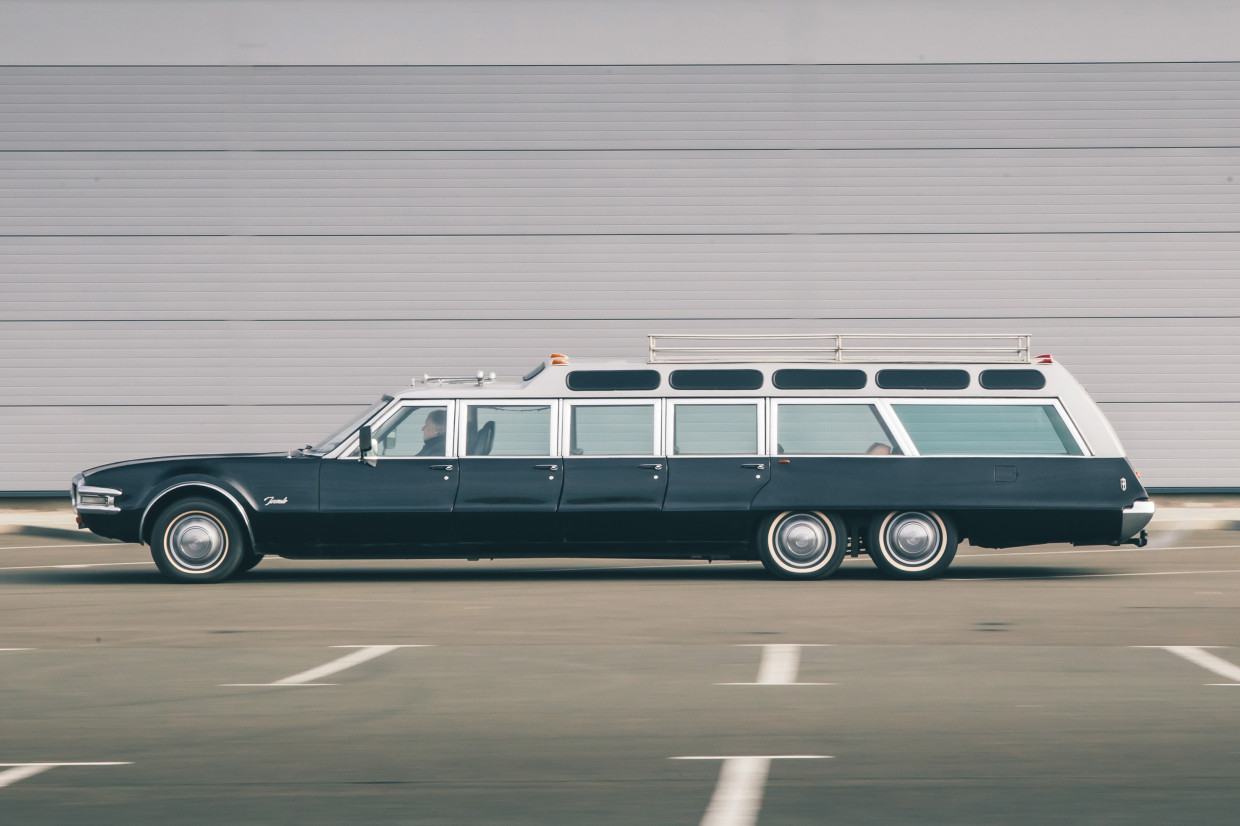
Let’s get the number-crunching out of the way first.
What takes 15 passengers via eight doors, has four rows of seats, runs on six wheels and, at a total length of 28ft (8.5m), is a good 5ft (1.5m) longer than most other road vehicles of its freakishly elongated ilk?
The answer, naturally, is an American Quality Coach (AQC) Jetway 707.
Based on a 1968 Oldsmobile Toronado, this is probably the most exotic airport or hotel taxi ever created and a machine that, in its prime, likely made for an exciting start to many an all-American family vacation.
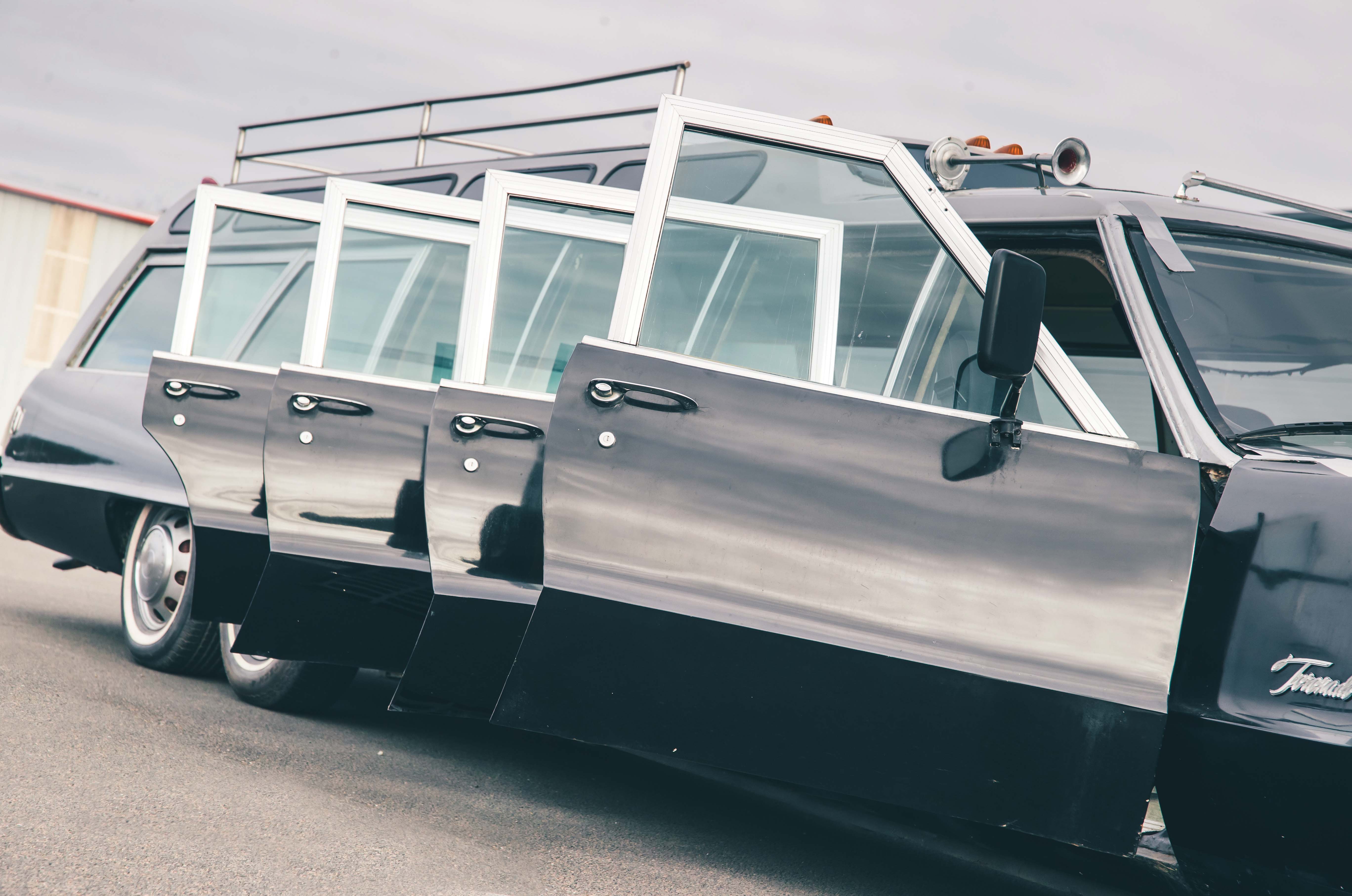
The AQC Jetway 707 boasts eight doors and up to five rows of seats
It’s certainly not the sort of thing you would expect to find waiting for you at Butlin’s in Skegness.
While we Brits were being herded on to buses and coaches, Americans were getting in the holiday mood with a ride in this low-slung, front-wheel-drive, 7.5-litre monster named after the most famous jet-engined passenger aircraft of the age, the Boeing 707 that entered service with Pan Am in 1958.
In fact, all 52 – or possibly as many as 100-150 (production records have been lost) – of the Jetway 707s produced between 1968 and 1970 were real, working vehicles of the American ‘professional car’ class, built to collect and dispatch paying punters between airports and hotels on a daily basis.
If you don’t believe me, the next time you watch All the President’s Men, hit the ‘pause’ button on your remote control 33 mins and 52 secs in and you can get a glimpse of a Jetway plying its trade on the early ’70s Washington streets, as it cruises past a phone booth occupied by Dustin Hoffman.
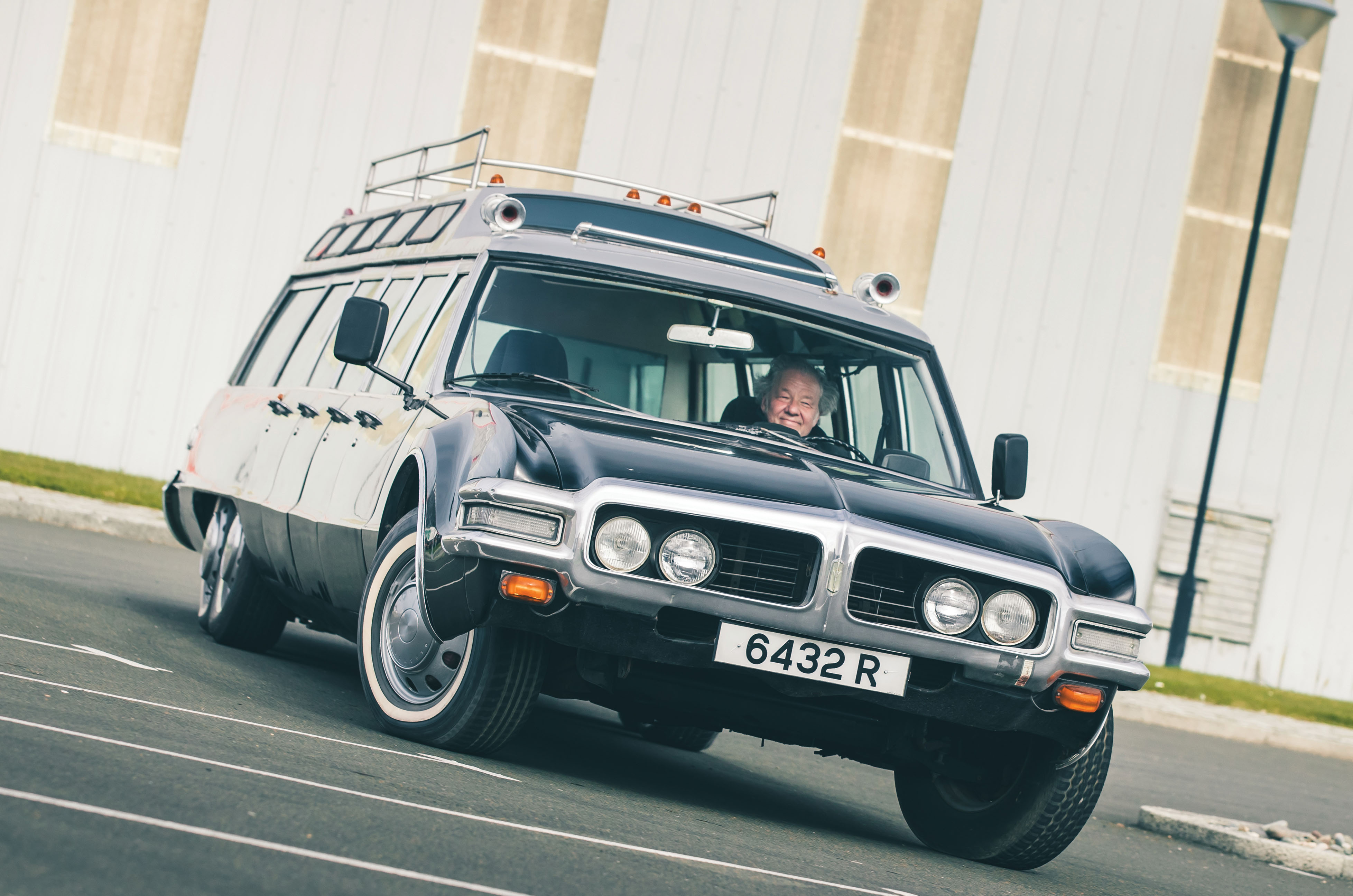
‘Our’ AQC Jetway 707 received air horns and a long roof-rack
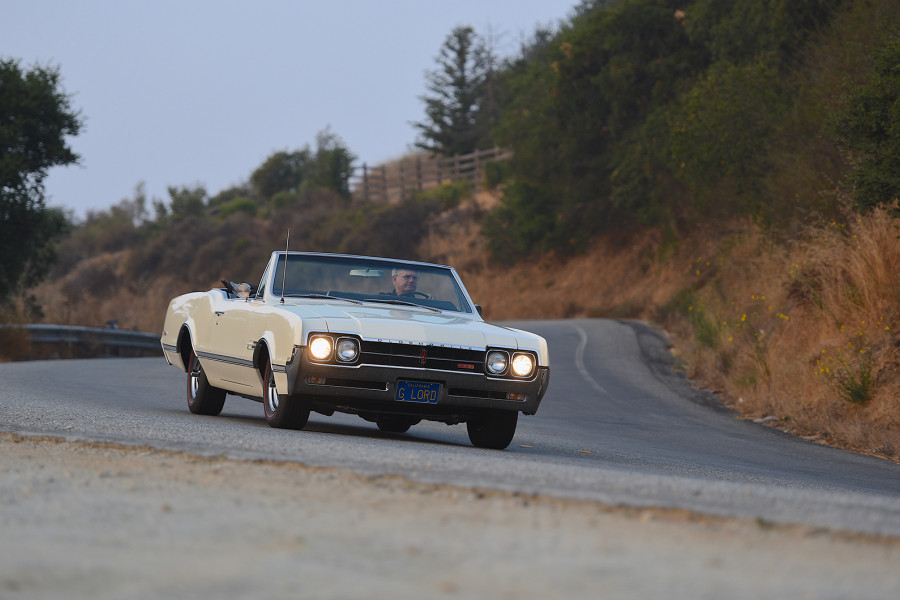
The convenience of Oldsmobile’s ‘Unitized Power Package’ meant that the big, front-wheel-drive coupe lent itself to adaptation and modification from the very beginning.
The marvellous, Toronado-powered GMC Motorhome of 1973-’78 is the most famous repurposing of the model.
Less widely known are a short-wheelbase, two-seater Toronado gran turismo (killed off by General Motors management in ’68) and a rather fine-looking factory prototype station wagon.
Because Toronados, with all of that weight sitting over the driven wheels, were famously good in the snow, a wacky, radically truncated and rubber-nosed ‘MiniToro’ was built by Oldsmobile engineers for purely practical purposes: to help workers escape from the Lansing plant’s car park on winter evenings.
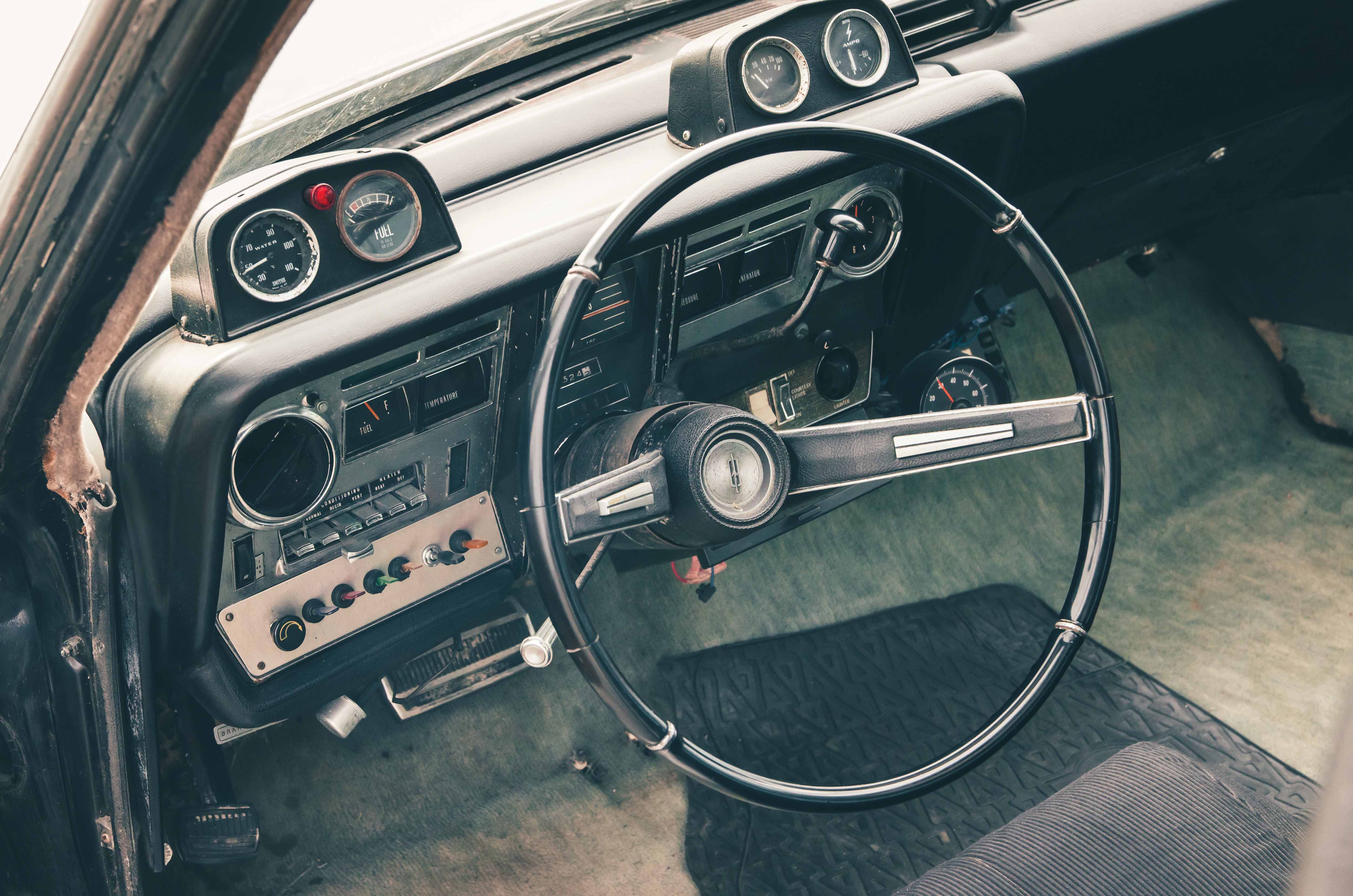
The AQC Jetway 707’s extra dials top an otherwise standard Oldsmobile Toronado dashboard
And then came George Barris. In 1967, he created for a private customer a four-door, 3ft-stretched Toronado executive limousine, the De Elegance.
In the realm of small-screen fantasy, meanwhile, his Mannix roadster and the Pink Panther car (see below) were both Oldsmobile-based.
However, the Jetway, believed to be the world’s first six-wheeled limousine, could be the daftest of them all.
Sitting on a wheelbase extended from 119in to 185in, the 6ft 5in-wide Jetway is a good 10ft longer than the not notably compact two-door, 5000lb coupe on which it is based.
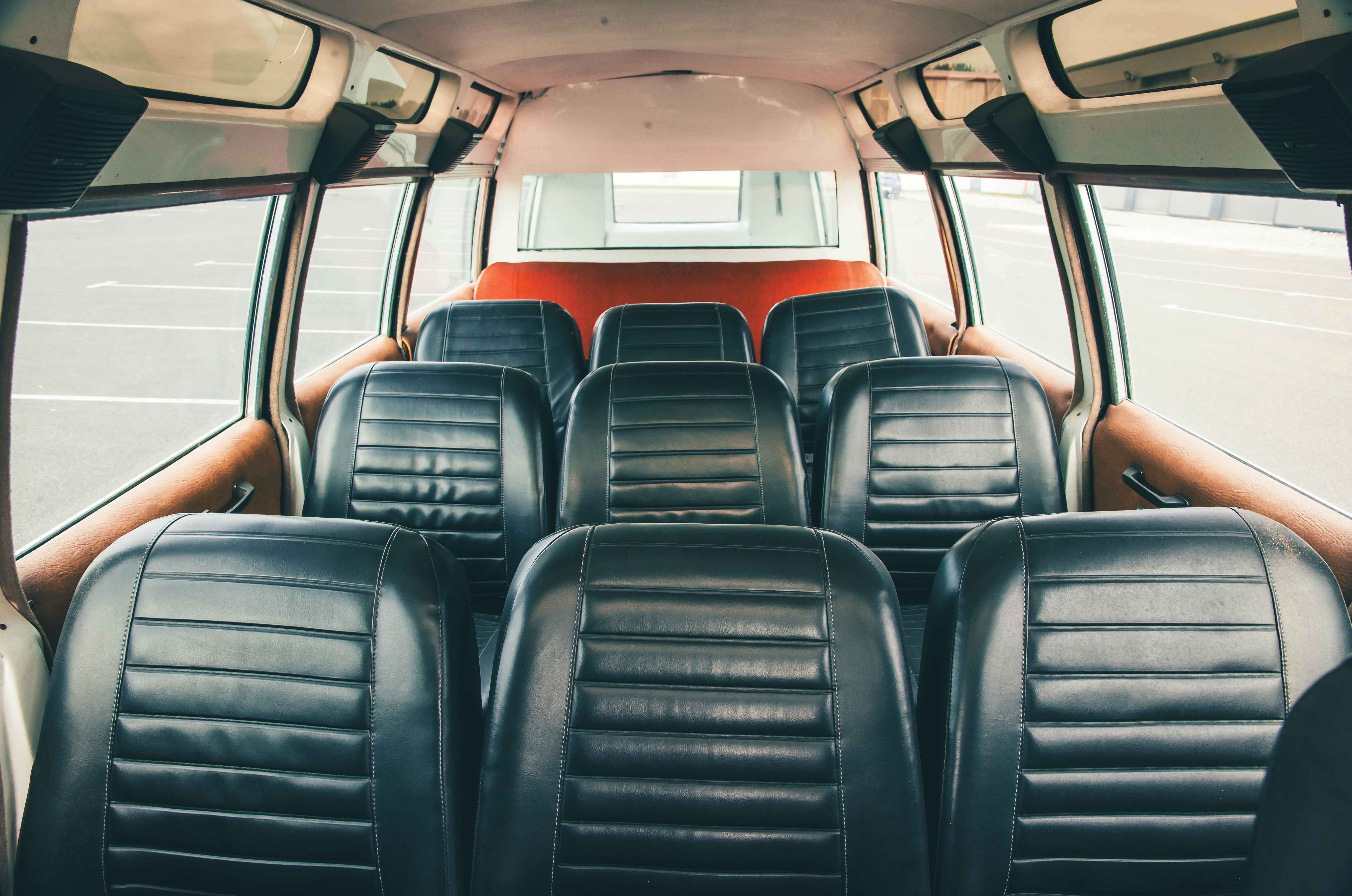
This AQC Jetway 707 is a 12-seater example, but space for up to 15 was possible
It could easily be double its weight: the tandem rear axles help here, but the brakes are still drums – albeit six of them.
Those rear axles are leaf-sprung, incidentally, not running airbags as has been mooted.
Among the many other interesting features are individual, aircraft-style seats, skylights let into the front and sides of its raised roof (for extra headroom), dual air-conditioning systems and, it being based on the Toronado, a completely flat floor with no propshaft.
The enclosed rear luggage area, accessed via a side-hinged door like that of a police van, has a supposed 100cu ft of luggage space – although operators of the Jetway in period claimed that this was still not adequate for the baggage requirements of a full load of sweaty, Hawaiian-shirt-wearing holidaymakers.
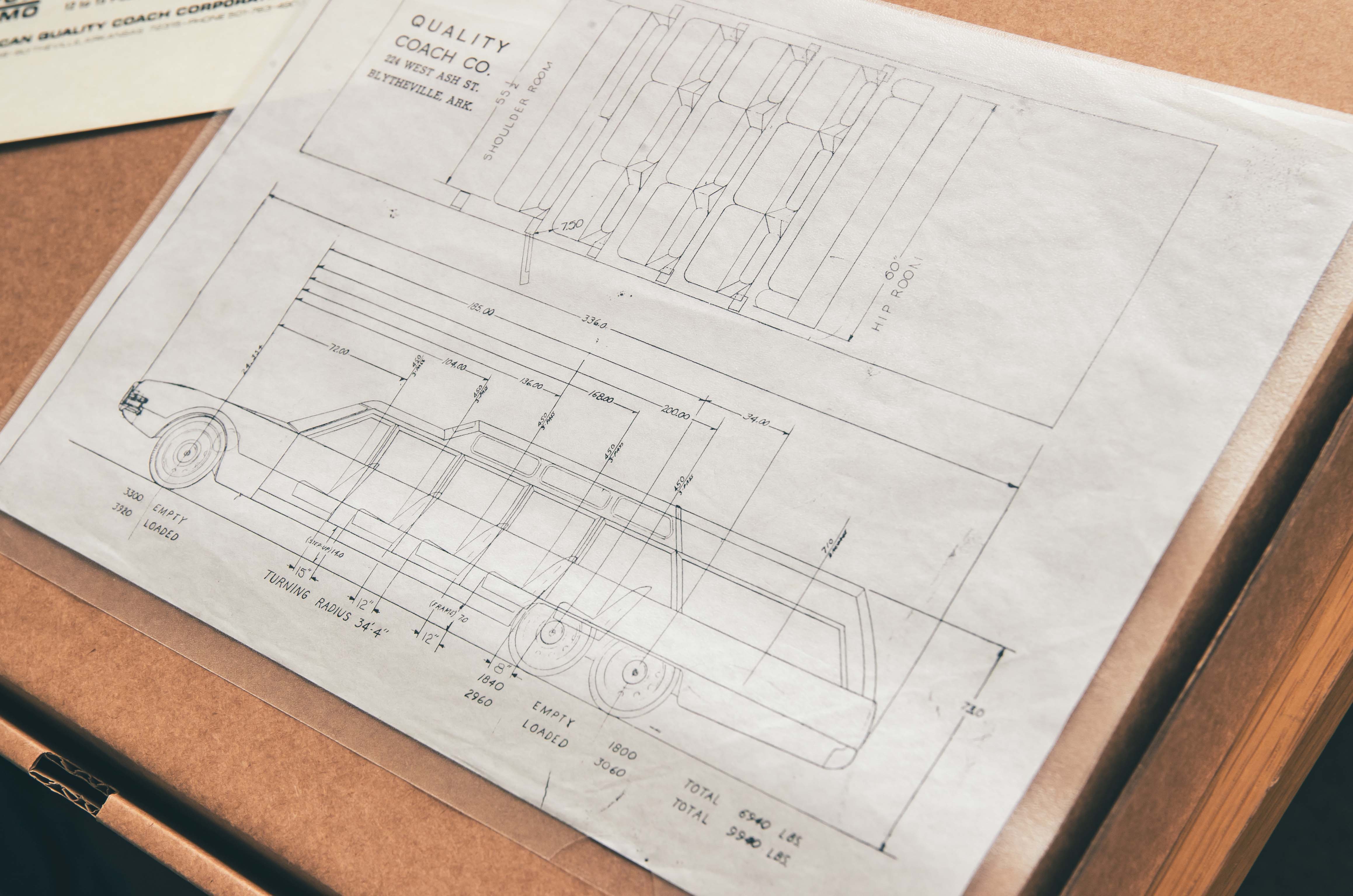
Technical drawings show the AQC Jetway 707’s gigantic dimensions
The creators of the 707, Waldo Cotner and Robert Bevington, had seen the potential of the new Oldsmobile immediately, and planned a whole family of executive limousines, hearses and airport courtesy cars using the Toronado’s new, front-wheel-drive technology.
Based in Memphis, Cotner-Bevington converted Buicks and Oldsmobiles into ambulances and hearses, but latterly worked mainly on Olds.
The firm had been formed in 1959, taking over where the Comet Coach Company left off after it sold the trademark to Ford.
Waldo and Robert stayed on in the same premises and renamed it after themselves.
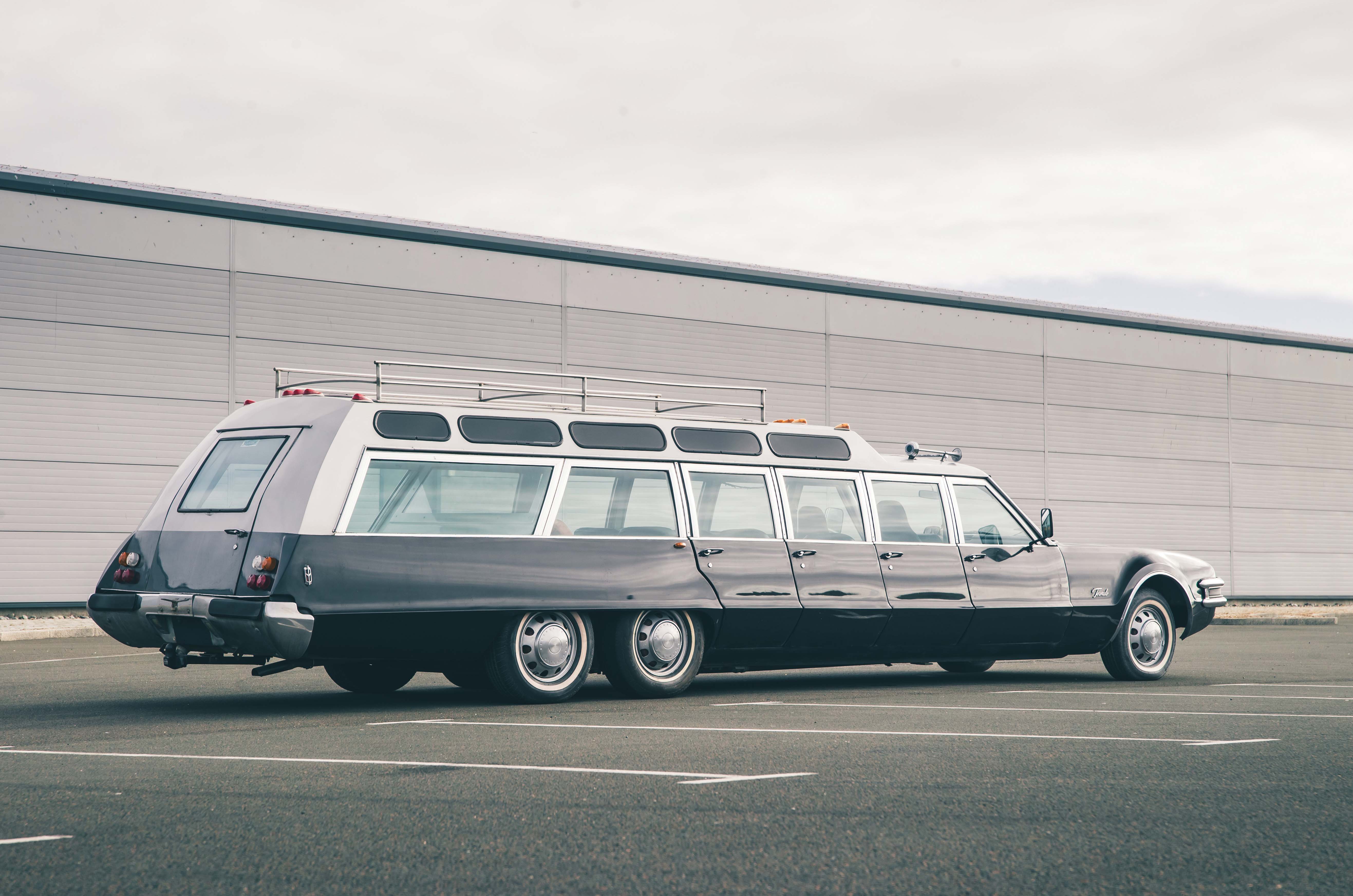
‘The AQC Jetway 707 could be the daftest Oldsmobile Toronado of them all, at a good 10ft longer than the not notably compact, 5000lb two-door’
They, in turn, were bought out by the Divco-Wayne group in 1964 as a budget companion brand to its more expensive, mainly Cadillac-based Miller-Meteor vehicles (think Ghostbusters Ecto-1).
The Cotner-Bevington Oldsmobiles would carry on being produced until Federal lawmakers killed off passenger-car-based ambulances in the mid-’70s. By then, the founders were long gone.
When the bosses at Divco overruled plans for the Jetway, seeing it as an in-house rival for the Miller-Meteors, Cotner and Bevington decided to go it alone, cashing in their shares and restarting as American Quality Coach, based in Blytheville, Arkansas.
They had big dreams for the Jetway 707, claiming in the promotional material it was ‘The limousine you requested’.
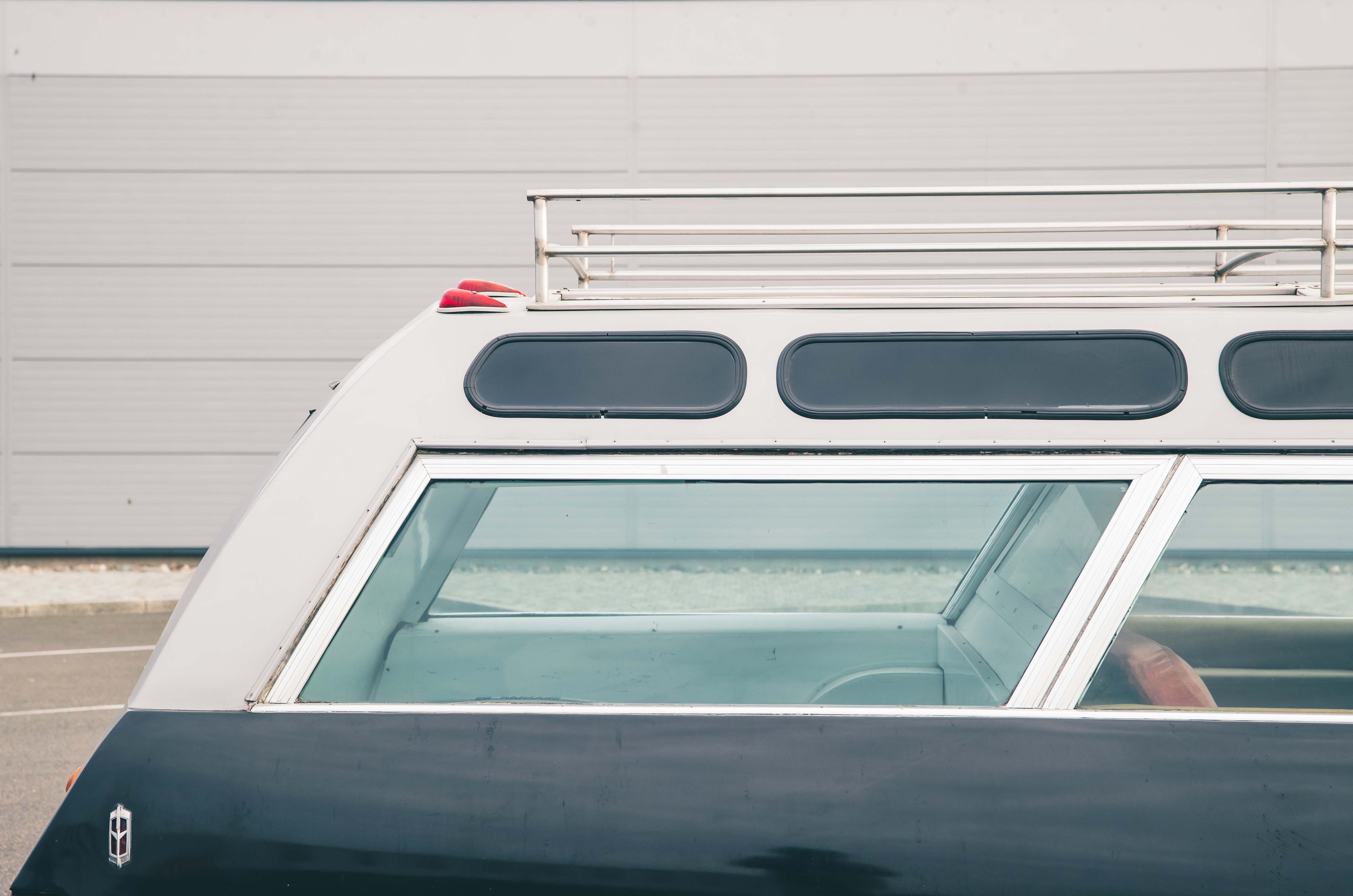
The AQC Jetway 707’s liberal use of glass keeps the cabin bright
In reality, it was a product that tested the limits of what fleet operators of the day really needed or were willing to pay for.
There were not enough customers to do good business even in the niche world of airport limousines.
Details are sketchy in terms of pricing, but we can take it that the Jetway, completely bespoke from the bottom of the A-pillars backwards, was a much more expensive production than, say, a Checker Aerobus or the Pontiac Catalina-based six- or eight-door airport shuttles of the same era.
All the glass was bespoke, as were the doors, so it’s easy to see how the costs ramped up.
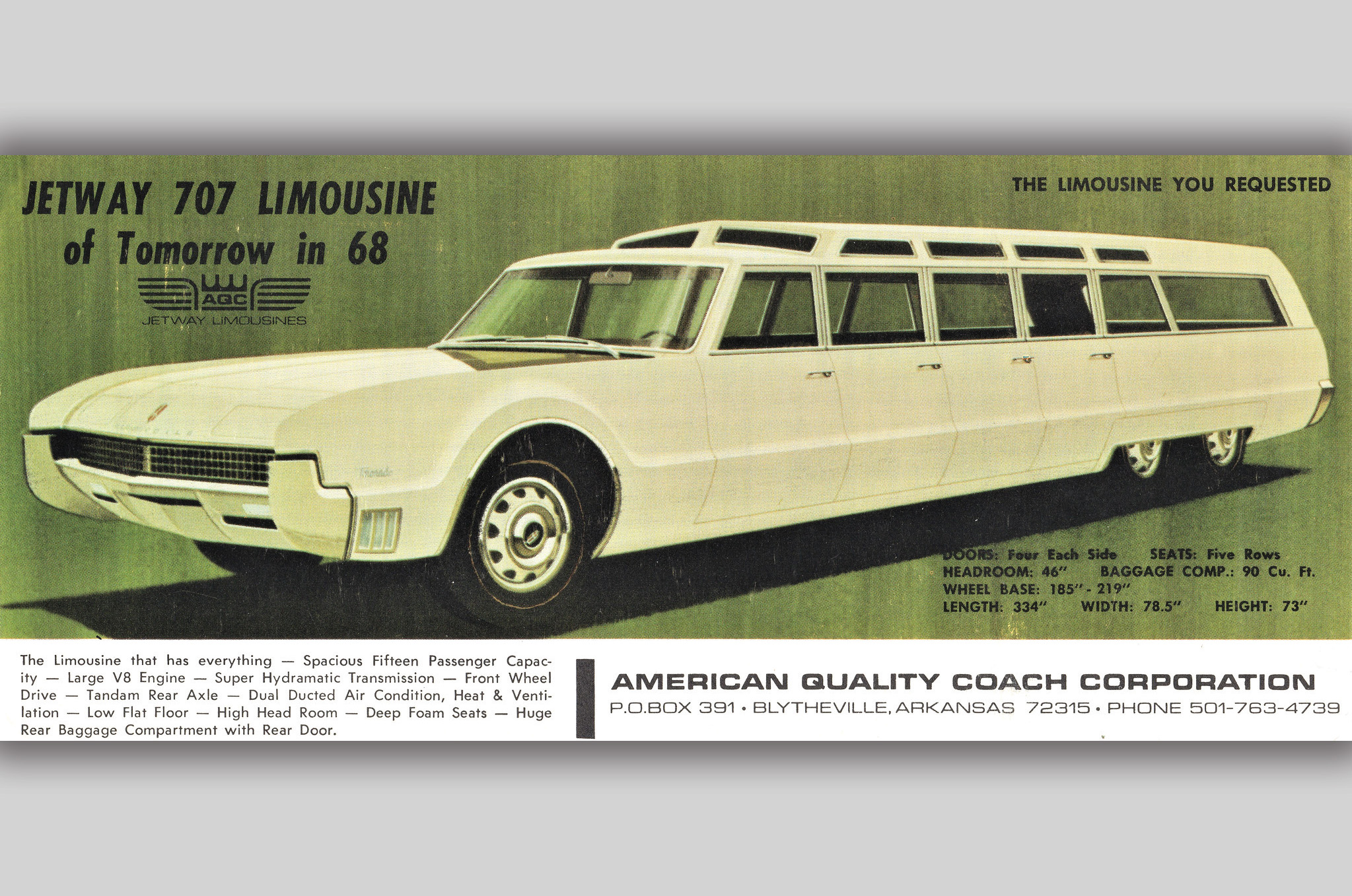
This early brochure shows the first AQC Jetway 707, based on the 1967 Oldsmobile Toronado
It has been suggested that the top speed could be as high as 90mph, and I’d put money on the average fuel consumption being significantly worse than the 11.8mpg Autocar got out of the standard Toronado it tested in 1966.
Specialist stretched airport/hotel/resort shuttles had been a feature of the American coachbuilding industry since the 1930s, but AQC was keen to point out that the Jetway 707 was ‘not a “stretchout,” but a jig-built, carefully-crafted coach’ that allowed its customers to choose colours and interior trim to match the rest of their fleet.
Although the original artist’s renderings for the 707 depict the 1966-’67 Oldsmobile front-end styling, most (but not all) of the production cars were based on leftover 1968 ‘bullnose’ Toronados, including the examples sold in 1969 and 1970.
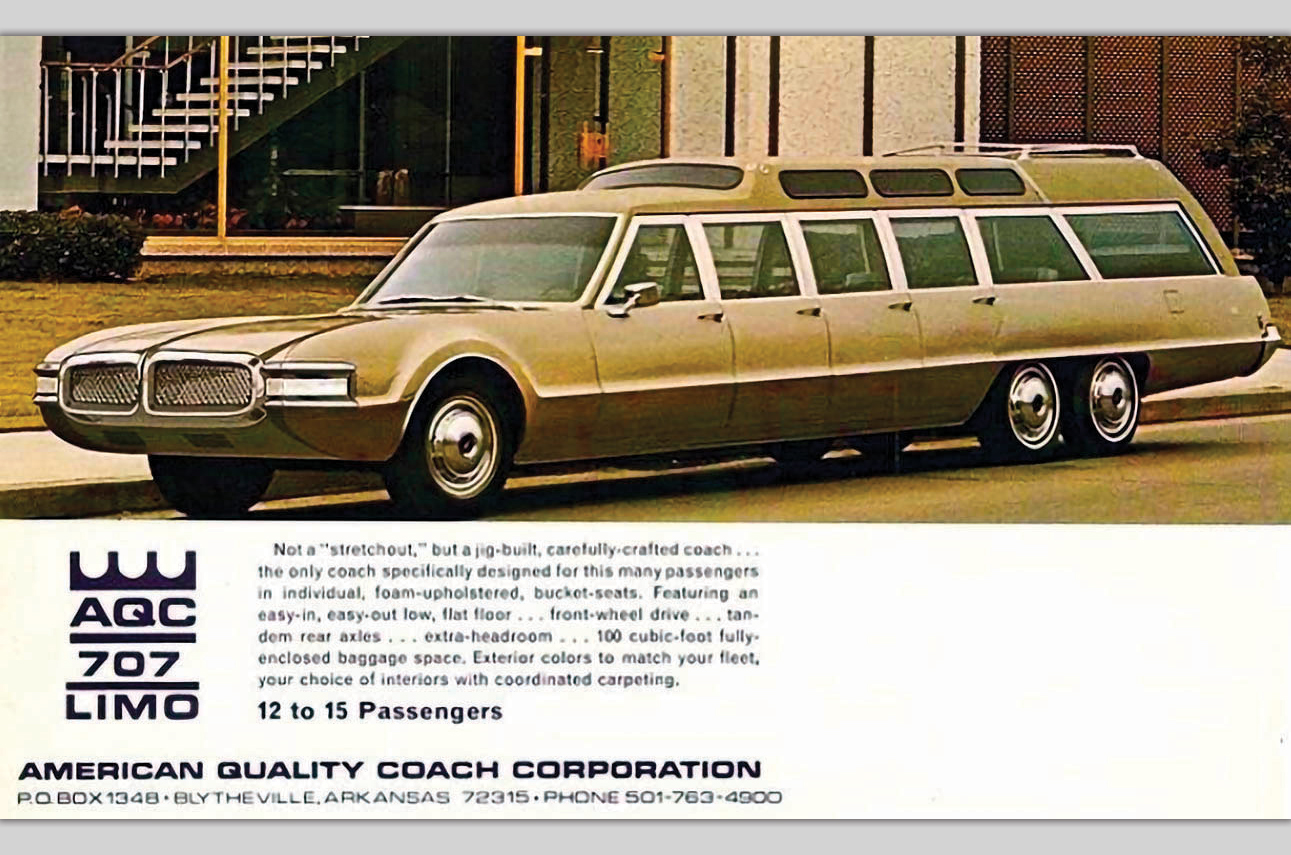
Later AQC Jetway 707s featured the ‘bullnose’-style front end
That later front end was not as pretty, but you got more power (400bhp) and headlamps hidden behind the grilles in the twin-nostril nose.
The number of windows in the ceiling varied, and some had steel roofs, others glassfibre.
Although the Toronado’s drivetrain was extremely rugged in its standard application, it appears that the extra loads imposed by the weight of the Jetway’s huge body caused problems, although their exact nature is not clear.
Whatever the truth of the matter, sales were too slow to keep the company alive and AQC closed its doors in 1970.
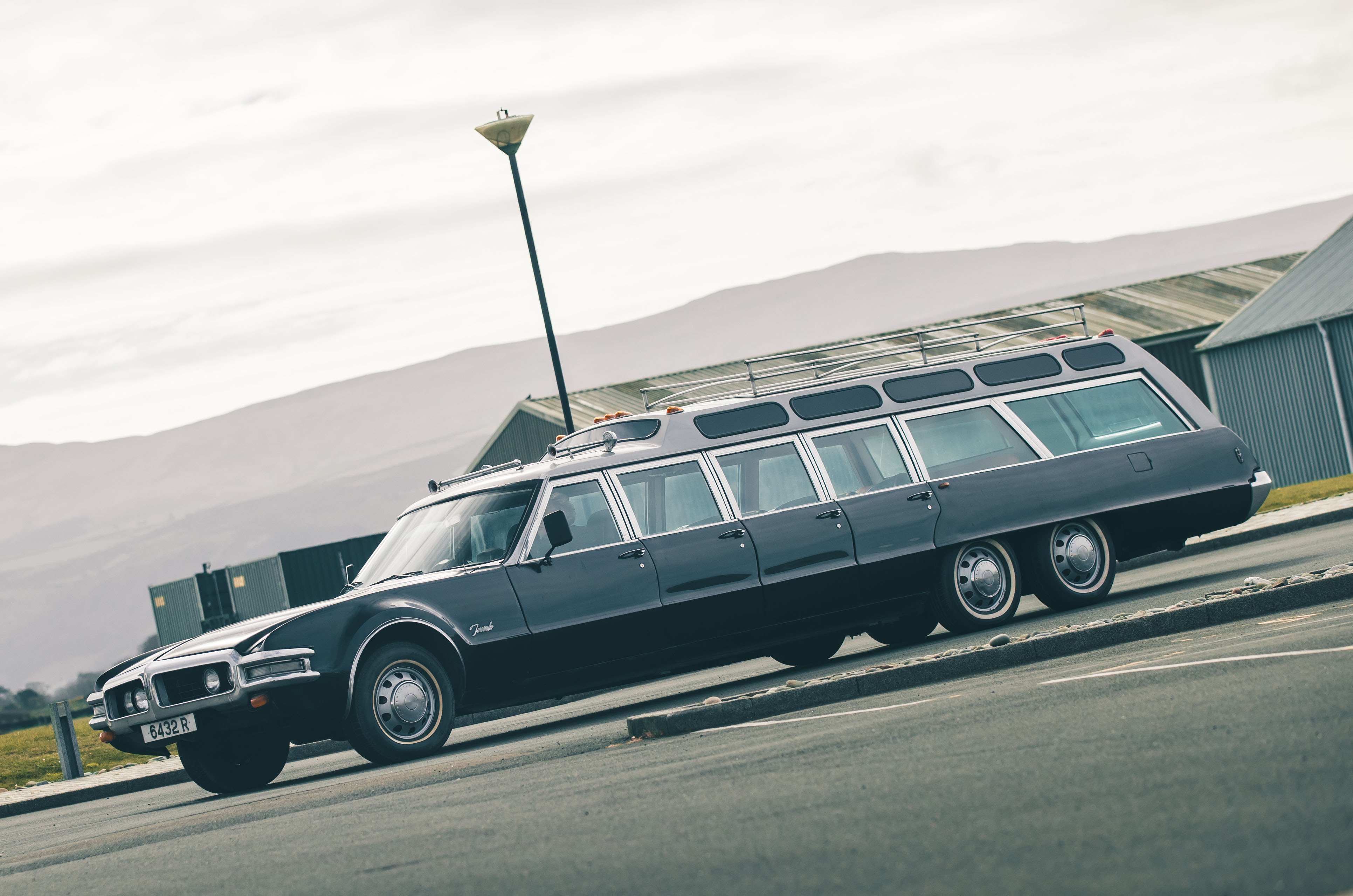
The AQC Jetway 707 turned Oldsmobile’s ‘personal car’ into a communal limousine
As well as hotel and limousine operators, buyers included corporate entities such as the National Cash Register Company, which bought two for shuttling executives to its headquarters, and GM itself for much the same purpose.
This one was sold new to the Hilton hotel in South Carolina in 1968 and imported into the UK in 1979, possibly by Ian Grange of Southern Car Sales in Manchester.
Today, in a 500-item collection not short on one-offs and oddities, the Jetway is one of the main crowd-pleasers of the superbly eclectic Isle of Man Motor Museum, where it lives alongside various military vehicles, abandoned Soviet space capsules, a GM Scenicruiser Greyhound bus, and all manner of oddball machinery assembled by the father-and-son team of Denis and Darren Cunningham.
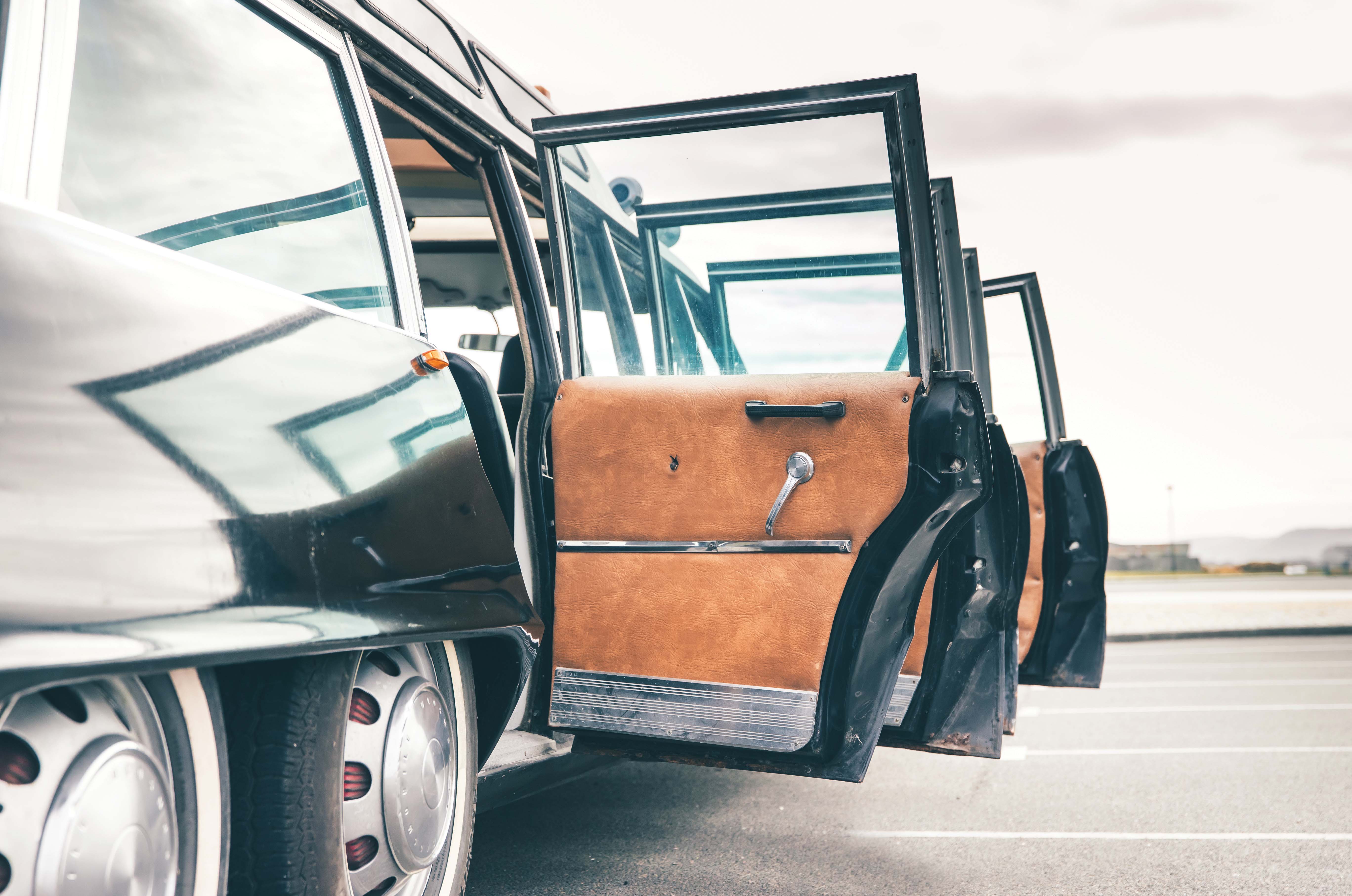
The Oldsmobile Toronado’s front-wheel-drive technology permitted the Jetway’s immensely long wheelbase
Although not in its first flush of youth, the 707 is probably one of the best-remaining examples: a quick internet search indicates that most of the others are living in US breaker’s yards, or in back gardens under brambles.
Seven Jetways are thought to survive in the United States, nine in the rest of the world.
Unless you own a museum, manage a brass band or are on a one-person mission to breed your own football team (plus substitutes), then this is a car that tends to lose its purpose in life on the day it stops working for a living.
Maybe it should have run away and joined a circus: even in a deserted, windswept car park people appear out of nowhere to have their pictures taken with the Jetway and appear satisfied when I tell them the engine is 7.5 litres.
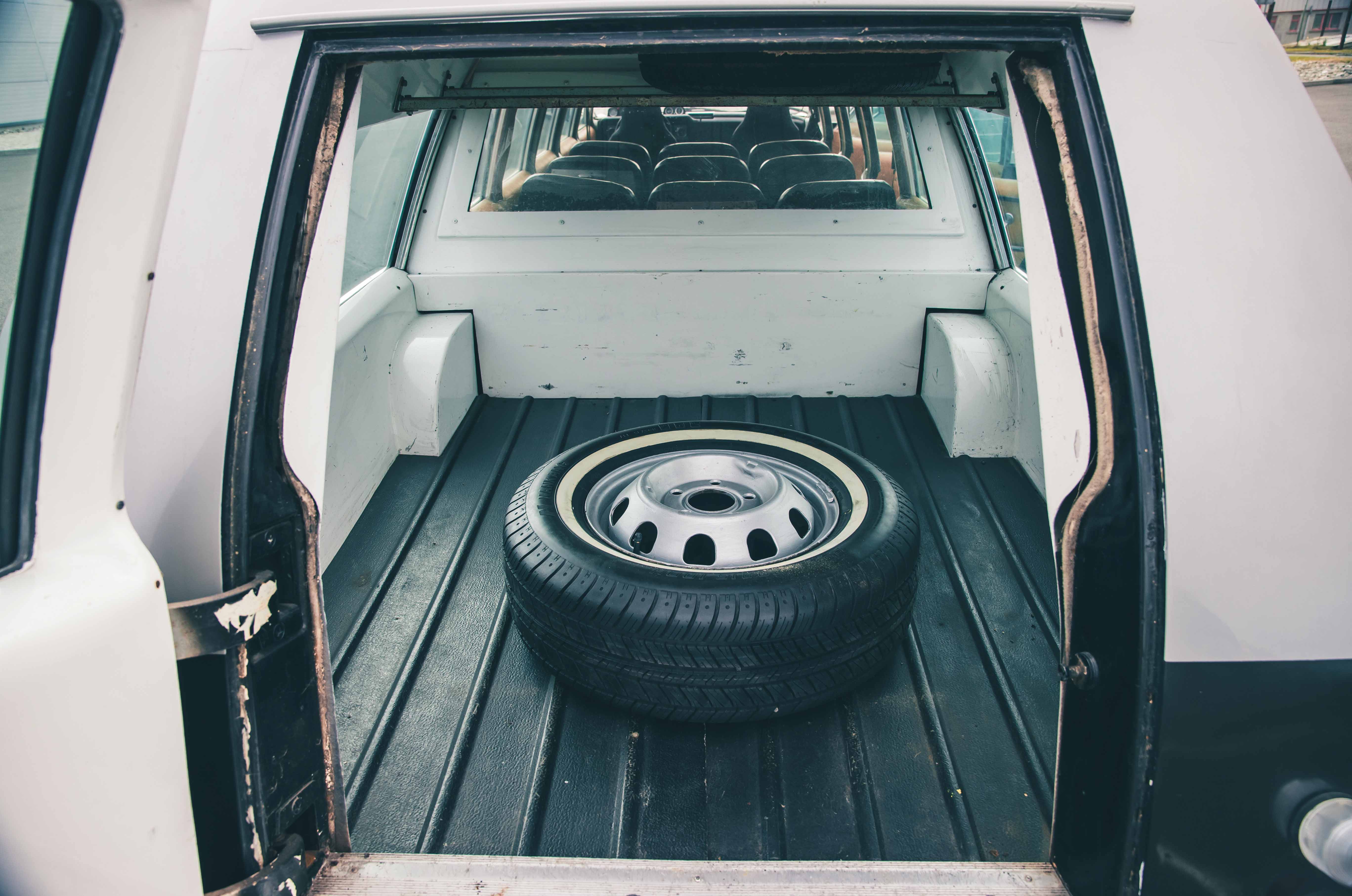
The AQC Jetway 707’s load bay was deemed too small
You could land a helicopter on that bonnet, which is a two-armed job to lift, and a light aircraft on the roof.
Its Rocket V8 is not a pretty sight, but you can spy the clever transfer case and gearbox/diff nuzzling against the right side of the block, and what appears to be an extra-large, heavy-duty alternator.
The headlamp covers are, apparently, permanently open.
Inside, the front bench seat has long since disappeared and the fascia is standard Olds, with various additional switches and gauges acquired over the decades.
It is simple to drive once you’ve worked out how to adjust the non-standard front seat, although I’m quite content to restrict my activity to the parking lot.
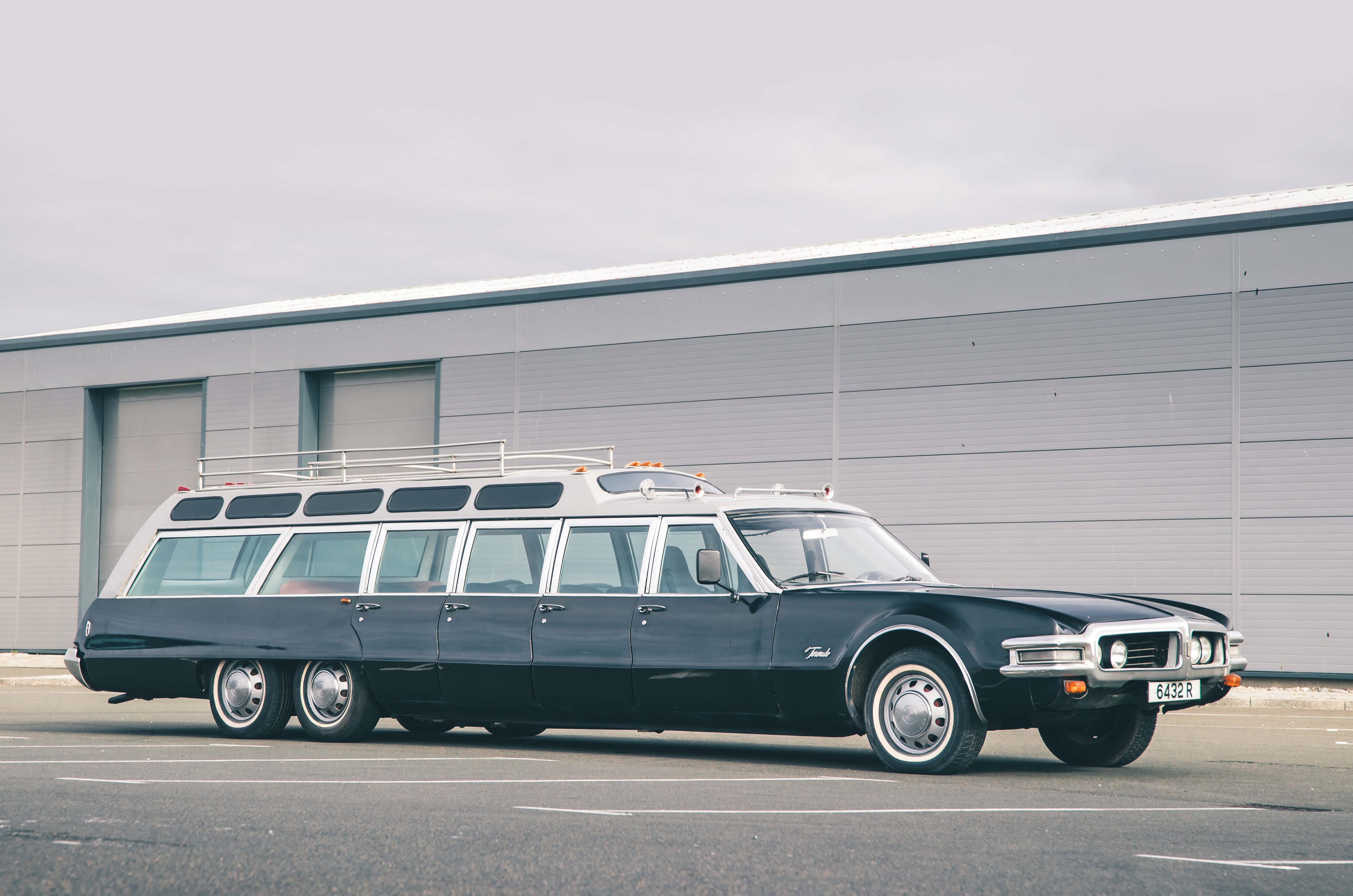
Is the AQC Jetway 707 the pinnacle of airport transport?
Front-wheel burnouts aren’t an option, but the giant car accelerates smoothly and lazily (with some pinking), and has a predictably ginormous turning circle.
You never quite forget the length, and the view over your shoulder seems to go on for ever.
The tapering vista of seats brings another purpose for the Jetway to mind: it would make an ideal mobile cinema.
Part Gerry Anderson prop, part George Barris fantasy, the 707 is one of those double-take, ‘did I really see that?’ cars you can’t quite believe existed. I think I’m glad it did.
Images: Jack Harrison
Thanks to: the Isle of Man Motor Museum
Oldsmobile Toronado reinterpretations
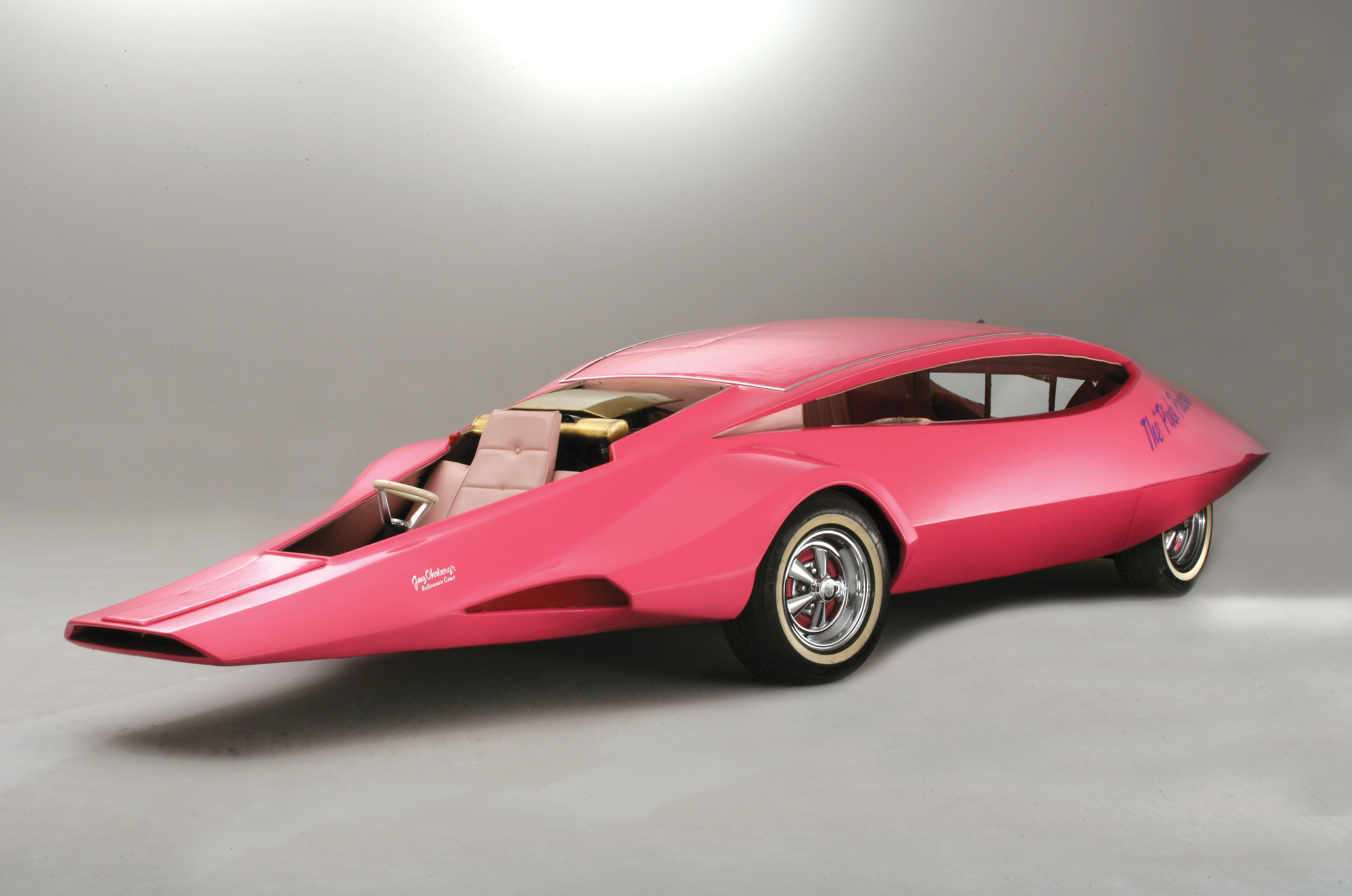
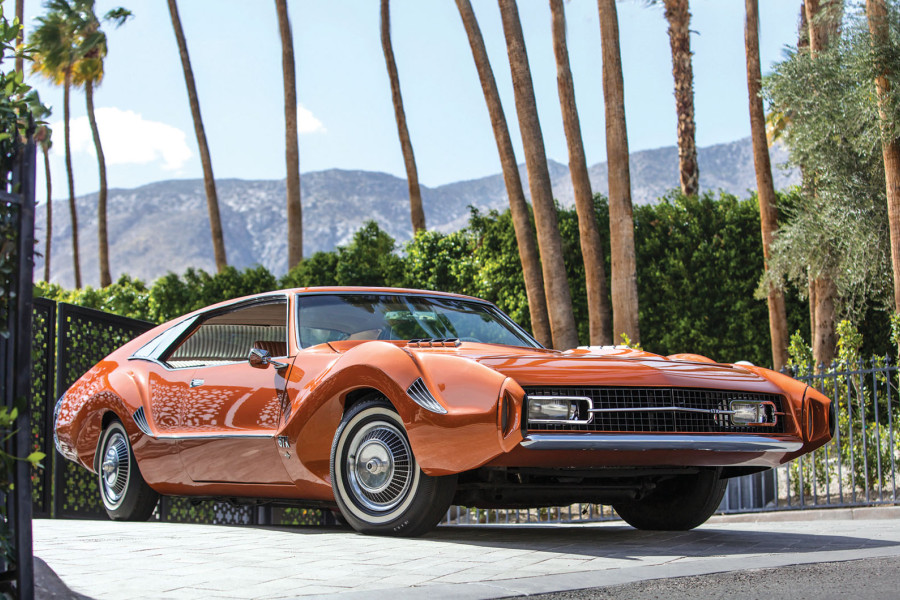
The Pink Panther car
Built to ferry the cartoon feline for the credits of The Pink Panther Show, this outlandish, steel-bodied creation was the work of California Show Cars on an Oldsmobile Toronado front subframe and rear end.
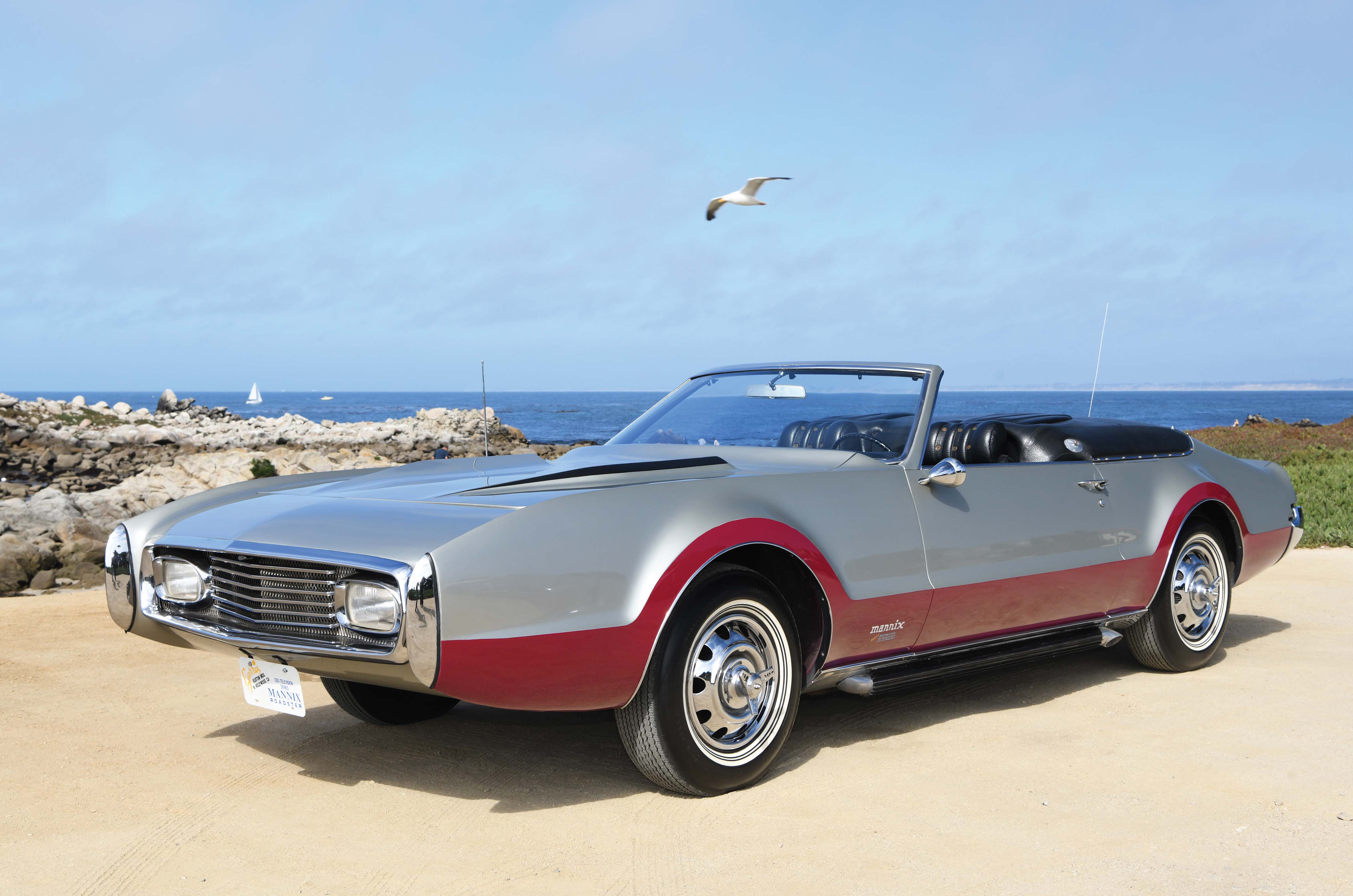
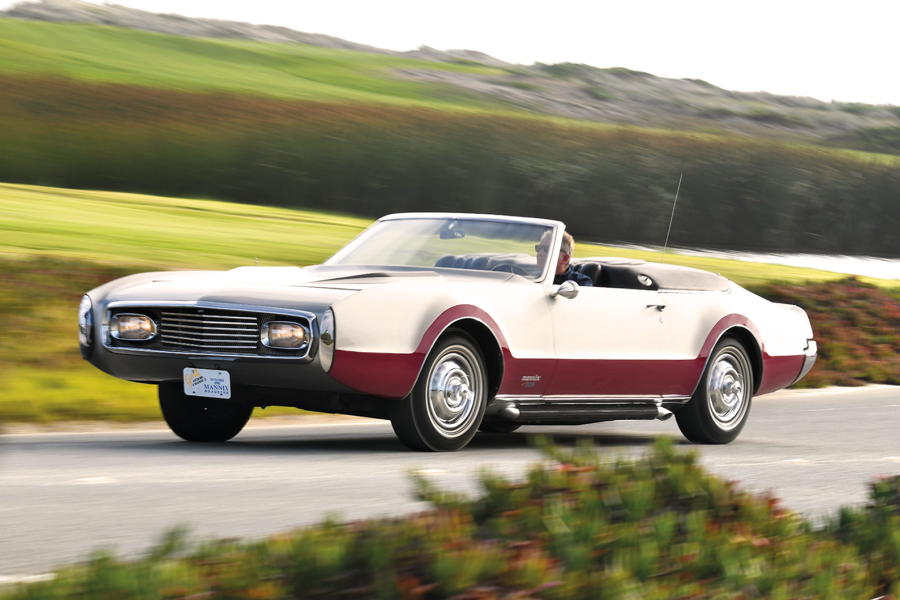
Mannix roadster
Detective Joe Mannix (Mike Connors) struggled to stay undercover in this wild drop-top, the work of ‘kustom king’ George Barris, with its restyled nose/tail, two-tone paint and on-board phone.
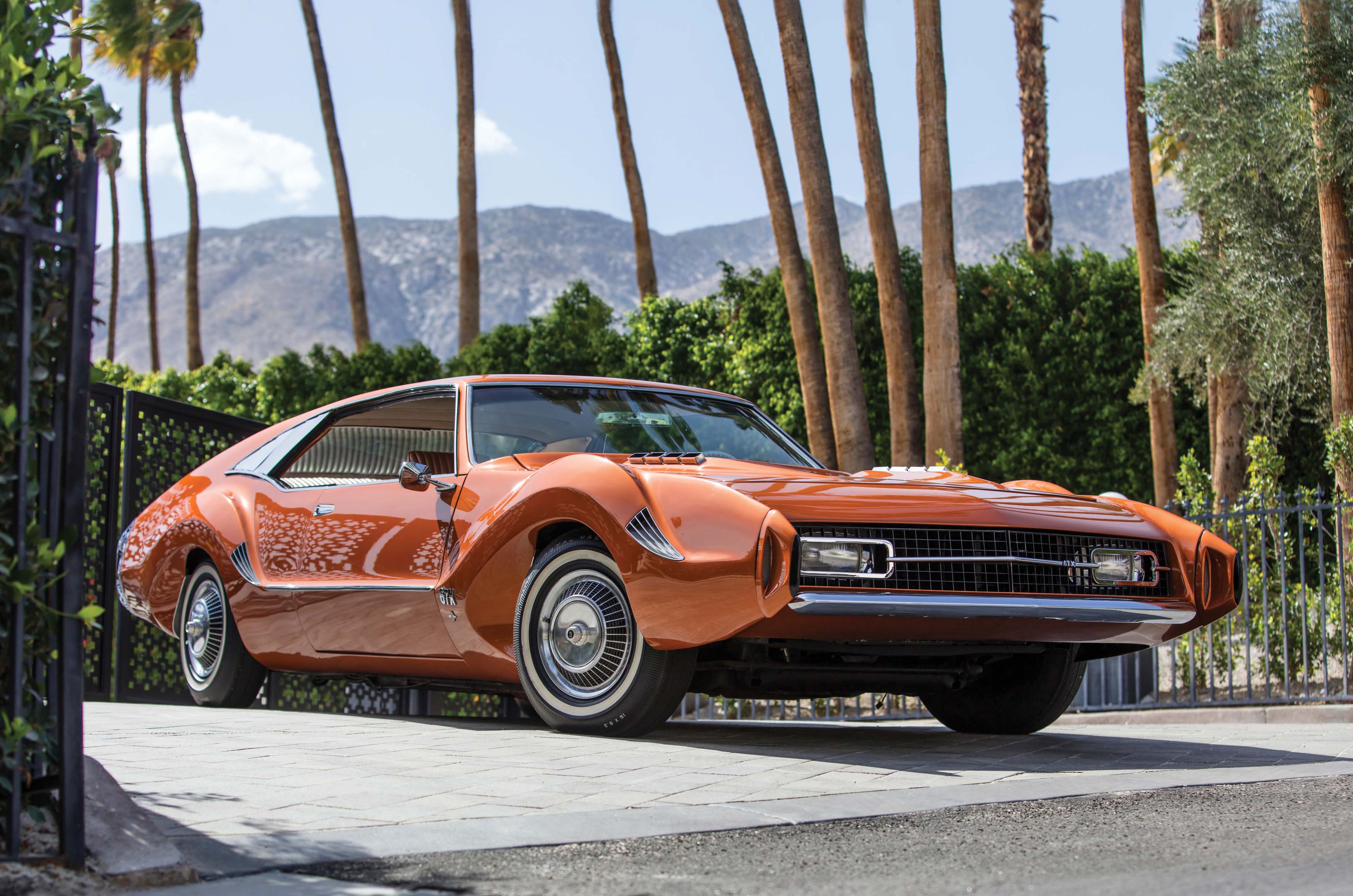
Esso 67-X
Yet another Barris Toronado rework, these stretched, restyled and retrimmed barges were giveaways for an Esso-backed competition, timed to coincide with Expo 67 in Montreal, Canada.
Enjoy more of the world’s best classic car content every month when you subscribe to C&SC – get our latest deals here
READ MORE
Esso 67-X: George Barris’ customised Oldsmobile Toronado
Mannix Toronado: the least undercover cop car ever?
Citroën SM and Oldsmobile Toronado: groundbreaking GTs
Senior Contributor, Classic & Sports Car