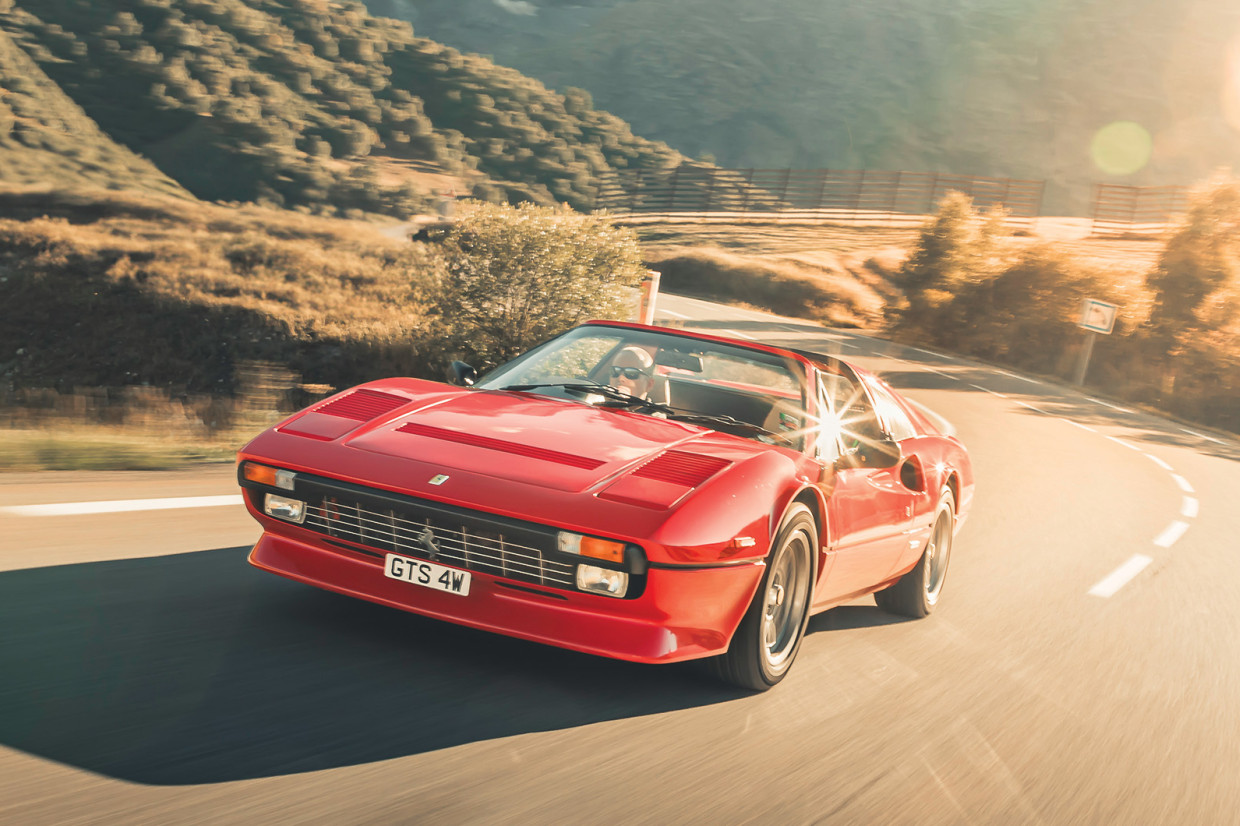
A road trip is a joyous affair.
Armed with a fine car, great roads and good company, it can hold the recipe for all that is good in life, and leave you and your travel companion with an unerring sense of bonhomie.
But it can teeter on the fringe of pointlessness, too: without a purpose at your final destination – a pot of gold, so to speak – it can also leave you feeling deflated and sad that, after days of adrenalin-filled driving, there is nothing left but a return ticket to normality.
Thankfully, as indulgent as schlepping across the Alps in an open-topped, rosso Ferrari sounds, on this occasion there will be an endgame to make all of that ‘hardship’ worthwhile.
Half a century after Pininfarina’s gorgeous Ferrari 308 hit the market, an open GTS is the perfect steed for an epic road trip back to its homeland
The Ferrari 308GTB was launched on 2 October 1975 at the Paris Salon.
To mark its 50th anniversary, we are taking arguably its best-known variant – the open-topped GTS – on an 800-mile transcontinental blast from London to Turin to be reunited with the very man responsible for its existence: design legend Leonardo Fioravanti (the full interview is in the November 2025 Classic & Sports Car).
Along the way, it will give us the chance to discover the 308’s enduring appeal that, in its various guises, was to make it Maranello’s biggest sales hit thus far.
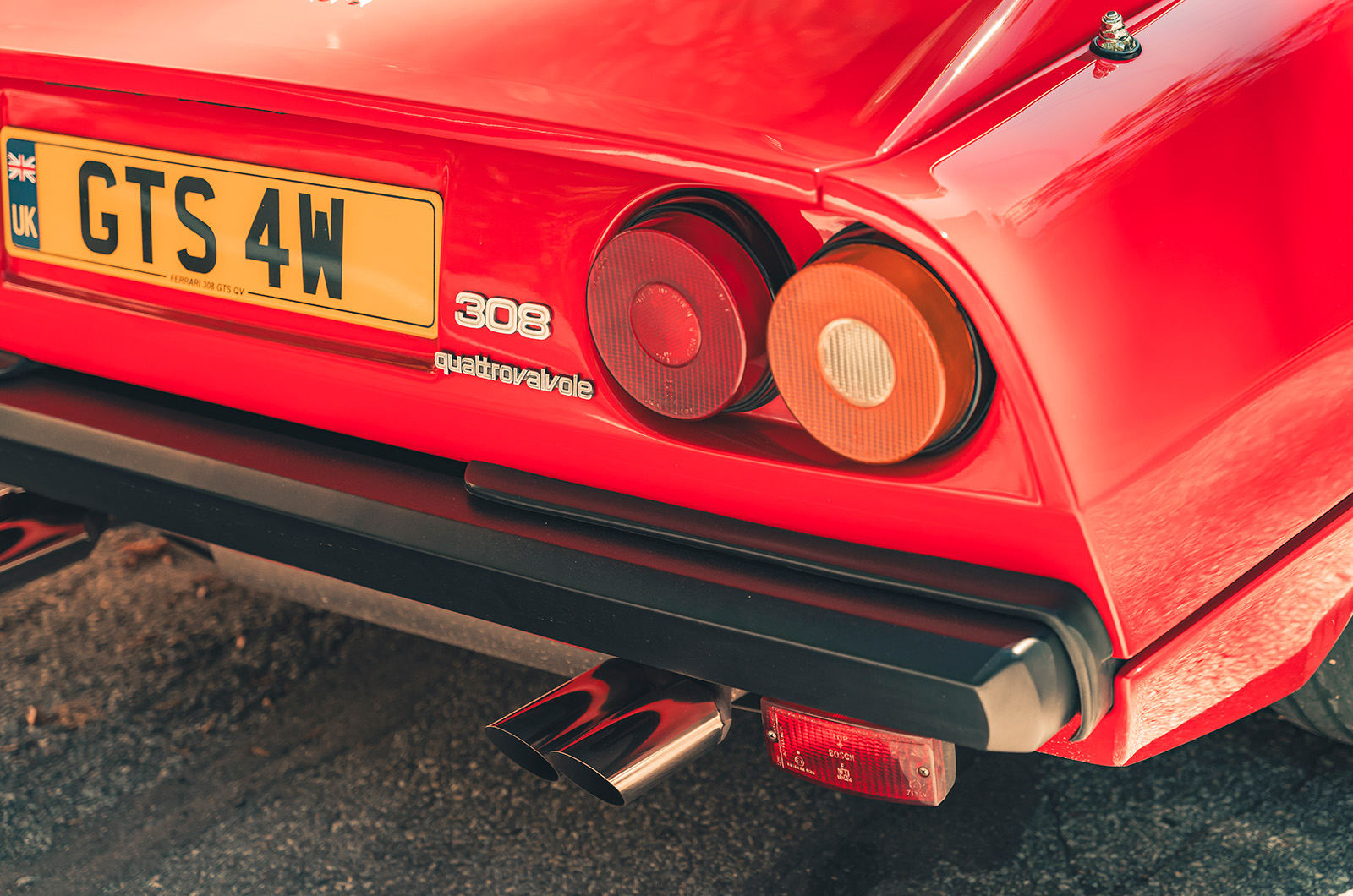
The Ferrari 308GTS quattrovalvole’s targa-style roof means minimal buffeting
But before we venture forth on this voyage of discovery, a brief history lesson.
The 308GTB launched into uncharted territory 50 years ago, being Maranello’s first non-V12 production model to wear a Ferrari badge (the V6-engined 206 and 246GTs, and V8-powered 308GT4, were officially labelled Dinos, not Ferraris).
Sergio Pininfarina, for whose carrozzeria Leonardo Fioravanti worked at the time, saw the new car as part of a mid-engined evolution for Ferrari which had started in 1965 with the Dino 206 Berlinetta Speciale show car in Paris.
As he told Autocar magazine many years later: “[The 308 is] an important chapter of a bigger book… The little Dino was the first seed; the F40 is the final fruit.”
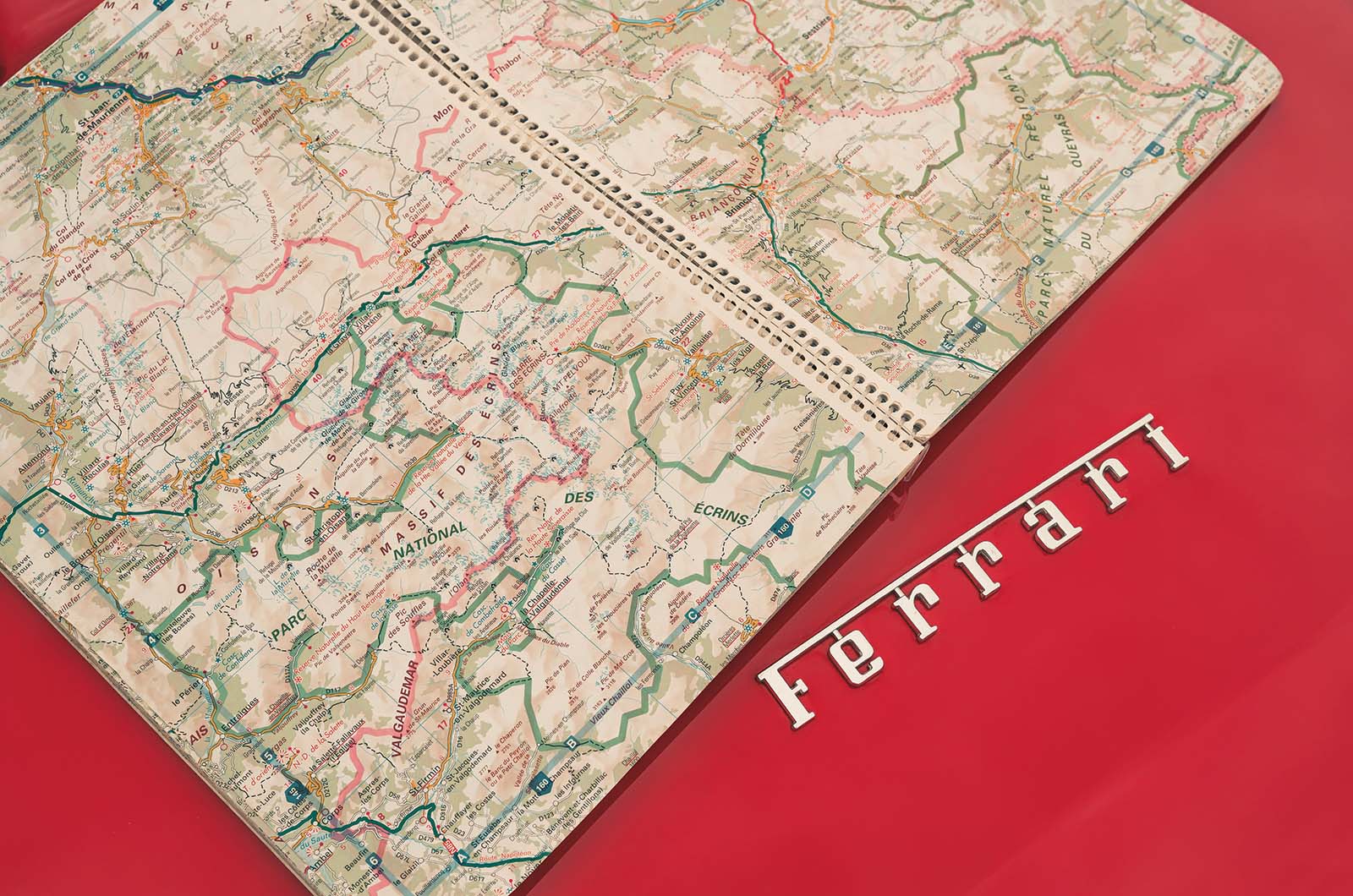
The Ferrari’s bootlid doubles as a desk for some enticing route planning
The Dino 206 and 246GT models had laid a solid foundation for their 1973 replacement, the Dino 308GT4.
But while the new car benefitted from 2+2 practicality, its acutely cab-forward Bertone design did little to engender praise from either press or public – though, happily, today any stigma about its looks appears to have passed.
So it was a relief for most when the Ferrari 308GTB was revealed in Paris in 1975.
Based heavily on the GT4’s platform and mechanicals, its two-seater body was as voluptuously curvaceous as the Bertone car’s was wedgy and slab-sided.
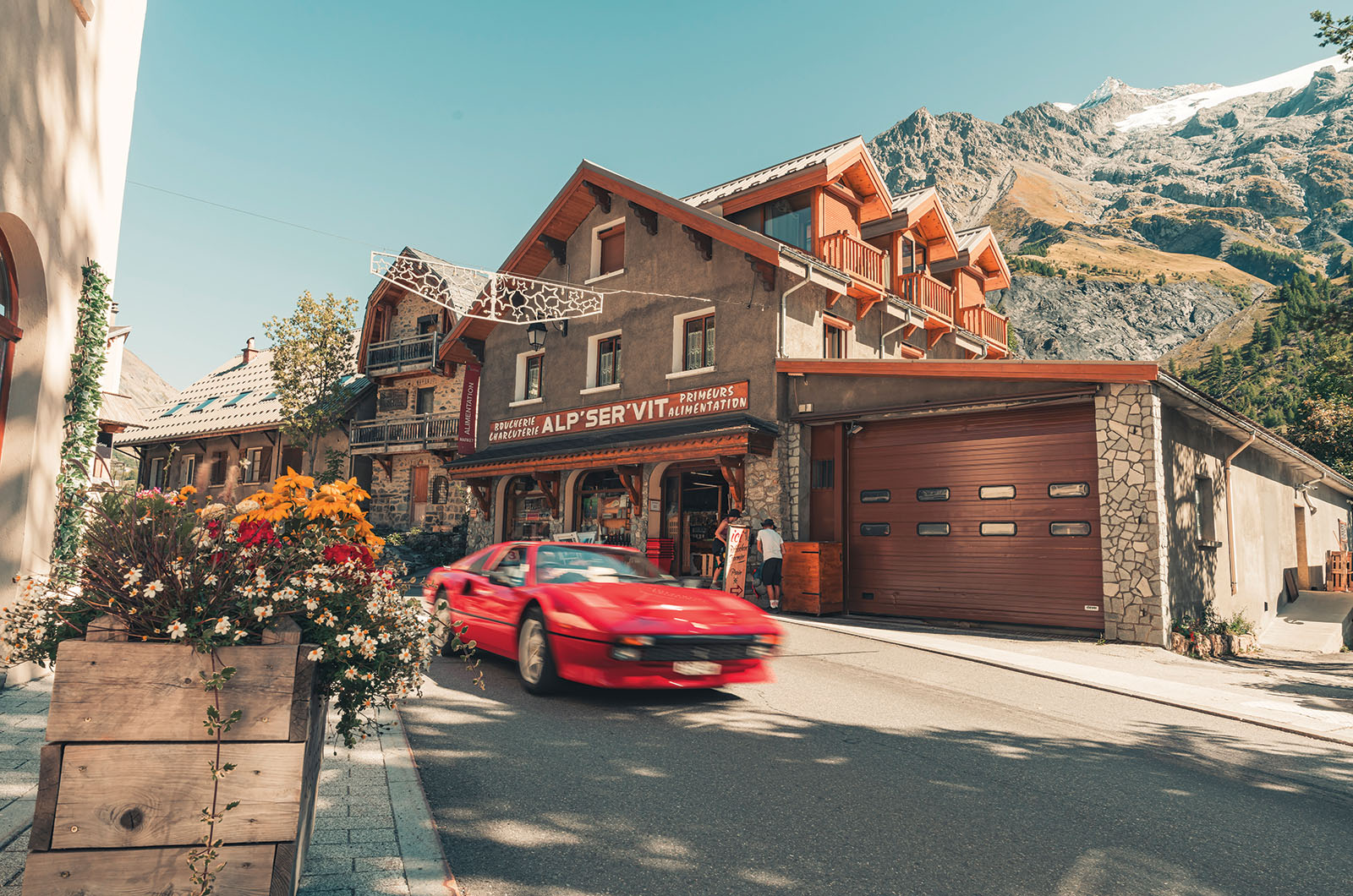
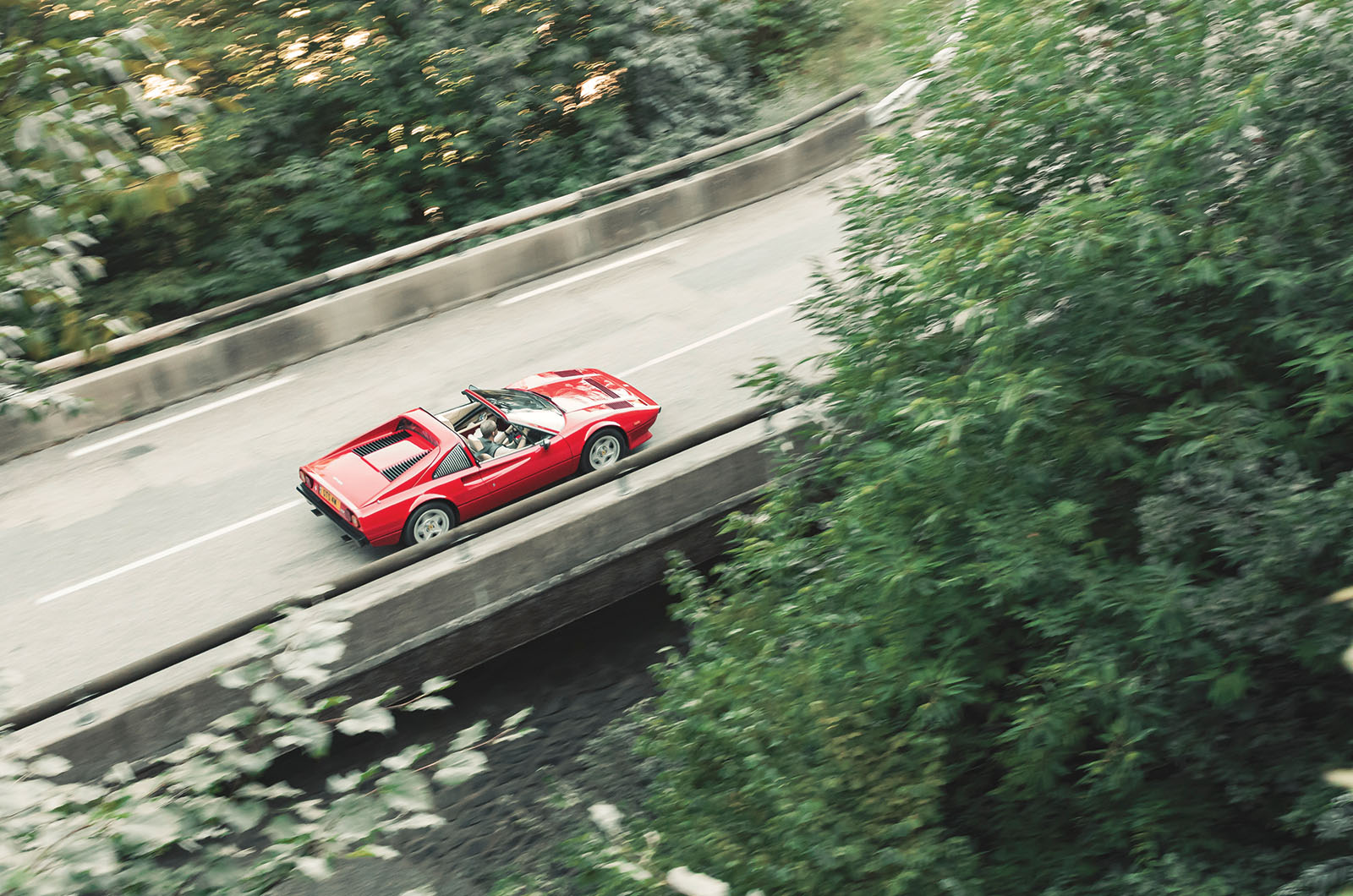
The Ferrari 308GTS flashes through the small French ski resort of La Grave, in the shadows of La Meije mountain
While the GTB was less than 3in shorter than its sibling, its wheelbase was reduced by a whopping 8½in, with longer overhangs making up the extra length, and providing space for a decent rear boot behind the compact engine.
That motor was near-identical to the GT4’s.
Still displacing 2927cc, the 90° V8’s cylinder banks each ran with two camshafts and housed four Weber 40DCNF carburettors within their vee.
Power was never greater than in the first 308GTBs, with Ferrari claiming 255bhp at a screaming 7700rpm and a healthy 210lb ft of torque from 5000rpm.
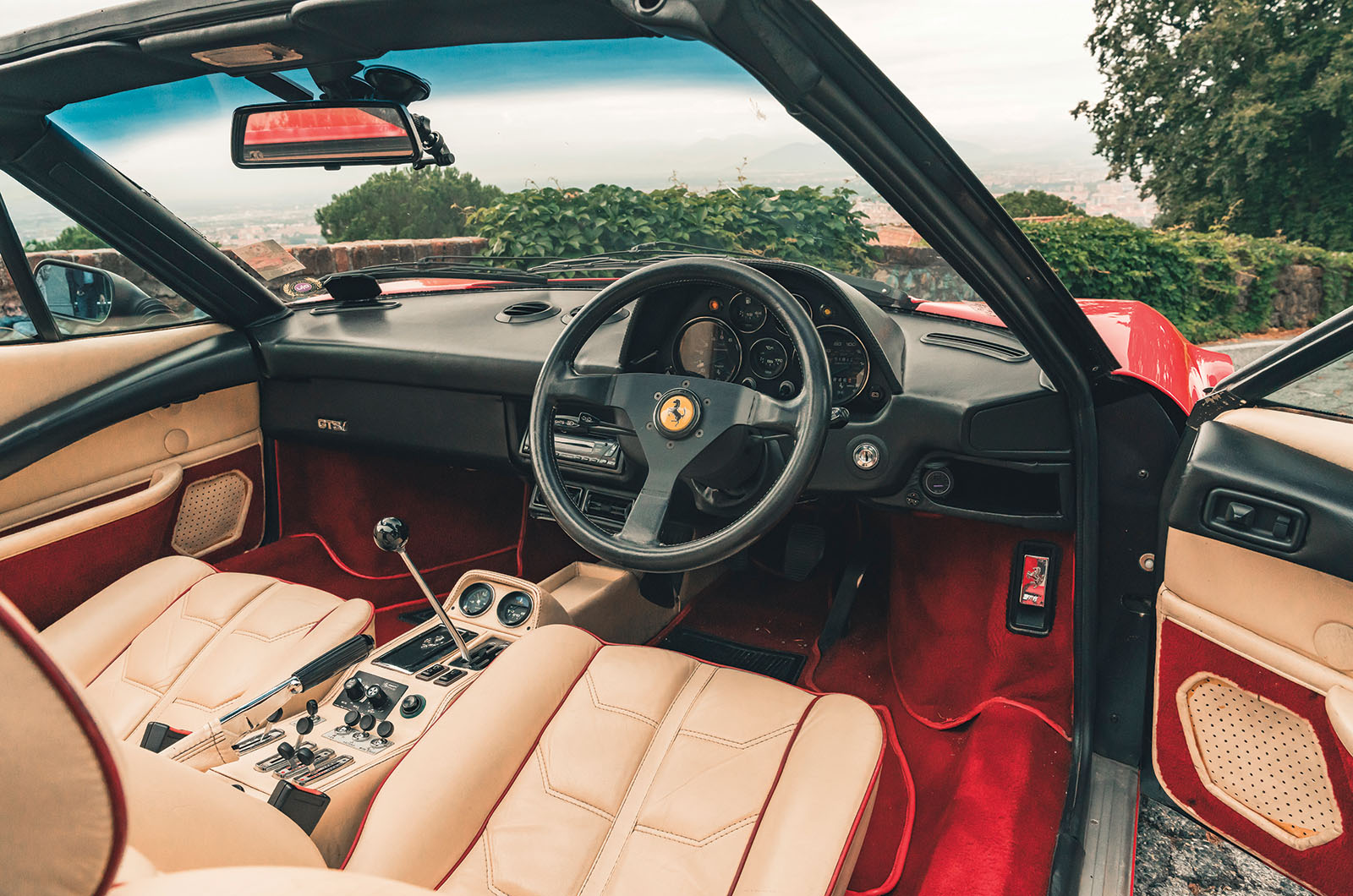
The Ferrari’s plush interior is perfectly comfortable for a schlep across the Alps
The unit was mounted transversely amidships, with drive from the left side of the engine via the clutch to a set of drop-gears that reversed the direction of drive towards a five-speed gearbox with a standard limited-slip differential.
However, unlike its application in the 308GT4, the GTB’s V8 was dry-sumped, dropping the unit lower in the car and providing more consistent lubrication under extreme driving conditions – a sure sign that the 308GTB was being positioned for competition at some point.
When Autocar road tested one the year after its launch, it recorded 6.5 secs for the 0-60mph sprint and 17 secs to 100mph, with a top speed of 154mph – slightly down on what the factory claimed.
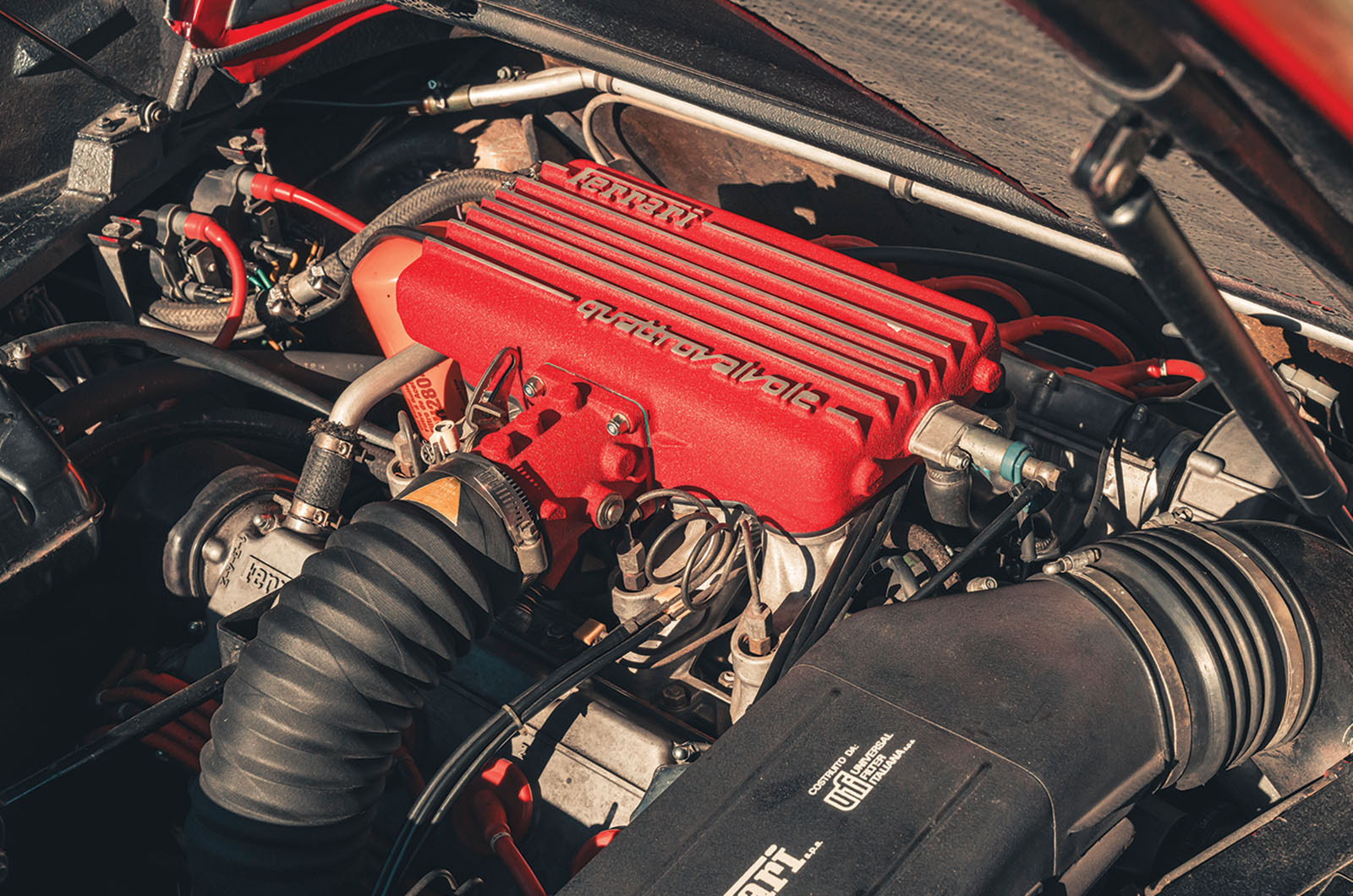
The Ferrari 308GTS quattrovalvole’s four-valve cylinder heads restored the V8’s power
The very first bodies to dress the GTB’s steel tubular frame were made from glassfibre – or vetroresina in Italian.
Not only did this mean that the car weighed 60kg less than the GT4, but it also gave it a minimum of 100kg weight saving versus any of the later, steel-bodied GTBs that started to replace it after little more than a year.
Chassis-wise, once again the GTB adopted the GT4’s set-up of unequal-length double wishbones and coils front and rear, with anti-roll bars at each end to control the car’s relative lack of suspension travel.
For me, the early, carburetted cars with their 14in Campagnolo alloys shod with 205/70 Michelin XWXs are the pick of the family, and conjure a lovely image of the GTB on a childhood Ferrari range poster that was stuck to my bedroom wall in the late ’70s.
‘Select a lower gear, exercise the throttle’s short travel and revel in the V8’s transformation from urbane to unhinged’
Along with the flat-12 Berlinetta Boxer and V12 400GT, that poster also included the first variation on the 308 theme, the targa-style GTS – much like the car with us today – which arrived in 1977, coinciding with the switch to steel bodies.
Four years later, in response to US emissions regulations and a demand for better economy, fuel injection and electronic ignition were standardised for both models, with the GTB’s engine now sharing the GTS wet-sump arrangement.
The major downside with what were then called the GTBi and GTSi models was the power hit inflicted through ditching the Webers: down to 214bhp in Europe, and a devastating 205bhp for US cars.
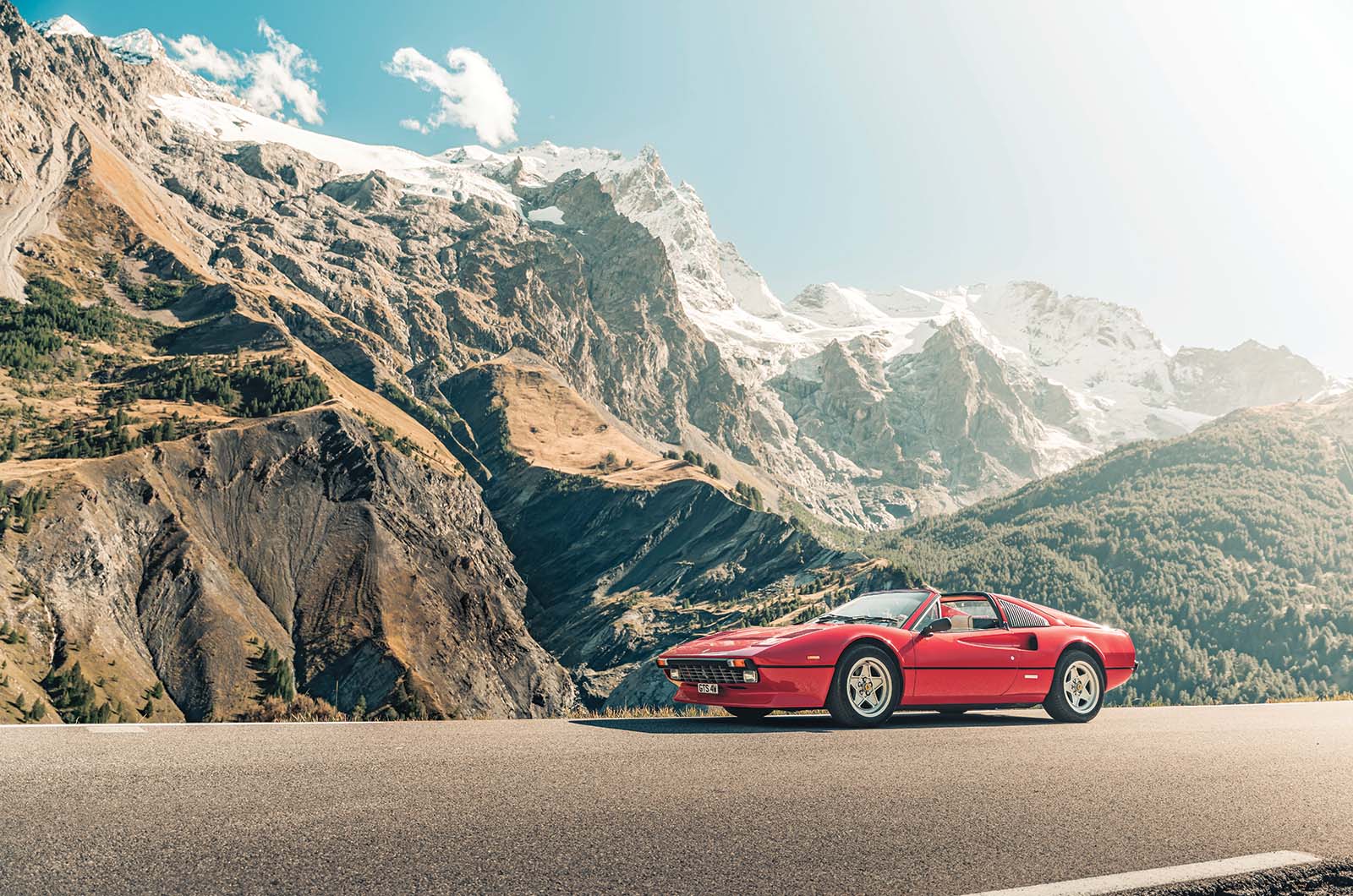
The beauty of machine and Mother Nature compete in the Écrins National Park
Fortunately, Mark Kieve’s stunning Rosso Corsa GTS – our wheels to Turin – is a slightly later quattrovalvole model, introduced in 1982 and representing the final hurrah for the 308 before it was replaced by the 328 in 1985.
Addressing the power deficit with four-valve heads restored outputs to 240bhp at 7000rpm (230bhp in the USA) and 192lb ft of torque at an unchanged 5000rpm.
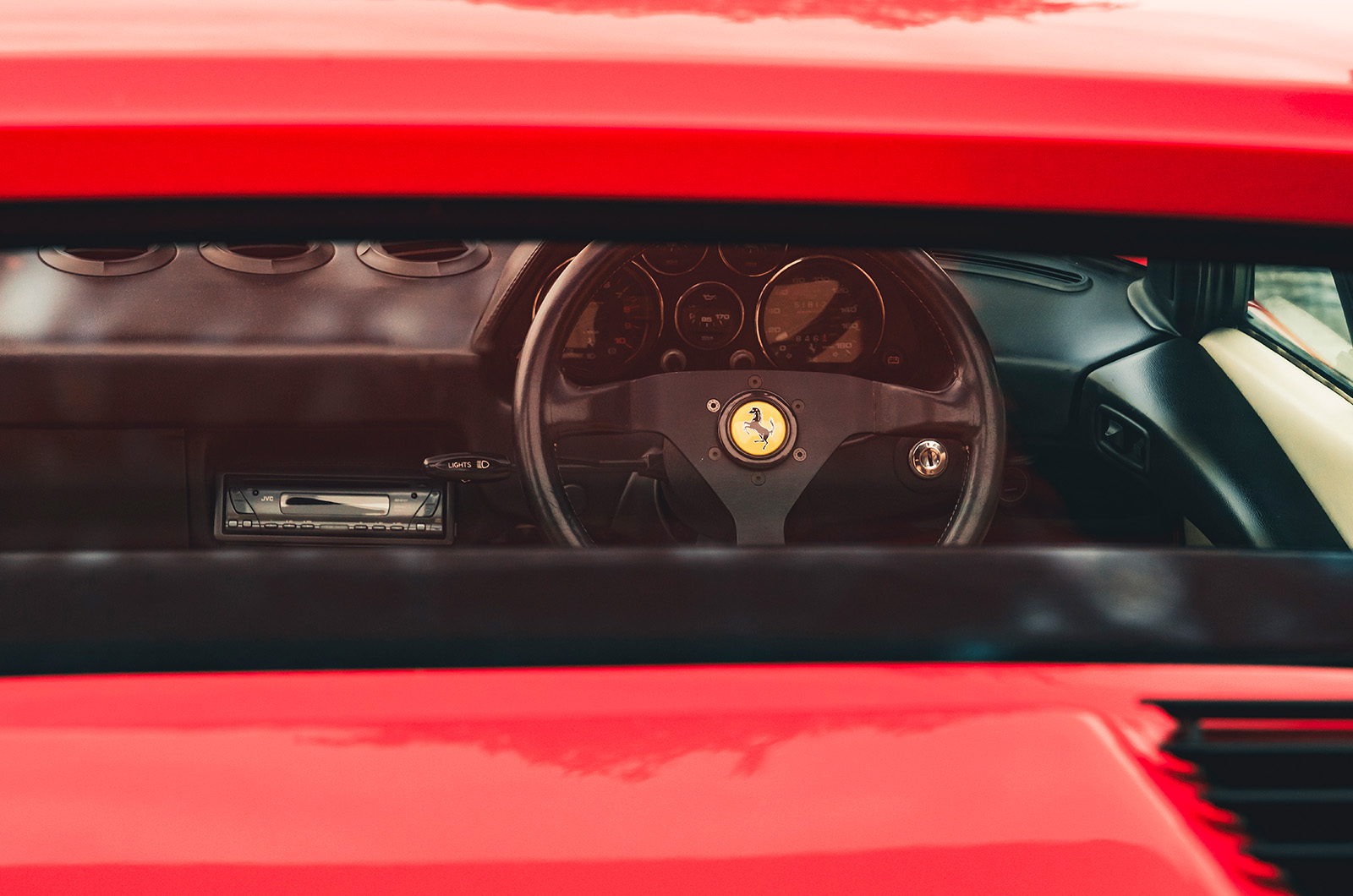
Visually, the qv gained a slim, louvred panel on the front lid, door mirrors adorned with small Ferrari badges, and a redesigned radiator grille, while inside a new steering wheel and a revised centre-stack layout set it apart from the earlier cars.
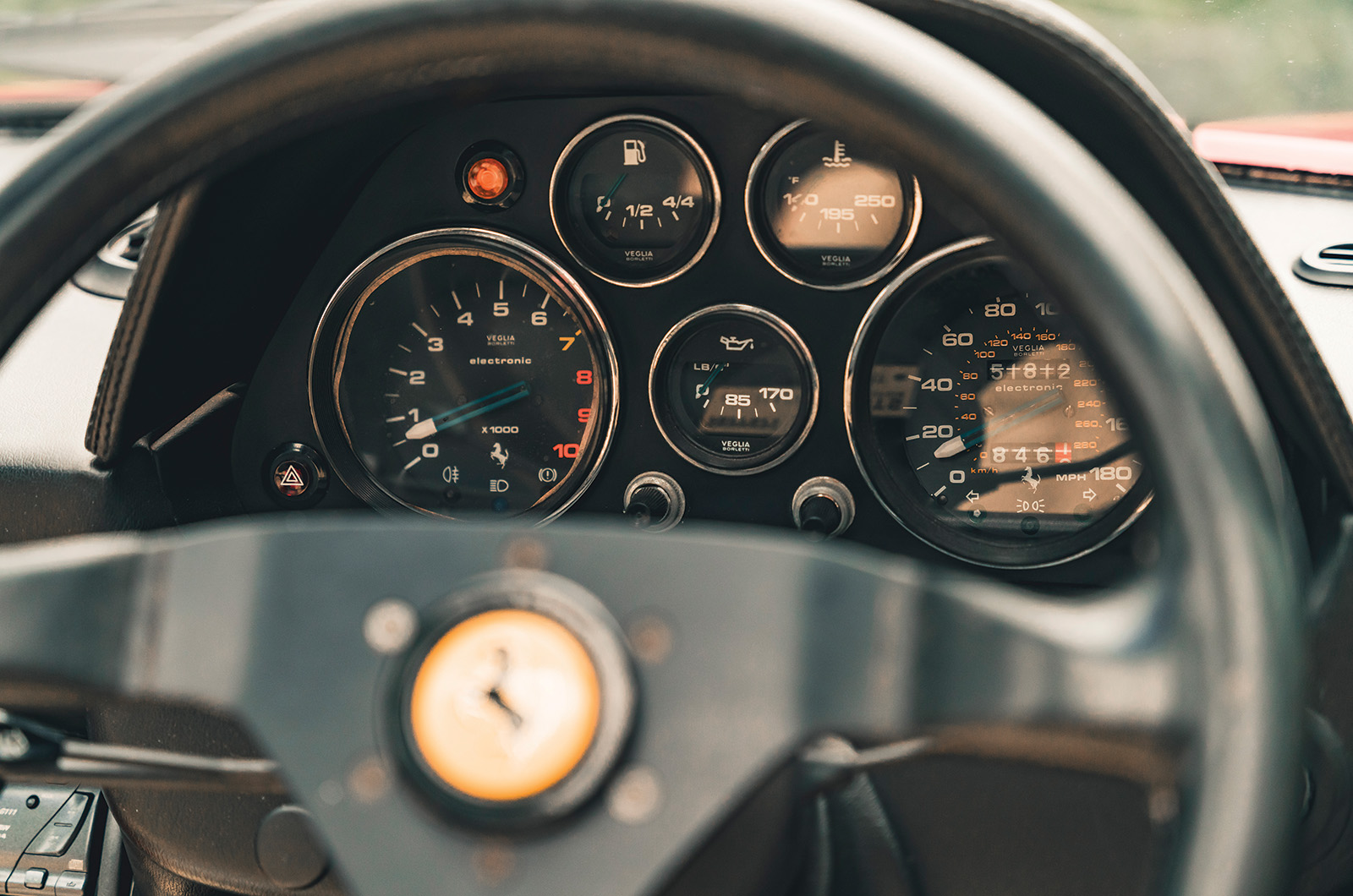
The Ferrari’s evocative instrument binnacle
We have motored down from the UK in two cars, the second to accommodate photographer Max’s estate-load of camera gear.
Nonetheless, the 308’s rear boot has proved ample for two people’s soft luggage for a few days away, and there’s even room for extra clobber behind the seats now that the roof has been removed and dropped into the same space in its leatherette storage pouch.
After enduring some torrential downpours during the 600-mile, motorway/autoroute-heavy jaunt south thus far (during which the Ferrari didn’t miss a beat), some open-topped solace is definitely welcome now that the skies are blue and cloudless.
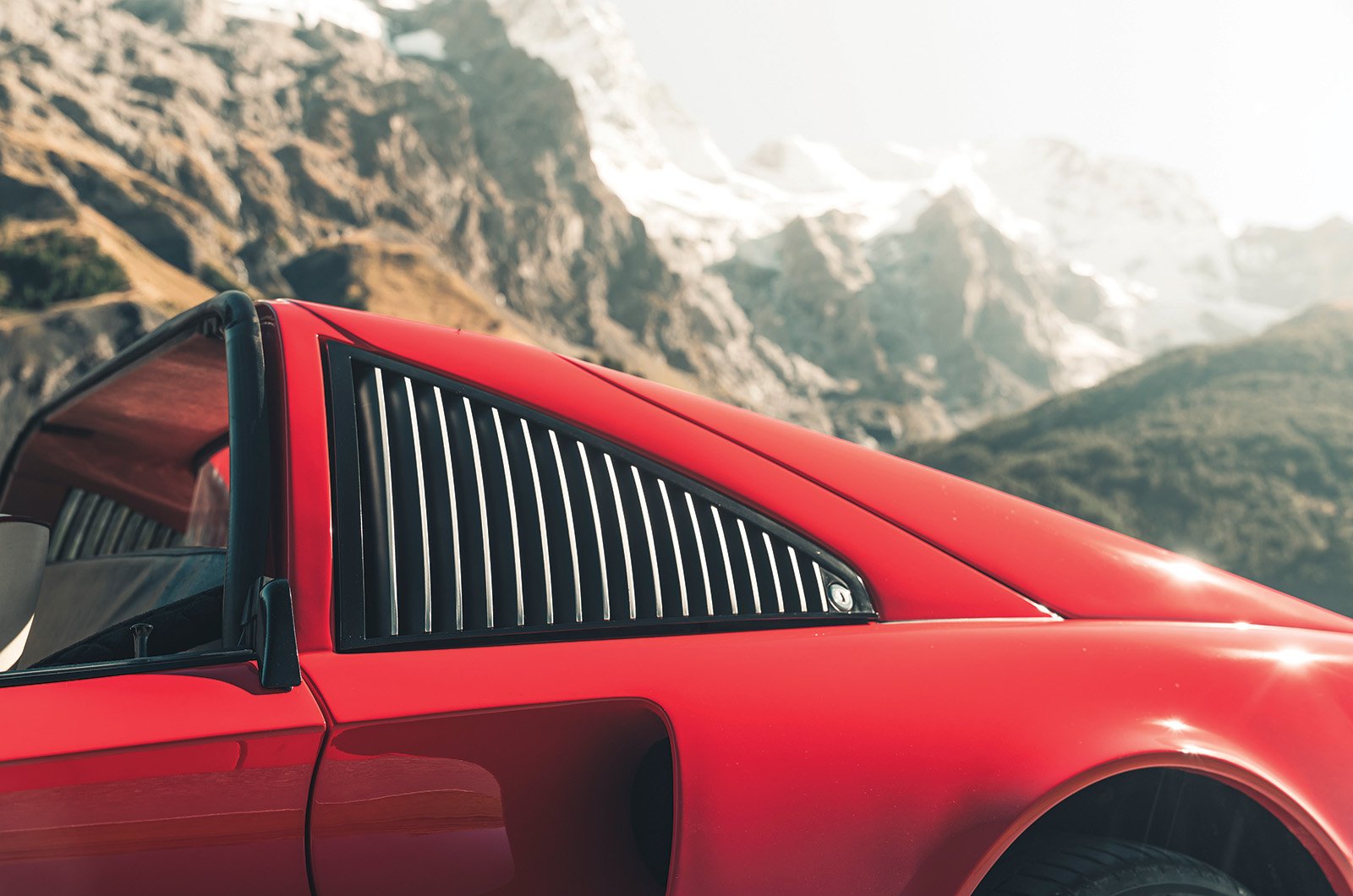
The Ferrari 308GTS qv’s opening grille gives access to the fuel-filler cap
Vizille, a commune just south of Grenoble in the Auvergne-Rhône-Alpes region, has been our overnight stop, and is the ideal starting point this morning for the trek east to Turin on the trans-Alpine D1091.
The town is famous for having hosted a meeting of the French estates of the realm in 1788 that heralded the nation’s revolution, but as we ease our way through its crooked, sleepy streets for some photography, it’s hard to imagine this little settlement playing such a pivotal role in the history of France.
The Ferrari feels equally incongruous: while it’s deceptively small, its abysmal steering lock, unassisted rack and restricted rear vision make this kind of back-and-forth manouevring for the cameraman more of a chore than usual.
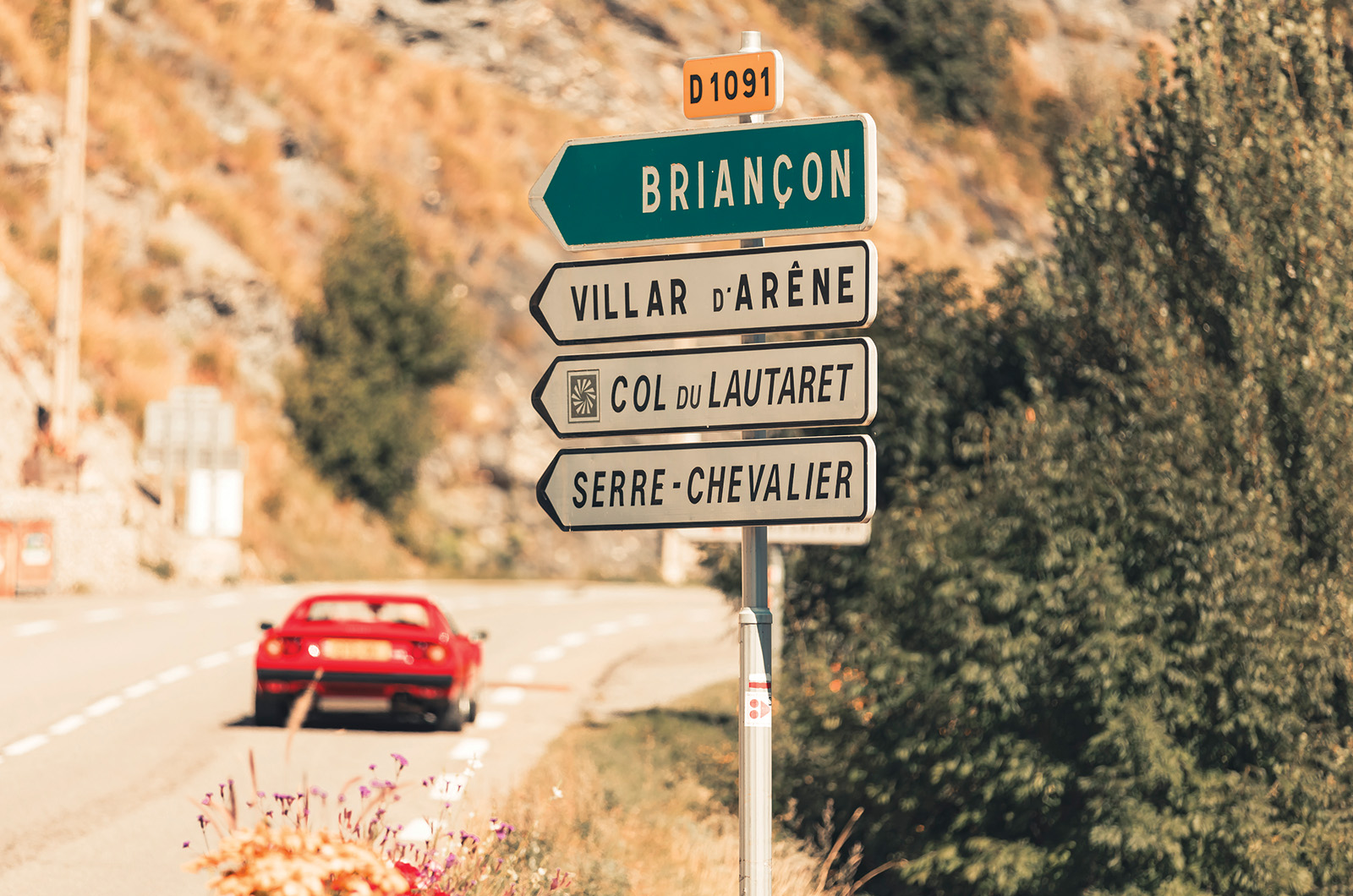
French roads are a joy in the Ferrari 308GTS
So when we do eventually hit the open road towards Briançon, it’s with much relief.
The early stages of this route are unremarkable: the Alpine Belledonne massif forms a magnificent and ever-present backdrop, but the road itself is still relatively distanced from the mountains, and it wends its way through the scenic valleys on a mainly level footing.
It’s a good opportunity to acclimatise with the 308 away from the previous day’s relentless motorway work.
You sit quite high behind the three-spoke Momo steering wheel – I now understand why, at 6ft 3in, actor Tom Selleck always appeared to be looking over the top of his open 308’s windscreen in Magnum PI, the detective series that helped to secure the legend of the GTS.
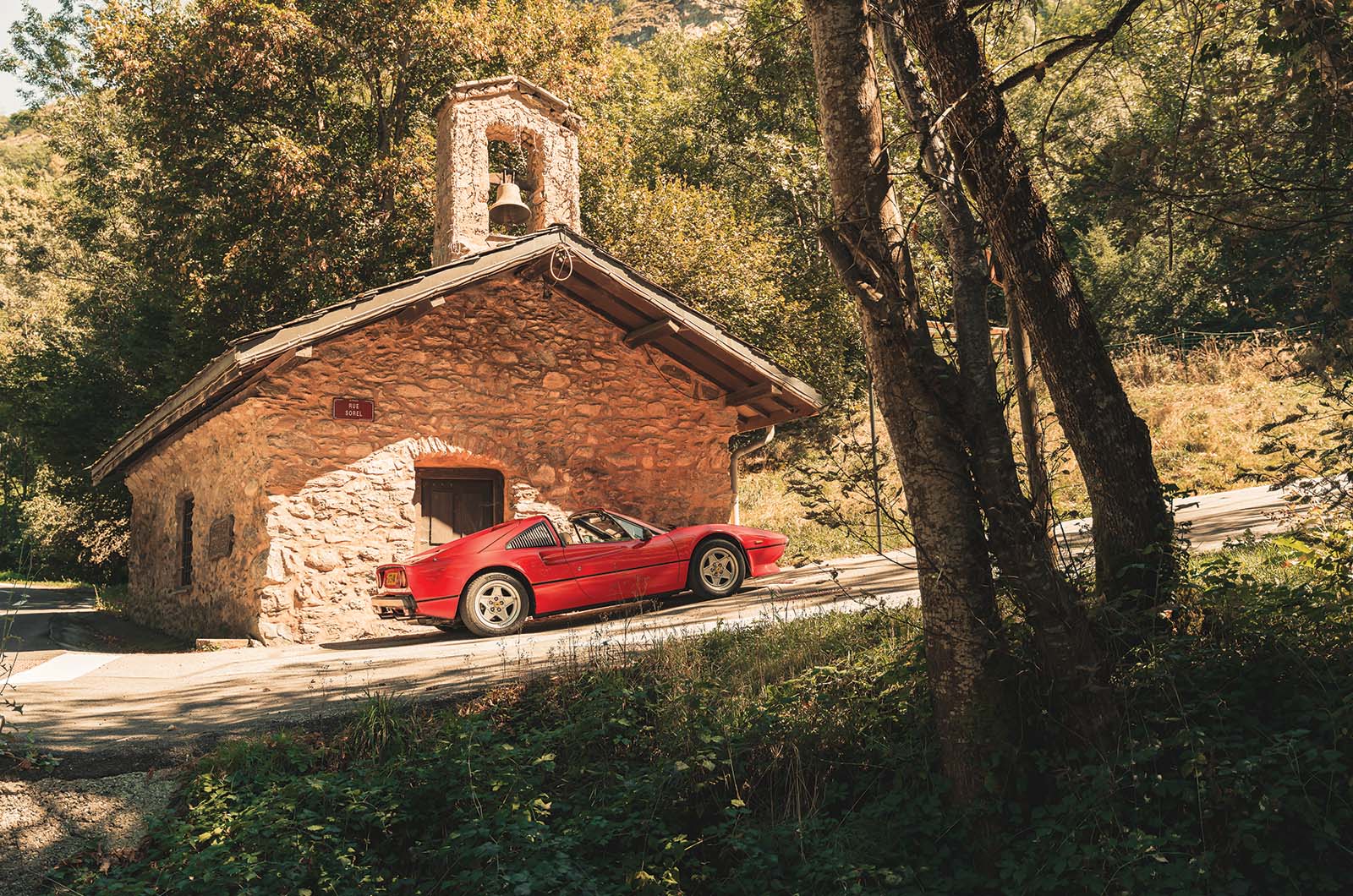
The Ferrari 308GTS qv at rest
But other than the pedals’ offset to the left, and the need for slimline footwear to avoid hitting brake and throttle together, the driver’s chair is a comfortable place to be.
Having recently driven an early, carburetted car, this fuel-injected quattrovalvole loses the delightful four-Weber warble and – at low to medium revs, at least – swaps it for something slightly more anodyne, as the 3-litre V8 fizzes away unobtrusively behind you.
Mark’s car – owned since 2020, and his ninth Ferrari and third 308 – was specified with factory air conditioning (£800) and a front spoiler (£230).
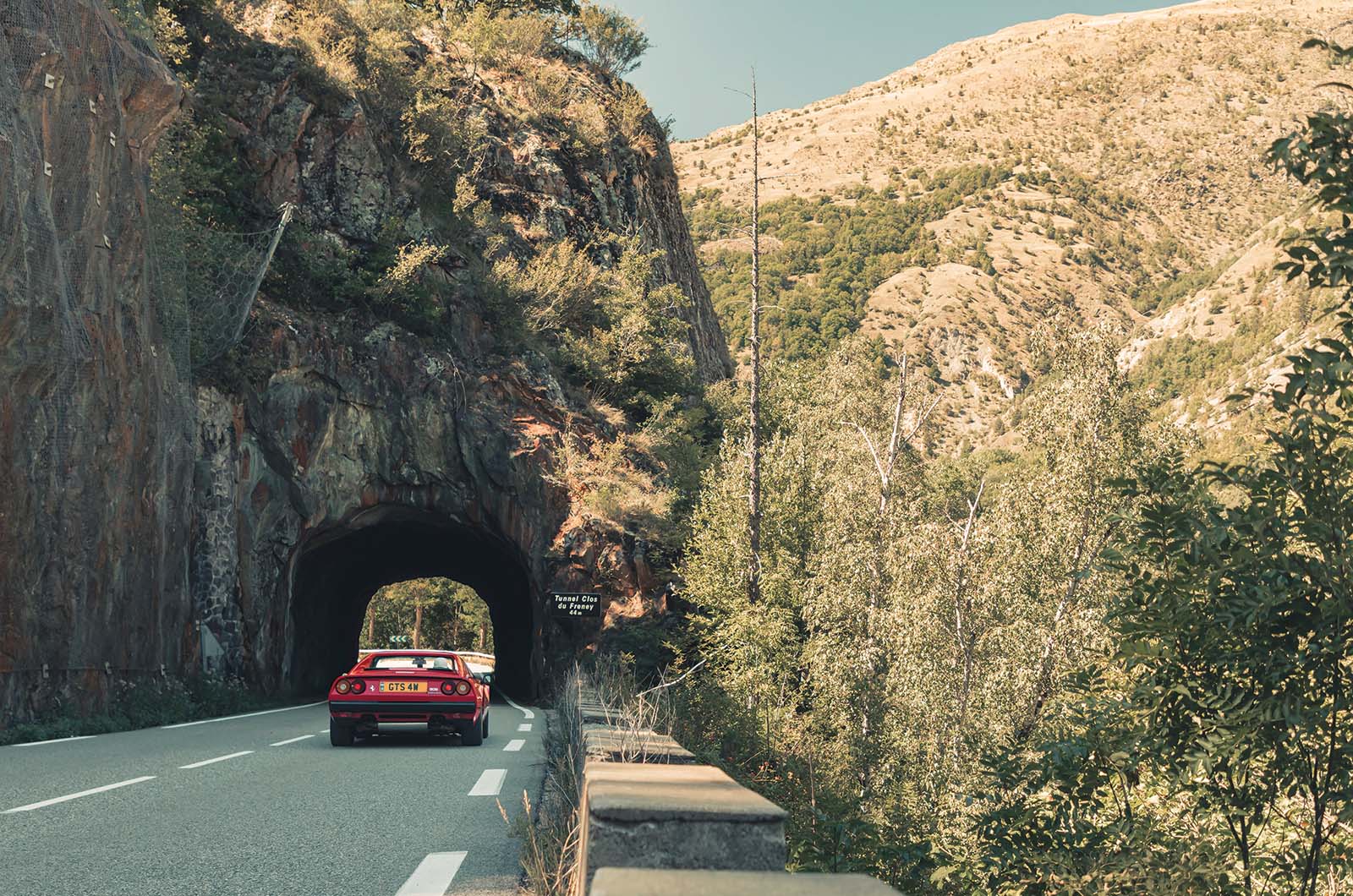
Tunnels amplify the Ferrari’s aural charms
It has covered 52,000 miles – around 30,000 in his tenure – and feels as fresh as it must have done when it was supplied by Colmore Ferrari Centre, West Bromwich, on 2 November 1984.
(Mark has had the car’s suspension rebushed and its steering rack overhauled in recent years, which surely helps here.)
That is just as well, because our route soon takes on a significantly more tortuous aspect as the mountains close in on our smooth ribbon of Tarmac, sometimes forcing passage through them, rather than around.
But that’s okay: select a lower gear than is strictly necessary, exercise the throttle’s relatively short travel and revel in the V8’s transformation from urbane to unhinged as its exhaust note bounces off the craggy tunnel walls.
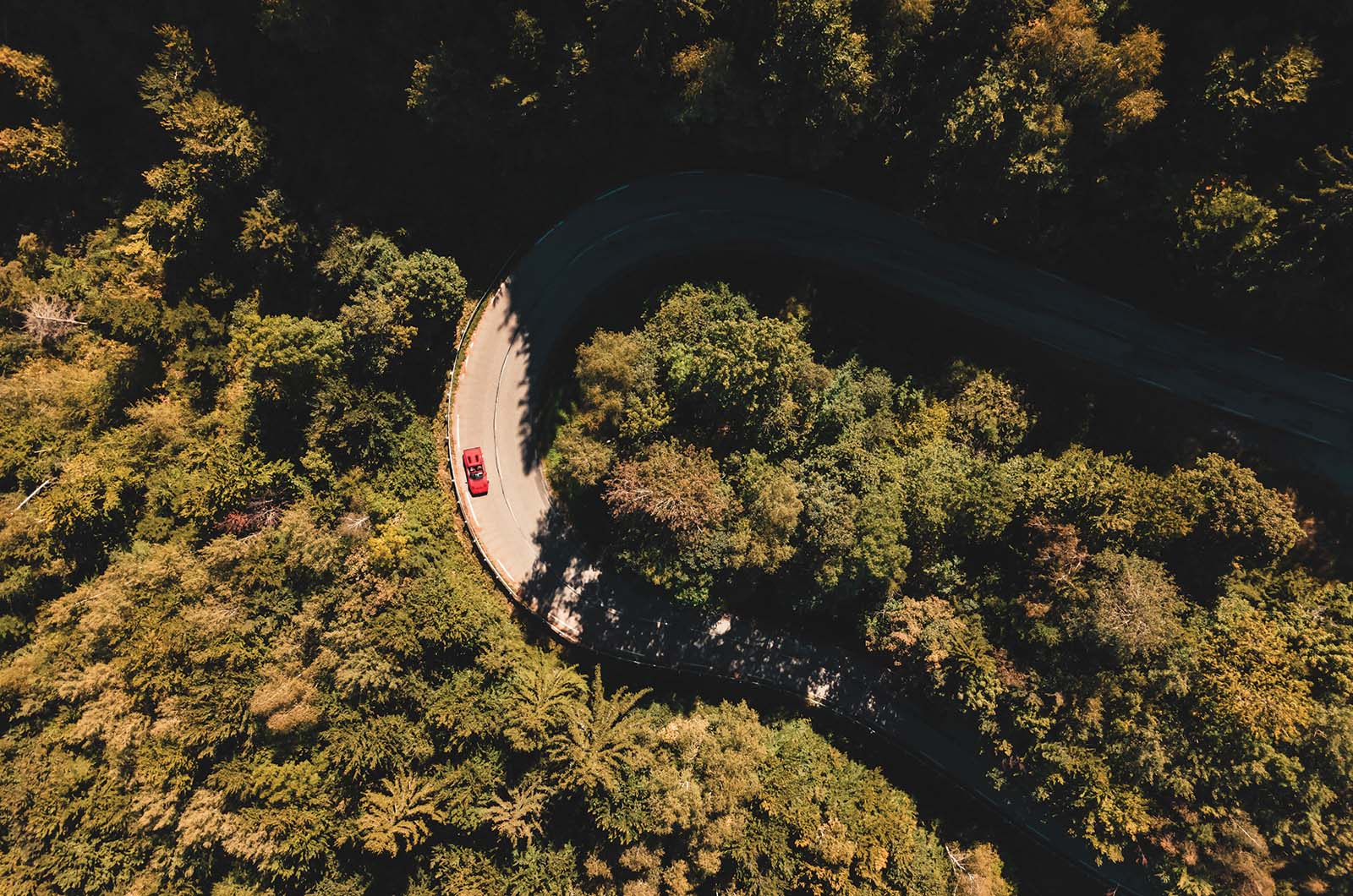
The Ferrari’s shape is arresting from any angle
You truly wake the motor at around 5000rpm, but from 7000rpm and beyond nothing comes close, its hard-edged, trumpeting blare somehow managing to be cultured and uproarious at the same time.
To be honest, by today’s standards that never translates into mind-bending performance – a current hot hatch would almost certainly show it the way – but that’s not the point.
It’s the way the 308 engages you as a driver that really counts, and in that respect it has few equals.
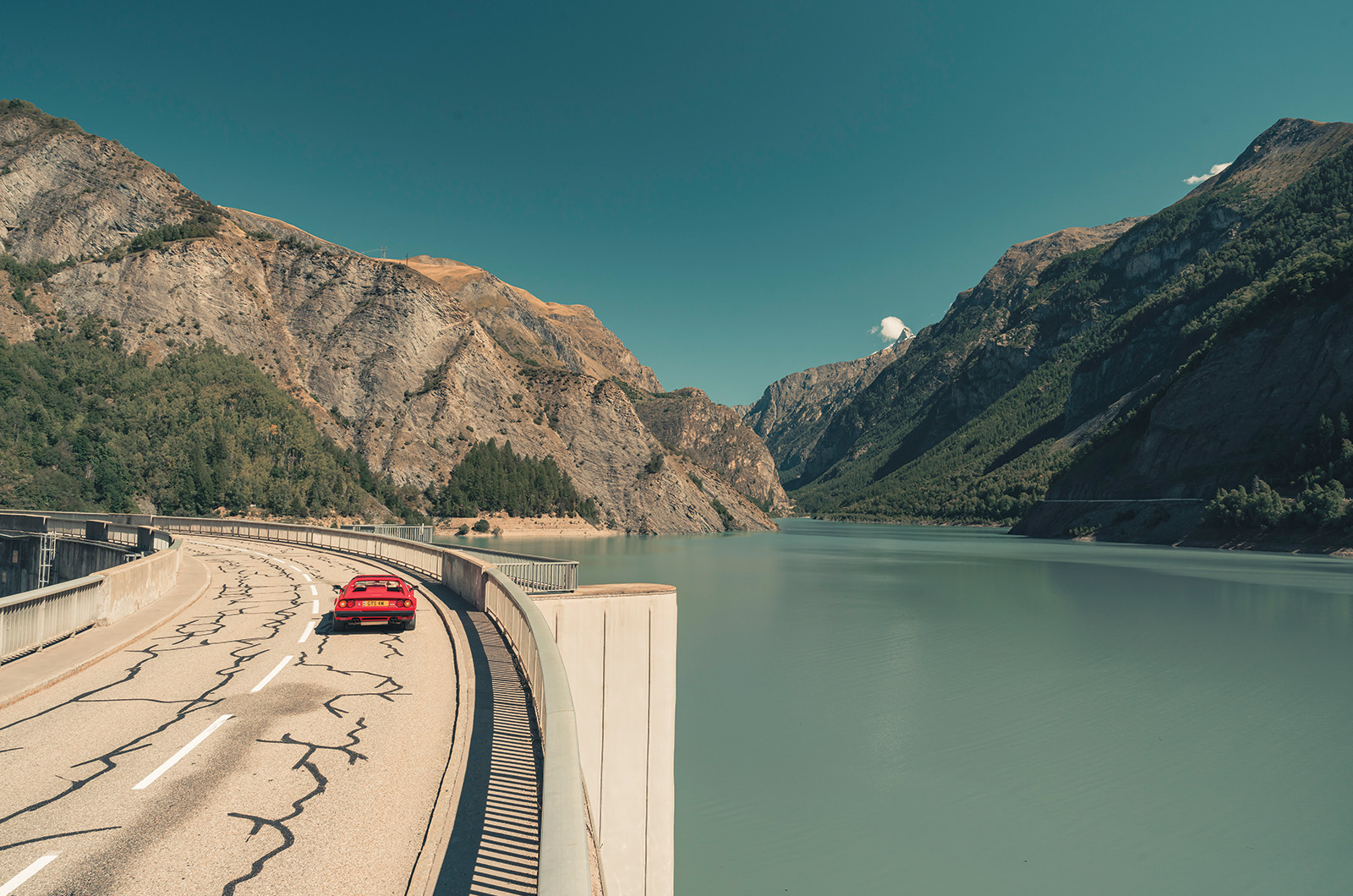
The Ferrari 308GTS howls along the road atop the dam for Lac du Chambon reservoir
Just past Le Freney-d’Oisans, we arrive at an oasis.
The Lac du Chambon, elevation 1040m, is a volcanic reservoir on the Romanche river, its vivid blue-green colour suggesting some kind of intravenous injection of dye, rather than a natural reaction from the lush green beech forests that surround it.
Our route skirts the perimeter of the lake, and while we wait for Max to capture some of its breathtaking beauty, a convoy of at least 20 UK-registered hypercars emerges from a tunnel, shattering the tranquility, their exhausts’ manufactured popping and crackling at odds with the purity of the 308’s more subtle soundtrack.
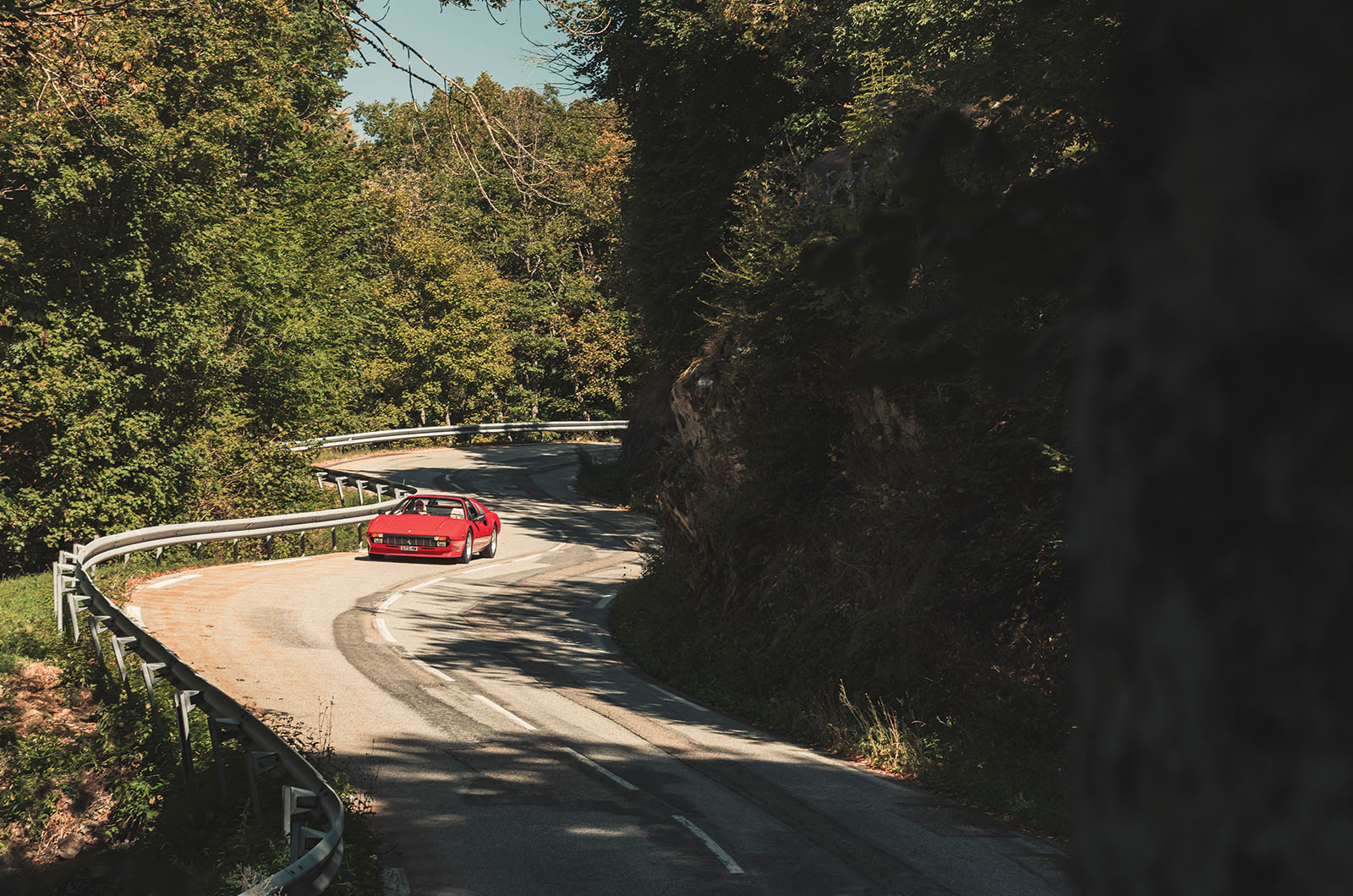
The Ferrari’s lively helm and great balance reward on sinuous roads
We continue eastwards, happy that this is mid-September and that the La Meije massif (3982m) that towers above us will not be making good on the avalanche warning signs that increasingly pervade this stretch.
We are now deep into serious skiing territory as we enter La Grave, a popular little resort for off-piste and extreme skiers, thanks to its near-vertical descent of 2150m.
The community is also a member of Les Plus Beaux Villages de France (The Most Beautiful Villages of France Association) and you can see why, with its attractive stone chapels, mills and monasteries from the Middle Ages perched amid the landscapes of the Massif des Écrins.
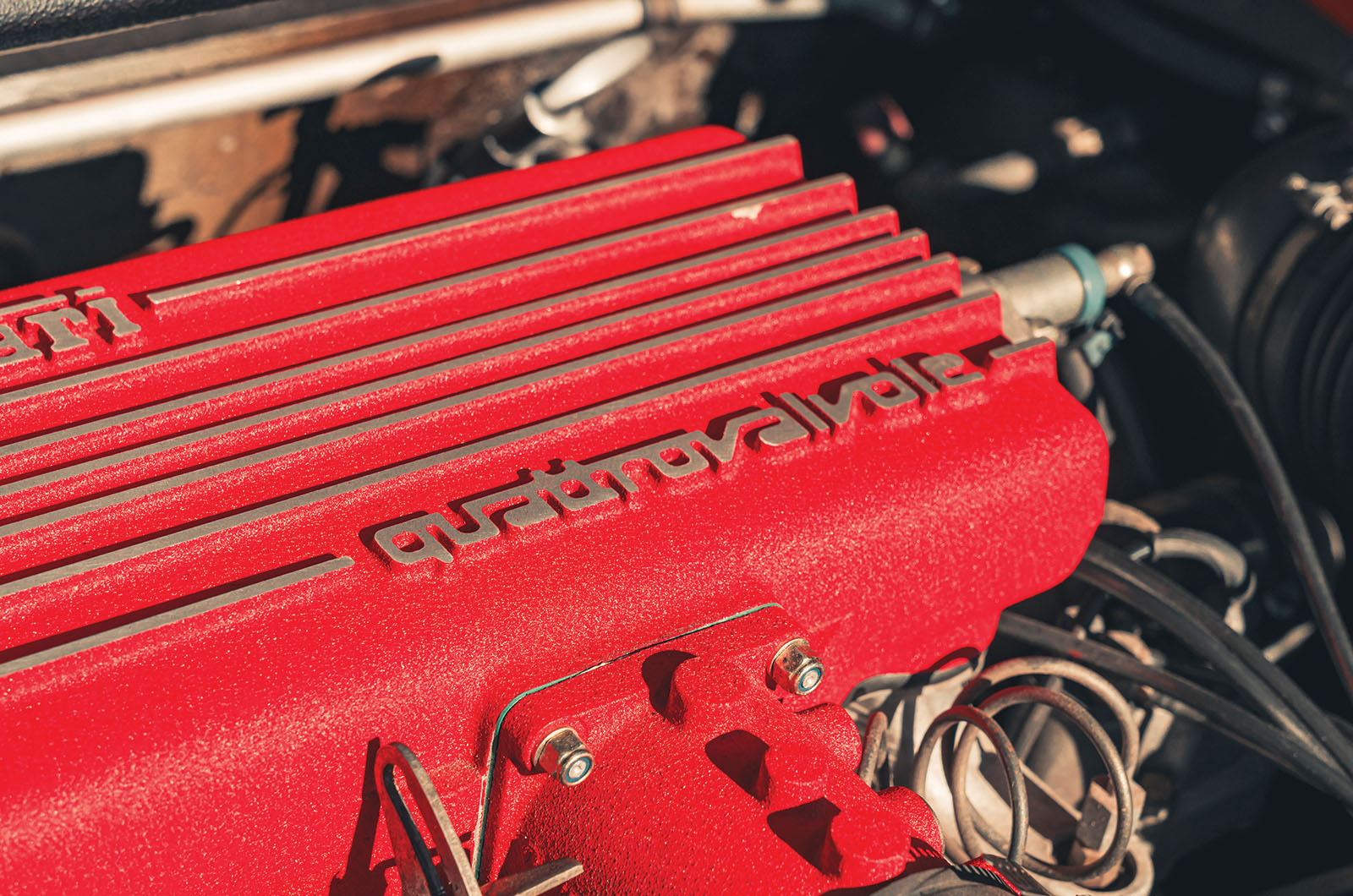
Fuel injection makes the Ferrari 308GTS quattrovalvole fairly docile at low revs
With the weather now bone dry, and with my phone recording a constant 26°C, there’s no evidence of the ski brigade soon to descend upon this village as we pootle through in the 308.
But as we leave the outskirts and climb further into the Écrins National Park, not only do the roads become ever more enticing – fast and open, with plenty of clear-sighted corners and ample opportunities for safe overtaking – but the peaks around us begin to gain a powdery covering, despite the glorious late-summer temperatures down here at road level.
It looks as if we’ll be getting an even better view of them, too.
Max has suggested a short diversion up the D902 to the Swiss border at Col du Galibier (2642m), which forms part of the Tour de France route.
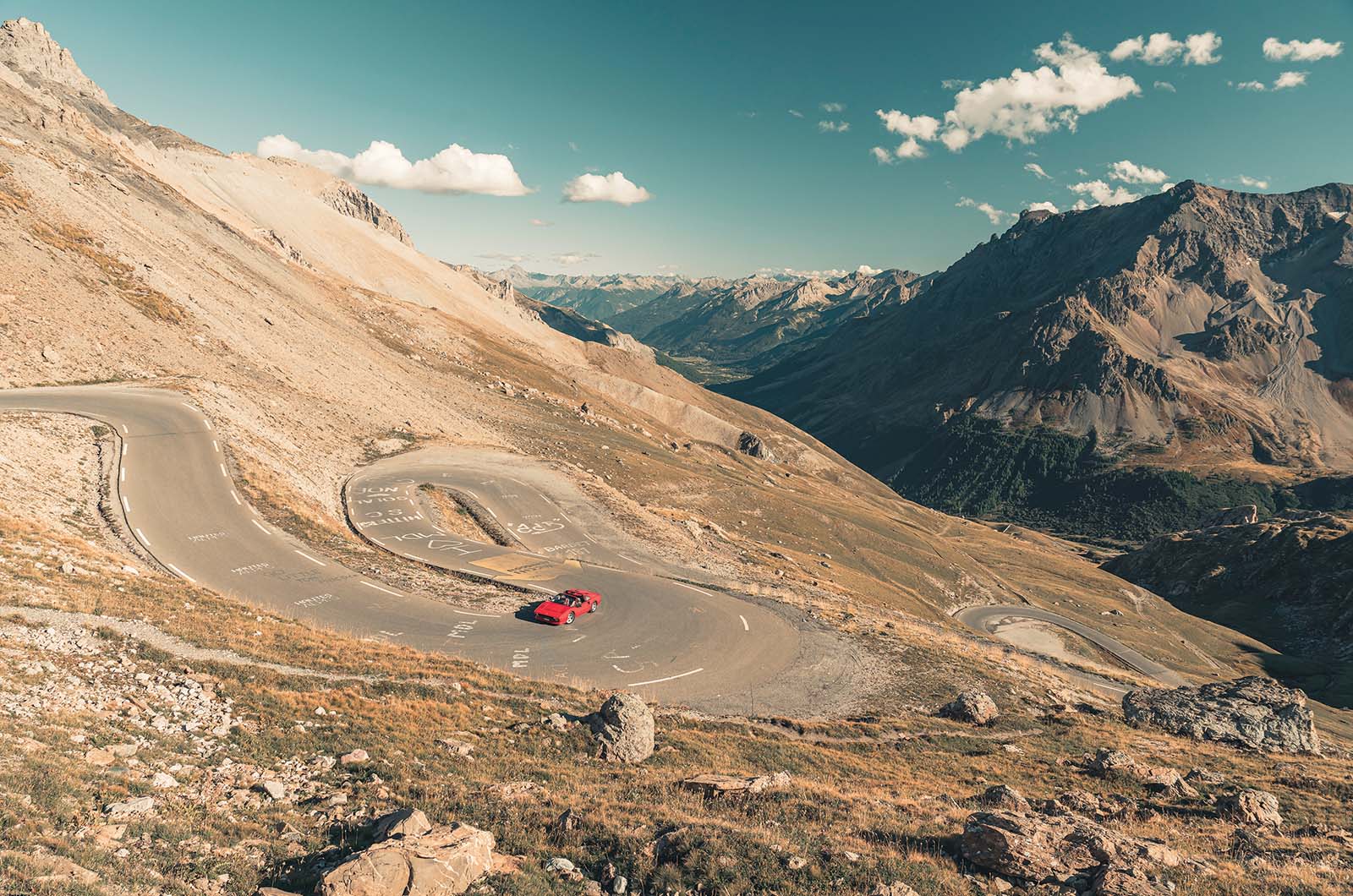
Enjoying the gloriously twisting roads in the magnificent Ferrari 308GTS qv
We attack the perilous switchback road with a bit more gusto than is prudent, given the unprotected drop mere inches from the Ferrari’s Michelins. But that’s fine: the 308 really does come alive as you push harder.
The steering, though still wearisome around the tightest hairpins, is pin-sharp elsewhere, allowing you to place the GTS with real confidence as you duck and dive up the mountainside, flicking occasionally into the other lane where vision allows (and daredevil downhill cyclists are absent).
It’s neat and precise through blind bends, and while the gearbox can be recalcitrant through its slotted chrome gate with less than full commitment, the shifts are fluid and quick when you’re truly on it, the accompanying ‘clack-clack’ from the spindly lever a telltale that it is being used as its maker intended.
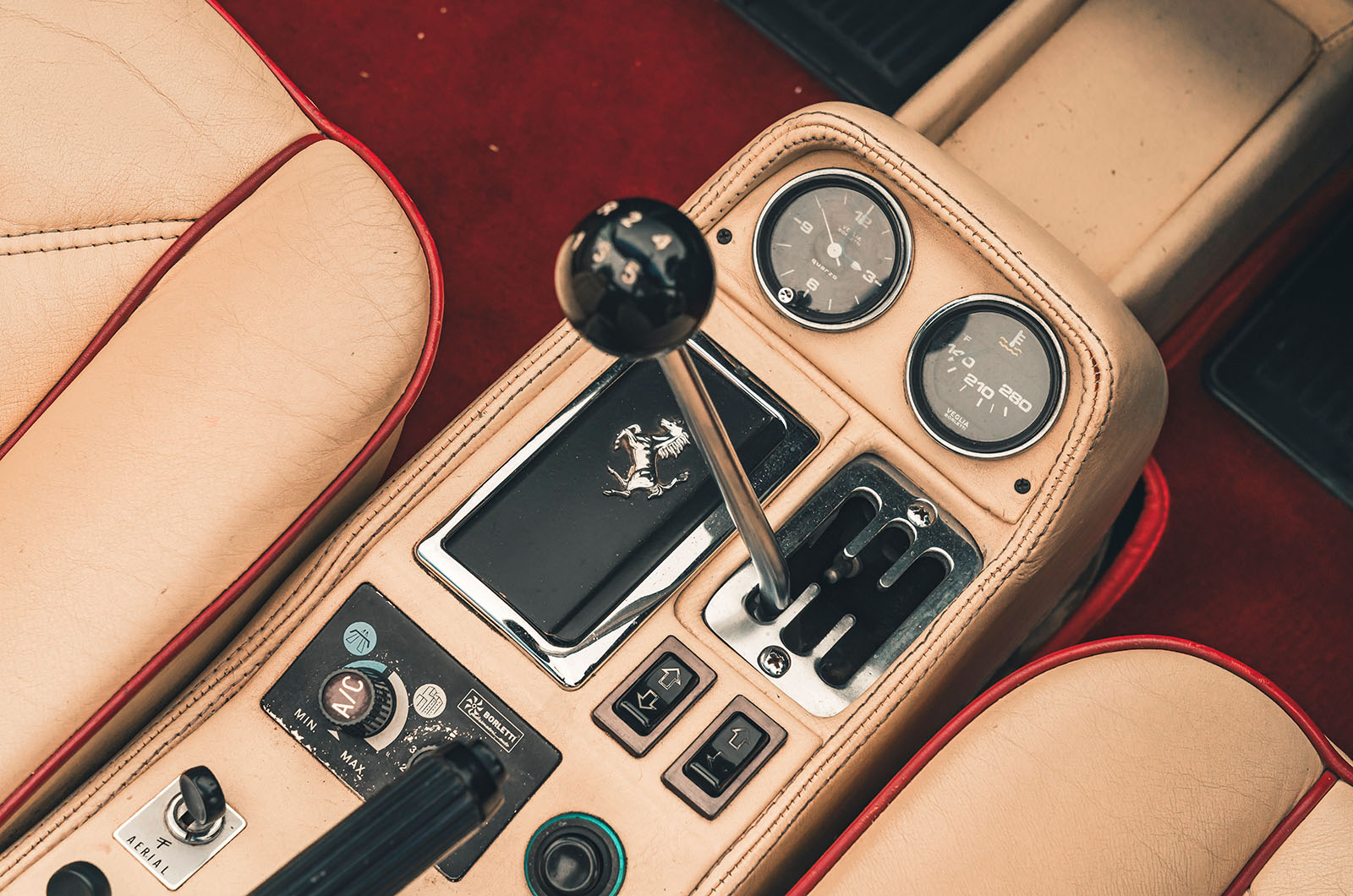
The Ferrari 308GTS qv’s slotted chrome gate
Border reached, we head back down at a more leisurely pace, casually sitting behind five reckless pushbikes regularly topping 65kph while cornering on tyres no thicker than the 308’s gearknob.
After a fuel and sandwich stop just shy of Briançon, we’re back on track for Turin.
As the D1091 joins the northbound N94, then on to the A32 autostrada, dusk is drawing in, but the air is still warm so the 308’s roof stays in its bag.
Mark and I chat away, not raising our voices, despite the speedo needle entering its upper reaches.
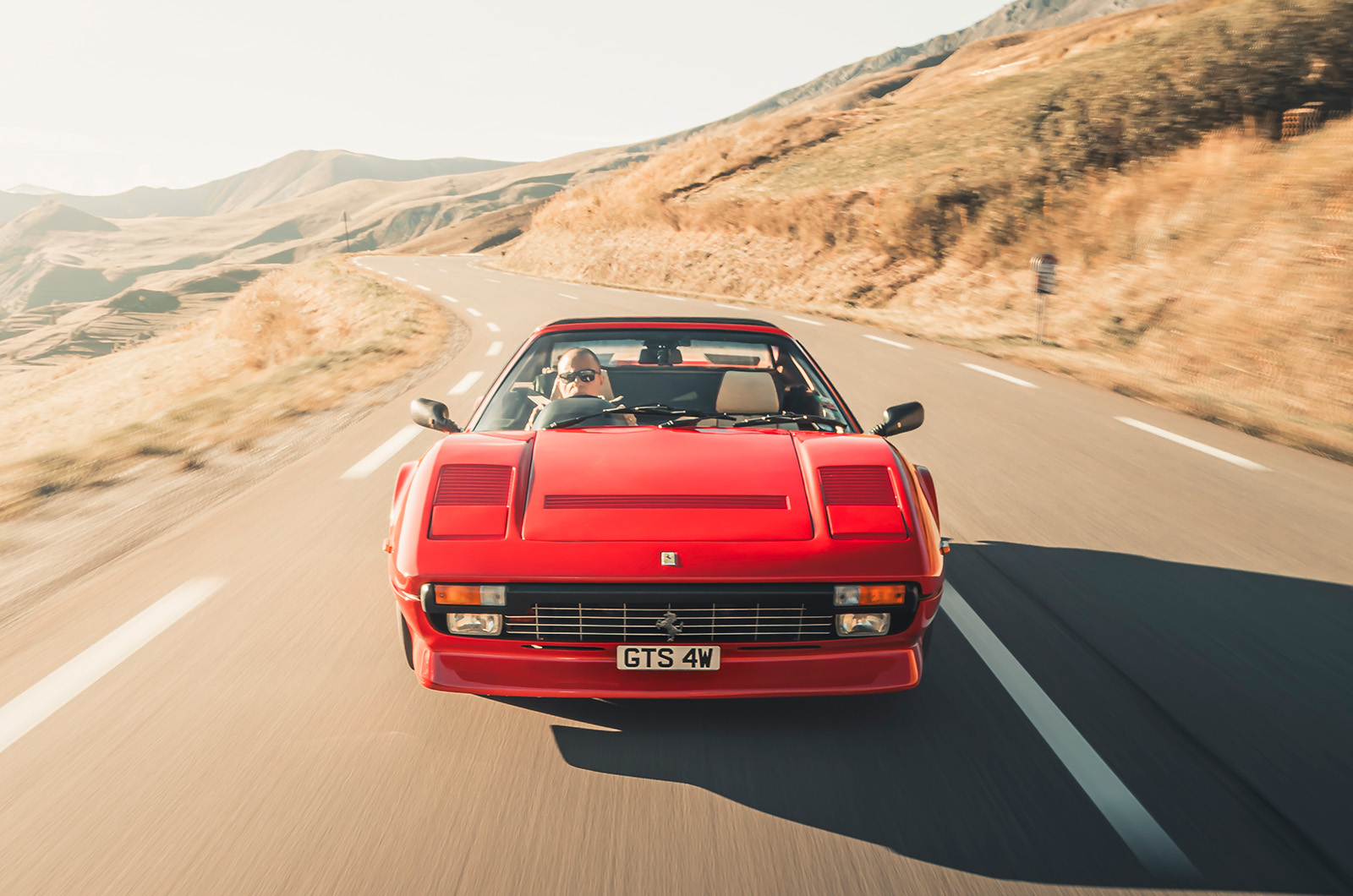
A dream drive across the Alps in the fast, beautiful and usable Ferrari 308GTS. Is this Maranello’s greatest real-world supercar?
Geared at 21mph per 1000rpm, the tachometer is showing a smidge over 4000, but the engine feels so peachy-smooth, and the car (and its occupants) so zen, that a finish at Milan – or maybe Venice – wouldn’t faze this delectable, covetable and highly usable classic Ferrari.
But Turin it must be, for tomorrow this particular 308 is to finally meet its maker…
Images: Max Edleston
Thanks to: Richard Dredge, Ferrari Owners’ Club of GB; Mark & Tracey Kieve
Factfile
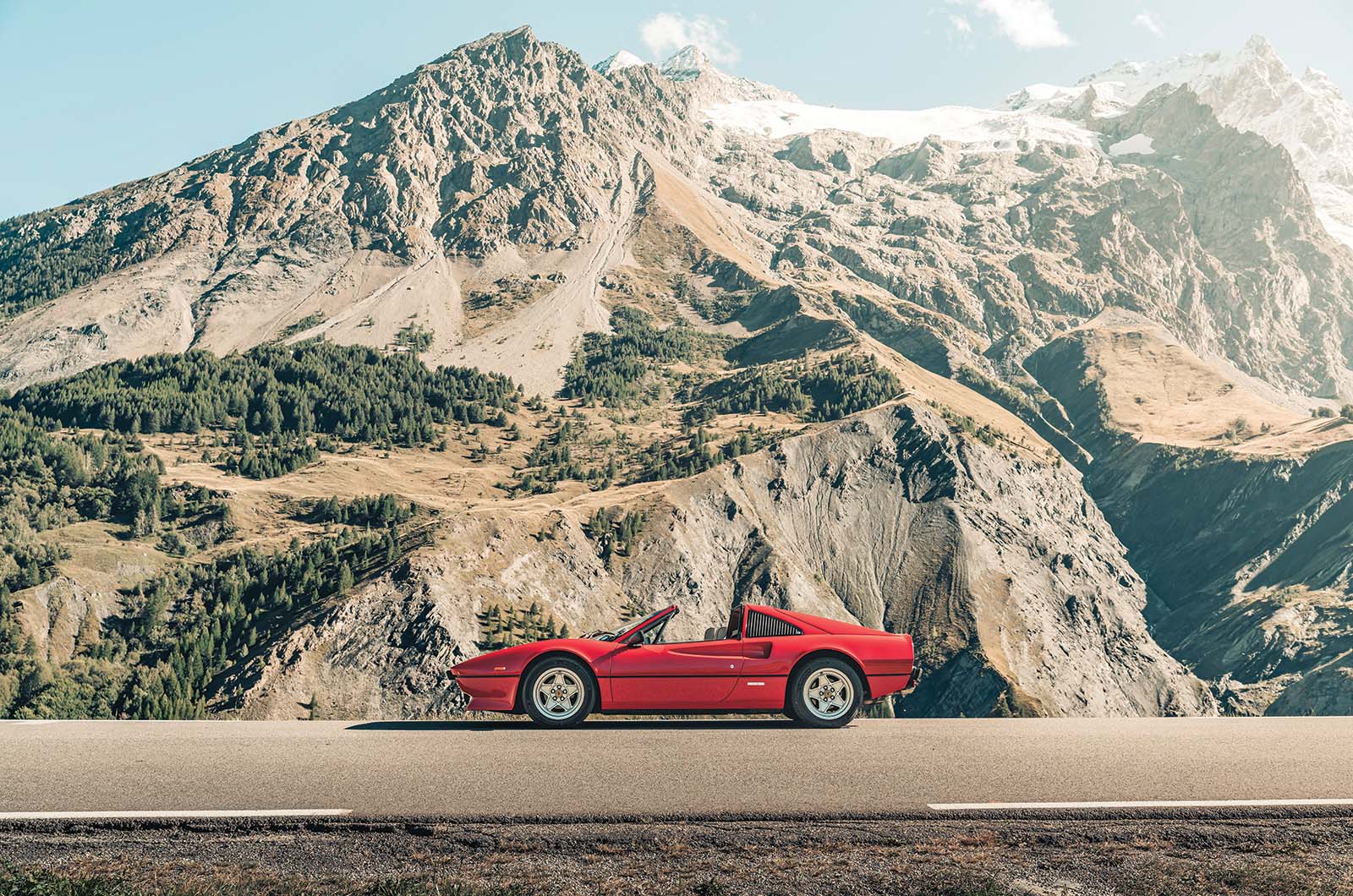
Ferrari 308GTS qv
- Sold/number built 1982-‘85/3042
- Construction steel tubular chassis, sills and rear bulkhead; steel, aluminium and glassfibre body
- Engine all-alloy, dohc-per-bank, 32-valve 2927cc 90° V8, Bosch K-Jetronic fuel injection
- Max power 240bhp @ 7000rpm
- Max torque 192lb ft @ 5000rpm
- Transmission ZF five-speed manual, RWD via limited-slip differential
- Suspension independent, by double wishbones, coil springs, telescopic dampers, anti-roll bar f/r
- Steering rack and pinion
- Brakes ventilated discs, with servo
- Length 13ft 10½in (4230mm)
- Width 5ft 7¾in (1720mm)
- Height 3ft 8in (1120mm)
- Wheelbase 7ft 8in (2340mm)
- Weight 2835lb (1286kg)
- 0-60mph 6.7 secs (est)
- Top speed 158mph
- Mpg 15-25
- Price new £29,300 (1984)
- Price now £60-100,000*
*Price correct at date of original publication
Enjoy more of the world’s best classic car content every month when you subscribe to C&SC – get our latest deals here
READ MORE
Ford Mustang at 60: Route 66 in the original pony car