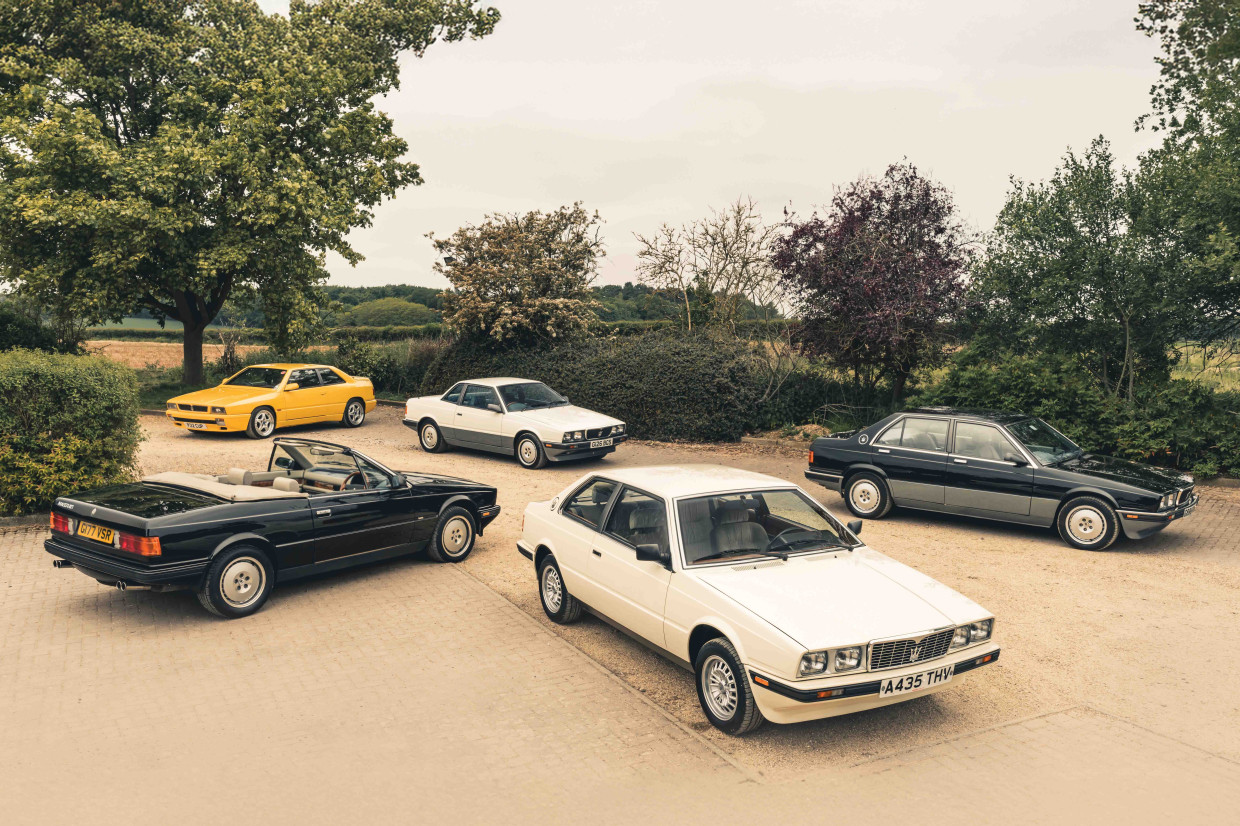
You often need a behemoth of a company to put up the funding for breakthroughs in technology, but desperation – that of a tiny firm trying to make waves on a limited budget – can also prove to be the mother of invention.
In the late ’70s, and recently acquired by Alejandro de Tomaso, Maserati was hovering around just 1000 cars a year.
Budgets weren’t large, but you can take risks when potential warranty claims and recalls number in the hundreds, not hundreds of thousands.
Already proven on the world’s racing circuits by the likes of Porsche’s 935, twin turbocharging was introduced the buying public by tiny Maserati.
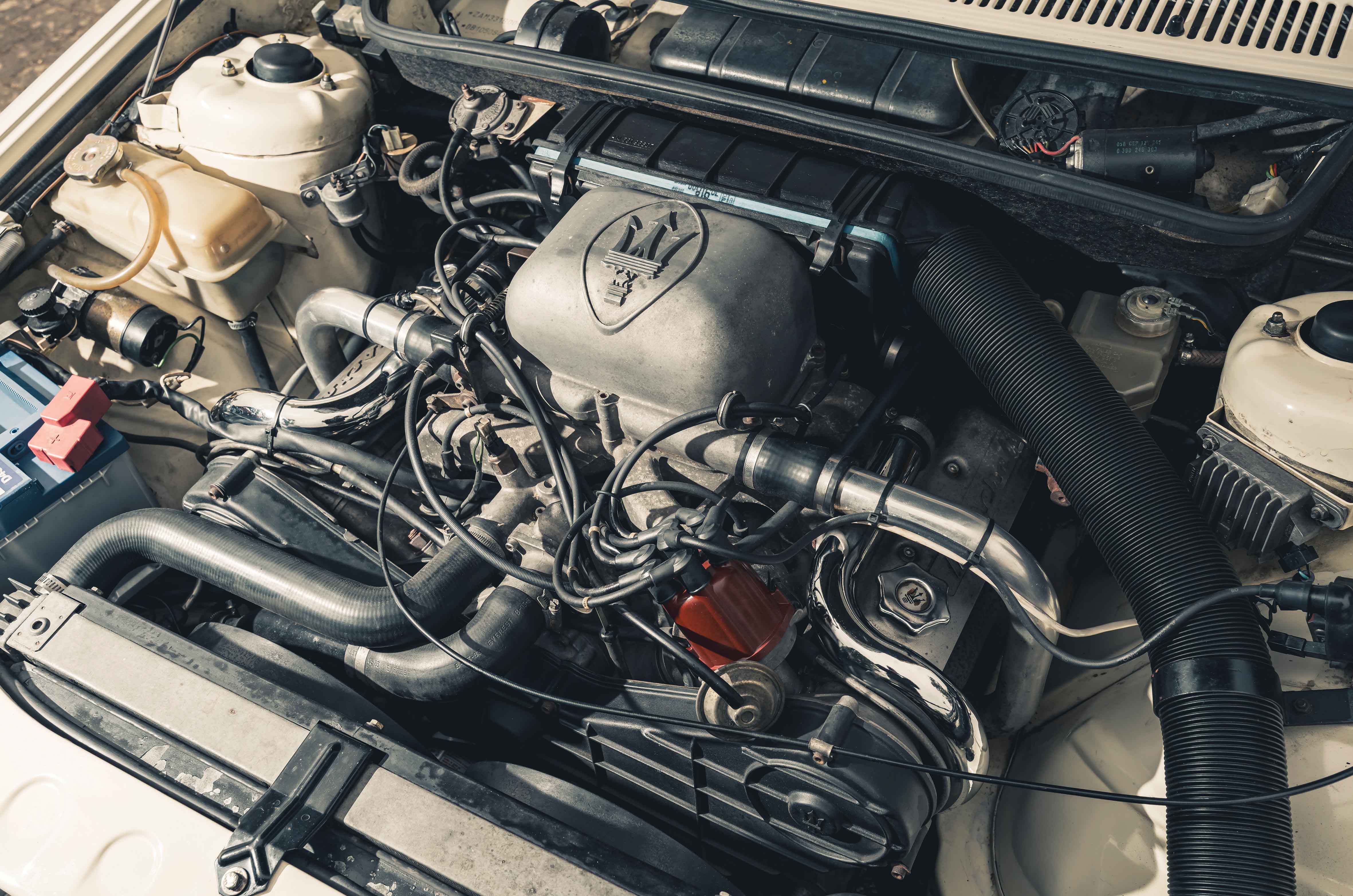
The original Maserati Biturbo used twin blowers to duck under Italy’s 2-litre tax threshold while making good power
Rarely in its turbulent history has the Italian firm’s product planning been logical, but twin-charging answered multiple questions for the new entry-level model.
The Biturbo’s raison d’être was to increase the manufacturer’s volumes, and sneaking under Italy’s punitive tax threshold for engines of more than 2 litres’ displacement would give an affordability boost over rivals such as the Mercedes-Benz 350SLC.
Forced induction provided the means of doing so without sacrificing performance.
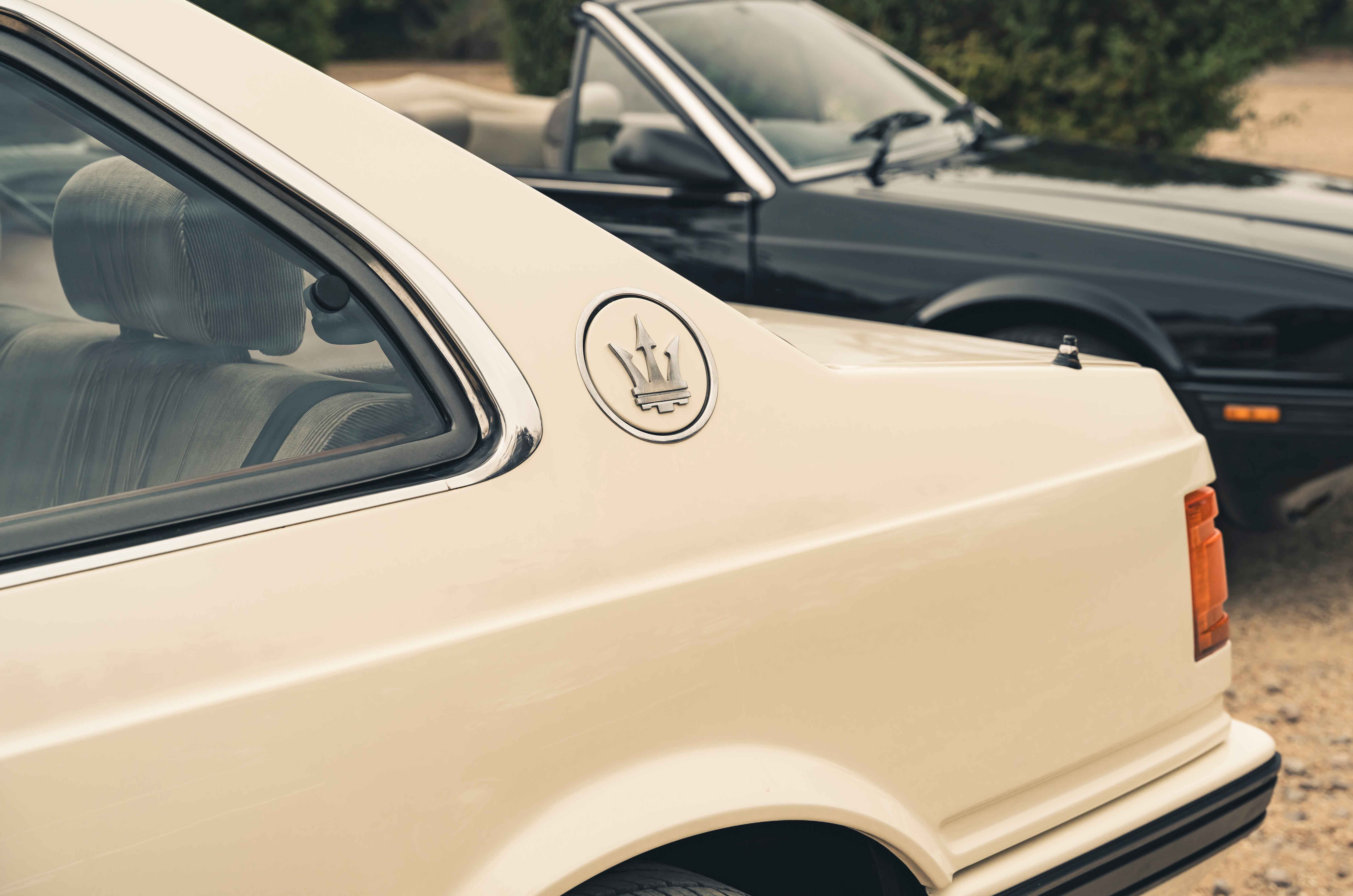
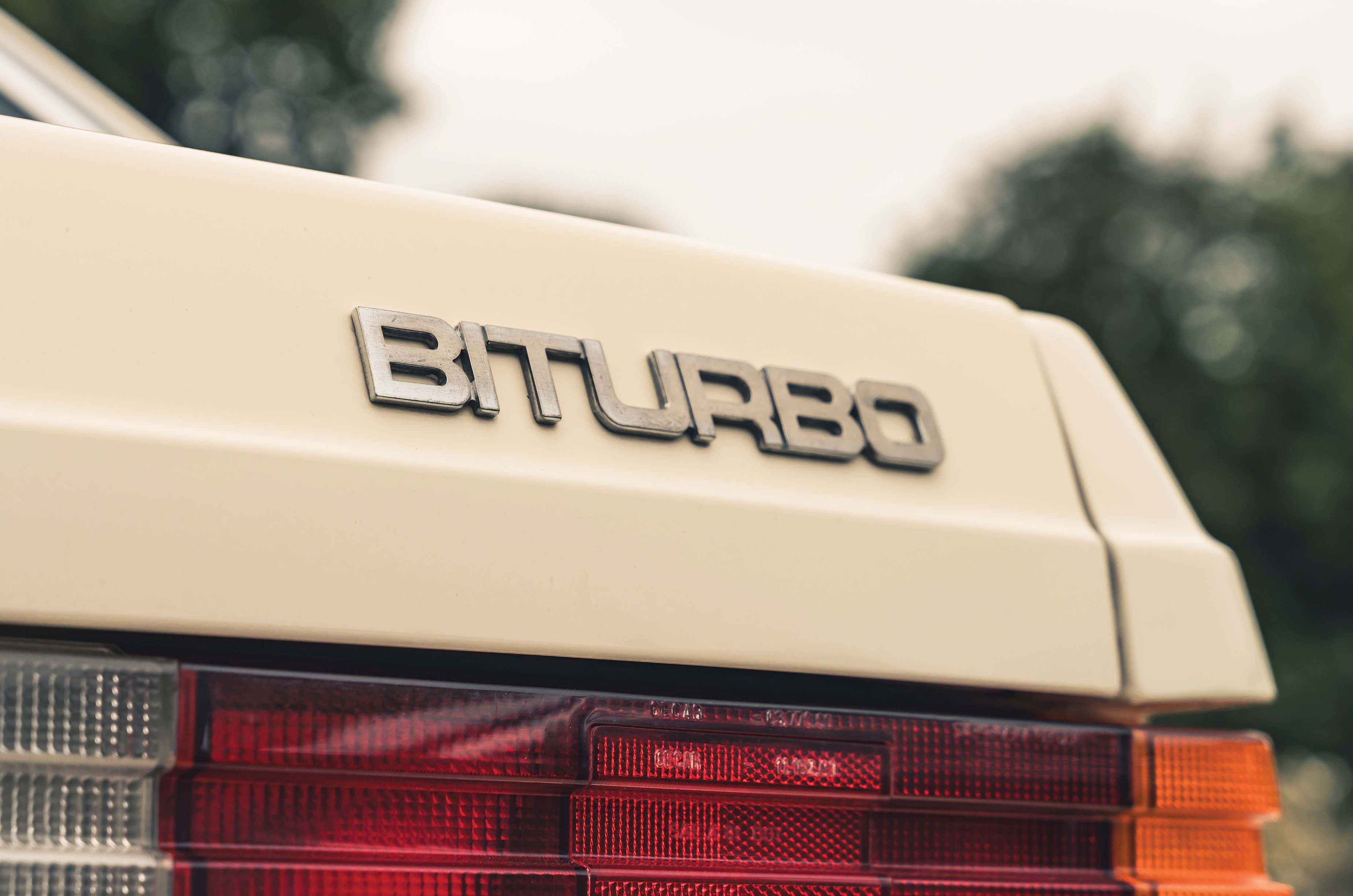
Maserati’s Trident sits proudly on the Biturbo, the pioneeering Italian that brought twin turbocharging to the road
Turbocharging was still in its infancy, with lag and reliability both big concerns.
Parallel twin turbos – where one big blower is replaced by two identical and, here, smaller units – promised lower spool times and reduced torque loads on the turbos’ internals.
At the car’s launch in 1982, two non-intercooled IHI turbos with separate boost control fed a single carburettor inlet in the Maserati, making the set-up as simple to develop as possible.
Styled in-house and developed on a small budget, the Biturbo’s specification was perfectly ordinary aside from a pioneering engine only loosely based on the old Merak V6.
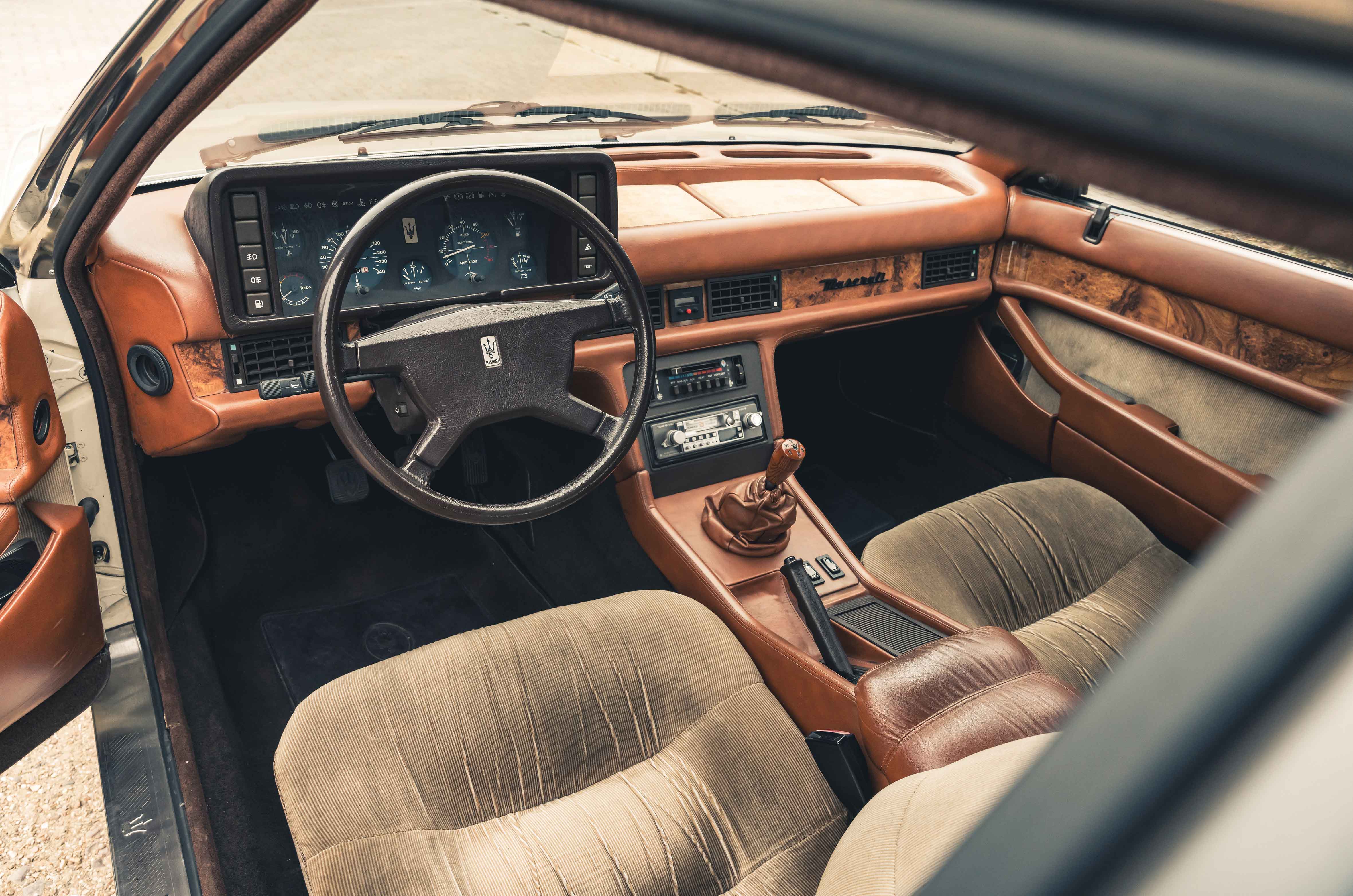
The Maserati Biturbo’s cabin is decorated with velour trim, brown leather and walnut inlays
It was not outdated – as many Maseratis of the past had been – but hardly at the cutting edge.
Its monocoque was suspended by MacPherson struts at the front and semi-trailing arms to the rear, while servo-assisted, four-wheel solid discs stopped the car and an unassisted rack-and-pinion steered it.
Not coincidentally, its chassis specification almost exactly mirrored the E21 BMW 3 Series, whose external design it also echoed.
Step into the white, launch-spec Biturbo here today and it’s clear that early development did indeed concentrate on the powertrain and cockpit rather than the chassis.
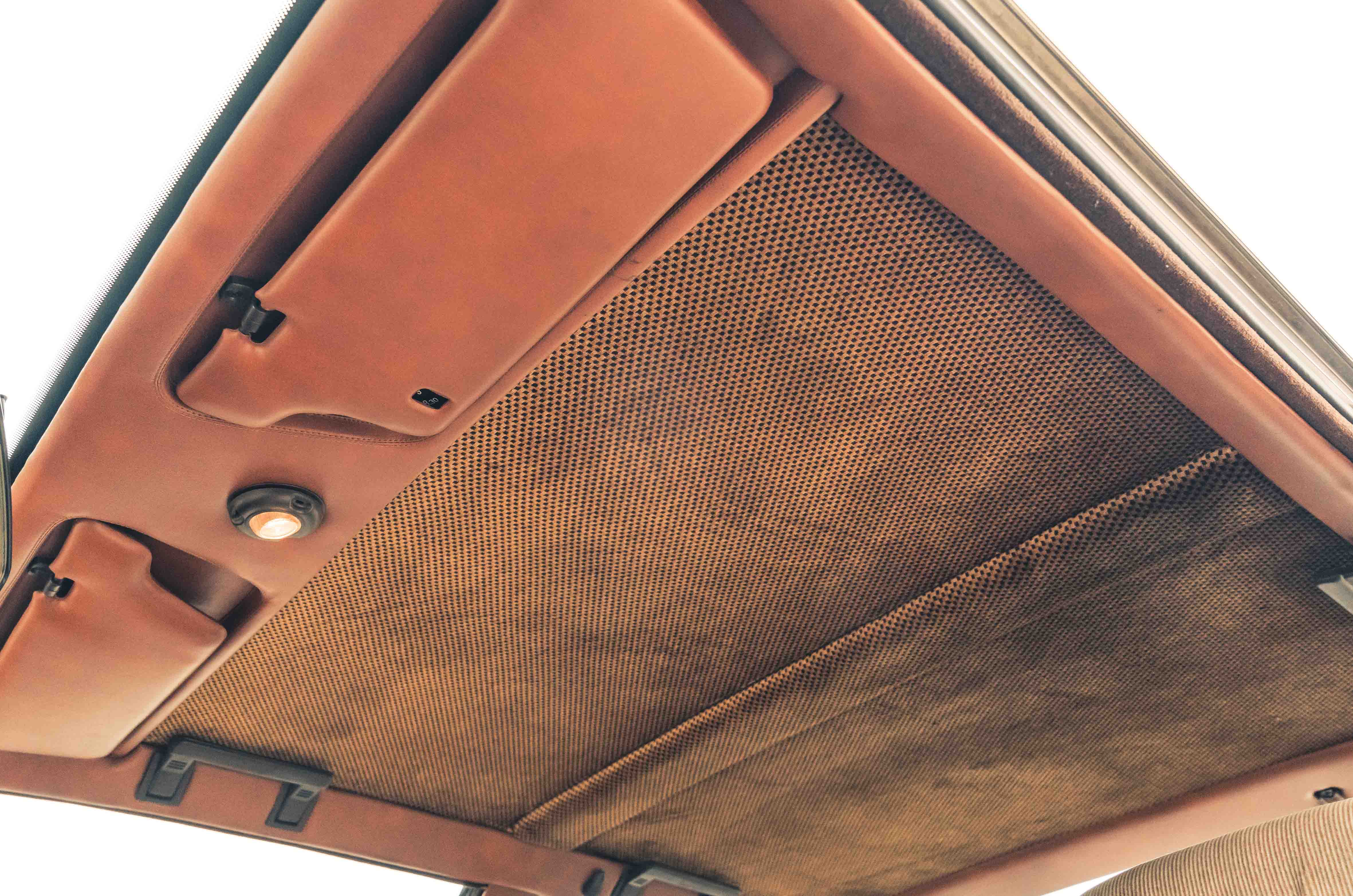
Black-and-gold headlining gives the early Maserati Biturbo’s interior a sense of period Modernist style
With striped, Champagne gold velour seats, walnut inserts and brown leather covering an interior that clearly takes inspiration from Modernist furniture, the Biturbo would have wooed customers with a vision of sophisticated, early 1980s Italian style inside, even if some accused its exterior of being generic.
A black-and-gold chequerboard headliner completes the impression of a chic hotel lobby of the period.
However, the most famous part of the Biturbo’s interior, the Lasalle dashboard clock, is notably absent.
That didn’t arrive until 1985, and instead this ’83 example has a rational, black-plastic digital clock that looks austere to 21st-century eyes but would have appeared modern and high-tech in the early ’80s.
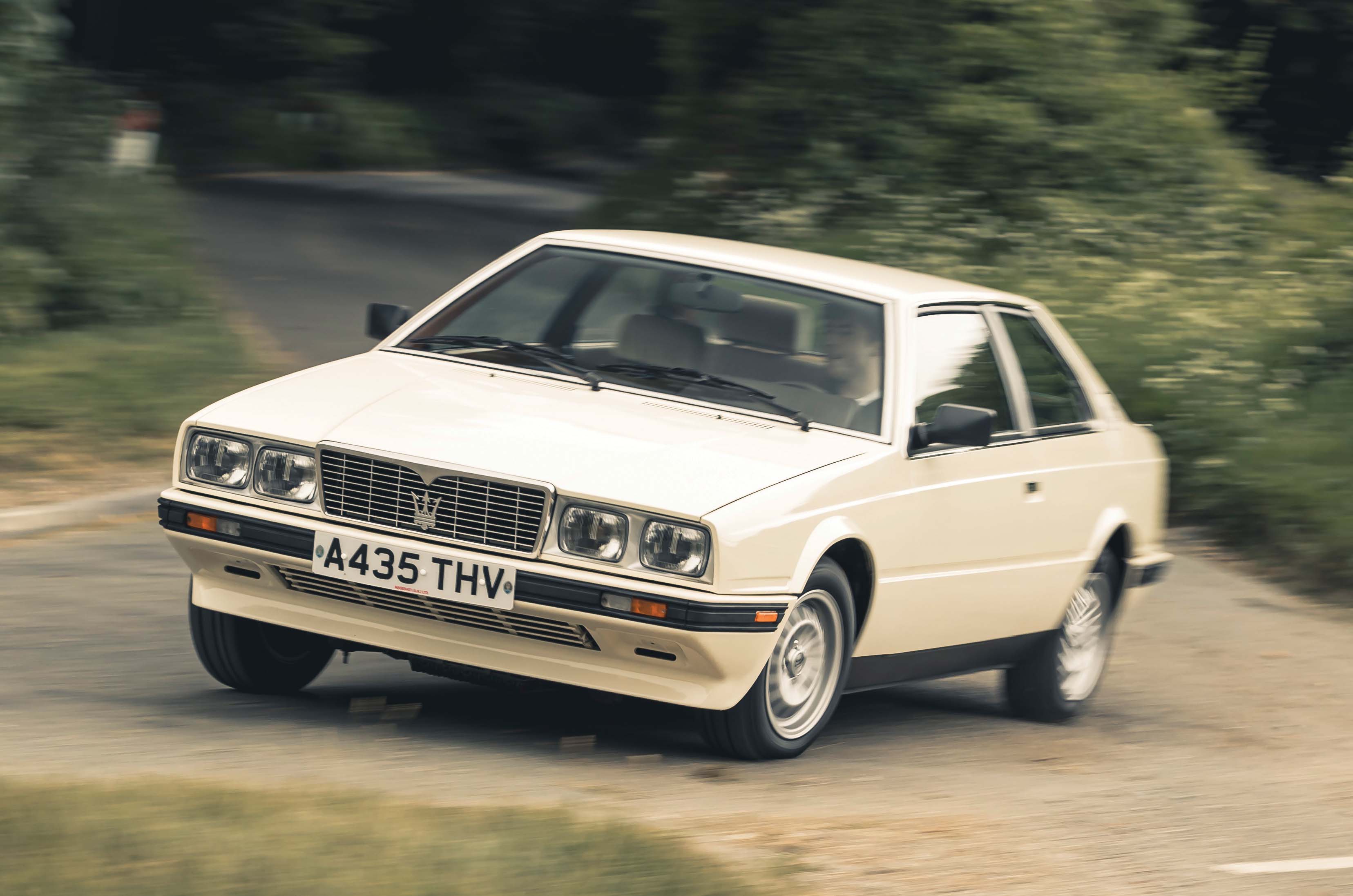
The Maserati Biturbo suffers from lag and needs care in the wet, but it still feels brisk
It takes a slightly long crank to get the 1983 car going – its Weber carb needs a few seconds to catch, says marque guru Andy Heywood of McGrath Maserati.
Once awake, it settles to a slight burble but reveals real character with a first prod of the throttle, projecting a hollow and throaty induction roar.
It’s the steering you really notice when first setting off, though.
Unassisted in this early car, with a fairly slow rack at 3.5 turns from lock to lock, it feels a bit woolly once at speed, and the arm-twirling required doesn’t fit the image of the car.
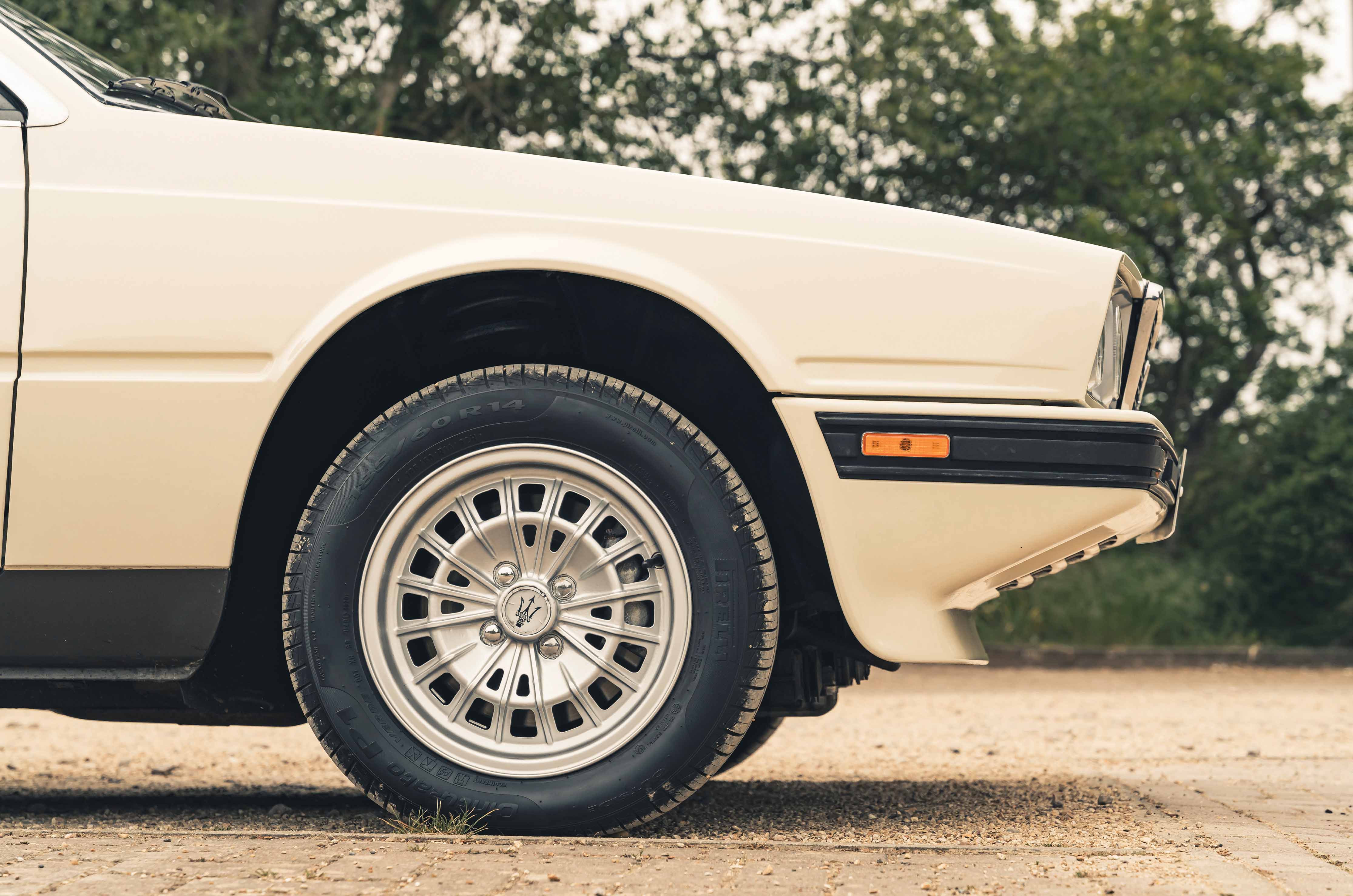
Alejandro de Tomaso redefined Maserati for the next two decades with the 1982 Biturbo
Still, it feels light on its feet and nimble, and close ratios in the ZF manual gearbox allow the 180bhp V6 to quickly reach 3500rpm, at which point its two turbos start providing good boost.
It is still laggy, the car races forward from here after pronounced flatness lower in the range, but it doesn’t deploy its power suddenly, with a blood-chilling whack in the back like some contemporaries.
More advanced boost control was producing better results by the late 1980s, but Maserati’s low-tech, hardware-based solution at least avoided the worst excesses of turbocharging at the start of the decade.
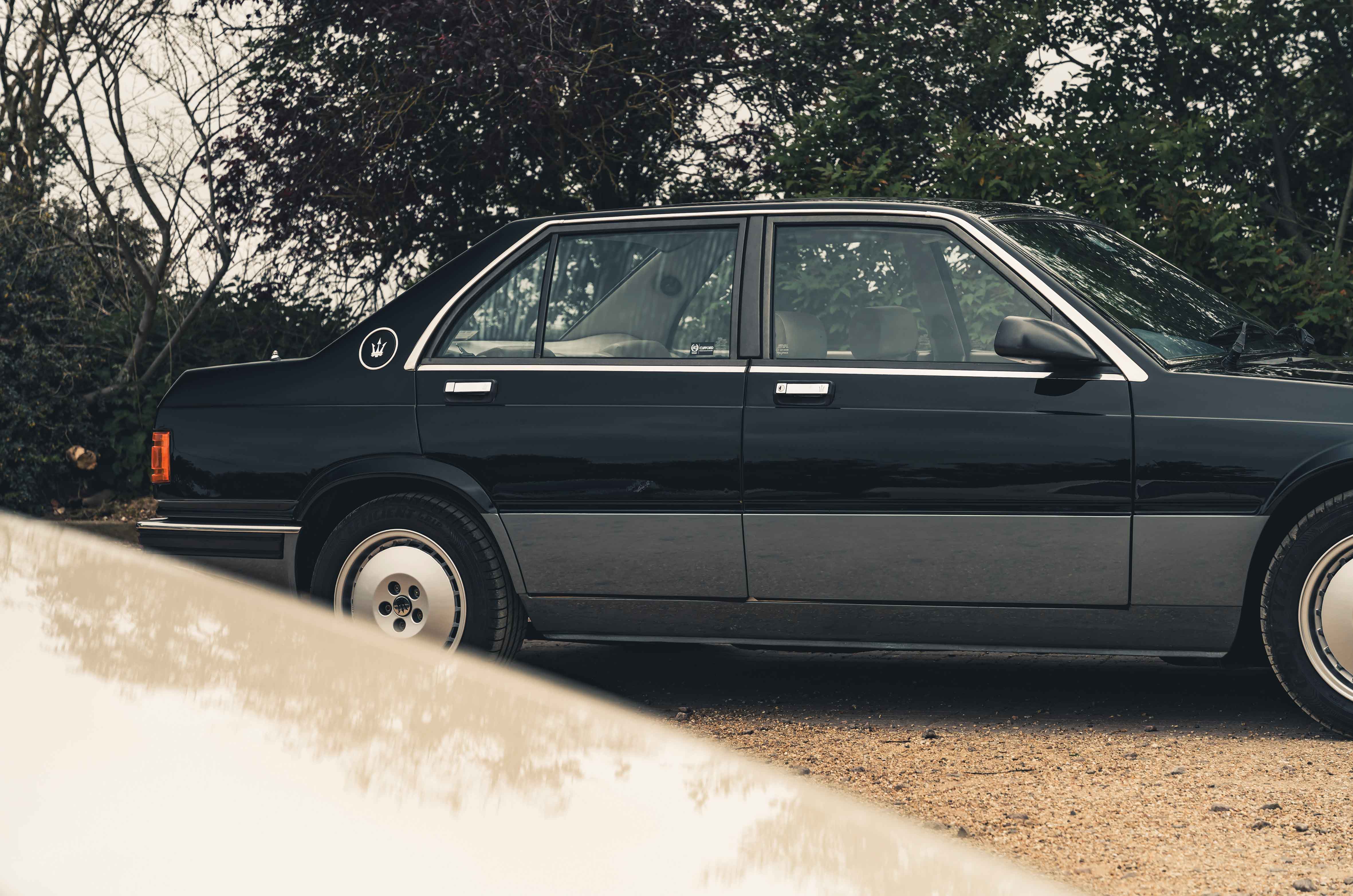
The Maserati Biturbo four-door looks better balanced than its coupé forebear
An early Biturbo is impressively quick for a car of its age and has to be driven with care – they are well known for swapping ends suddenly in the wet, and catching the rear is made all the harder by soft springing and that slow steering.
But, when driven like a GT rather than a sports car – with pace but not outright brutality – this charming, idiosyncratic early example doesn’t fail to raise a smile.
That personality allowed the Biturbo to morph into a premium sports saloon, which arrived as the 425 in 1983.
Where the two-door Biturbo looks slightly stretched in its middle section to fit four, the four-door, with its longer wheelbase, is supremely well proportioned: very much a pointier, Italianate BMW, as was Maserati’s aim.
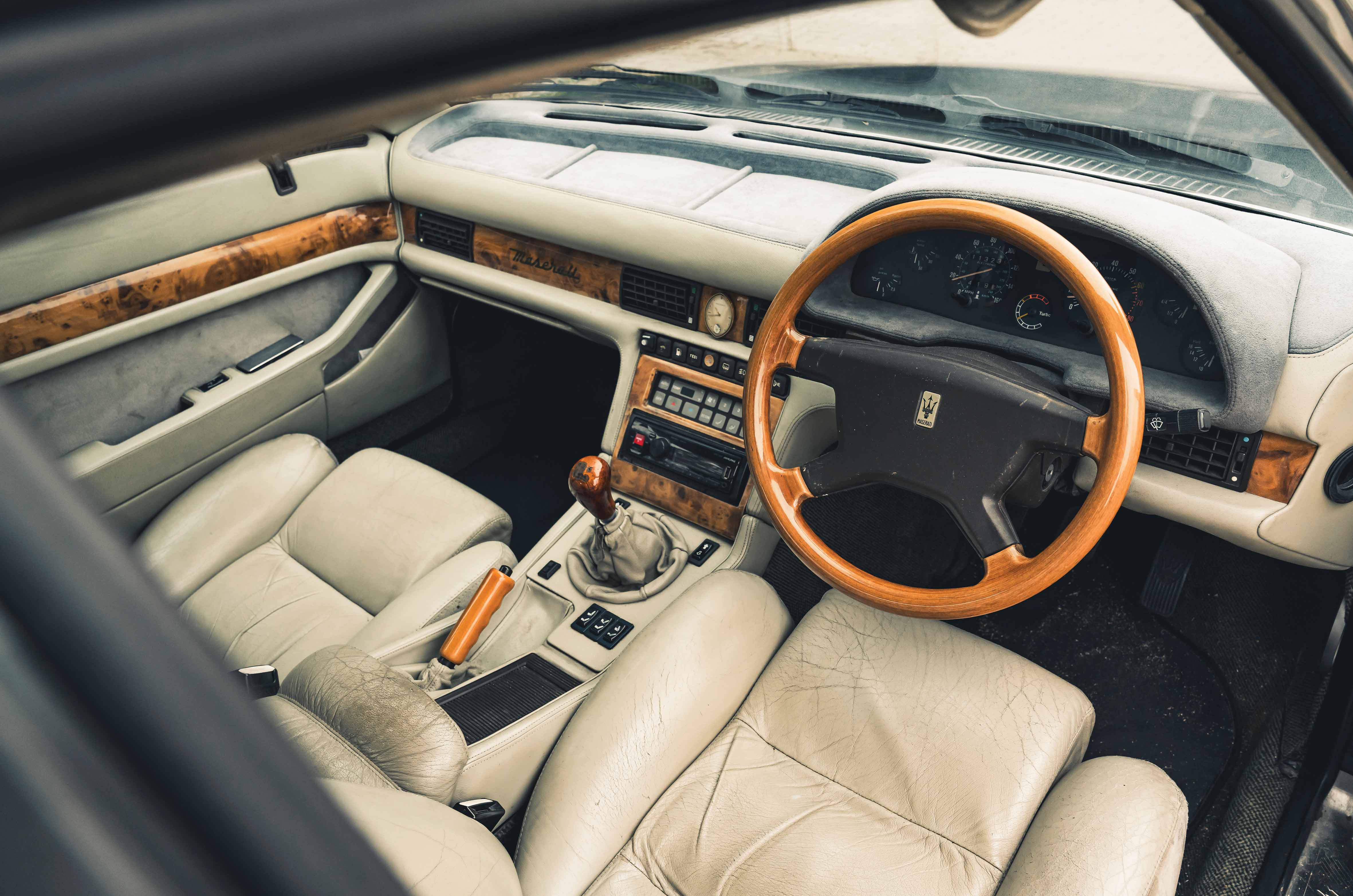
The Maserati 430’s cabin has more kit; all Biturbos switched to curved binnacles in 1985
Launched with the export model’s 2.5-litre V6, the car suffered the ever-changing nomenclature typical of de Tomaso’s Maserati tenure, variously badged 420, 422, 425, 4.18v, 4.24v, 430 and 430 4v.
Here today is a 430 – which, naturally, has a 2.8-litre engine.
Its thick, pillowy leather bears the wear of a car well loved, but the interior of the 430 is the most opulent here, bringing to the Biturbo family electrically adjustable seats and central locking.
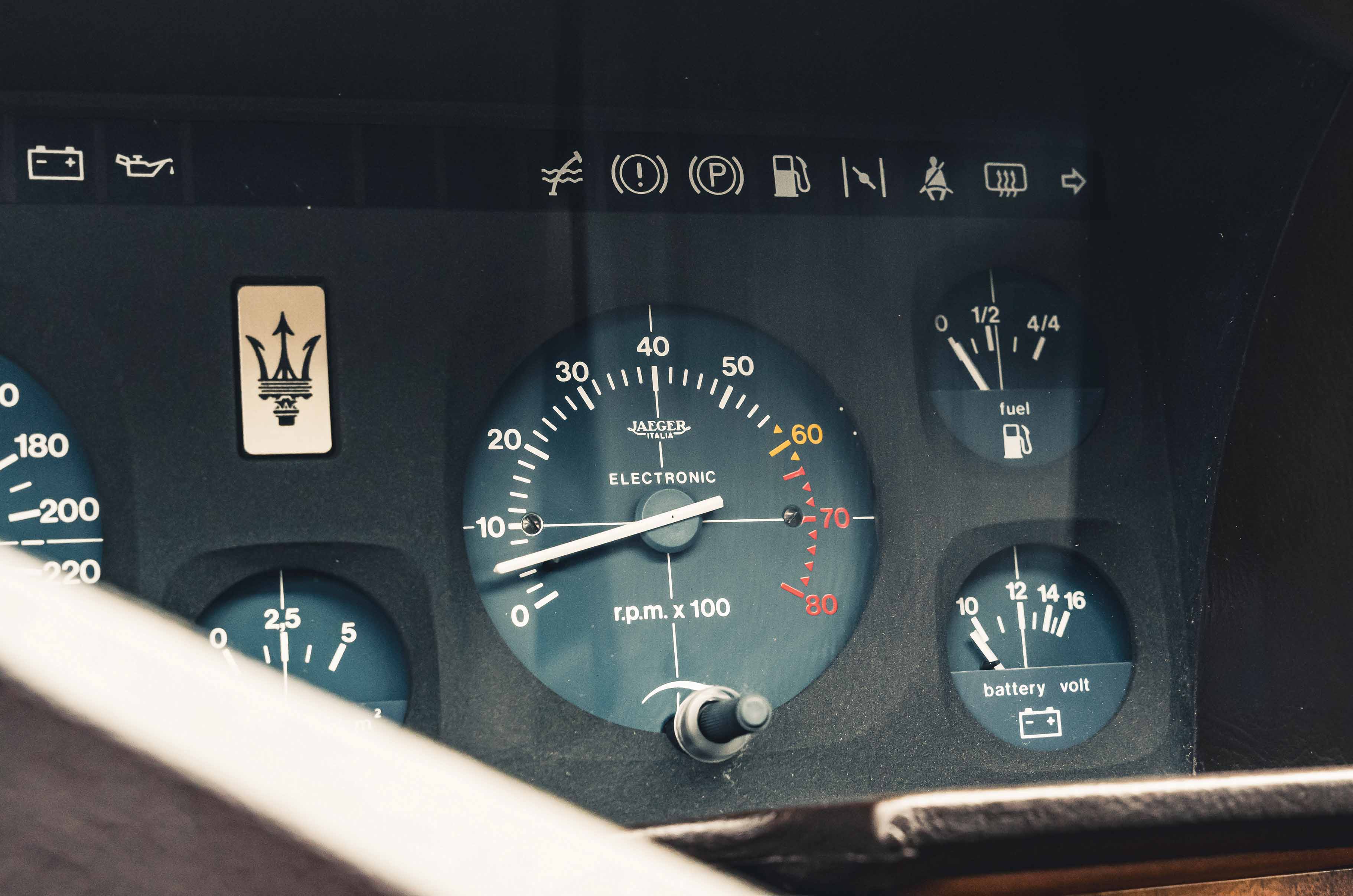
The Maserati 430’s dashboard display includes an array of very 1980s warning lights
Common with all Biturbos, but most pronounced here, is the odd driving position.
Opening the car’s door reveals a dashboard that barely projects itself forward of the door’s aperture.
It’s a sign of the feeling to come of a fascia and steering wheel too far away, and pedals too close – get comfortable with one and the other is off.
It’s the classic, clichéd Italian driving position at its most conspicuous.
Even drivers of perfectly average height with legs on the shorter side will struggle to ignore the dodgy ergonomics – which is likely less about any local preference than simply trying to maximise interior space.
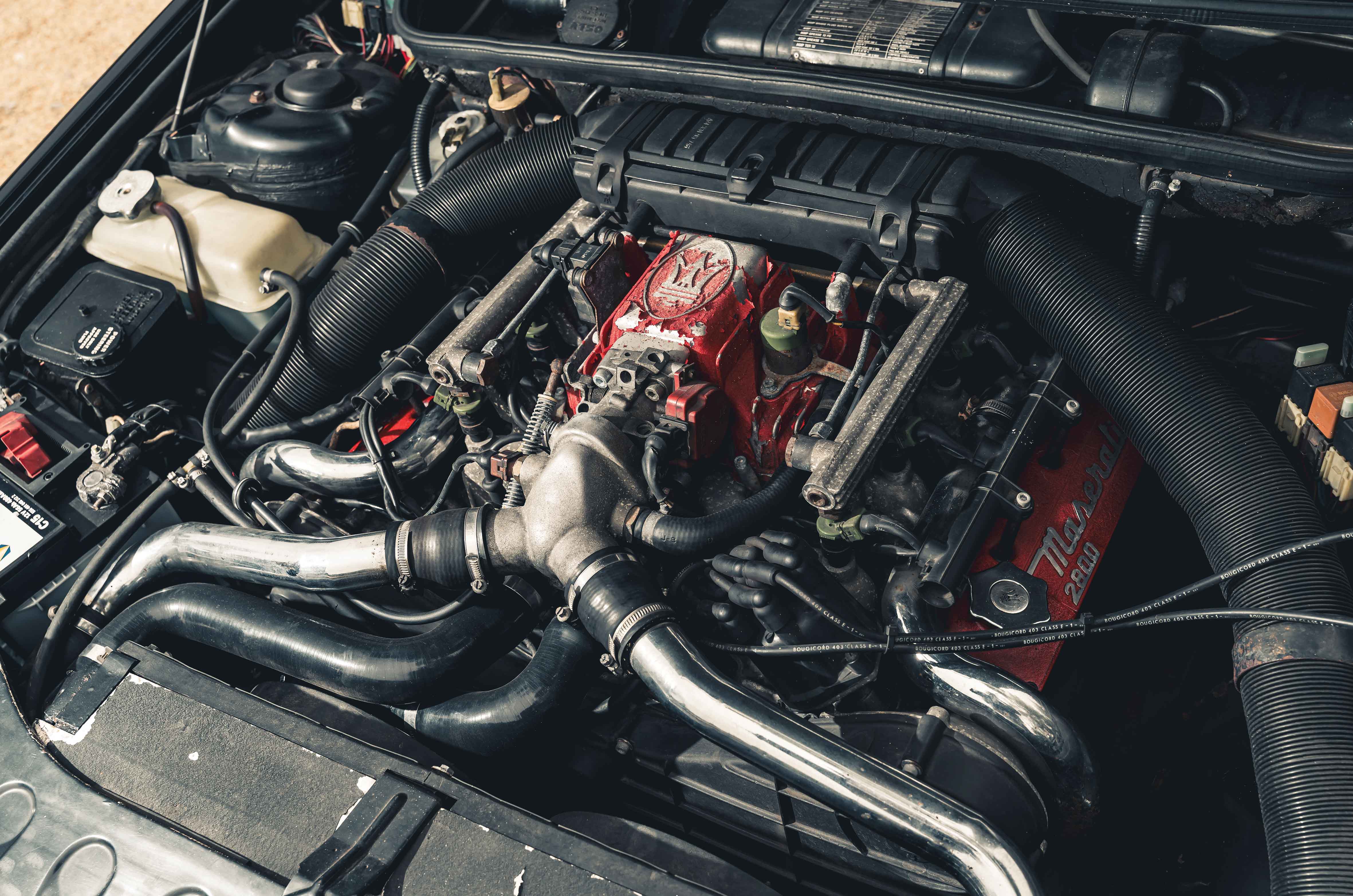
The later Maserati 430 uses the injected 2.8-litre V6 with 285bhp and 319lb ft torque
But when this is put out of your mind, the 430 is otherwise quite beguiling.
Here, in two-tone black over grey, it looks every bit the mafia fixer’s chariot, and the extra power that comes with a 40% capacity increase and fuel injection is pronounced.
Significantly quicker than a contemporary BMW 325i, this 285bhp compact saloon was in a niche of its own with such performance, while the extra length in its wheelbase gives it a stability the standard two-door lacks.
Perhaps this high-mileage example rattles more than most, but, predictably, it’s in terms of quality where the 430 feels wanting.
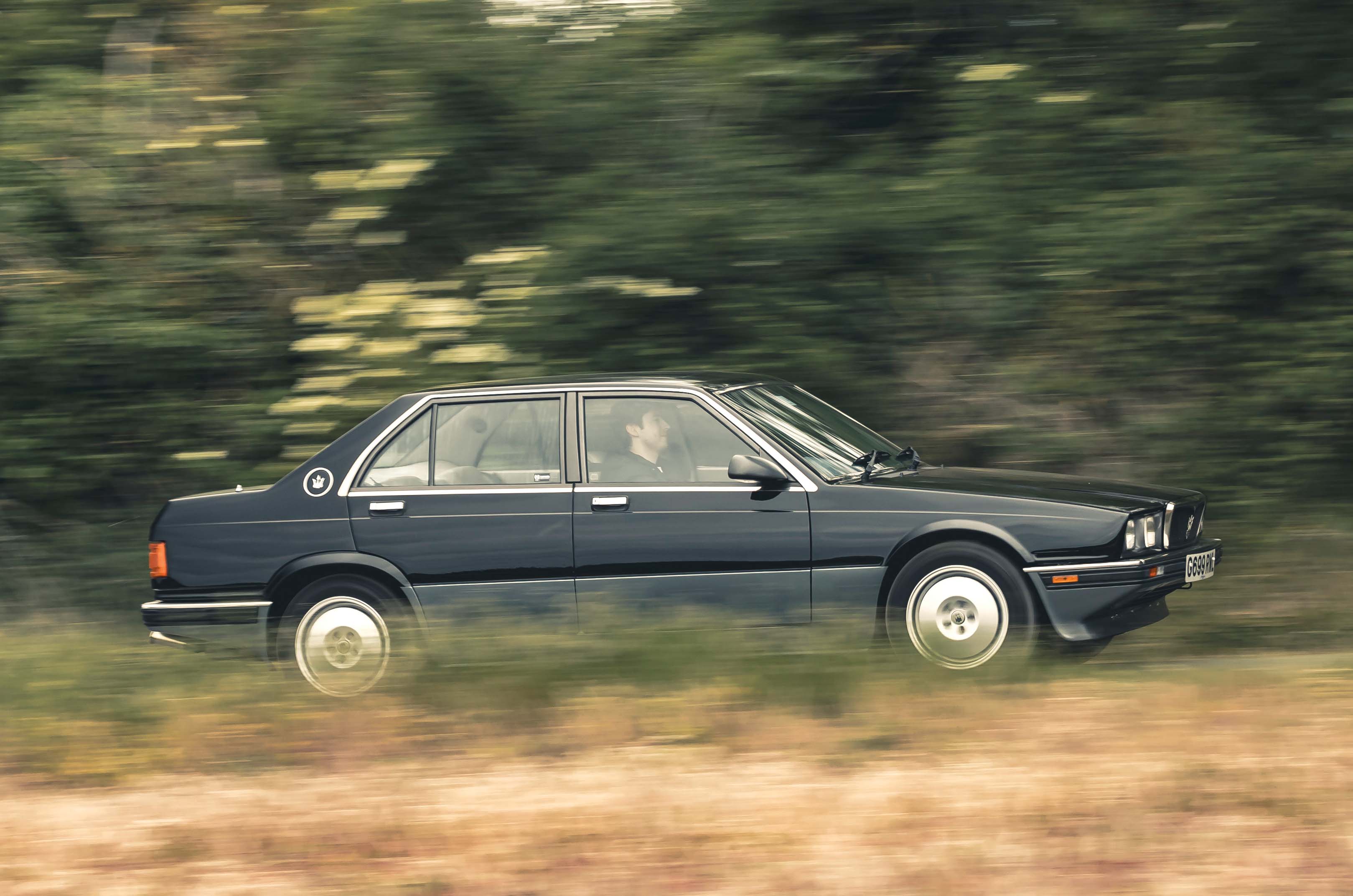
The Maserati 430 has more engine than its chassis can cope with on all but the smoothest roads
Not without reason did BMW wait until the 3 Series had more advanced rear suspension until it put this much power in such a compact saloon car.
When the V6 spools up and you plant the throttle to the floor, the 430 feels over-engined on all but a billiard-table-smooth surface.
It’s not a question of springing or damping, because the ride is pretty well judged, but the Maserati gets disconcertingly flustered when going over bumps, with the brittle interior squeaking and the controls juddering.
On good Tarmac it is the faster, meaner BMW that de Tomaso had always dreamed of making – but it can’t quite keep up the act when the road gets more technically demanding.
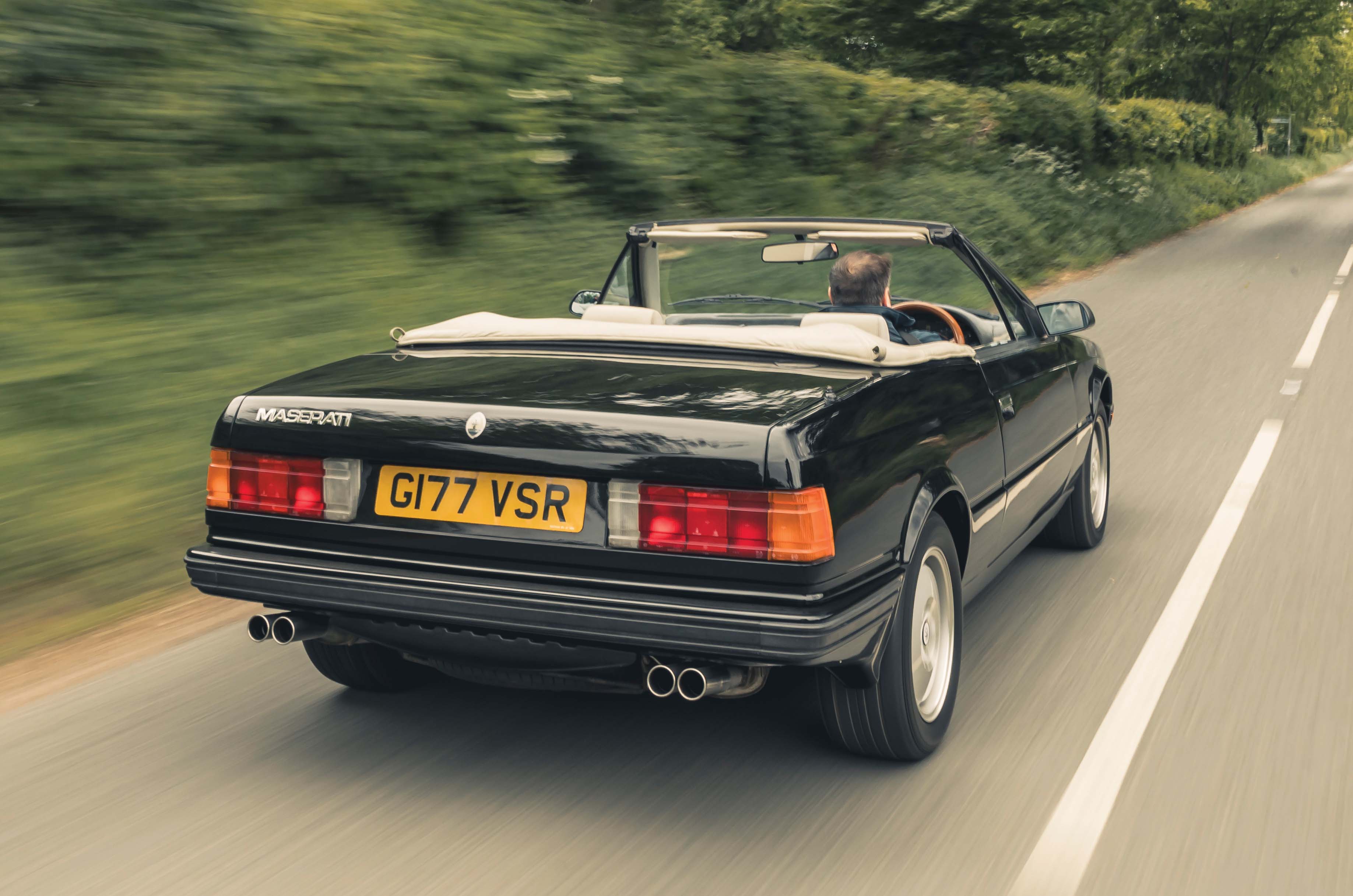
The Maserati Biturbo Spyder is softly sprung but agile and impressively rigid, if tricky to handle at times
The next logical step for the Biturbo was a convertible, to create – had the roof been simply cut off the two-door – a four-seater drop-top once again mirroring the BMW 3 Series.
Instead, Zagato got the job to design and assemble the 1985 Spyder.
To do so, it took 200mm out of the wheelbase, and the unkind might have pointed out that the last thing a car not known for directional stability needed was a squarer footprint, although the shorter car’s wedgy, taut profile is undoubtedly prettier.
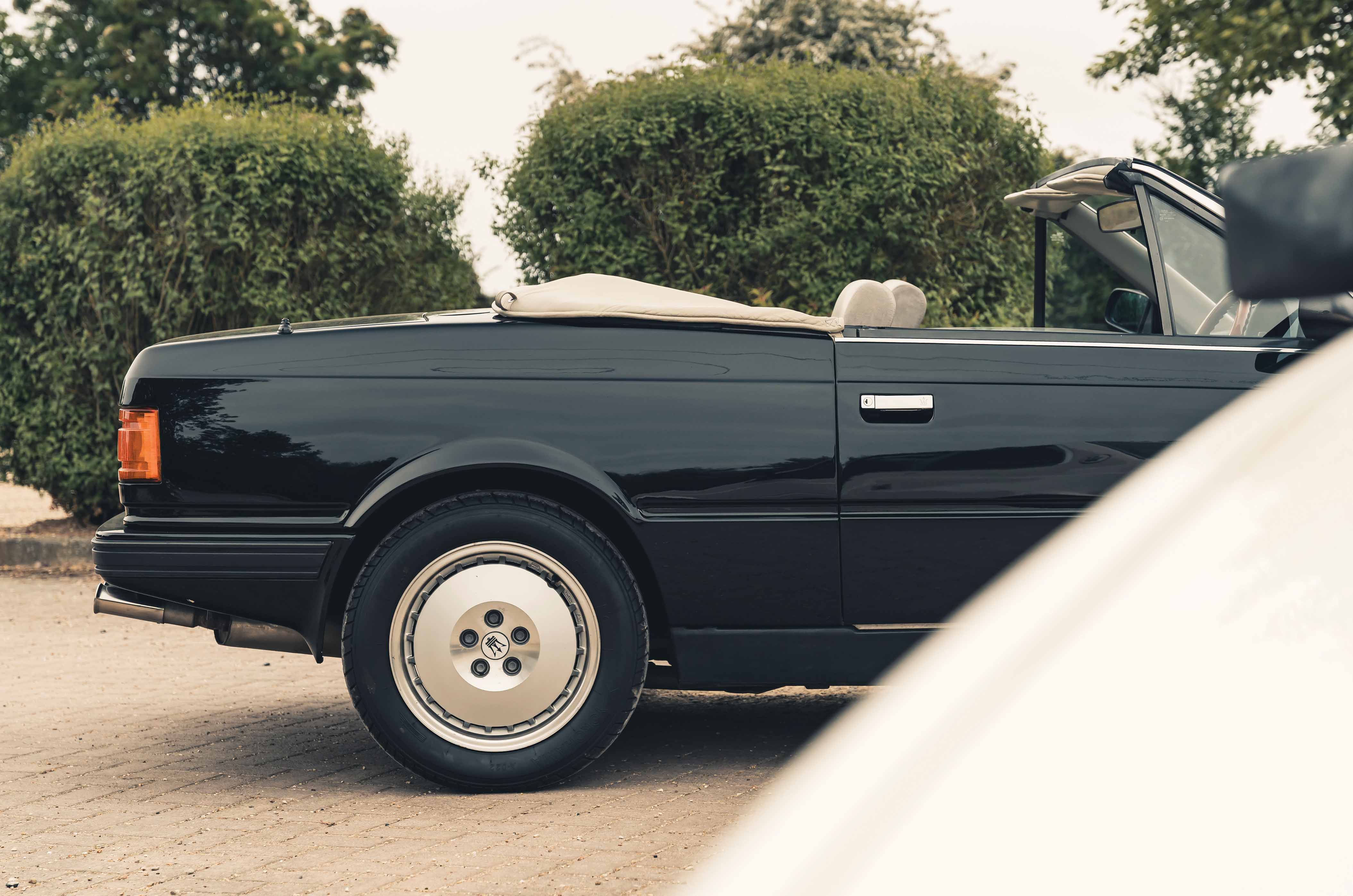
The Maserati Biturbo Spyder was designed and built by Zagato
Rear-seat squabs that simply Velcro down to the carpet and a backrest made from a tube of cushion attached to the bulkhead make clear just how occasional Zagato intended the back seats to be.
Its hood is manually operated, too, reinforcing its sports-car focus.
The entire Biturbo engine line-up was offered in the Spyder in Italy, but in the UK Maserati tended to import only high-spec variants, and this ’89 Spyder uses a motor identical to the 430’s.
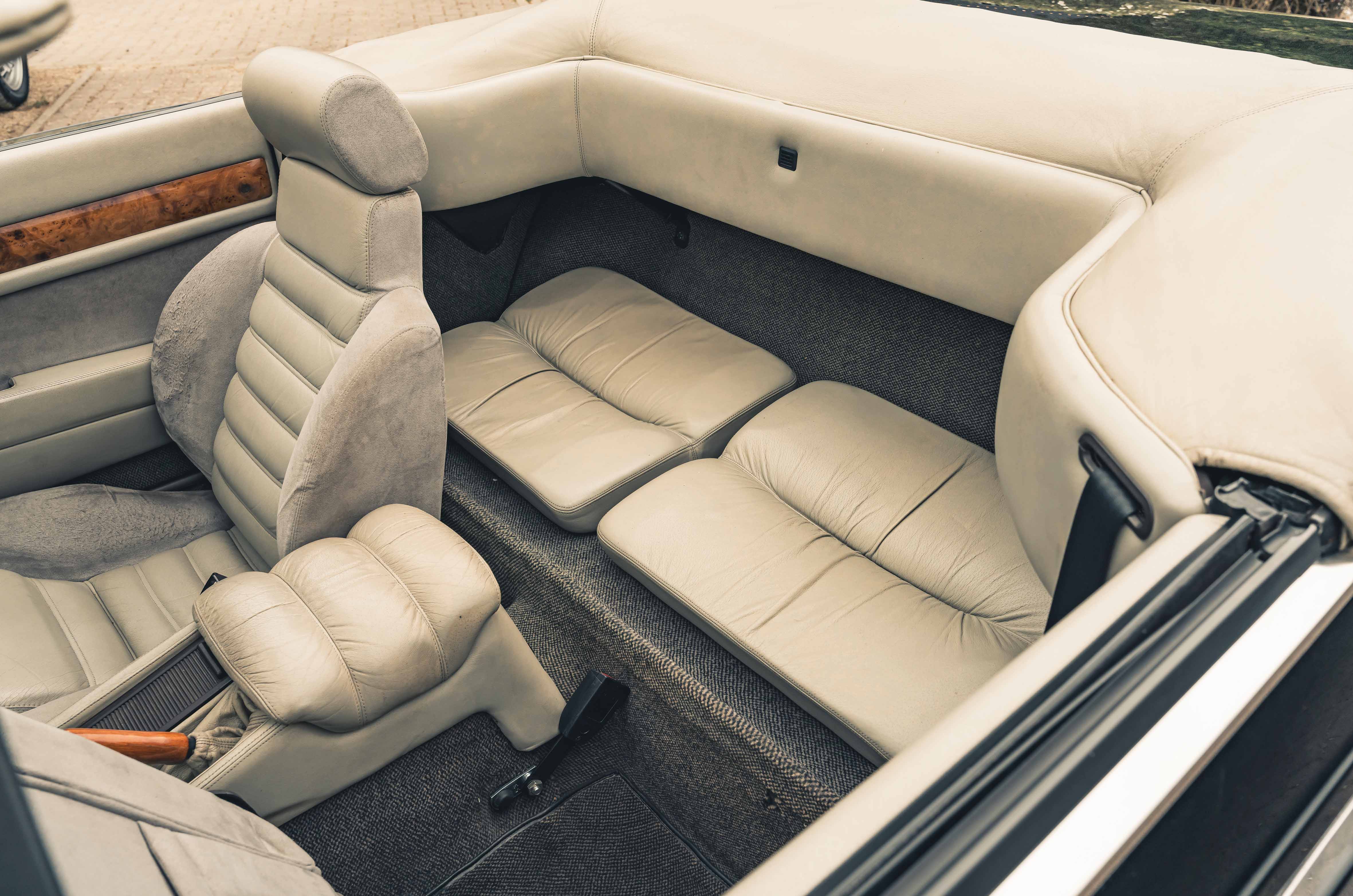
The Maserati Biturbo Spyder’s token rear seats are held on by Velcro
Thanks to underbody strengthening and the wheelbase chop, the Spyder resists scuttle shake well and feels quite rigid.
Stepping into it from the 430 reveals more agility, too, although springing that was well judged in the saloon feels too soft for this short version and makes controlling the jittery Spyder harder than it needs to be.
The payoff is plush ride comfort that marries with the luxurious interior to create a car that proved popular with high-end convertible buyers – nearly 10% of all Biturbos were Spyders, despite a £2650 premium.
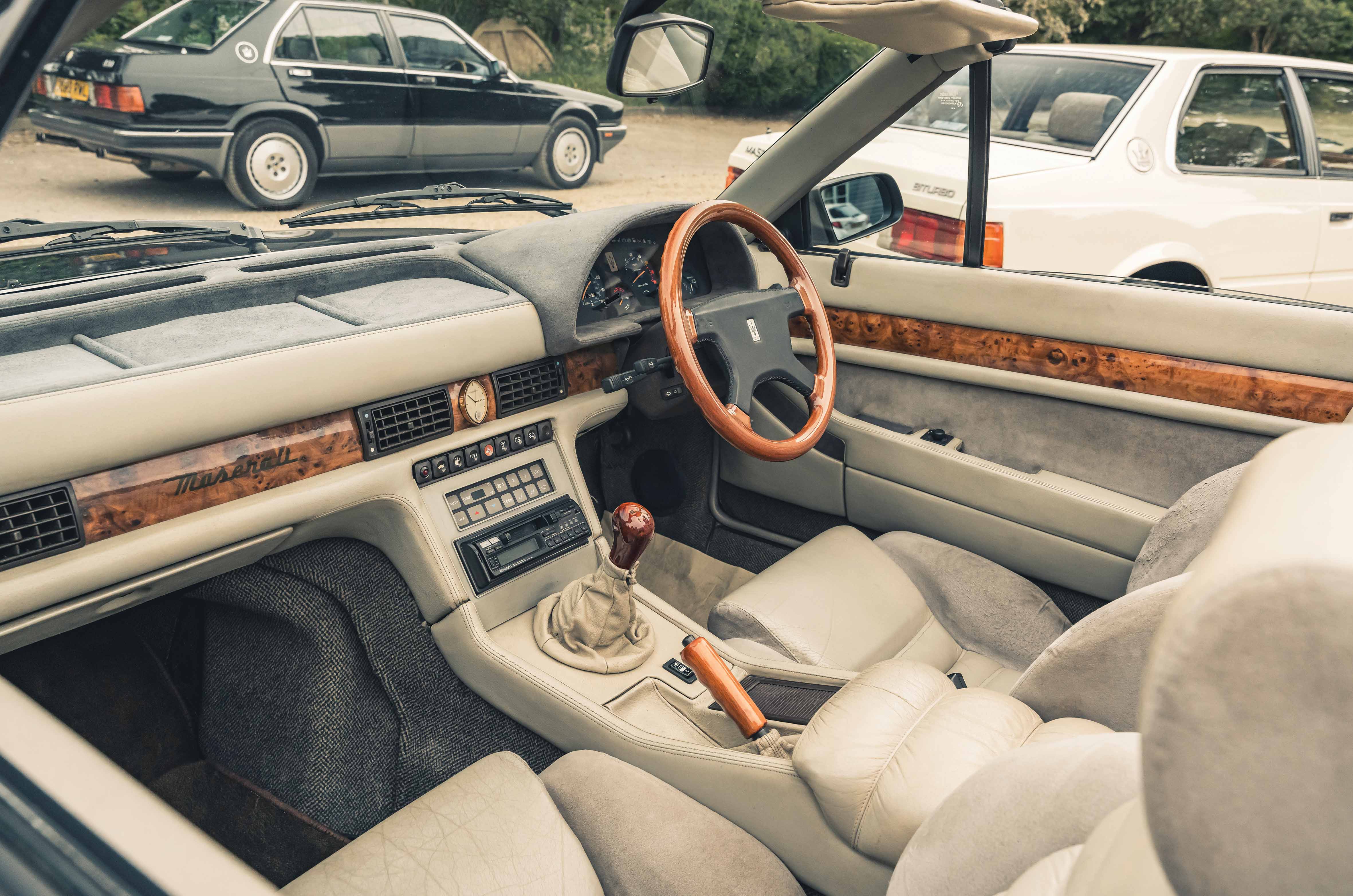
The Spyder’s awkward driving position affects all Maserati Biturbos
If the drop-top appears confused in its character – or, at least, not to have made the most of its short wheelbase – the extremely rare Karif is the reply.
Another of Zagato’s productions, it was formed, confusingly, by taking the Spyder and welding a roof back on.
The notchback coupé was the fastest-accelerating Maserati yet when released in 1988: its 0-60mph time of just 4.8 secs was able to dispatch even a 4.9-litre Bora.
Its small size helped, of course, but everything was thrown at the Karif to make it as sporty as possible.
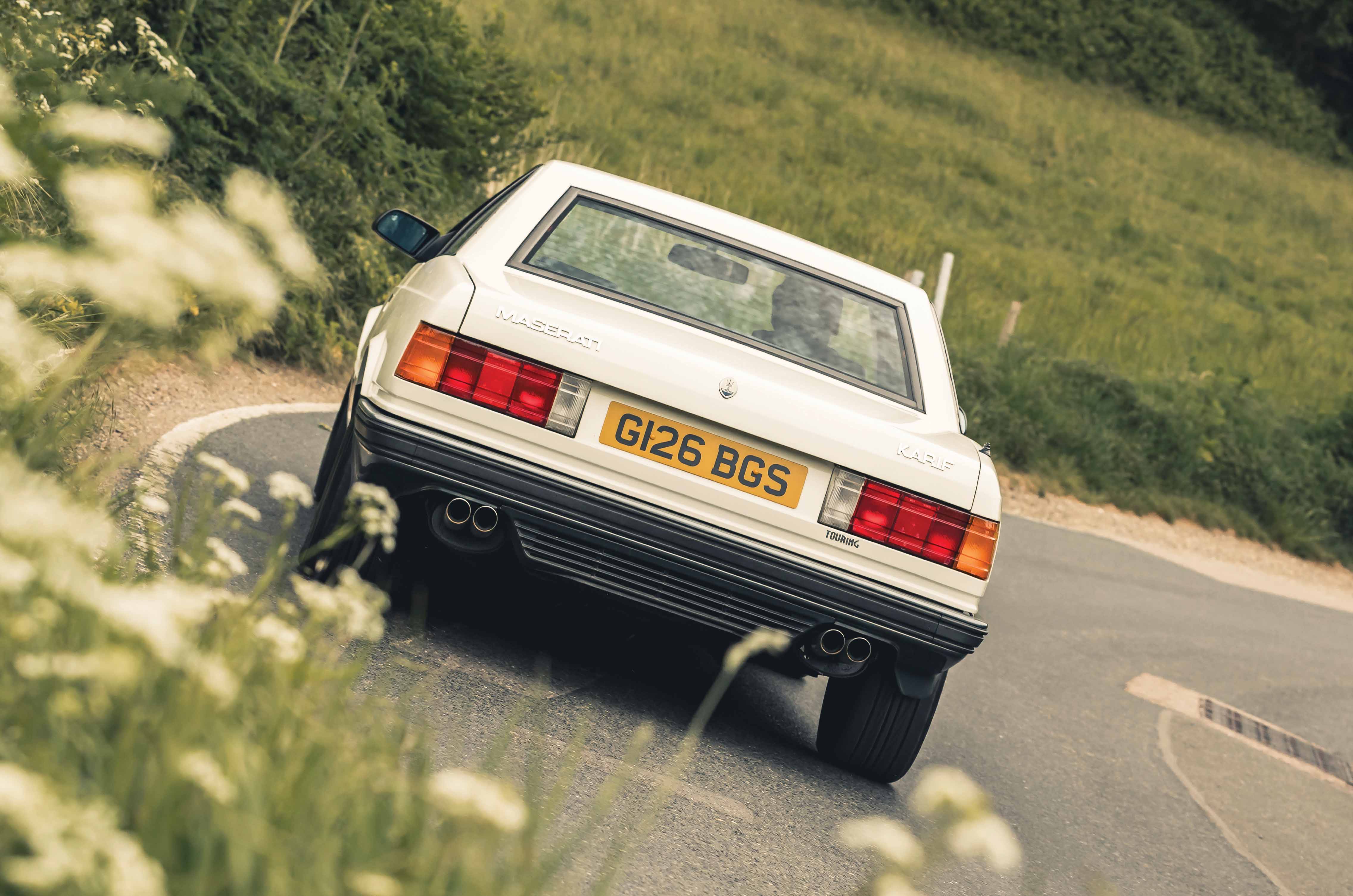
The rapid Maserati Karif works better when pushed and excels on B-roads
Along with shorter gearing, there was Maserati’s new Meccanica Activa suspension – an electronically interlinked shock-absorber system later offered throughout the Biturbo range – that improved the handling.
Unsurprisingly, the Karif is the pick of the 1980s Maseratis for sorties on twisty roads. It is very quick and feels more nimble than any car here.
It would give a contemporary Porsche 911 a scare, but would surely rival it for unruliness in the wet, too.
Nonetheless, it’s the first of our set that feels better the faster it is driven, being able to flow through bends more fluently and, perhaps aided by this car’s exceptionally low mileage, resist untoward shakes and rattles.
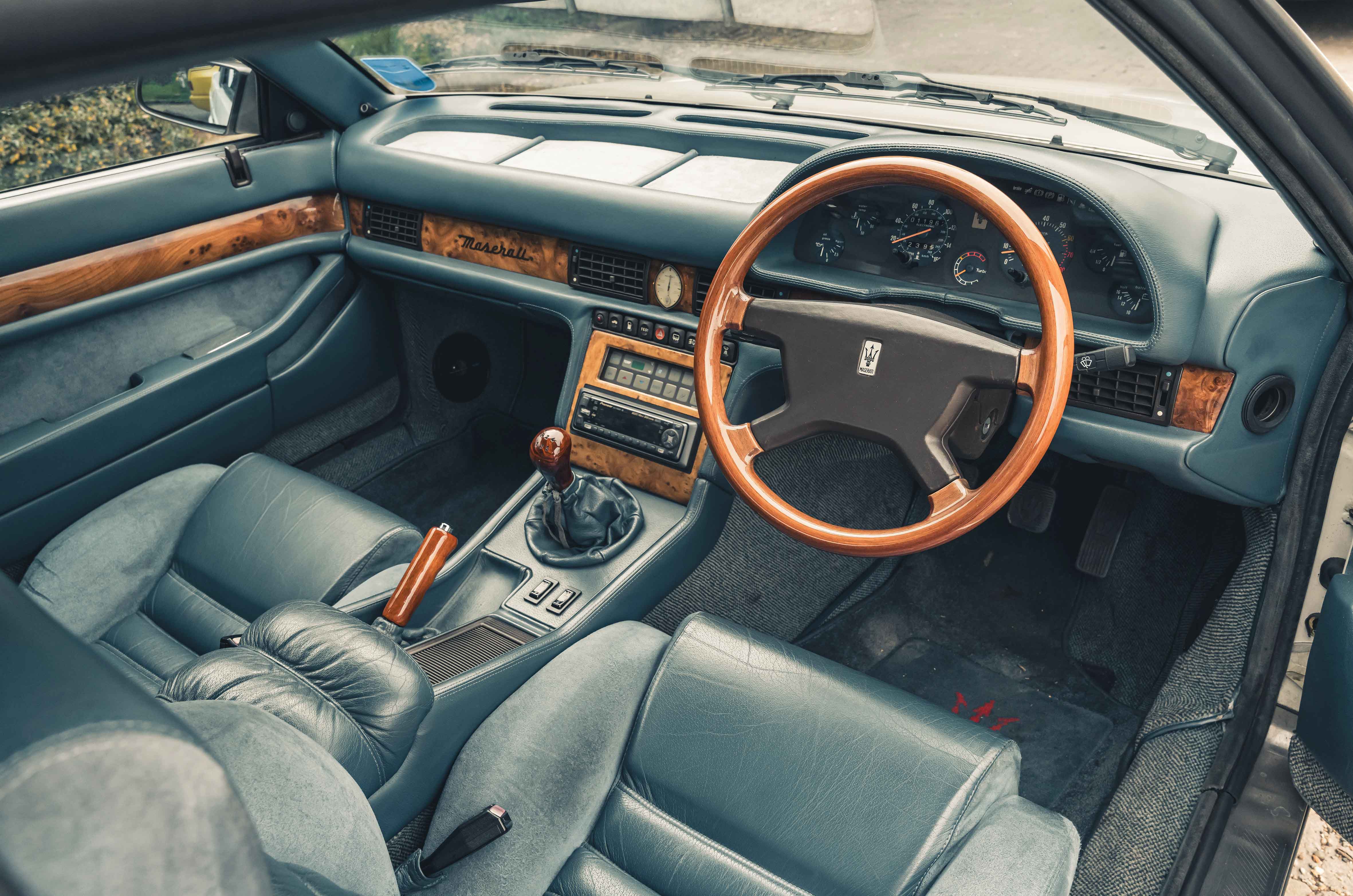
The Maserati Karif continues the familiar luxury theme inside; the now-iconic, oval-shaped, gold-plated clock was made by Swiss firm Lasalle
Despite a positive response, the Maserati Karif sadly found few buyers.
Its high list price put off customers who asked why they were paying more for the smallest of the Biturbo models, while many found its looks awkward. Just 222 were made, across a five-year run.
From 1990 the Karif found itself in an even stranger place in Maserati’s range, after Fiat’s December 1988 investment in the loss-making company bore its first fruits.
They were a 24-valve, 279bhp version of the V6 and a ‘nuovolook’ front-end facelift for the top-spec 222, as the coupé was then known, and 430 models (the Karif was overlooked), while the shortened wheelbase was then used for the new Shamal V8.
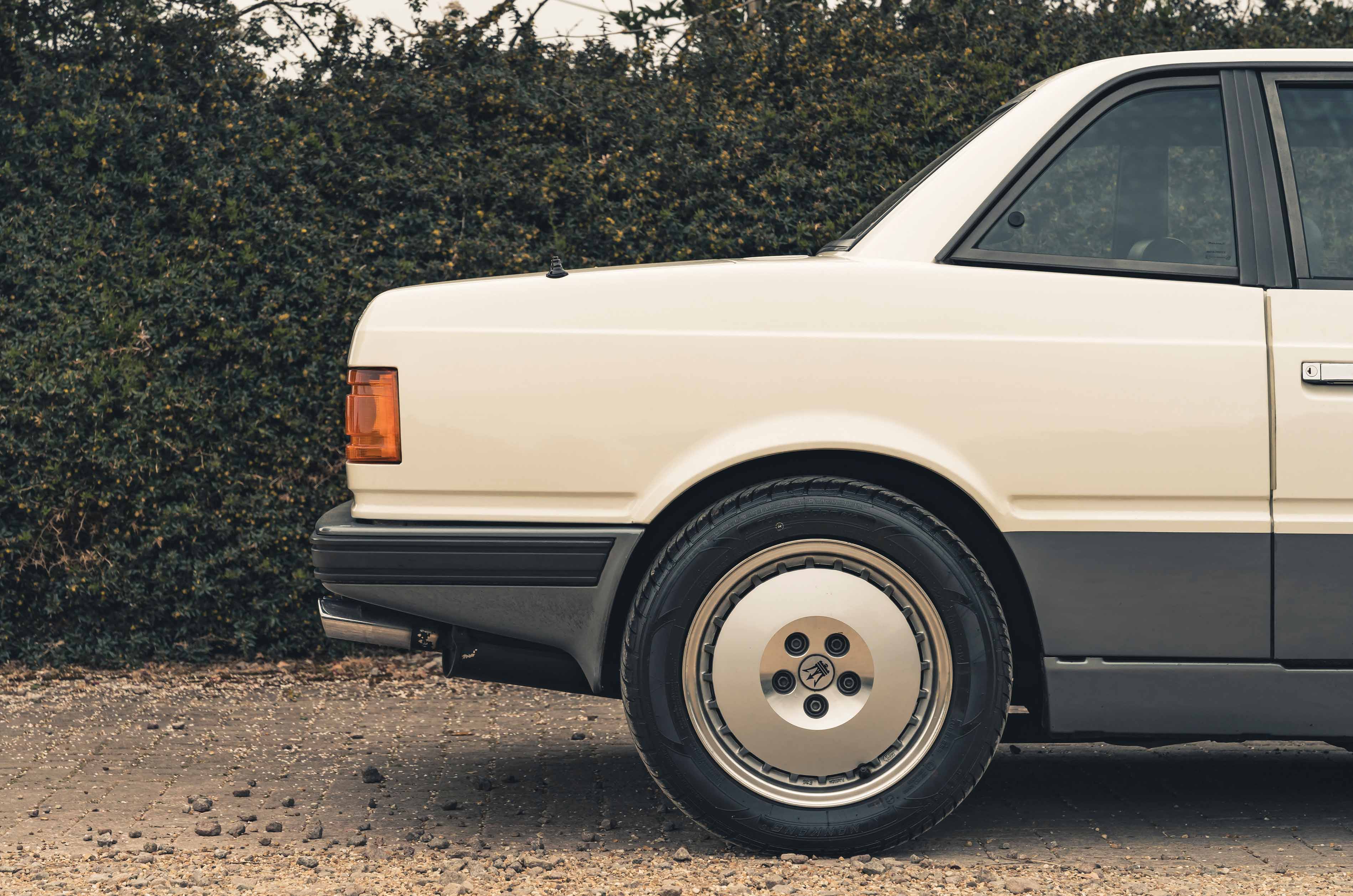
Confusingly, coachbuilder Zagato attached a solid roof to the short-wheelbase Spyder to create the Karif
That was an entirely reskinned car, designed by Marcello Gandini and built at Maserati’s Modena HQ rather than the former Innocenti works where the non-Zagato Biturbos were produced, and it shared only the Karif’s door panels.
The Shamal was to prove an opening statement of Maserati’s new Fiat-owned era, a low-volume halo car – at just 369 built – that would point to the Biturbo’s more mainstream future.
The Ghibli arrived in 1992, as a reskin of the original, mid-length-wheelbase, two-door Biturbo.
It took many of the best parts of the Shamal, including its limited-slip differential, six-speed ’box and a further improved active suspension system that could be adjusted from the cockpit, but it retained the Biturbo’s 24-valve V6.
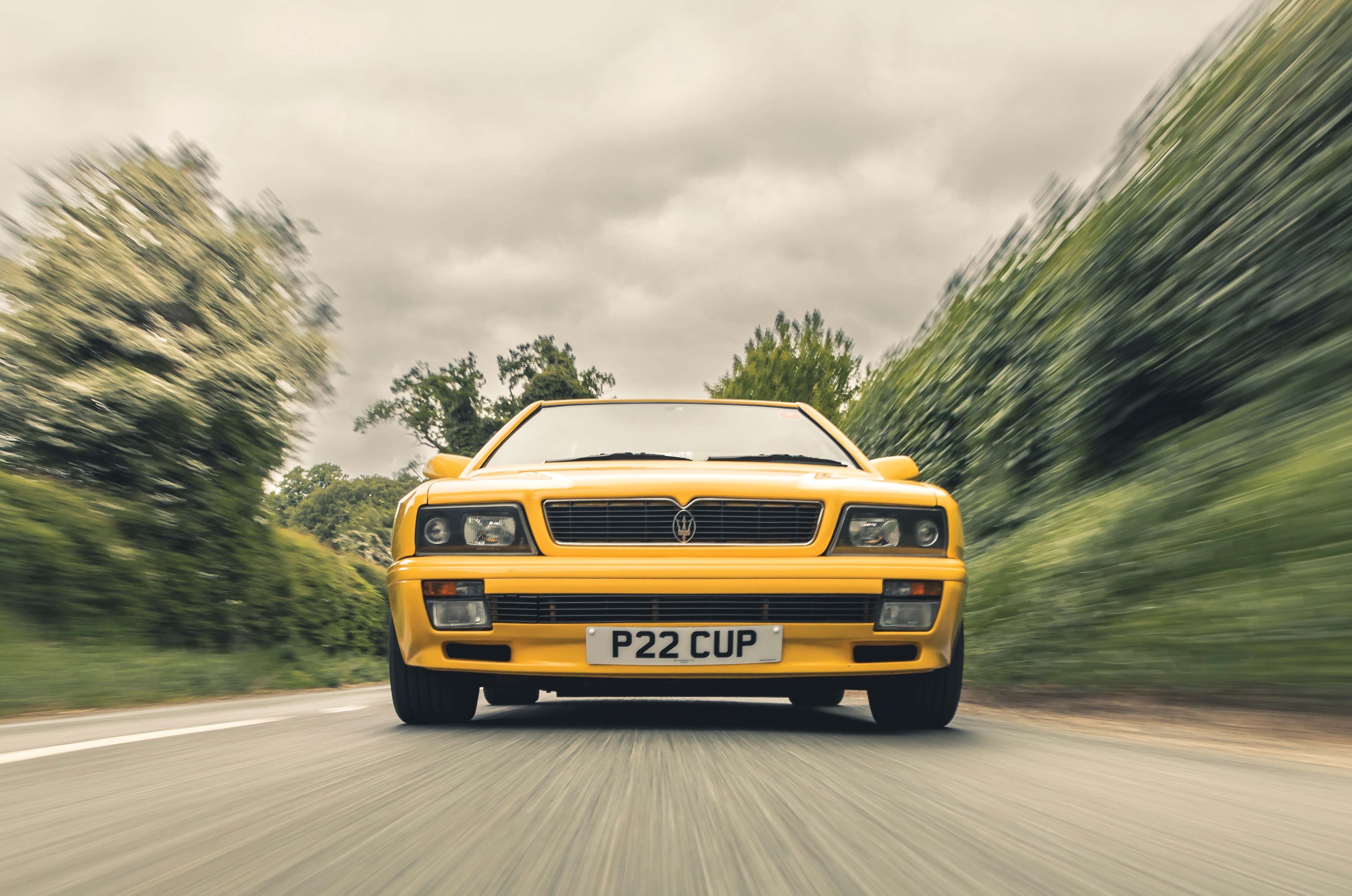
The Maserati Ghibli Cup is the distilled essence of the Biturbo’s original promise and makes for an incredibly effective back-road weapon
Styling clearly followed Gandini’s Shamal, too, losing that car’s roll-over hoop but keeping its cleaner panelwork and the distinctive windscreen-scuttle spoiler.
The Ghibli replaced the original Biturbo two-door, but the Spyder and 430 saloon hung around for a few years more, alongside the Shamal.
By 1995, Maserati had focused everything on the Ghibli, discontinuing every other model except the new Quattroporte IV (based on a stretched Biturbo platform).
The Ghibli gained a GT suffix, and the 2-litre Cup was offered to reflect the one-model race series being run at the same time.
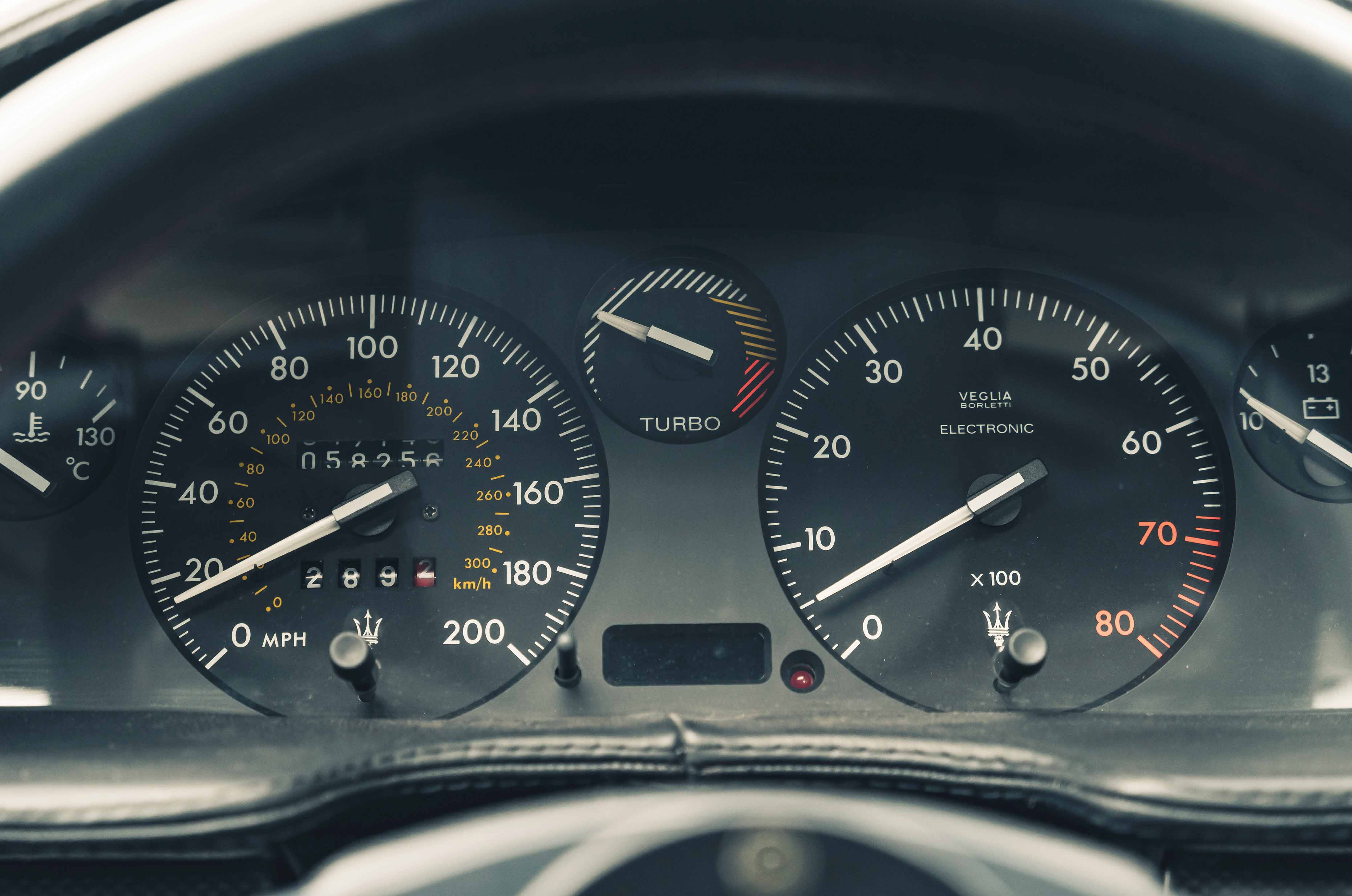
The Ghibli Cup’s clear dials include a prominent turbo-boost gauge
It was the first instance the 2-litre V6 was officially sold in many markets, including the UK, but it didn’t disappoint, with its 330bhp giving it the highest specific output of any engine on sale and its six, free-revving little cylinders providing their peak output at a heady 6800rpm.
Just 60 were built, including the rare right-hand-drive car with us today.
Beyond its arresting bright yellow colour and aggressive, 17in Speedline alloys, the Ghibli may well be the plain Jane of the group to look at and is certainly less characterful to modern eyes.
To drive, though, it’s a firecracker.
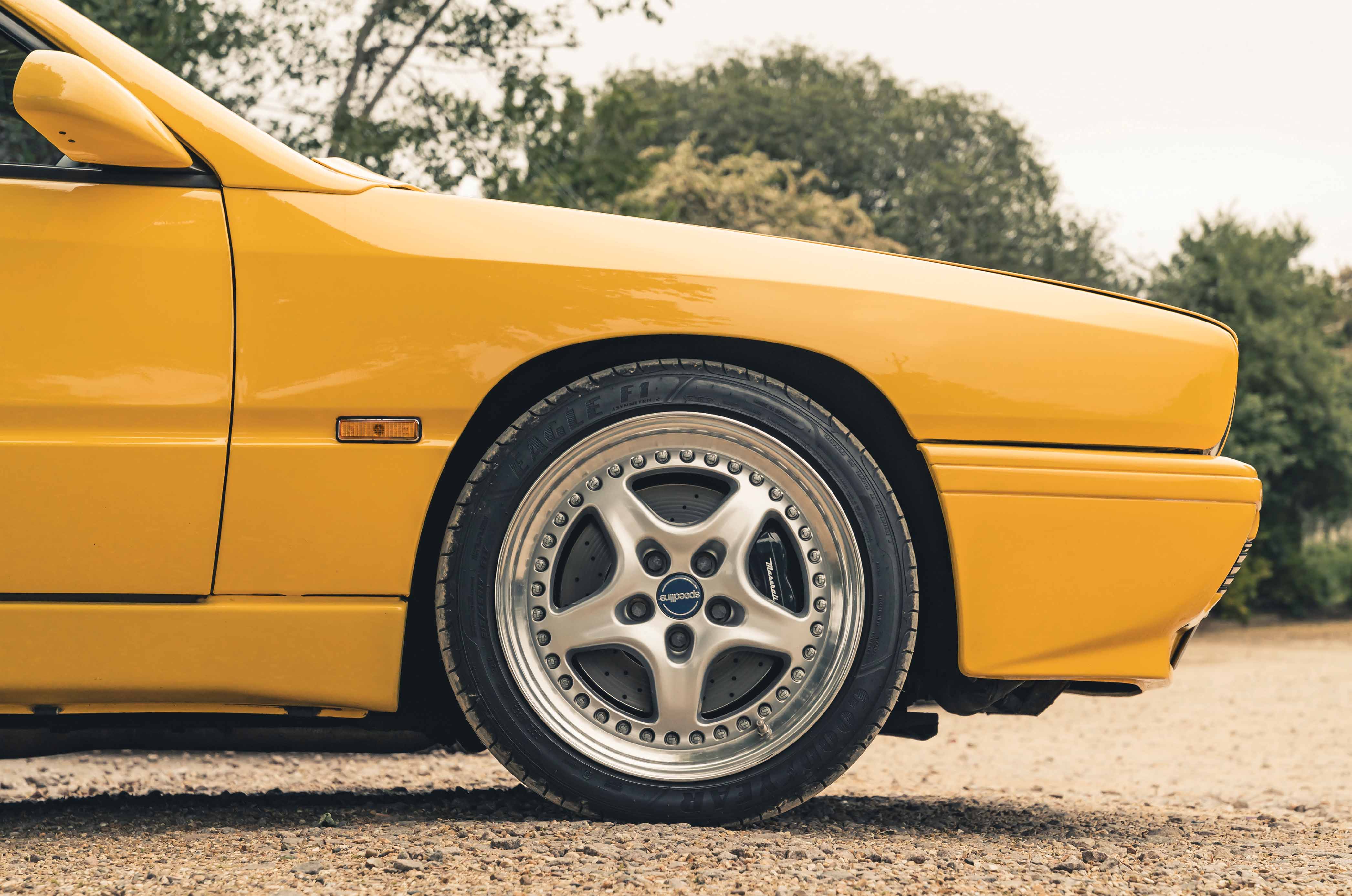
The Maserati Ghibli Cup is explosive when its V6 comes on song
There’s still hefty lag, despite much more intelligent boost control and fuel management, but when the compressors comes on song the Cup flies, giving serious exotics a run for their money.
Even more impressive are the composure and subtlety of the chassis. Finally, this is a Biturbo (of sorts) that requires no excuses made for it when driven hard.
Its rear wheels will still slip when provoked, but with the adjustable suspension to a B-road-friendly setting 3 (4 is firmest), it becomes a perfectly judged weapon that feels like a touring-car racer for the road.
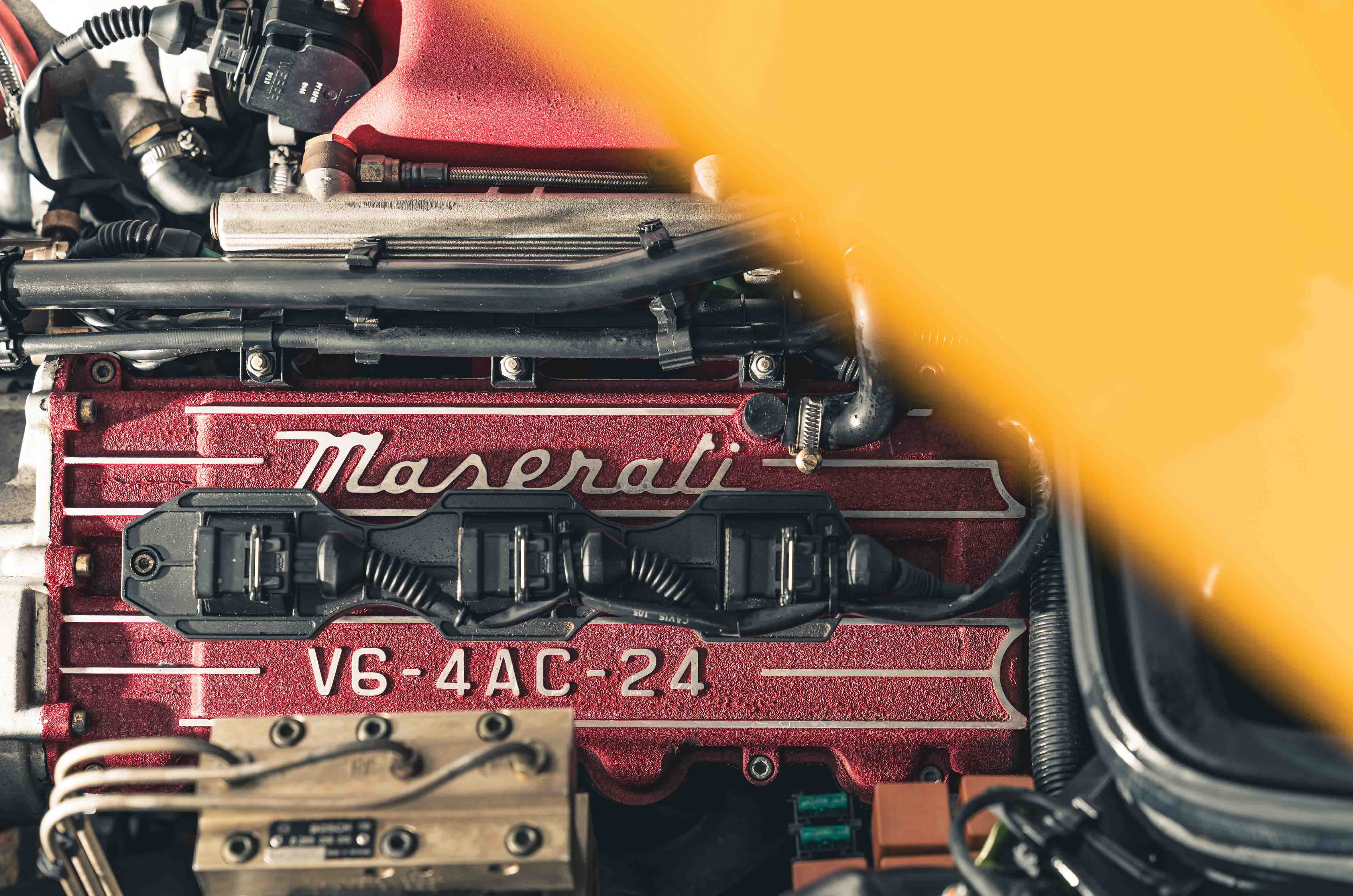
The Maserati Ghibli Cup’s quad-cam V6 displaces just 1995cc, but produces an impressive 330bhp at 6800rpm
It follows undulations rather than crashing into them and corners with real tenacity, while four-pot Brembo calipers give tremendous stopping power.
The Ghibli and Cup were the Biturbo come good, and nearly all who drive them agree that, driving positions excepted, they are brilliant.
Even putting the thunderous engine, trick diff and six-speed gearbox aside, it’s a shame earlier Biturbos aren’t more similar, particularly in their suspension and steering.
Developed on tight budgets and starved of funds until 1989, it took a decade for the Biturbo’s chassis to match the potential of its awesome powerplant.
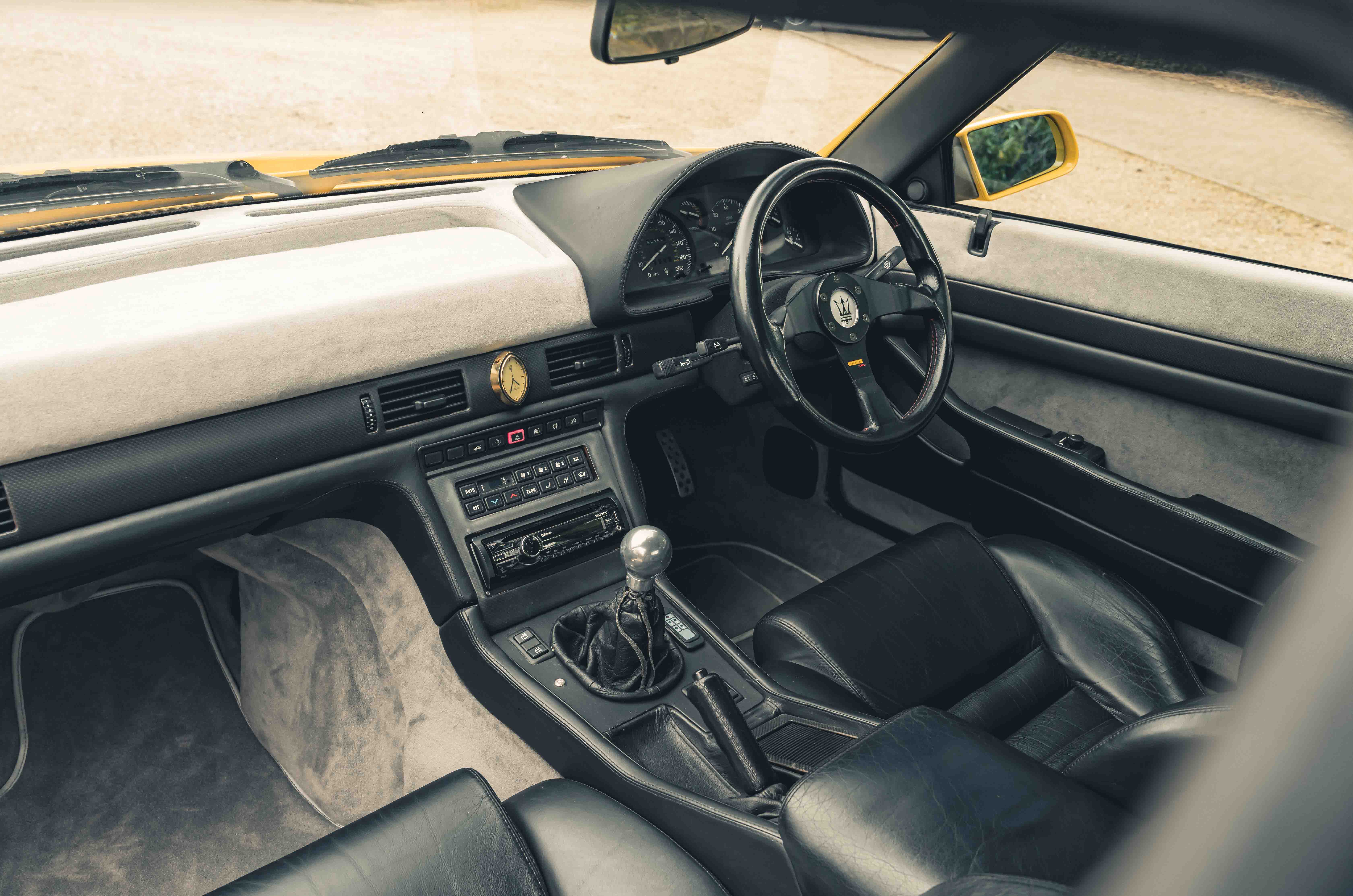
The Maserati Ghibli Cup’s darker, more understated cabin has an air of early ’90s sporting intent
There is, though, undeniable charisma to the earlier Biturbos.
The chic launch-spec coupé, rakish 430 and tenacious Karif especially have a particular allure, and were all special prospects in their day.
Today they offer fans of boxy ’80s metal performance found in few cars that cut a similar profile.
The closest driving experience to a late-’80s Biturbo is probably a Ford Sierra RS Cosworth, a similarly lairy car with a more mundane body and less glitzy interior, and now worth many multiples of the Maserati.
Biturbos have been bargains for most of their lives, but even with a recent upturn in prices as the market clamours for 1980s and ’90s cars, they are still incredible value.
Images: Max Edleston
Thanks to: Bill Briffa and Yanni Argyrou; McGrath Maserati
Factfiles
Maserati Biturbo
- Sold/number built 1982-’91/23,003
- Construction steel monocoque
- Engine all-alloy, sohc-per-bank, 12v 1995cc 90° V6, Weber 36 DCNVH carburettor, twin IHI turbochargers
- Max power 180bhp @ 6000rpm
- Max torque 186lb ft @ 3500rpm
- Transmission five-speed manual, RWD
- Suspension independent, at front by MacPherson struts, anti-roll bar rear semi-trailing arms, coil springs telescopic dampers
- Steering rack and pinion
- Brakes discs, with servo
- Length 13ft 7½in (4153mm)
- Width 5ft 7½in (1715mm)
- Height 4ft 3¼in (1303mm)
- Wheelbase 8ft 3in (2515mm)
- Weight 2394lb (1086kg)
- 0-60mph 6.5 secs
- Top speed 134mph
- Mpg 22
- Price new 25,710,000 lire (1982)
- Price now £7-20,000*
Maserati 430
(where different from Biturbo)
- Sold/number built 1987-’94/995
- Engine 2790cc, Weber-Marelli fuel injection
- Max power 285bhp @ 6000rpm
- Max torque 319lb ft @ 4000rpm
- Steering power-assisted rack and pinion
- Length 14ft 5in (4400mm)
- Wheelbase 8ft 6in (2600mm)
- Weight 2837lb (1287kg)
- 0-60mph 5.4 secs
- Top speed 149mph
- Mpg 18
- Price new £40,793 (1991)
- Price now £6-18,000*
Maserati Spyder
(where different from 430)
- Sold/number built 1984-’94/3373
- Length 13ft 3in (4043mm)
- Wheelbase 7ft 10in (2400mm)
- Weight 2837lb (1345kg)
- 0-60mph 5.7 secs
- Top speed 143mph
- Mpg 17
- Price new £42,402 (1991)
- Price now £8-28,000*
Maserati Karif
(where different from Spyder)
- Sold/number built 1988-’93/222
- Suspension active dampers
- Length 13ft 4in (4064mm)
- Weight 2824lb (1280kg)
- 0-60mph 4.8 secs
- Top speed 158mph
- Mpg 20
- Price new £45,774 (1991)
- Price now £18-32,000*
Maserati Ghibli Cup
(where different from Biturbo)
- Sold/number built 1995-’97/60
- Engine dohc, 24-valve, Weber multi-point fuel injection
- Max power 330bhp @ 6800rpm
- Max torque 280lb ft @ 4000rpm
- Transmission six-speed manual, RWD
- Suspension electronic dampers
- Brakes vented discs, ABS
- Length 13ft 10in (4223mm)
- Width 5ft 10in (1775mm)
- Weight 3139lb (1424kg)
- 0-60mph 5.6 secs
- Top speed 165mph
- Mpg 19
- Price new £47,000 (1995)
- Price now £25-80,000*
*Prices correct at date of original publication
Enjoy more of the world’s best classic car content every month when you subscribe to C&SC – get our latest dealshere
READ MORE
Maserati Shamal: the best of the biturbos
Future classic: Maserati Gran Turismo
Ferrari Mondial vs Porsche 911 vs Alpine GTA vs Lotus Excel: 2+2 equals phwoar