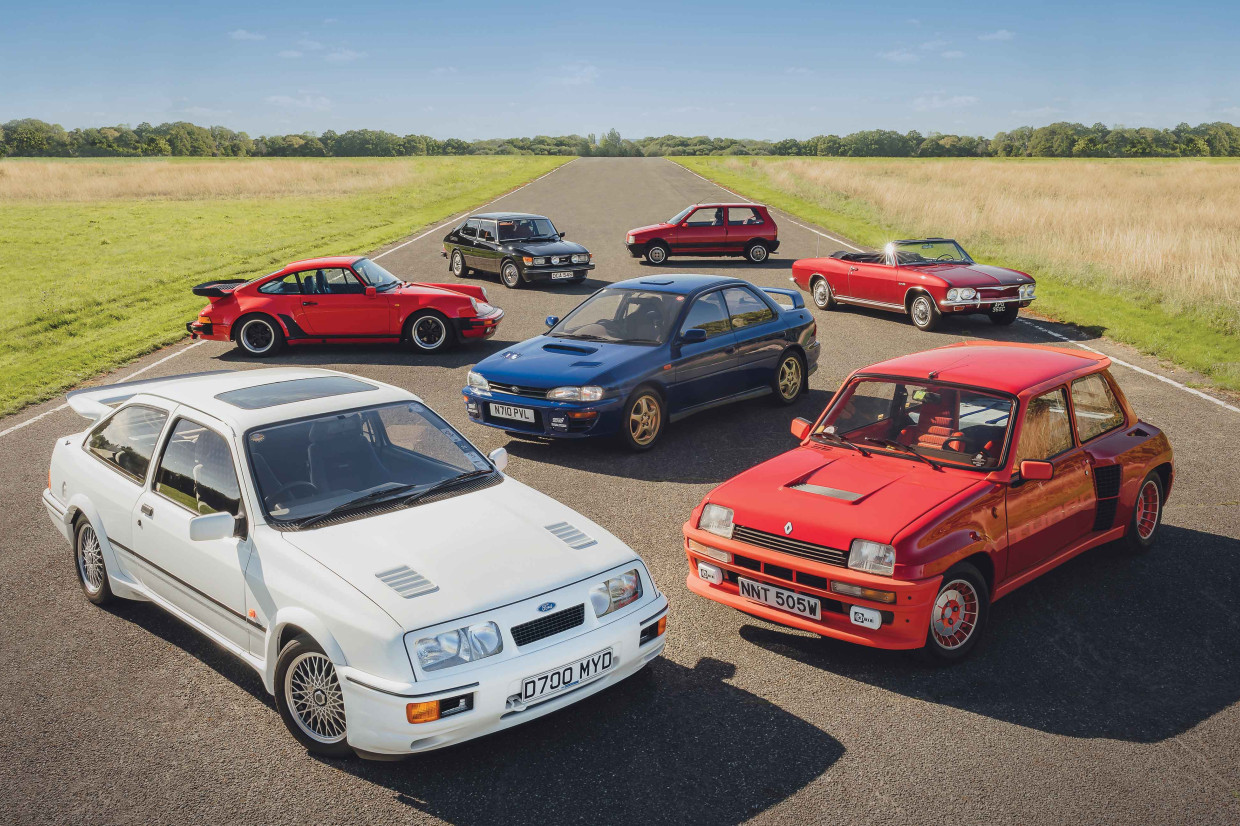
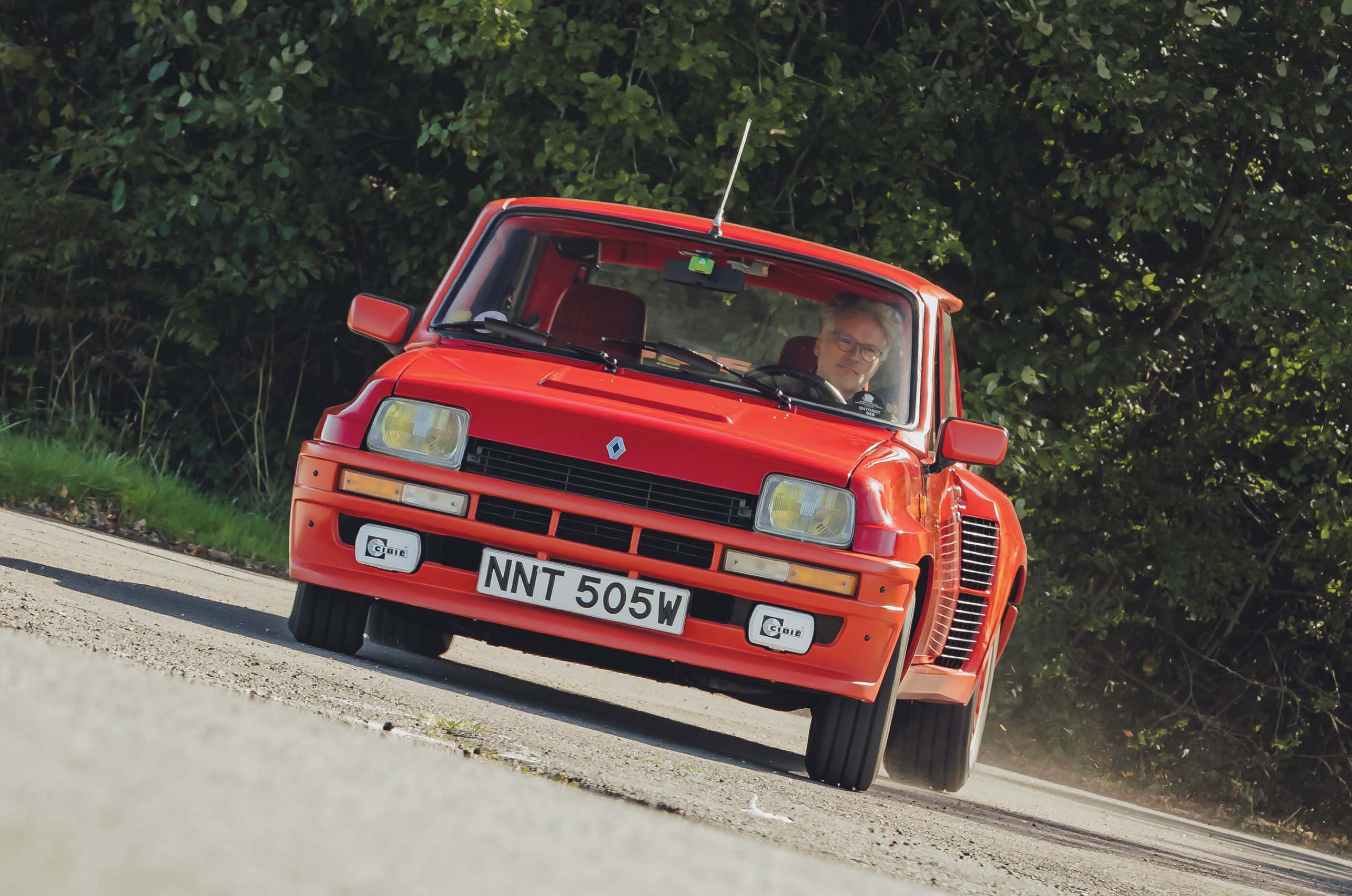
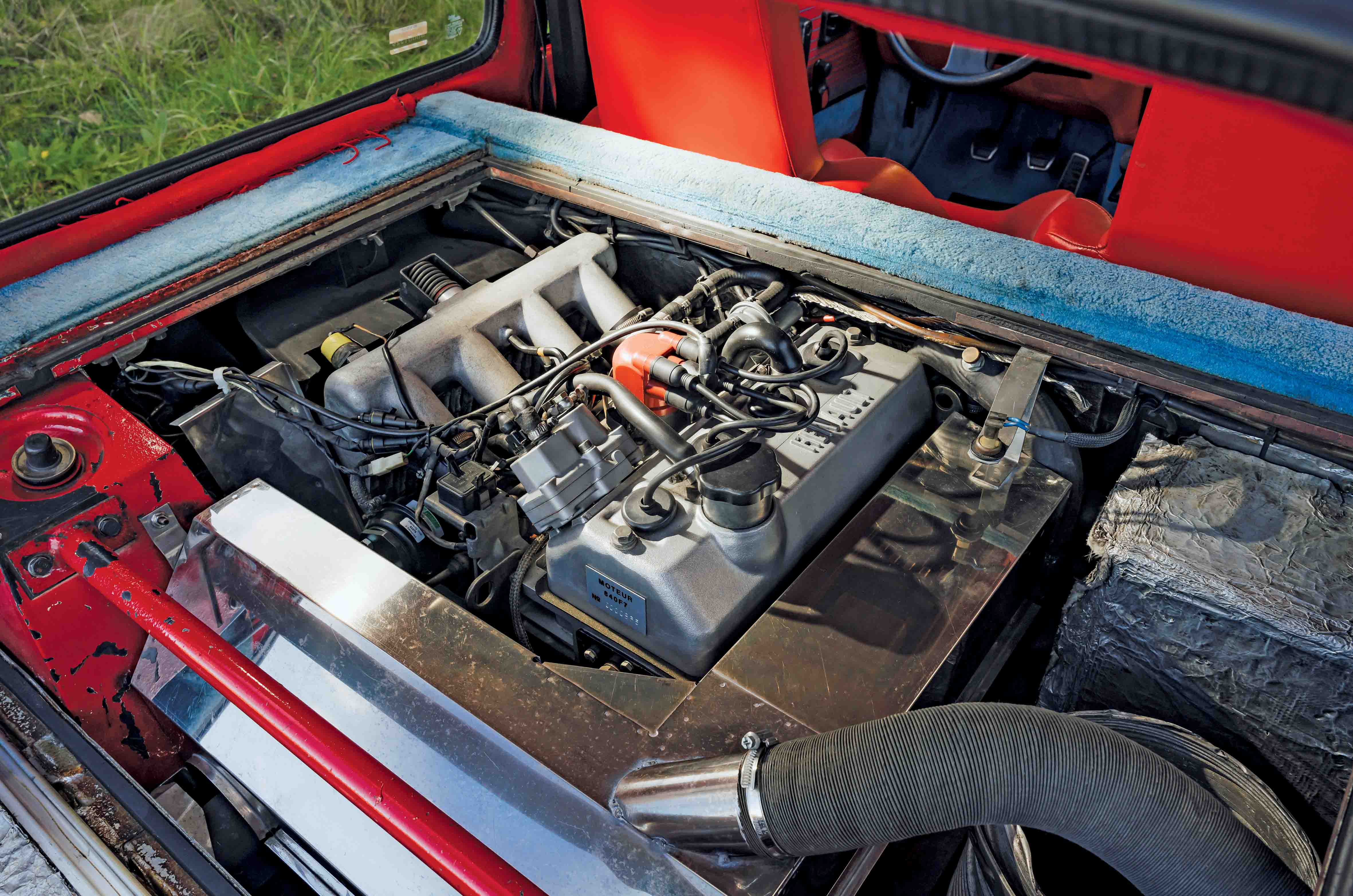
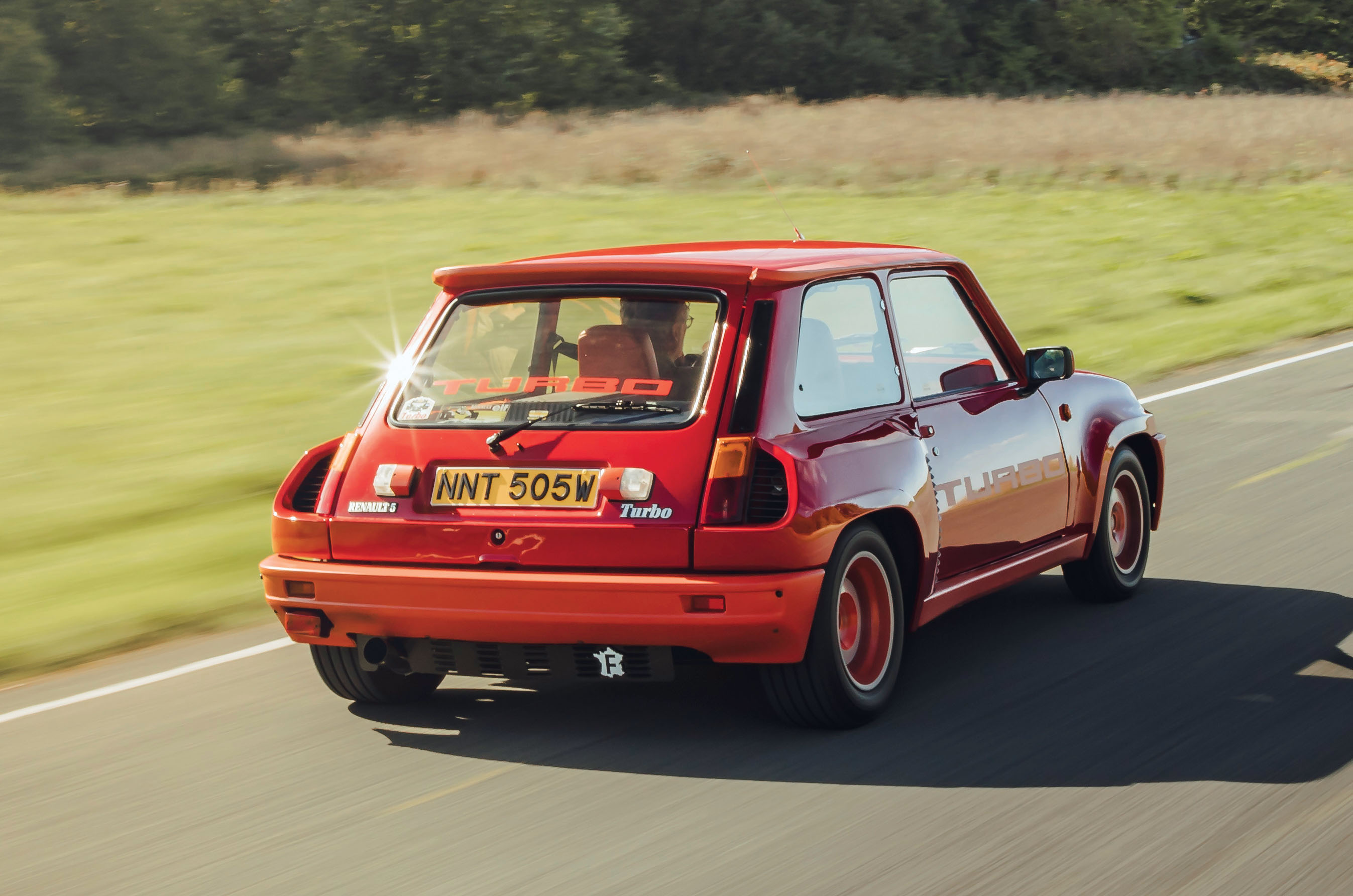
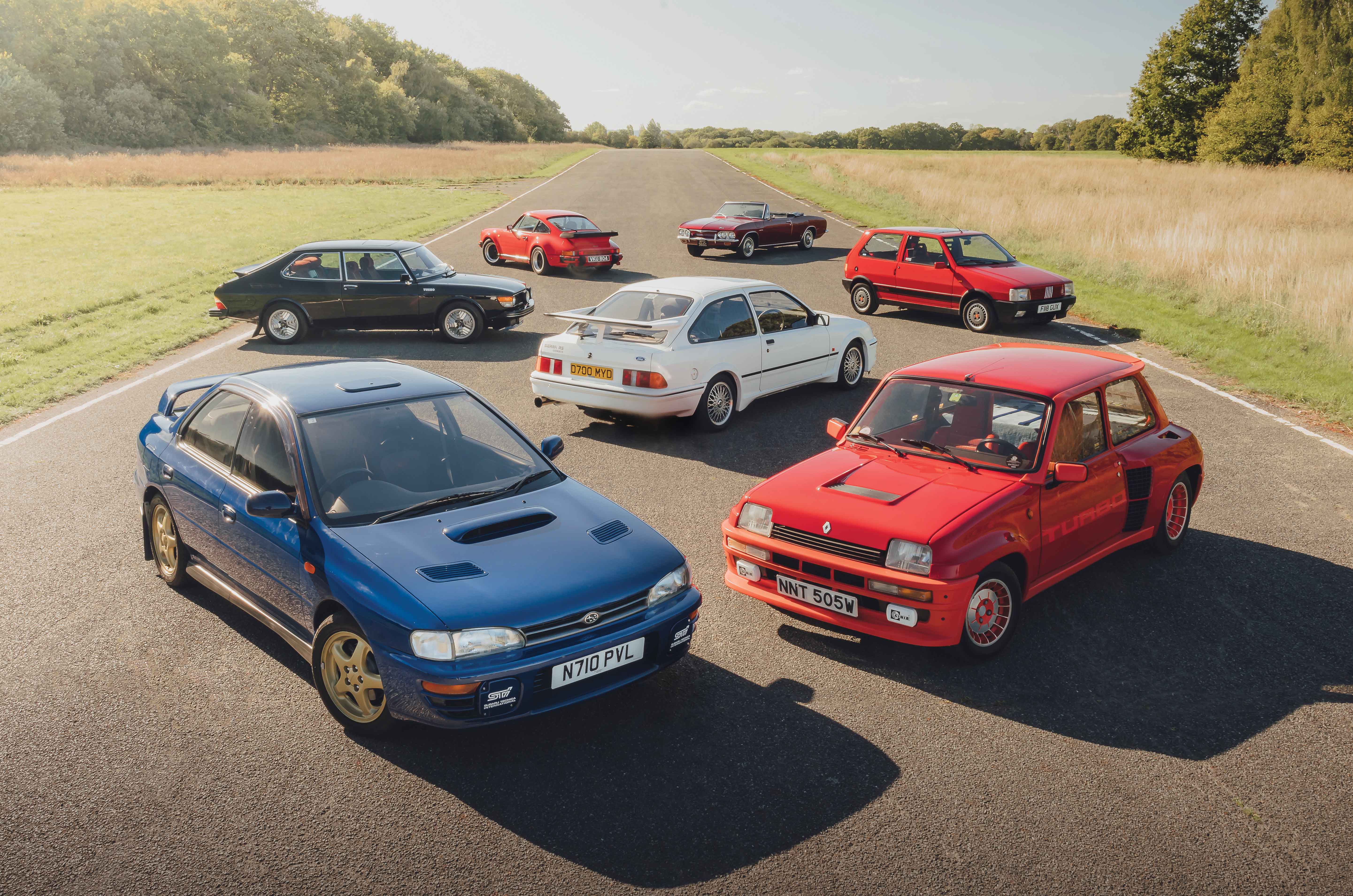
It’s not hard to see why: with its squat stance and the face of the R5 peeking out through a profusion of aero addenda, it’s an irresistible blend of cheek and aggression.
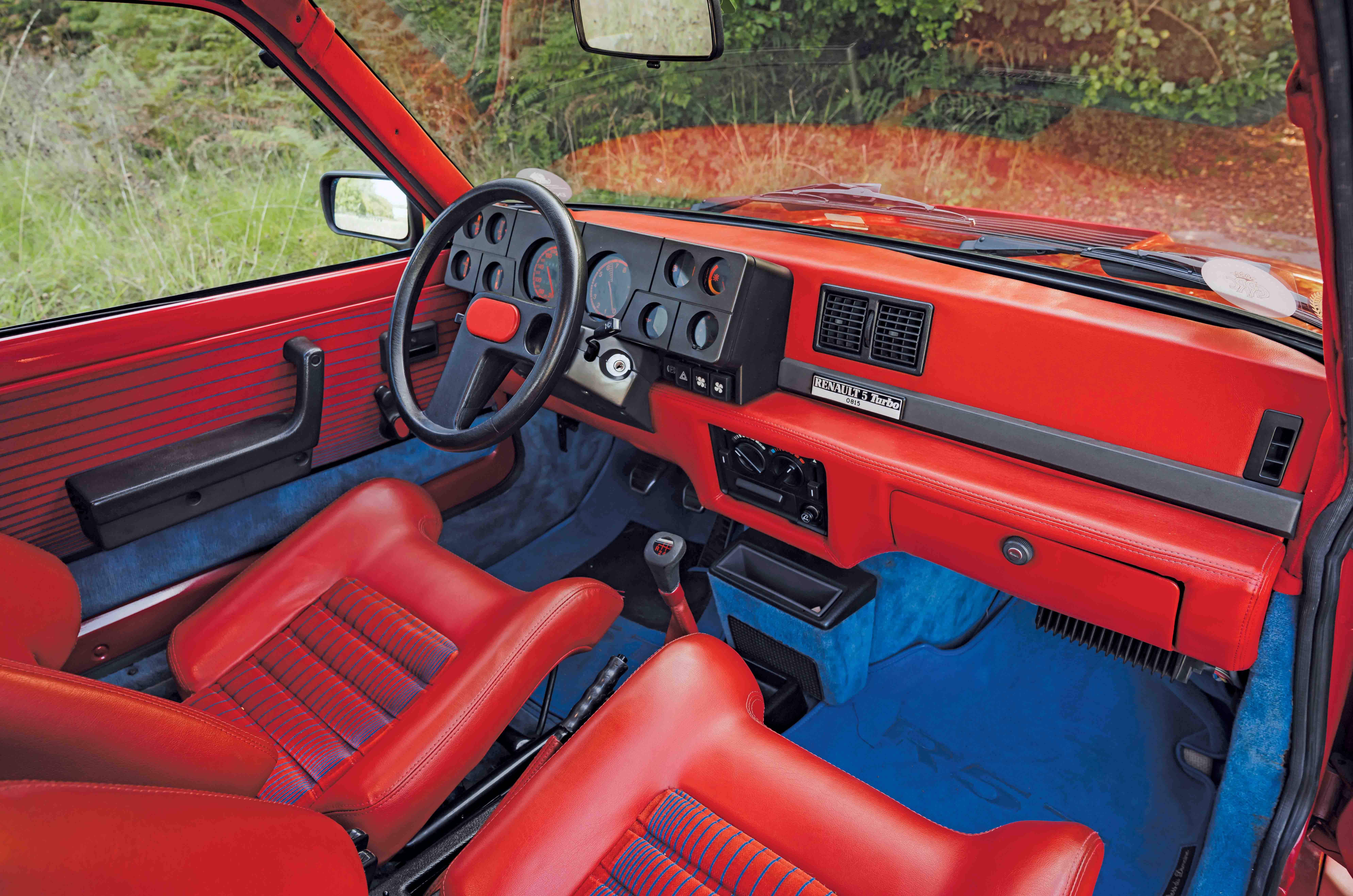
And if the exterior doesn’t capture your heart, the cabin will.
Designed by Marcello Gandini at Bertone and finished in bright red over electric blue, it’s more modern art than automotive engineering.
The bespoke, Cubist dashboard stacked with orange-on-black dials is fronted by a bizarre, offset two-spoke wheel, and you settle into outrageously sculpted – yet surprisingly comfortable – cutaway seats; no wonder true Francophiles cherish these early cars over the Turbo 2 with its R5 Gordini-sourced interior.
Fire up and it’s docile, but immediately feels alien, the hefty steering and enormous width at odds with the shopping-car origins.
The gearchange is initially notchy, particularly from first to second, and the brakes – big, ventilated discs – feel dead, but it’s surprisingly compliant and refined, even with the period-option Devil exhaust fitted to this car.
Refined? Compliant? That’s not what you look for in a performance icon is it? Get a bit of speed on, though, and the Renault 5 Turbo’s character begins to emerge.
The steering quickly frees with speed and feels direct, if not hugely feelsome, while the engine just loves to rev.
Boost starts to come on stream from 2000rpm, is running at its 0.86bar maximum at 3200rpm and by 4000rpm you’re really charging, hammering towards the 6500rpm redline and the next gearchange – which gets more slick with a bit of attack from the driver, rapid and rewarding despite the convoluted linkage.
The Renault 5 Turbo has huge grip and excellent balance
It’s all accompanied by a fantastic noise: not particularly tuneful, just loud and full of purpose, with an angry blare on throttle followed by what Richard calls the “swarm of angry bees” on the overrun.
If the engine is special, the chassis is something else.
Turn-in is ridiculously eager, with nimble balance, minimal roll and massive adhesion from the 190/55 front, 220/55 rear Michelin TRXs; no protest – it just grips and goes.
It’s an uncanny sensation: with your eyes closed, you’d swear you were in a Ferrari 308 or a Lotus Esprit, yet it has the upright driving position and great all-round vision of a supermini.
This is not a car that responds to a gentle touch, either: it demands the full Jean Ragnotti – not necessarily trying to enter every corner on the lock-stops and peering through the side windows, but to operate the steering wheel, gearlever and pedals decisively and confidently.
Not too confidently, however, particularly in the wet: with that ultra-short wheelbase and 60% rearward weight bias, you’ll need to be Ragnotti to catch it, too.
Just 400 cars had to be built for homologation, but in the end nearly 5000 were made including the toned-down Turbo 2. I’m not surprised: this is a car that quickly gets under your skin.
Words: Alastair Clements
Thanks to Richard Head; John Law Engineering
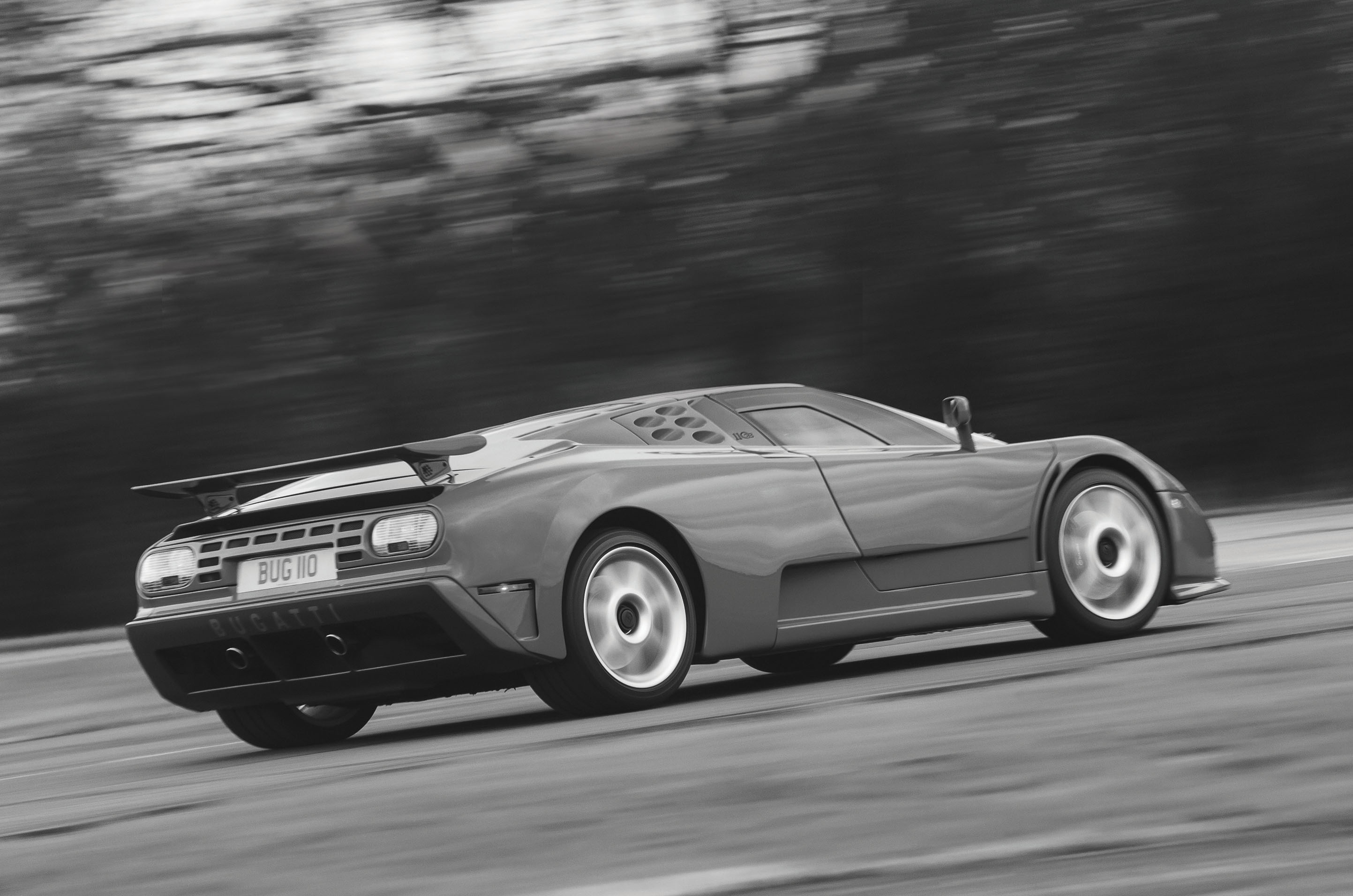
Turbocharged compatriot: Bugatti EB110
While Italy and the Maserati Biturbo introduced twin turbocharging, France went one – well, two – better in 1991 with the world’s first quad-turbo production car.
The outrageous EB110 (above) added four IHI turbochargers to a 3.5-litre, quad-cam V12 for 553bhp and – briefly – the production-car speed record at 342.7kph.
Romano Artioli’s EB110 is the missing link between the Ettore era and the Bugatti of today.
Sweden: Saab 99 turbo
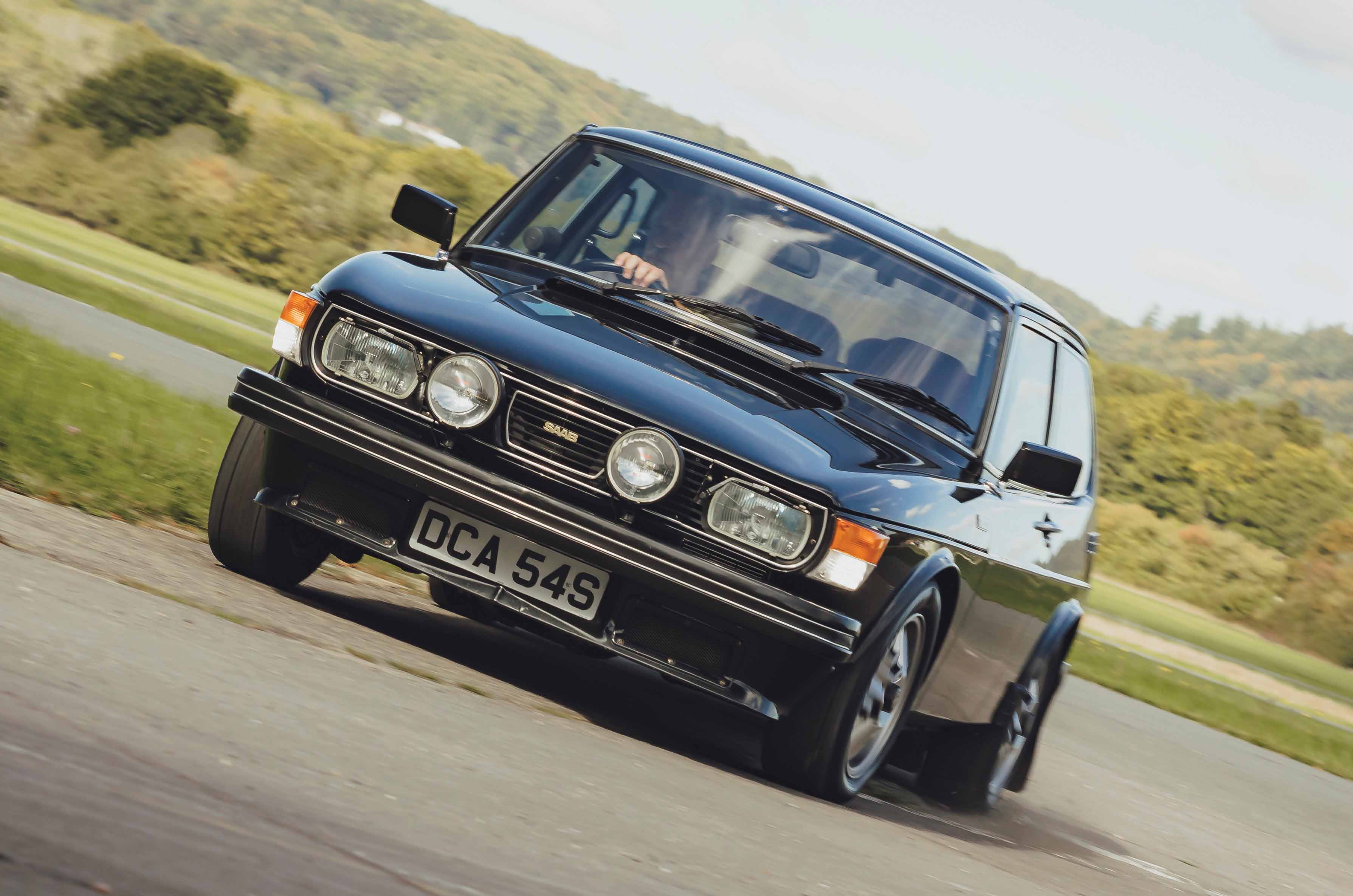
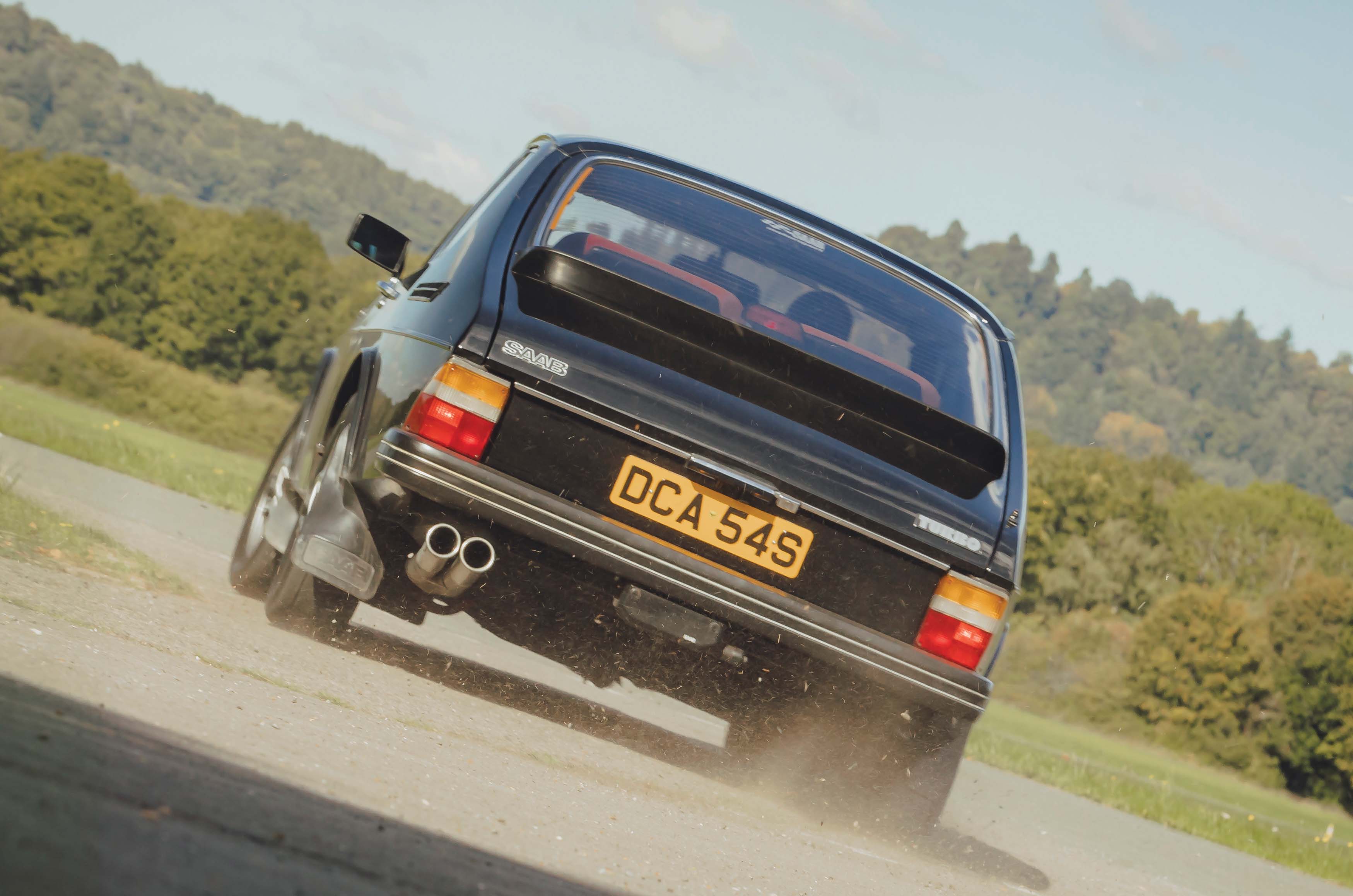
The Saab 99 turbo’s spoiler and spotlights add a sense of purpose
By 1976, Saab was in grave danger of being left behind.
The 96 was already 16 years into its 20-year production run. The 99, which had arrived back in 1967, was also starting to feel its age and, with the new 900 still a couple of years away from production, something exciting needed to be done to stem the tide and turbocharge Saab’s fortunes.
Rewinding to before the 99’s debut, power outputs were going up and fuel economy was coming down, and with a growing pressure from the USA to comply with ever-stricter emissions regulations, the Swedes needed to show that they could compete on a global scale.
However, the budget for a new engine design was clearly going to be a stretch for the modest Trollhättan company.
During negotiations with British engineering firm Ricardo, it was noted that Triumph was in a similar situation and a partnership was conceived to build a modern 2-litre engine that they could both use in their respective line-ups.
From the outset, though, it became clear that while the basic package was sound, Saab could take the design, modify and improve it at the newly acquired Scania lorry-engine plant without too much difficulty.
Little did it know at the time how far the envelope could be pushed for this humble little four-pot.
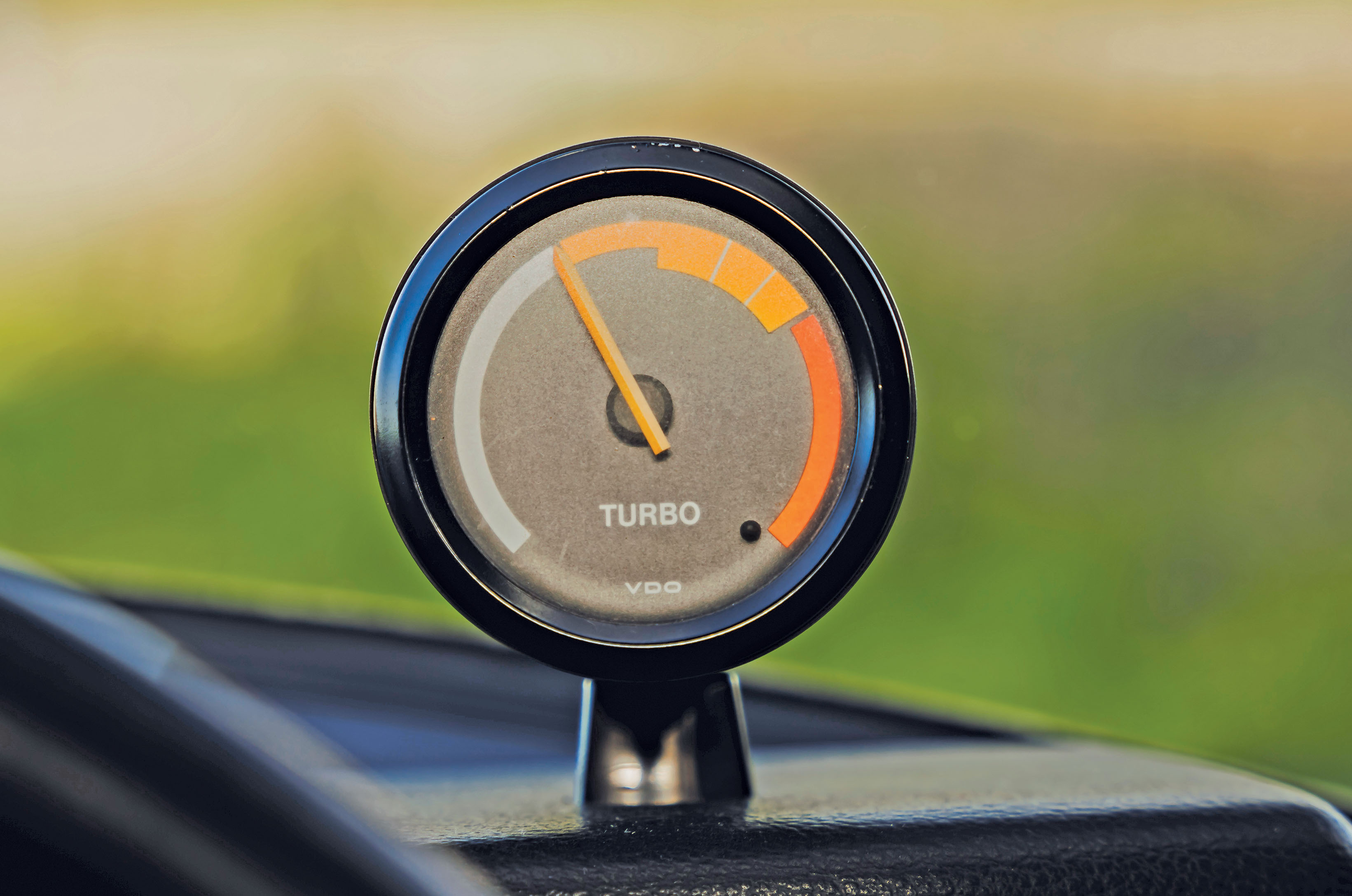
The Saab 99 turbo’s evocative boost gauge
As the years ticked by for the Saab 99, the idea of a new unit was once again on the planning table and, again, a limited budget meant developing a six-cylinder was out of the question.
What was interesting, though, was the newfangled turbocharger that American firm Garrett had just introduced.
No bigger than an alternator, its compact size and healthy power output from a mere 1500rpm looked ideal for the Swedes, who weren’t interested in supercar-hunting numbers.
What was more exciting was how the delivery would work in the realm of real-world driving, with estimates that the turbo would only be needed 15% of the time.
Because the new project was created away from the glare of the press, the factory was able to take the very Saab-like step of installing
a development turbo unit into an old rallycross 96, and even entered it into a few events.
Quite how the poor 96 felt about having 140bhp-plus stuffed into its rounded snout goes unrecorded.
The main differences from a non-turbo version were new pistons, valves and camshaft, combined with an oil cooler plus an upgraded radiator and exhaust, but the majority of the components were deemed strong enough to handle the extra stress of the turbocharger.
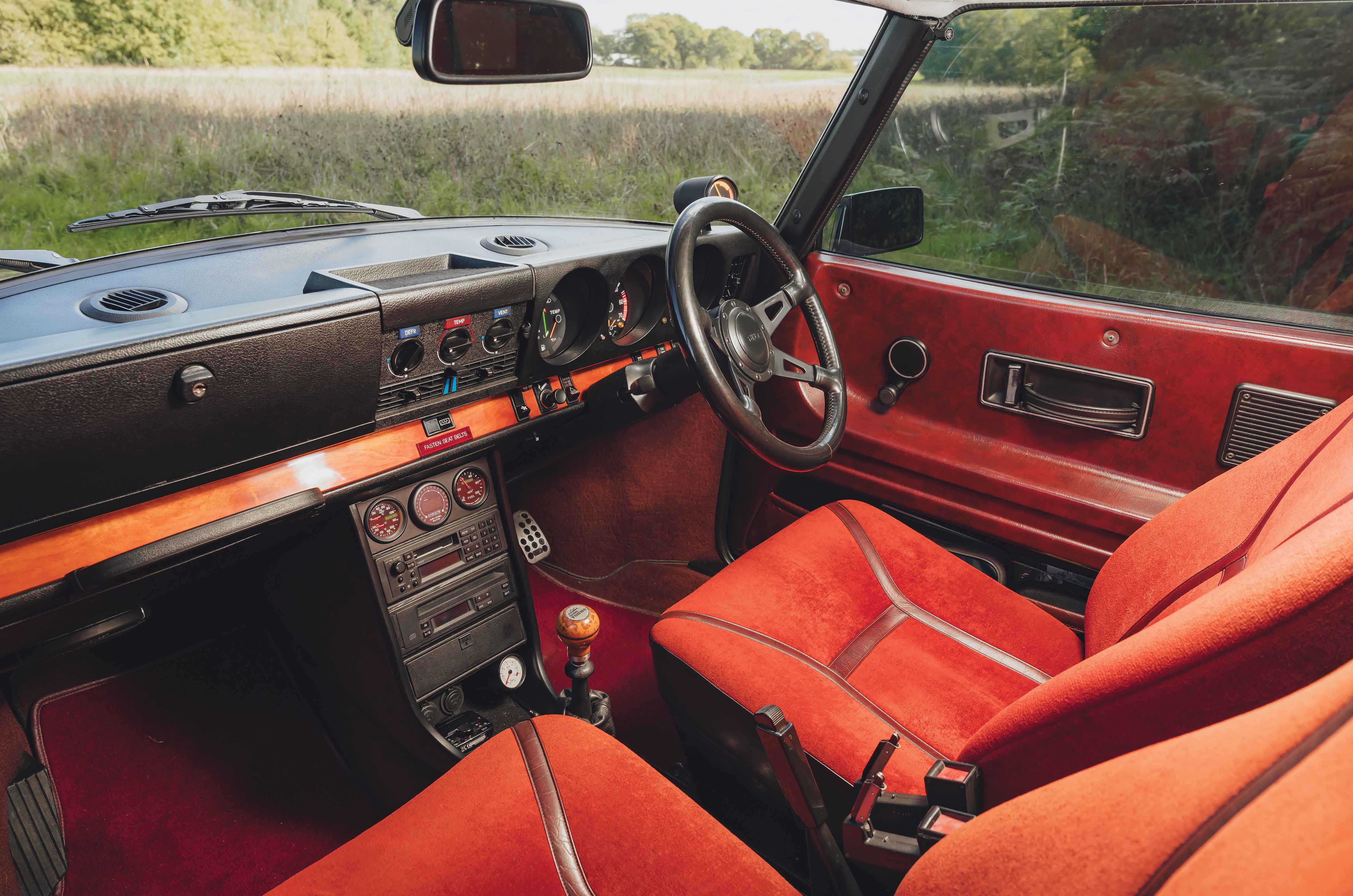
The Saab 99 turbo’s bright cabin
The godfather of Saab’s turbo programme, engineer Per Gillbrand, had the revolutionary idea of controlling boost pressure, gaining both economy and performance.
He harnessed the turbo’s potential by adding Automatic Performance Control, a brilliant advance that remains commonplace today.
By redirecting excess pressure to the wastegate, this simple invention restrained unruly boost from an all-or-nothing onslaught to a more manageable delivery and prevented knock.
Much more what Saab had in mind for its civilised 99.
What makes Saab’s approach different from rivals such as BMW and Porsche, which were developing comparable systems, is they are brands with a focus on performance.
Saab had always prided itself on being a little different; to quote its advertising blurb at the time: ‘The turbocharger only works when you want it to.
‘Cutting in with a surge of monster power for overtaking or accelerating. Making motoring safer – and splendidly more enjoyable.’ Quite.
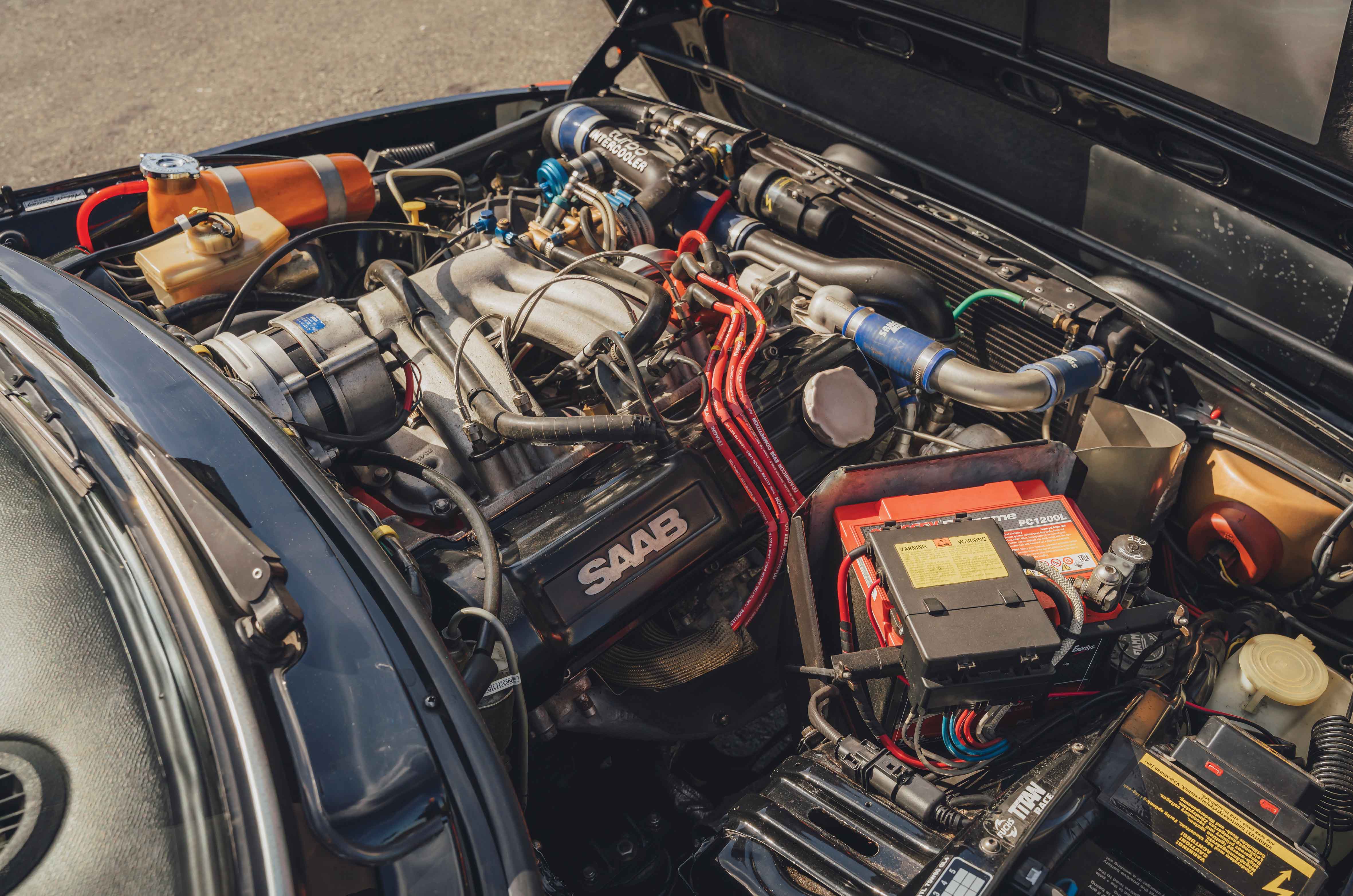
The Saab 99 turbo’s boosted motor majored on refinement
After a run of 100 pre-series cars, the 99 turbo entered the market in 1978 and was a breath of forced air to a buying public who knew Saab as a reliable and safety-first choice.
For many of us, our parents are to blame for our classic car buying choices, and a childhood memory still burns brightly of my dad taking me one Saturday morning to try an impossibly cool, black Saab 99 turbo at our local main dealer.
I sat in the back with a nervous salesman in the passenger seat as my father treated us both to a spirited test drive; I recall being transfixed by that little boost gauge atop the dash spinning up whenever his right foot was planted.
I was hooked by my first turbo experience, and that childlike excitement was revived on stepping aboard Chris Foxley’s very original car, bought new in late 1979 from the dealer in Chester.
Chris was a dyed-in-the-wool Saab fan from a young age. This isn’t his first example, either, back in 1979 he traded in a 99 Combi for the turbo, and admits that he has now owned about 15 Saabs in his lifetime.
He also realises that he probably needs to trim his current fleet, which varies in terms of condition and mileage, but he’ll never part with this, his firm favourite.
To his credit, this 120,000-mile example has led a busy life, with the polar opposites of track days and caravan-towing both being a feature over the years.
The three-door Saab 99 turbo was followed by a two-door in 1979
A recent engine rebuild, adding nothing more than a reworked head, liberated more horsepower than anyone expected, when a rolling-road test revealed a whopping 212bhp!
After a few squirrely days at that output, Chris decided to back it off slightly and now reckons the current 180bhp is enough to keep him entertained.
The surge of a standard 99 turbo is one of progressive progress rather than the walloping thump of other boosted rivals.
This car has a little more shove without ever being anything other than smooth and controlled.
The extra Swedish horses do mean that the corners arrive a little sooner, but the inherent tendency to understeer is still there, which all feels very predictable and safe.
Indeed, safety is the overriding sensation when the doors thunk shut, giving the impression of a car with many fewer miles than it has under its Inca alloys.
Today the 99 is considered a pioneer among ‘normal’ production cars.
There were other turbo outliers, but none could comfortably seat four, pack the boot with suitcases and be serviced by the local dealer, all while being able to smash the speed limit thanks to that stealthy secret lurking under the bonnet.
Words: Damon Cogman
Turbocharged compatriot: Volvo 850 T-5R
Saab and Volvo faced each other as rivals from the 1940s, but also shared similar traditions of solid Swedish safety allied to unexpected turns of speed when required.
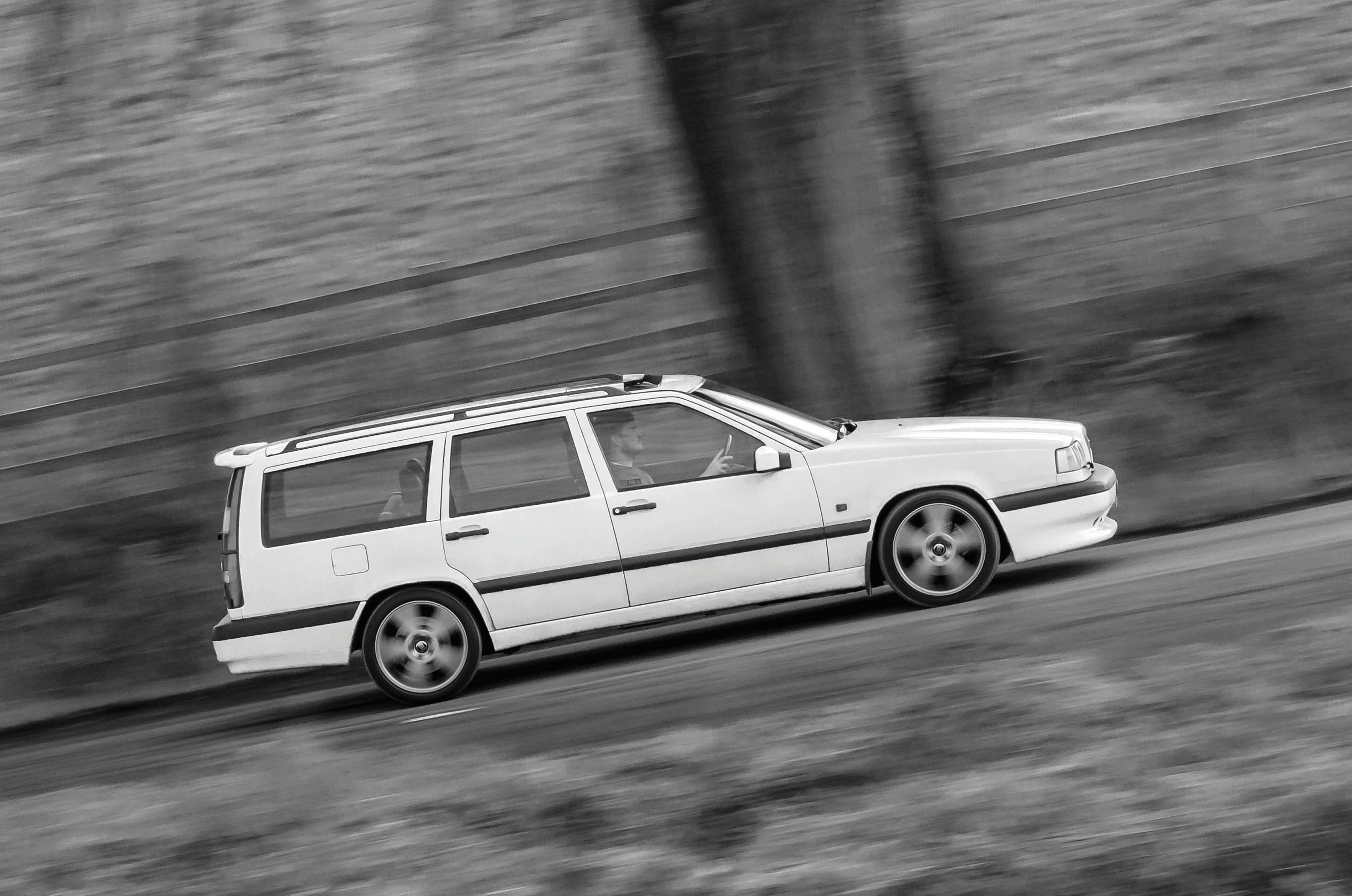
The wonderfully rectangular 850 was a torquesteering, tyre-shredding beast in 240bhp, turbocharged T-5R form (above).
Subtle it wasn’t, but an absolute hoot to drive. A nailed-on cult classic, especially as a wagon in original pastel yellow.
Great Britain: Ford Sierra RS Cosworth
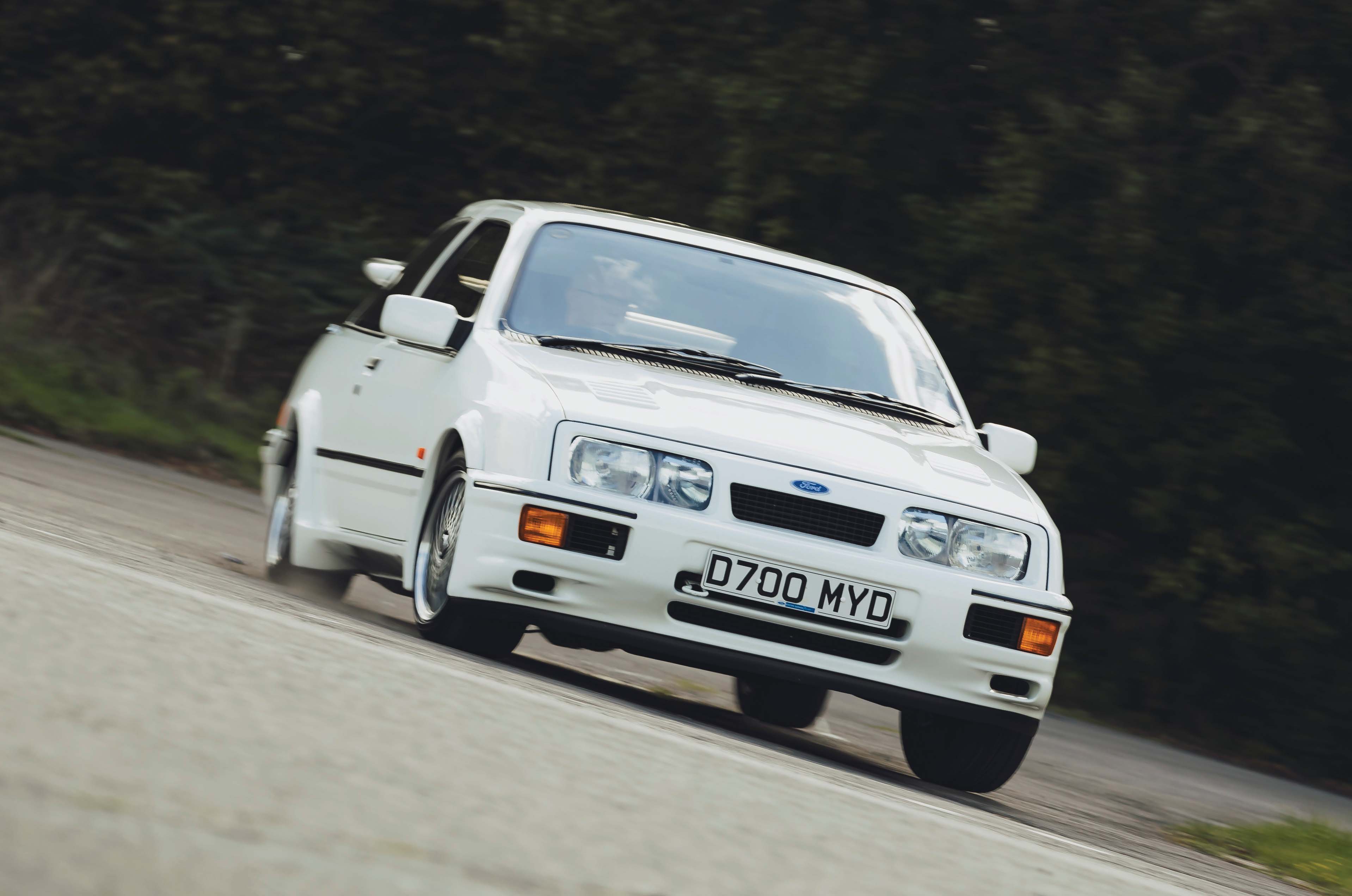
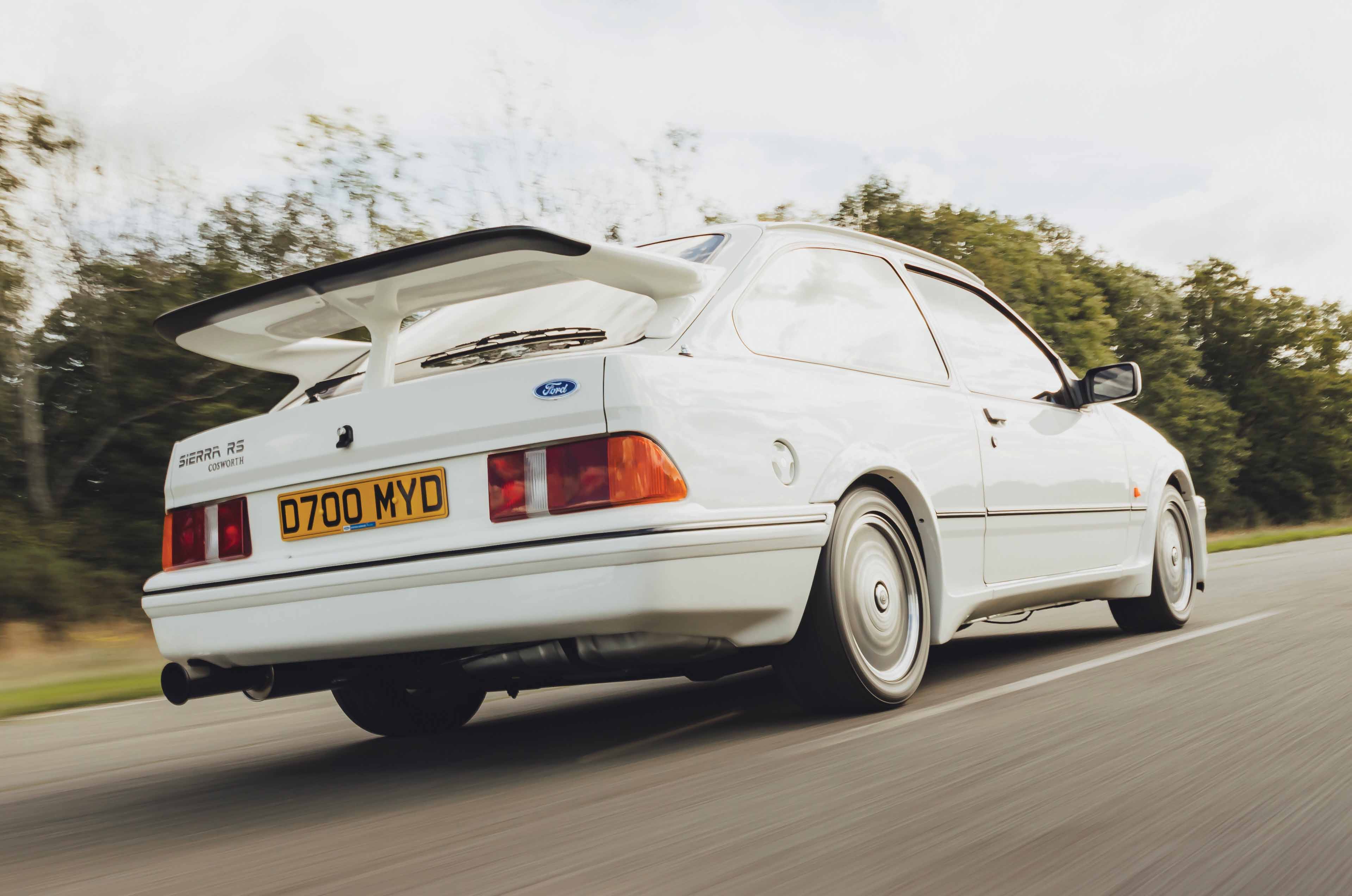
The Ford Sierra RS Cosworth oversteers readily, but it’s easy to catch
The Ford Sierra RS Cosworth’s British credentials are upheld here, not because of where the base car was manufactured – its assembly plant was in Genk, Belgium – but rather by its UK-led conception and powertrain development for this iconic high-performance model.
That’s important because, before the RS Cosworth’s launch at the Geneva Salon in ’85, the only turbocharged production cars of note that had emerged from Blighty were the MG Metro Turbo in 1983 and its MG Montego Turbo sibling, along with a gaggle of blown M-series TVRs.
Prior to that, British buyers’ limited exposure to turbocharging had come in the form of the left-hooker-only BMW 2002 turbo and Saab’s 99, plus the exotic Porsche 911 turbo.
So Ford of Britain’s first turbo production car had the potential to be a real trailblazer for the company, riding on the coat-tails of what was becoming a highly fashionable technology.
Its genesis lay with Ford Motorsport’s need to fill a gap in Group A competition, specifically in touring cars.
Stuart Turner, with the backing of legendary Ford PR man Walter Hayes, led the homologation programme that required 5000 cars to be built in order to satisfy the regulations.
The Sierra was chosen because it used a rear-drive platform, but also because it desperately needed a sales boost following its 1982 launch.
Ford did have some turbocharging precedent with the Sierra’s US-based sibling, the Merkur XR4Ti, which was already powered by a blown 2.3-litre, all-iron Lima engine, closely related to Ford’s European 2-litre Pinto unit.
While this avoided the need to put the new model through Type Approval, the Sierra RS Cosworth was destined to be a markedly different machine.
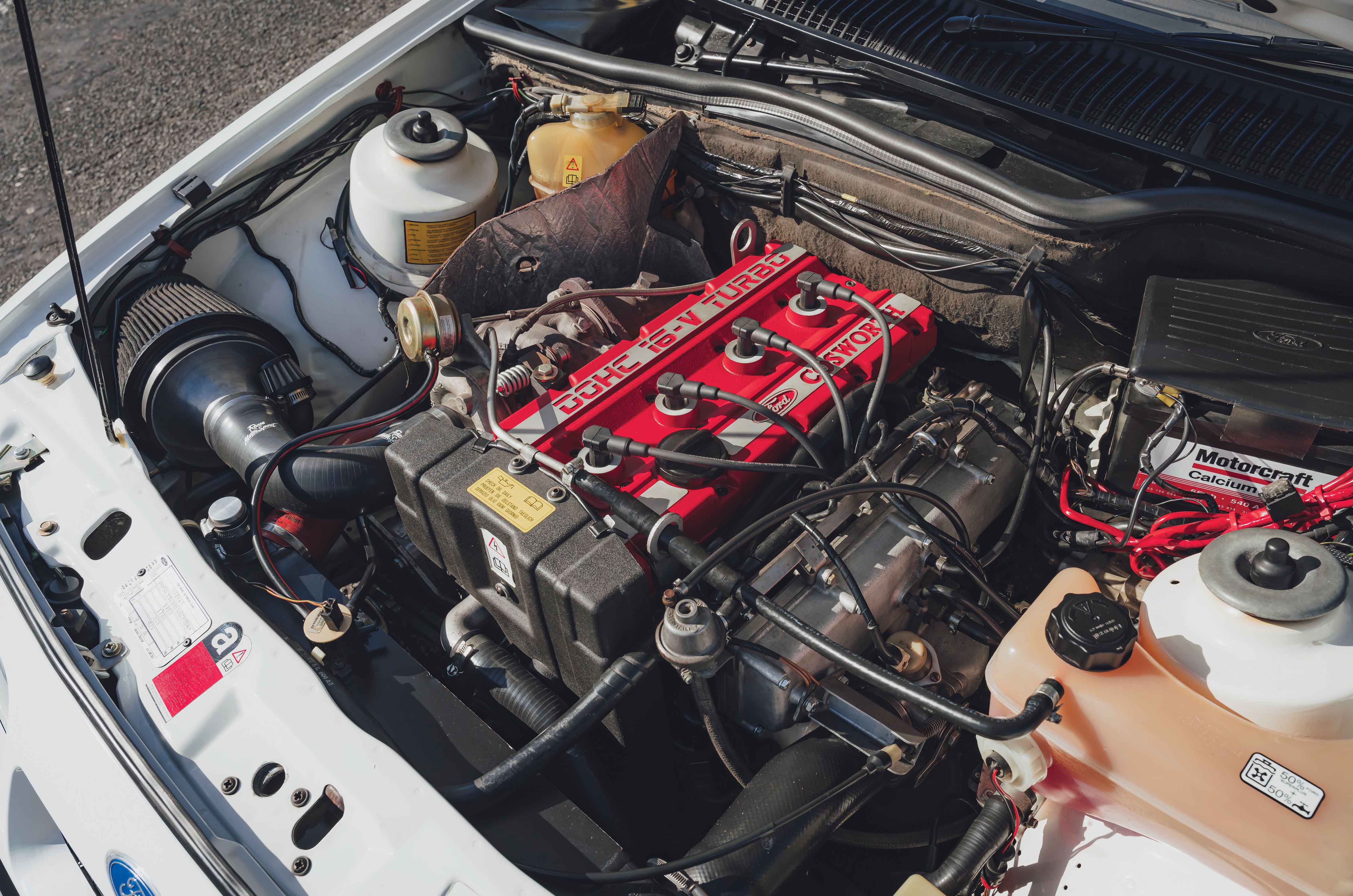
The Ford Sierra RS Cosworth’s turbocharged engine has a twin-cam, 16-valve cylinder head
Starting with the entry-level Sierra’s lighter and more rigid three-door body, Ford’s iron-block, 1993cc Pinto ‘four’ was given a Cosworth makeover.
The famed Northampton tuner developed an aluminium cylinder head with twin overhead camshafts operating four valves per cylinder.
Turbocharging the new unit was a no-brainer since it liberated so much extra performance, while remaining under the 2-litre capacity limit for Group A racing.
Thus, a Garrett AiResearch T3 blower was employed, complete with an intercooler, to give a maximum output of 201bhp at 6000rpm and 205lb ft of torque at 4500rpm.
Mated to a five-speed Borg-Warner gearbox, and sending drive to the rear axle via a viscous-coupling limited-slip differential, the resulting performance was vivid: 0-60mph in 6.5 secs and on to a top speed of 149mph.
Despite this considerable lift in poke versus any cooking Sierra, the Cossie’s underpinnings did not fundamentally change.
Different spring rates and unique damper tunes were developed by Ford’s Special Vehicle Engineering division, as was a quicker steering rack, but the design of the MacPherson-strut front and semi-trailing-arm rear suspension remained.
Braking was by discs all round, the 283mm fronts ventilated and fitted with four-pot calipers.
Externally, a new design of 15x7in alloy wheel was introduced, with the rear arches widened to accommodate them.
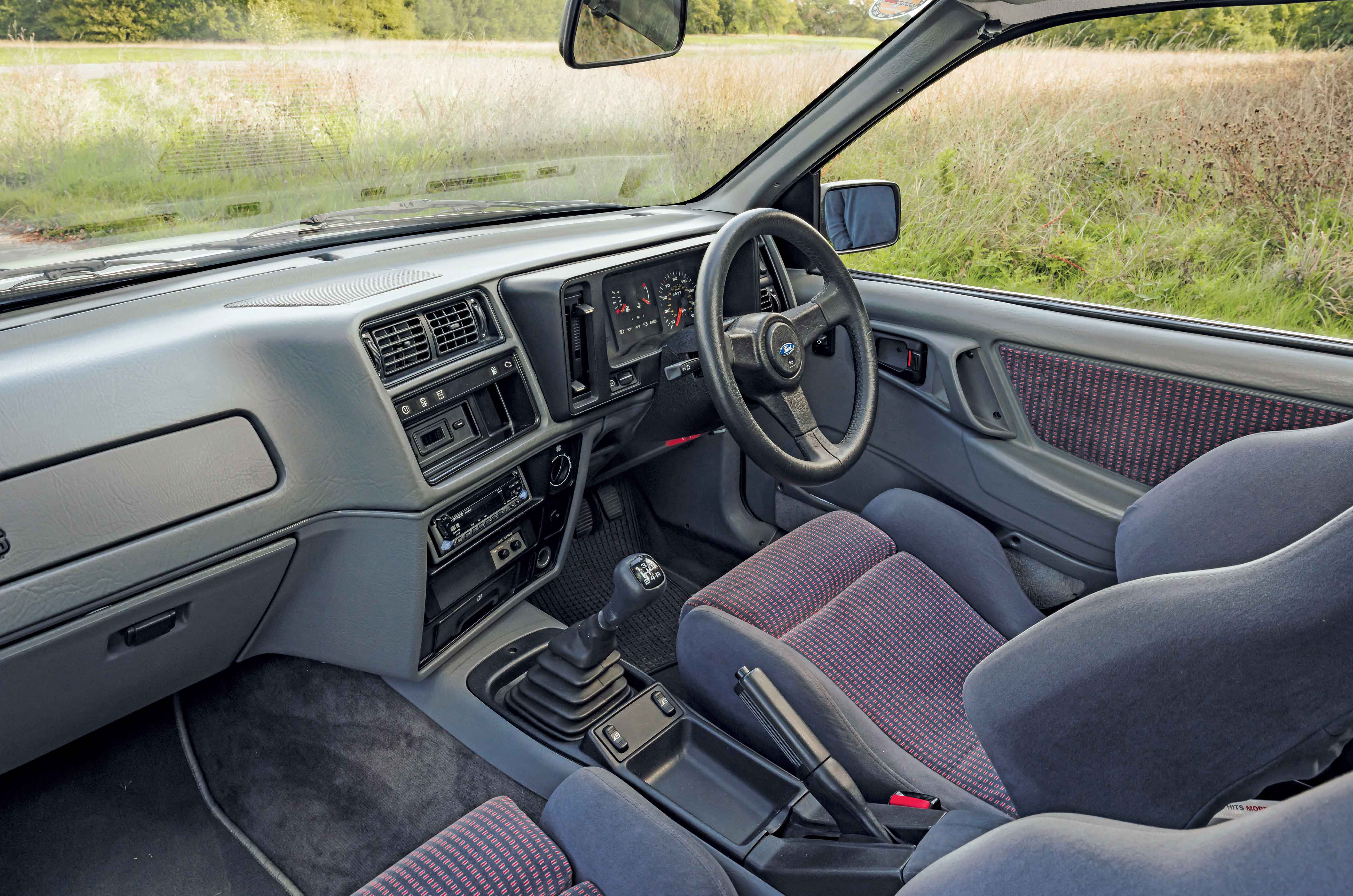
Familiarly Ford feel in the Sierra RS Cosworth’s cabin
But it was the Cosworth’s body – only available in Black, Diamond White or Moonstone Blue – that gave it true poster-child status.
An outrageous ‘whale-tail’ rear wing perched atop the car’s tailgate supposedly created 20.4kg of downforce at 70mph, while a front airdam and deep sill extensions paid tribute to those of the 375bhp touring cars.
Trimmed inside as per Ghia spec, the Cossie added Recaro seats, a smaller, three-spoke steering wheel and a tilting glass sunroof – not forgetting, of course, a tiny turbo-boost gauge integrated within the existing tachometer.
‘Our’ car belongs to serial Fast Ford owner Clive Munns, who bought D700 MYD 24 years ago. It’s now covered 103,000 miles, which has included a number of trips to the Nürburgring.
However, like most other Cosworths, Clive’s car’s engine has been remapped and the fuel-injection system uprated to deliver closer to 300bhp.
The stainless-steel exhaust system is also non-standard and has a larger bore.
All of which makes driving it an enticing prospect. Memories flood back to my last-of-the-line company Sierra in 1993 as I drop into the Recaro chair.
Ergonomically, it’s utterly conventional and none the worse for it, though you do sit a little high. No fireworks on start-up, just a muted rumble from the big-bore tailpipe.
With that vast rear wing it could only be a Ford Sierra RS Cossie, star of so many bedroom walls
You need more revs than expected to get off the line, thanks to relatively low compression, and as you start to work the throttle there’s plenty of wastegate chatter, but no real ‘whoosh’ from the turbo – caused, Clive tells me, by his removal of the dump valve and standard airbox.
At moderate road speeds, other than a nuggety secondary ride, Clive’s car feels like any other Sierra: the meatily weighted power steering provides excellent feel and accuracy, and as you pick up speed, the Cossie corners flat, with decent body control for a 40-year-old.
You start to feel the Garrett from around 2500rpm and, if you were heavy-footed, it would be easy to progress in a series of surges, due to the contrast in off- and on-boost delivery.
But apply power more sensitively and by around 3000rpm there’s a robust swell of torque that’s ideal for fast overtakes.
By the time 5000rpm arrives, the RS lifts its side skirts and bolts towards the horizon
Progress is manic, and if you happen to be mid-corner while in mid-boost, it’ll happily rotate, but progressively enough to be catchable. It’s fun, for sure, but respect is needed.
There’s not enough room here to recount the Cossie’s success on the circuit and stage, but as a road car it continued to evolve.
A slightly more hardcore RS 500 Cosworth followed, with Aston Martin Tickford commissioned to build a run of 500 cars.
In 1988, the four-door Sierra Sapphire took on the mantle, with the all-wheel-drive RS Cosworth 4x4 completing the series between 1990 and 1992.
Words: Simon Hucknall
Thanks to Clive Munns; Ford RS Owners’ Club
Turbocharged compatriot: Lotus Essex Turbo Esprit
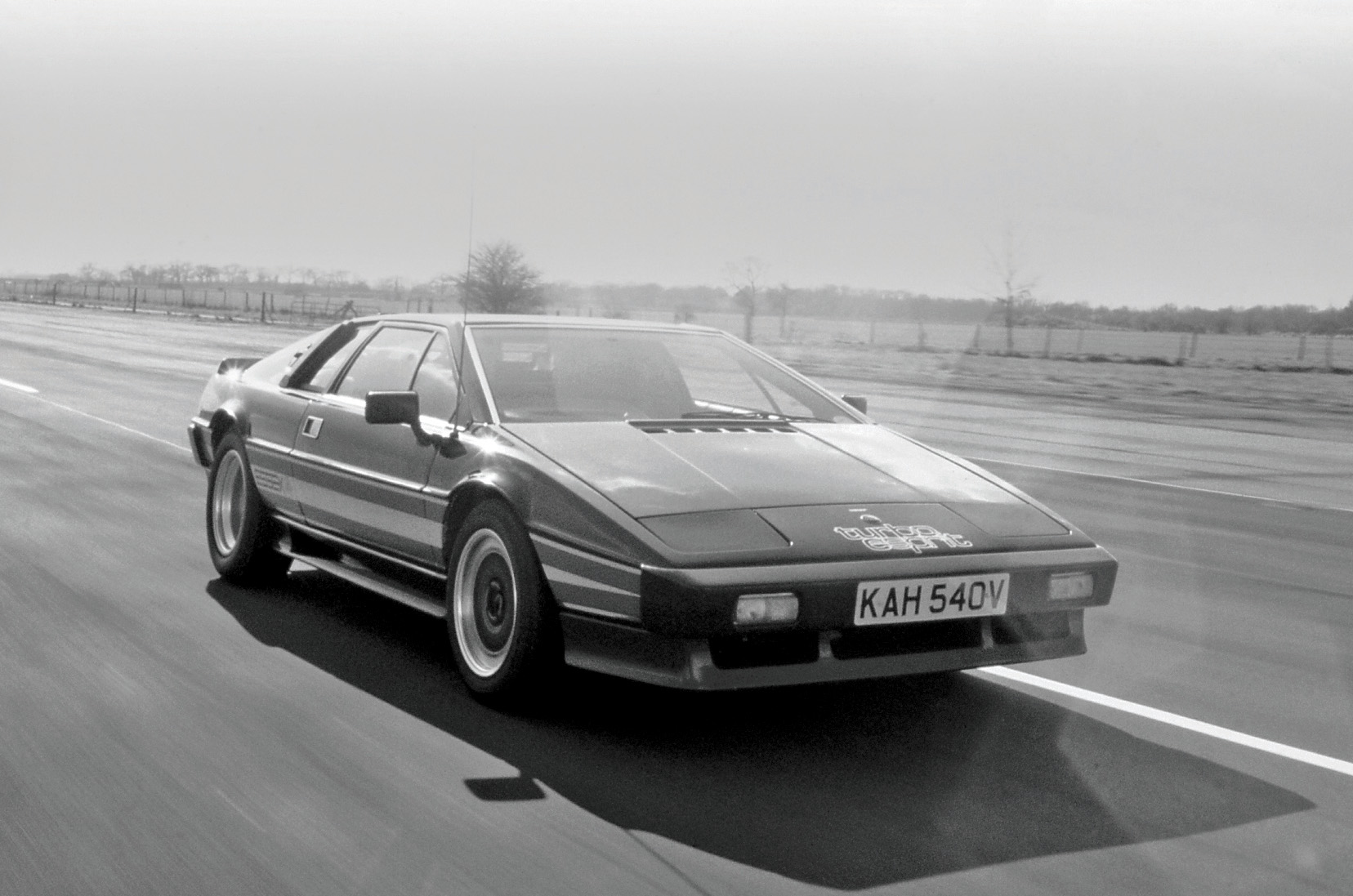
The first turbocharged production Esprit, the Essex Turbo (above) was a special edition in the blue, red and silver of Team Lotus Formula One sponsor Essex Petroleum.
Introduced in 1980, it used the dry-sump Type 910 engine with a Garrett T3 turbo mounted upstream of twin Dell’Orto carburettors, supplying up to 8psi boost.
Performance took a leap into the supercar league, with 0-60mph in 5.5 secs and 152mph flat-out.
Germany: Porsche 911 turbo
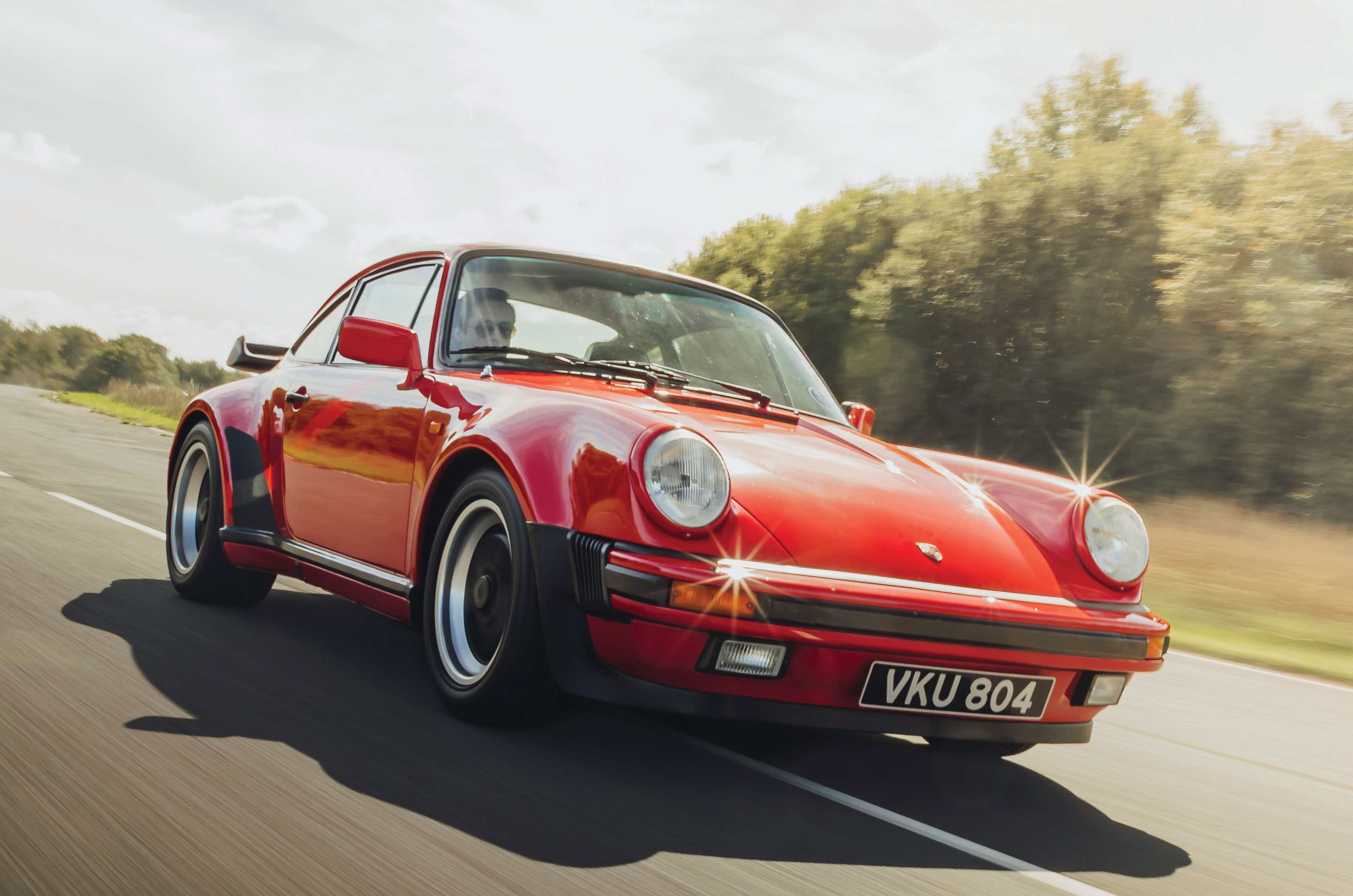
The Porsche 911 turbo’s flared rear wheelarches added discreet muscle to the famous shape
Forget the figures for a moment. When the 911 turbo finds a straight, on boost, it will leave everything behind. On paper, a Carrera RS should keep up. It won’t.
“A 3.2 is basically just as quick,” say the doubters, those who see 3500rpm as time to consider easing off. The 911 turbo rewards commitment.
Roll on the throttle and a hissing, tearing building of pressure begins an irresistible surge of torque that ignites like an afterburner on Porsche’s thumping flat-six behind.
Stay in, line up your corner exit and the horizon, and it becomes a full-force explosion of momentum at 4000rpm, firing forward in a tachometer-blurring rush.
All that’s left for those behind is an empty space that had once displayed the word: turbo.
The blaring, race-car growl in its wake is no coincidence, because the roadgoing 911 turbo that first appeared at the 1973 Paris Salon was a product of Porsche’s motorsport programme.
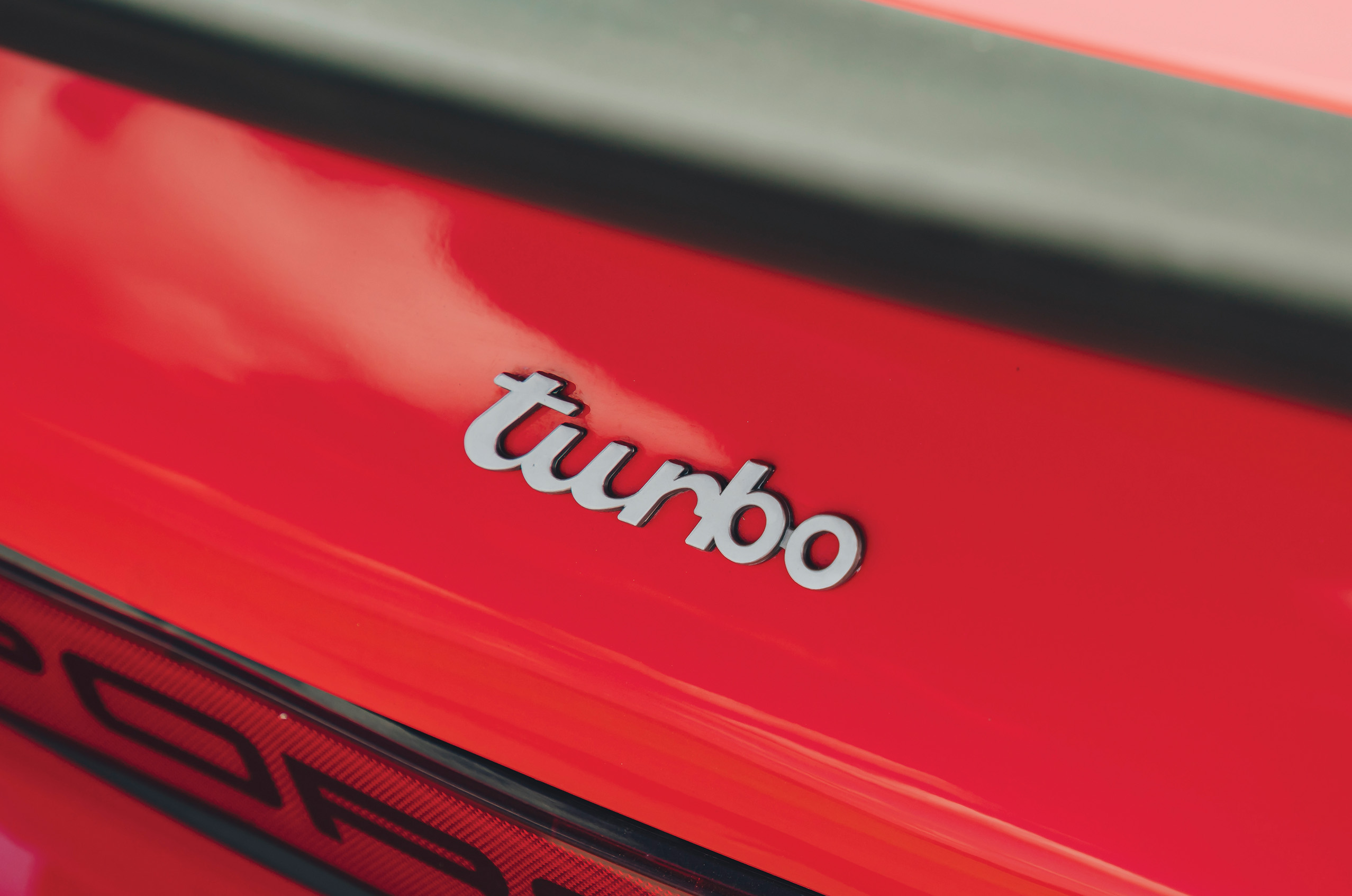
The Porsche 911 turbo’s iconic script
Having discovered success with turbocharging its 917 sports-racer for the 1972 Can-Am series – the twin-charged 917/30 made upwards of 985bhp – Stuttgart was finding its second wind in Group 4 racing by endowing its formidable 911 RSR with forced induction for 1974.
The results were as spectacular as had been enjoyed by near rival BMW, which had developed a turbocharged 2002tiK to win the 1969 European Touring Car Championship, and continued to chase outrageous bhp figures in Group 5 and Formula One into the 1980s.
It was homologation requirements for Group 4 that led to the series production of Porsche’s new 911 turbo, codenamed ‘930’ after the 917/30 project, and sealed its popularity beyond that of a specialist device for racing.
It was largely developed out of the Carrera RS 3.0, using much of that car’s drivetrain and brakes, plus suspension geometry derived from the RSR racing programme and a fixed rear wing over the engine bay.
The RS-spec 3-litre flat-six was reworked under chief engineer Herbert Ampferer to accommodate 0.8bar of boost from a KKK 3LDZ turbocharger hung just ahead of the silencer, for 260bhp and 253lb ft of torque.
K-Jetronic fuel injection, milder cams and a compression ratio down to 6.5:1 (effectively 11.7:1 at full chat) helped flexibility, but Porsche would always be chasing improvements, as well as Federal emissions targets, through the 930’s 14-year run to 1989.
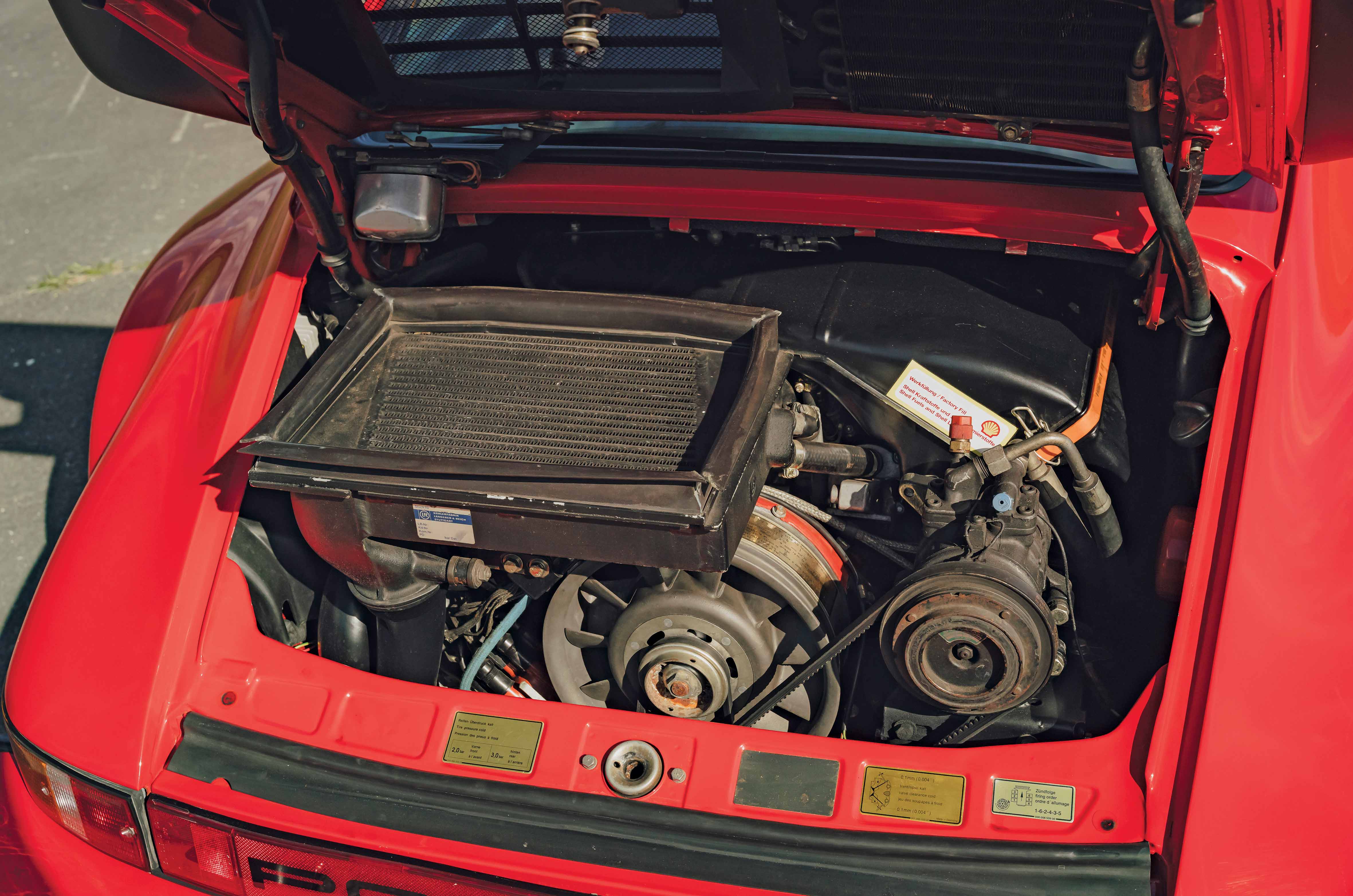
The Porsche 911 turbo’s intercooler is fed by a vent in the spoiler
The vision of the 911 turbo as a range-topping GT car was established early on, championed by newly installed Porsche chairman Dr Ernst Fuhrmann, and the 930 was thus equipped with the few luxuries – leather trim and headlamp washers – available to the sports-car maker, as well as extra sound-deadening, for a list price in the UK that started at £14,752.36 in 1974.
This rose to £23,200 in ’77, for the 3.3-litre 911 turbo that lifted outputs to 300bhp and 303lb ft with the assistance of an air-to-air intercooler under the famous ‘tea-tray’ rear wing.
The 917-derived brakes always intended for the 930 were finally installed, along with a servo, while an uprated clutch pushed the engine back by 30mm.
With air conditioning, an electric sunroof and leather as standard, weight was up to 1200kg; the final, five-speed models of ’89 were 1335kg.
‘Our’ 1981 example, owned by Jarrod Ellis, is equipped with the optional limited-slip differential and orthopaedic ‘Dr Fuhrmann’ seats, developed to help with the chairman’s backache.
A former Porsche GB press car, first registered THE 911, this Guards Red 911 turbo is the wide-bodied archetype of aspiration for the 1980s.
Not as flash as a Ferrari and, oddly designed seats aside, no luxury car, the 930’s defiant ability to punch above its weight – it could beat a £40,000 512BBi in a quarter-mile sprint – and businesslike demeanour gave it an intimidating mystique that resonated perfectly with those just hitting the big time.
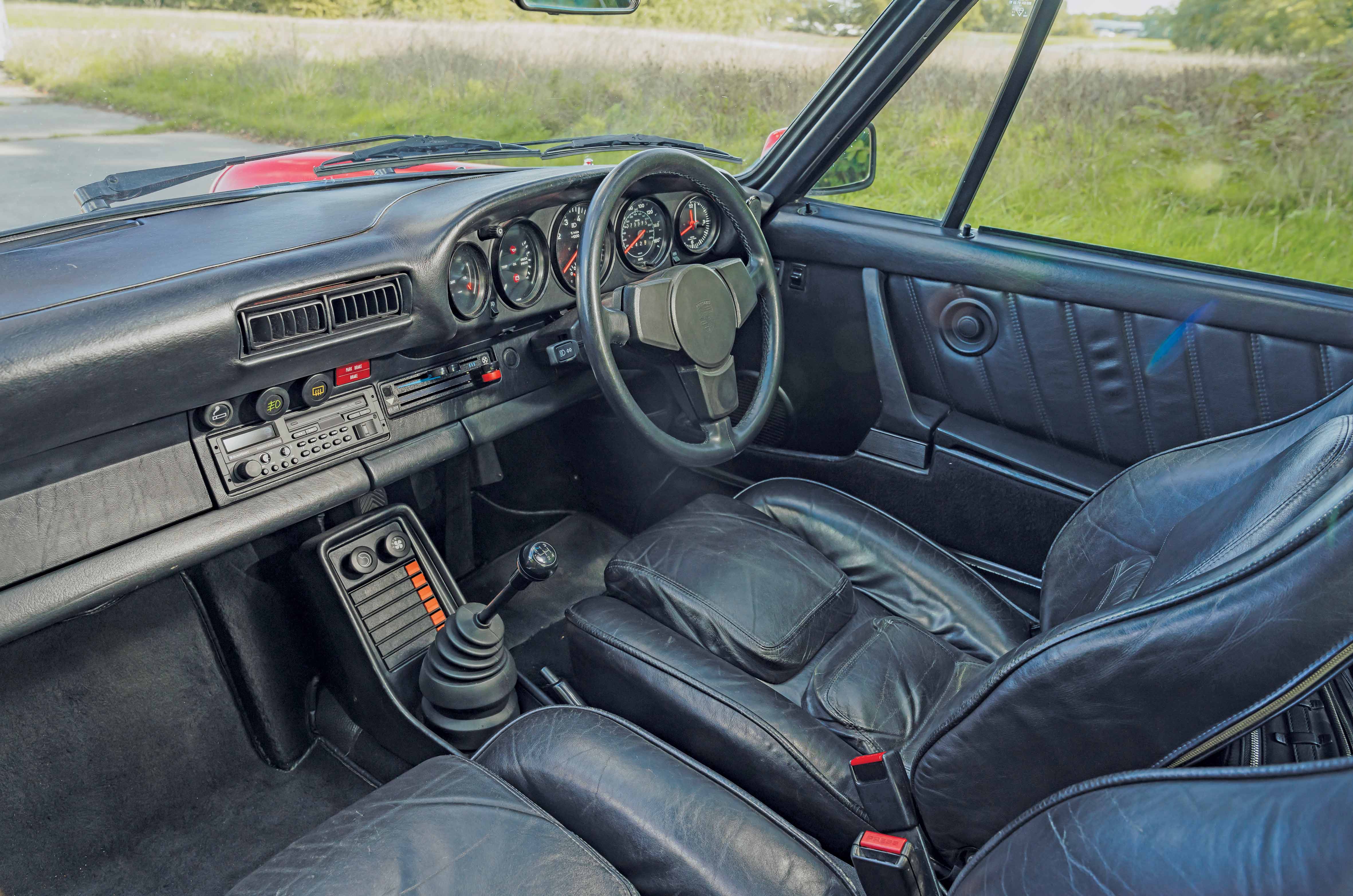
The Porsche 911 turbo’s timeless cockpit
With 205mm front and 225mm rear Pirelli P Zeros (where once P7s would have been fitted), the unassisted steering courtesy of the 930’s aggressive front geometry is noticeably heavier than a standard Carrera’s, but the classic organ-type pedals aren’t unduly difficult to manage and neither is the relatively docile flat-six from a standstill.
Only the big hips looming in the mirrors redraw slightly the parameters of a sports car you could easily use every day.
But it longs for the open road, where its firmly sprung, heavy footprint smooths out and the huge grip dares you to take on more speed.
Those vast, 917-derived brakes haul the car in with detailed feedback and as the turbo shoves you into the seat, the steering wheel lightens with its classic 911 pattering over the Tarmac.
The 90mph second and 130mph third gears have horizon-grappling reach, and the addictive thrust of the torque peak at 4000rpm makes it difficult to resist.
Get carried away and you can understand the ‘widowmaker’ reputation: even more than a standard 911, the 930 rewards planning and confidence.
In this sense, it charmed the hearts of 911 diehards looking for the ultimate dance with dynamics, as well as the new generation of fans awestruck by its capabilities.
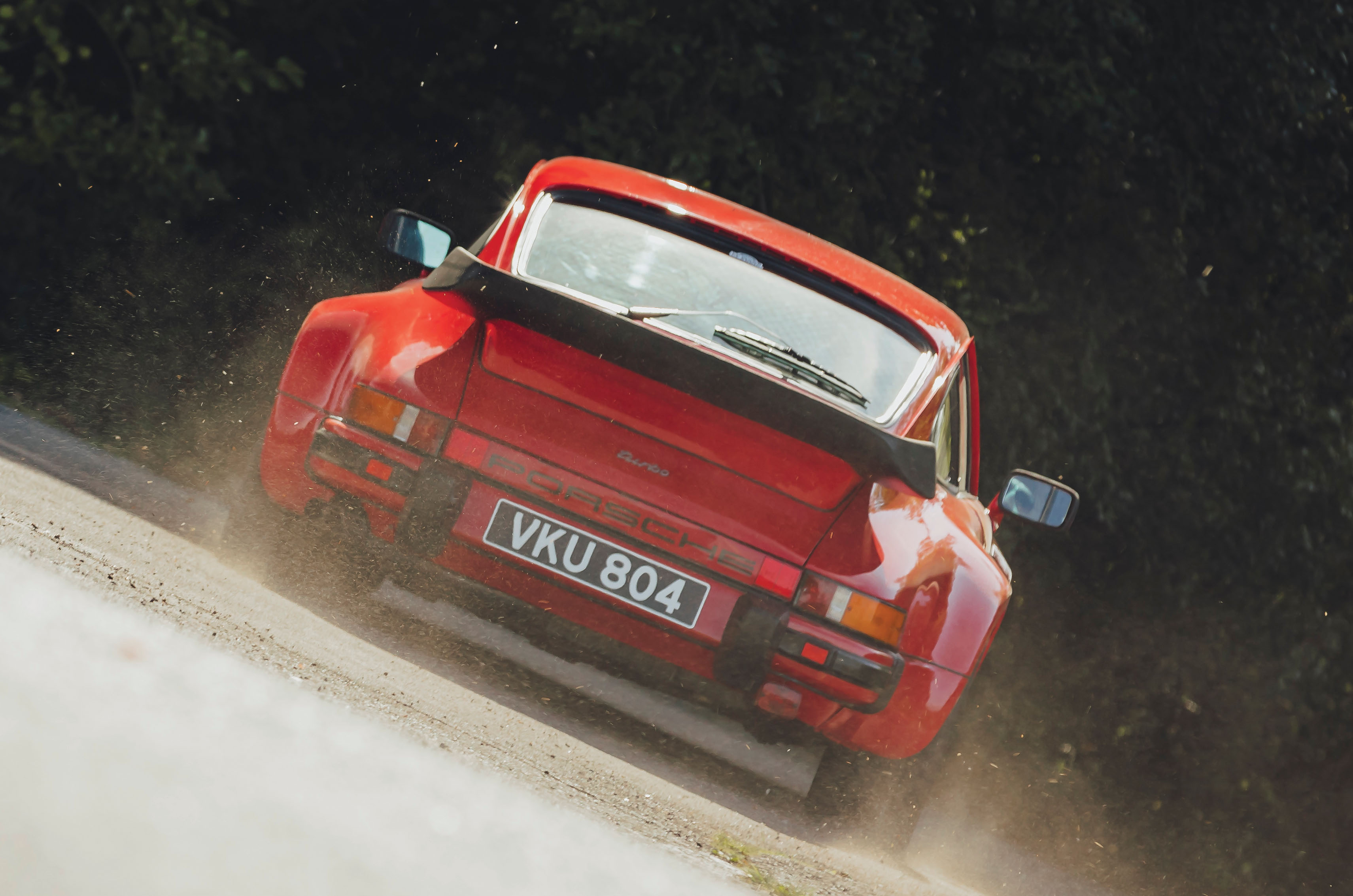
The Porsche 911 turbo’s huge ‘tea-tray’ wing grew further for the 3.3-litre model from 1977
By the end of the 930’s run in 1989, the Porsche 911 turbo was well established as a performance icon: from the 935’s win at Le Mans in 1979 to the frenzied demand that produced road-burning special editions and kick-started Porsche’s lucrative Sonderwunsch-programm for bespoke orders.
Turbocharging became synonymous with Porsche flagships, with a 924 turbo arriving in 1978 and a 944 to follow, then the twin-turbo 959 becoming a hypercar showcase for the marque in ’87.
The 911, as ever, has remained the focal point, with each successive iteration a performance statement, despite shifting upmarket.
From the polished resolve of the 964, via the four-wheel-drive 993 and water-cooled 996, barriers of what an increasingly plush Porsche 911 turbo could do appeared to be smashed continuously.
Today’s £200k, 701bhp turbo S maintains the tradition.
Spot the wide body, the wing, the big intakes: relics of a 1980s power dream. “It’s a turbo,” they’ll say: “the fastest real-world supercar.”
Words: Aaron McKay
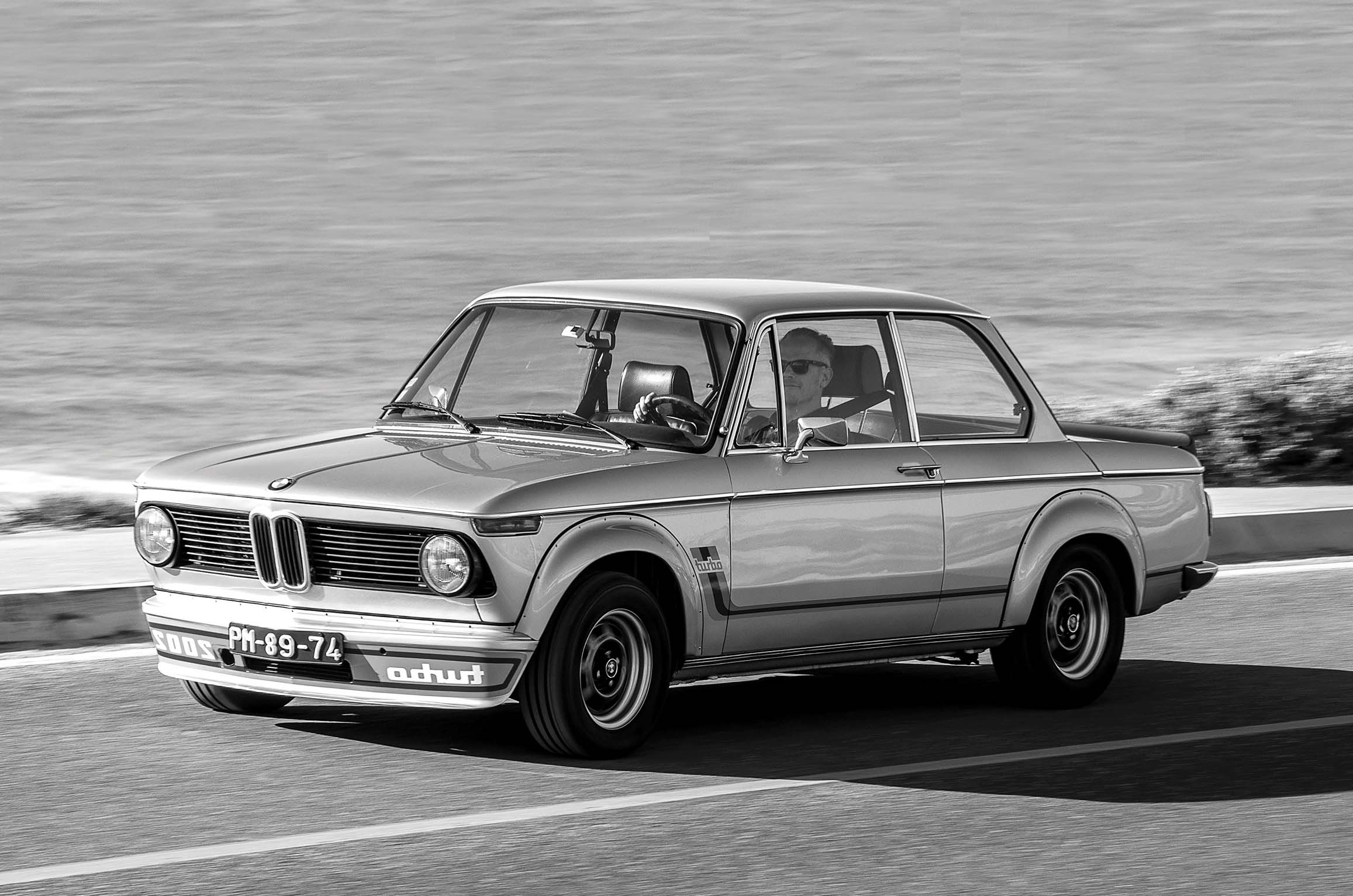
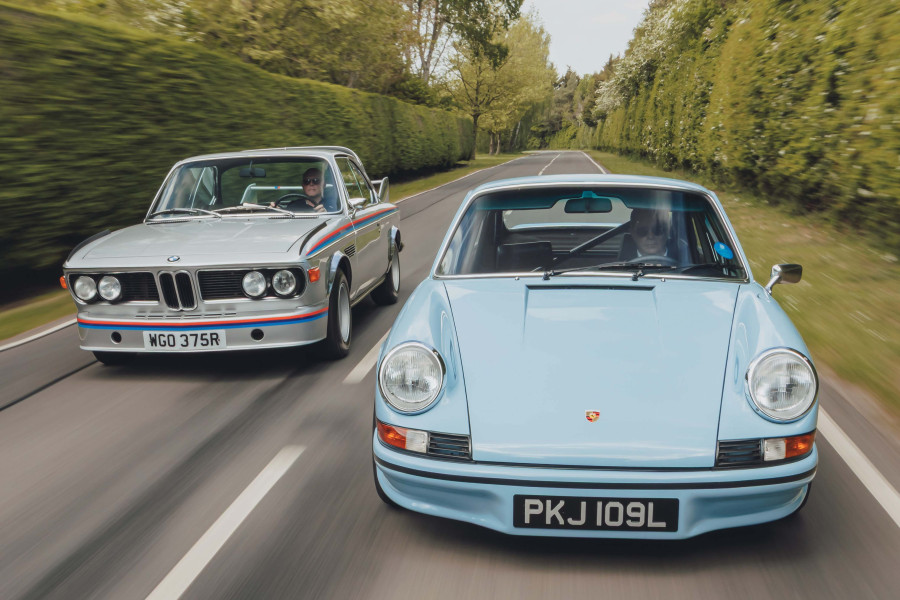
Turbocharged compatriot: BMW 2002 turbo
Inspired by its successful 1969 2002tiK touring car, BMW produced a roadgoing 2002 turbo (above) from 1973-’74, just before the popular small saloon was replaced by the E21 3 Series.
Adding a KKK turbo at 0.5bar to the 1990cc slant-four gave 170bhp and 177lb ft of torque in a car that weighed just 1034kg.
Only 1672 were built and there was to be no 3 Series turbo, apart from a Group 5 monster, but the legend stuck.
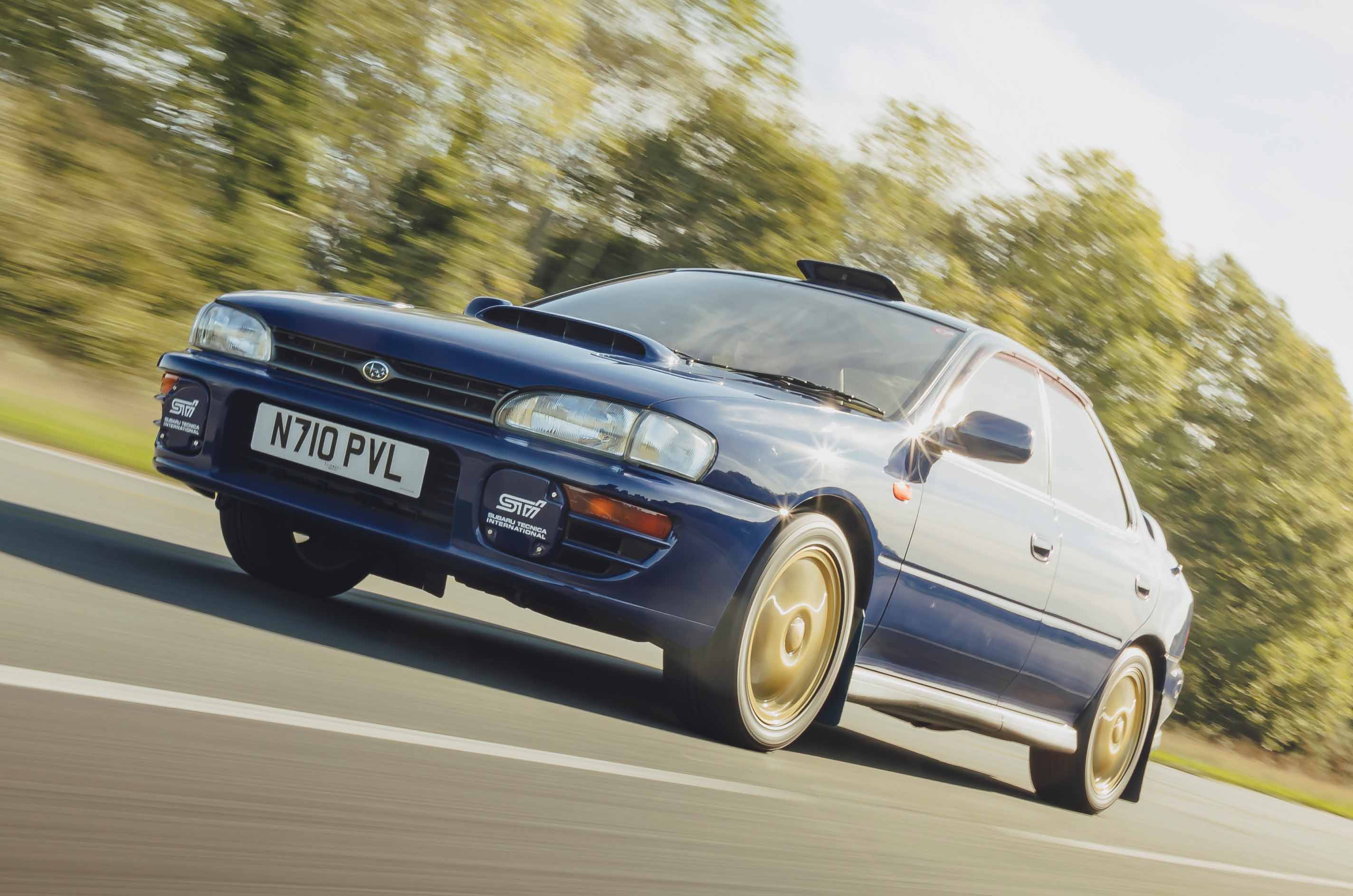
Japan: Subaru Impreza WRX STi
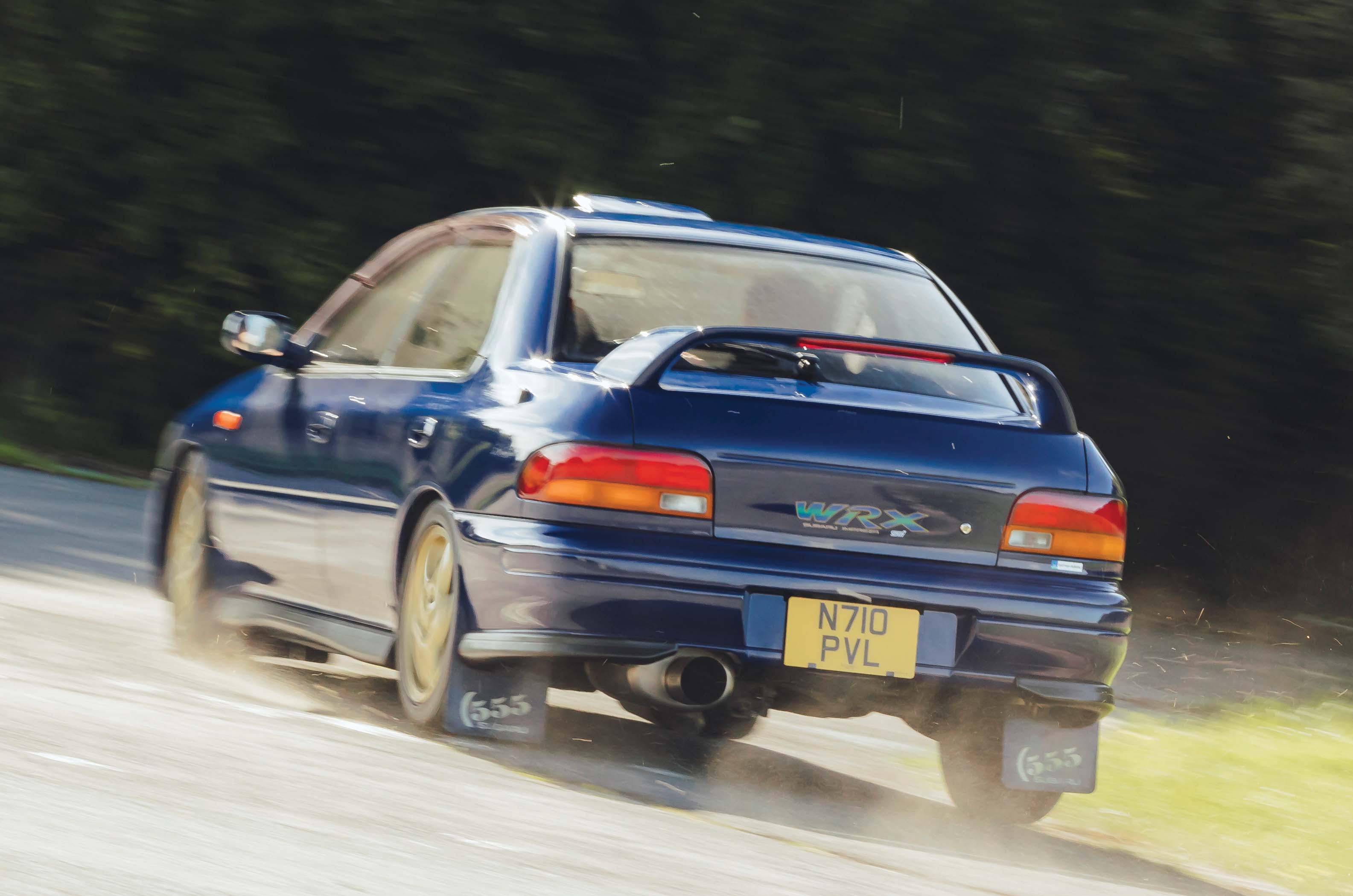
The Subaru Impreza WRX STi 555 edition’s roof flap is best closed at high speeds
The turbocharger was a gift for the Japanese car enthusiast, more than perhaps any other nation.
Expensive fuel and oppressive tax regimes kept engines over 2 litres – and thus real performance – the preserve of the very wealthy in Japan before its arrival.
Though not first to the technology, Japanese car makers would take to it like few others, applying characteristic rigour to create some of the best engines of the 20th century with the aid of forced induction.
Toyota, Mitsubishi and Nissan were all developing turbocharged engines by the late 1970s, displaying prototypes at the 1979 Tokyo motor show.
In the UK, Mitsubishi (then Colt) was first out of the blocks with the Lancer Turbo in 1981, swiftly followed by the Datsun 280ZX Turbo.
Much of Japan’s early turbocharging was focused on the home market, however, where it became de rigueur for cars exported with big engines to be offered with a JDM-only 2-litre turbo powerplant – whether in sports cars like the Nissan Fairlady Z, or saloons such as the Toyota MkII.
Not long after, Japanese car makers also began fitting turbos to the tiny engines found in the country’s space-saving economy cars.
Honda joined the party with 1982’s City Turbo, then Daihatsu with the Charade Turbo a year later.
Subaru was relatively late to the game, a far smaller concern in the early 1980s than it is today, with only one full-size car in production: the Leone.
A simple, low-pressure-turbo 1.8-litre joined the range at the end of 1983, at first only in the BRAT pick-up and Turbo Wagon estate.
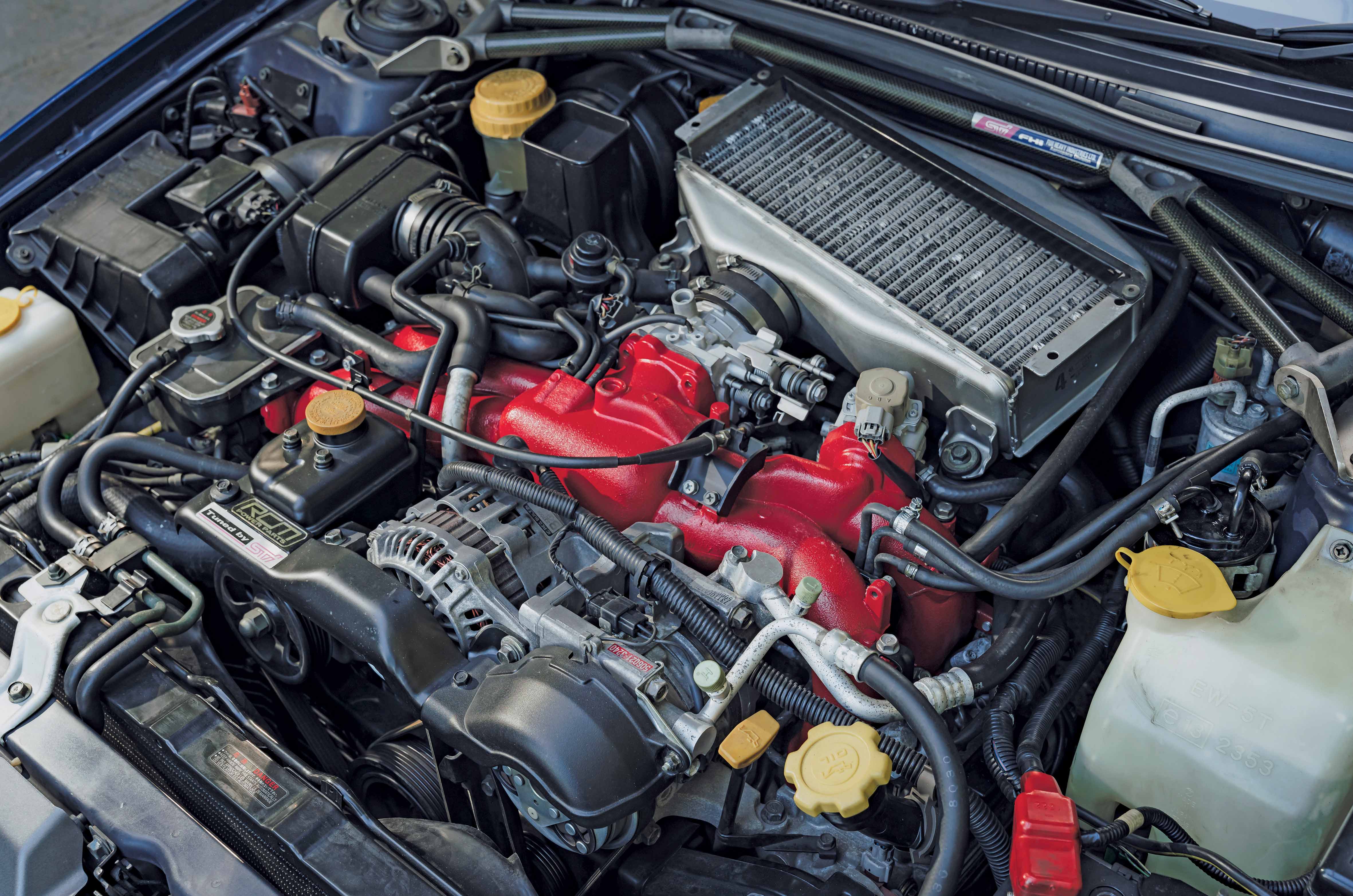
The Subaru Impreza WRX STi’s flat-four has a trademark offbeat warble
From the start it was paired with Subaru’s signature four-wheel-drive system – true of all future Subaru turbos with a couple of minor exceptions.
But it was with the famous 16-valve EJ-series engine, introduced simultaneously with the new Legacy in 1989, that Subaru began offering real turbocharged performance.
At launch, the Legacy RS got 217bhp from its 2-litre turbo, resulting in a 0-60mph dash of just 7 secs.
All this in a practical, four-wheel-drive family estate car that cost little more than a naturally aspirated 2-litre Ford Sierra.
It also mounted Subaru’s first meaningful challenge in international rallying, under the guidance of Prodrive for the 1990-’93 seasons.
The car did particularly well on gravel stages, taking multiple victories, and landed Colin McRae the British Rally Championship in 1991 and ’92.
The same engine would go into Subaru’s compact Impreza model, which was already in development by 1990.
It was a shrunken Legacy in construction, including marrying the turbo powerplant with permanent four-wheel drive controlled by a central viscous coupling.
Japan got the hot, 236bhp WRX straight after the car’s November 1992 release, the model designed to homologate the car for the World Rally Championship.
Prodrive was consulted from the start, having particular input on the air inlets and intercooling.
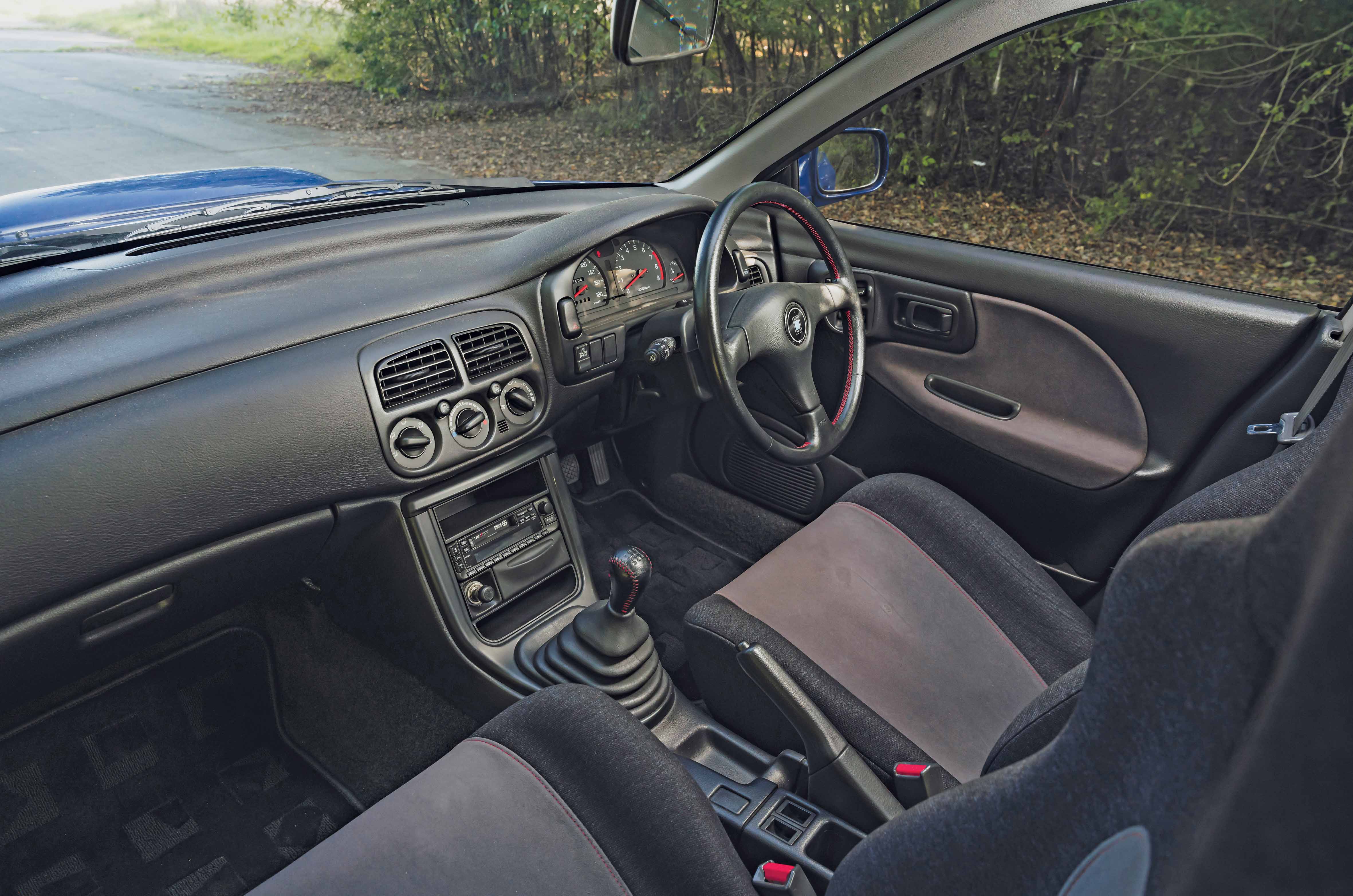
The Subaru Impreza WRX STi’s drab interior belies its performance
A long-awaited but detuned – due to the lesser availability of 100-octane fuel outside Japan – 208bhp export version arrived in ’94, badged Turbo 2000 in the UK, GT in Europe and WRX in the Antipodes.
The best was yet to come, albeit again limited to the domestic market.
In January 1994, three more letters were added to WRX: STi.
Named after Subaru’s in-house motorsport wing, the new model promised a road car closer to the rally machines that would soon win three consecutive constructors’ championships from 1995-’97.
It was not mere marketing bluster, either: each engine was blueprinted, with forged pistons, a steel crankshaft, a better intercooler and an uprated turbo.
A giant, 3in exhaust made clear the change, both visually and aurally, while the transmission was strengthened and the suspension stiffened.
Power jumped up by 10bhp initially, then to a whopping 271bhp by late 1994, the flat-four motor now revving to a heady 8250rpm.
That lofty redline should give a clue to the nature of the STi’s power delivery, but it’s still something of a surprise to those familiar with torquey UK-spec Imprezas.
The turbo starts to provide real shove at around 3500rpm, just like a Turbo 2000, but where you drive those cars by riding a relatively narrow band of mid-range torque, the acceleration just keeps coming in this 1995 WRX STi 555 edition.
The boost continues to build while the revs climb at an ever-increasing rate, and the car tears at the Tarmac relentlessly much higher into its rev range.
The Subaru Impreza WRX STi’s deep blue paint with signature gold wheels recalls the iconic rally cars
Though far from the unsophisticated turbos of the early 1980s, it can still catch out those who fail to treat it with proper respect – even though front-end grip is tenacious.
Neat features specific to the 555 include a water spray into the intercooler to keep the boost dense, and a roof flap that does a surprisingly good job at cooling the driver, too.
Despite all the power and the lairy-sounding rally engineering, the really special thing about the STi is the breadth of its abilities. Though thrilling and agile on a track, it’s practical, too.
Thanks to mastery of the turbocharger, Subaru put 271bhp in a 2.5m wheelbase incorporating four doors, a roomy interior and a big boot – a feat only matched at the time by its arch rival, the Mitsubishi Lancer Evo.
But while that car feels like a rally car made road-legal, the Scooby remains usable and comfortable in all driving scenarios.
It has a pleasing tightness to its primary ride, yet over poor surfaces that doesn’t come at the expense of rattles and shaking through the body.
Sound insulation is good, too, and none of the controls are at all heavy. Only the STi’s short gearlever is an ergonomic oddity.
You can just as happily take the Subaru on a commute, across Europe, for a wintry B-road blast or on a track day.
The Impreza makes compromises to achieve its flexibility, and it probably isn’t the best car at any single task.
Yet few cars manage to do so many things so well, and it’s the versatility of the turbocharger that is key to its multiple talents.
Words: Charlie Calderwood
Thanks to: Fairmont Sports and Classics
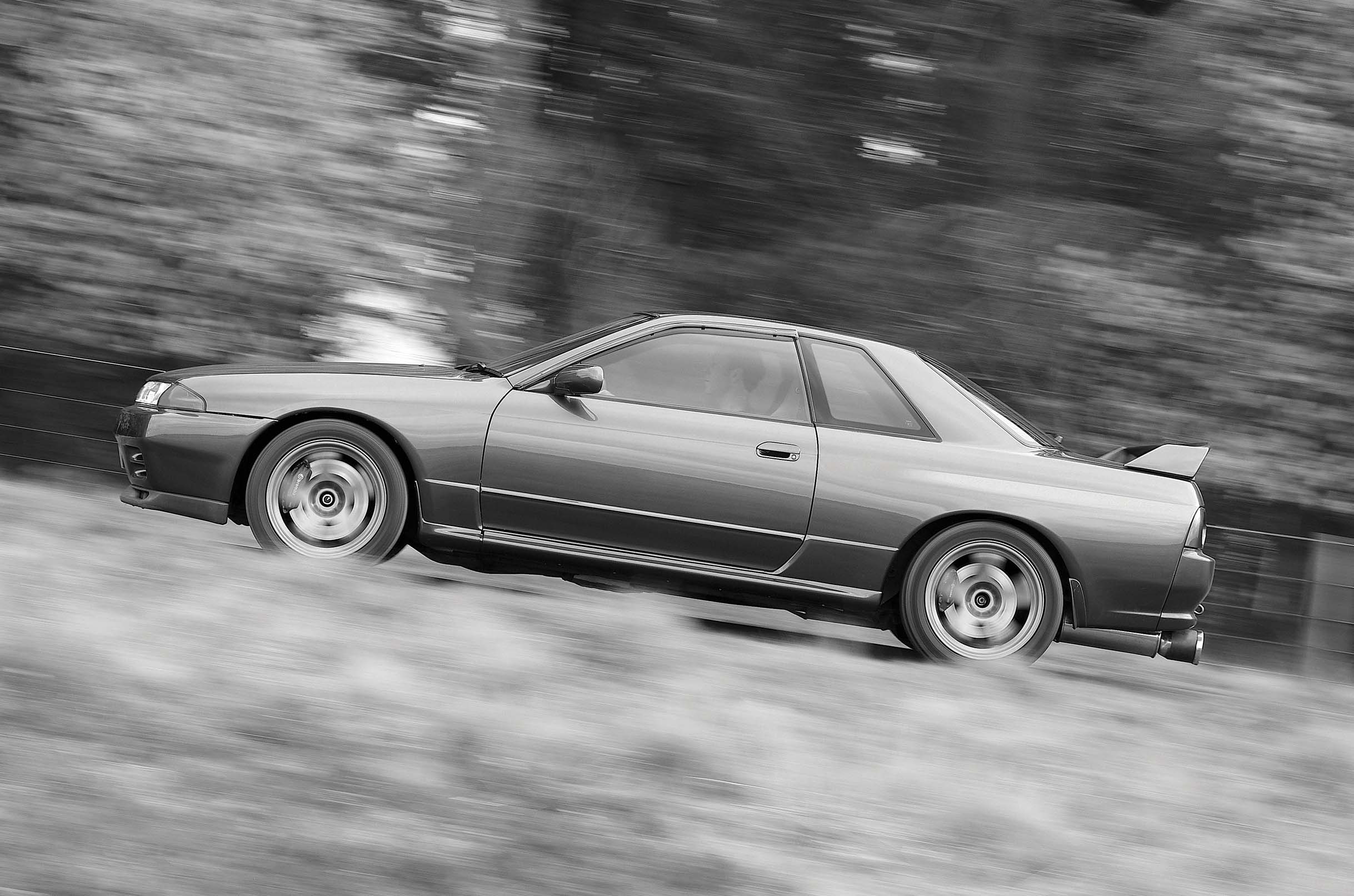
Turbocharged compatriot: Nissan Skyline GT-R (R32)
As Japan’s relative wealth reached its peak in the late ’80s, its manufacturers were developing a golden generation of high-performance cars that broke free from the domestic 2-litre limit, yet retained potent turbocharging.
The R32 (above) marked the start of Japan’s bubble-era hero cars, arriving in 1989 with a twin-turbo, 2.6-litre twin-cam ‘six’ putting a claimed 276bhp (in reality 300bhp+) through all four wheels.
Italy: Fiat Uno Turbo ie
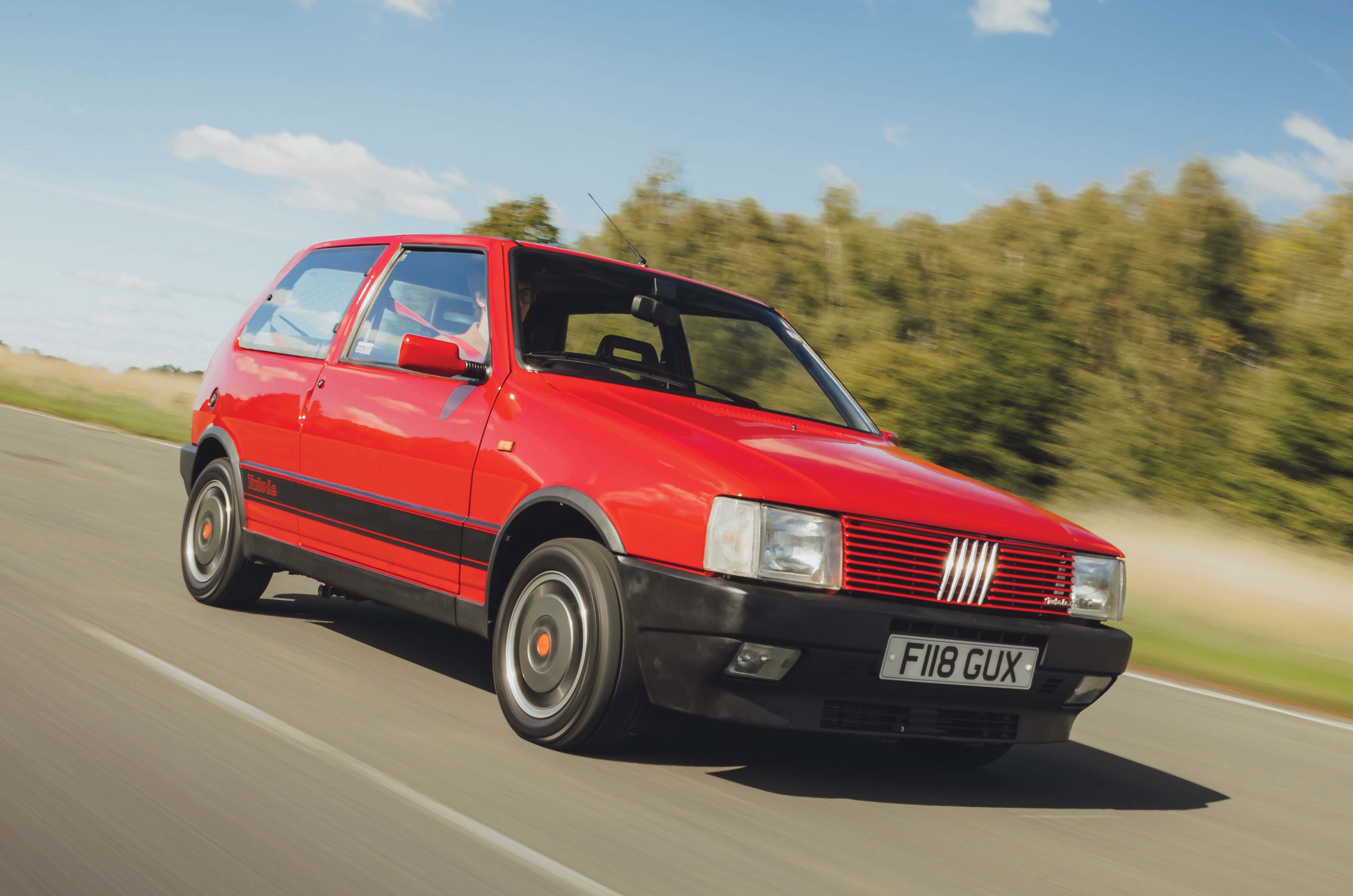
The eager Fiat Uno Turbo ie undercut the Peugeot 205 GTI 1.6 and matched it for pace
Fiat released something rather special in 1985.
To mark the 1,000,000th Uno being produced, the Italian car maker dropped its first album, Fiat Million Hits.
Available on cassette or 12in vinyl, it was a compilation of million-selling singles, from Wouldn’t It Be Good by Nik Kershaw and Tina Turner’s Let’s Stay Together to Wham!’s celebration of piña coladas and Speedos, Club Tropicana.
Unfortunately, Fiat’s groovy mix tape was overshadowed by another new release from Turin: in the spring of 1985, the Uno Turbo ie was launched.
The Italian motor industry had first dabbled with turbocharging in the late 1970s, albeit at arm’s length.
Alfa Romeo left its motorsport division, Autodelta, to experiment with the art of using exhaust gases, turbines and condensed air to make more power, and the result was the ’79 Alfa Romeo Alfetta Turbodelta.
Meanwhile, it took until 1980 for Ferrari to start testing the 126 CK, its first turbocharged Formula One car, more than three years after the Renault RS01 hit the track.
The Fiat Uno Turbo ie was an Italian hot-hatch pioneer
At this point you could probably have accused Italy of being a bit late to the party, but the nation’s manufacturers certainly made up for lost time in the years that followed.
The resurgence began with the Maserati Biturbo, the world’s first twin-turbo production car, in 1981, and by the end of the decade Ferrari had unleashed the 478bhp F40.
So, how come we’ve shunned 200mph supercars and homologation specials in favour of a hotted-up version of Fiat’s best-selling small car?
After all, it wasn’t even the first hatchback with forced induction (that gong goes to the Renault).
But the Uno Turbo ie was Fiat’s first turbocharged production car, and Italy’s first truly affordable one.
The standard Uno hatch was introduced under the stewardship of Vittorio Ghidella, who guided the Italian firm through one of
its most tumultuous periods.
The engineer-turned-CEO put his neck on the line by setting aside five years of development and a trillion Italian lire for the 127’s successor.
It didn’t disclose how much of that budget was blown on hiring the Kennedy Space Center, Daytona International Speedway and part of Walt Disney World for the Uno’s 1983 launch, but it was worth it: the model was named European Car of the Year in 1984, and the success of the cooking models would have certainly helped convince the higher-ups that there was enough demand for a feistier model in the line-up.
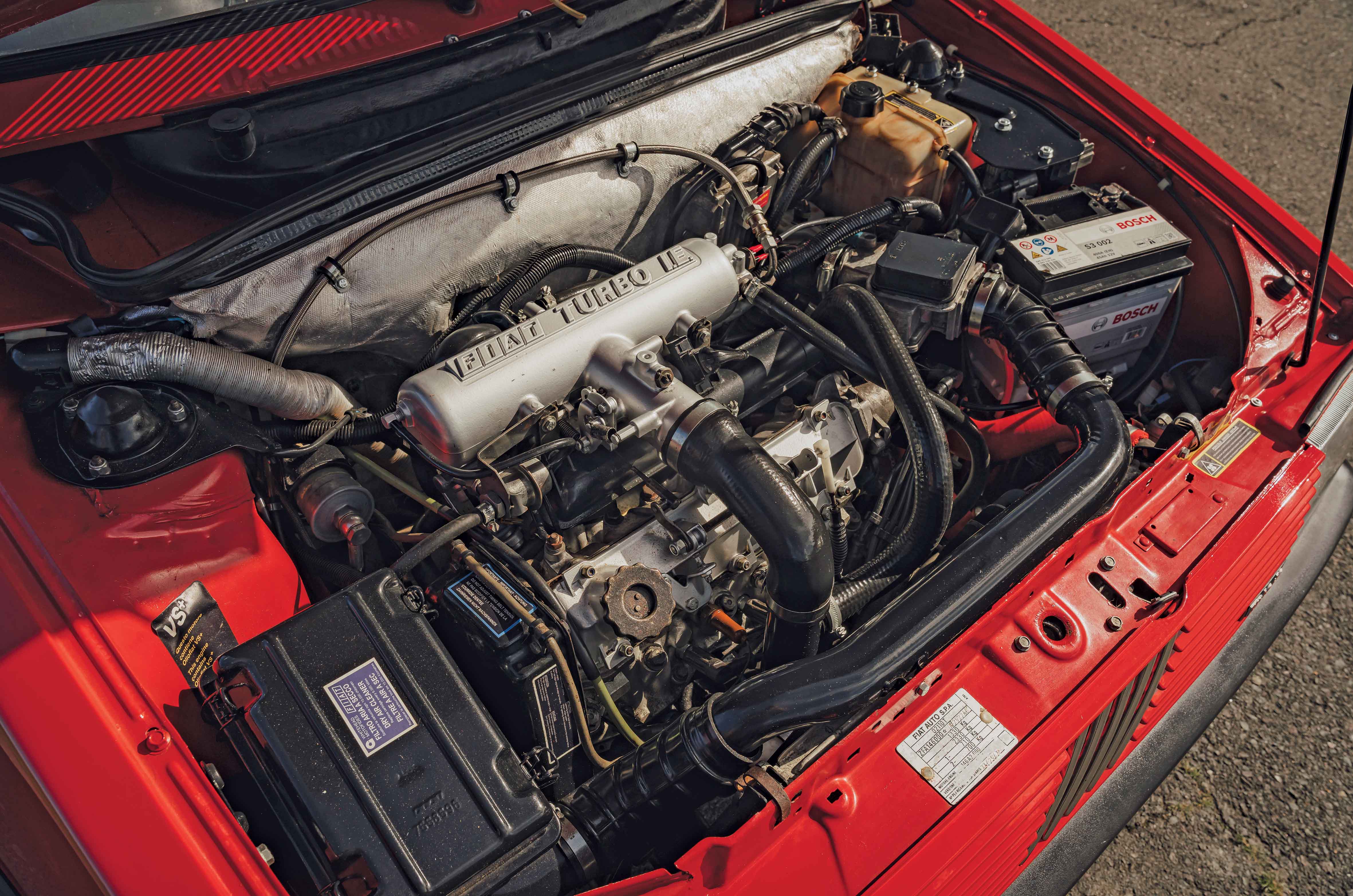
The Fiat Uno Turbo ie’s 1301cc ‘four’ was developed from the X1/9’s
Ghidella reportedly consulted ‘Mr Turbo’ Nicola Materazzi, the engineer who’d already helped tame Ferrari’s 126C F1 car, developed the 288GTO and created the Group 5 Lancia Stratos HF: just the man for the job, then.
Fiat turned to Japanese firm IHI for the Uno’s turbocharger, the pair having worked together in 1981 to create a factory-approved conversion for the Spider 2000, solely for the US market.
For the Uno, IHI supplied its water-cooled VL2 unit, which Fiat mated to an air-to-air intercooler to squeeze 105bhp from the Bosch electronic fuel-injected engine – enough to fling the 845kg Fiat to 60mph in 8.3 secs.
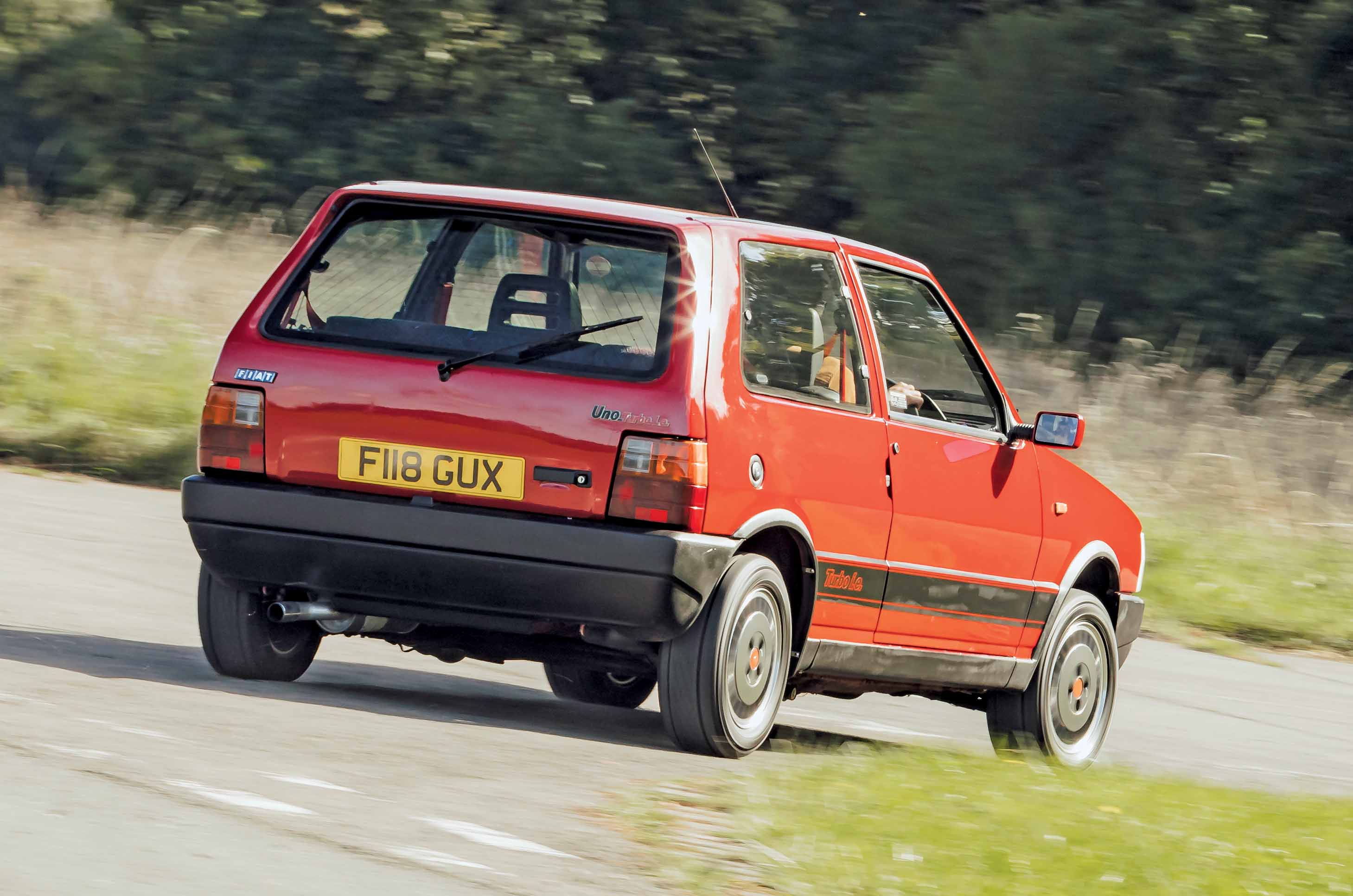
Unlike the metamorphosed Renault 5 Turbo, there are only a few giveaways that the Uno Turbo is something special.
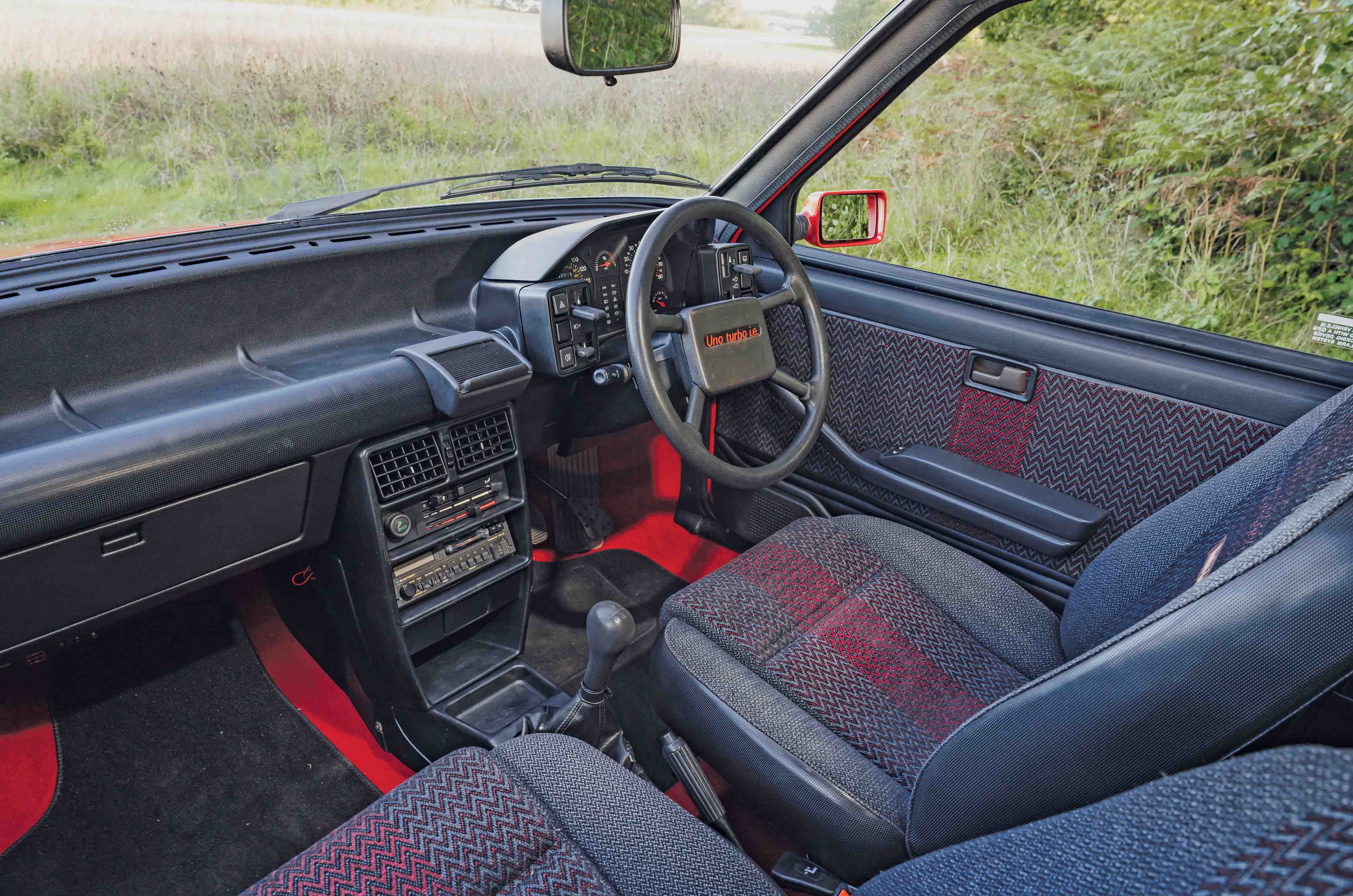
Unpainted plastic bumpers remain, albeit reshaped to direct cold air to the intercooler, while inside the sliding ashtray is shared with the utilitarian Panda.
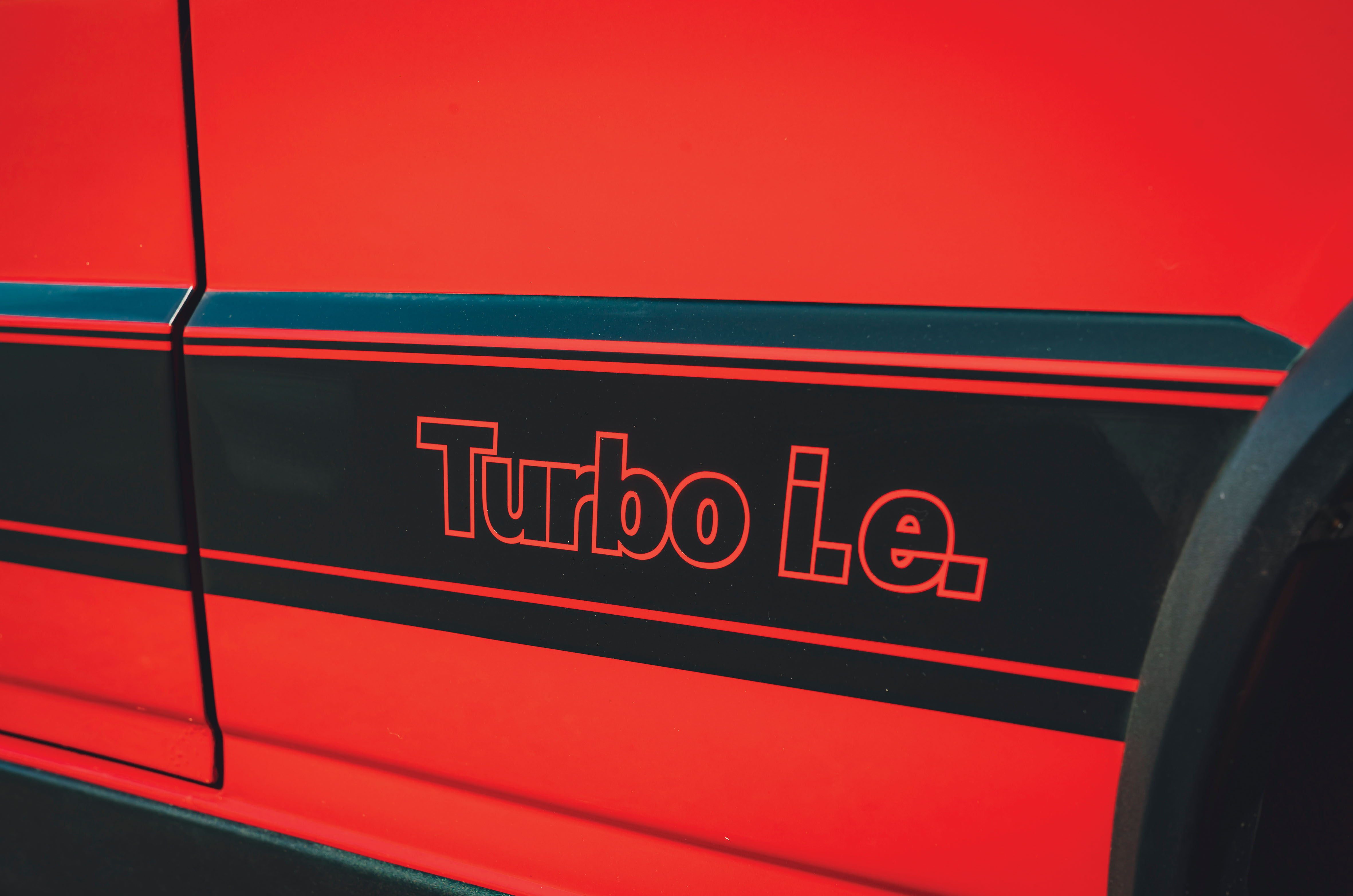
That said, it doesn’t take long to spot where Fiat splashed the cash: there are comfy Recaro seats with ‘Turbo ie’ script stitched into the backrests, red seatbelts and a larger throttle pedal that’s set up for heel-and-toe downshifts.
On the outside, there are Abarth-badged 13in wheels and a glassfibre tailgate with a spoiler.
The Fiat Uno Turbo ie’s cheery but flimsy cabin
Bashing the little Fiat for the cheapness of some of its components would be easy, but that would be missing the point.
The idea of a hot hatch is to take something mundane and turn it into an object of desire for enthusiasts – and that’s just what Fiat did.
Fire up and there’s immediately a spicy burble that doesn’t sound as if it should come from an Uno – and that’s because it’s not, sort of.
Fiat went to town under the bonnet: rather than bolting the IHI turbo to the Uno’s 1.3-litre engine, it created a bespoke unit based on the X1/9 motor, with an oil cooler and Marelli Microplex electronic ignition.
But first impressions fall slightly short of expectations: this sub-50,000-mile car is a near-perfect example, yet the gearshift feels long and loose, and the clutch over-light, while the four-wheel discs only wake up when the pedal is halfway to the floor.
Happily, the flyweight Fiat silences your concerns when you push a little harder and pass 3000rpm.
The needle in the boost gauge flicks around the dial and the IHI VL2 blows the cobwebs away.
Suddenly the gearlever that felt floppy a few moments ago finds its get-up-and-go – the action is still quite long and deliberate, but in a satisfying sort of way – and the ventilated front discs zap speed with a quick stomp on the pedal.
Rust means a mint Fiat Uno Turbo ie like this is now super-rare
Best of all, the zippy Fiat is small enough that you can pick your line on a country lane and delve into what its nimble chassis can do.
It’s never buttock-clenchingly fast, but the turbo adds a sense of occasion that creates a captivating dual personality, like adding a dollop of spicy ’nduja to a bowl of ravioli.
The Turbo fulfils the hot-hatch brief with aplomb, but it has since been overshadowed by contemporaries such as the Peugeot 205 GTI and Renault 5 GT Turbo.
Now, as the genre becomes a dying breed, enthusiasts are looking back at the affordable icons of years gone by, only to discover that cars such as this are hard to find – especially in this condition.
Corrosion was the enemy (Fiat galvanised some panels for the second-series Turbo ie, which got a Garrett T2 in place of the IHI) and it appears that many rusted away before fans realised just how significant this Uno truly was.
As Nik Kershaw foretold in his best-selling single: “You don’t know when you’ve got it good.”
Words: Ryan Standen
Thanks to: Charles Winterton; Iconic Auctioneers
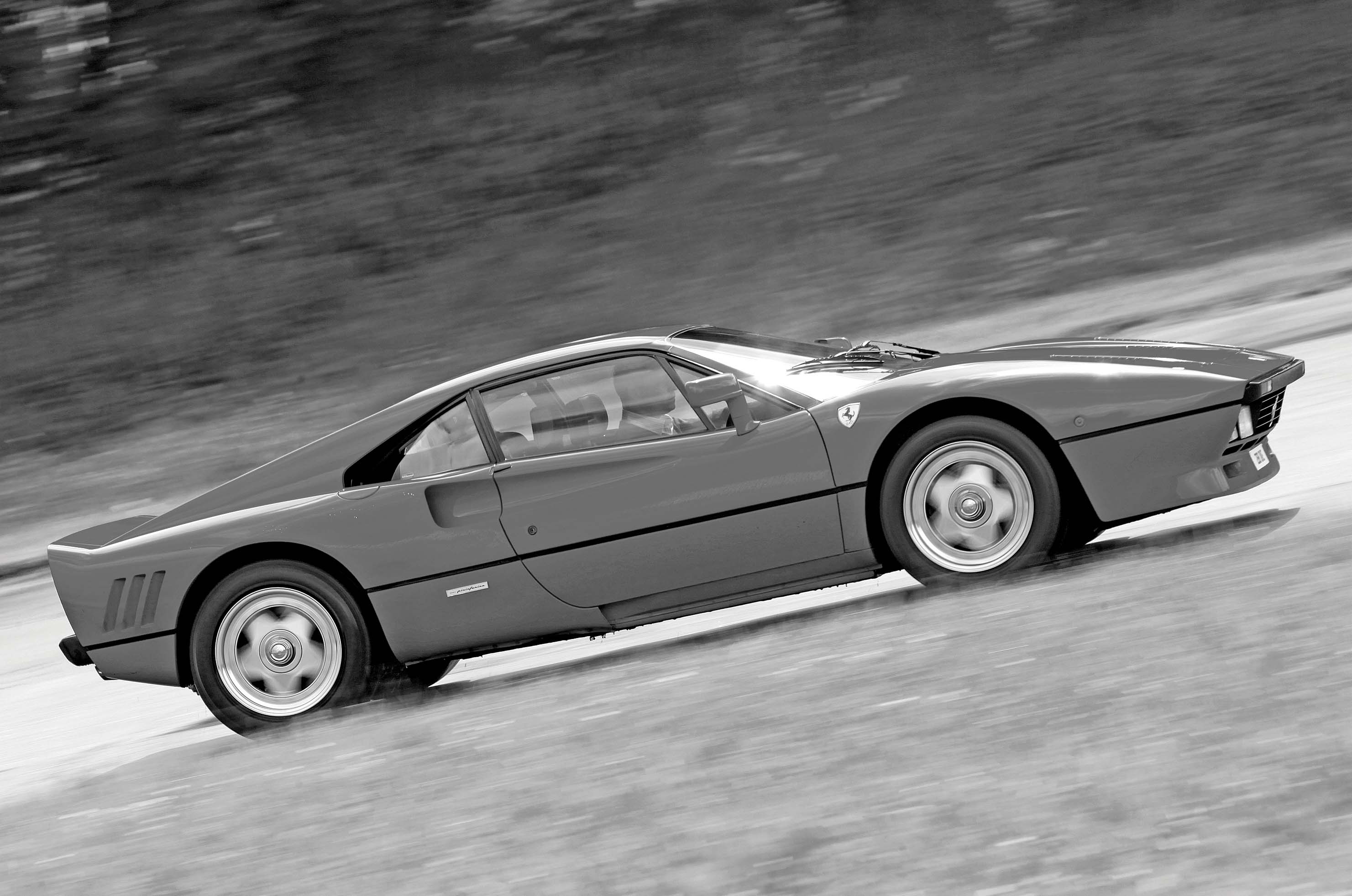
Turbocharged compatriot: Ferrari 288GTO
If you’re after the ultimate turbocharged Italian, this might be it.
The Ferrari GTO (above) was the first in a line of Prancing Horse supercars whose descendants include the F40, F50, Enzo and LaFerrari.
Like the Uno, the 288’s boost comes courtesy of IHI, but that’s where the similarities end.
The GTO has a pair of turbos bolted to its 2855cc V8 and was due to become a Group B star before organisers pulled the plug on the category.
Factfiles
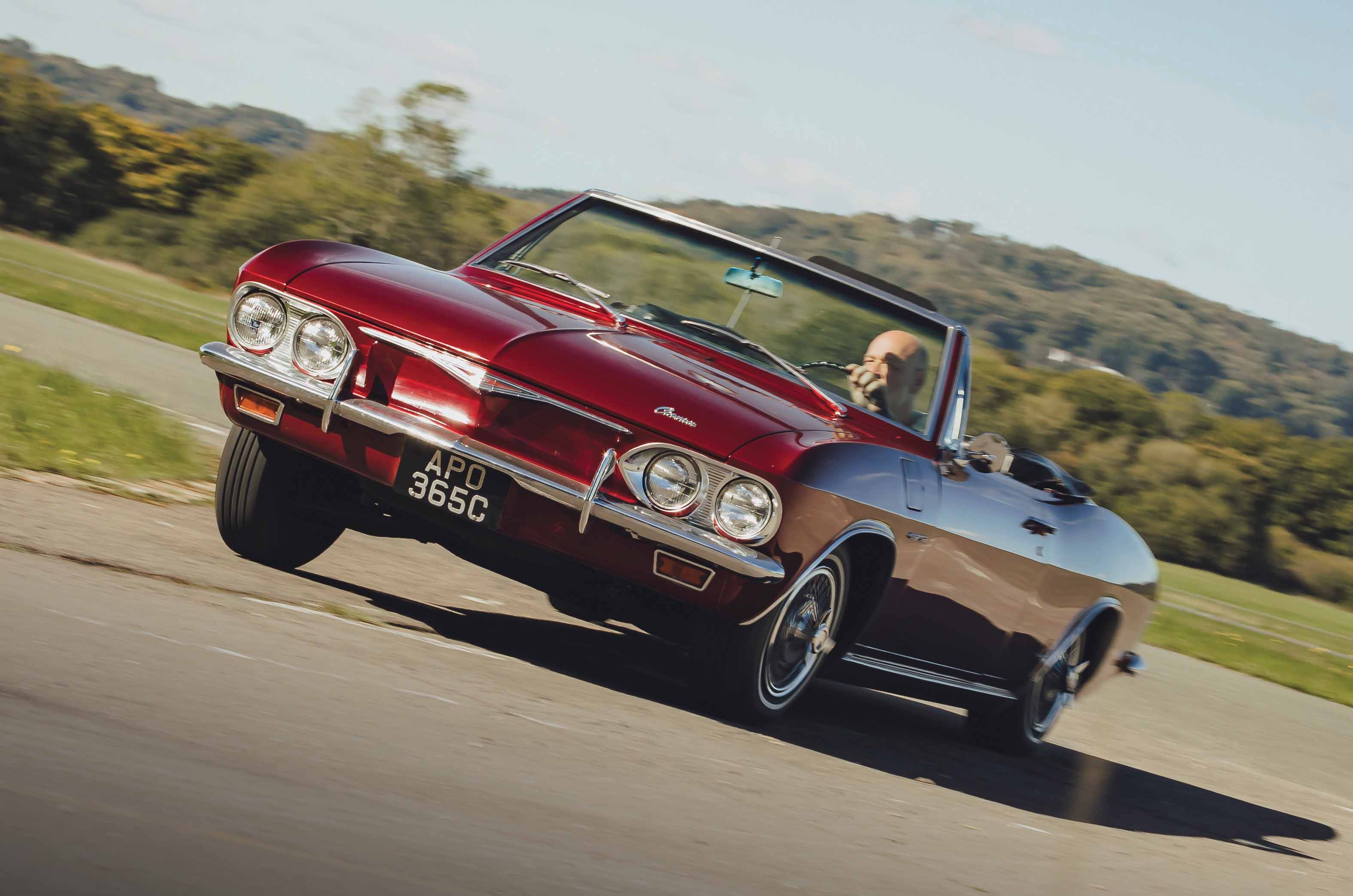
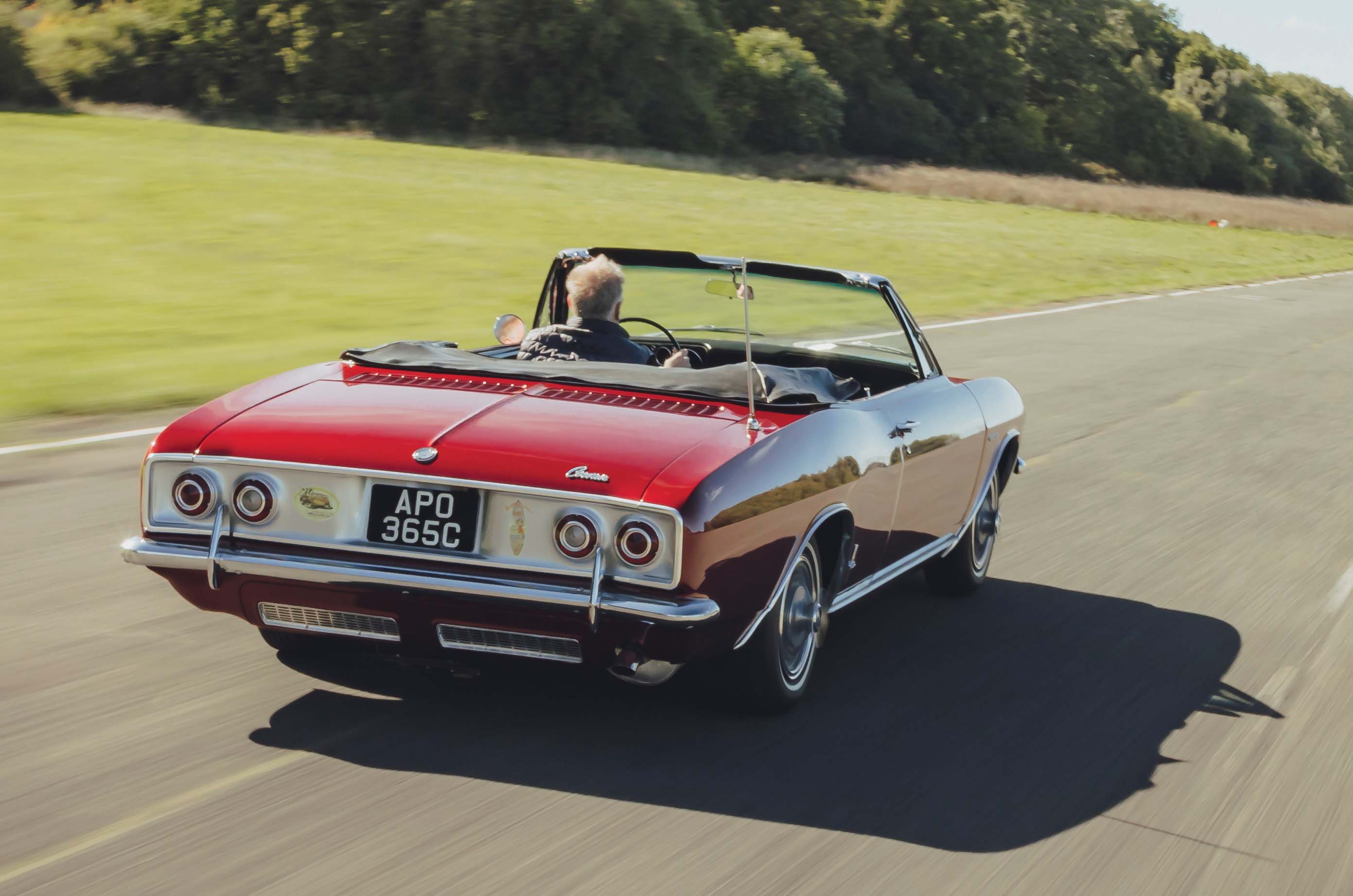
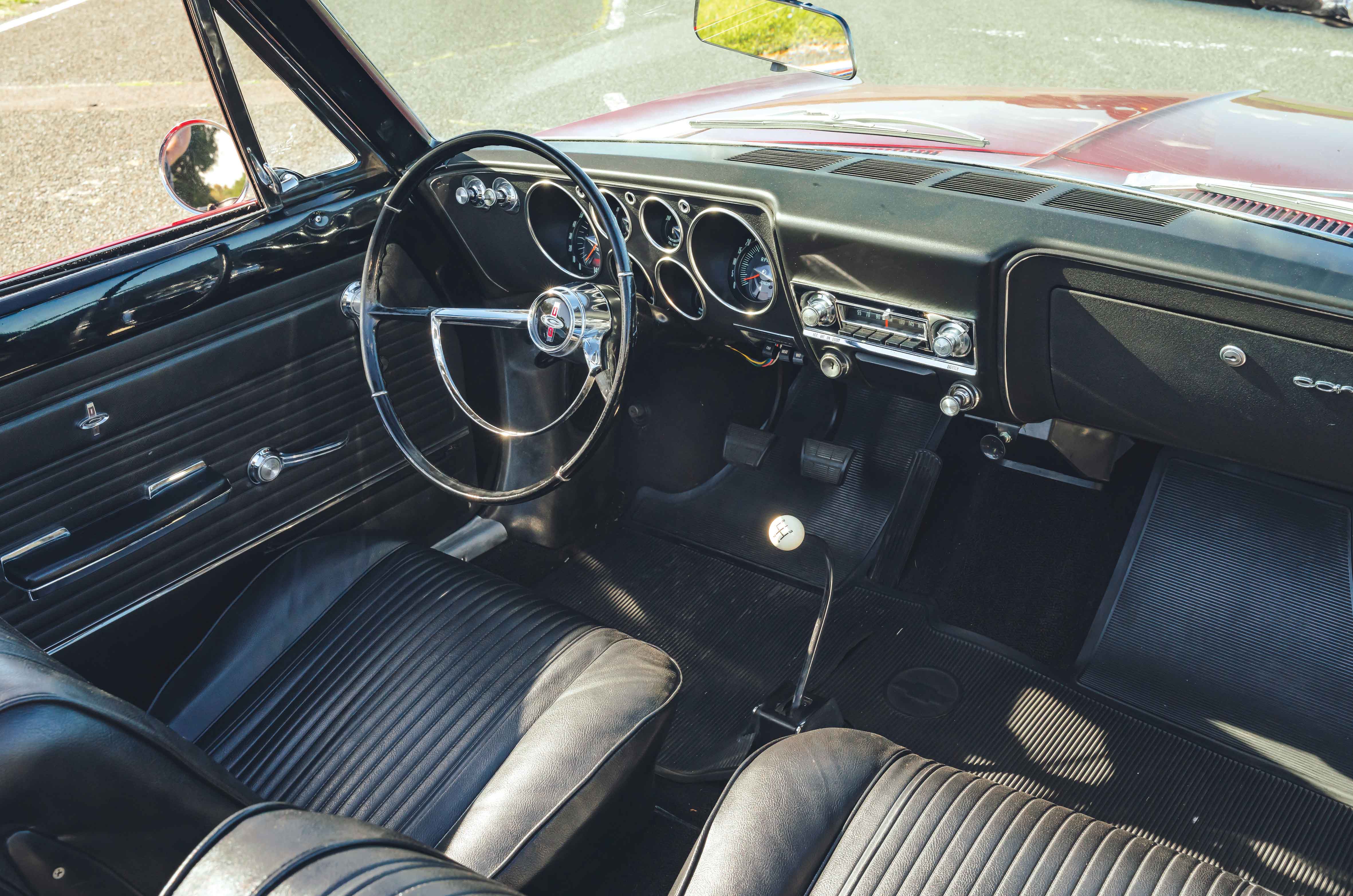
Chevrolet Corvair Corsa Turbo
- Sold/number built 1965-’67/9157
- Construction steel monocoque
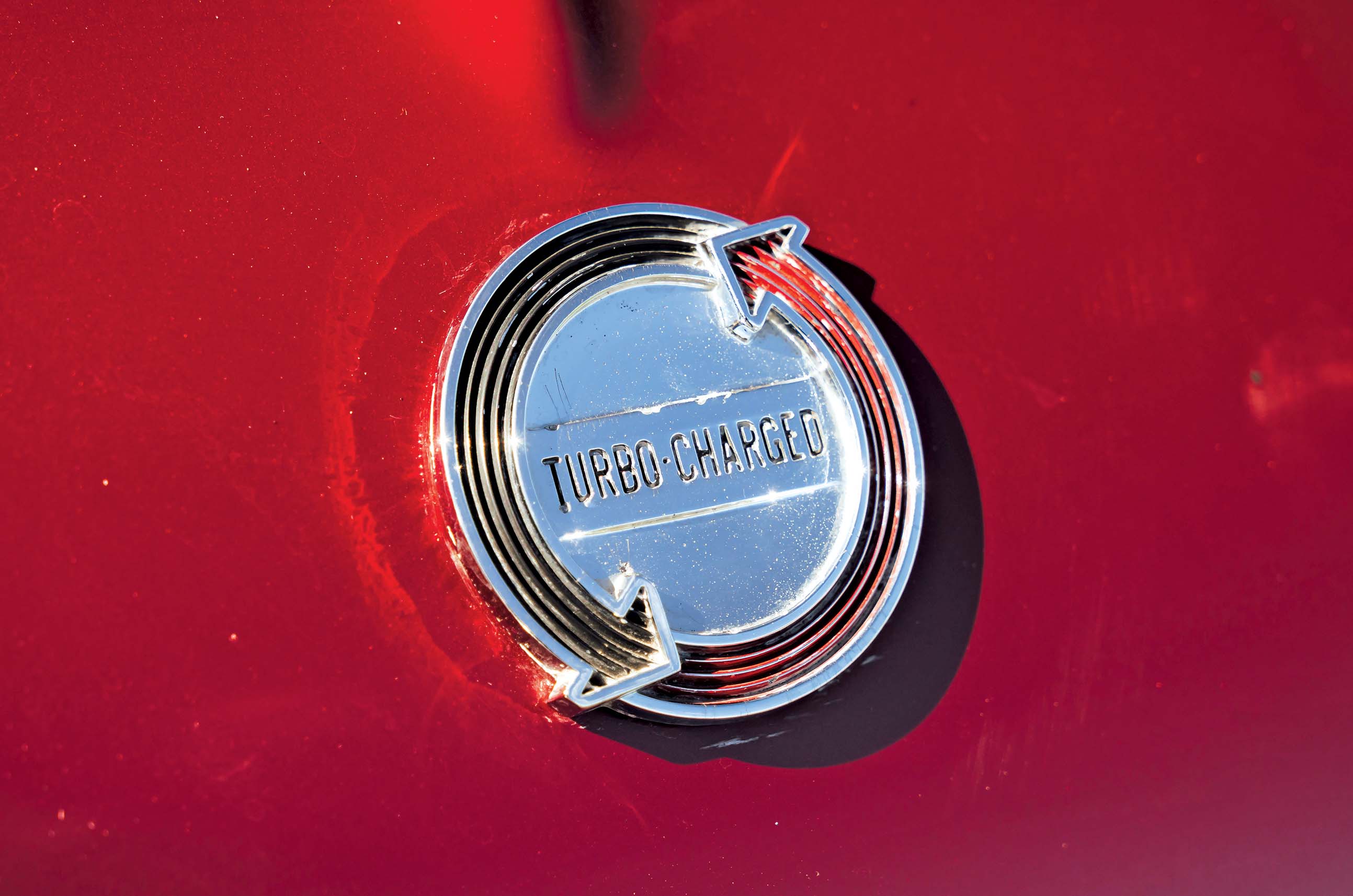
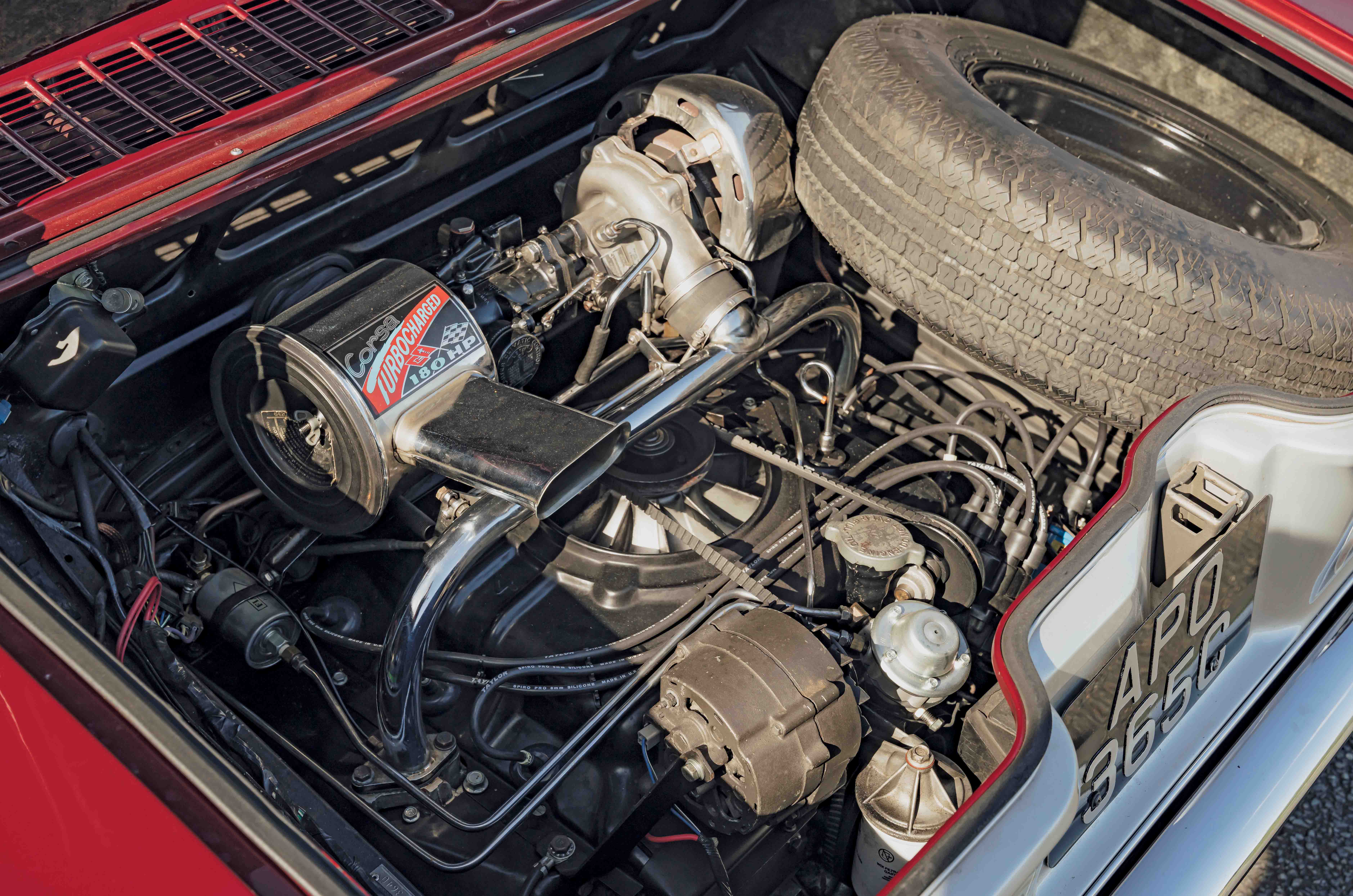
- Engine all-alloy, ohv 2683cc flat-six, single sidedraught carburettor, Thompson Ramo Wooldridge turbocharger
- Max power 180bhp @ 4000rpm
- Max torque 232lb ft @ 3200rpm
- Transmission four-speed manual, RWD
- Suspension independent, at front by wishbones, anti-roll bar rear lower transverse links, longitudinal radius arms, fixed-length halfshafts; coil springs, telescopic dampers f/r
- Steering recirculating ball
- Brakes drums
- Weight 2540lb (1205kg)
- 0-60mph 9.7 secs
- Top speed 114mph
- Mpg 20
- Price new $3200
- Price now £15-30,000*
Renault 5 Turbo
- Sold/number built 1980-’83/1820
- Construction steel monocoque, with glassfibre and aluminium panels
- Engine iron-block, alloy-head, ohv 1397cc ‘four’, Garrett AiResearch T3 turbocharger, intercooler and Bosch K-Jetronic injection
- Max power 160bhp @ 6000rpm
- Max torque 155lb ft @ 3250rpm
- Transmission five-speed manual, RWD
- Suspension independent, at front by torsion bars rear coil springs; wishbones, telescopic dampers, anti-roll bar f/r
- Steering rack and pinion
- Brakes ventilated discs, with servo
- Weight 2138lb (970kg)
- 0-60mph 6 secs (est)
- Top speed 124mph
- Mpg n/a
- Price new Ffr115,000
- Price now £70-150,000*
Saab 99 turbo
- Sold/number built 1977-’82/10,607
- Construction steel monocoque
- Engine iron-block, alloy-head, sohc 1985cc ‘four’, Garrett AiResearch turbocharger and Bosch fuel injection
- Max power 145bhp @ 5000rpm
- Max torque 174lb ft @ 3000rpm
- Transmission four-speed manual, FWD
- Suspension: front independent, by wishbones rear beam axle, four links, Panhard rod, anti-roll bar; coil springs, telescopic dampers f/r
- Steering rack and pinion
- Brakes discs, with servo
- Weight 2716lb (1234kg)
- 0-60mph 8.9 secs
- Top speed 123mph
- Mpg 21.4
- Price new £7850
- Price now £10-20,000*
Ford Sierra RS Cosworth
- Sold/number built 1986-‘87/1653
- Construction steel monocoque
- Engine iron-block, alloy-head, dohc 1993cc ‘four’, Garrett AiResearch T3 turbocharger, Weber-Marelli multi-point fuel injection
- Max power 201bhp @ 6000rpm
- Max torque 205lb ft @ 4500rpm
- Transmission five-speed manual, RWD via limited-slip differential
- Suspension independent, at front by MacPherson struts rear semi-trailing arms, coils, telescopic dampers; anti-roll bar f/r
- Steering power-assisted rack and pinion
- Brakes ventilated front, solid rear discs, with servo
- Weight 2657lb (1205kg)
- 0-60mph 6.5 secs
- Top speed 149mph
- Mpg 38.2
- Price new £15,950
- Price now £40-100,000*
Porsche 911 turbo
- Sold/number built 1974-’89/20,652 (all)
- Construction steel monocoque
- Engine all-alloy, sohc-per-bank 3299cc flat-six, turbocharger, intercooler and Bosch K-Jetronic fuel injection
- Max power 296bhp @ 5500rpm
- Max torque 304lb ft @ 4000rpm
- Transmission four-speed manual, RWD
- Suspension independent, at front by struts, longitudinal torsion bars rear semi-trailing arms, transverse torsion bars; telescopic dampers f/r
- Steering rack and pinion
- Brakes discs, with servo
- Weight 2645lb (1335kg)
- 0-60mph 5.1 secs
- Top speed 162mph
- Mpg 16.4
- Price new £31,590 (1983)
- Price now £100-200,000*
Subaru Impreza WRX STi
- Sold/number built 1992-2000/28,608 (all WRX STIs)
- Construction steel monocoque
- Engine all-alloy, dohc-per-bank 1994cc flat-four, IHI turbocharger and multi-point fuel injection
- Max power 271bhp @ 6500rpm
- Max torque 235lb ft @ 4000rpm
- Transmission five-speed manual, 4WD
- Suspension independent, by MacPherson struts, transverse links, anti-roll bar f/r, plus rear trailing arms
- Steering power-assisted rack and pinion
- Brakes ventilated discs, with servo and anti-lock
- Weight 2711lb (1230kg)
- 0-60mph 5 secs
- Top speed 149mph
- Mpg 25
- Price new c£17,000 (1995)
- Price now £20-45,000*
Fiat Uno Turbo ie
- Sold/number built 1985-’94/50,000
- Construction steel monocoque
- Engine iron-block, alloy-head, sohc 1301cc ‘four’, Bosch LE2 electronic fuel injection, IHI VL2 turbocharger
- Max power 105bhp @ 5750rpm
- Max torque 108lb ft @ 3200rpm
- Transmission five-speed manual, FWD
- Suspension independent, at front by MacPherson struts rear torsion beam, semi-trailing arms, coil springs, telescopic dampers; anti-roll bar f/r
- Steering rack and pinion
- Brakes discs, with servo
- Weight 1863lb (845kg)
- 0-60mph 8.3 secs
- Top speed 125mph
- Mpg 28.7
- Price new £6889 (1985)
- Price now £10-30,000*
*Prices correct at date of original publication
Enjoy more of the world’s best classic car content every month when you subscribe to C&SC – get our latest deals here
READ MORE
History of turbocharging: the force awakens
Maserati Biturbos: two’s a party
Bentley Turbo Rs: brawn with a silver spoon