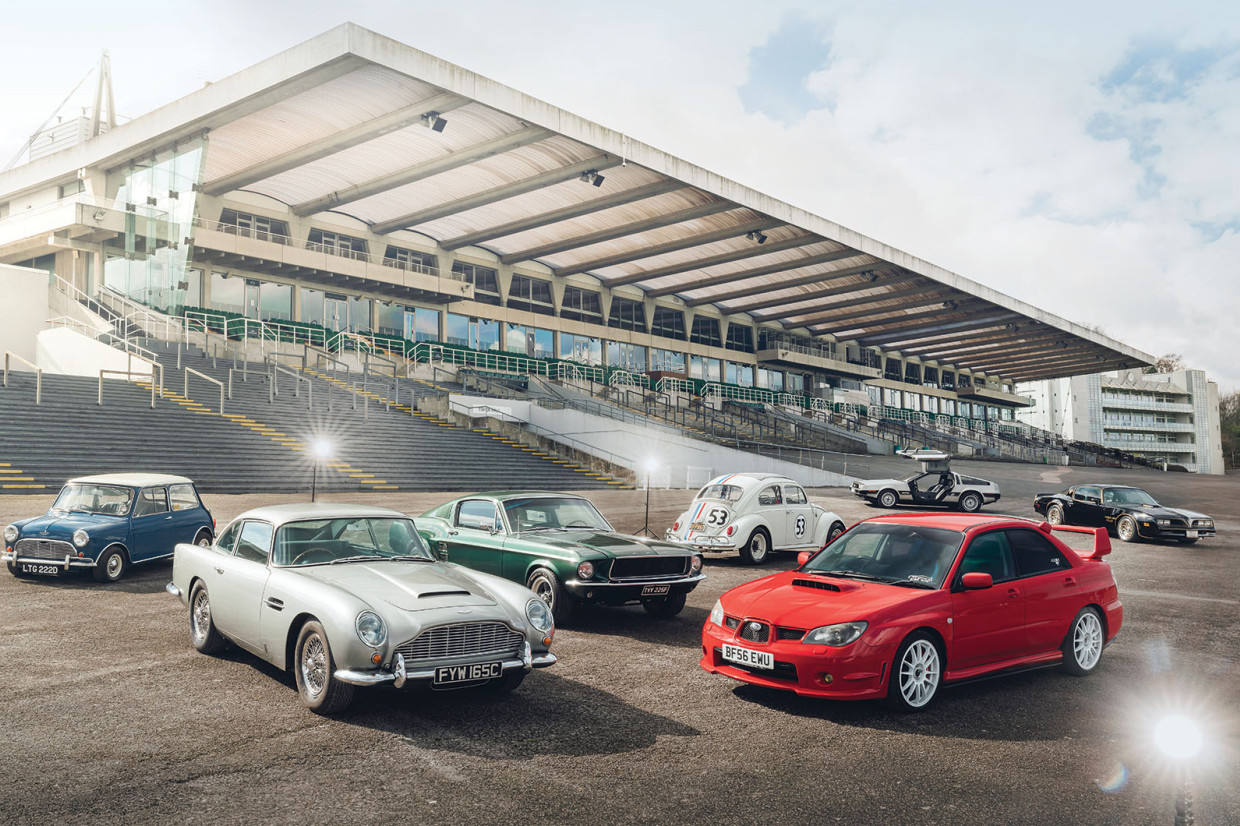
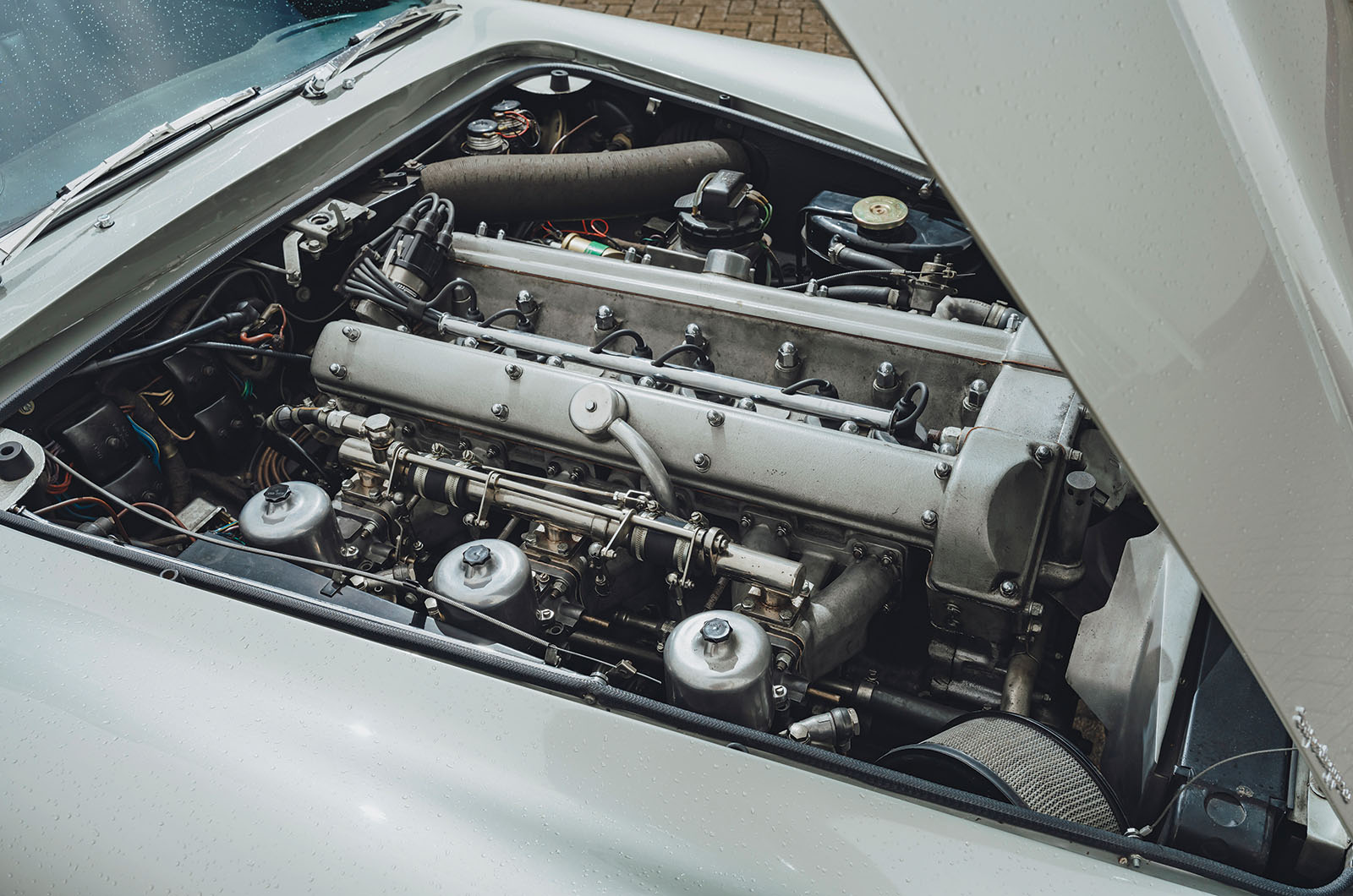
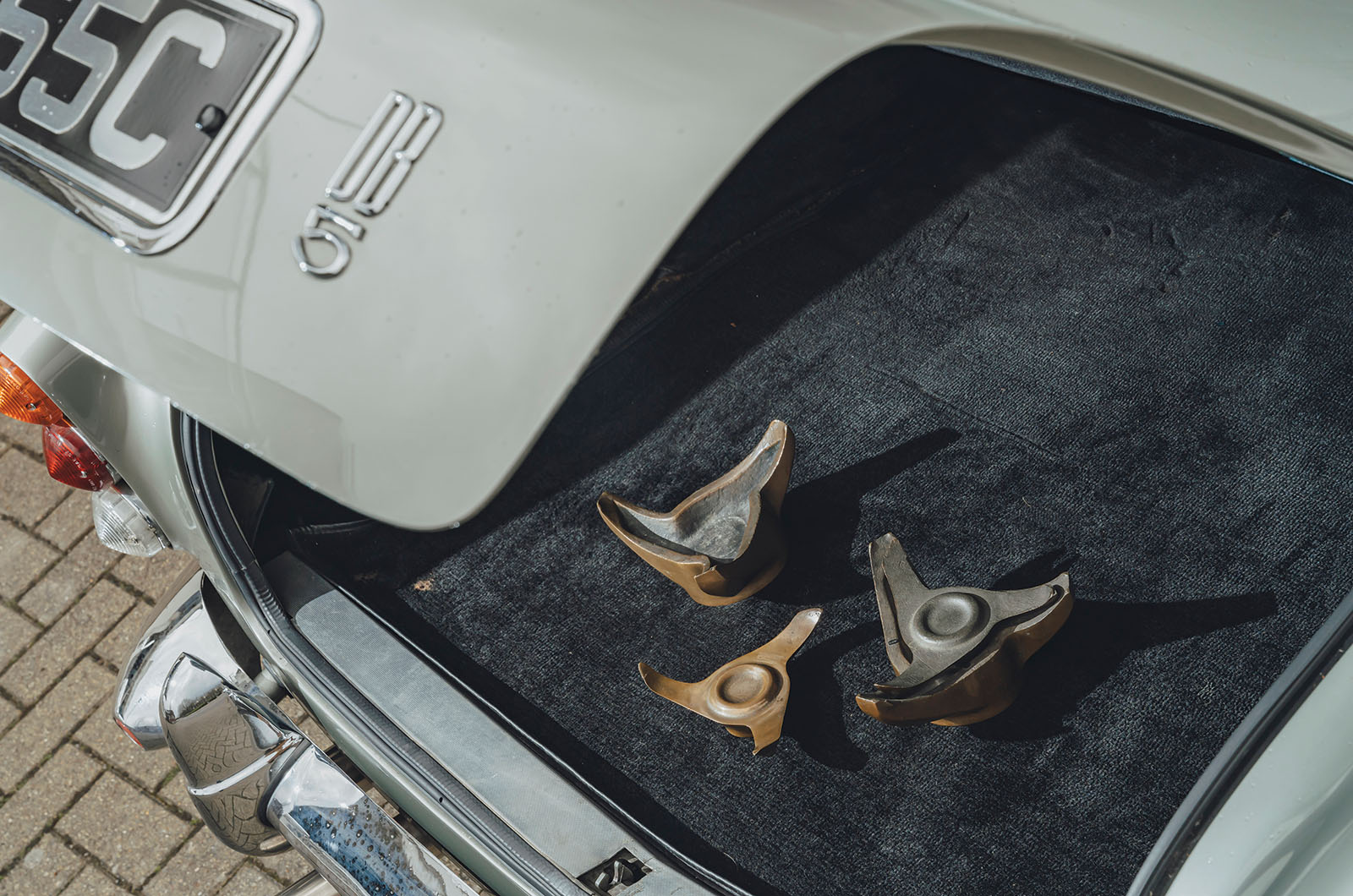
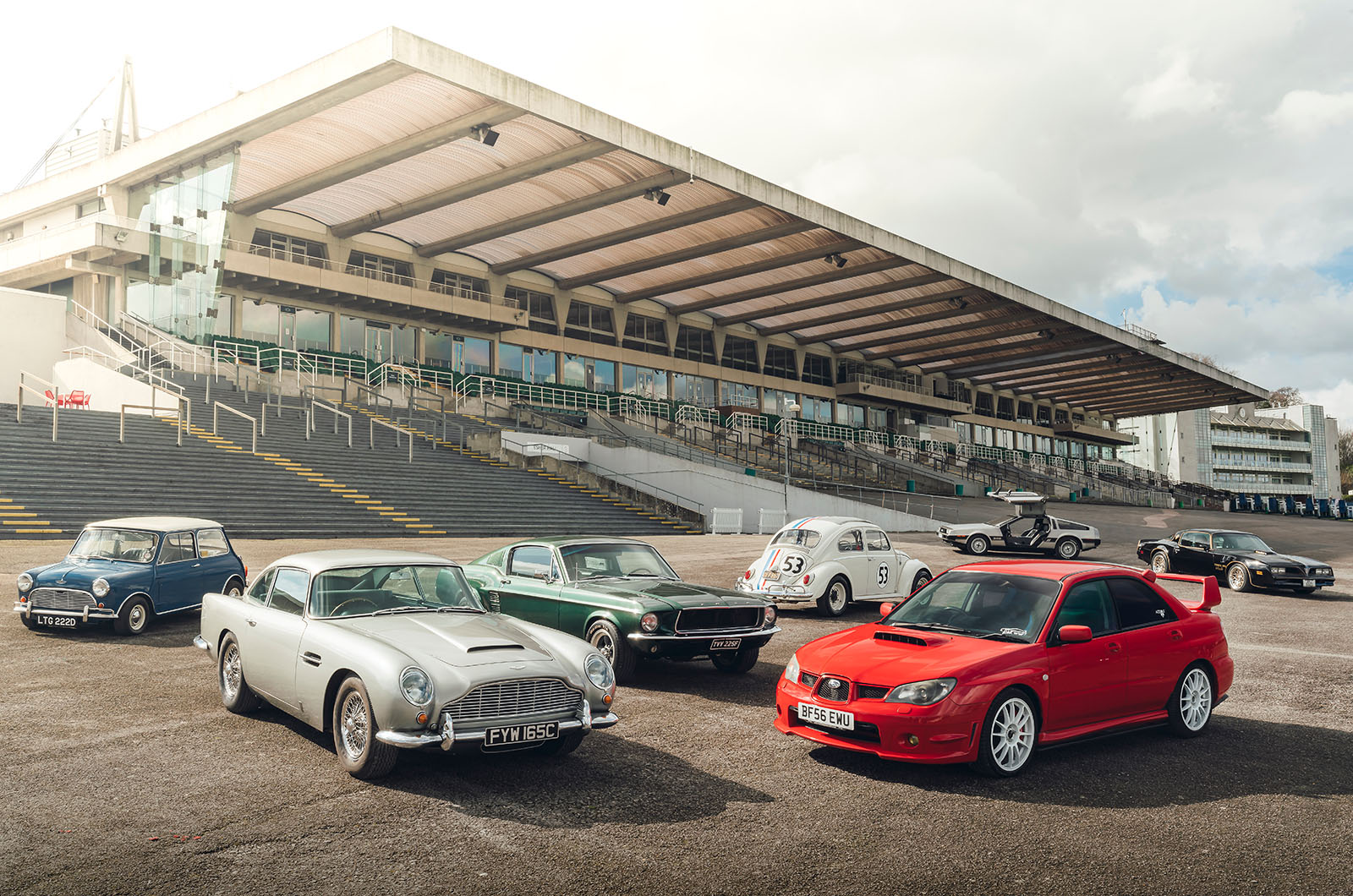
There’s no doubt that Bullitt’s epic chase has given the film inestimable kudos over the past 50-plus years, and paved the way for a golden era of pursuits such as Vanishing Point and The French Connection.
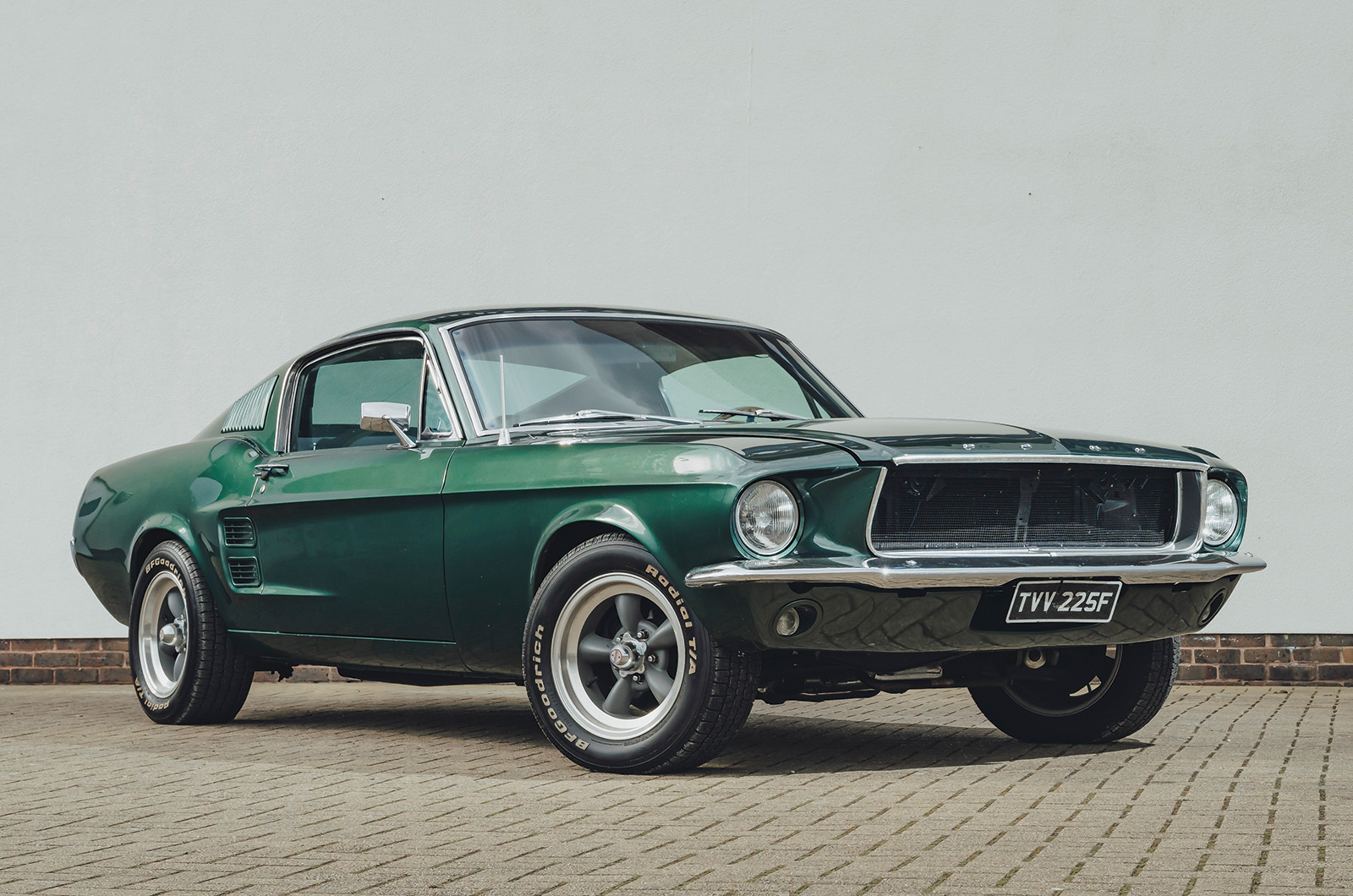
But it also created probably the most widely recognised movie car ever, in the shape of a Highland Green Ford Mustang 390 GT.
No surprise, then, that Ford has made hay with a number of Bullitt special editions over the years, but the fact that one of the two Mustangs used in the film sold at a 2020 Mecum Auctions sale for $3.4m is what really underscores its place in the pantheon of car-chase royalty.
It also makes ‘our’ c£70,000 Highland Green Mustang look spectacular value.
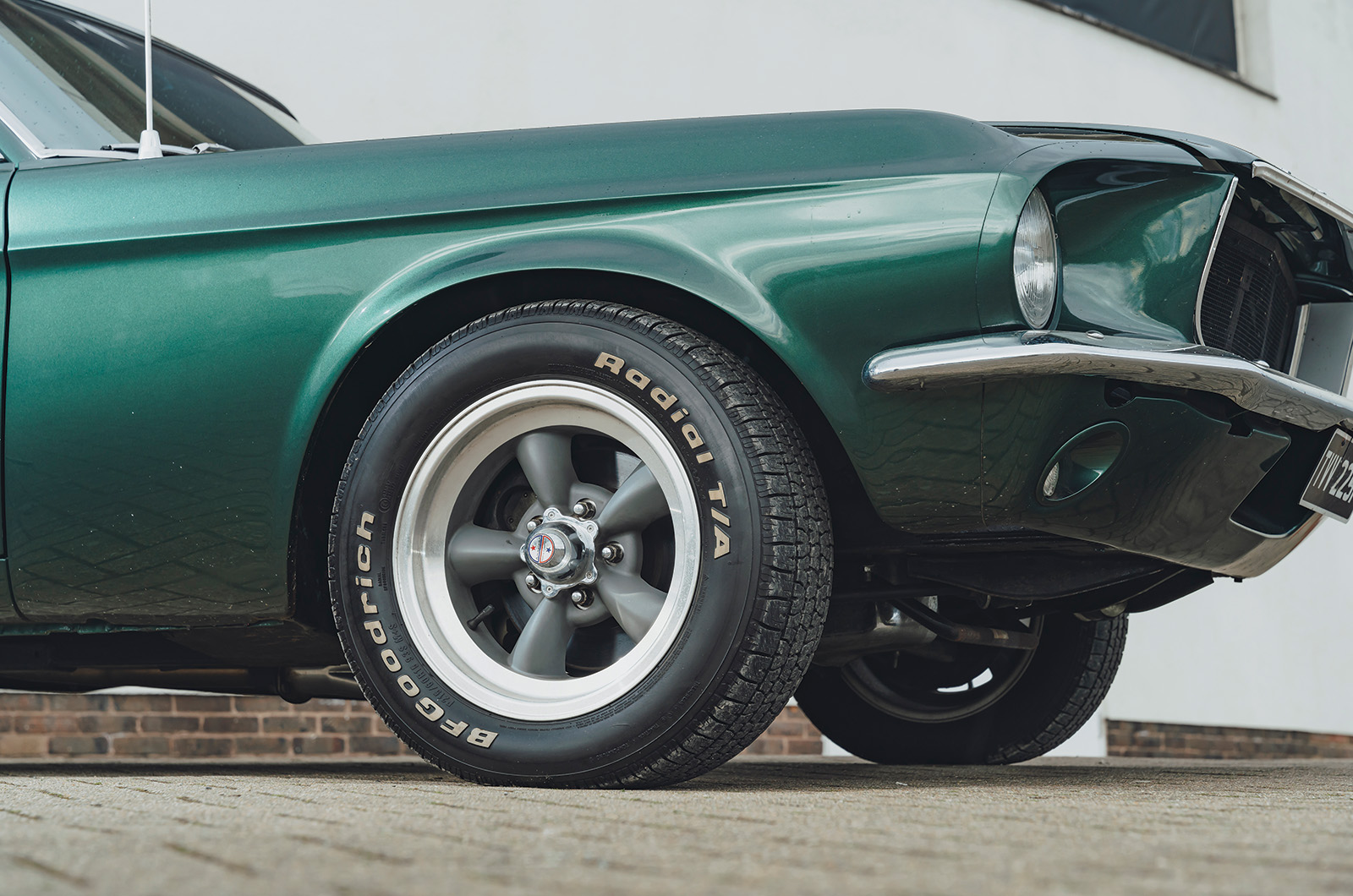
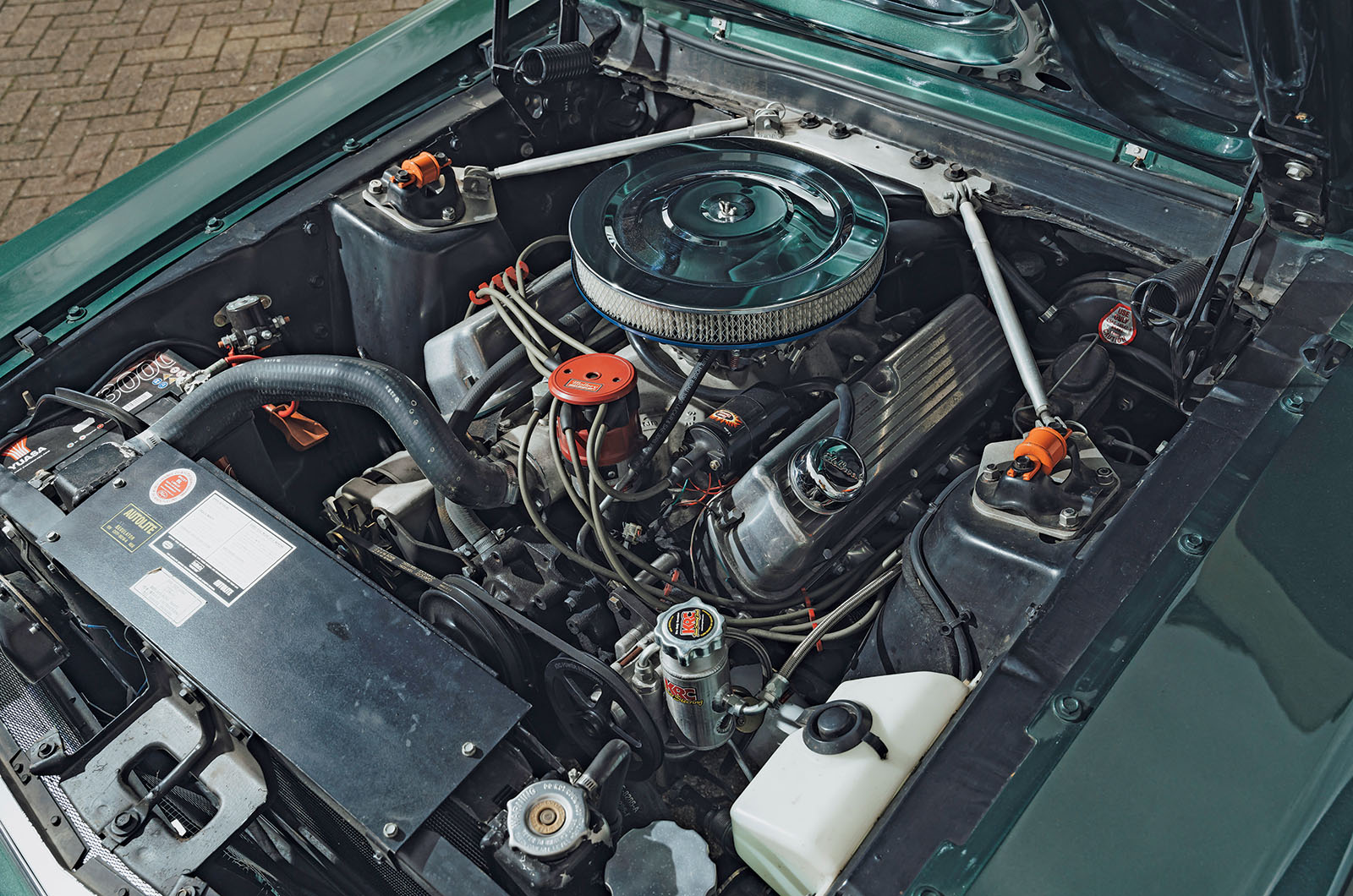
This California car was registered in November 1966 and restored to Bullitt spec in the early 2000s. Its 289cu in V8 was swapped for a 351 Windsor and mated to a Tremec transmission.
For a ’60s American the Ford is fairly compact, and you can see why it appears to have had the handling edge over the big Charger.
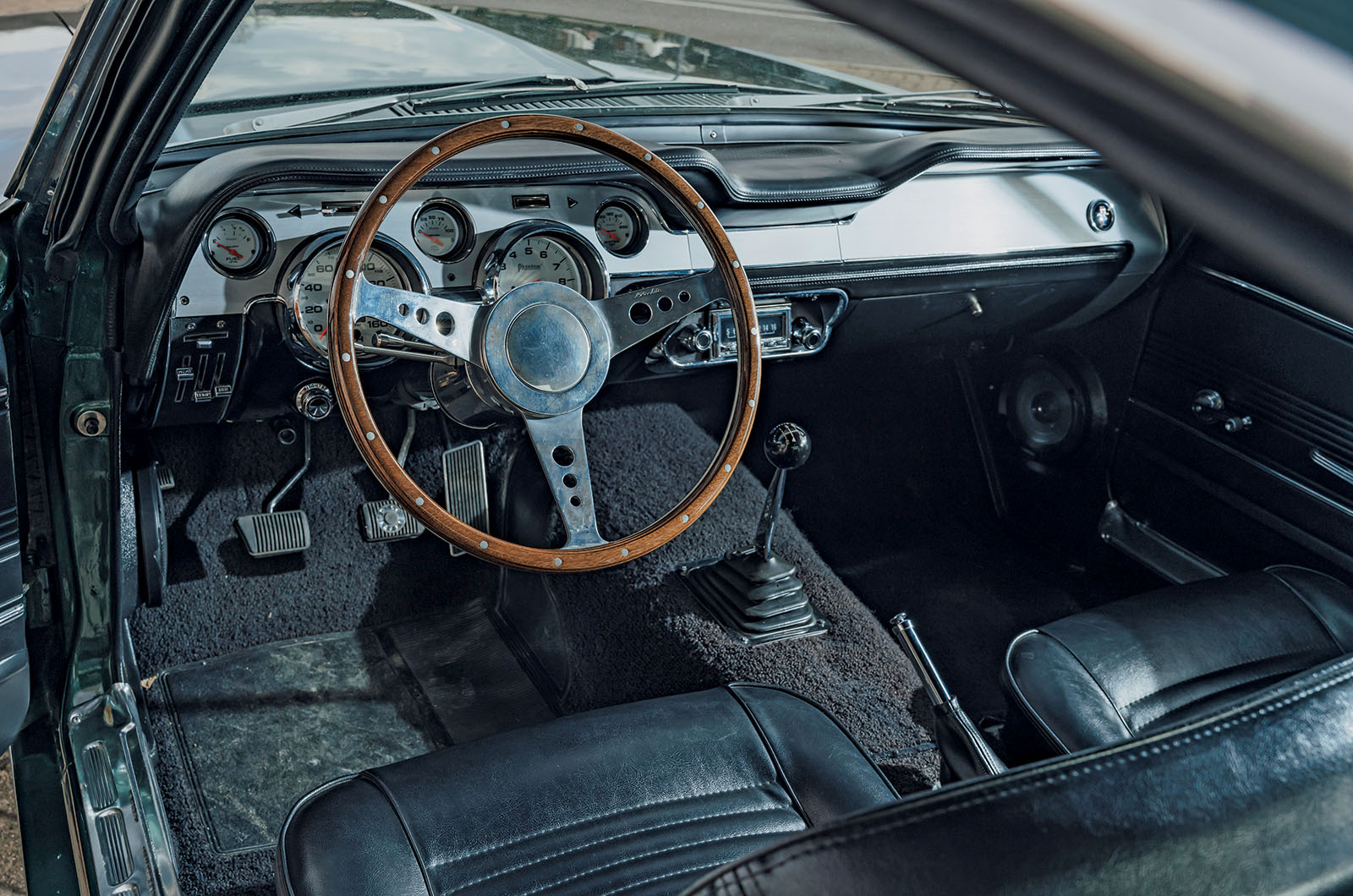
Decent aftermarket power steering and a five-speed manual ’box (still operated by a classic Hurst shifter) make it more palatable for modern tastes, without detracting from the all-American character.
That means a crisp and vibrant V8 exhaust note, copious torque, tall gearing and a chassis that allows the car to be hustled at a fair lick, even on sinuous roads.
Best of all is the instant recognition it gets wherever you stop. “My favourite car of all time,” remarks one youth at a filling station. The power of film, eh?
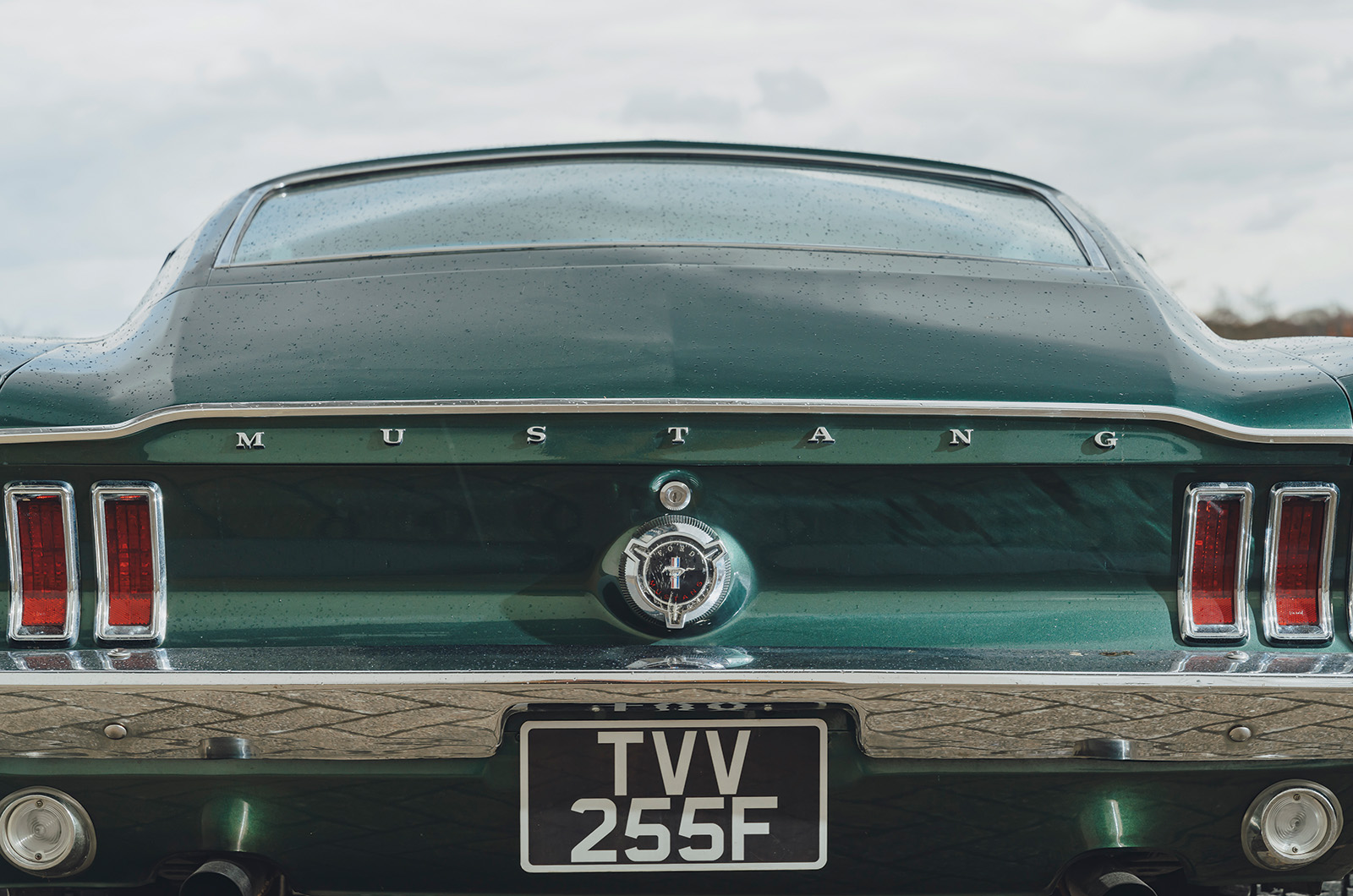
The Ford Mustang 390 GT has a central fuel-filler cap
Also starring…
Two now-famous ‘control cars’ were used during Bullitt’s epic chase, and repeatedly appear early on in the scenes shot in San Francisco to represent regular traffic on roads that had been closed for filming.
The first is a dark green Volkswagen Beetle and the second a white Pontiac Firebird, both being driven at a sedate pace as McQueen’s Ford and Hickman’s Dodge pass them time and time again.
Later during the sequence, a rider on a BSA 650 motorcycle comes to grief when he meets the Charger driving on the wrong side of the road and loses control of his ’bike.
Words: Simon Hucknall
Thanks to Slade’s Garage
Volkswagen Beetle 1200
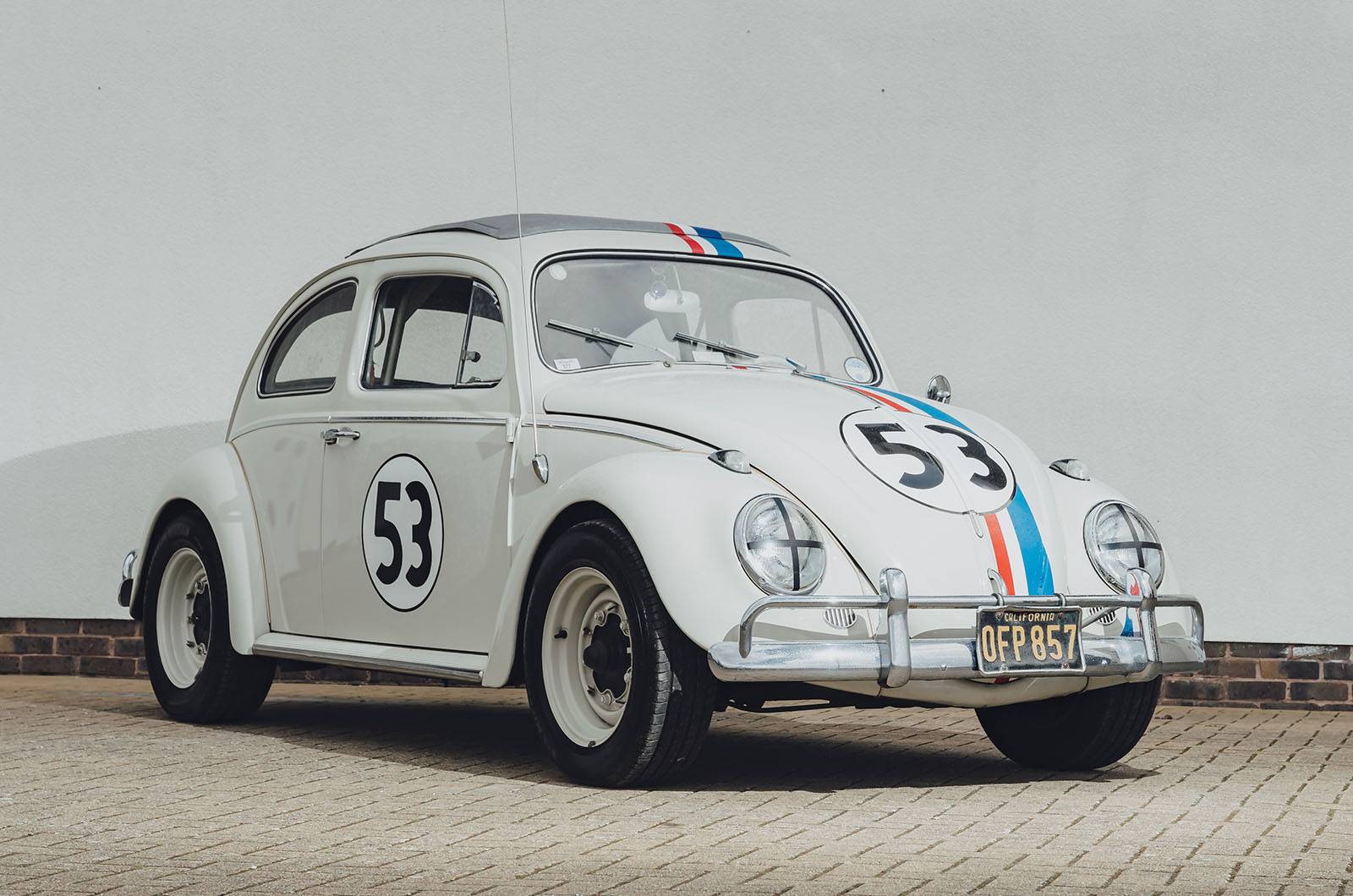
A 1960 Volkswagen Beetle 1200 that can beat an AC Cobra and a Chevrolet Corvette Grand Sport? It can only be Herbie!
I blame my dad. With college looming, I fell into VW Beetle ownership courtesy of his optimistic idea of me driving myself, thereby removing him from the chains of taxi duty.
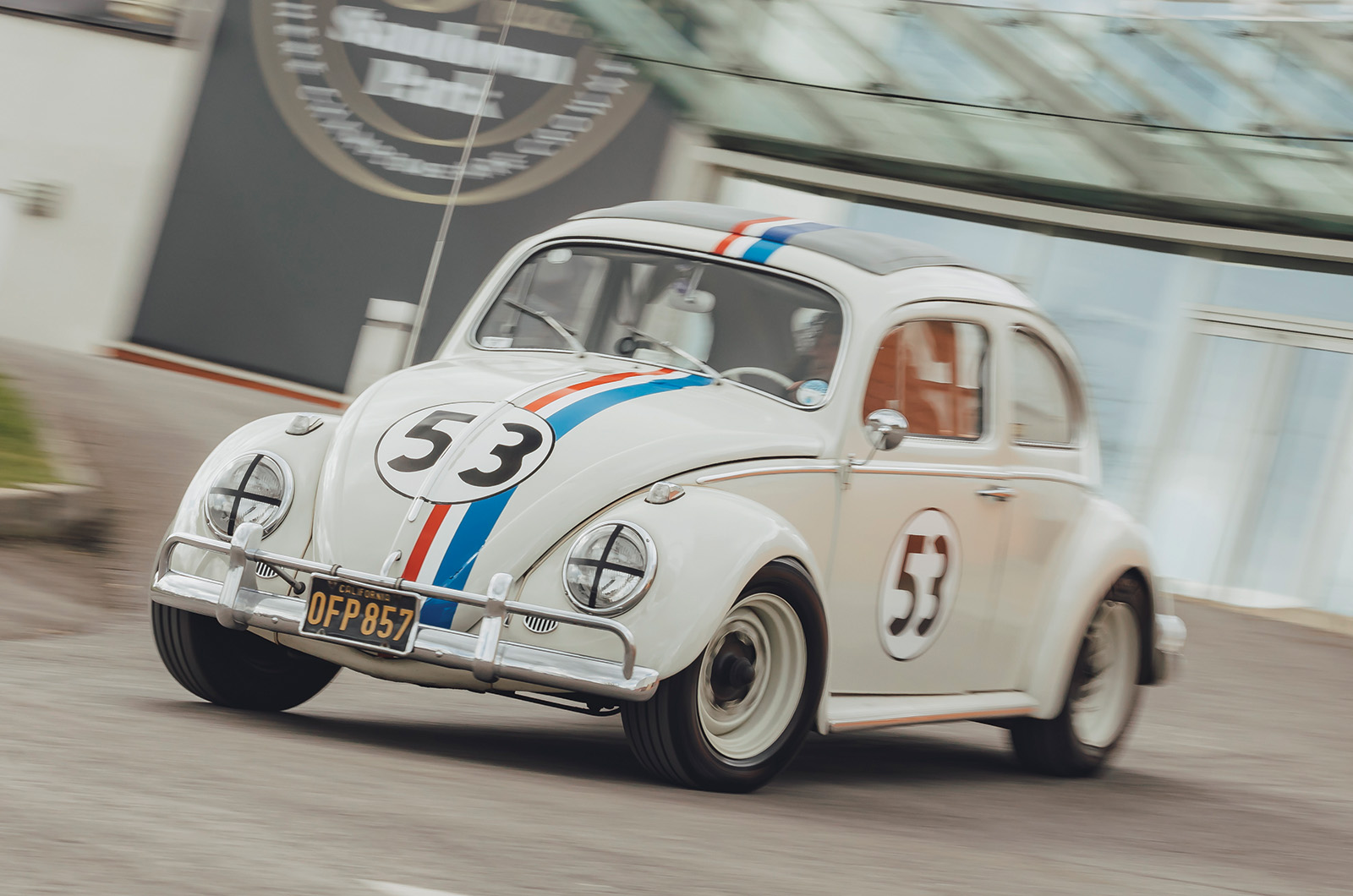
Suddenly I had a white 1970 VW in my possession, full of charm (and rust) and not dissimilar to the one I had seen on film, racing about in California as it upset faster cars at Riverside Raceway with a big ‘53’ on the bonnet.
Little did I realise it, but the VW had got under my skin in the same way people all over the world fell in love with that little Bug on the big screen.
It’s amazing how folks who have never even seen the films still refer to all Beetles as ‘Herbies’, showing just how far-reaching the magic of cinema can be.
Disney’s The Love Bug had a limited release in late ’68 – by which time the German people’s car was already two decades old – with a full launch early in ’69, no doubt titled to tap into the hippy movement’s love of VW.
Walt Disney himself is rumoured to have green-lit the film as a last act before his death in ’66
A box-office hit, The Love Bug launched to rave reviews and still has a 78% score on sourpuss site Rotten Tomatoes – not bad for a 57-year-old kids’ film with no CGI and a car as the lead.
Jim Douglas (Dean Jones) is the key human character, with terrifically named best friend and mechanic Tennessee Steinmetz (Buddy Hackett) supporting.
Jim’s love interest, Carole Bennett (Michele Lee), proves to be the mole-turned-girlfriend when evil dealer and racing rival Peter Thorndyke (David Tomlinson) tries every trick in the Dick Dastardly book to get the better of Herbie on track.
Inevitably, his efforts go awry as Jim – sorry, Herbie – beats him every time. Until, that is, Thorndyke tips Irish coffee into Herbie’s petrol tank, thereby giving him victory over the ‘drunk’ VW. You get the idea…
‘Part of the charm was seeing a car clearly not meant for such sporting adventures taking on and beating expensive rivals’
The Beetle you see pictured here isn’t just any clone, but real Hollywood royalty.
This is not a Herbie, but the Herbie, as seen on film back in the late ’60s.
Well, to be completely accurate, this is one of the seven Beetles that were used in the movie – H2 to be precise.
Cars H1 to H7 all had a role, with H2 used for the high-speed racing scenes.
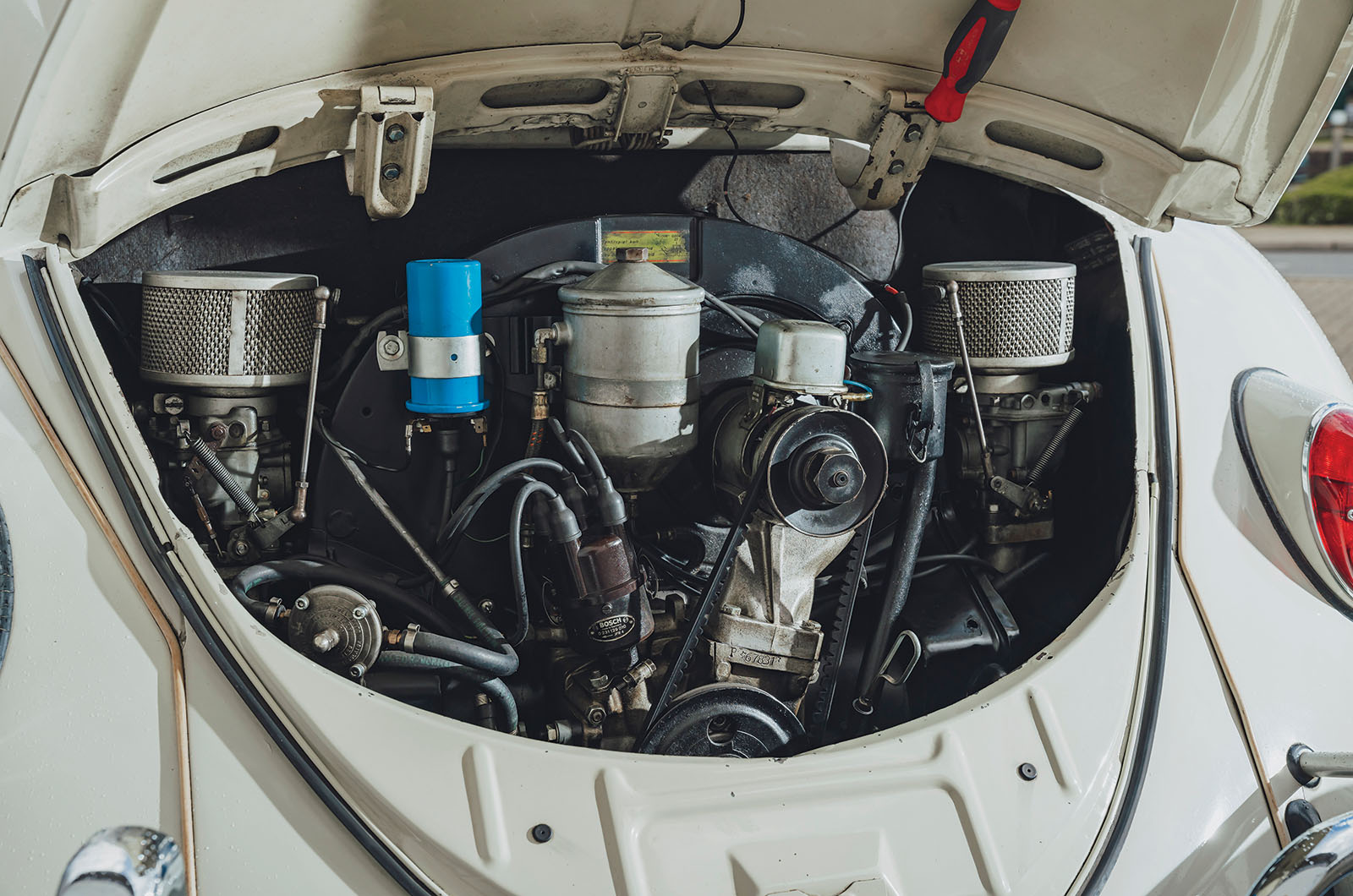
The production company got it from famed Californian VW and Porsche tuner EMPI, which had replaced the wheezy flat-four with a hot Porsche 356 motor, complete with all the choice go-faster goodies of the day.
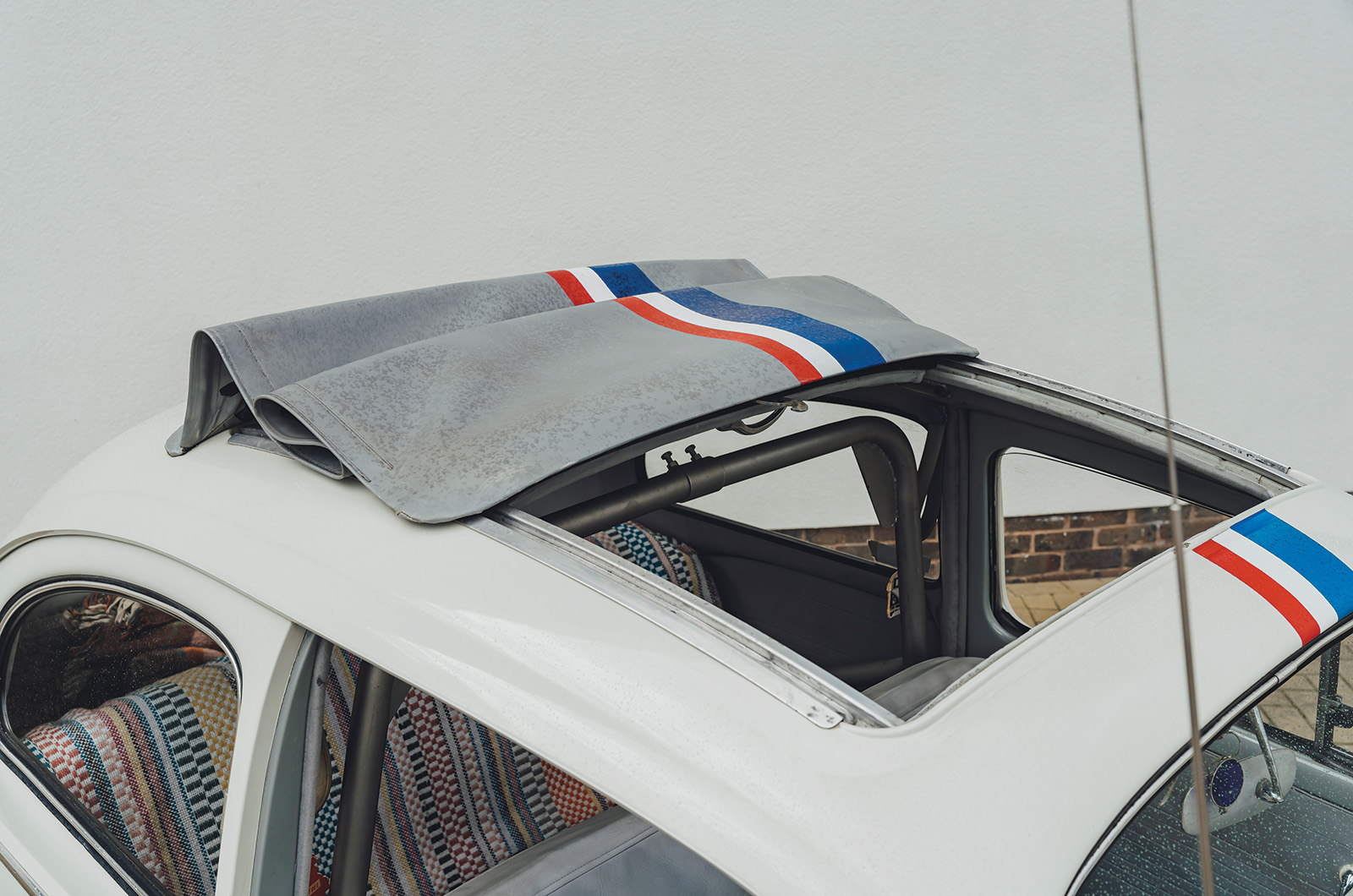
With uprated brakes and suspension, and sporting a rollcage, Herbie looks every inch the racing car – if not quite living up to the impression the movie gave as it overtook Ferraris, Chevrolet Corvettes and AC Cobras as if they were standing still.
Part of the charm of The Love Bug was seeing a car clearly not meant for such sporting adventures not only taking on and beating such expensive rivals, but also doing it with a driver who was just a regular Joe.
Having taken a few knocks along the way, Jim finally comes good and, along with his faithful Herbie, provides the essential Disney happy ending.
As with all successful leading characters, Herbie returned for many encores.
The second installment of the franchise, Herbie Rides Again, arrived in 1974 with a story of the little car saving the day from an unscrupulous property developer.
Herbie’s Porsche 356 motor was a source of cheap, reliable power
Dean Jones was notable by his absence, but reprised his role as Jim in 1977 for Herbie Goes To Monte Carlo.
This time, our four-wheeled hero races across France with yet another brilliantly named supporting character in Wheely Applegate (Don Knotts) – along with their villainous new German rival, Bruno von Stickle. You couldn’t make it up…
Once Herbie gets over his love affair with a French-owned Lancia Beta Monte-Carlo named Giselle, it’s off to Mexico for the next installment with Herbie Goes Bananas in 1980.
The usual shenanigans take place, but by this time the magic is fading: times have changed and even Herbie is heading towards old age.
There was another, made-for-TV version of The Love Bug in 1997, starring Bruce Campbell and John Hannah, which is just plain awful.
There’s even a harrowingly dark scene in which the VW gets jumped in a dark alley to be beaten up – and almost killed – by an evil version of himself called Horace. All a bit troubling.
The franchise was revived in 2005 with Herbie: Fully Loaded.
Lindsay Lohan took the lead, with some unfathomably big stars getting involved, such as Hollywood heavyweights Michael Keaton and Matt Dillon.
Let’s not get too far into that film here, but I’m not sure even Herbie can quite believe he’s now in NASCAR.
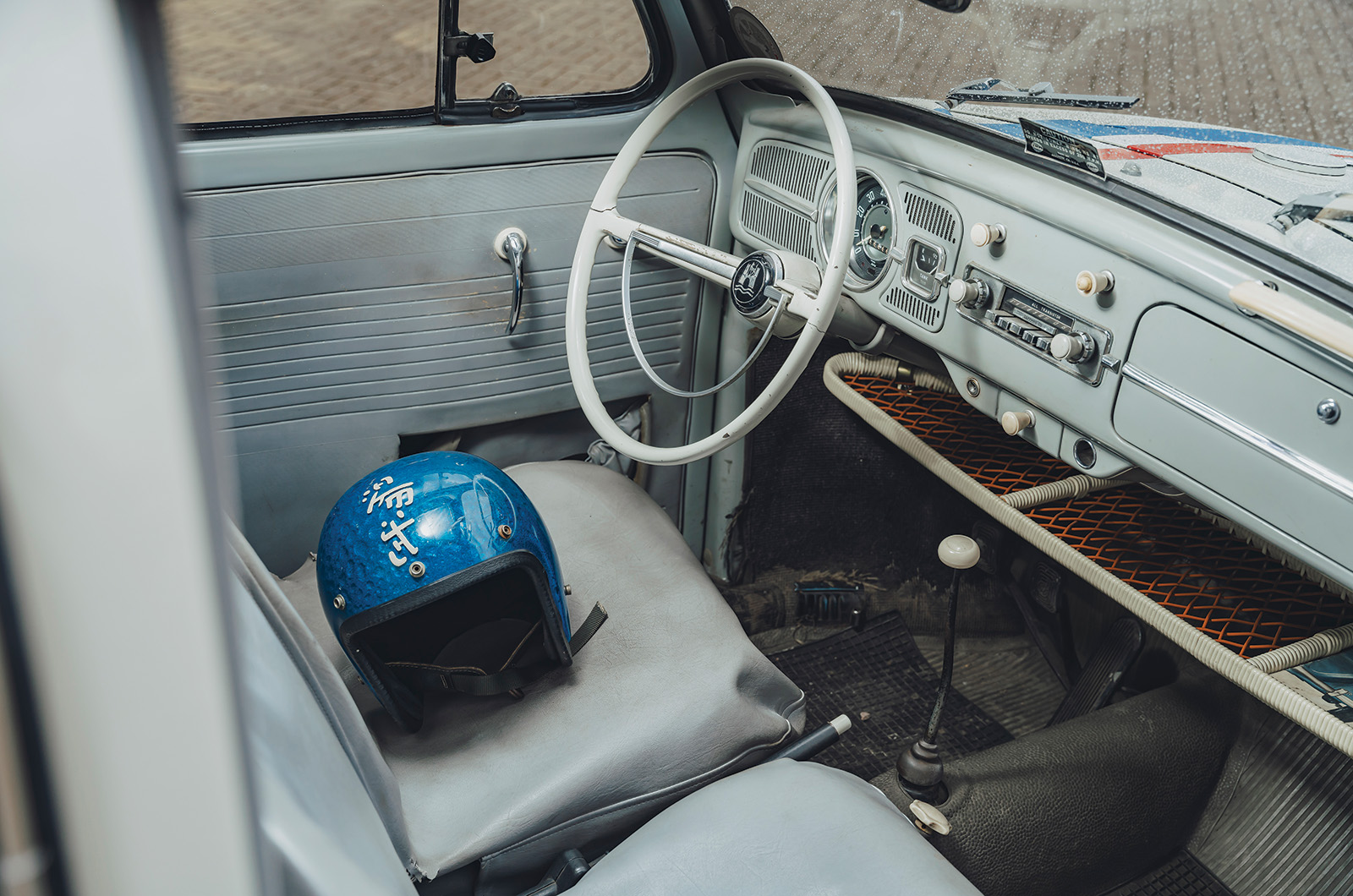
This Volkswagen Beetle 1200’s squat stance and wide steel wheels make it clear this is no ordinary Type 1
Today, Luke Theochari is the custodian of ‘our’ Herbie and it’s hard to think of a better person for the job.
The co-founder and owner of Terry’s Beetle Services in West London, Luke has been a part of the Volkswagen community since the late 1980s when he set up his shop dedicated to looking after the air-cooled cars.
His love of Herbie goes back even further, to being a 10-year-old boy in 1969 when he went to see The Love Bug at Northfields Odeon.
Fast-forward a few years and he purchased the famous OFP 857 numberplate from the DVLA, intended for a film replica, which indirectly led to a conversation with the owner of the real, Porsche-powered car in Florida.
Many months of emailing resulted in the acquisition of H2 in 2007, on the condition that Herbie was kept just as he was.
What swung the deal was how Luke referred to the car as “him”, confirming to the owner’s wife that he was the right person to look after Herbie over here in the UK.
The car has been driven all over Europe to events, clocking up thousands of miles.
There have been many big-money offers for the VW, but all have been rebuffed: Herbie is “part of the family” and not for sale at any price.
He is in the best place he can be, ready to bring the magic to a new generation of adoring fans.
This VW Beetle 1200 was fitted with a rollcage for the Herbie films
Also starring…
With an array of Italian and German rivals to beat, Herbie blitzes them all with ease.
The one that causes the most trouble is the ‘Thorndyke Special’, better known as an Apollo 3500GT.
Powered by a 3.5-litre Buick V8, it loosely resembles a Jaguar E-type with an Italianate flourish.
Moustachio’d Terry-Thomas-lookalike baddie Thorndyke spends much of his time concocting ever more desperate ways to beat Herbie, without success.
In the El Dorado finale, the Thorndyke Special appears to finally have the edge, but the little VW swerves all the obstacles and finds a way to win.
Words: Damon Cogman
Thanks to Terry’s Beetle Services
Austin Mini Cooper ‘S’
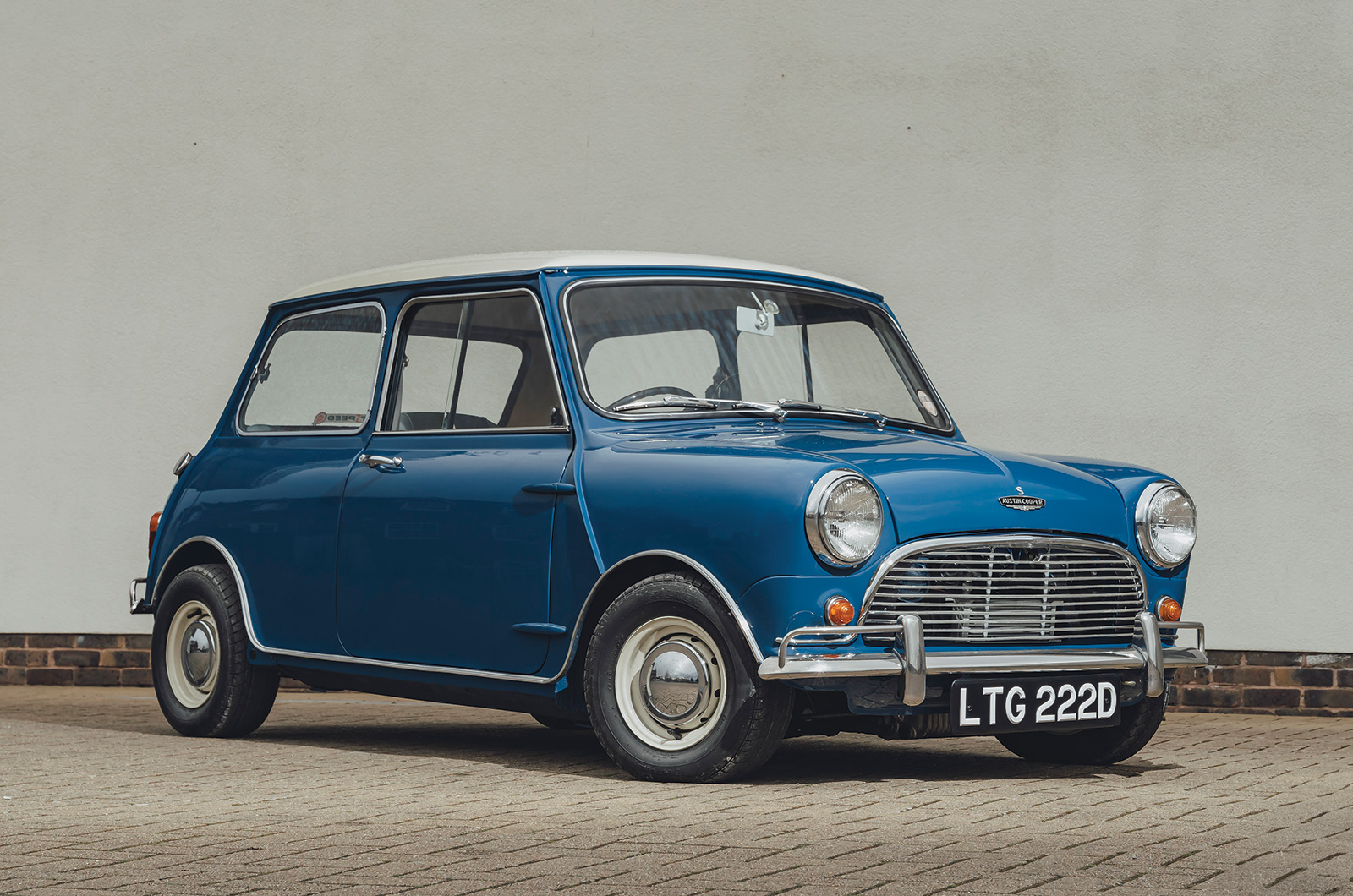
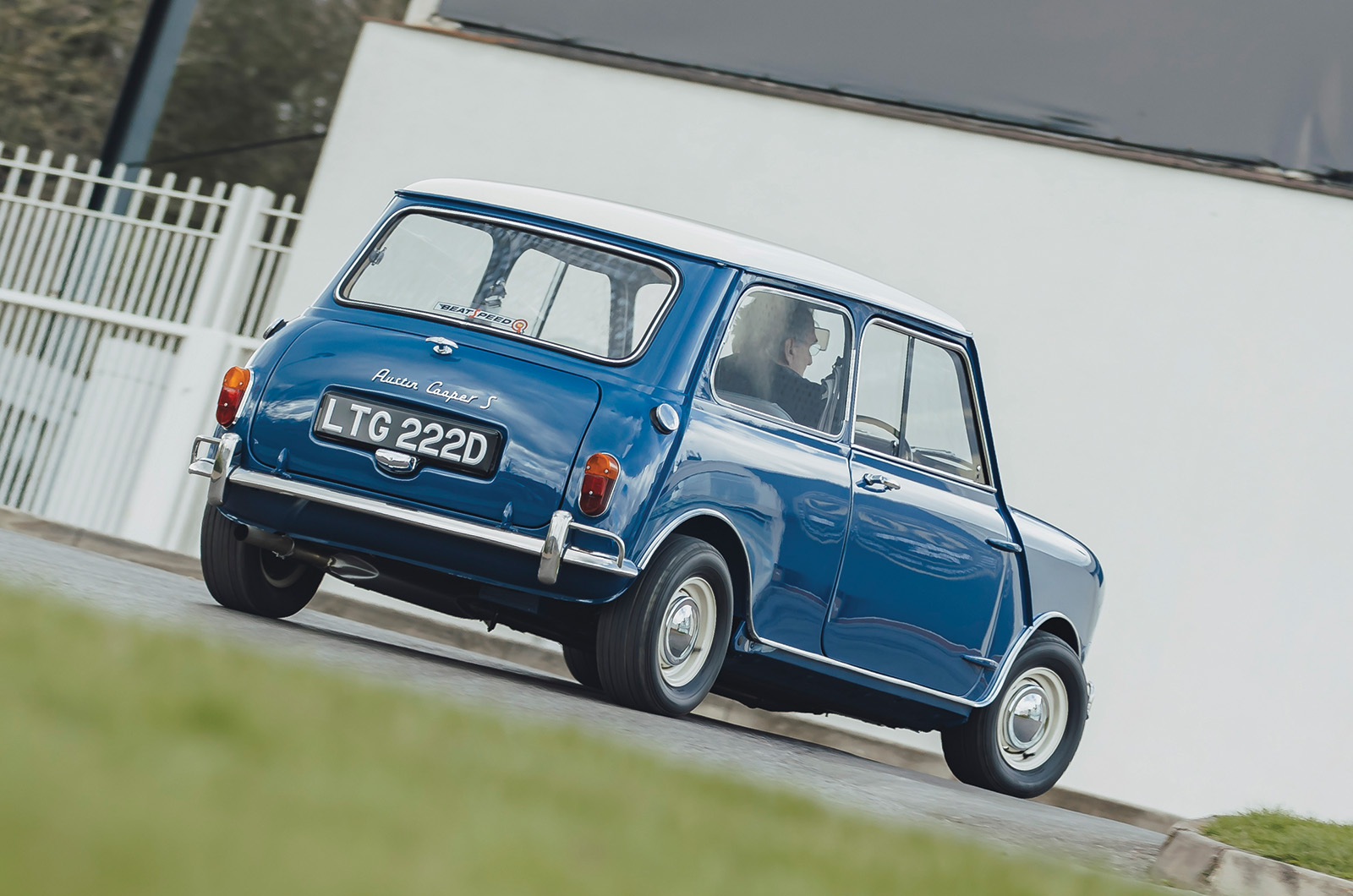
The Italian Job Minis’ roofs were originally a contrasting hue, like ‘our’ car’s, but were repainted to match their bodies
If the Mini defined the ’60s, then The Italian Job defined the Mini.
Three Cooper ‘S’ Minis laden with gold bars are chased through the jammed streets of Turin and leap from the top of the old Fiat factory, through a sewer and across the River Po, pursued by Alfa Romeo Giulia Super police cars.
Coming long before the advent of CGI, which has made audiences blasé about the most improbable stunts, it was all real. Maybe it is the best car-chase movie of all.
With any other cars except Minis, the film could not have worked.
They were narrow enough to squeeze into tiny gaps during the various stunts – such as through a pavement restaurant, down a grand staircase, and up ramps into a moving bus – and their agility and sharp handling were crucial.
When the movie went on general release in 1969 it was not a great success in British cinemas, and in the USA it bombed.
American audiences found the little cars ridiculous, and failed to get the very British humour that runs throughout.
An inferior remake (with BMW MINIs) in 2003 did worse, and a planned sequel called The Brazilian Job never surfaced.
But to mark its 30th anniversary The Italian Job was re-released in the UK, and reached a whole new audience.
It rapidly gained cult status, becoming a fixture on Christmas TV schedules.
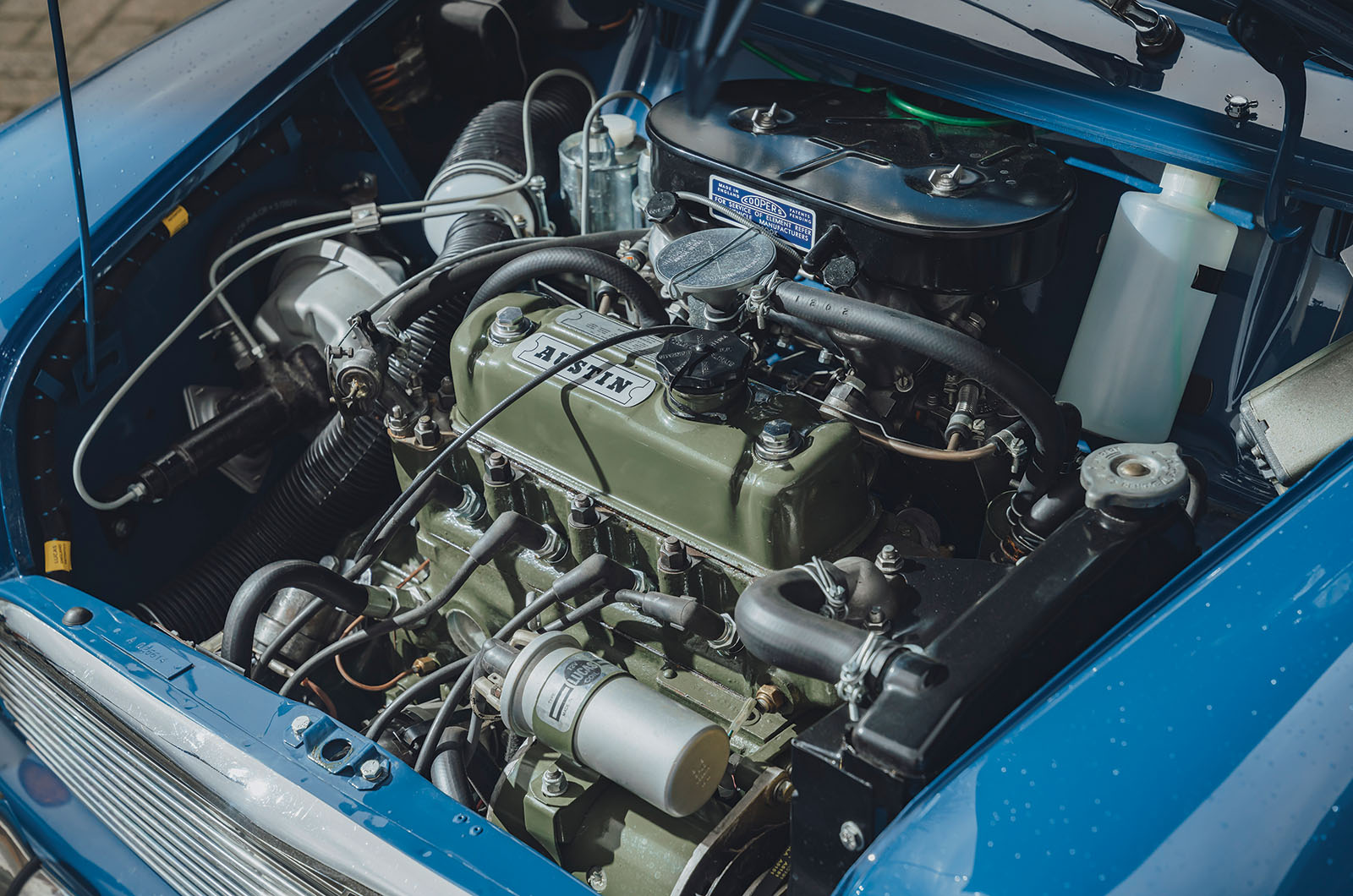
The Austin Mini Cooper ‘S’ has a zingy A-series engine
Much of this was due to nostalgia, because in its dress, its language and its humour the film is very much of its period.
It is also beautifully shot and full of inventive ideas, many of which emerged off the cuff during filming.
Several of Michael Caine’s best lines have become common currency, such as “You’re only supposed to blow the bloody doors off” and his final words as the bus, laden with the gold bars, hangs teetering over a precipice: “Hang on a minute, lads. I’ve got a great idea…”
The three Minis are painted red, white and blue.
Six standard 1275cc Cooper ‘S’s were bought, two in each colour; despite the film’s massive promotion potential, the British Motor Corporation refused to give them for free.
Coopers had a contrasting roof as standard, so they were resprayed into single colours, which worked better on screen.
Three of them turned up in Morris spec, so they had to be rebadged as Austins and have their grilles changed.
They were fitted with big sump-guards, Minilite wheels and rather basic roll-over bars, and purely for appearance each car had three big front spotlights and leather bonnet straps.
The studio’s normal camera cars were too wide for some of the gaps demanded by the stunts, so a 1275-engined Mini Moke was used, with cameramen hanging off it strapped to the floor.
Red, white and blue scrap Minis were used for the footage of the cars being pushed over the edge to destruction in the Alps.
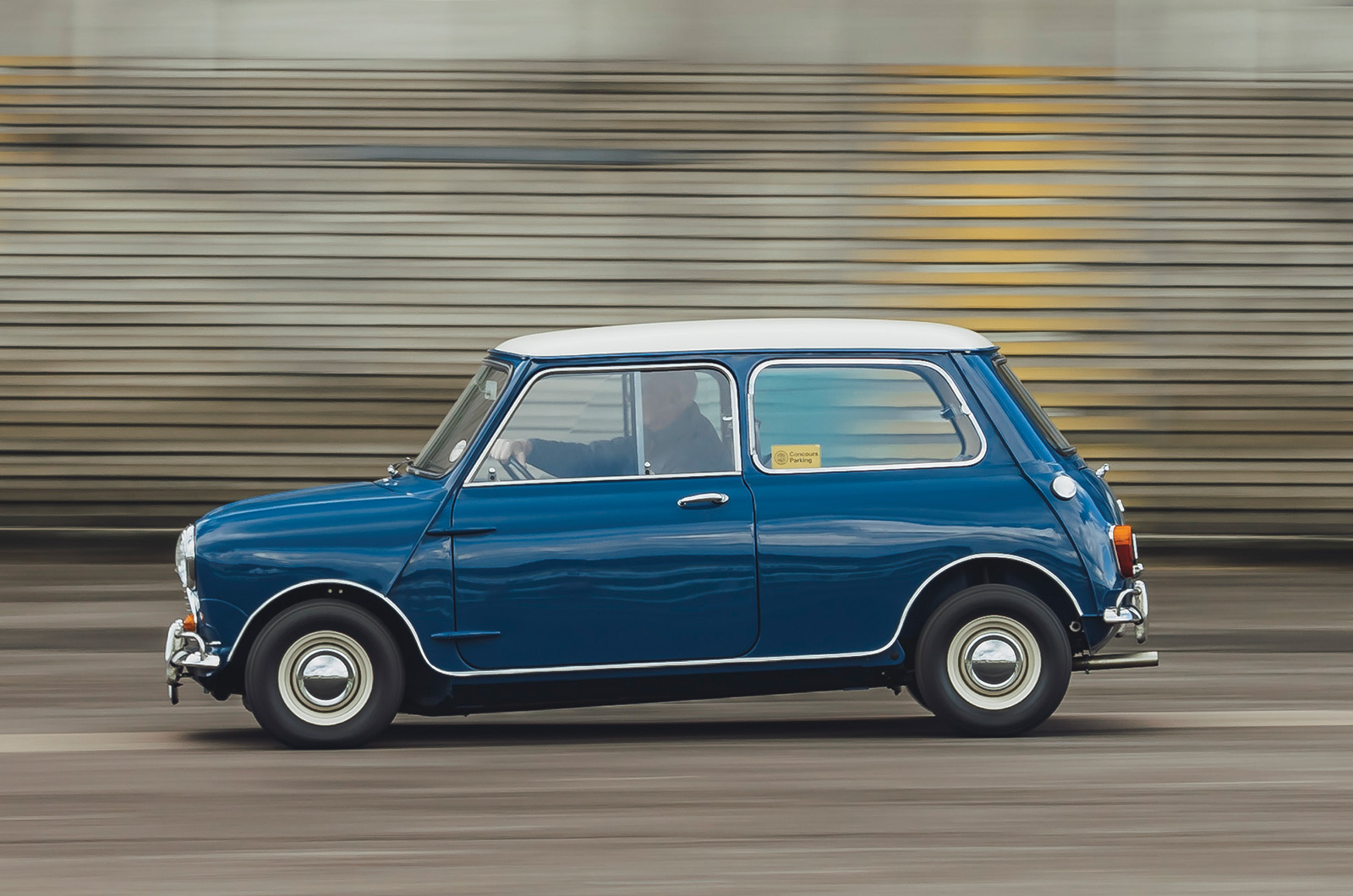
The Mini’s unmatched agility and extra performance of the 1275 ‘S’ made it ideal for The Italian Job
For the stunts the three cars were driven by members of the French team run by Rémy Julienne, a former motocross champion who in a 40-year career created action for more than 1400 films, including six James Bond movies.
He interpreted the vision of director Peter Collinson and decided what couldn’t be done and what could – which was almost everything.
The scene in which the Minis drive through a massive sewer pipe, swerving up the walls, was shot in an unfinished Warwickshire sewer.
Julienne wanted the cars to perform a complete loop, going up and over the top, and down the other side.
But in the confines of the pipe it wasn’t possible to get up enough speed, and after Julienne had written off a Mini when it landed on its roof, the stunt was toned down.
David Salamone’s garage in North London, Blenheim Motors, had a sideline sourcing cars for films.
As well as driving the red Mini on screen, he was tasked with finding all the cars apart from the Lamborghinis, which came from the factory: one mint demonstrator, one that had already been wrecked by a customer.
The Mini in our pictures is in the film car’s Island Blue, but with a white roof. It is the most perfect Mini Cooper ‘S’ I have ever seen.
Michael Beattie’s restoration is flawless, with paint and shutlines that Longbridge could have only dreamed of, and every period detail is exactly as it should be, from the pedal rubbers to the radiator hose clips and underbonnet labels.
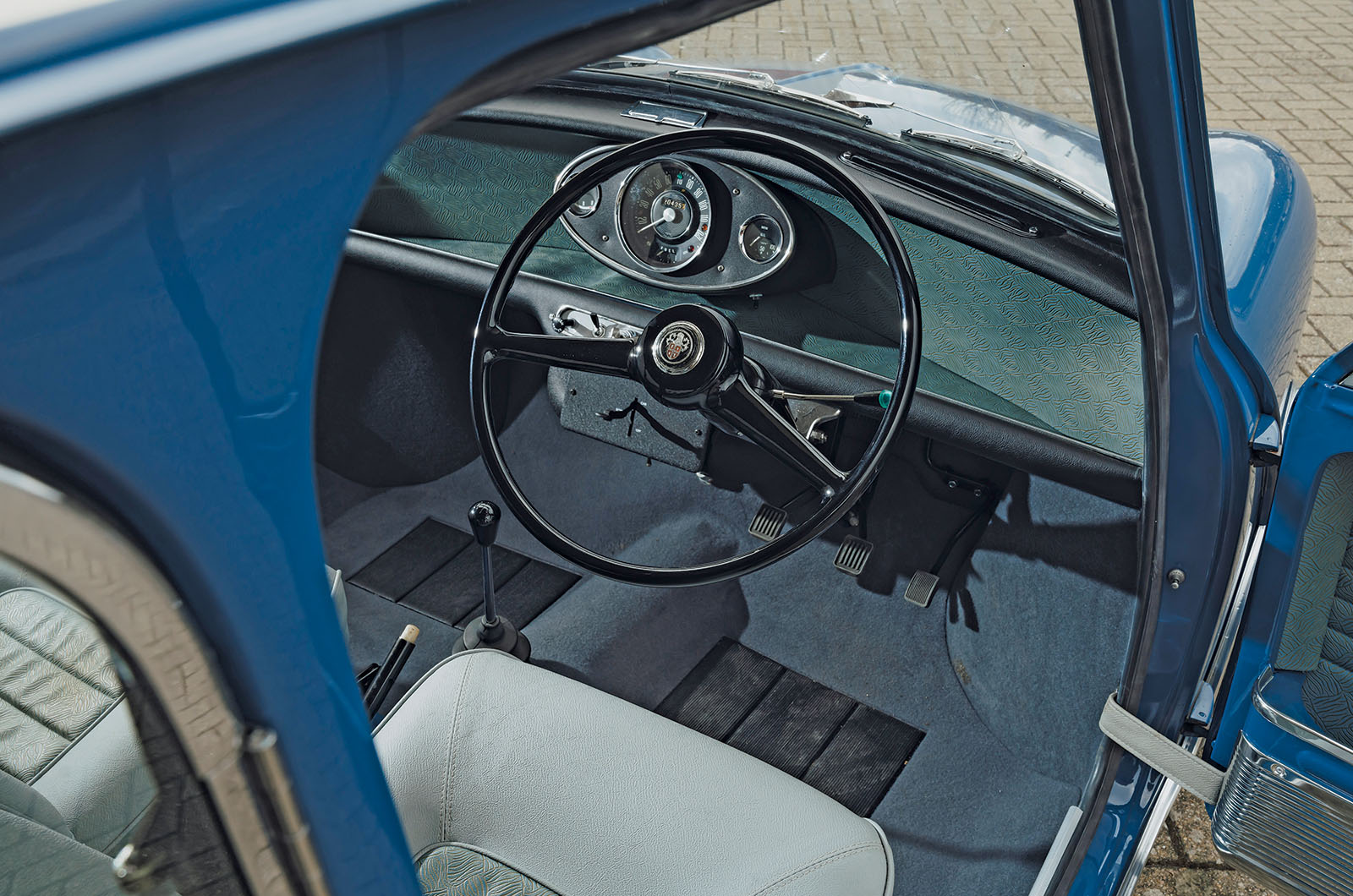
The Austin Mini Cooper ‘S’ has a spartan interior
The Cumulus Grey upholstery includes reclining seats, a rare period factory extra, and the only visible difference is 165-section tyres on the standard 4½J steel wheels.
It feels familiar – aeons ago my hard-driven company car was an 850 Mini – but in a modern context it seems absurdly small.
Yet once you get inside, the genius of Alex Issigonis quickly manifests itself: it is perfectly accommodating for four friendly people.
A big surprise is the torque of the compact engine, pulling strongly from quite low revs, and sitting near the ground inside that little box the acceleration feels really strong.
The car’s rebuild is only 200 miles old so I didn’t push it, but I was able to sample its unforgotten sharp and responsive handling.
It feels as though it would turn on a sixpence – to use a period currency – although with the standard plastic wheel the steering is not as high-geared as I remembered.
The film cars used Hydrolastic suspension, which was standard at the time, but Michael is not a fan and has replaced it with the earlier rubber-cone set-up.
It’s hard to believe that this car is 60 years old, and it could easily be a daily driver. Michael is now restoring another Mini – his fifth – so this one is for sale.
Not long ago prices for the very best Minis were starting with a six, but he is asking £45,000 for this one.
Seen as an important period artefact rather than merely a car, perhaps that’s not so expensive.
‘With any other cars the film could not have worked: the Minis could squeeze into tiny gaps, were agile and sharp handling’
Also starring…
The film used two Aston Martin DB4 Convertibles, a good one and a scruffy one to go off the mountain, which Salamone picked up for £700.
It carried a small bomb, set to explode when it hit the river below, but it went off early and ruined the shot.
Salamone was sent to find a replacement overnight. He recalls: “I rushed to Turin, found a Lancia Flaminia Convertible, blew it over in silver, and was back on location by 6am. Watch the movie and you won’t see the join.”
The Daimler DR450 that picks up Caine from prison was the Pakistani ambassador’s (Salamone had it in for service).
The mafiosi run Fiat Dinos, and the final stunt uses a Bedford with Harrington Legionnaire body.
Words: Simon Taylor
Thanks to Mini Cooper Register
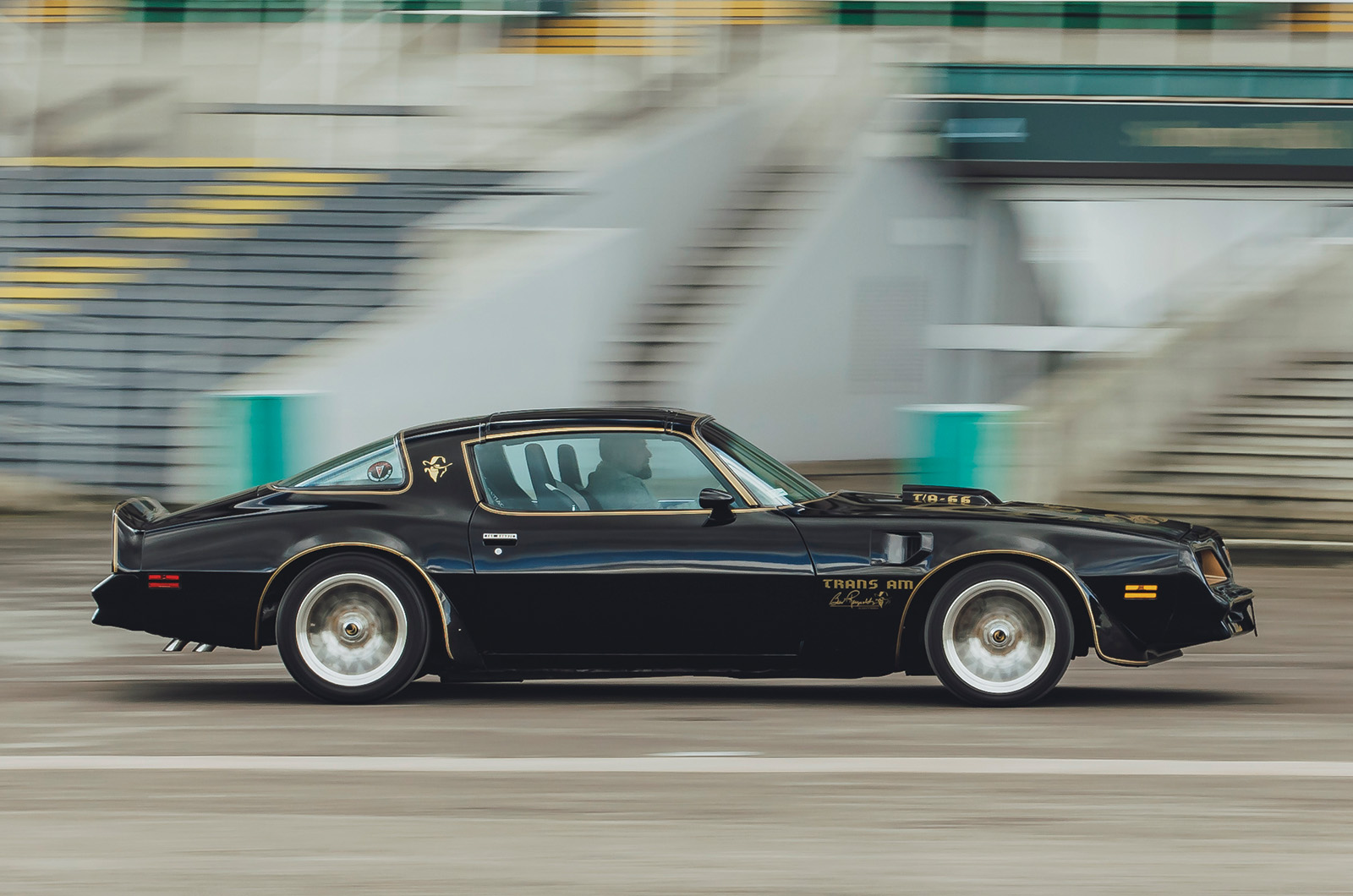
Pontiac Firebird Trans Am
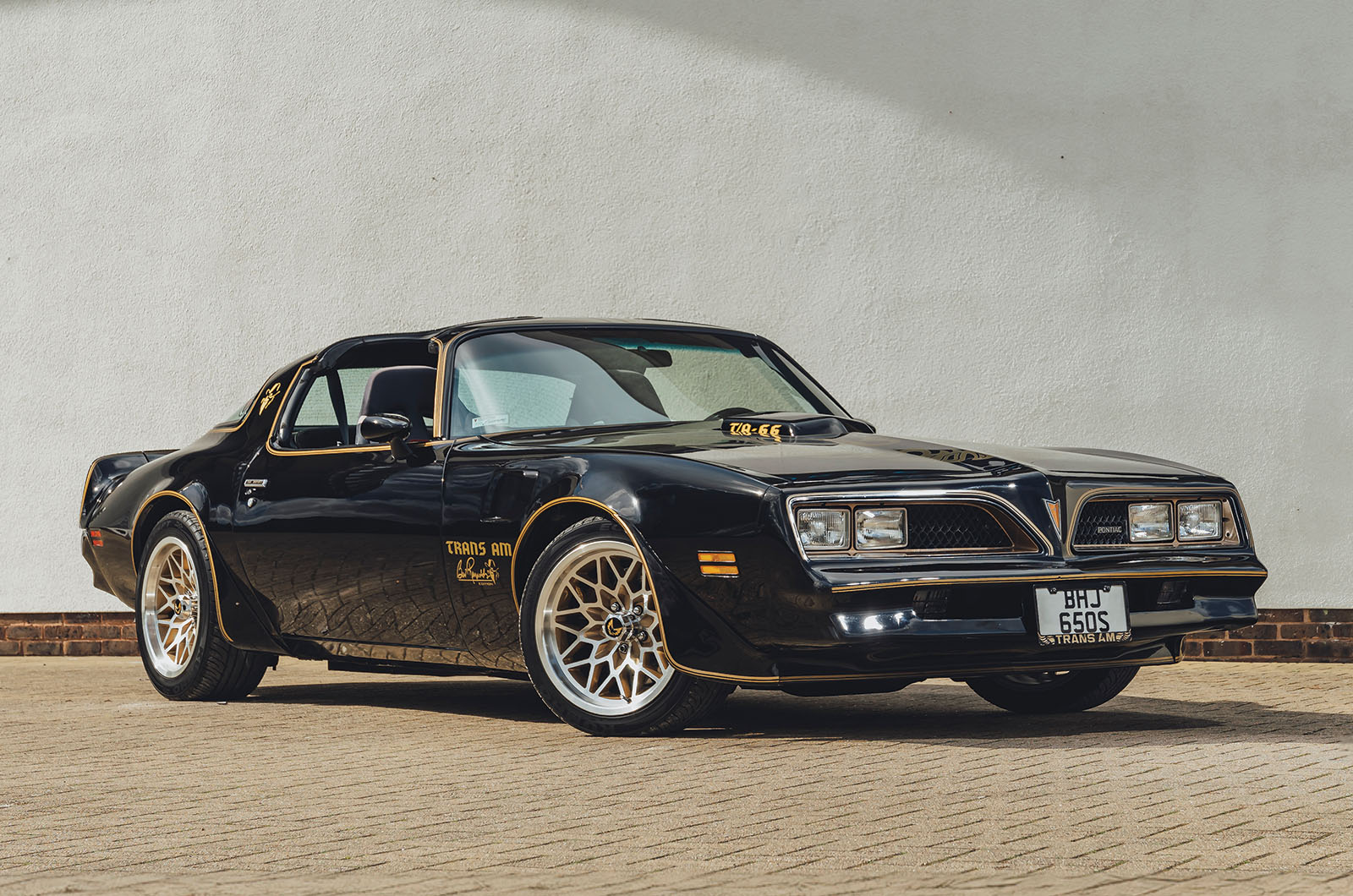
The hotter Trans Am version further distanced the F-body Pontiac Firebird from the Chevrolet Camaro on which it was based
A car chase almost from start to finish, the simple premise of Smokey and the Bandit is irresistible for fans of all-out, high-octane action in the mode of Vanishing Point and Gone in 60 Seconds.
Burt Reynolds’ Bo Darville and Jackie Gleason’s Sheriff Justice – CB radio callsigns ‘Bandit’ and ‘Smokey Bear’ – bring easygoing wit, charm and increasing silliness to this rollercoaster of stunts laid out by professional crash-man turned writer/director Hal Needham, but it’s the perfectly rebellious Pontiac that defines the picture as the lead runaway from an ever-growing tail of cops.
Little time is wasted on Needham’s concept: the tantalising prospect of bootlegging Coors beer across state lines to quench the thirst of those denied the chilled, unpasteurised lager east of the Mississippi.
A bet is swiftly made and Bandit secures funding for a speedy ride. “Speedier,” he says, and gets another wad of cash from his unscrupulous bankrollers.
With $80,000 on the line, he introduces the challenge – 400 cases from Texarkana to Atlanta in 28 hours – and a glistening new ’77 Trans Am in black and gold to his truck-driving partner in crime, Cledus ‘Snowman’ Snow (Jerry Reed).
“For the good old American life; for the money, for the glory, and for the fun... Mostly for the money,” urges Bandit, and they set off.
Almost immediately they ensnare comedy Sheriff Justice, ostensibly for speeding but more for Bandit facilitating the wedding-day getaway of his son’s bride-to-be, Carrie (Sally Field).
The police Pontiac sets off in siren-howling pursuit, perfectly taking the heat off the beer-laden truck.
This Pontiac Firebird Trans Am was turned into a ‘Bandit Edition’ in 2009
Efforts are taken to make the Trans Am’s pace look less strangled than the lumbering smokeys, with the usual doses of speeded-up footage, tyre-shredding turns and an overlaid V8 roar – sourced from the ’55 Chevy used in American Graffiti.
Carrie’s “Are we really doing 110?” is less convincing when you notice the speedo only shows that figure in kph.
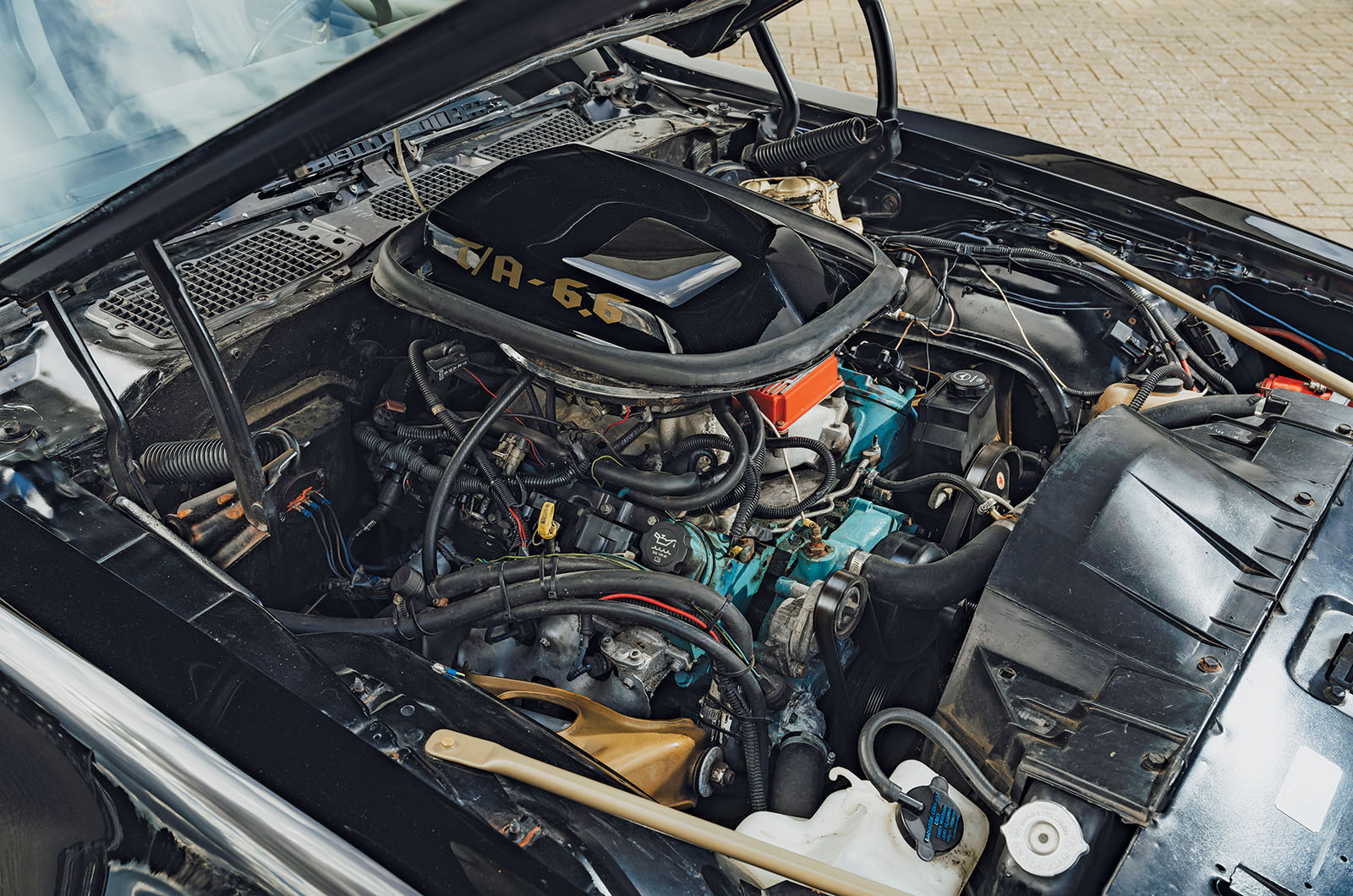
It’s understandable when you consider that by 1977 the Firebird was producing as little as 200bhp in full-fat ‘TA 6.6’ trim.
Only one of the three cars provided by Pontiac for filming was in this spec, fitted with the W72 tune of the L78 400cu in V8.
Another was in lower, 180bhp form; the third was actually a ’76 remodelled with a new bumper to match the other ’77 cars, so it could have had the 200bhp 455.
Fortunately, Needham’s passion for action shines through and we get some well-planned sequences, most famously the jump over an old, broken bridge.
According to an interview with the director by Hot Rod magazine, one of the Trans Ams was fitted with a hot engine and manual ’box, via his NASCAR connections, to get enough speed for the stunt, although it’s also reported that a rocket gave extra propulsion.
Either way, there was a ramp hidden out of shot and the car was all but destroyed by the landing.
The pursuing police were left variously in the Flint River or hanging over the edge.
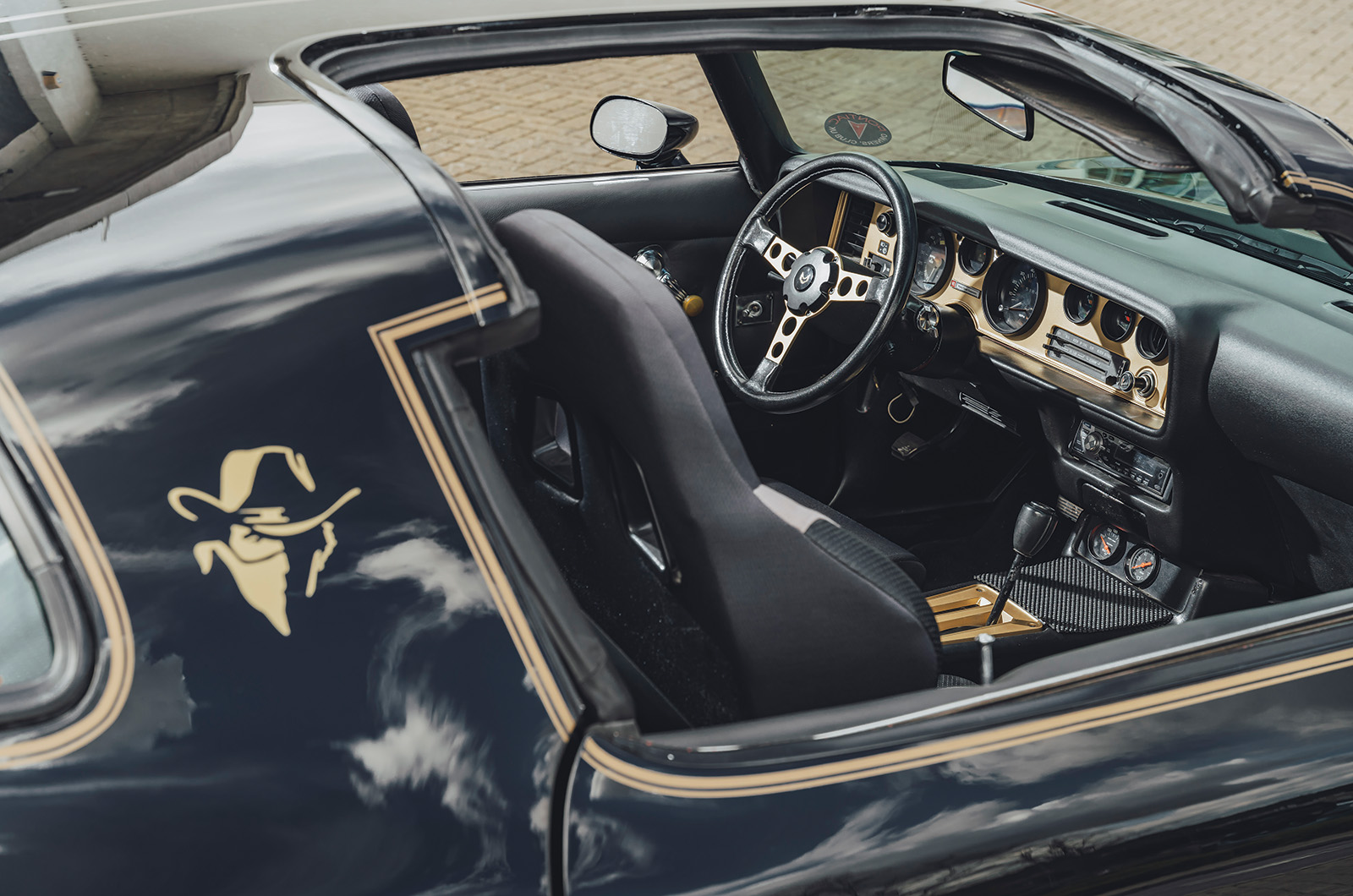
This Pontiac Firebird Trans Am has an LS1 V8, in place of the original 400cu in unit
There’s plenty more high-speed running on the highway, leaving police rolling into ditches left and right – one even jumping unluckily on to a moving flatbed truck – while the Bandit and ‘Frog’ (as he christens Carrie) make good their escape.
We’re treated to the classic car-through-board scene following an impromptu drift over a football field, and a helicopter even makes an appearance in the police-swarming climax.
The film was a surprise success, initially faltering before picking up an audience keen on its lighthearted thrills and breaking of southern stereotypes – exemplified in the contrast between the buffoonish Justice and a level-headed black Sheriff Brandford.
It was the second highest grossing film of 1977, drive-ins around the US showed it for months and Trans Am sales went through the roof.
Dealers scrambled to repaint their cars in black and gold, while waiting lists extended to as long as six months.
The livery that had originally been displayed at the 1973 Chicago Auto Show was no longer anything to do with GM designer Bill Mitchell’s appreciation of the Lotus Formula One team: it was ‘The Smokey and the Bandit car’.
And the Corvette? What Corvette?
The budget was far bigger for Smokey and the Bandit II in 1980, although the challenge of speeding up the latest 301cu in turbo V8 Trans Am for on-screen drama was even greater, despite the supply of five from Pontiac along with hundreds of stunt-fodder sedans.
‘Efforts are taken to make the Pontiac’s pace look less strangled than the lumbering smokeys, with an overlaid V8 roar’
Though still making 200bhp, and with 340lb ft, the Garrett TBO-305 turbo was an uncooperative partner for the even-more-ambitious action set-pieces lined up for the largely disappointing sequel.
The 150bhp Trans Am in 1983’s Smokey and the Bandit Part 3 did little to replace the charisma of a missing Burt Reynolds; the third-generation car ended up better remembered for its starring role as KITT in Knight Rider.
While none of the original film cars survive – even the hero car for close-ups was crushed after production – few Trans Ams have been spared the Smokey and the Bandit treatment.
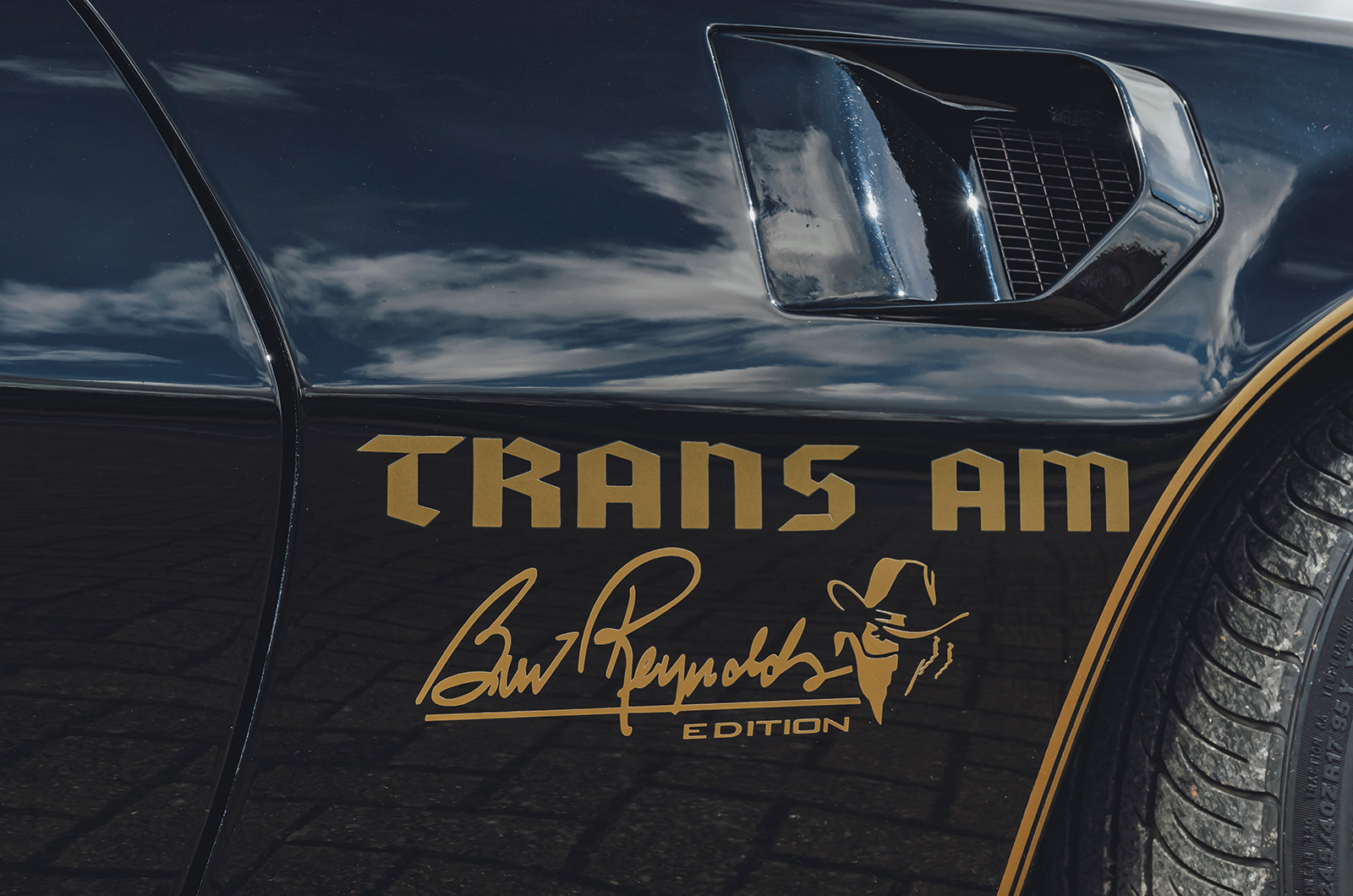
‘Our’ car is perhaps one of the most extreme representations of this inextricable link, being a ‘Burt Reynolds Bandit Edition’ created by US customiser Year One in 2009.
It fills the distance between on-screen fantasy and mechanical reality by swapping in modern mechanicals: an LS1 V8 with c400bhp, big brakes behind 19in snowflake-style alloys and firmer suspension.
Earth-rumbling V8 noises, burnouts on cue and jump-worthy acceleration are granted, and the whole thing feels much tighter than an original F-body Trans Am did in the ’70s, but it’s still no sports car.
But then, it’s all showmanship anyway: what’s the point of a gold Firebird emblazoned on the bonnet or a cold Coors in Georgia? It’s just good, old-fashioned fun.
This Pontiac Firebird Trans Am’s owner is looking for original seats
Also starring…
An embarrassment of pursuing Plymouth Fury and Dodge Polara police cars was topped by Sheriff Buford T Justice’s 1977 Pontiac Le Mans, which quickly lost sight of Bandit’s Trans Am – most memorably after shearing off his brown sedan’s roof under the middle of a truck’s trailer.
This unintentional convertible continues to be outwitted, including by other truckers in on the game – although it’s Snowman’s 1972 Kenworth W900A that’s the co-hero.
Bandit, Frog and Snowman all make their final escape, post-delivery, in a lipstick-red 1974 Cadillac Fleetwood Eldorado.
Words: Aaron McKay
Thanks to Russell Satcher of American Dreams; owner Bob Frank
De Lorean DMC-12
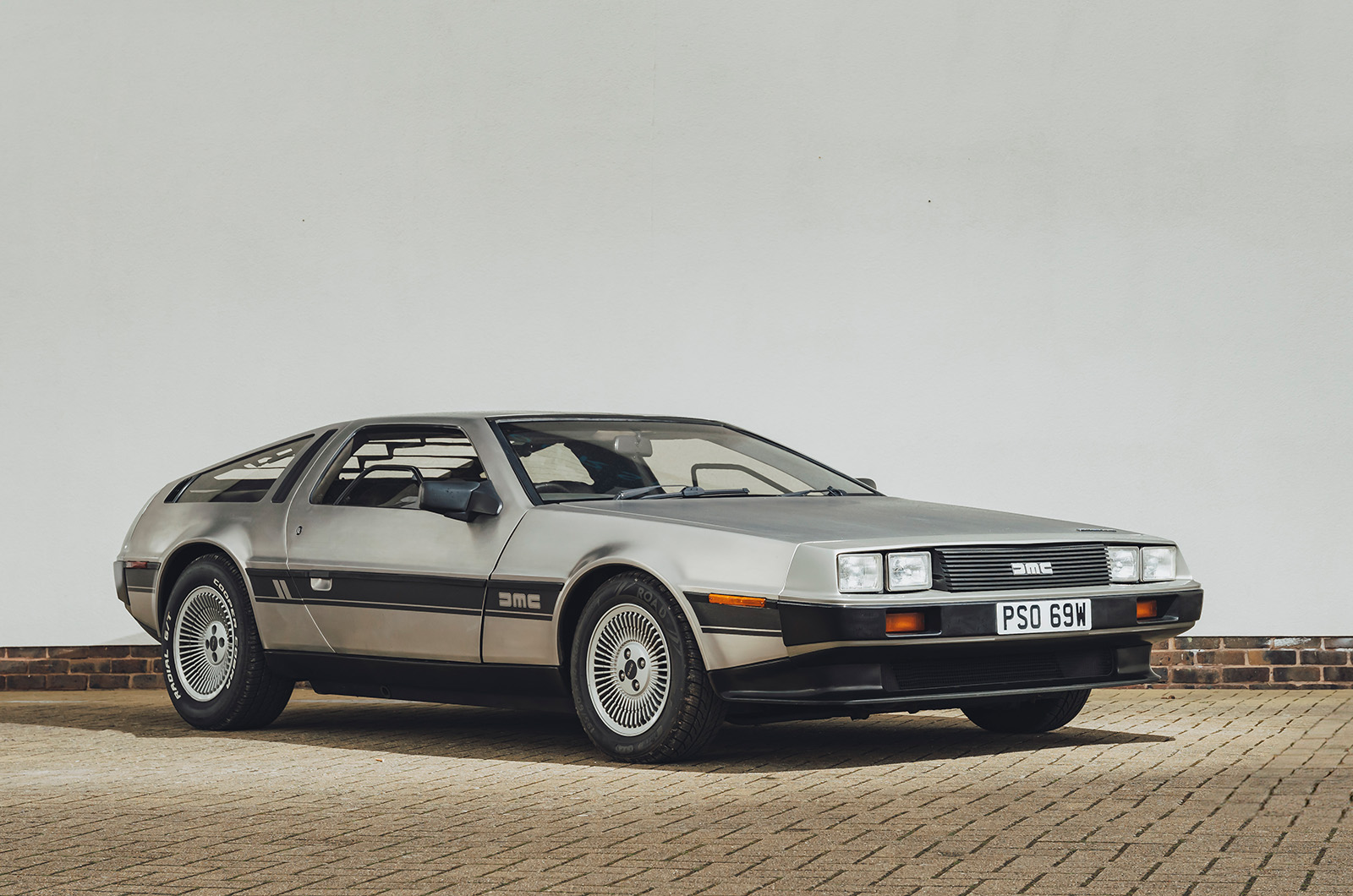
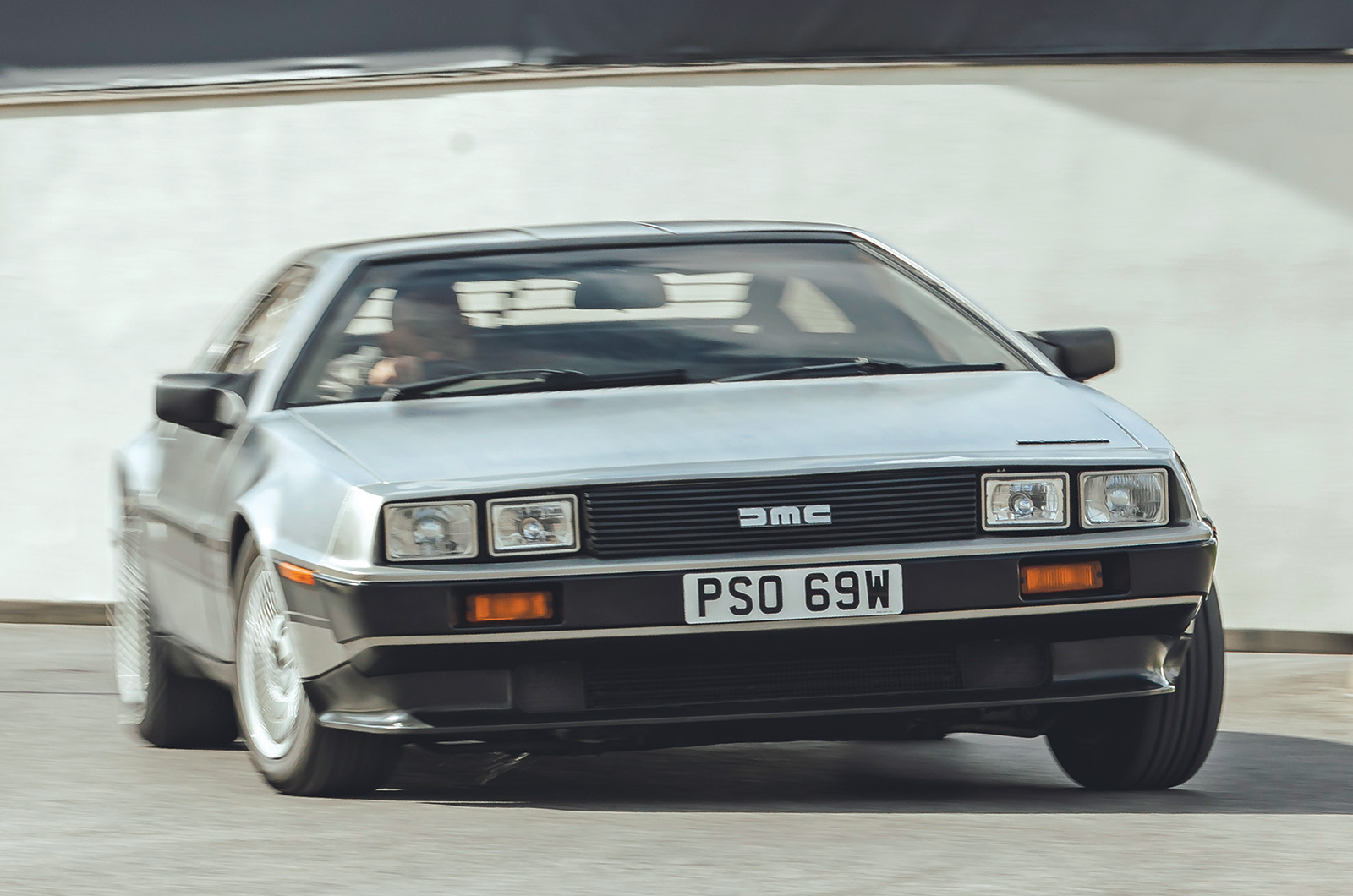
The stainless-steel De Lorean DMC-12’s rarity and other-worldly looks made it the perfect choice for the Back to the Future time machine
The De Lorean owes its legend to cinema like no other car.
We’d still love DB5s, Minis and Mustangs regardless of their silver-screen appearances, but the De Lorean?
Had the DMC-12 never been Back to the Future, it would surely be no more famous than the Bricklin SV-1 or perhaps the Cord 810/812: a strikingly styled flash in the pan and a curio for nerdy enthusiasts, but one that stopped well short of even 10,000 examples being built.
You’d need a time machine to truly consider that counterfactual, however.
Instead, Robert Zemeckis chose the De Lorean as his mechanism for temporal transportation in his upcoming light-hearted adventure film.
Like fellow ’80s action-adventure staples Indiana Jones and The Goonies, Back to the Future tackled thought-provoking and occasionally dark themes with blithe, family-friendly cheer.
Zemeckis insisted on a time-travel vehicle that was similarly fun, and not to be thought about too seriously.
Once the idea of a time-travelling fridge was ditched – Steven Spielberg warned Zemeckis this would lead to an epidemic of kids shutting themselves in white goods – the DMC-12 was quickly decided upon for its distinctive looks.
When filming began in November 1984, the white dust had already settled on the sports-car business of former General Motors tycoon John De Lorean, and Zemeckis reckoned the Giugiaro-styled coupé looked dated already – a deliberate bit of irony for a time-traveller.
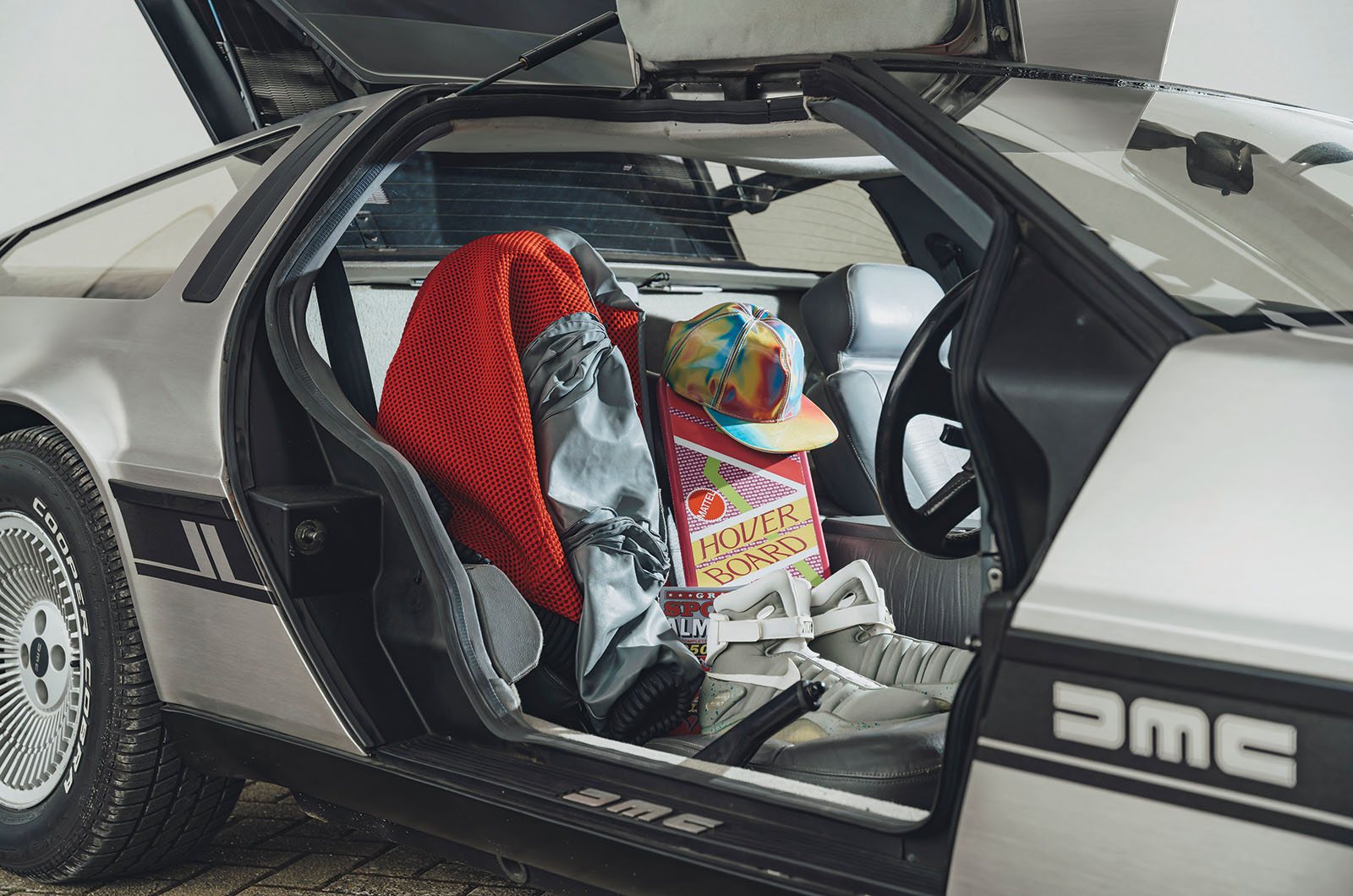
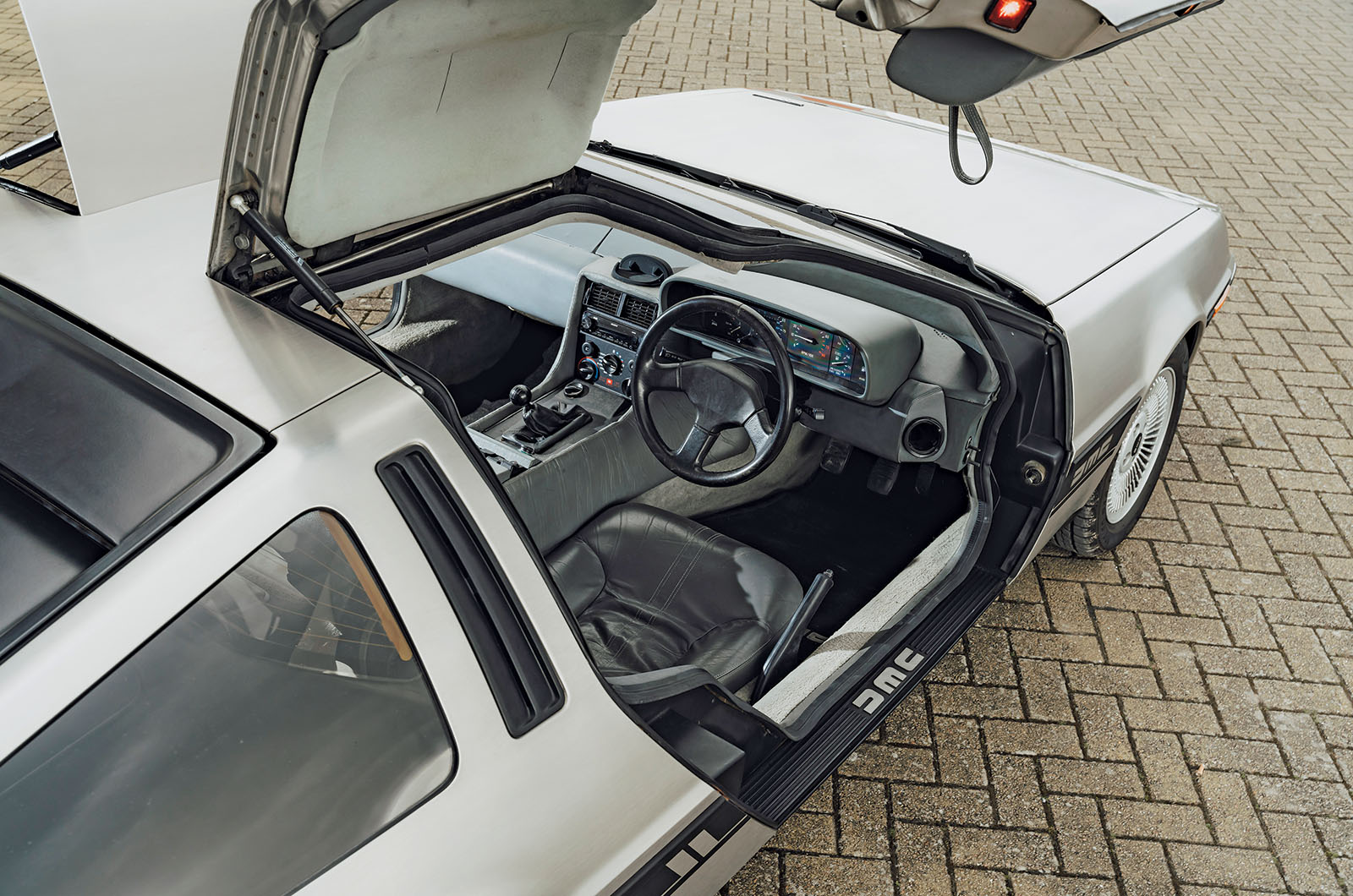
Back to the Future memorabilia beneath the De Lorean DMC-12’s gullwing door
The stainless-steel bodywork and gullwing doors gave a desirable, spaceship-like quality, while its rakish shape fitted the developing character of Dr Emmett Brown, best summed up in the Doc’s own words: “The way I see it, if you’re gonna build a time machine into a car, why not do it with some style?”
The prop-dressed DMC-12 was designed to look like something built in a home garage, with a Dodge Polara hubcap forming the lid of the nuclear reactor, while the ‘Mr Fusion’ fuelling system was actually a Krups coffee grinder.
Not long before filming started, Ford offered a chunk of money to switch to a Mustang, to which screenwriter Bob Gale famously responded: “Doc Brown doesn’t drive a f***ing Mustang!”
Poor build quality dogged the De Loreans on set, just as it had done the cars on sale, further proving the challenges of opening a factory in an area completely devoid of car-building experience – this time Dunmurry, near Belfast, but it could have been Linwood or Pomigliano d’Arco.
Interior items broke, holding up the production while the FX team glued parts back together, while the gas struts on the gullwings proved only just capable of supporting the prop additions.
The first time liquid nitrogen was poured over the cars, to make post-timewarp smoke, the doors slammed shut on the actors; in subsequent takes the props department had to pre-heat the gas struts with hairdryers.
Through the various sequels the De Lorean remained the star.
Its time-travelling speed of 88mph is now iconic – a number chosen purely because it is memorable and looks cool – and a custom speedometer had to be made to display it: firstly so it could be controlled, but also because US speedometers in the ’80s had a legislated maximum readout of 85mph.
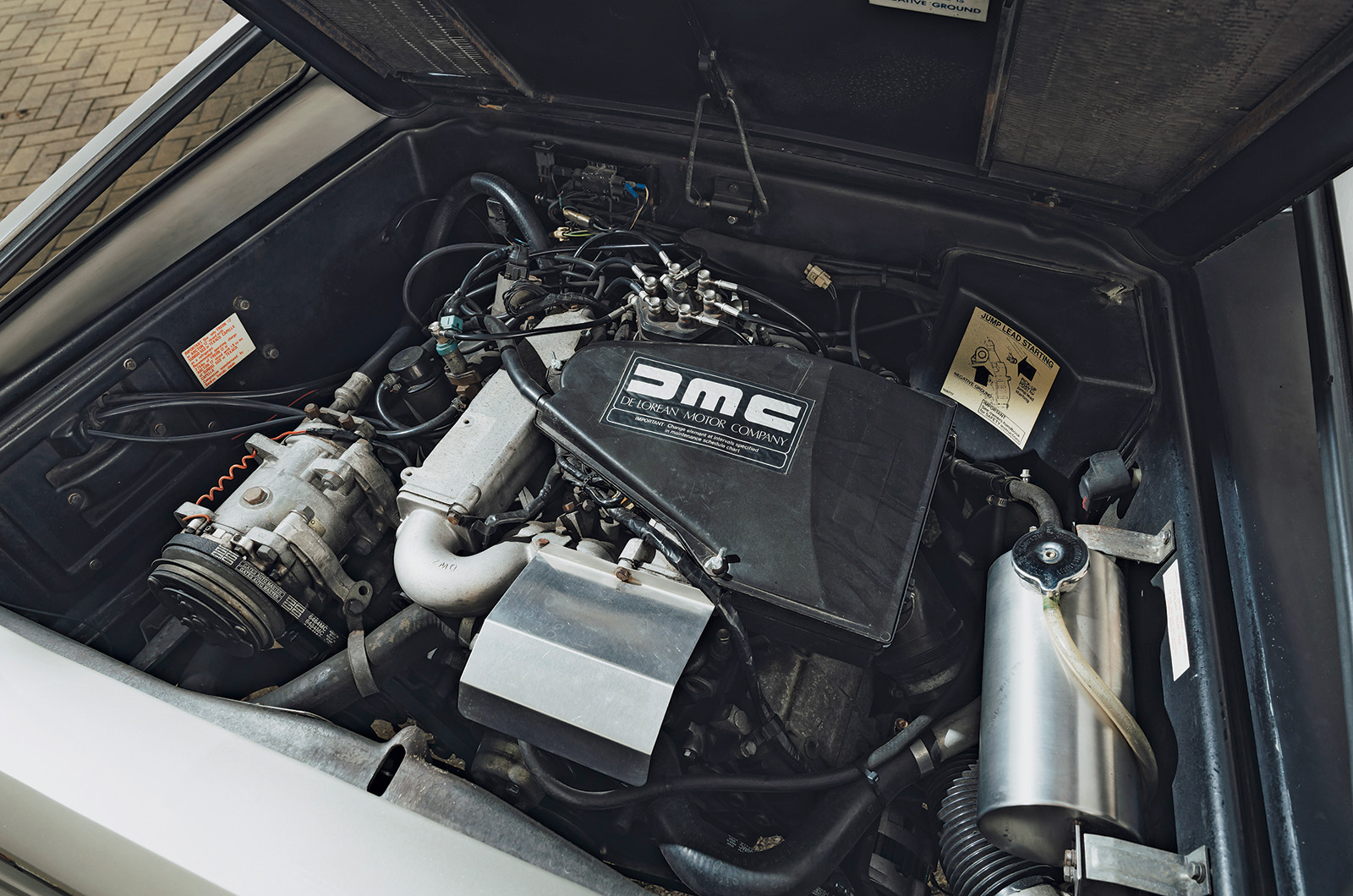
The De Lorean DMC-12’s PRV V6 struggles with the car’s heft
Six DMC-12s were used across the three films, plus a glassfibre replica for scenes where the car flies.
The most interesting variants, however, were two fitted with modified beach-buggy chassis and highly tuned Volkswagen motors for Back to The Future Part III’s desert driving.
That the production team felt the need to swap the De Lorean’s 2.9-litre V6 for a hotted-up VW motor speaks to the car’s great weakness.
Put charitably, the Peugeot-Renault-Volvo V6’s 130bhp didn’t match the abilities of the part-Lotus-developed chassis, or the exotic looks of the body.
Unsurprisingly, then, there’s a long tradition of engine swaps, from ever-popular LS V8s to Oxfordshire-based Electrogenic’s recent battery-electric conversion.
For all that talk of a sheep in wolf’s clothing, Warren Morgan’s 1981 DMC-12 is far more entertaining than reputation would have you believe.
The addition of later Volvo-spec fuelling and ignition components has added what Warren estimates to be another 15bhp, which no doubt helps, but these PRV V6s have always felt faster than on-paper numbers suggest.
Designed for long-legged saloons, they provide strong torque and real smoothness, giving the DMC-12 good tractability off the line.
It rides well, too, and the Lotus-tuned steering is a particular surprise – far from the boat-like racks of many contemporary American cars.
The De Lorean DMC-12’s Lotus Esprit-derived chassis means tidy handling
It feels more ordinary at higher speeds, and hitting 88mph is not the work of a moment – as it probably should be for a car that cost more than a Corvette (even at its most strangled, a C3 could muster 190bhp).
Comparable 0-60mph times show the car wasn’t as far off the pace as was often made out, however.
The low roofline forces a reclined driving position, and while it’s near-impossible to stop a De Lorean cabin from rattling, it’s a competent coupé that straddles the line between GT and sports car, just as US buyers would have probably preferred it.
But it is the DMC-12’s looks that made such an impact on both cinema and the world.
Never will you be let out of so many junctions, with fellow drivers keen to see those distinctive tail-lights and imagine lines of flame coming from its fat rear tyres.
The De Lorean is arguably the most famous car of the ’80s, and gives a visual motif for the decade in The Simpsons, American Dad!, Grand Theft Auto V, Ashes to Ashes and countless music videos.
No other car is quite so woven into the fabric of movie history, such that no film could ever star a De Lorean without referencing the exploits of Marty McFly.
‘Zemeckis reckoned that the Giugiaro-styled coupé looked dated already – a deliberate bit of irony for a time-traveller’
Also starring…
The De Lorean DMC-12’s perceived lack of pace isn’t helped by the fact that the movie begins with it struggling to escape a VW T2 – and that’s the only true car chase in the film.
Biff Tannen’s 1946 Ford Super De Luxe appears in the first two films, chasing a hoverboard-wielding Marty McFly in Part II, while Griff Tannen’s ride in 2015 is a hot-rodded BMW E24 6 Series retrofitted with parts to make it a hover car.
Most other vehicles in Part II’s future scenes are dressed Ford Probes, the ’89 coupé looking achingly modern at the time, while a DS is used as a taxi – proving just how avant-garde the ’55 Citroën was.
Words: Charlie Calderwood
Thanks to RADwood
Subaru Impreza WRX
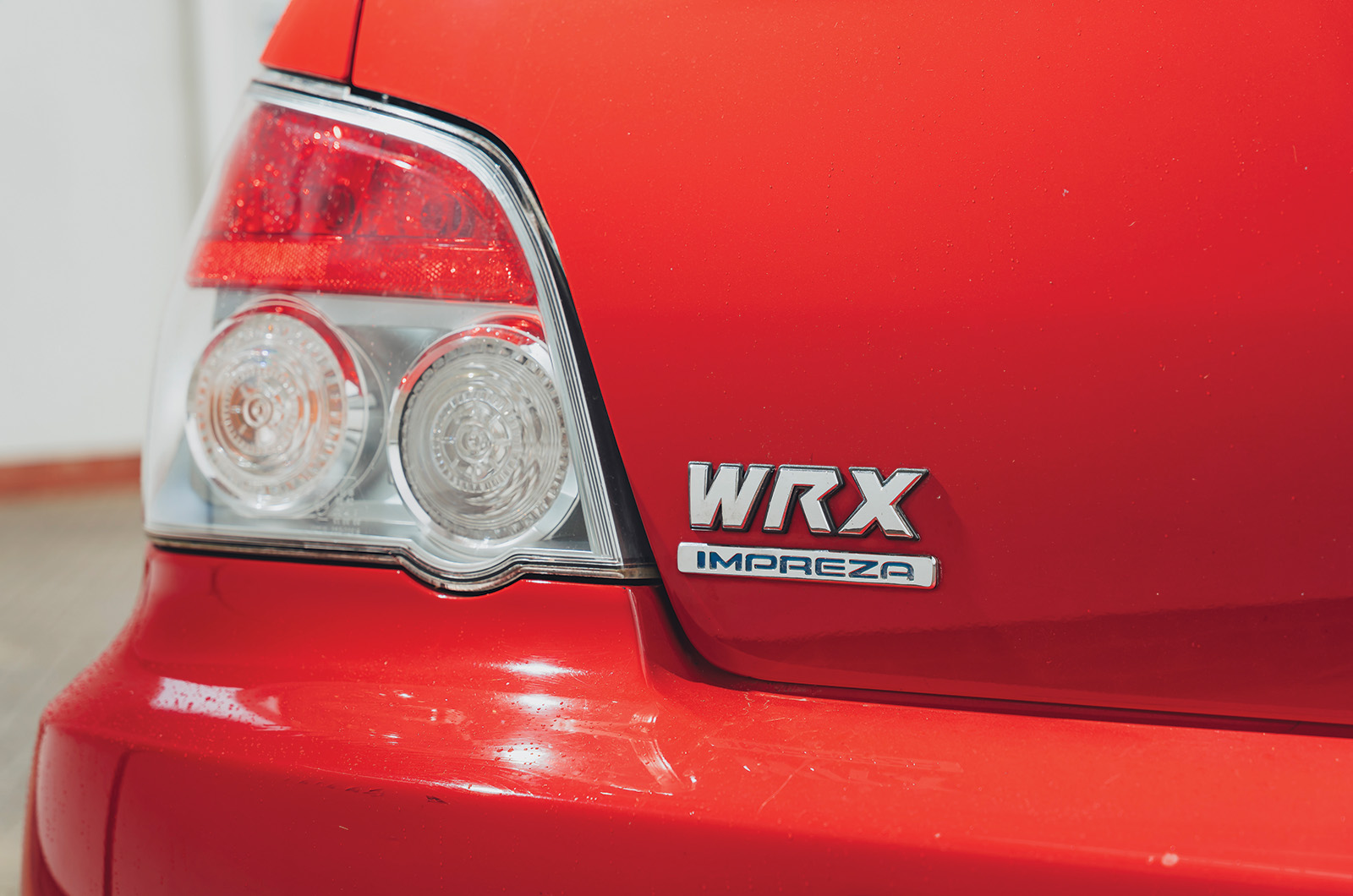
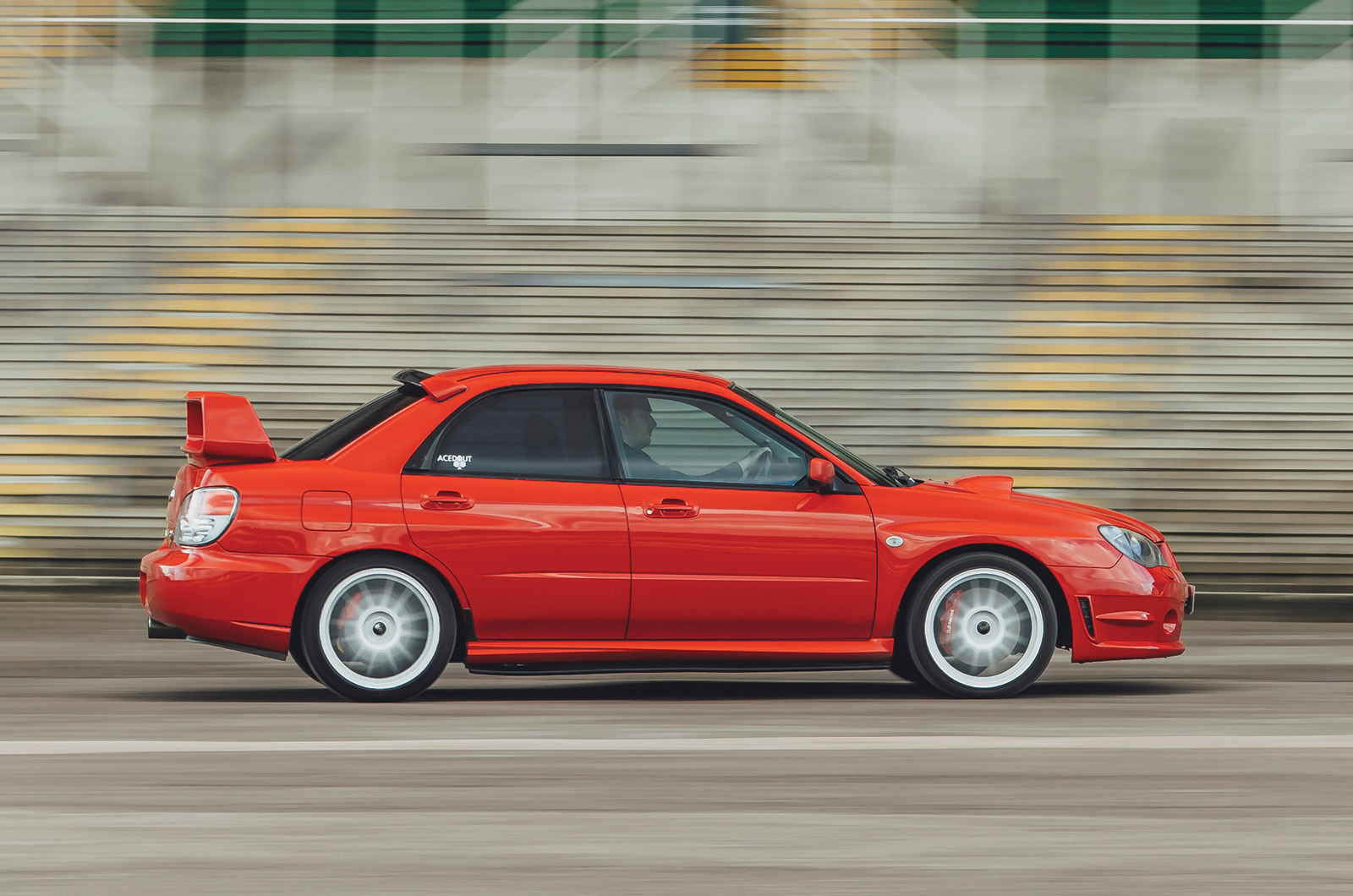
The Hot Red Subaru Impreza WRX enabled a clever escape from the pursuing cops in the opening scene of Baby Driver
It’s only on the screen for five minutes and 20 seconds of pre-credits action, yet the Subaru Impreza is crucial for setting the scene, the pace and the whole mood of Baby Driver, a super-stylish film that provides a fitting homage to the car-chase genre.
As we tune in to the infectious beat of Bellbottoms by The Jon Spencer Blues Explosion, playing on the earbuds worn by getaway driver Baby (the tinnitus-suffering protagonist played by 21-year-old Ansel Elgort), he balances the twirling wheel, pedals and handbrake to make the little saloon dance to the music with a series of J-turns, perfectly judged pirouettes and lurid, tyre-smoking drifts.
It’s a masterpiece of car choreography that continues to play out over the ensuing hour and 55 minutes, creating what critic Mark Kermode summed up as: “A mash-up between a car-chase crime thriller and a musical.”
The red Scooby sticks out like a sore thumb, tiny and bright against the muted blacks, greys and silvers of the humdrum Atlanta traffic in a sequence that blends cues from Bullitt, The Driver and more, while police Ford Crown Vics meet their maker with The Blues Brothers-style abandon.
That the film is such a passionate tribute to the great motoring movies of the past should come as no great surprise when you learn that writer/director Edgar Wright cites the likes of The French Connection as among his key influences, and ahead of the release of Baby Driver in 2017 he programmed a season of 10 classic car-chase films for the British Film Institute’s ‘Car Car Land’ festival.
The Subaru is an ideal choice as a getaway car thanks to its blend of four-wheel-drive agility and four-door practicality, a formula that took a bow in Japan with the 1992 WRX, then two years later in the UK with the 208bhp Turbo 2000.
‘The little saloon dances to the music with a series of J-turns, perfectly judged pirouettes and lurid, tyre-smoking drifts’
After a mid-life facelift it was revamped in 2000 for the second-generation (GD) Impreza, but its ‘Bugeye’ looks were controversial enough to prompt a restyle for the ‘Blobeye’ in 2003, the same year that its turbocharged flat-four engine was stretched to 2.5 litres for the US market.
The bigger unit reached the UK in October 2005 when it got another nose job in line with Subaru’s new family look, creating the short-lived ‘Hawkeye’ with its more aggressive headlamps and three-piece front grille that lasted just two years until the launch of the all-new Impreza hatch.
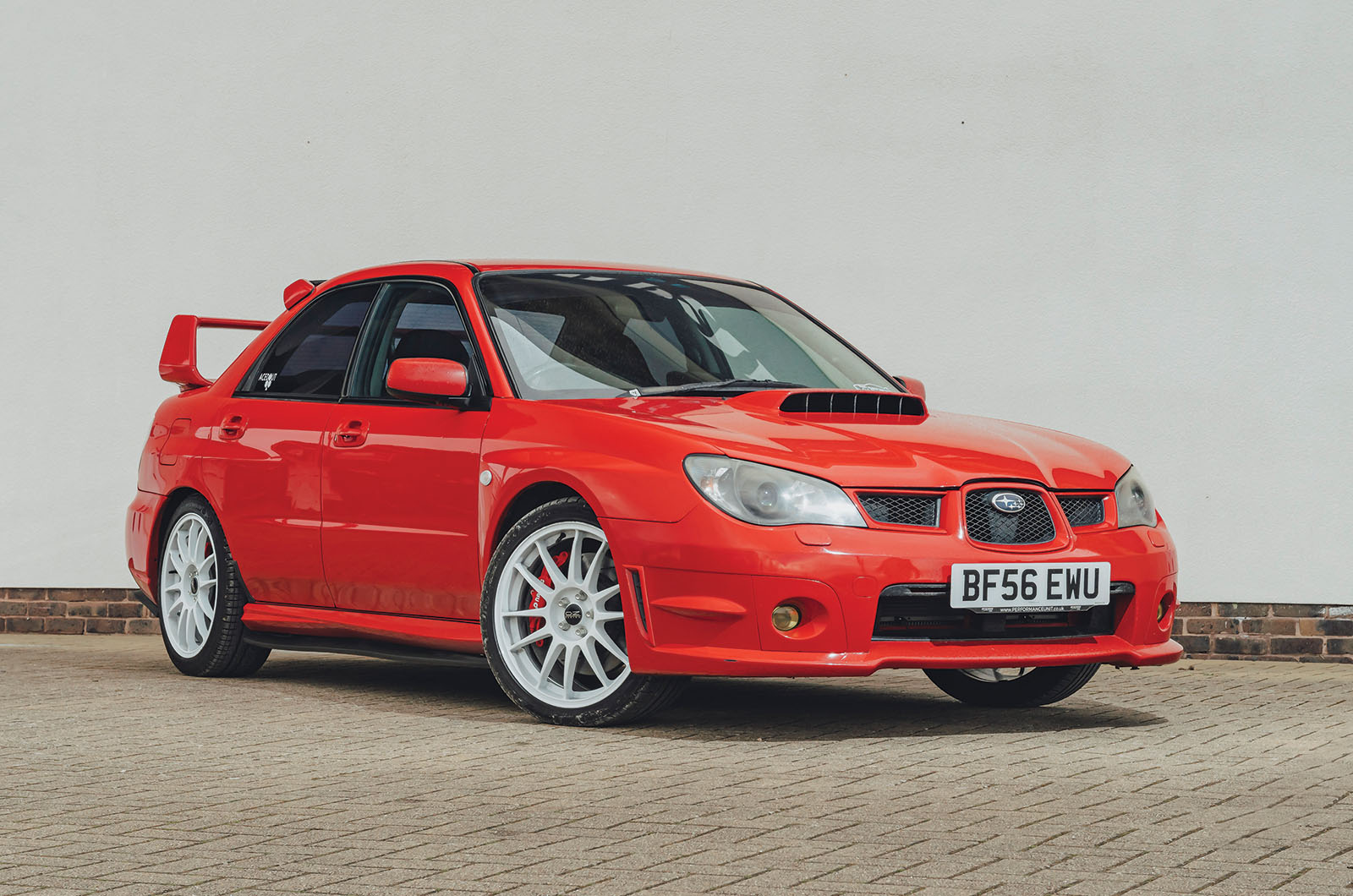
Looking at Michael Gutsell’s 2006 WRX, to my eyes the Hawkeye has aged the best of the GD’s multiple restyles.
And, STi rear wing aside, Michael’s car is very close in specification to the film star, being a WRX with a few STi extras and painted in the super-rare shade of Hot Red.
“I was looking for a Subaru and the colour drew me to it,” he explains. “I’d never seen a red Subaru before, let alone a Hawkeye, and I’ve not seen another one since.
“It was only after I picked it up that I remembered Baby Driver – and I’ve still only seen half the film!
“It’s a bit of a project, but my kids love it and it drives well.
“Eventually I plan to take it to Stage 1 spec – I’ve uprated the drop-links, brakes and intercooler, and next up is a remap and an exhaust.”
This Subaru Impreza WRX’s STi rear wing differs from the Baby Driver car
Although lacking the outright pace of the 276bhp STi, the stock WRX rides more sweetly and is still pokey enough, with a smoother thrum and torquier power delivery from the more muscular 2.5 than the warbly old 2-litre.
Michael’s UK car further diverts from Baby’s US-spec WRX in being fitted with the Prodrive Performance Pack, lifting it from 227bhp and 236lb ft to 266bhp/310lb ft, but the three cars used for filming were hardly standard, either.
“One was converted to rear-wheel drive, one was modified for more power, with limited-slip diffs in the front and rear, and one was a stock car, but converted to an STi-spec drivetrain,” lead stunt driver Jeremy Fry tells C&SC’s Simon Hucknall, “plus we disabled the cars’ ABS and traction control.
“There were also two highly modified vehicles used to give the illusion that Elgort is driving – one with a stunt driver in a pod on the roof, the other mounted to a rig – though, according to Jeremy, the star himself was fairly handy: “Ansel did a good amount of driving, and he did a great job. He was quick to learn and really enjoyed it.
“We spent a lot of time driving, including several stunts such as 180s, 90s and drifts – he was proficient enough to do some of these things on film.”
But why choose a Japanese Impreza for an American film? “The choice of the Subaru was intentional,” says Jeremy.
“[Pod driver] Robert Nagle suggested it and Edgar went with it.
“I thought it was great – an all-wheel-drive car let us do some stuff that we hadn’t usually done, and it had enough of a following that it would stand out to a lot of car people.”
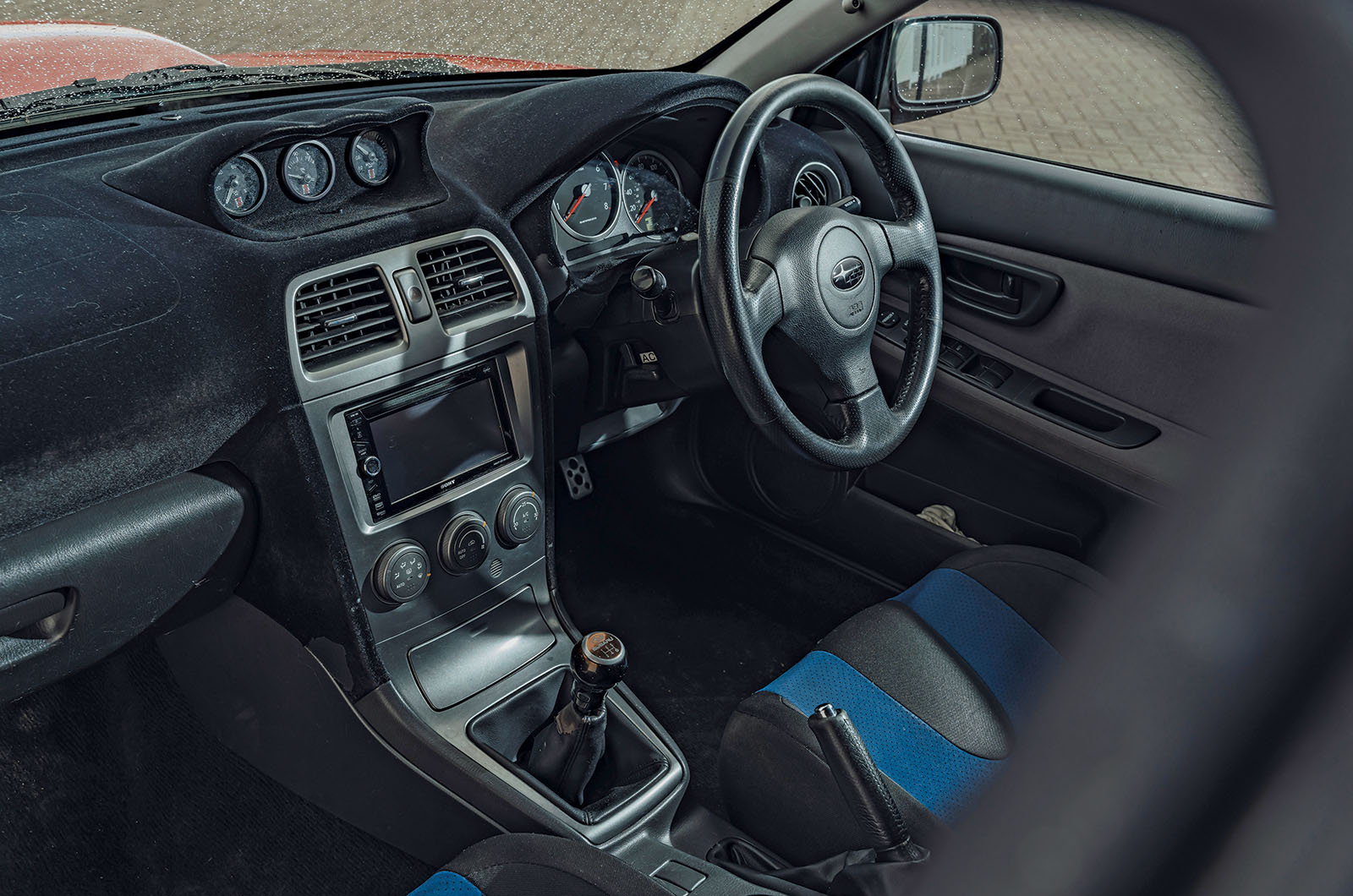
The Subaru Impreza WRX’s roomy cabin
And stand out it does, particularly in red – so much so that you wonder why there aren’t more of them: finding a car in the correct hue for our photoshoot proved almost impossible.
“I guess rallying was still big back then, and they didn’t want to be too close to Mitsubishi,” says owner Michael.
By the time the Hawkeye came along, the Impreza’s rally star was already beginning to fade, yet the same abilities that had made the Subaru such a dominant force on the Tarmac, snow and gravel – bringing it three drivers’ and three constructors’ titles in the World Rally Championship – also made it the perfect fit on film, turning the busy streets of Atlanta into Baby’s own expansive special stage.
As he leads his gang of bank robbers away from the Subaru to switch cars in a multi-storey, leaving its frameless doors open and ignition warning bonging, it feels as if the car has unfinished business.
We can only hope it returns when the long-awaited Baby Driver 2 finally graces our screens.
After all, every good car movie deserves a sequel.
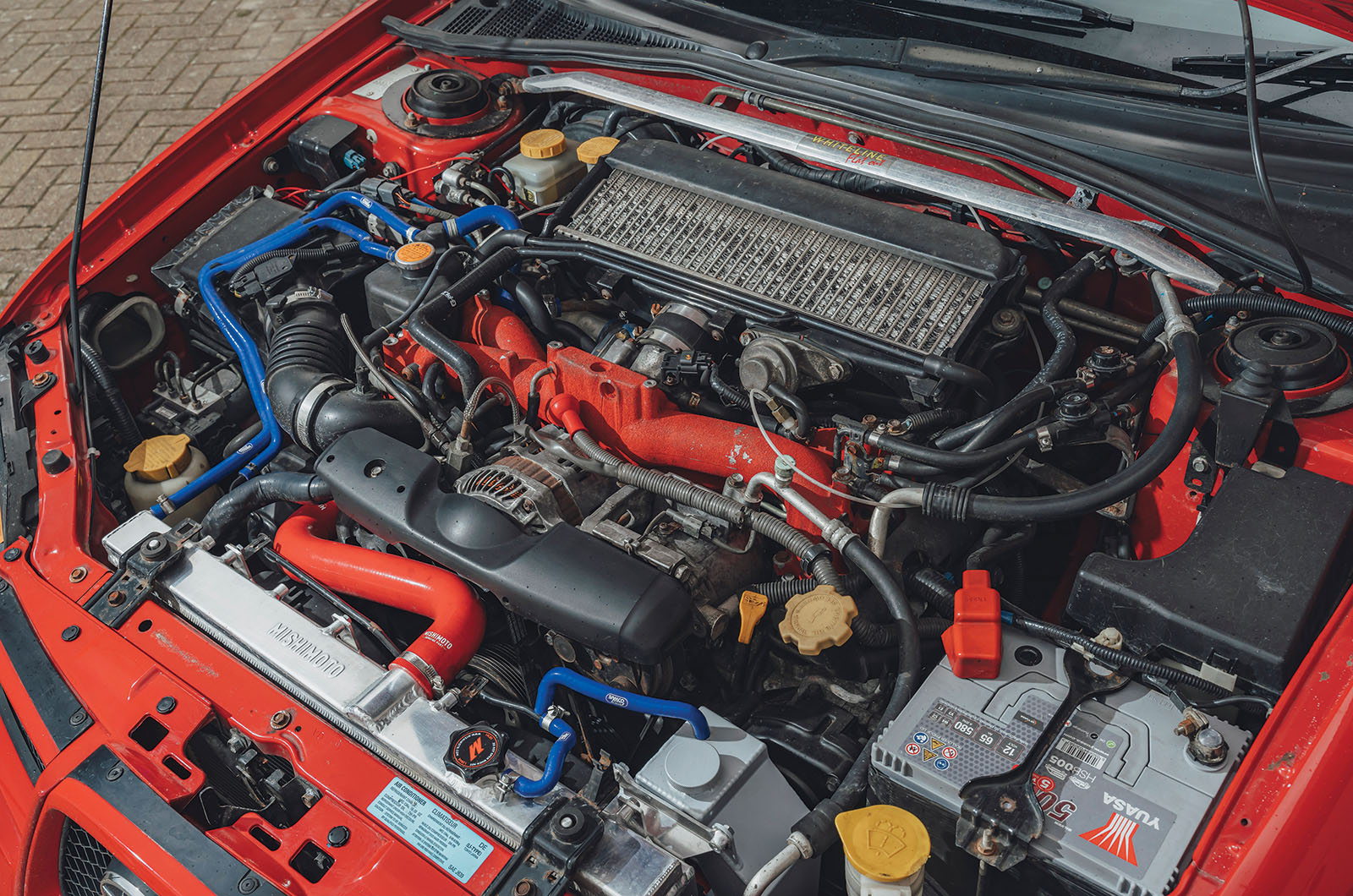
The Subaru Impreza WRX’s modified flat-four
Also starring…
A lot of the cars Baby uses are dull street furniture – “Something that blends in well with morning traffic” – such as a Chevrolet Avalanche pick-up and vanilla sedans.
But his own ride is a huge Lincoln Continental MkV, his fantasies of the future picture love interest Debbie in a ’59 Chevy Impala, and he jacks a few interesting cars in his escape, such as a Dodge Challenger SRT Hellcat and Chevy Caprice Classic.
For the denouement – “All I want to do is head west on 20 with a car I can’t afford and a plan I don’t have. Just me, my music and the road” – the couple flee in a battered Chevrolet Blazer.
Words: Alastair Clements
Thanks to Performance Unit
Factfiles
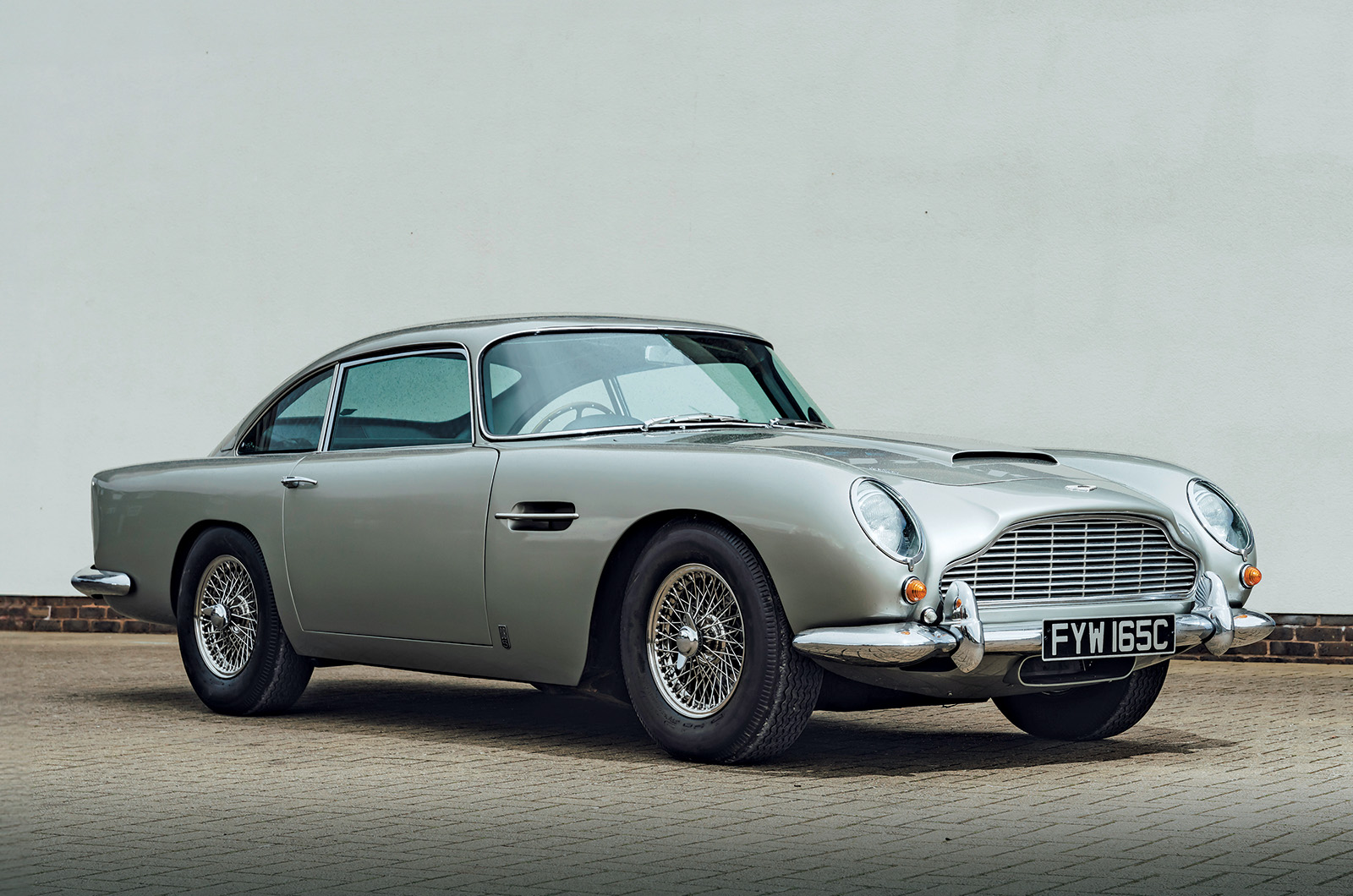
Aston Martin DB5
- Sold/no built 1963-’65/1059
- Engine all-alloy, dohc 3995cc straight-six, triple SU carburettors; 282bhp @ 5500rpm; 280lb ft @ 4500rpm
- Transmission five-speed manual, RWD
- Weight 3236lb (1468kg)
- 0-60mph 8.1 secs
- Top speed 142mph
- Mpg 17
- Price new £4084
- Price now £500-800,000*
Ford Mustang 390 GT
- Sold/no built 1967-’69/18,838 (’68)
- Engine all-iron, ohv 6384cc (390cu in) V8, single Holley carburettor; 320bhp @ 4800rpm; 428lb ft @ 3200rpm
- Transmission four-speed manual, RWD
- Weight 3340lb (1515kg)
- 0-60mph 6.2 secs
- Top speed 130mph
- Mpg 12
- Price new $3700
- Price now £60-90,000*
Volkswagen Beetle 1200
- Sold/no built 1938-2003/21,529,464 (all)
- Engine all-alloy, ohv 1192cc flat-four, single Solex carburettor; 30bhp @ 3400rpm; 55lb ft @ 2000rpm
- Transmission four-speed manual, RWD
- Weight 1609lb (730kg)
- 0-50mph 21 secs
- Top speed 67mph
- Mpg 38
- Price new £665 (1964)
- Price now £10-25,000*
Austin Mini Cooper ‘S’
- Sold/no built 1964-’67/14,313
- Engine all-iron, ohv 1275cc ‘four’, twin SU carburettors; 76bhp @ 5900rpm; 79lb ft @ 3000rpm
- Transmission four-speed manual, FWD
- Weight 1435lb (651kg)
- 0-60mph 11.2 secs
- Top speed 96mph
- Mpg 32
- Price new £755 (1964)
- Price now £15-50,000*
Pontiac Firebird Trans Am
- Sold/no built 1977/68,744
- Engine all-iron, ohv 6609cc V8, single four-barrel Rochester carburettor; 200bhp @ 3600rpm; 325lb ft @ 2400rpm
- Transmission three-speed auto, RWD
- Weight 3812lb (1733kg)
- 0-60mph 7 secs
- Top speed 130mph
- Mpg 15
- Price new £7917 (1978)
- Price now £30-50,000*
De Lorean DMC-12
- Sold/no built 1981-’83/c8000
- Engine all-alloy, sohc-per-bank 2849cc V6, Bosch K-Jetronic fuel injection; 130bhp @ 5500rpm; 162lb ft @ 2750rpm
- Transmission five-speed manual, RWD
- Weight 2840lb (1288kg)
- 0-60mph 8.8 secs
- Top speed 109mph
- Mpg 25
- Price new $26,175 (1981)
- Price now £25-75,000*
Subaru Impreza WRX
- Sold/no built 2005-’07/13,733 (UK)
- Engine all-alloy, dohc-per-bank 2457cc flat-four, multi-point fuel injection, turbocharger and intercooler; 227bhp @ 5600rpm; 236lb ft @ 3600rpm
- Transmission five-speed manual, 4WD
- Weight 3109lb (1410kg)
- 0-60mph 5.4 secs
- Top speed 143mph
- Mpg 20.3
- Price new £20,945 (’06)
- Price now £8-15,000*
*Prices correct at date of original publication
Enjoy more of the world’s best classic car content every month when you subscribe to C&SC – get our latest deals here
READ MORE
Sunbeam Alpine: driving the original James Bond car
Genevieve reunion: meet the Darracq and Spyker film stars
Bullitt Mustangs: Ford’s silver-screen icons