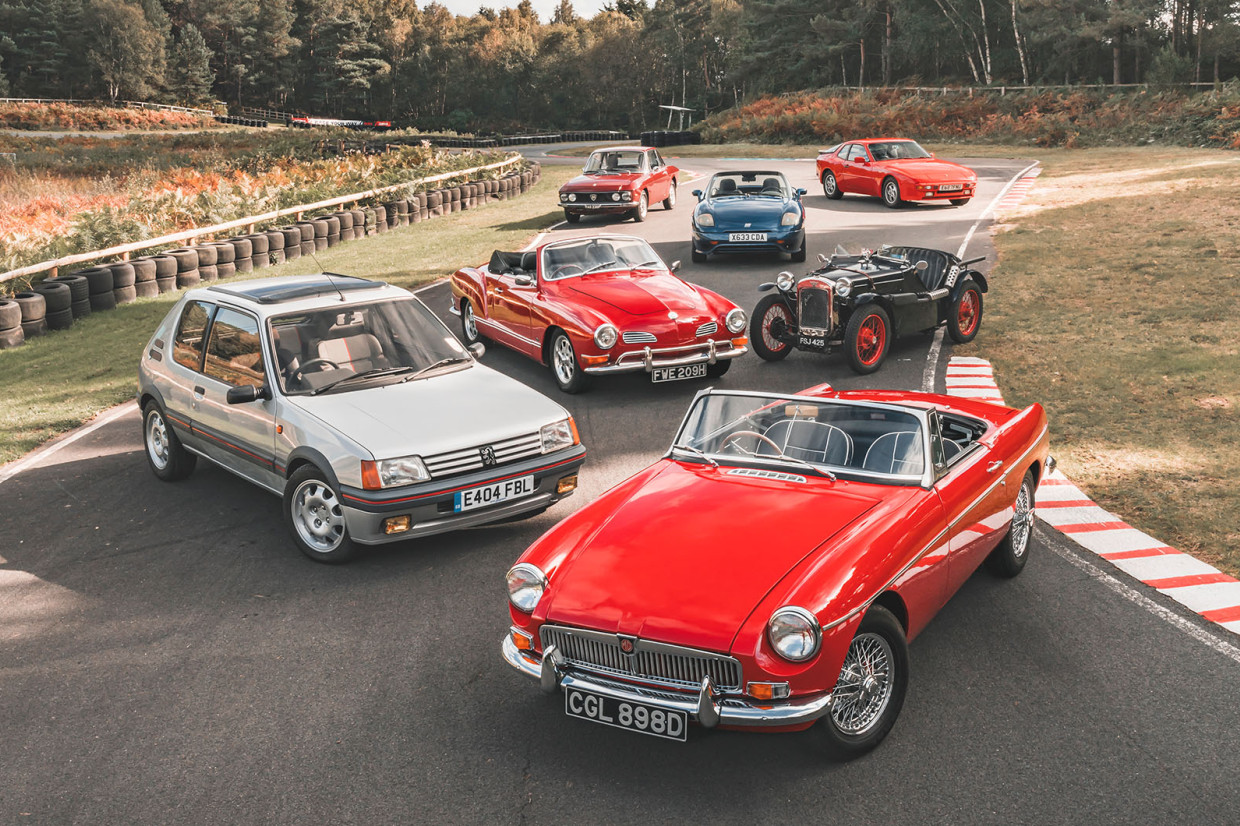
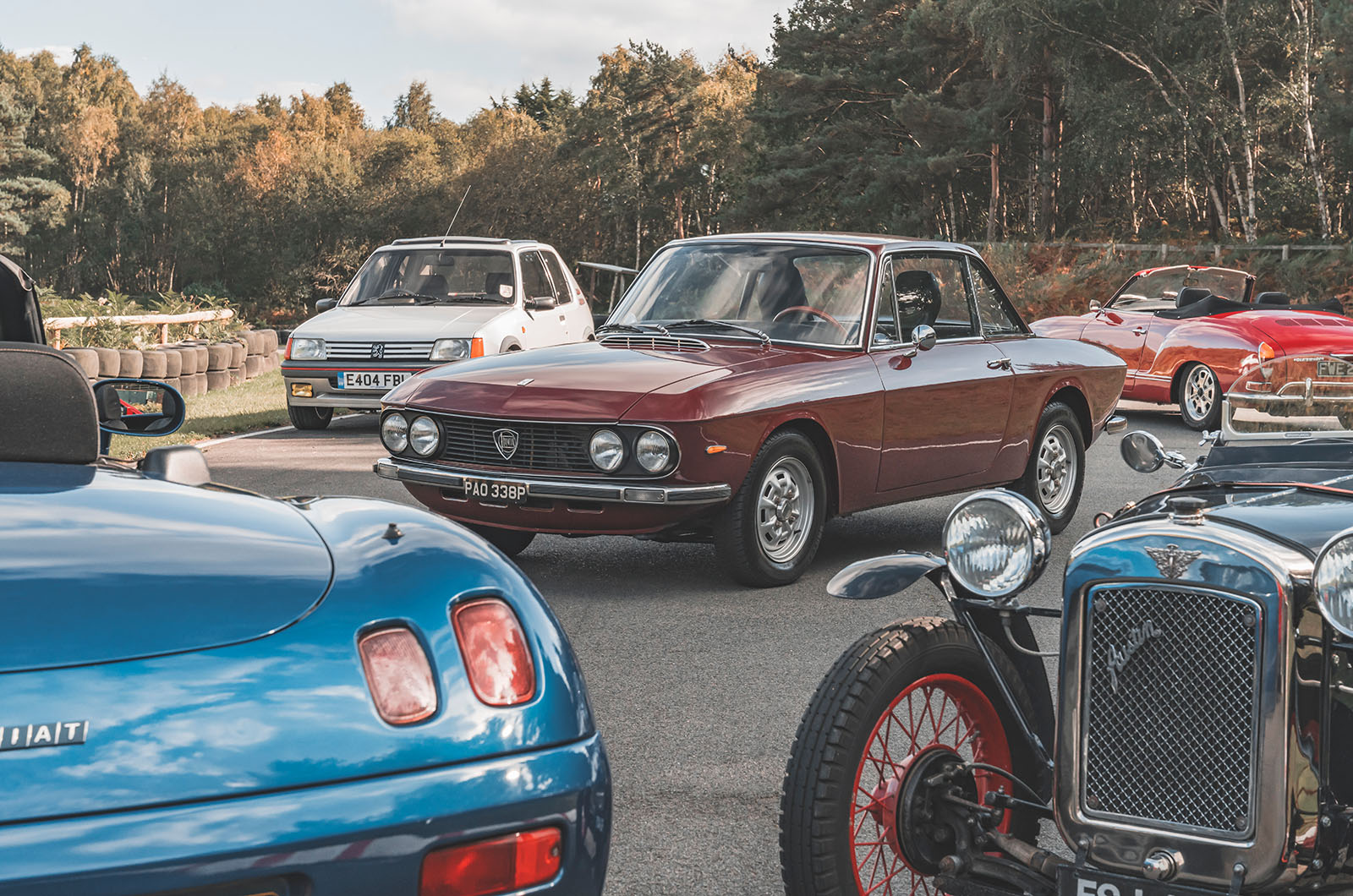
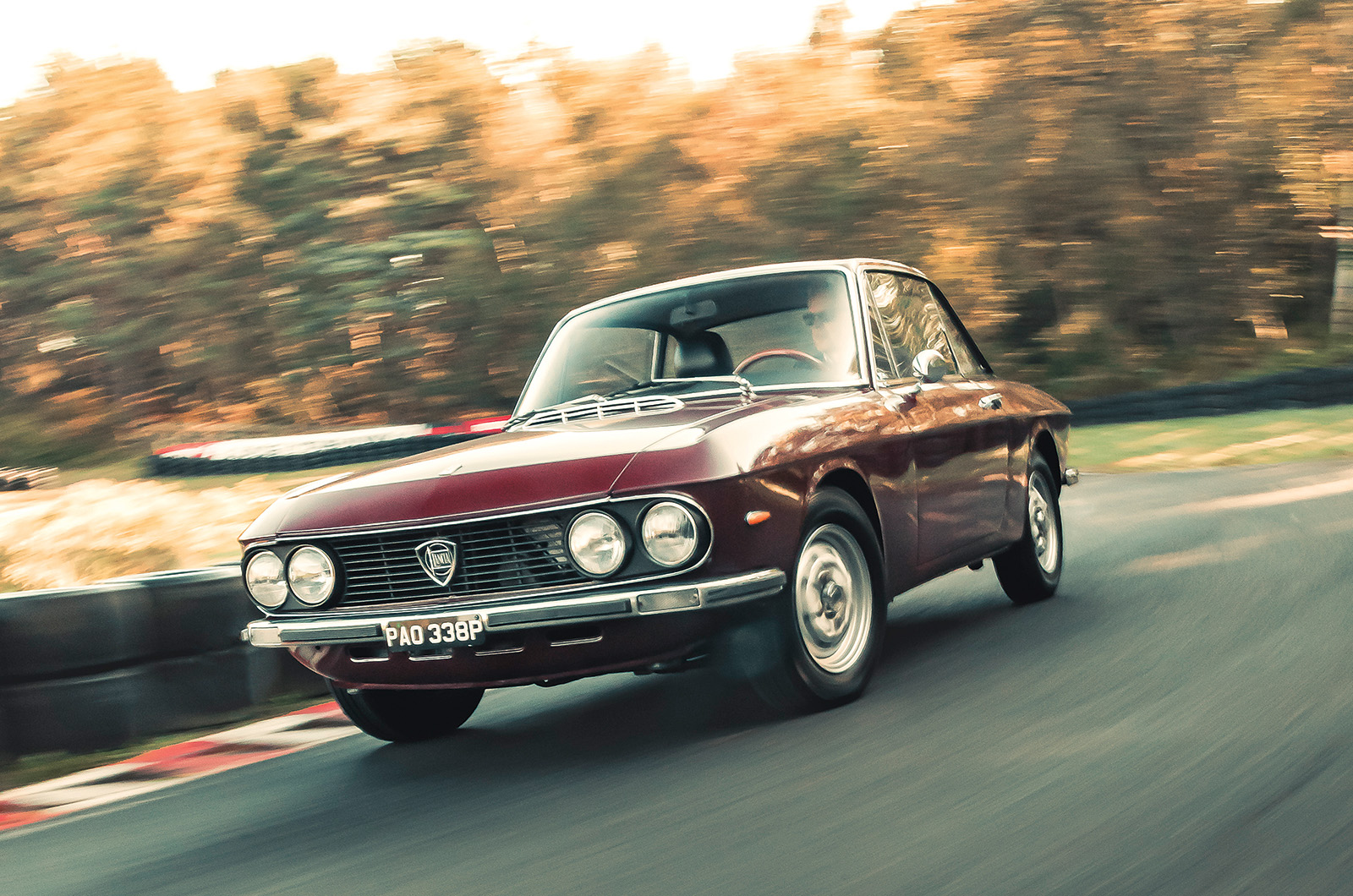
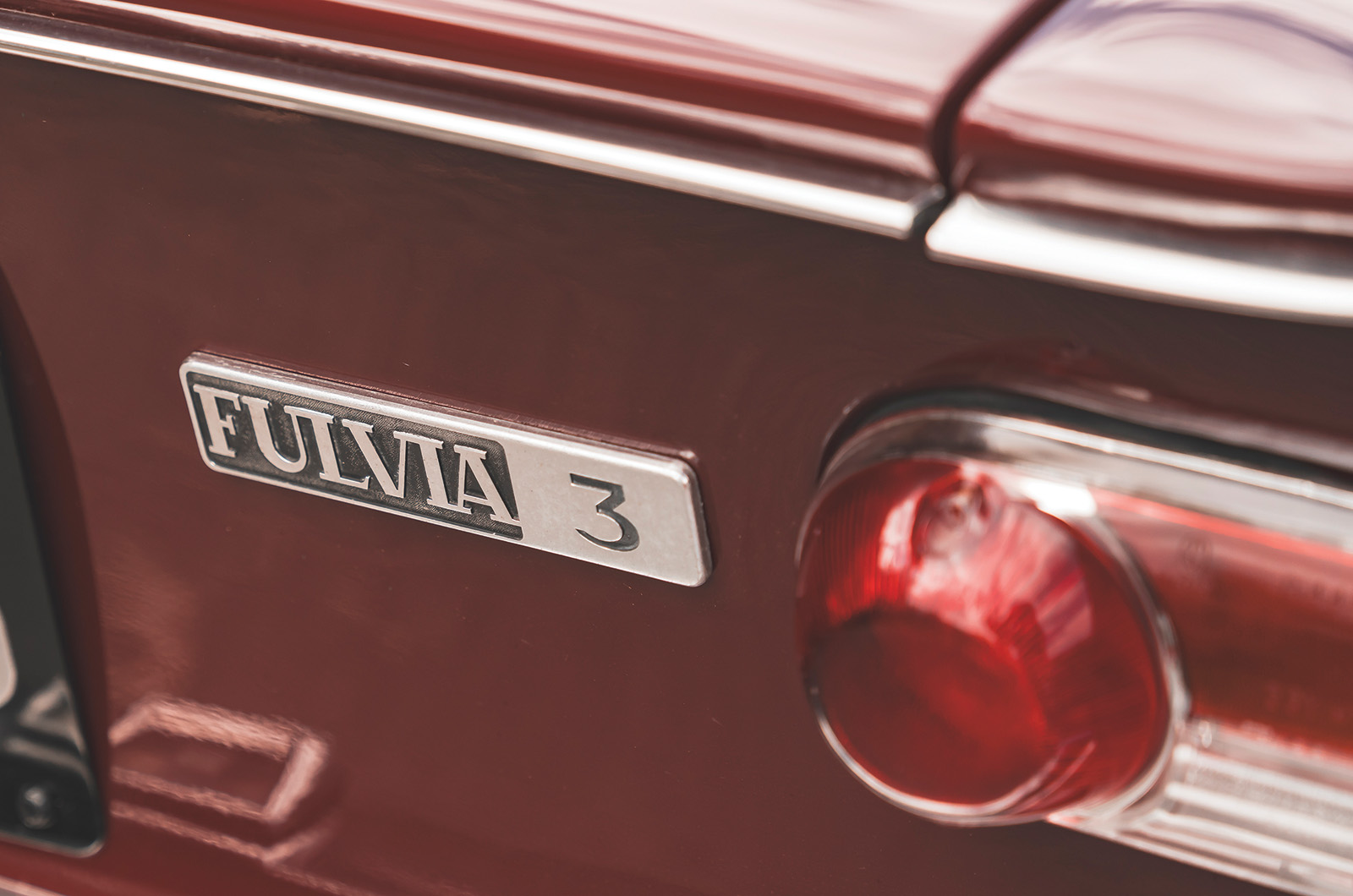
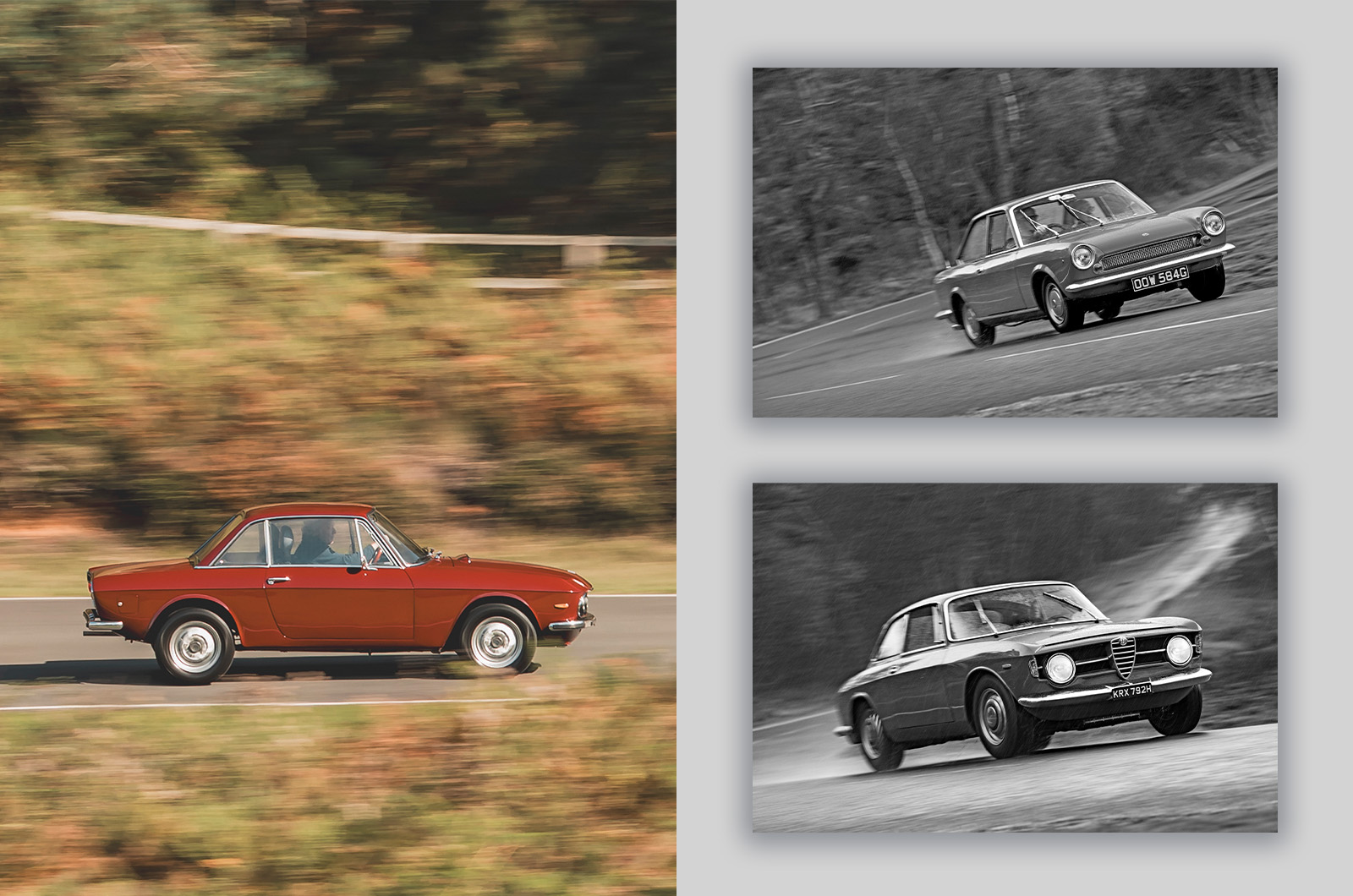
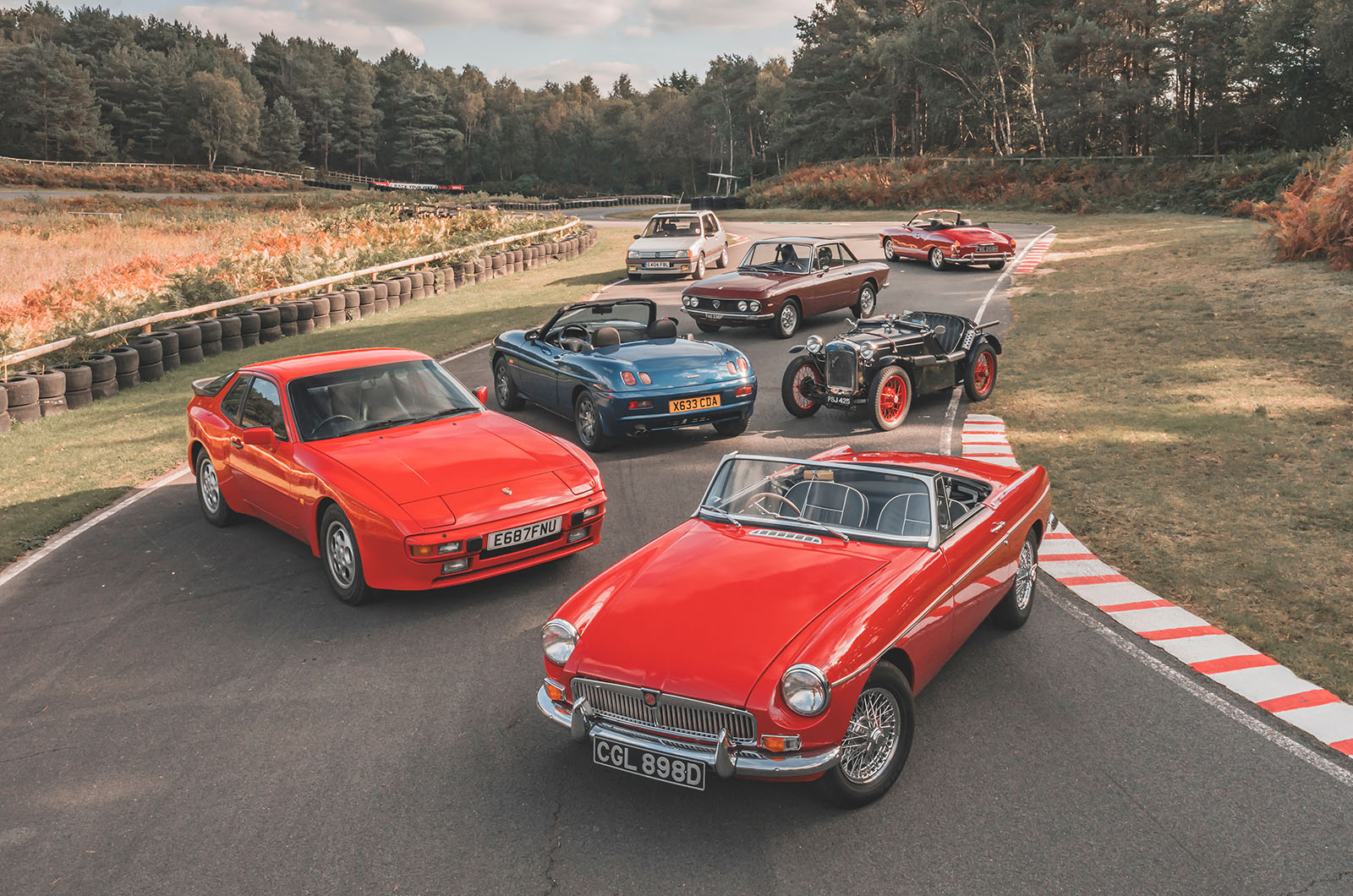
Finished in Rosso York, this beautiful, four-owner, LHD Lancia Fulvia 3 was brought to the UK by Tony Rosewell of Fulvia Classics.
Steeped in all things Lancia and with good Italian contacts, he has imported 250 Fulvias since setting up his Hertfordshire firm.
Like most ‘real’ Lancias, the Fulvia will not necessarily reveal its charms during a brief trial run, and not everyone will get on with it.
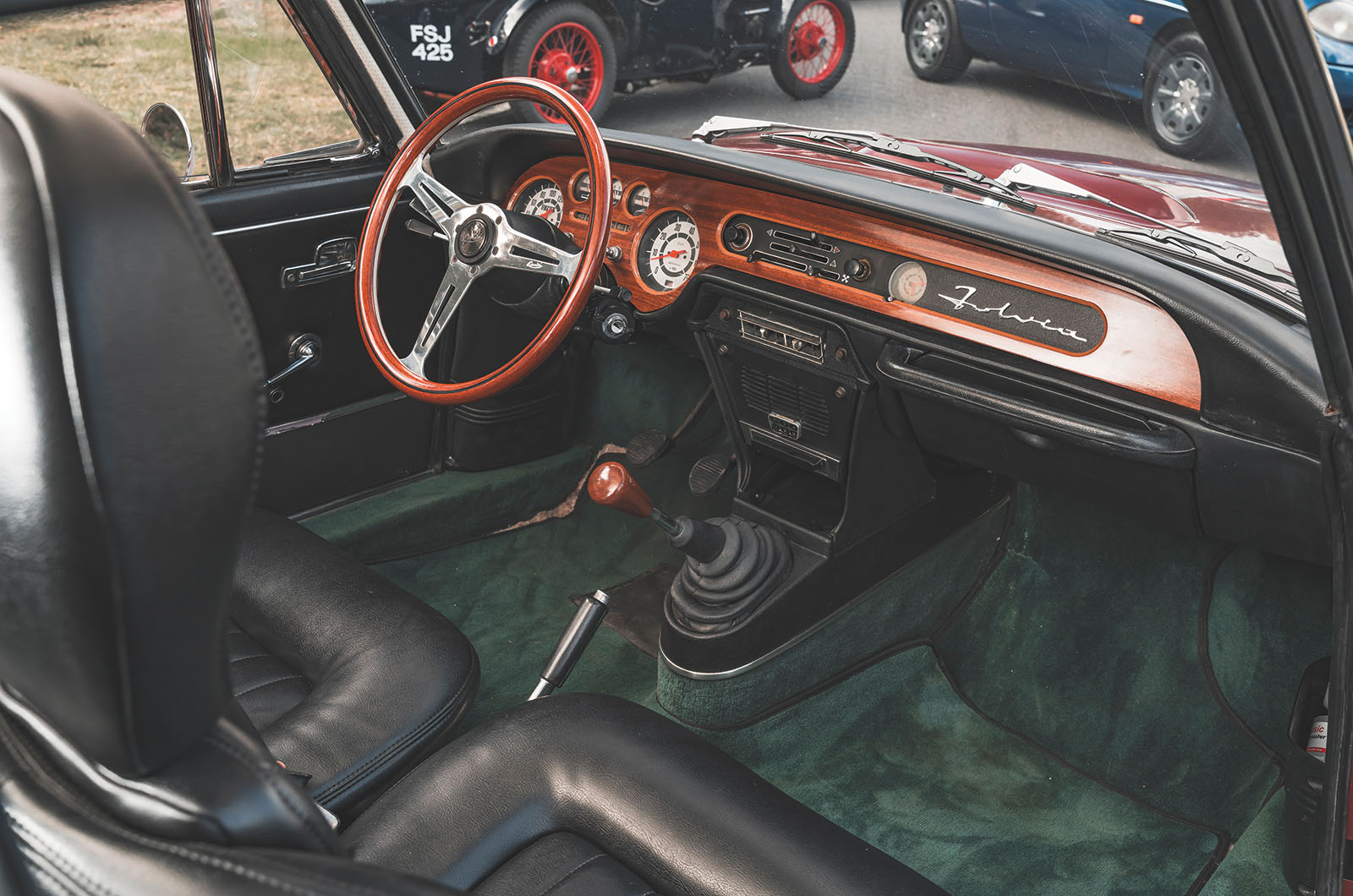
The V4 doesn’t pull well below 2000rpm, the steering feels ponderous at low speeds, and the gearchange is hard to negotiate smoothly with its dogleg first and notchy, long-throw action.
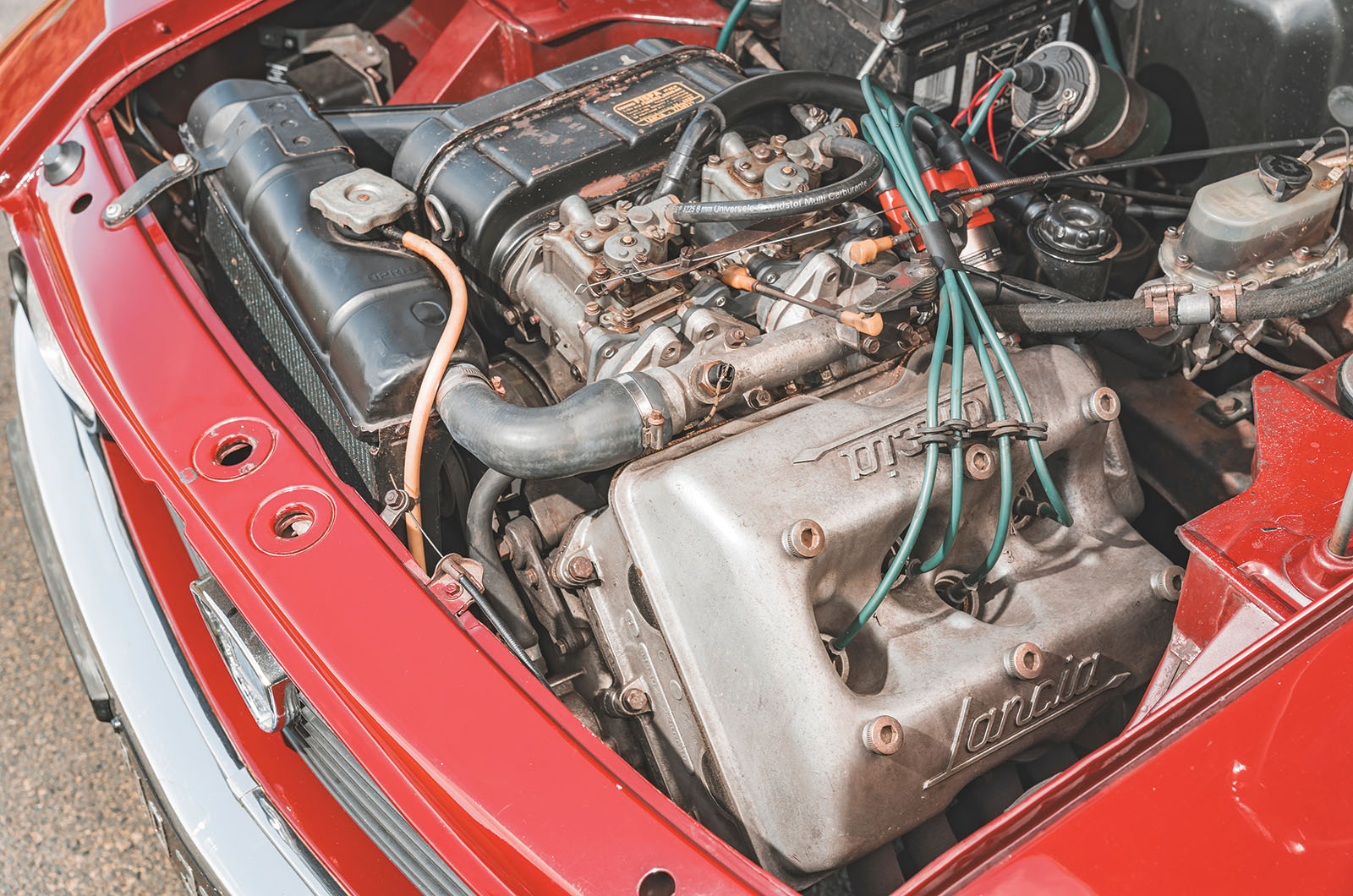
Yet the ratios, with a direct fifth plus a low first and second, prove to be well-spaced and, once you attune to the V4’s zingy character and crisp throttle response, the car begins to make sense.
With a choke for each cylinder and a relatively high compression ratio, it sings towards the 6500rpm redline with a snorting roar, and you soon learn the gears are there to be used freely.
Any impression of flabbiness in the steering is cast aside, the handling becomes neutral in all but the tightest curves, and you search in vain for ways to unsettle the little Lancia’s stability and sense of purpose.
It even rides well on its narrow tyres. It feels almost exotic: refined, yet somehow cheeky at the same time.
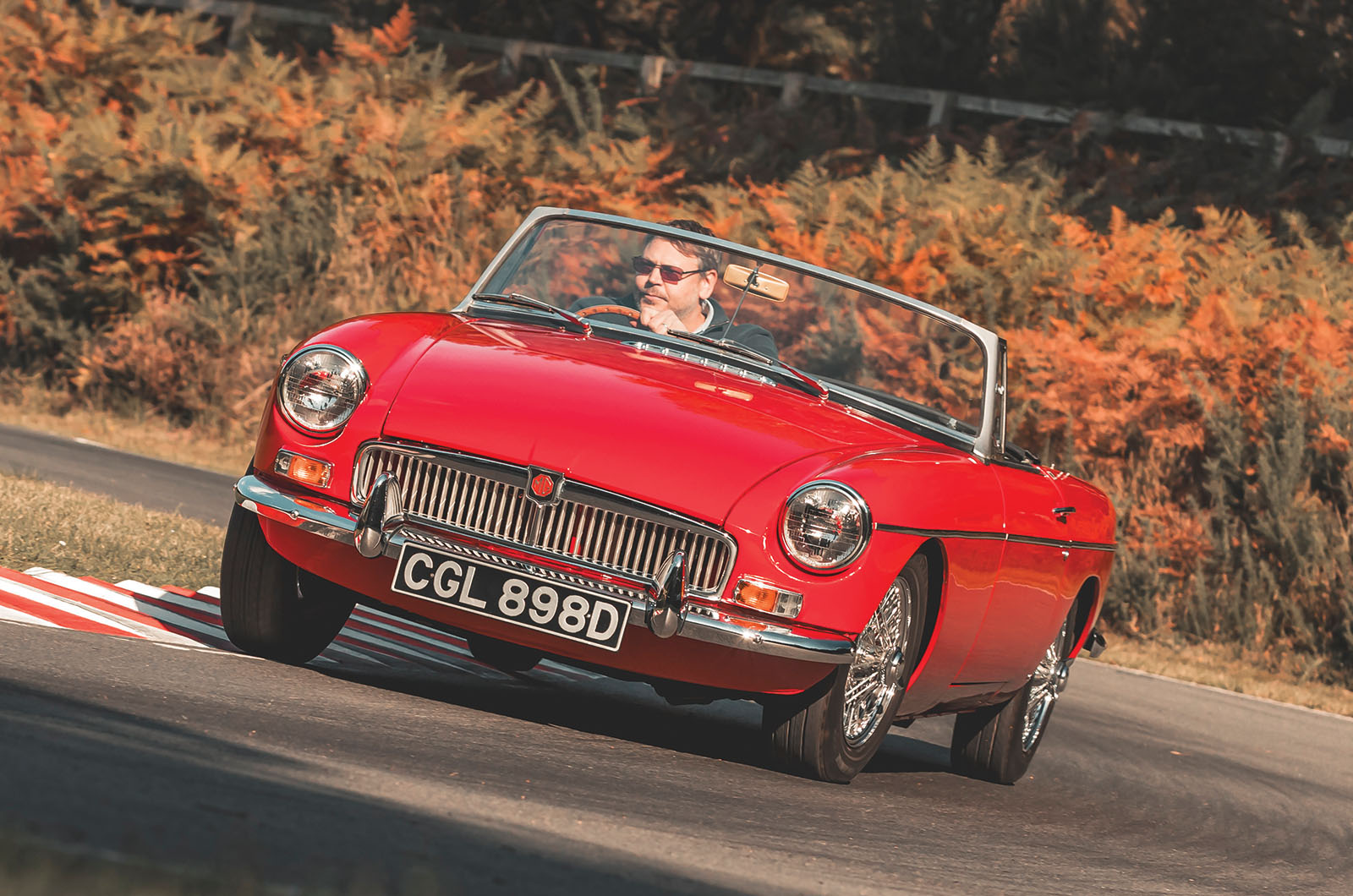
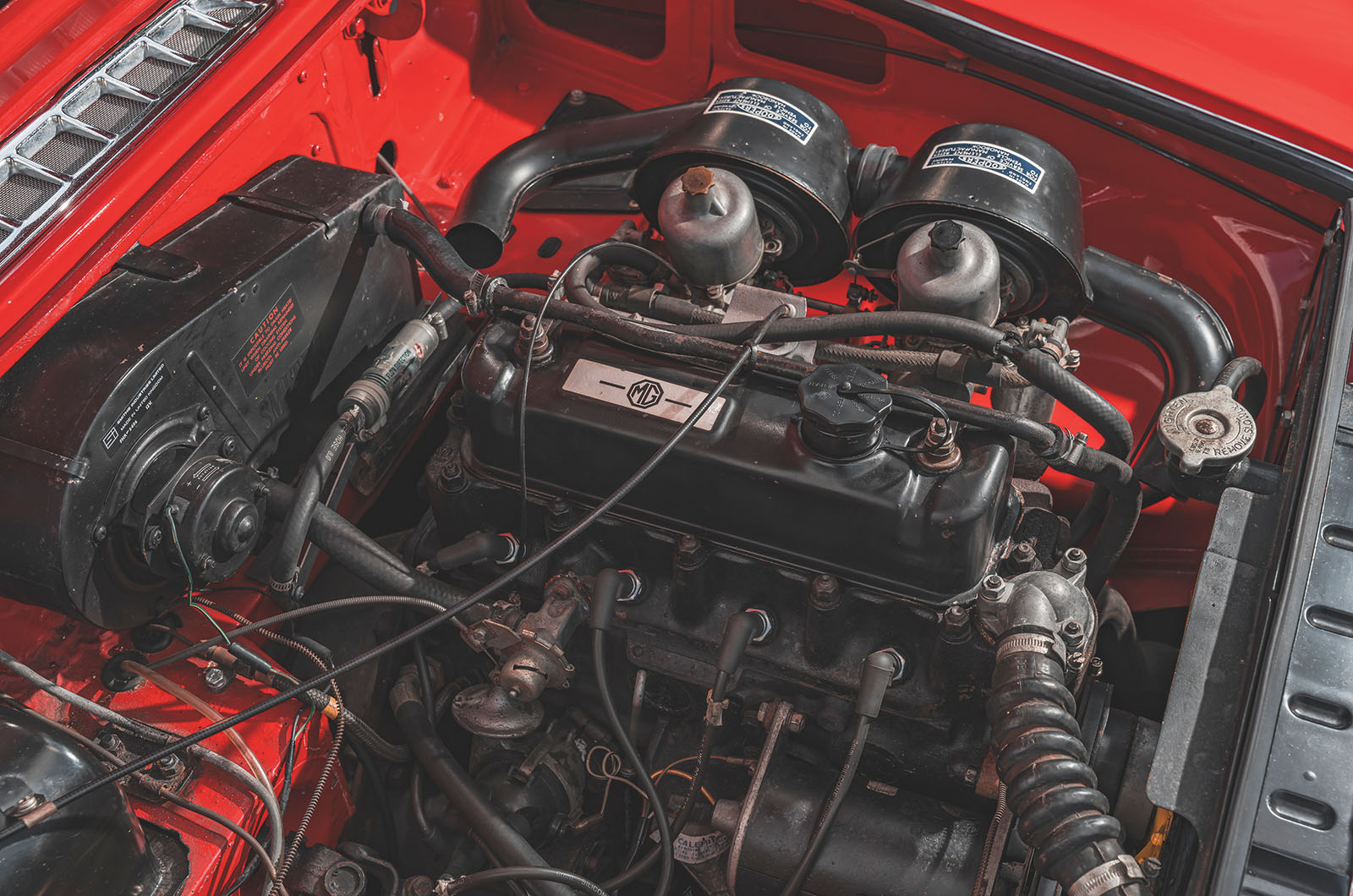
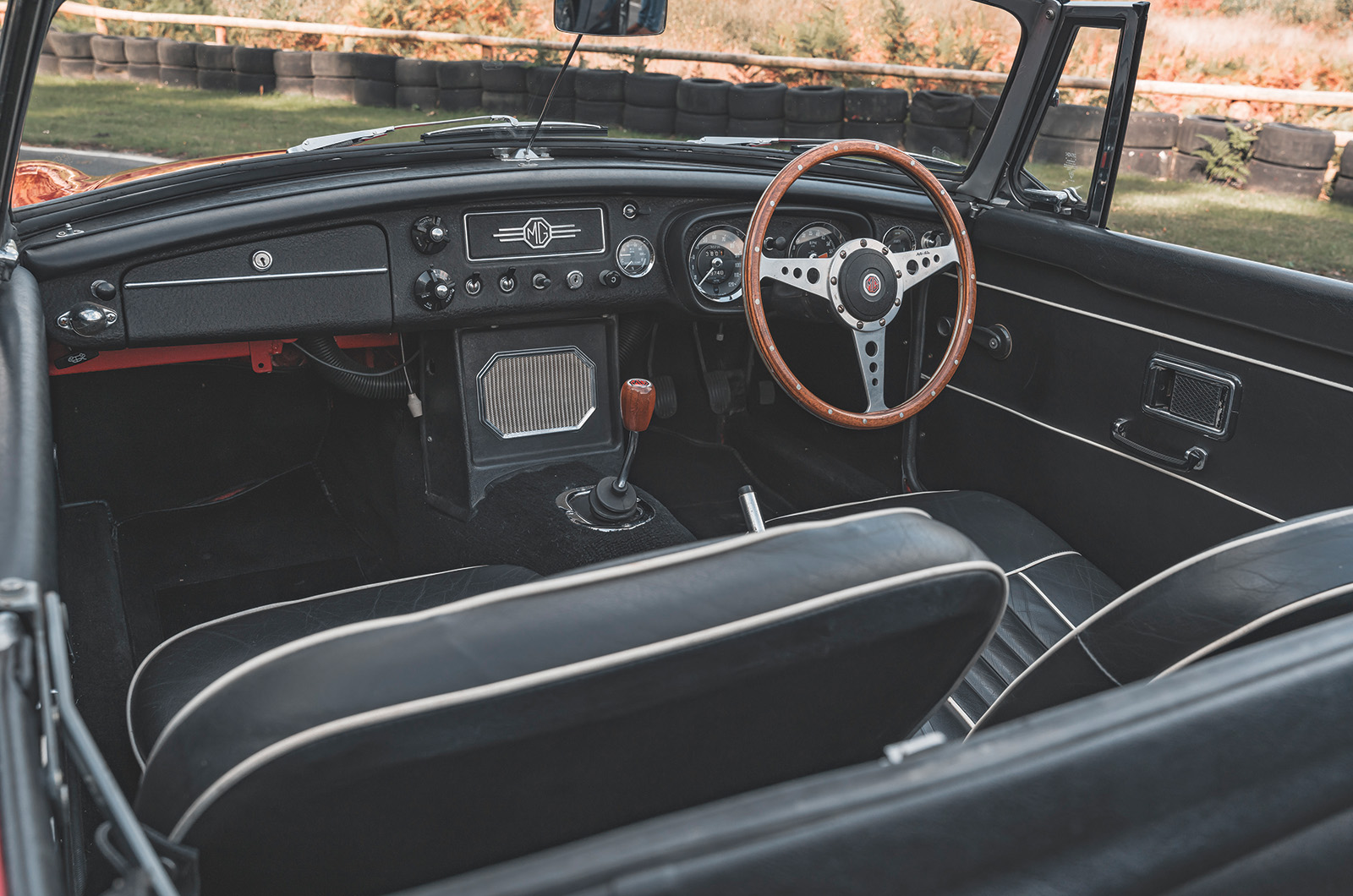
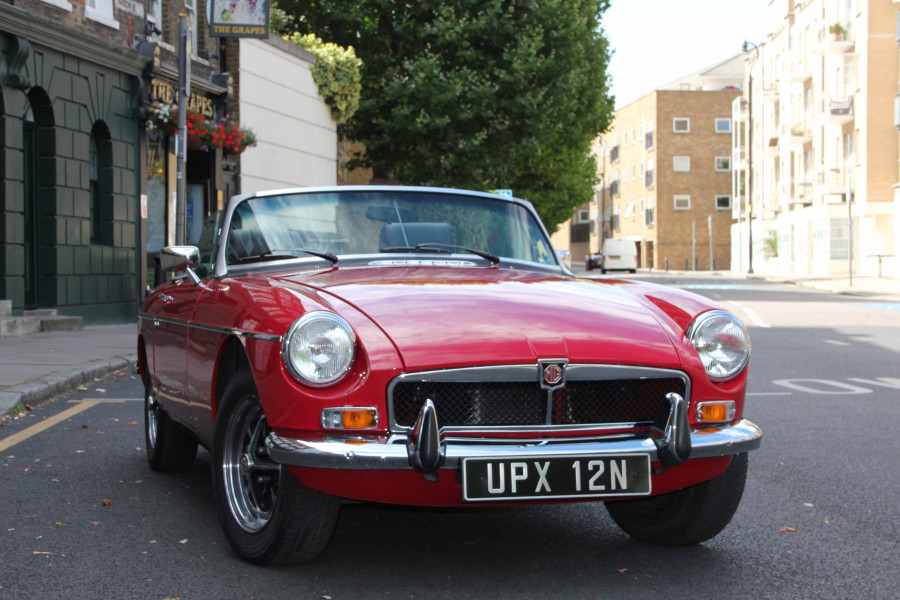
Once it has been sampled, it is hard to see how anyone would ever again be content to drive an MGB.
Words: Martin Buckley
Thanks to: Fulvia Classics
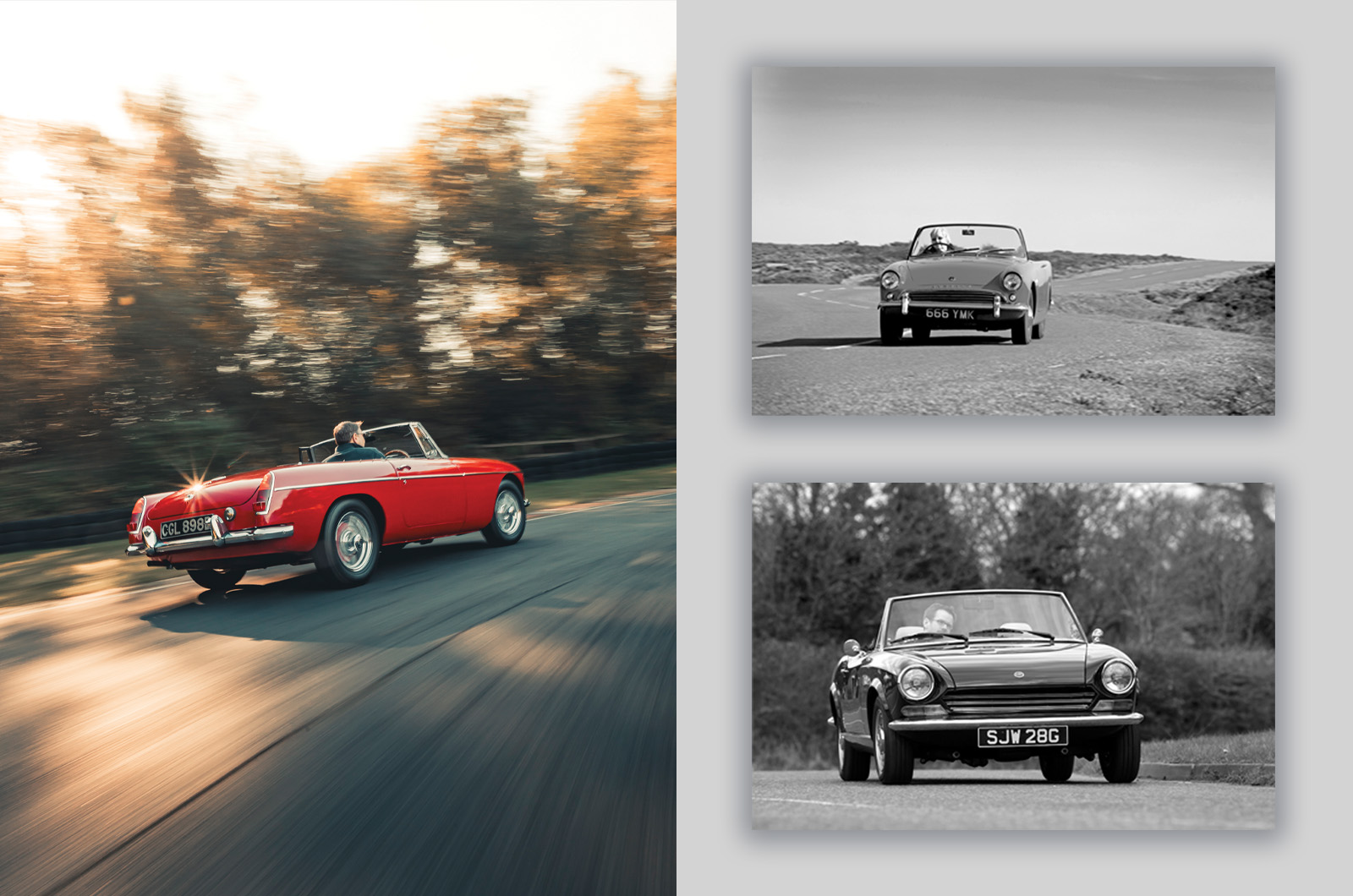
Clockwise from main: the Lancia’s profile is angular yet elegant; Fiat 124 Sport Coupé; Alfa Romeo GT Junior
Scorecard
- Value for money 2/5
- Ease of maintenance 2/5
- Parts availability 3/5
- Practicality/usability 4/5
- Driver appeal 5/5
- Cars & Coffee factor 5/5
- Total 21/30
Buying tips
- Check the engine for a noisy timing chain, low oil pressure and head-gasket leaks. A rebuild won’t be cheap on this relatively exotic motor
- Special factory tools are required for what you might think are simple DiY jobs, such as changing the wheel bearings
- Lancia Fulvias rust, but no more than anything of the period. Reproduction panels are available
Alternatives
- Fiat 124 Sport Coupé Fiat employed more conventional rear-drive running gear for the 1967-’74 124 Coupé, and its performance is very similar to the Fulvia, despite the Lancia being more expensive when new. Rarity makes the Fiat harder to find parts for today, however
- Alfa Romeo GT Junior Another stellar-handling beauty from Italy powered by a small, fizzing twin-cam, the 1965-’76 105-series GT Junior has become the market’s favourite. As a result, they are up to twice or three times the purchase cost of an equivalent Fulvia today
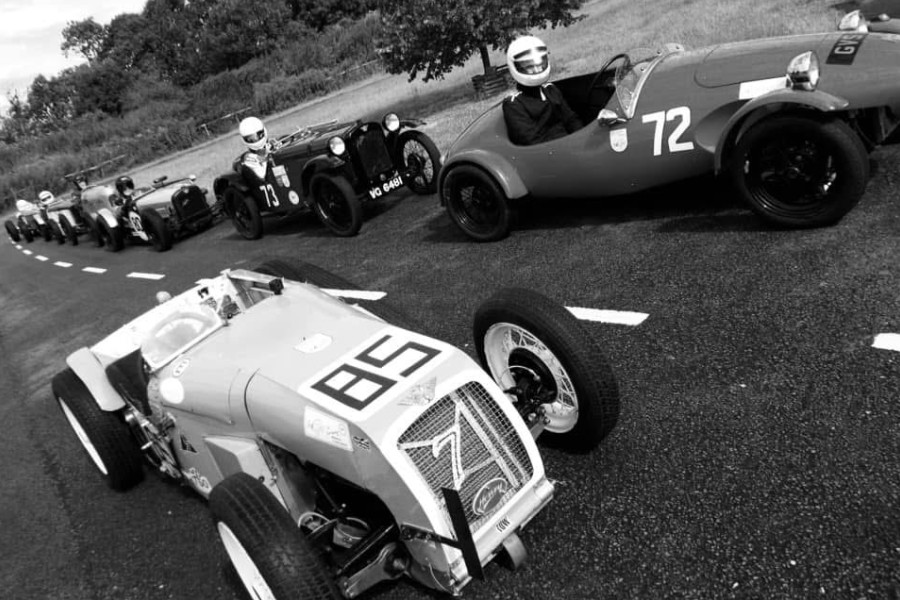
Austin Seven Special
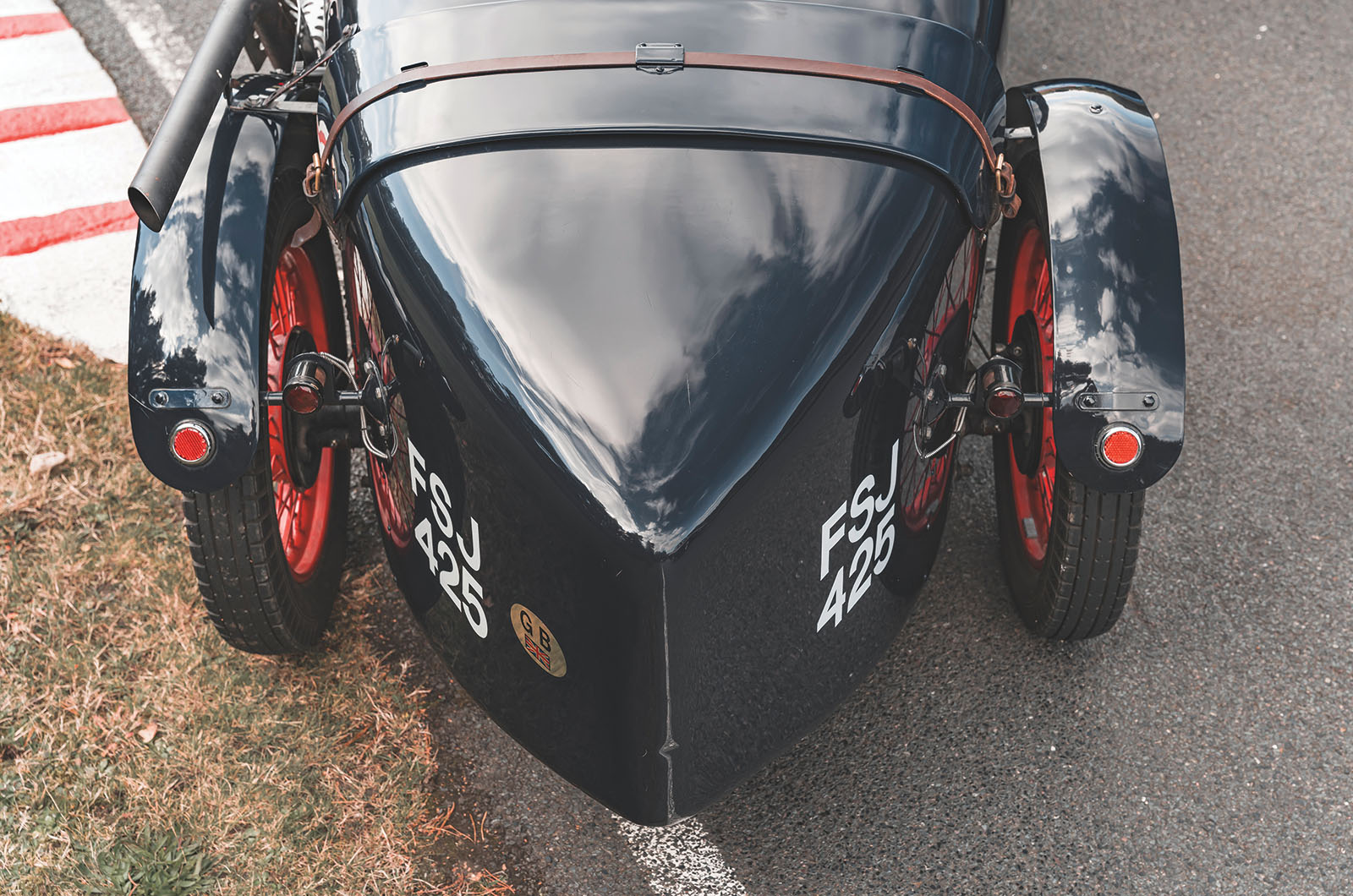
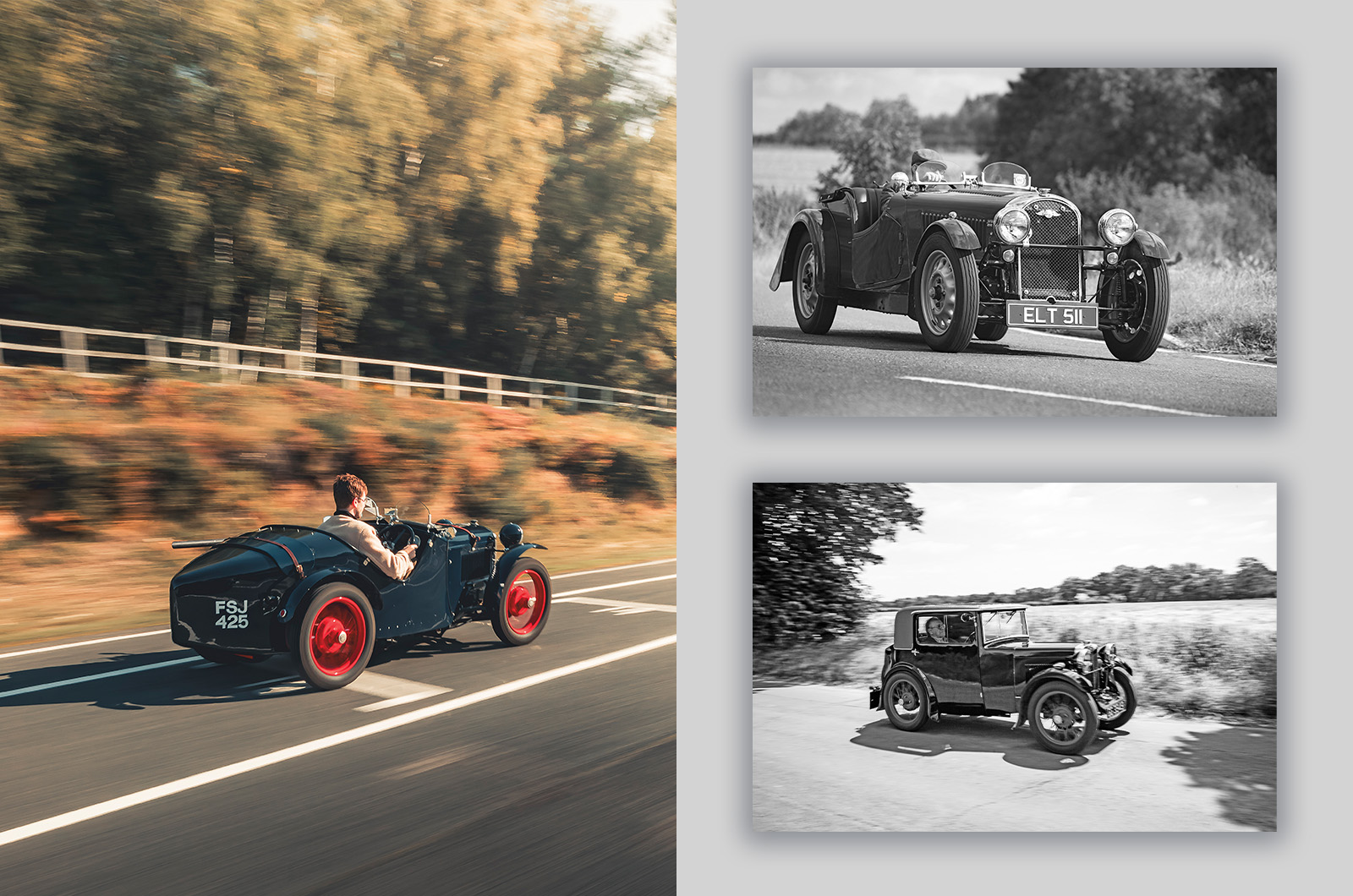
The Austin Seven Ulster’s mini-racer looks inspired plenty of replicas
Four supercharged Austin Sevens lined up on the startline of the Ards circuit on 17 August 1929.
Record-breaking heroics at Montlhéry, victories at Brooklands and a 790-mile reliability run had proved the baby Austin was up to scratch, but success at the Ulster RAC Tourist Trophy would be the cherry on top.
Ahead lay 30 gruelling laps of the closed-road circuit linking the towns of Comber, Newtownards and Dundonald.
The plucky underdogs got a head start on the rest of the field, which included Bentleys, Alfas and Bugattis, and the Austins fought amongst themselves in the opening laps.
Despite heavy downpours, the lead pair was soon clocking 60mph-plus tours, but Rudi Caracciola’s Mercedes-Benz SS and Giuseppe Campari’s Alfa Romeo 6C closed in.
The German and Italian cars were first and second, but Austin drivers Archie Frazer-Nash and SV Holbrook crossed the line in third and fourth respectively, heading a top-four lock-out in the 750cc category.
More high-profile victories and speed records followed, but the County Down win triggered a run of ‘Ulster’ road cars, available with or without a supercharger.
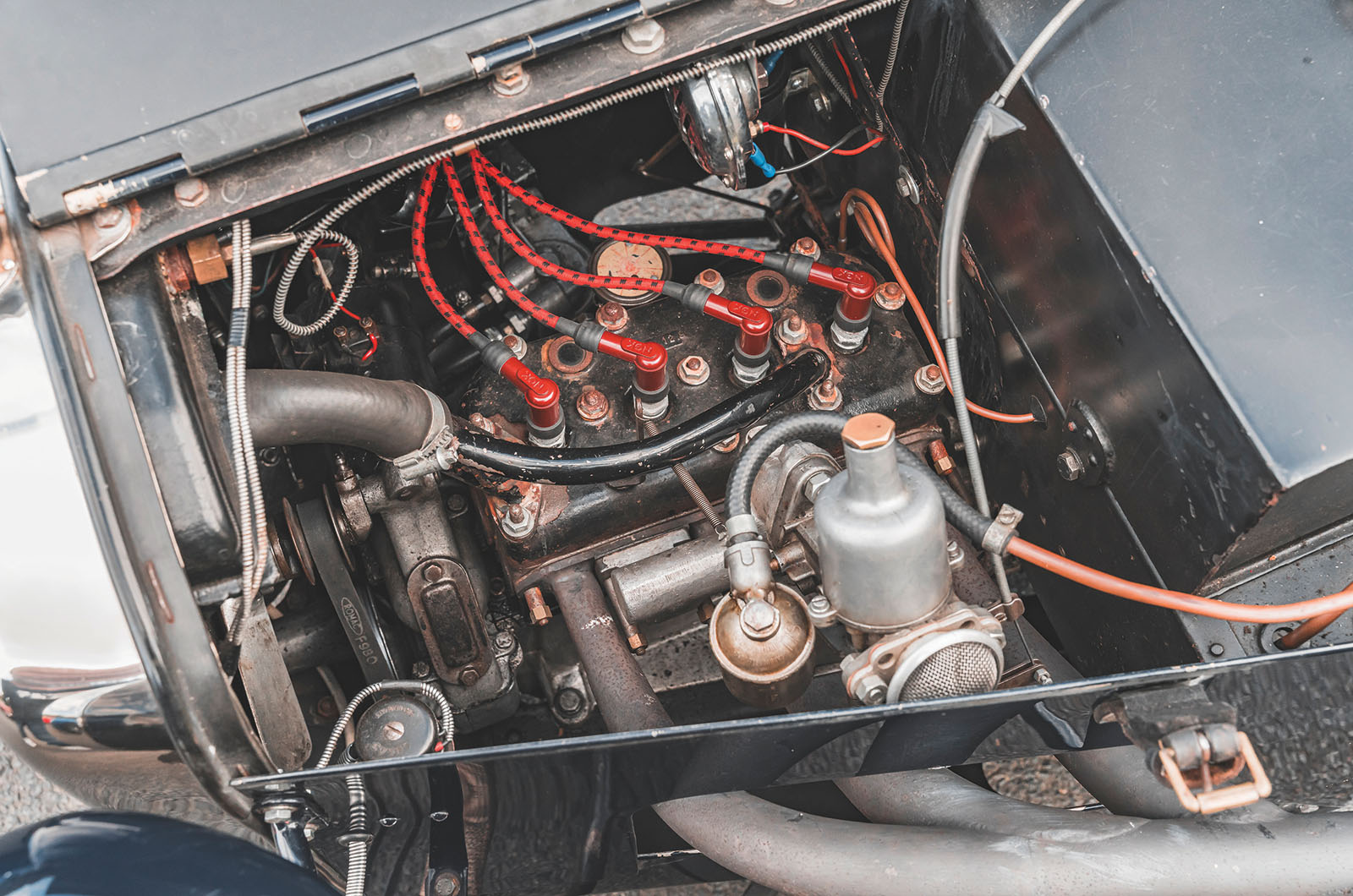
The Austin Seven Special’s simple 747cc ‘four’
The car that democratised motoring in the early 1920s was kick-starting its next chapter with a model that could compete with the best, but was within reach for most.
Its success on both the world stage and at grassroots secured the Ulster’s popularity well beyond its two-year production run, leading to countless replicas and Specials.
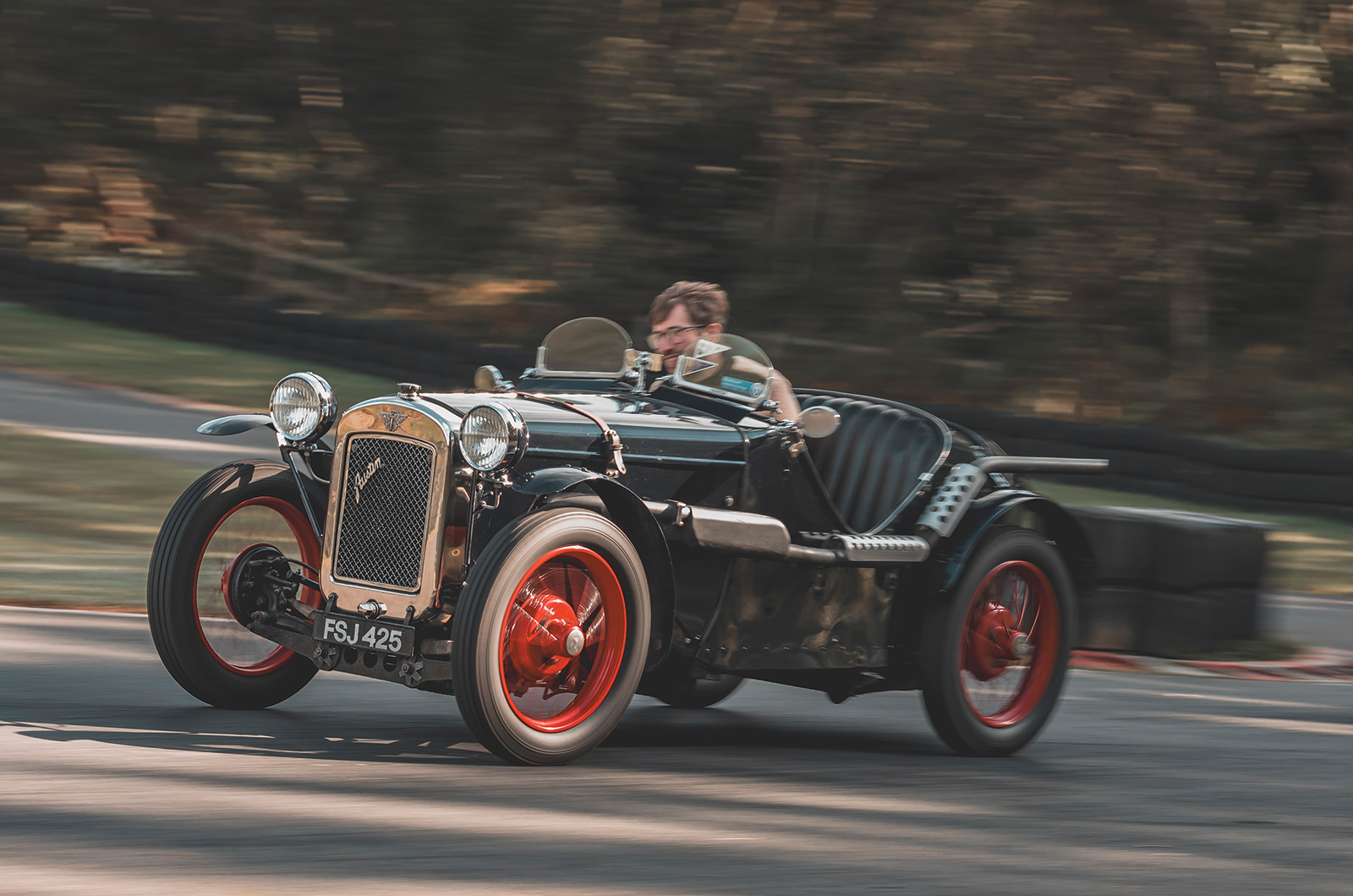
Even today, the little Austin Seven’s performance at the 1929 Ulster TT continues to inspire: “I’ve always been fascinated by exploration and travel,” says owner James Moon. “Because of that, I love vintage racing cars and what people did in the early days of motorsport.”
He shares this superb Ulster replica with his father, Adrian. It started life as a standard Seven saloon, but was first turned into a Special not long after WW2.
“The previous owner referred to the first conversion as ‘Ulster-esque’,” says Adrian. “It was a rather crude two-seater body.”
Today, it’s a very authentic homage to the TT racers, having been rebuilt in the 1990s with aluminium bodywork by Roach and a remote linkage for the three-speed gearbox.
“For me, it was important that it wasn’t just something that looked like an Ulster, but was true to the works cars from 1930,” says car designer James. “It’s a pocket rocket and I think it’s absolutely beautiful.”
The Austin Seven Special’s tight cockpit limits the market
In truth, James and Adrian’s pristine example is well out of our budget – you’d need to spend upwards of £20,000 to land a replica anywhere near as good as this; however, there are plenty of highly usable Austin Seven Specials, Ulsters or otherwise, well within reach.
Unless you’re planning to use your classic car every day and throughout the winter, then why not consider something a little more left-field?
Admittedly, in our line-up of MGB alternatives the Austin is clearly the brave-pill option.
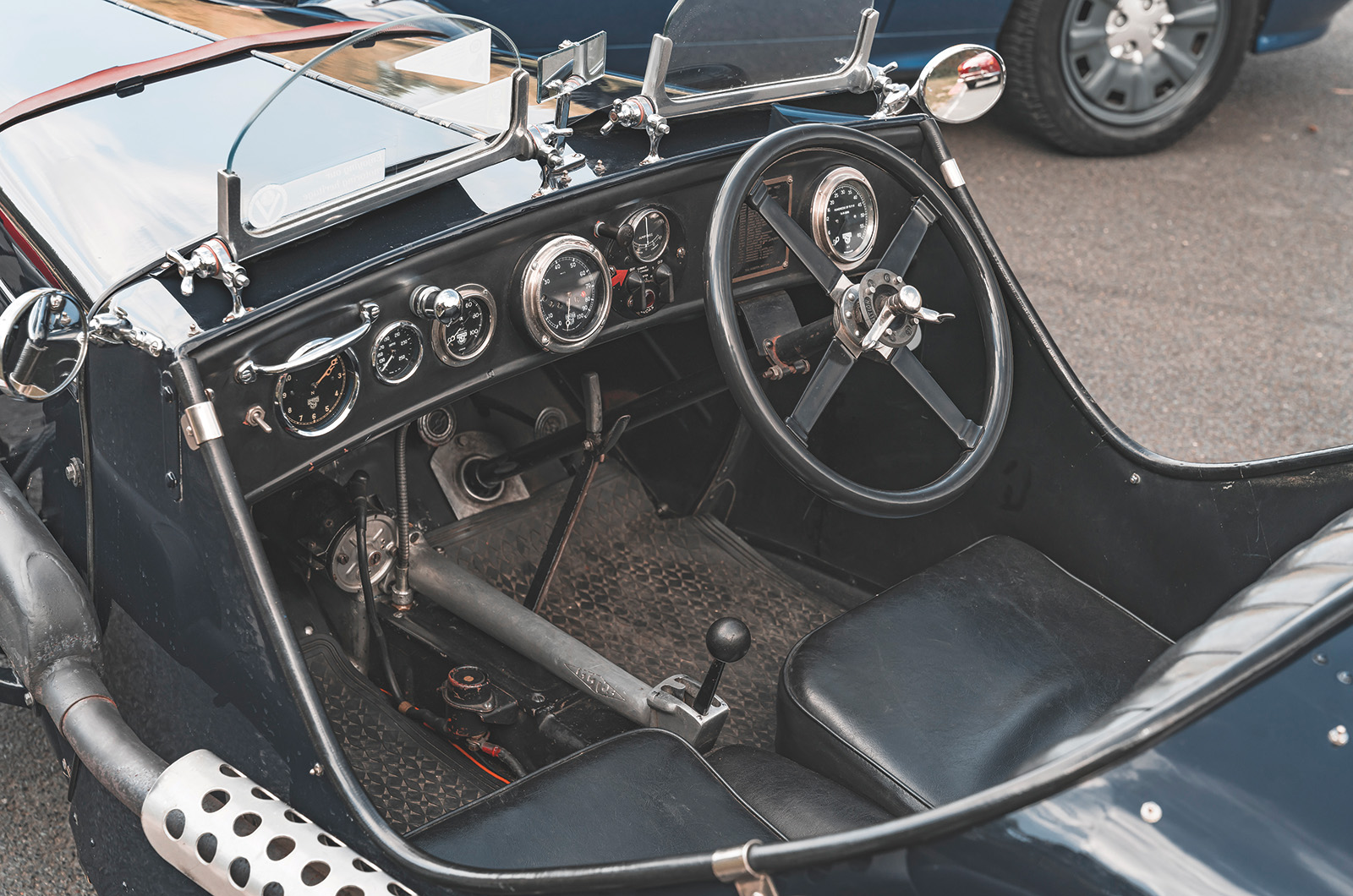
For a start, all of the other cars have doors; in the Seven, you hop over the cut-outs and shimmy your way down into the snug cabin – you don’t so much sit in the Ulster as wear it.
Despite its tiny capacity, this is the loudest car here, too: push the starter, and the sidevalve ‘four’ jumps into life and settles into a not-inconspicuous idle.
Engage the pushbutton clutch in the tight pedalbox and select first with the short, stubby lever.
There’s no synchromesh, so you need to be cautious, but get it right and you’re rewarded with a short-throw shift that could be hooked up to a distant ancestor of the Mazda MX-5’s snickety gearbox.
The Austin Seven Special’s elegant tail hides a decent-sized ‘boot’
Malcolm Campbell managed 94.06mph in a rebodied supercharged Ulster at Daytona Beach, and while this unblown replica can’t quite manage that, the sensation of speed is laugh-out-loud fun – even though I’m barely touching 35mph on our test track’s short straight.
Unless you are part of the Vintage Sports-Car Club community, it’s easy to view racing cars of this era as museum pieces, stories of the fearless pioneers who campaigned them existing only in books, archive images and our imaginations.
But get behind the wheel of one and those black-and-white photographs spring into life – and the full-colour experience makes you appreciate the bravery of those early racers even more.
In many ways, the Austin Seven is the polar opposite of the MGB: one is a relaxed cruiser, the other a pint-sized screamer, at its best when it’s being revved hard and wrestled through a series of bends, revelling in its thrummy, race-inspired soundtrack.
So while the MGB is the practical choice (even if the Ulster has a surprisingly large ‘boot’ in the boat-tail rear), the Austin is certainly the most evocative.
Sure, if it rains you’ll get cold and wet, you need to have your wits about you on the road, and you must even dress sensibly – Adrian advises dodging cow pies, or you’ll end up with it splattered up your arm.
But nip out for a pint of milk on a Sunday morning and you’ll find yourself skipping the local shop to drive to the next one. Then the next one, and the next.
The Austin Seven turns every trip into an adventure you won’t want to end.
Words: Ryan Standen
Thanks to: James and Adrian Moon
Clockwise from main: not much power, but thrills aplenty in the Austin Seven Special; Morgan 4-4; MG M-type
Scorecard
- Value for money 2/5
- Ease of maintenance 4/5
- Parts availability 4/5
- Practicality/usability 2/5
- Driver appeal 5/5
- Cars & Coffee factor 4/5
- Total 21/30
Buying tips
- Inherently, every Austin Seven Special will be different, so do your research to find out just how authentic the car in question is
- The 747cc engine isn’t long-lasting, especially if driven hard. Parts are prevalent, but budget for work if the most recent rebuild was long ago
- The three-speed gearbox has no syncromesh, so you need to double-declutch. A worn gearbox will be noisy, so listen out for rattles on a test drive
Alternatives
- Morgan 4-4 Morgan’s first crack at a four-wheeler set the template for the Malvern maker, and you can pick one up for not much more than an Ulster rep. Early models have a Coventry Climax engine and later 4/4s use a Standard motor – as does the more powerful Plus Four from 1950
- MG M-type The first-generation MG ‘Midget’ was on sale at the same time as the Austin Seven, although its 1929 release meant that it nabbed the title of the first affordable sports car… just. It enjoyed plenty of motorsport success, too, plus you can get one for similar money
Peugeot 205 GTI
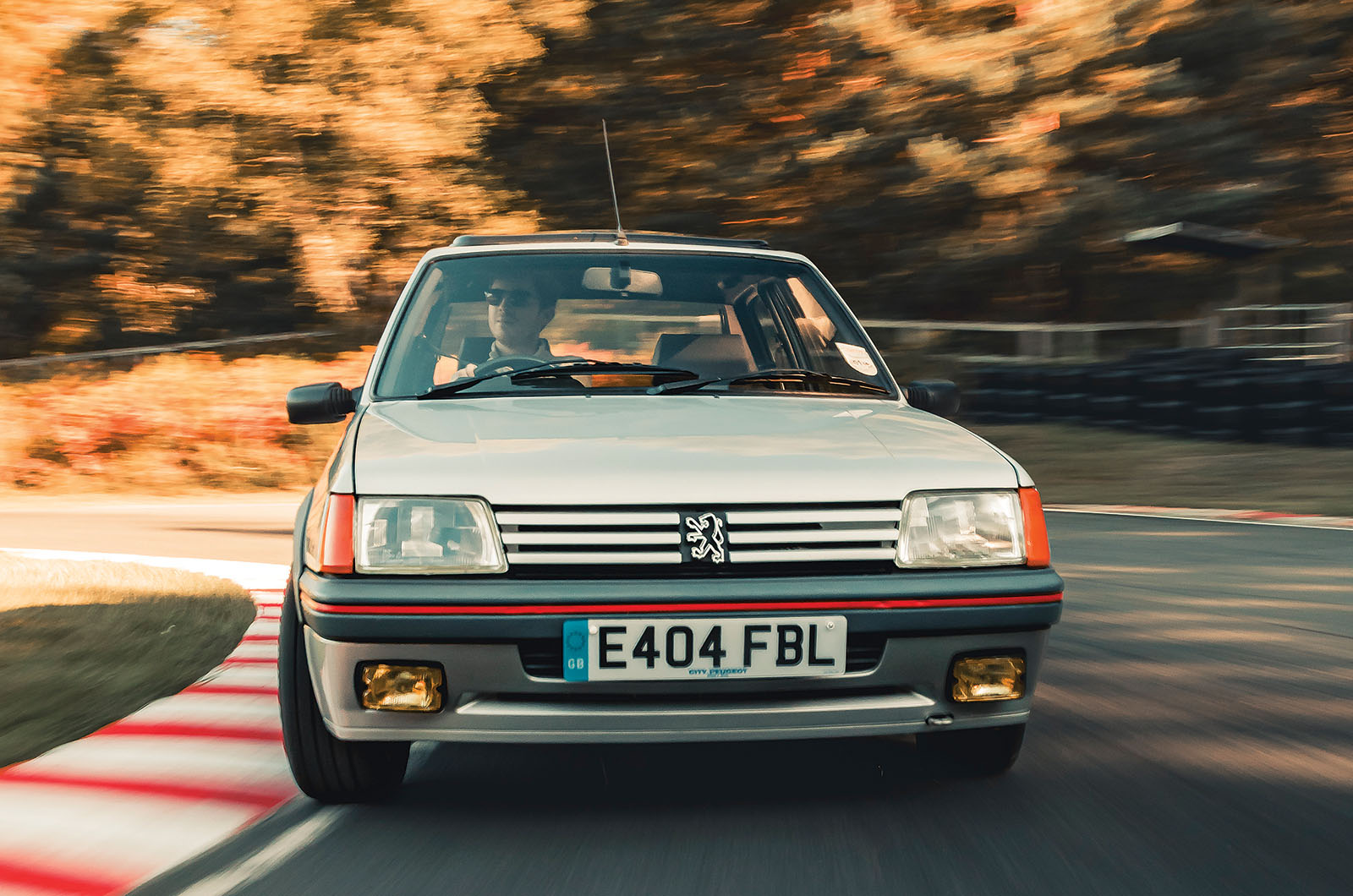
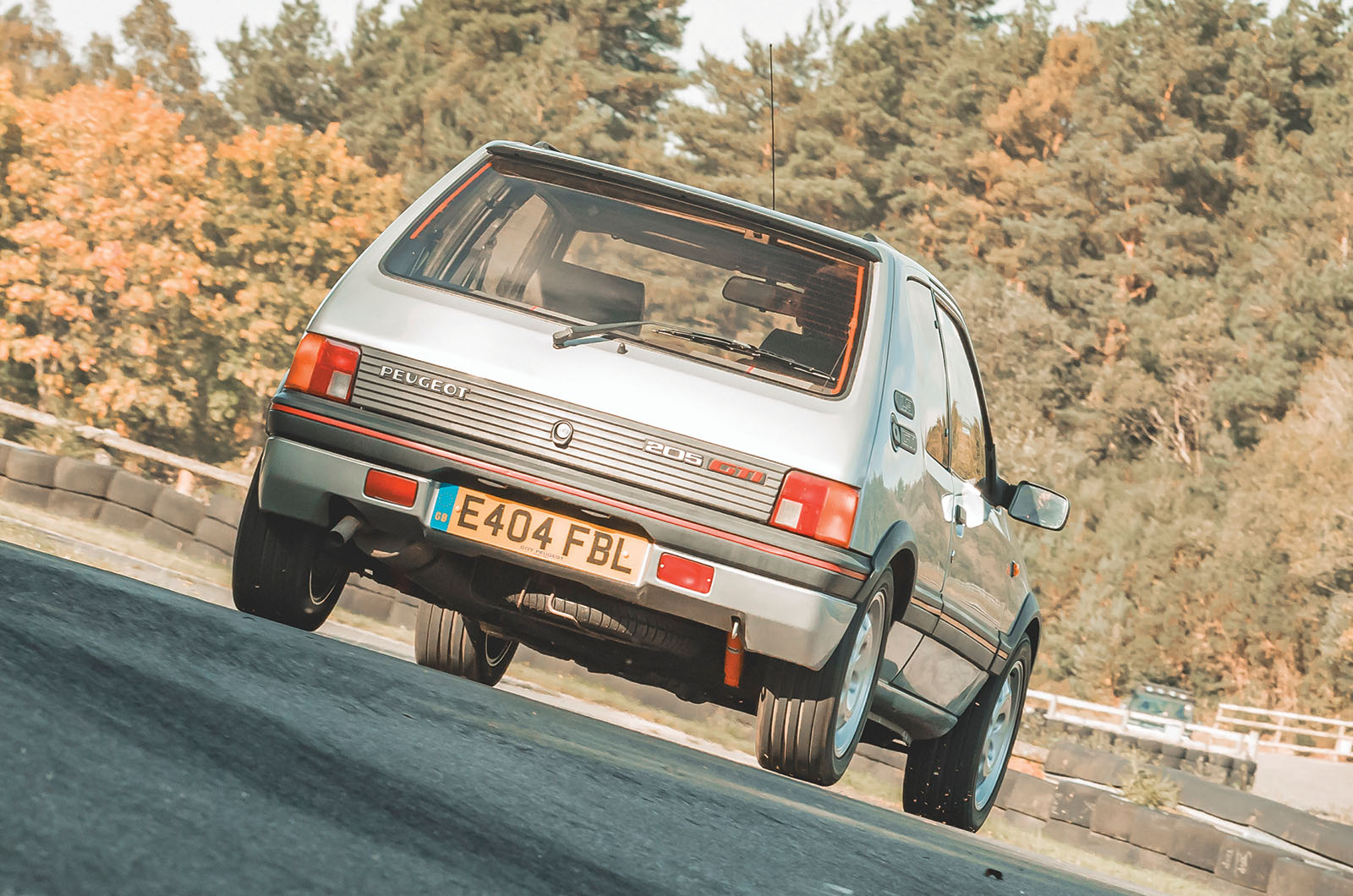
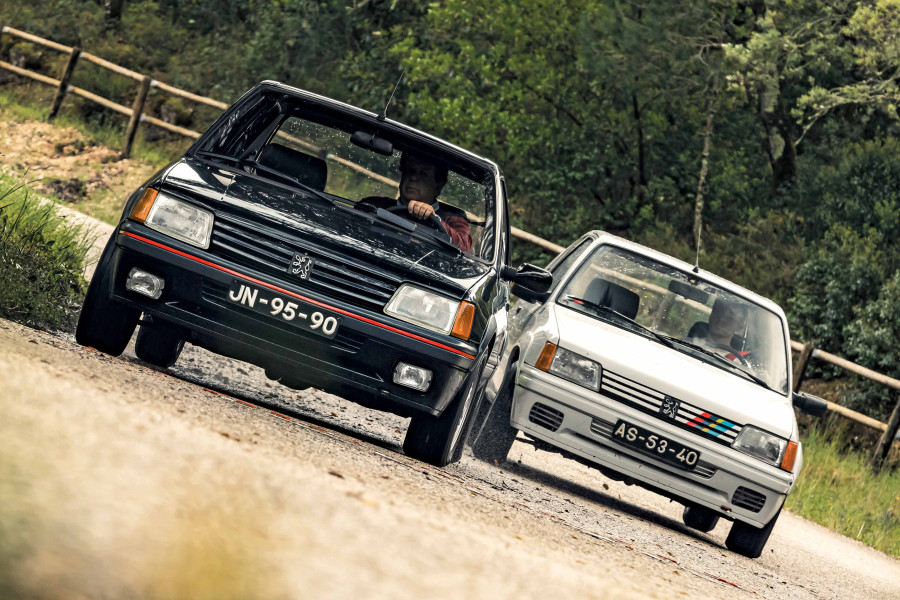
The Peugeot 205 GTI’s cheeky face reflects its pugnacious character
The Peugeot 205 GTI is second only to the MGB here in its lack of need for an introduction.
You know what it is, and unless you have a closet full of Volkswagen T-shirts, you probably consider it the best hot hatch of all time.
There have been faster ones, both in a straight line and in the g-forces they can pull in a corner, but none have matched the Peugeot’s nimbleness, effervescence and tack-sharp throttle response.
The question is whether it deserves to be here.
Sitting as it does, surrounded by cabrios and coupés, the 205 could be unkindly dismissed as a shopping cart doing its best attempt at a sports car with the addition of a bigger engine, flashy wheels and some red striping.
But I put it to you that, in the feeling of its controls and the sensation it imparts to the driver, the Peugeot 205 GTI is better than most sports cars. That it comes with decent carrying capacity is a bonus.
Much of that is thanks to its lightness: glance down to the GTI’s kerbweight and you’ll see that it is a small person in the passenger seat away from the MGB.
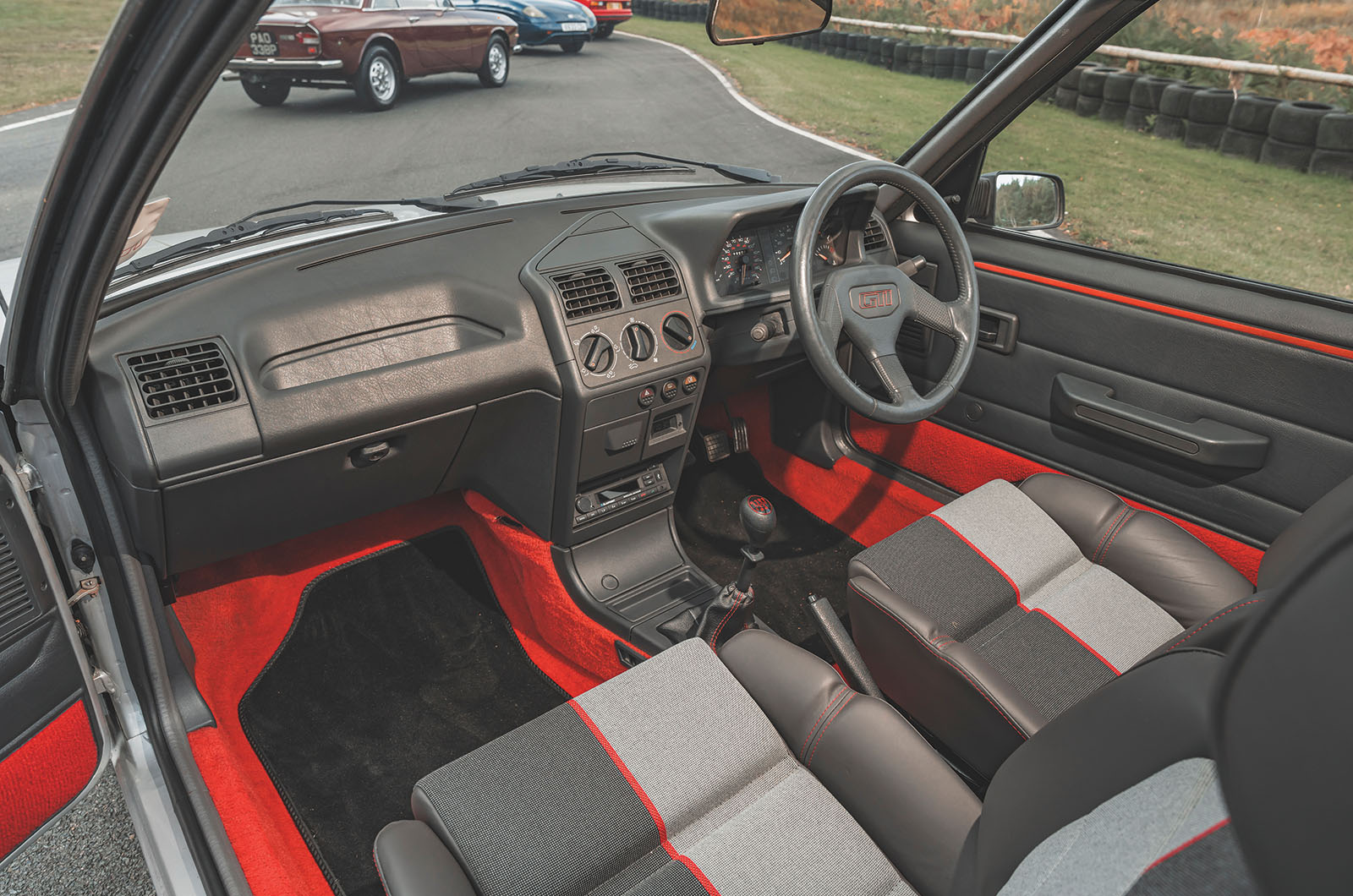
This ‘phase 1.5’ Peugeot 205 GTI got the pre-facelift exterior with the 1988 dashboard update
Built from steel so thin you’ll swear you hear it flexing away like a baking tray, that Peugeot managed to make a car with a roof, back seats and a boot weigh this little in the ’80s is an impressive feat – and a point of virtue of the front-drive set-up many enthusiasts will hold against it.
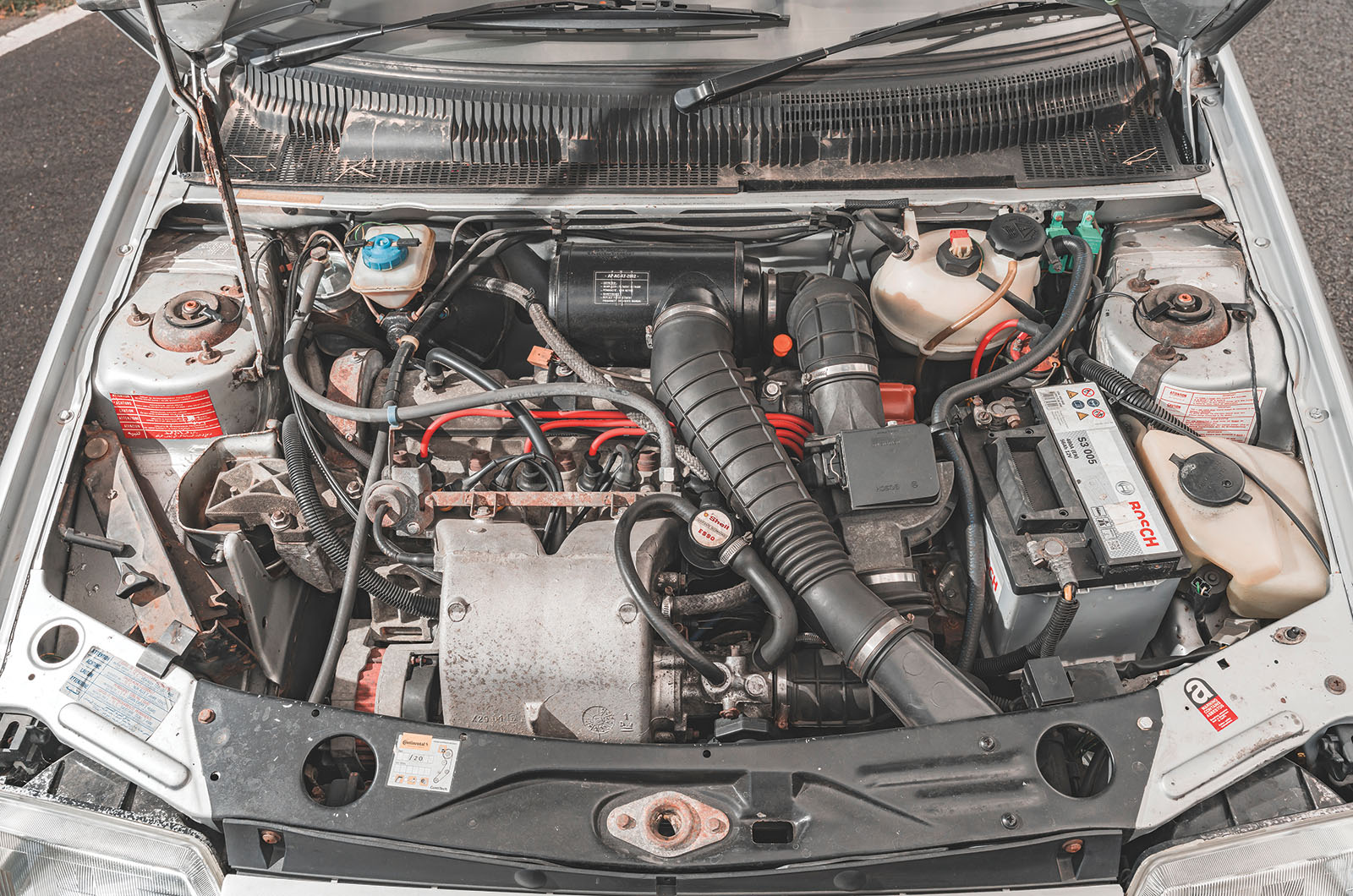
There’s proper engineering here beyond the flimsy metal, too: the engine is all-aluminium, while the weight- and space-saving independent rear suspension by trailing arms and torsion bars set the standard for the supermini class.
Beyond the spec sheet, however, the secret sauce of the Peugeot 205 GTI is in the unquantifiable expertise in the tuning of its chassis and controls.
Step into one, and the first thing you notice is an engine that revs with virtually no delay after just a look at the throttle.
The brakes are similarly keen. It takes adjustment, but gives an impression of urgency and telepathic control.
The clutch in this car is particularly heavy, perhaps due a new cable, though all right-hookers suffer the issue to some extent.
A turn of the wheel will bring a grin back to your face. Unassisted in this car, it fizzes with feedback, but more impressive is its response.
Another car might take only half a second to react to your input, but the 205 feels that bit faster. It’s an addictive experience, making even driving around town at 30mph enjoyable.
The Peugeot 205 GTI’s torsion-bar rear gives it a nimble feel
It’s not actually that quick in its steering (at 3.9 turns from lock to lock): the agility is achieved instead by the car’s light weight, front-end grip, short overhangs and front-wheel toe out.
These honed responses, as well as a rapid (if slightly long-throw) gearshift, allow the driver of a Peugeot 205 GTI to revel in the car’s lively chassis.
Essentially, you’ve got all the front grip you could ever need and a rear axle that follows like a small child holding the leash of an excitable Great Dane.
That creates a hot hatch that resists torquesteer and understeer, the bogeymen of the genre, while delivering real adjustability at the rear.
With the extra poke of the 1.9 – as here – it’s more pugnacious, though in truth it feels faster than it really is.
The big drawback to the 205 GTI’s driving brilliance is that it is so well known, with prices to suit.
The nicest cars are now fetching £40k, and Aguttes blew all records out of the water with an exceptional low-miler fetching €82,960 in 2022. As values have increased, however, so has their spread.
Rough cars hanging on to an MoT can still be found from about £5000, whereas a perfectly decent car with a mileage the wrong side of 100,000 can be had for £10k, with a premium on 1.9s and rare colours.
This Peugeot 205 GTI’s muscular 1.9-litre engine
This car, a smart 1.9 with 188,000 miles but a recent job list longer than your arm, was taken as a part-ex on a Porsche 911 GT3. At the time of writing, it was for sale for £15,995.
That popularity does make them easy cars to look after. Peugeot itself now remanufactures some components, including all the interior fabrics and many trim items, while ancillaries, suspension bits and the like are still in stock at regular motor factors.
The used-parts community is strong, and restorer Tolman has responded to the extra money surrounding these cars with both a restomod and a range of upgrade parts for the model.
Beyond some tight packaging in a few spots in the engine bay, they are very simple cars to work on, too.
The Peugeot 205 GTI was built in huge numbers, filling the niche left by the MGB GT as an accessible car for the sporty driver, so its comparison today should not be the surprise it may appear as its boxy silhouette looms over the Abingdon staple.
I’ll concede that the 205 will never have quite the visual charm of a chromed MG in a bright colour on a summer’s day, but, were driving with a blindfold possible, I’m confident most would choose the little French nugget.
It’s not just what I’d buy with MGB cash, it’s what I’d buy if I could only drive one car ever again.
Words: Charlie Calderwood
Thanks to: Ashgood Classic & Sportscars
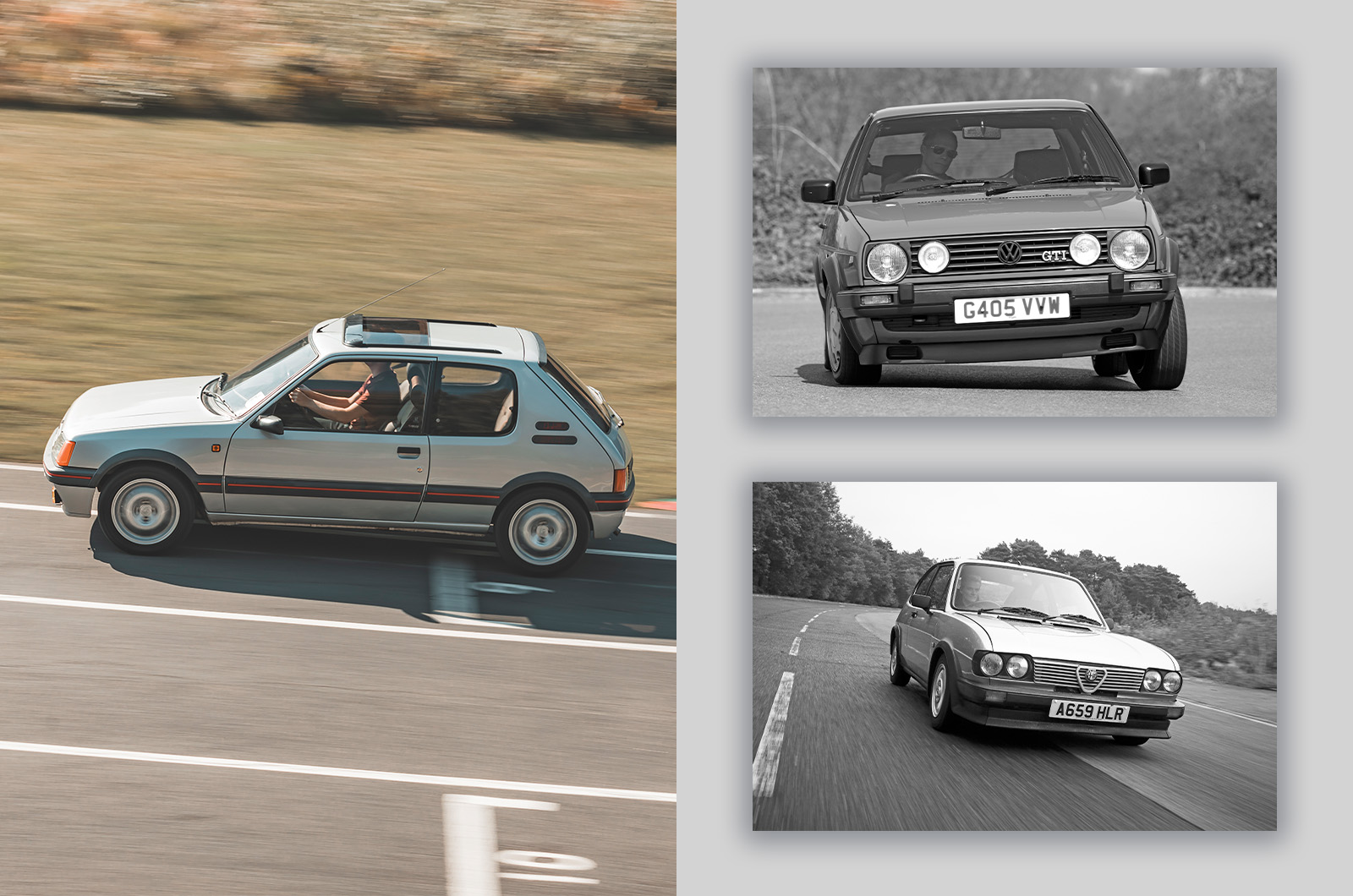
Clockwise from main: fine vision thanks to the Peugeot 205 GTI’s huge glass area; Volkswagen Golf GTI MkII; Alfa Romeo Alfasud Ti
Scorecard
- Value for money 2/5
- Ease of maintenance 4/5
- Parts availability 4/5
- Practicality/usability 5/5
- Driver appeal 5/5
- Cars & Coffee factor 4/5
- Total 24/30
Buying tips
- Peugeot rustproofed the cars well, but sills are corroding now, especially at their ends
- Driveshafts are weak: accelerate on full lock to test them. The clutch is cable-operated and on the heavy side as standard, but a fresh cable can improve things
- The bearings of the torsion-bar rear axle eventually fail, leading to excessive negative camber. A reconditioned axle is c£250 online
Alternatives
- Volkswagen Golf GTI MkII The MkI Golf GTI inspired the 205, but for MGB money you’re looking at a MkII. Significantly larger than the Pug, the Golf is more refined, better built and more practical, but less sharp. You should get a lovely 8v at this price point, or a higher-mileage 16v
- Alfa Romeo Alfasud Ti Gaining a hatchback and a 103bhp, twin-Weber-fed version of its zingy 1.5-litre flat-four in 1982, the Alfasud belatedly became a hot hatch for its final two years. The Ti is a brilliant handler, but with a ruinous reputation for rust and a high-maintenance engine
Fiat Barchetta
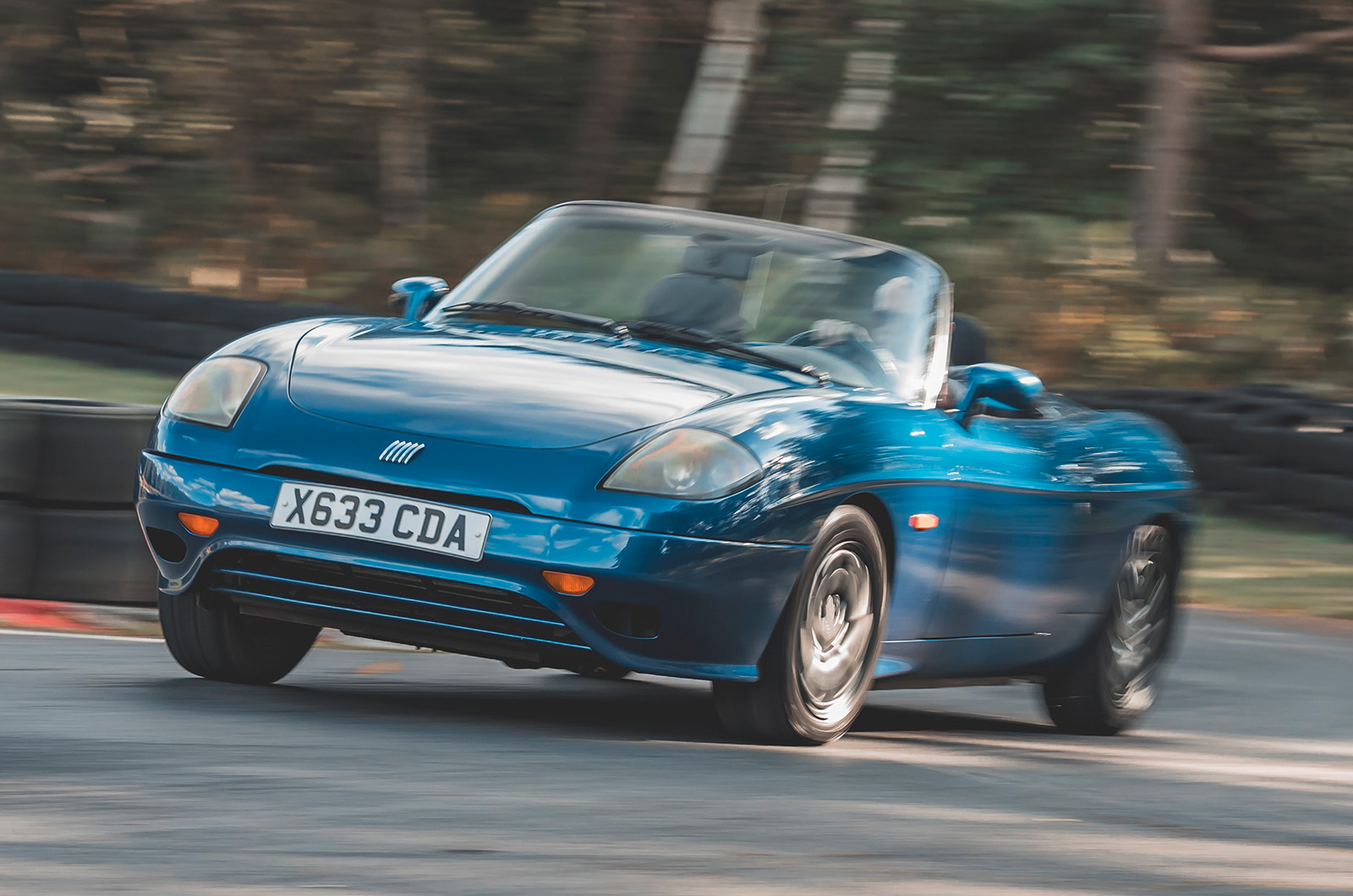
‘The Fiat Barchetta’s throttle response is crisp, delivering a wholesome rasp from the twin tailpipes, and performance is strong’
There are so many reasons why my choice of a Fiat Barchetta is seriously flawed that I’m now starting to eye up the other cars here with a mixture of longing and envy.
Why did I do it? Oh yes, I remember: because the Barchetta is simply one of the prettiest two-seater soft-top roadsters to emerge in recent times.
It was the model’s impish good looks that perhaps made Fiat UK so bullish, despite the Barchetta’s most obvious drawback in this market.
‘WHO CARES IF IT’S LEFT HAND DRIVE?’ was the importer’s devil-may-care strapline in a contemporary print advert.
On the face of it, the Fiat Barchetta lived up to its advertising bravado, too.
Centro Stile Fiat designer Andreas Zapatinas’ inspiration for the Barchetta’s lines came in part from Ferrari’s 1948 166MM, for which the nickname barchetta had also been coined.
There were other neat styling references, too: the roadster’s flush doorhandles mimicked those on the elegant 1947 Cisitalia Pinin Farina Coupé; and the way the Barchetta’s hood stored out of sight beneath a flush, body-coloured panel (without impacting on boot space) was reminiscent of an 850 Spider’s arrangement.
The Fiat Barchetta displays flashes of body colour inside
Slightly more prosaic was Fiat’s front-wheel-drive ‘Type B’ platform, around which the Barchetta was developed.
Bucking the rear-wheel-drive norm in its class, it was to share its underpinnings – albeit on a shorter wheelbase – with the new Punto.
Naturally, the roadster’s lack of a structural roof meant its chassis was reinforced, with the windscreen frame acting as a rollbar.
Uprated springs and dampers also provided a more sporting feel to the whole. Weighing a snip over a tonne, it mattered little that the 1747cc 16-valve ‘four’ made just 128bhp.
For the first time, Fiat used a phase variator in the intake mechanism to provide variable valve geometry and more rounded performance at any revs. This gave a useful 0-60mph in 8.6 secs and a 118mph maximum.
Driving Richard Lohman’s pre-facelift 2001 example (post-’03 models received a restyled nose and some trim/equipment changes), that acceleration figure feels slightly pessimistic.
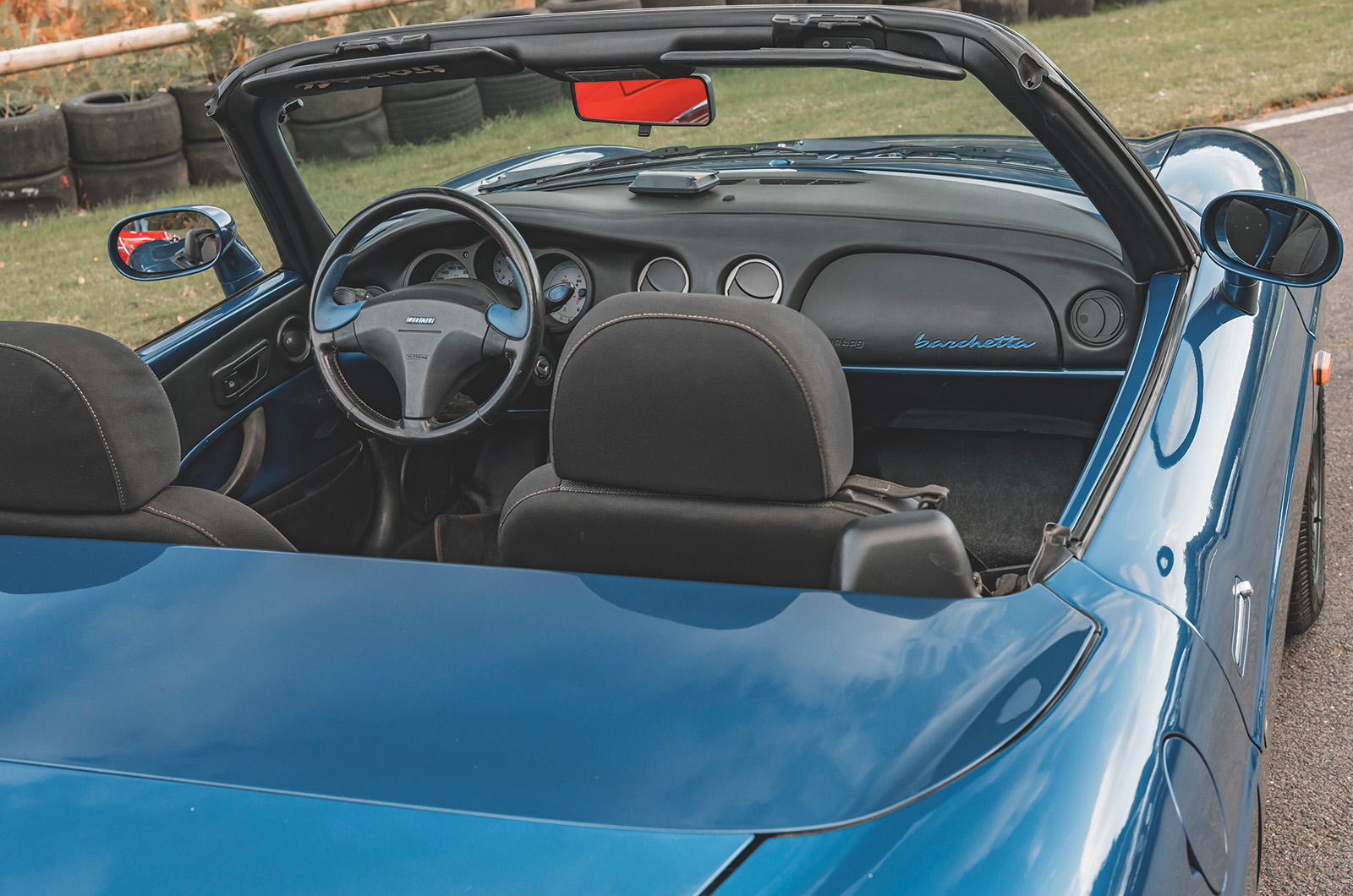
Roof down, you sit low in the Fiat Barchetta’s cabin facing a chunky, airbag-equipped, three-spoke wheel and three white-faced dials in a moulded plastic binnacle.
Body-coloured flashes of trim abound, and the decent kit-count includes air conditioning and electric windows.
The Fiat Barchetta’s flowing lines
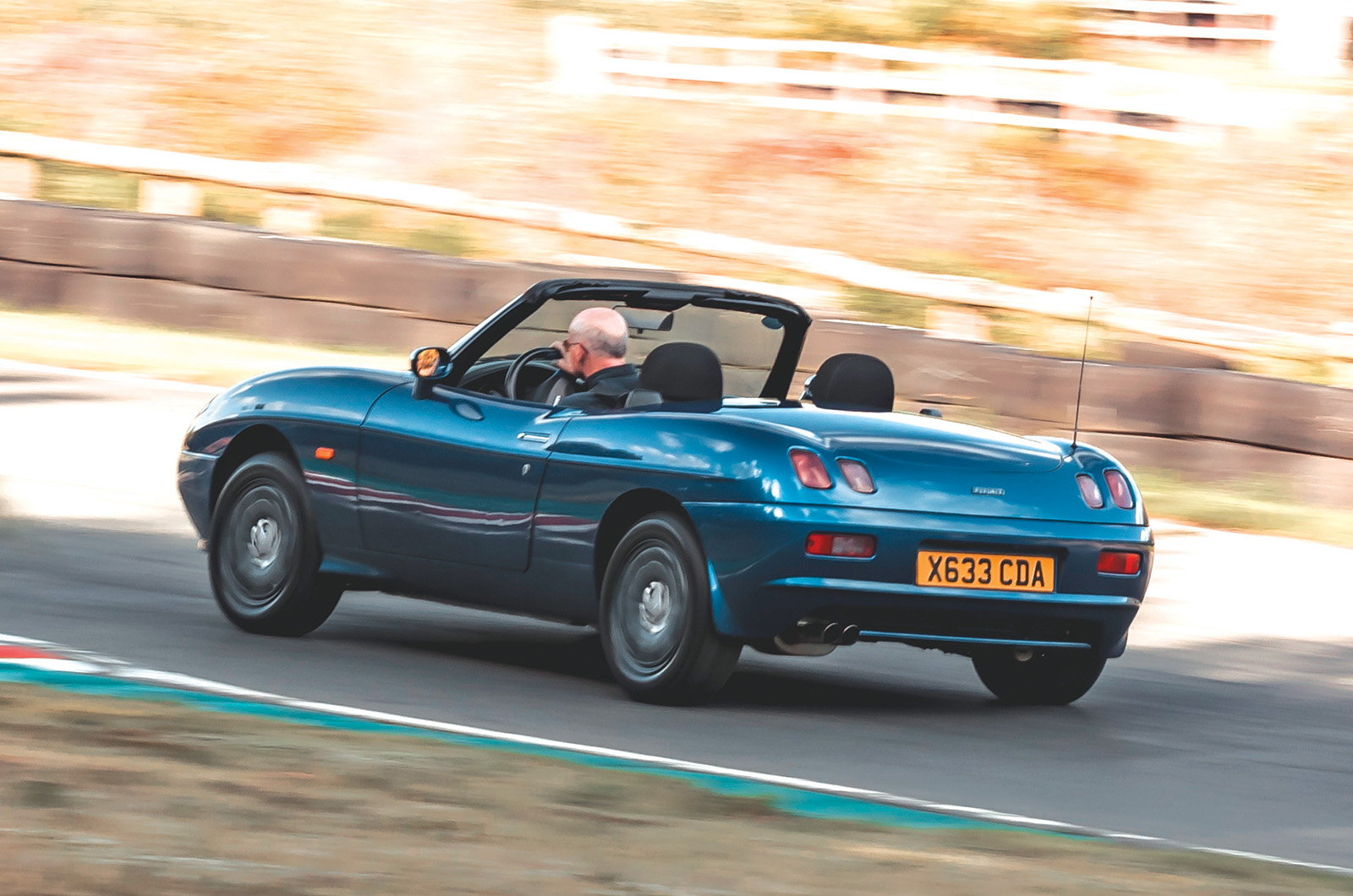
Out on the road, perched on the left-hand side of the car as you would be in any Barchetta, the biggest drawback is that you have to choose your moments wisely before overtaking.
But everything else gels nicely. Throttle response is crisp and the Fiat’s five-speed gearbox, while not as precise as a Mazda MX-5’s, is quick and satisfying through shifts.
Extending the engine delivers a wholesome rasp from the twin tailpipes, and the performance feels strong.
There is a touch of roll through corners (which I like), but the overall body control is tight and well contained, with only a hint of steering-column wobble over broken surfaces.
Unfortunately, owning a Fiat Barchetta is not all sunshine and lollipops. Like the MX-5, rust is its bugbear, with the main issues arising from faulty rear hood seals, allowing water to find its way into the footwells and then rotting the floorpan from the inside out.
Official UK cars were also plastered with a thick layer of underseal, which can often disguise rusty floor sections. Inner and outer rear wheelarches are other areas to watch for corrosion, too.
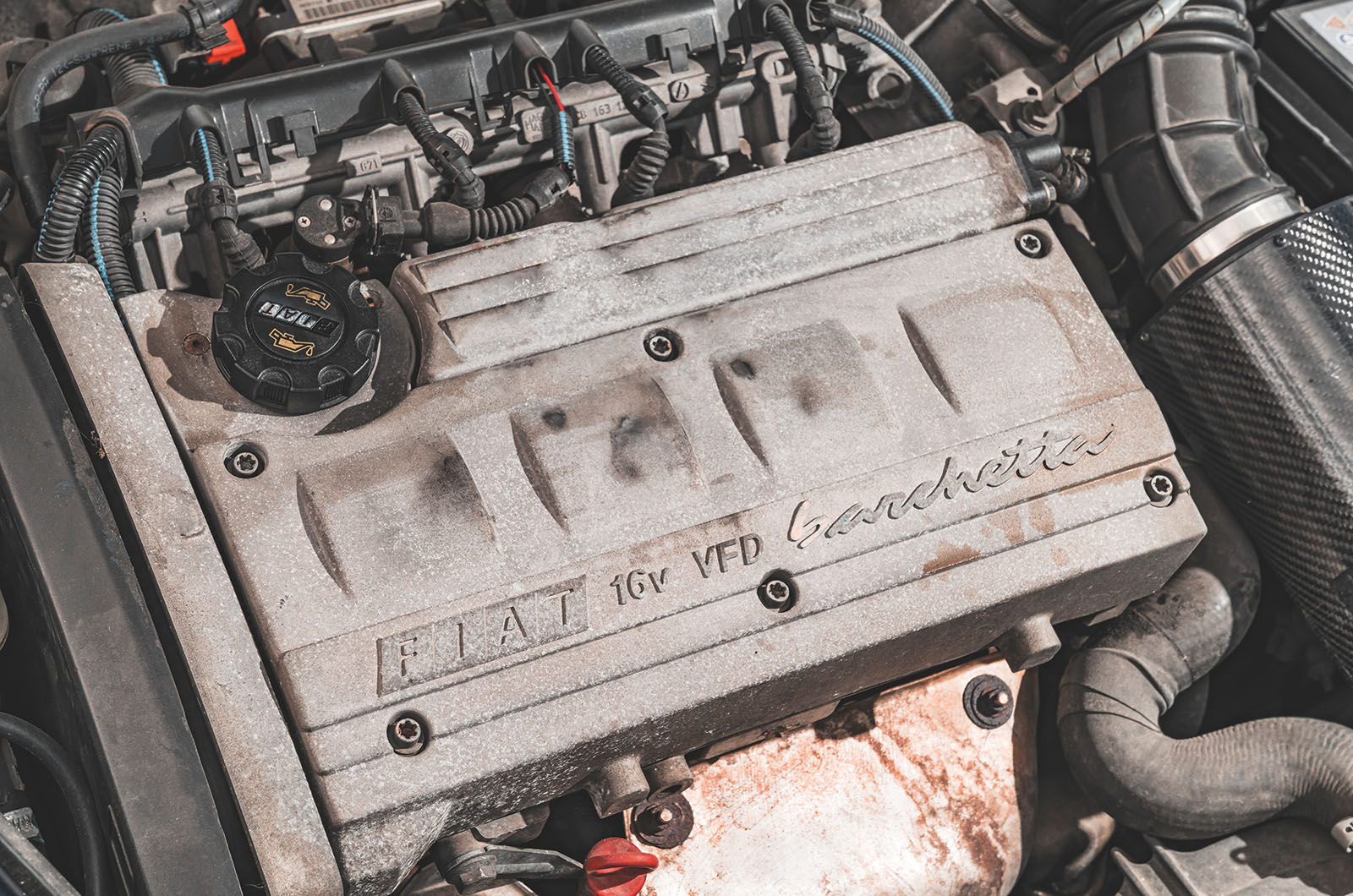
Mechanically, the Fiat Barchetta’s powertrain is fairly robust, save one particular issue. The variator that controls the inlet timing can seize, causing the engine to run badly and sound almost like a diesel.
The Fiat Barchetta’s zingy 16v twin-cam engine
Prevention is better than cure here, and Paul de Turris from Barchetta specialist DTR European Sports Cars suggests replacing the variator – along with the water pump – at every second cambelt change.
This is due every three years or 36,000 miles and, while the belt itself is durable, the tensioner can fail – especially in cars that are laid up for long periods.
The other blight of Fiat Barchetta ownership is general parts scarcity. While obtaining regular service and mechanical components is rarely a problem, sourcing body panels and light units is becoming increasingly difficult.
Replacement rear wings are almost non-existent, but can be fabricated, and front bumpers and headlights are also hard to find (though the latter can often be refurbished).
DTR holds a stock of bonnet panels and front wings, but it’s gradually being depleted.
On the upside, the Fiat Barchetta is served by an excellent owners’ club, which has around half of the remaining 500 cars in the UK on its books.
It’s also a good place to start hunting for what is surely one of the rarest, prettiest and yet most usable classic cars in this group.
Words: Simon Hucknall
Thanks to: DTR European Sports Cars; Barchetta UK Owners’ Club
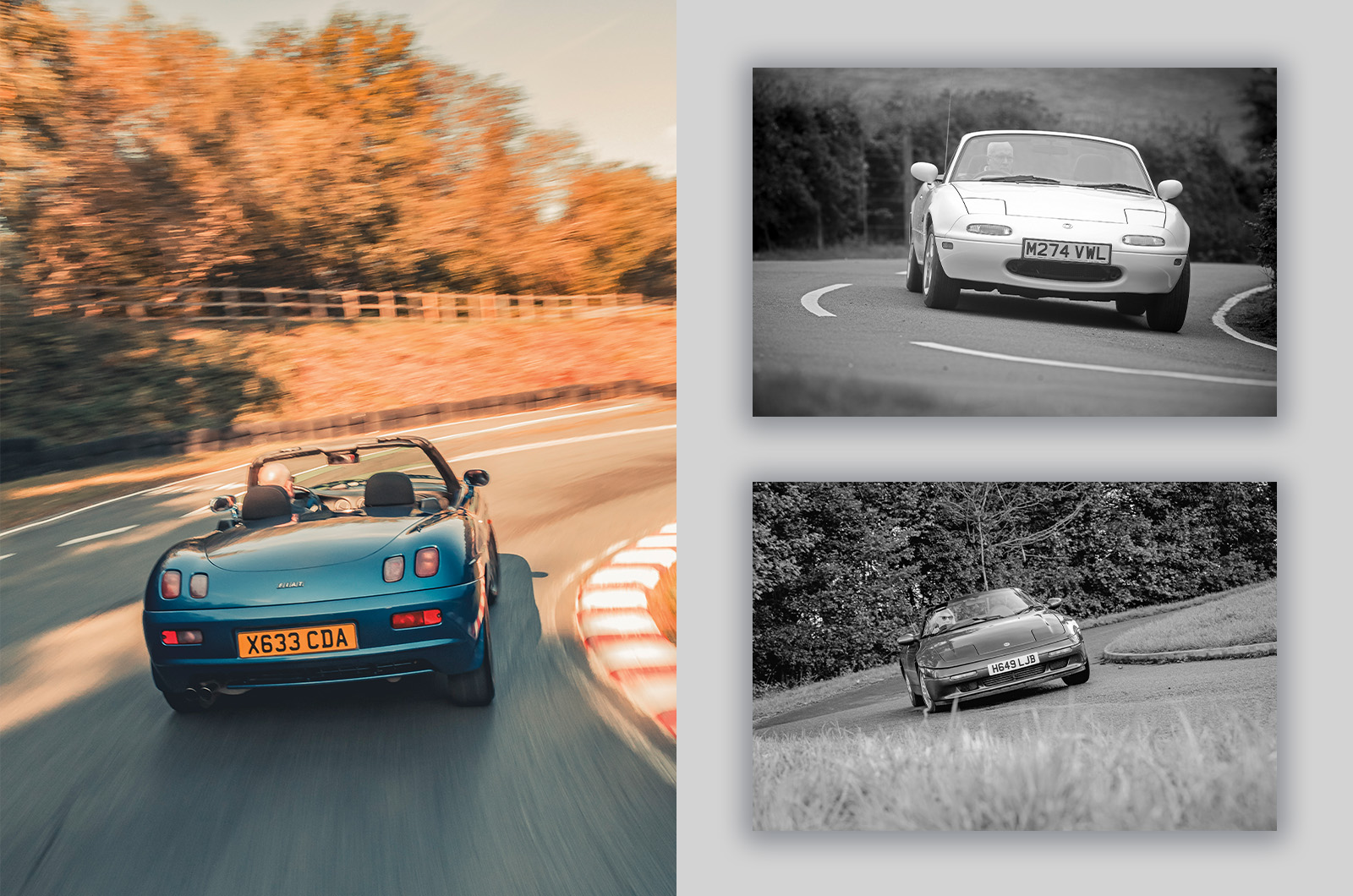
Clockwise from main: Fiat’s ‘little boat’ resists understeer admirably; Mazda MX-5 (NA); Lotus Elan (M100)
Scorecard
- Value for money 2/5
- Ease of maintenance 4/5
- Parts availability 4/5
- Practicality/usability 5/5
- Driver appeal 5/5
- Cars & Coffee factor 4/5
- Total 24/30
Buying tips
- Rust can write a car off due to a lack of panels, so a thorough inspection is vital. Check jacking points, sill edges and inner/outer rear arches
- The inlet variator is a weak spot, causing the engine to run poorly. Listen out for a diesel-like rattle at c2000rpm, especially on the overrun
- On pre-’96 cars, an improperly folded frame can cut the hood fabric, so check above the side windows and in the lower rear corners for rips
Alternatives
- Mazda MX-5 (NA) UK-launched in 1990, the first-generation MX-5 reincarnated the traditional rear-drive roadster that MG had abandoned a decade before, but with a new level of build quality and durability. Cheaper and more common than the Fiat, and with better parts supply.
- Lotus Elan (M100) A front-wheel-drive Elan was an affront to Lotus purists, but its chassis was one of the best in the business. With values on a par with the Fiat today, the Elan’s relative rarity and practicality, plus the cachet of its Lotus badge, make it a compelling alternative.
Volkswagen Karmann Ghia
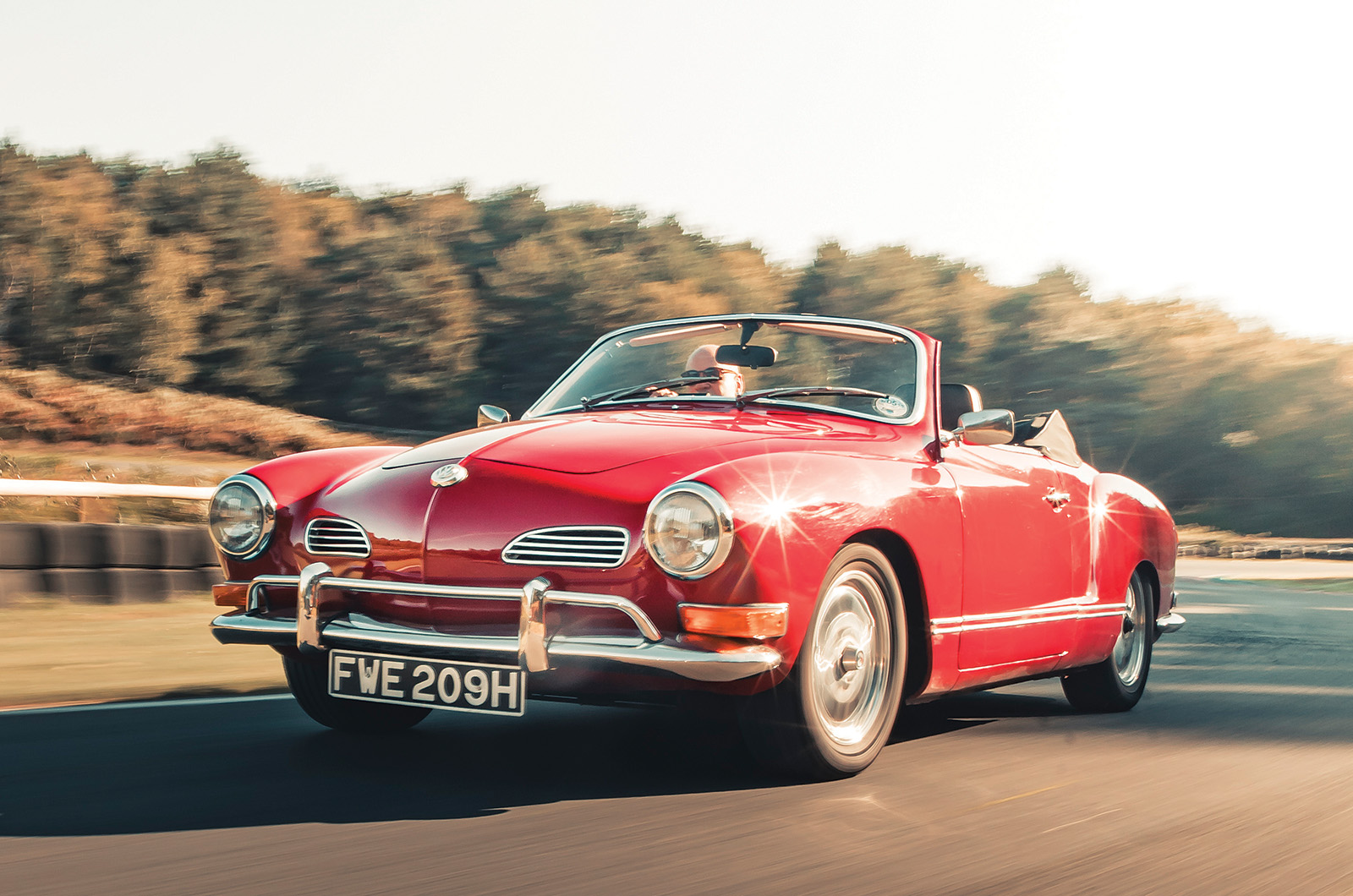
The Volkswagen Karmann Ghia’s styling is its main attraction
That the Volkswagen Karmann Ghia exists at all has more to do with the political machinations of Detroit than you might think.
Little did Volkswagen know, but Chrysler and its strong ties to styling house Ghia had several designs floating back and forth across the Atlantic in the early ’50s, with the best ones being picked off by stylist Virgil Exner and his team to form the next Chrysler cars.
The American firm’s D’Elegance concept car of 1952, designed and built by Ghia, had many of the cues we know today in the Type 14 Karmann Ghia, such as the swage line that flows from behind the front wheelarch, along the side then gracefully arcs over the rear wheel to create the top of the rear wing crease. Simply beautiful.
In the background, utilitarian VW was keen to produce an exciting sports car to join the Beetle and Bus as a new member of the family.
It approached German coachbuilder Karmann, which was already creating a cabriolet version of the Beetle, to see if it could help.
Conveniently, Ghia’s design for the D’Elegance was going spare, with Chrysler deciding not to take it, so the photocopier was set to -40% to fit the Beetle floorpan.
The concept was then presented to the VW board, who fell in love with it – just as everyone instantly swoons upon seeing a Karmann Ghia for the first time.
The Volkswagen Karmann Ghia’s beautiful detailing
Admittedly, this isn’t the finest genesis story for creating a sports car to rival the best Europe had to offer.
When the first cars rolled off the Osnabrück production line in August 1955, the motoring world was filling up with exciting cars such as the Ford Thunderbird, MGA, Triumph TR3, Mercedes-Benz 190SL, Jaguar Mk1 and Citroën DS, among many others, all incredibly hitting the streets in the same year as VW’s Karmann Ghia.
It was tough to make any kind of headway in such stylish company.
Whether this little air-cooled beauty is a true sports car is, to be honest, an argument that I’m never going to win.
When launched, 36bhp from its flat-four was as much as the VW Beetle engine could muster, and even in this 1969 version with its later, bigger motor producing a heady 57bhp, performance is sprightly at best.
But searching for speed is to miss the point entirely. Today I’m surrounded by my Classic & Sports Car chums debating their choices and offering arguments about smooth power delivery, perfectly weighted gearchanges and sonorous engine notes.
But I’m just standing and staring at the gorgeous result of Italian design meeting German coachbuilding, and revelling in the fact that I have the best-looking car here by a mile, including that little red MGB over there.
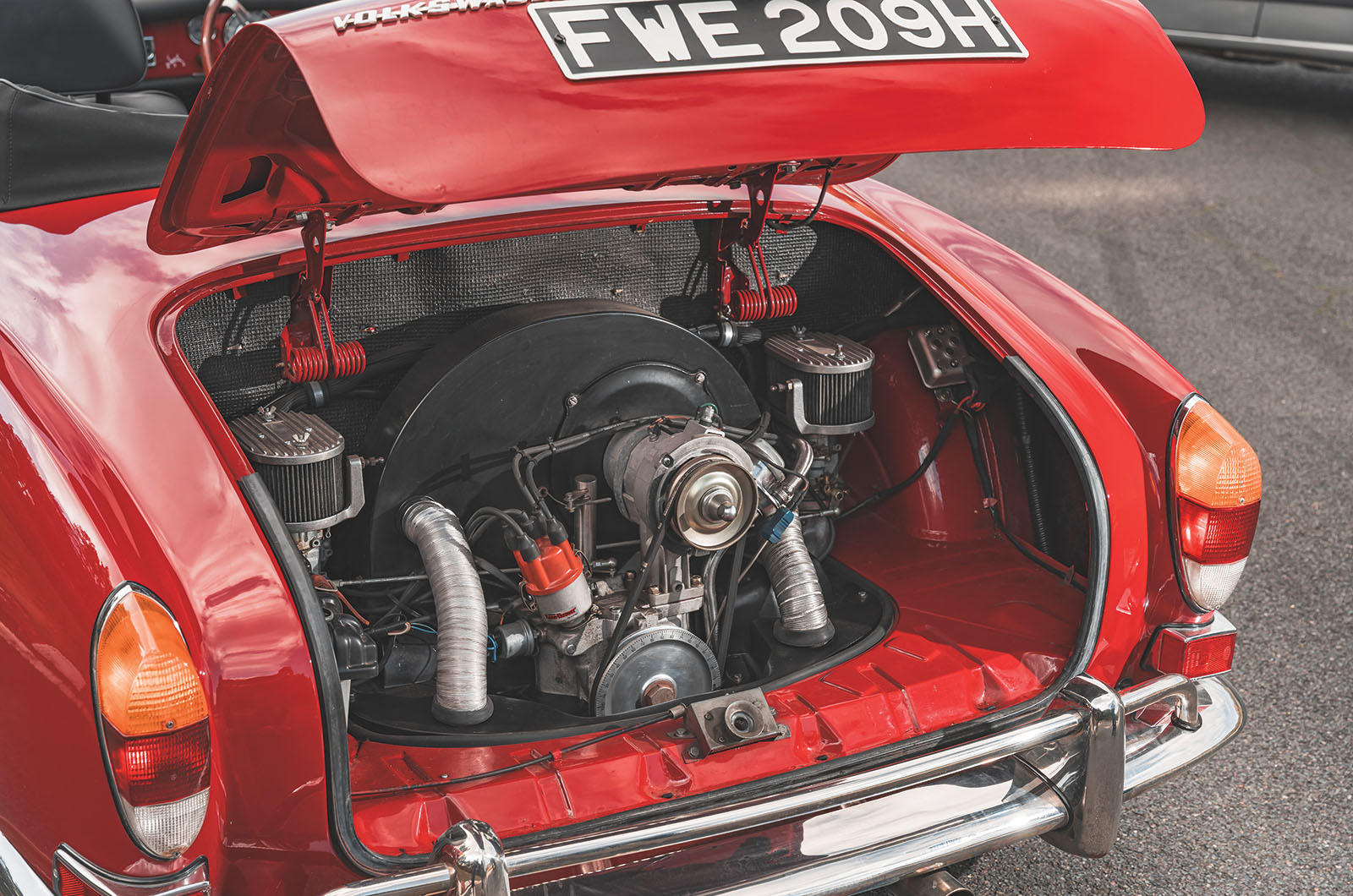
This Volkswagen Karmann Ghia’s uprated flat-four engine has twin carburettors
However, I do have to stop gazing and start driving at some point. Dropping down into the seat means an impressive change of altitude.
With a flat floorpan and low-profile seat, you sit deep within the body looking out over the curvy bonnet/bootlid, which helps give a sense of sportiness – even if the familiar flat-four thrum doesn’t exactly set your heart aflutter.
Changing gears in an old Volkswagen is often like a game of Where’s Wally?, with each ratio hiding in there somewhere, but with a simple and commonly used short-shift kit installed here, gears are easily clicked into place.
If you’ve ever driven an air-cooled VW, the Karmann Ghia provides few surprises.
The lower, more streamlined body should mean a better top speed, but with all the molten lead that Karmann used to hand-finish where the curvy panels join together, the weight crept up.
The usual skinny-tyred understeer on turn-in shifts to oversteer once the weight of the rear-mounted engine catches up with you, but fear not, you’re probably only doing 28mph and well within the speed limit.
A sports car this is not, but it does feel sporty.
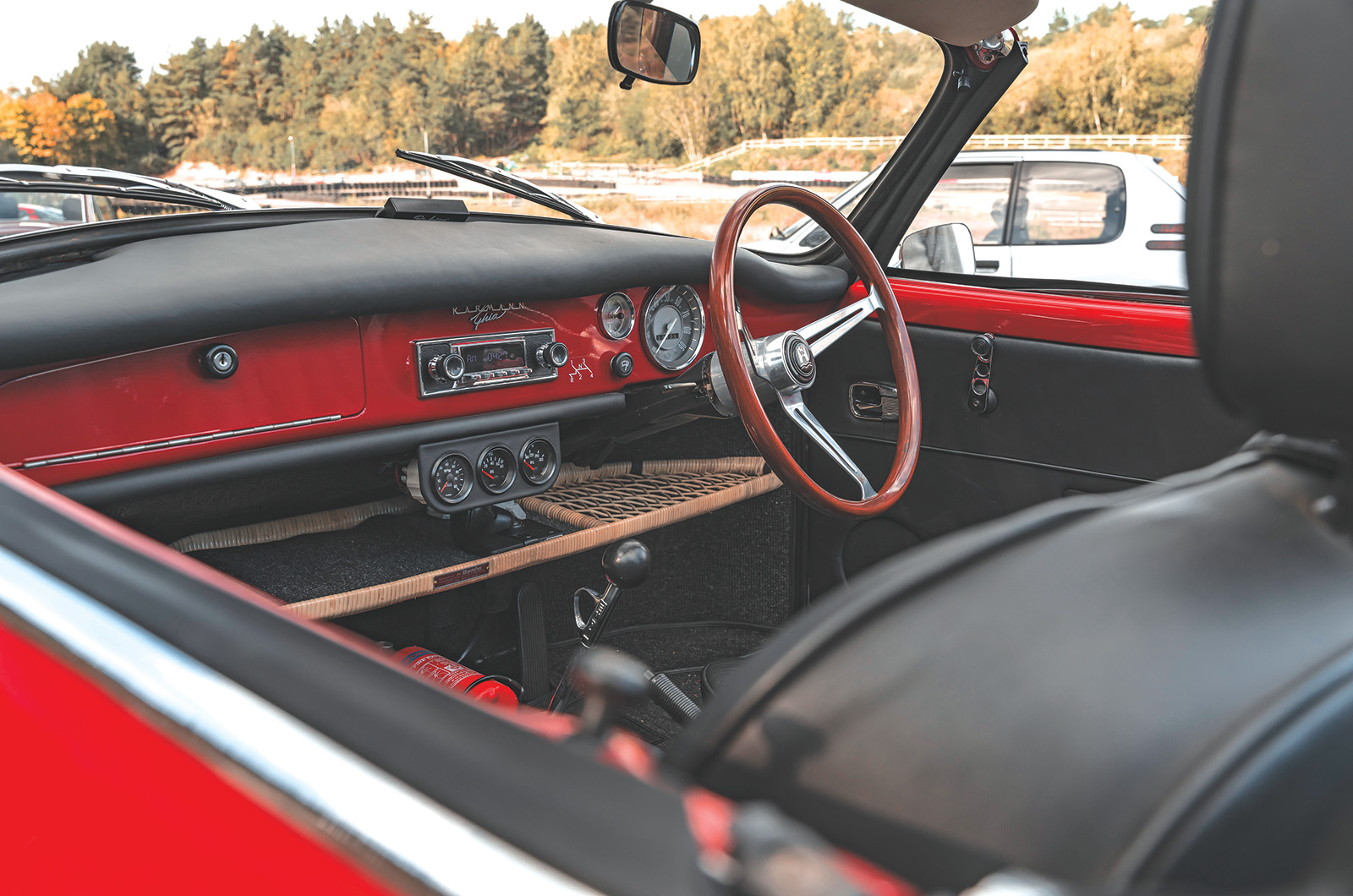
The classic painted dashboard remains in this Volkswagen Karmann Ghia’s much-modified cabin
Owning one is equally rewarding, with spares availability being about as easy as it gets thanks to many shared parts with the Beetle – VW specialists carry most mechanical items you’ll need for very reasonable prices.
Things only get expensive when the dreaded tinworm starts appearing. With hugely costly panels, often only available overseas, it is always best to buy one that has a solid body.
Especially if it’s one like this – without a roof – which will be substantially more expensive in the first place.
Nice Coupés start at around £12,000, but you can add a sunshine premium of c£5000 for an equivalent Cabriolet.
Prices vary wildly, with the market skewed by a large number of left-hand-drive US imports, but in the usual VW way it was on sale for a remarkable 20 years, so there are always plenty to choose from.
John Nicholas is the keeper of this 1969 drop-top, and with eight years of ownership under his belt he still reckons it has “one of the sexiest bodies going”.
Early in his tenure, a trip to Scotland with the owners’ club, where it rained every day, meant not only did he find out which seals were missing, but also confirmed how much his wife loved the VW, too.
“The brakes could be better,” he admits, “but overall it’s a cracking car to own.” I couldn’t agree more.
Words: Damon Cogman
Thanks to: John Nicholas
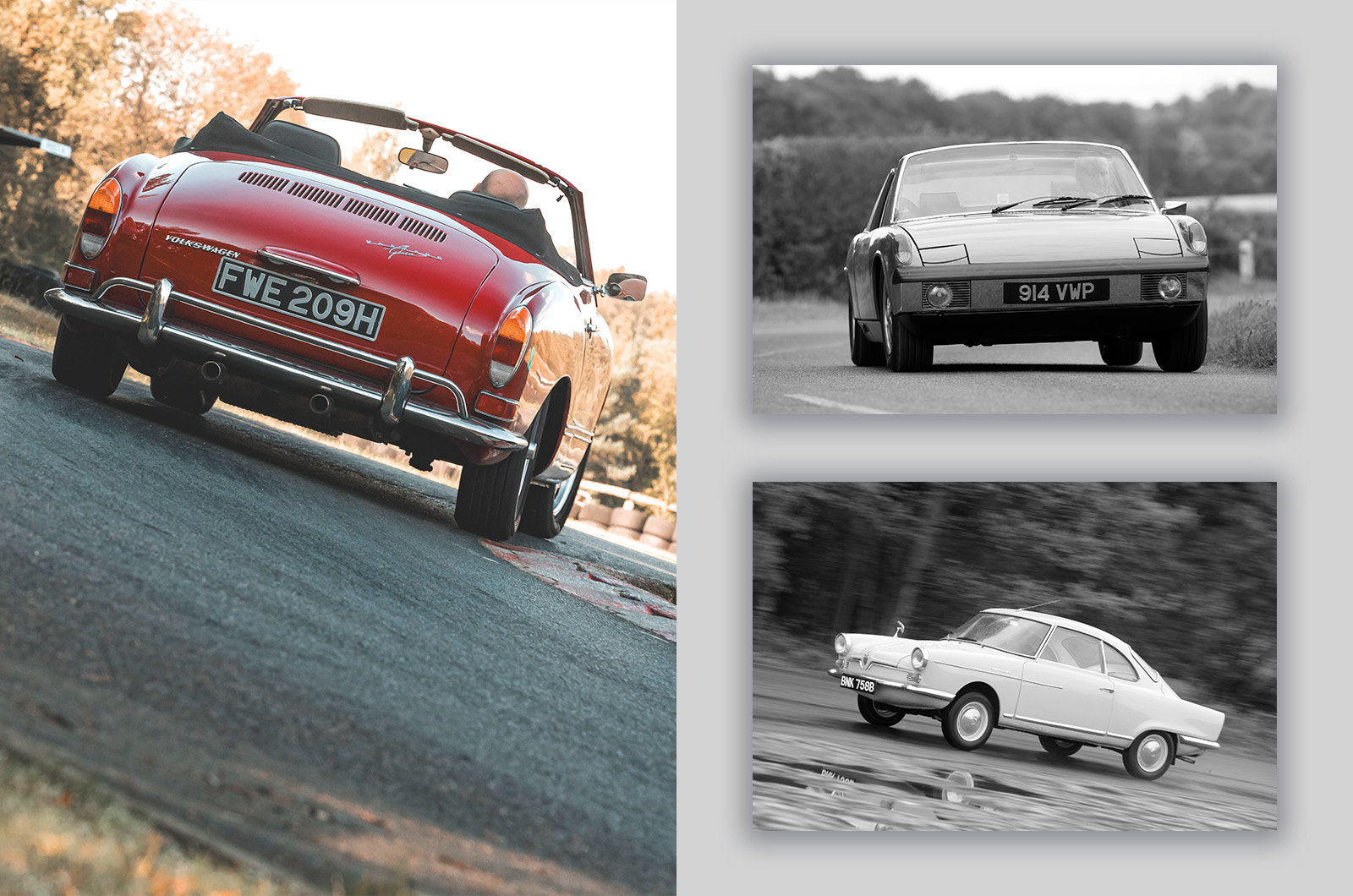
Clockwise from main: the Volkswagen Karmann Ghia’s rearward weight bias is pronounced; Porsche 914; NSU Sport Prinz
Scorecard
- Value for money 2/5
- Ease of maintenance 5/5
- Parts availability 4/5
- Practicality/usability 3/5
- Driver appeal 2/5
- Cars & Coffee factor 4/5
- Total 20/30
Buying tips
- Most VW Karmann Ghias have been restored several times; quality of workmanship is key, so research firms that have done major work
- Earlier ‘low-light’ versions are rare, and command more money, but are painfully slow
- The lead-loaded front and rear bodywork is the province of specialist metalworkers only. Walk away from a car laden with filler in these areas – it’ll cost a fortune to put it right
Alternatives
- Porsche 914 The Karmann Ghia’s brother from another mother has a Volkswagen engine mounted amidships, quirky Germanic looks and a targa-style roof. The Porsche 914 comes with a more upmarket badge, but shares the same DNA and offers a stylish Teutonic rival to the very British MGB
- NSU Sport Prinz Another air-cooled, rear-engined sporty(ish) car, this time penned by rival Italian styling house Bertone and built from 1958-’68. The NSU Sport Prinz is similarly slow, and even if you can trace one, it’ll be trickier still to find parts to keep it puttering along. A bold option, but chic
Porsche 944
The Porsche 944’s transaxle gearbox gives ideal weight distribution and superb balance
As a rational answer to the sports car question of 1976, the original Porsche 924 fulfilled most of what the genre’s buyers had come to expect in a post-Datsun 240Z world.
Practical, relatively affordable and great to drive, its only crime has been one of muddled identity: was it a Volkswagen orphan or an adopted Porsche?
Developed out of the best of that car, the 944 confidently shut down such arguments in favour of Stuttgart, went on to sell more than 163,000 units and has gracefully aged into a classic car with the same sort of broad appeal behind the MGB’s enduring popularity.
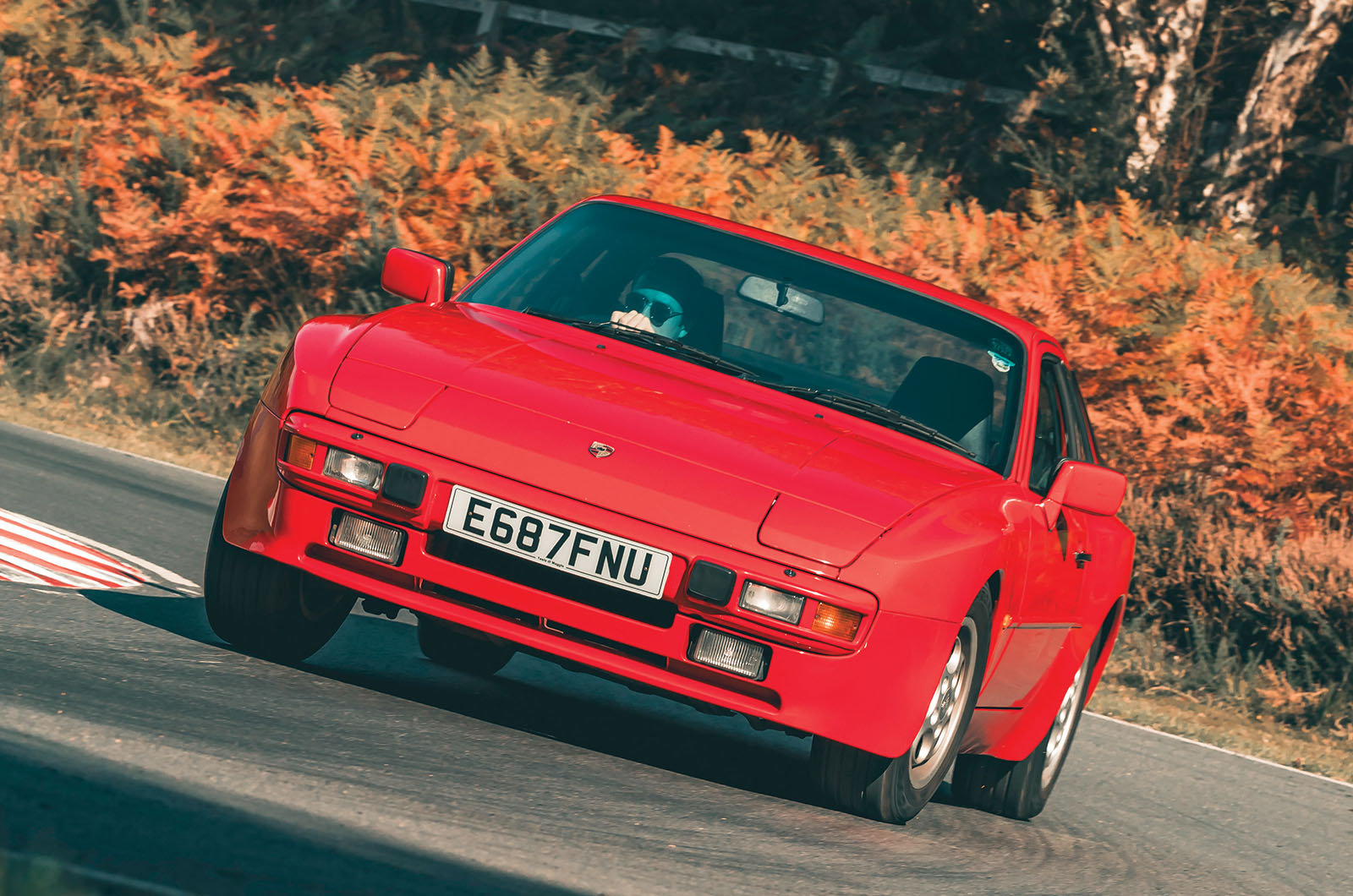
From a mile away, the Porsche 944 is so obviously a sports car, revealing some of the 1980s’ greatest hits of performance styling as you get closer.
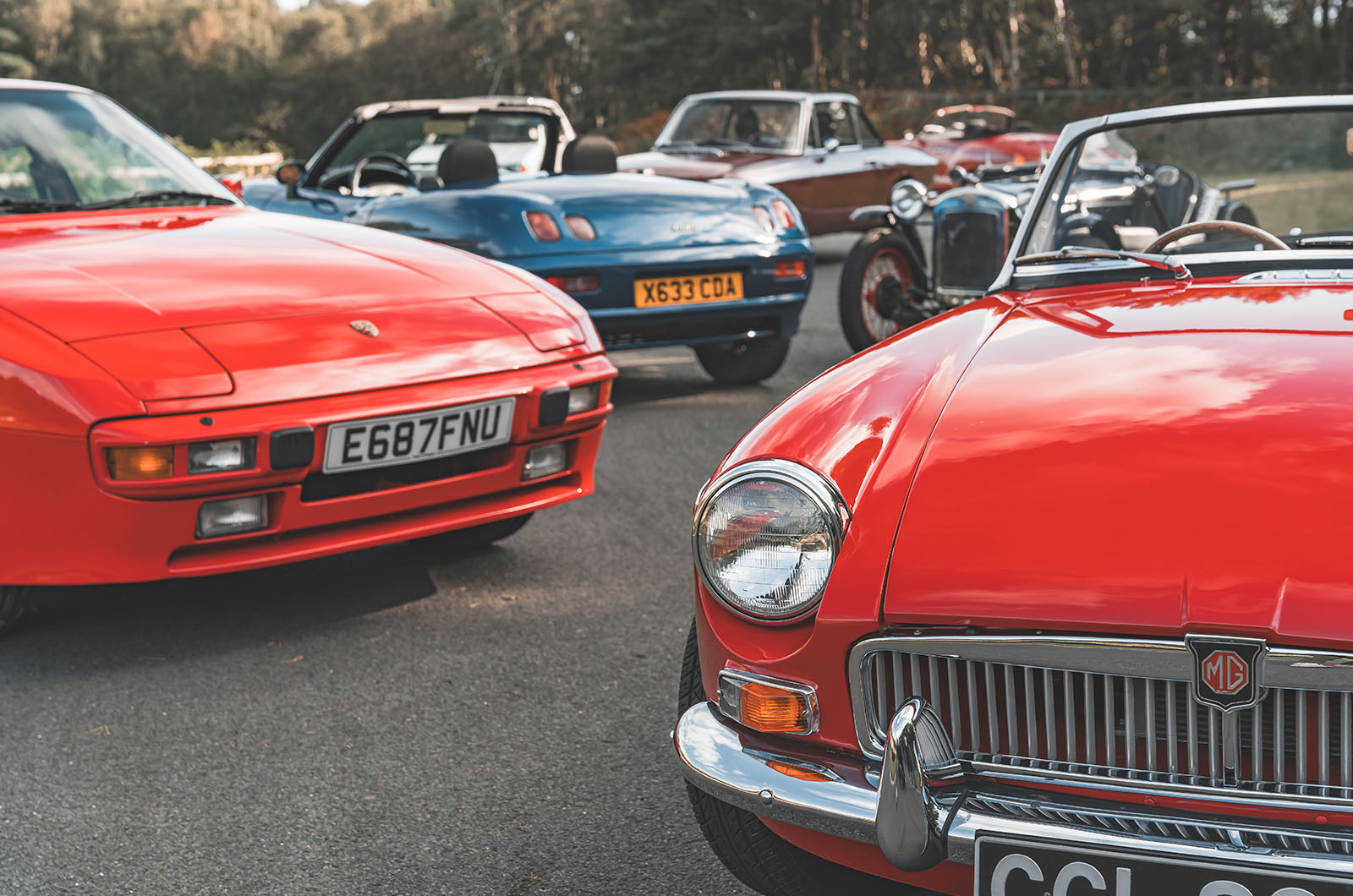
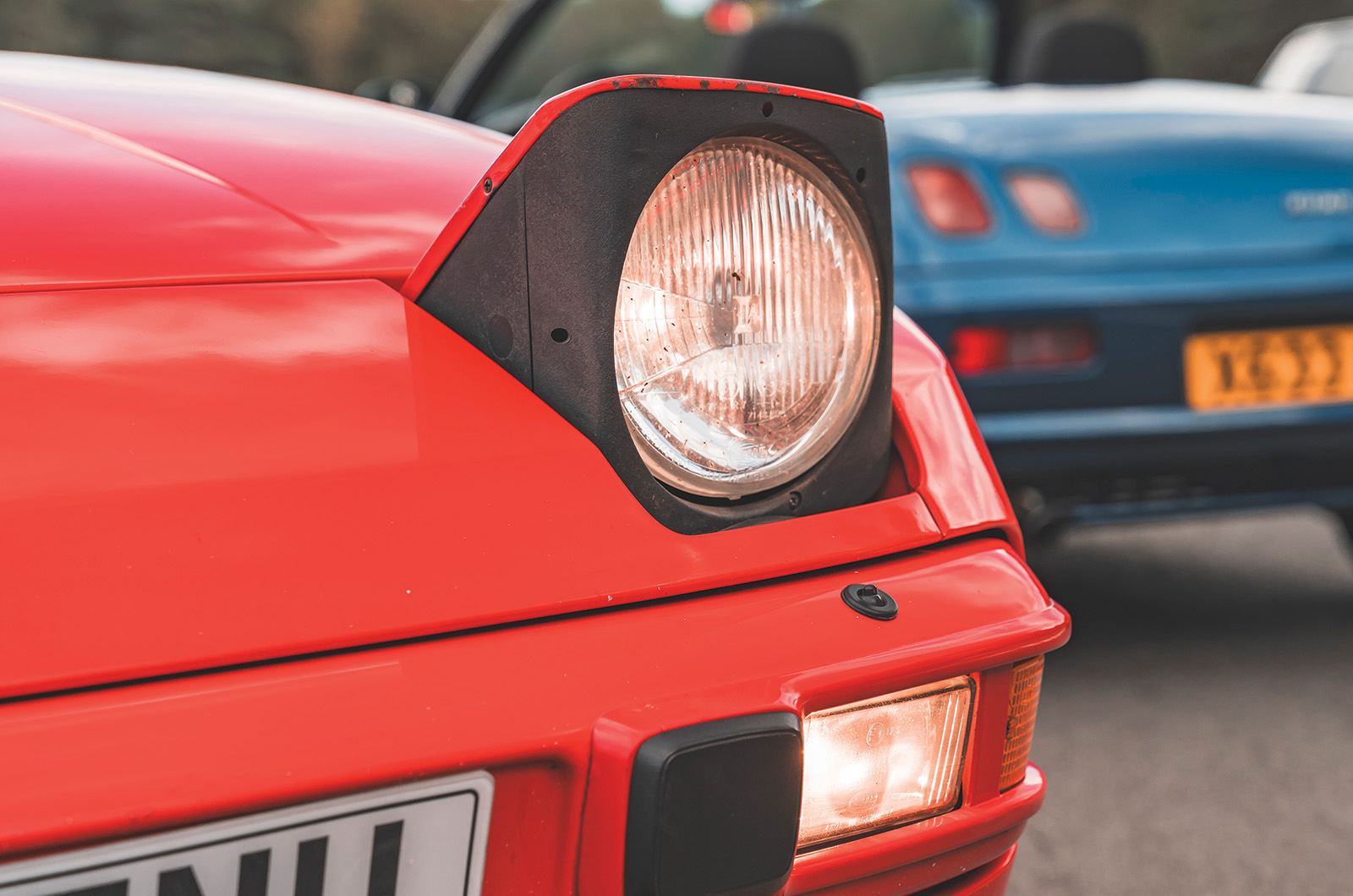
The pop-up headlights accentuate the long bonnet and wedge-shaped profile, while flared wheelarches and a deep, wraparound rear spoiler denote this as ‘the one with the Porsche engine’.
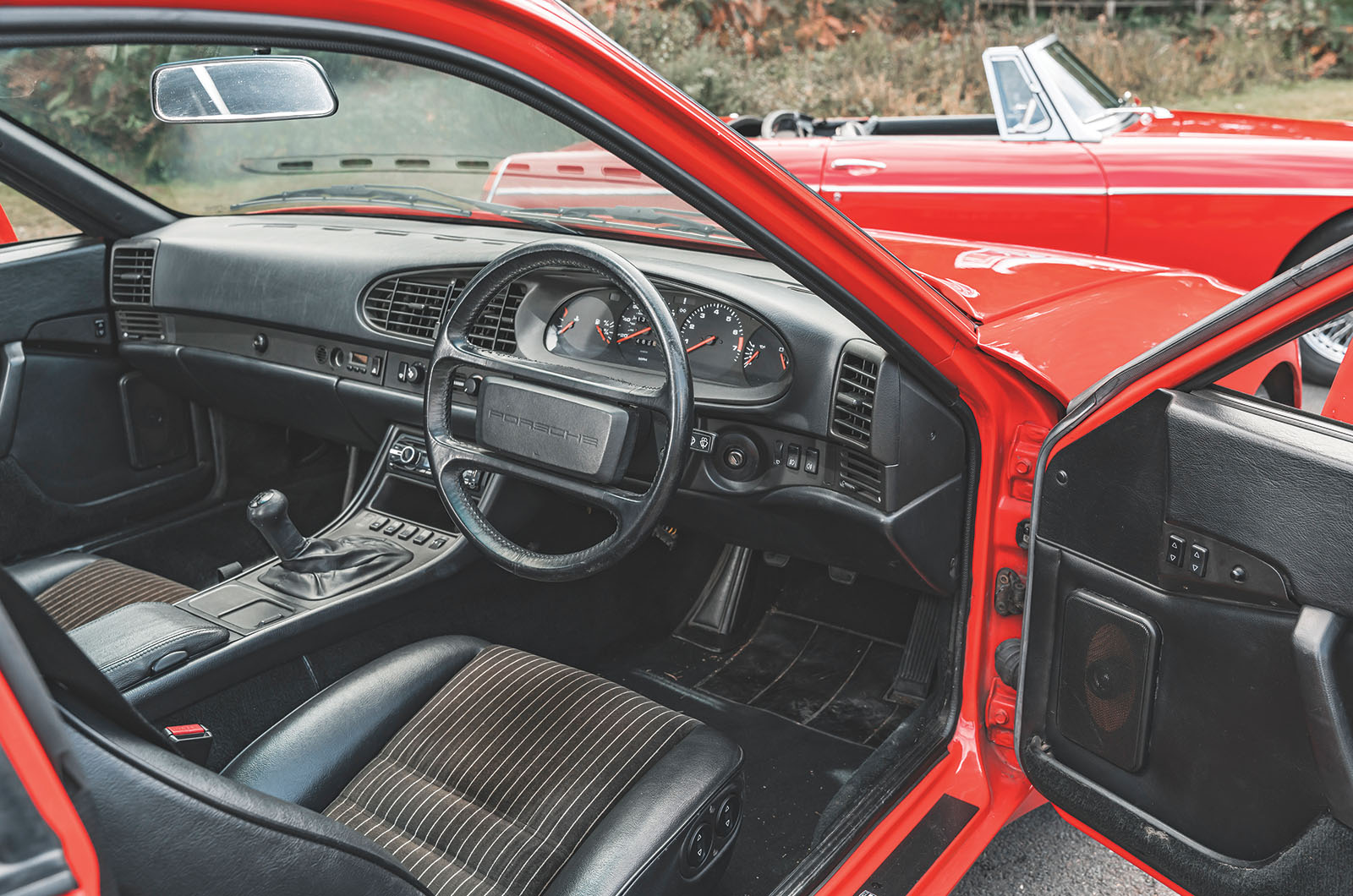
There are Teledial alloy wheels, supplementary driving lamps and, inside, an array of serious-looking dials and low-set seats – both out of a Porsche 911, if that matters.
The Porsche’s sober but stylish interior is well made
Apart from the pinstripe trim fitted to so many examples – including ‘our’ 1988 eight-valve Lux, which market expert John Mayhead has owned for 12 years – the interior is a little austere, but time has lent it some charm: the scattered, clunky plastic controls and divisive steering wheel are part of its ’80s Porsche identity.
To John’s 22-year-old son, Freddie, the 944 is a world apart from his modern hatchback: “It immediately feels different, purposeful, and I like how everything is easy to use and built to last.
“You sit so low and the steering has real weight to it. The whole car really involves you.”
With a perfectly in-line driving position and a sense that you’re sitting right in the middle of the car, there is a natural focus to the Porsche 944 even as you saunter off from a standstill.
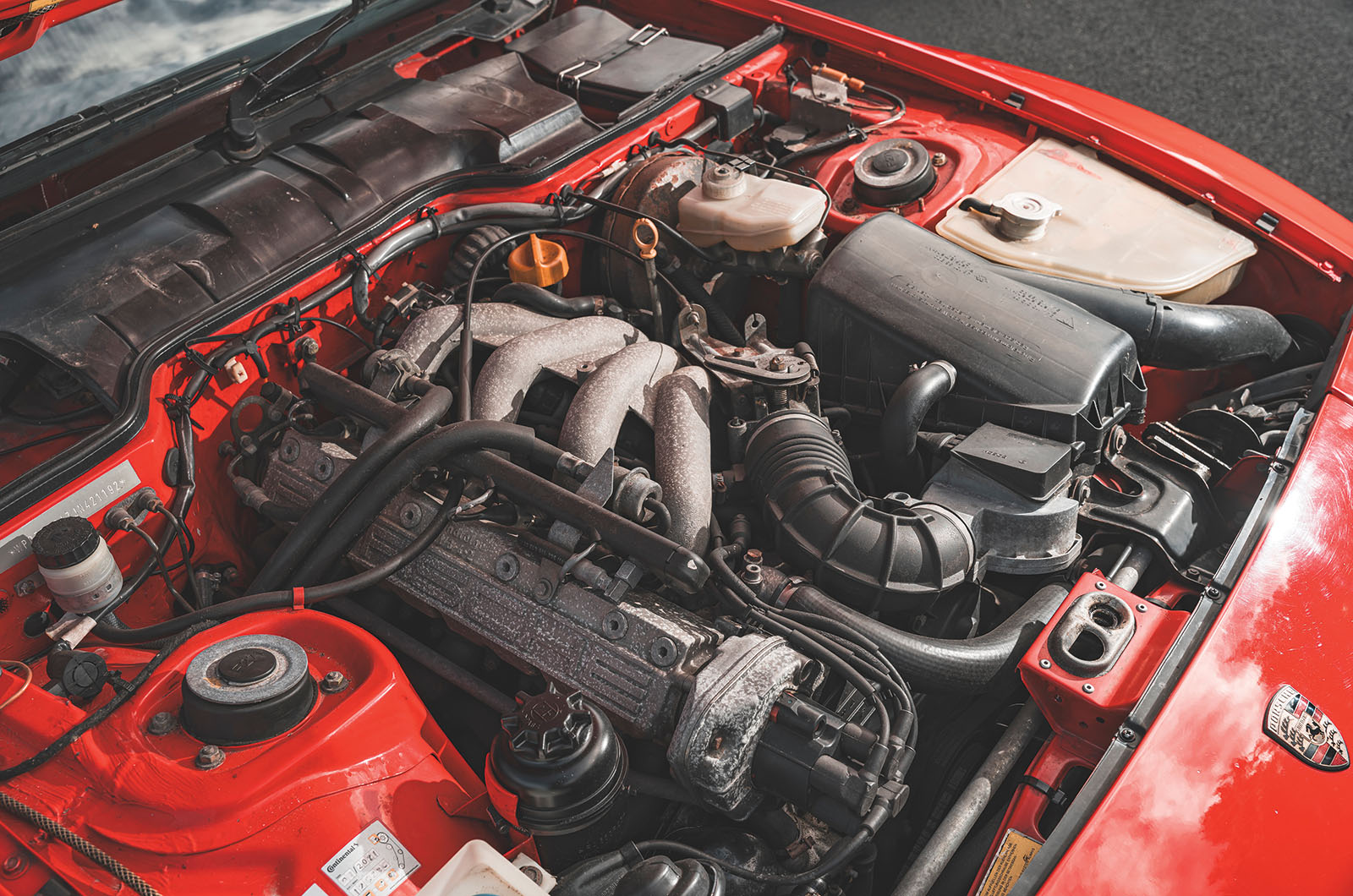
Yet it is so easy: the big, double-counterbalanced 2479cc ‘four’ is smooth, flexible; the transaxle gearbox is positive, slick; and the all-independent, long-travel suspension is forgiving and controlled.
It doesn’t take long before you’re planting your right foot and seeing just what this thing can do, which is a lot.
The first 924s danced on 165mm-wide tyres, but the Porsche 944 can sink its 205/55 front and 225/50 rear Pirelli P7s into the Tarmac and fly through corners at a rate that would leave many moderns far behind.
The Porsche 944’s 2479cc ‘four’ is smooth
The steering, throttle and brakes have a weighty precision about them, and inspire measured inputs; even the gear ratios are long, best for leaving the gutsy ‘four’ to mete out big doses of shove with a delightfully crisp response.
The Porsche just gets better, sharper and more energetic the harder you push it.
You can see the appeal of the more powerful and lighter-weight models for those caught up in the pursuit of faster lap times; wieldy and easy to manipulate, the 944 can launch drivers from a pleasant Sunday jaunt to improving their lines around a race track without changing its tune.
Inevitably, these more specialist models have their financial premiums: the 247bhp 944 turbo starts from around £20,000 and the ultimate, track-focused 968 Club Sport is an increasingly collectible investment of £30k or more.
The 16-valve, 3-litre S2 has long been considered the Goldilocks variant, which saw out the Porsche 944 production run from 1989 to its 968 replacement in 1992, but there’s something to be said about the older, eight-valve cars, whose smaller wheels and more pronounced bumpers are better matched with such older sports car company as we have today.
Either way, from as little as £5000 the 944 is not only all the sports car you could ever need (Porsche even did a few drop-tops), but it could even be your only car.
The Porsche 944’s 1980s cliché pop-up headlights
It’s quiet and refined enough to be comparable to a contemporary saloon, and its servicing demands are not much worse, either, thanks to a large community of keen owners, plentiful parts that eschew most of the 911’s eye-watering prices, and the typically German layout of regular touchpoints that would encourage even the most reluctant DiY mechanic.
It’ll tip over 25mpg on a run, too. Certainly passable as a daily driver, then, and even better for long road trips.
While the rear plus-two seats are more for short journeys, the front buckets are supremely comfortable and the boot has space enough for weeks away.
John and Freddie have taken this car to the south of France more than once, and recently returned from the Scottish Highlands, where the Porsche’s comfortable, 6ft-friendly driving position, good ventilation, effective windscreen wipers and decent headlights added another layer of sports-car capability.
No wonder there are so many examples with hundreds of thousands of miles under their wheels.
A sports car for all people and all seasons, ready for your favourite section of the commute as much as the occasional track day or epic run to the Alps.
The only problem is that your mother may like it, too.
Words: Aaron McKay
Thanks to: John and Freddie Mayhead
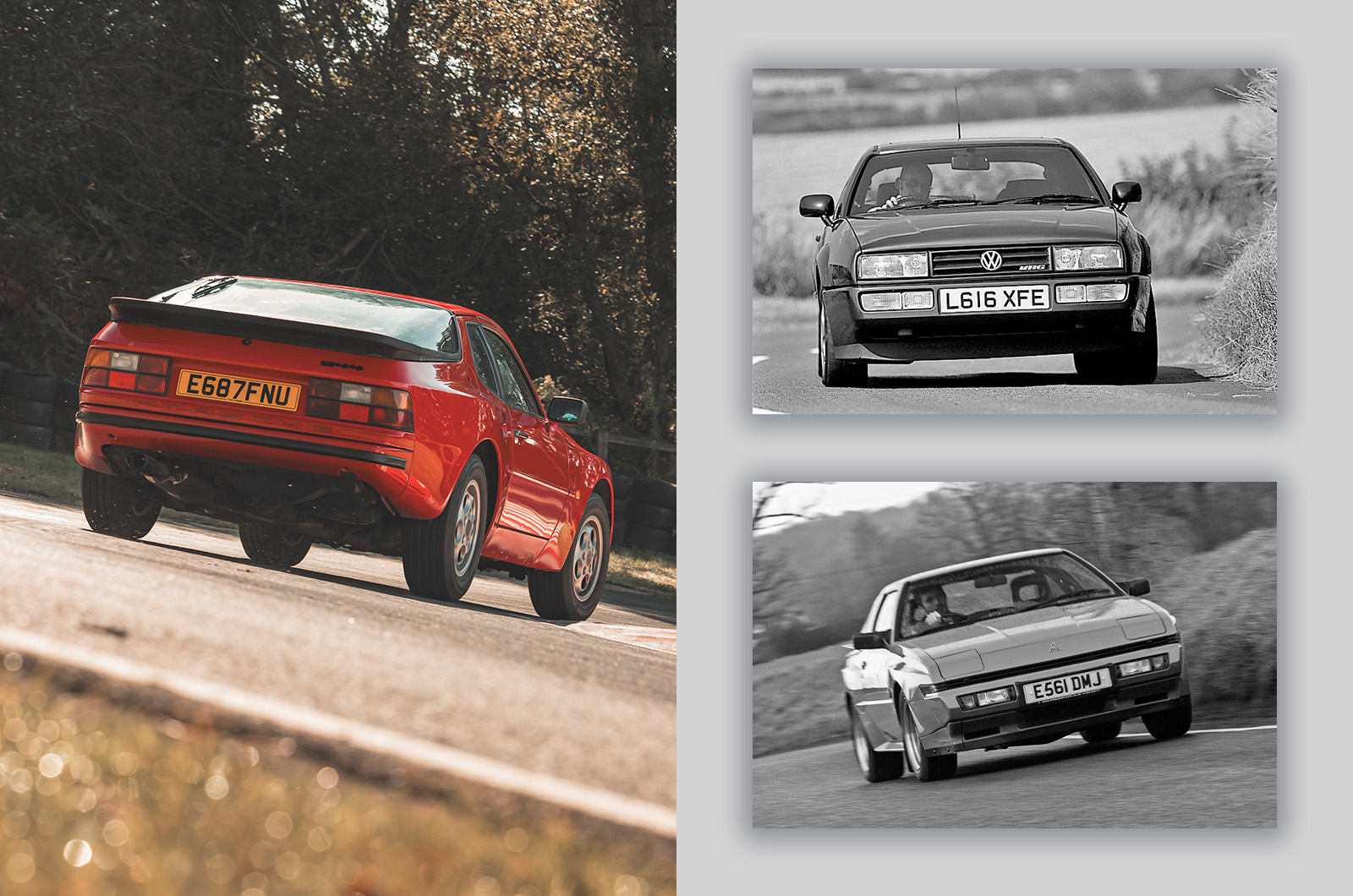
Clockwise from main: the Porsche 944’s practical hatchback rear; Volkswagen Corrado; Mitsubishi Starion
Scorecard
- Value for money 4/5
- Ease of maintenance 4/5
- Parts availability 4/5
- Practicality/usability 5/5
- Driver appeal 4/5
- Cars & Coffee factor 3/5
- Total 24/30
Buying tips
- The engine and gearbox should be smooth, so beware if it feels rough or reluctant, and especially of whining in the gears
- Check for regular fluid changes, plus cam drive and balancer-shaft drive replacement at 48k miles or four years, and inlet chain at 96k on twin-cams
- Electrics can suffer from lack of use and water ingress through the sunroof, and some, such as the pop-up headlight motors, are expensive
Alternatives
- Volkswagen Corrado The sporting coupé that VW actually did market, from 1988-’95, with four-cylinder and V6 power. Rarer than a 944 and bound to make more of an impact at car shows, but trickier to maintain thanks to some unique parts and quite pricey at £8-15,000
- Mitsubishi Starion The Porsche 944’s arch nemesis from Japan, with a similar silhouette and, from 1985, even more aggressively wide arches. Its turbo ‘four’ is strong enough to match the S2, especially the 1986-on intercooled models, and it’s a cult classic with values to match
Factfiles
MGB
- Sold/no built 1965-’80/c500,000 (all)
- Engine ohv 1798cc ‘four’, twin SU carbs
- Max power 95bhp @ 5400rpm
- Max torque 110lb ft @ 3000rpm
- Transmission four-speed manual, optional overdrive, RWD
- Weight 2028lb (920kg)
- Mpg 29
- 0-60mph 11.5 secs
- Top speed 106mph
- Price new £1217
- Price now £8-17,000*
Lancia Fulvia Coupé
- Sold/no built 1965-’76/134,035 (all)
- Engine sohc 1298cc V4, two twin-choke Solex carburettors
- Max power 90bhp @ 6000rpm
- Max torque 84lb ft @ 4500rpm
- Transmission five-speed manual, FWD
- Weight 2050lb (930kg)
- Mpg 27
- 0-60mph 13 secs
- Top speed 105mph
- Price new £2177
- Price now £15-20,000 (Fulvia 3)*
Austin Seven Special
- Sold/no built 1930-’32/168 (Ulster)
- Engine sidevalve 747cc ‘four’, Solex carburettor
- Max power 24bhp @ 4500rpm
- Max torque n/a
- Transmission three-speed manual, RWD
- Weight c952lb (432kg)
- Mpg 40
- 0-60mph 24 secs
- Top speed 60mph
- Price new £185 (1930)
- Price now £10-25,000*
Peugeot 205 GTI
- Sold/no built 1986-’94/332,924 (all GTIs)
- Engine sohc 1905cc ‘four’, Bosch LE2-Jetronic fuel injection
- Max power 128bhp @ 6000rpm
- Max torque 122lb ft @ 4750rpm
- Transmission five-speed manual, FWD
- Weight 2004lb (910kg)
- Mpg 32
- 0-60mph 7.8 secs
- Top speed 127mph
- Price new £10,295 (1988)
- Price now £8-25,000*
Fiat Barchetta
- Sold/no built 1995-2005/57,625
- Engine dohc 1747cc ‘four’, fuel injection
- Max power 130bhp @ 6300rpm
- Max torque 121lb ft @ 4300rpm
- Transmission five-speed manual, FWD
- Weight 2328lb (1056kg)
- Mpg 28
- 0-60mph 8.6 secs
- Top speed 118mph
- Price new £14,000 (1998)
- Price now £4-10,000*
Volkswagen Karmann Ghia
- Sold/no built 1955-’74/80,877 (Type 14 Convertibles)
- Engine ohv 1584cc flat-four, Solex carburettor
- Max power 57bhp @ 4400rpm
- Max torque 82lb ft @ 3000rpm
- Transmission four-speed manual, RWD
- Weight 1918lb (870kg)
- Mpg 26.7
- 0-60mph 21.3 secs
- Top speed 84mph
- Price new £1166 (Coupé, 1960)
- Price now £12-35,000*
Porsche 944
- Sold/no built 1982-’92/163,820
- Engine sohc 2479cc ‘four’, with digital ignition and Bosch L-Jetronic fuel injection
- Max power 163bhp @ 5800rpm
- Max torque 151lb ft @ 3000rpm
- Transmission five-speed manual or three-speed auto, RWD
- Weight 2815lb (1274kg)
- Mpg 25
- 0-60mph 8.2 secs
- Top speed 136mph
- Price new £18,234 (1985)
- Price now £5-10,000*
*Prices correct at date of original publication
Enjoy more of the world’s best classic car content every month when you subscribe to C&SC – get our latest deals here
READ MORE
Buyer’s guide: MGB roadster
More for less: 12 £18,000 classic sports cars
Triumph Spitfire vs MGB vs Lotus Elan: a new dawn
Classic & Sports Car Editorial team