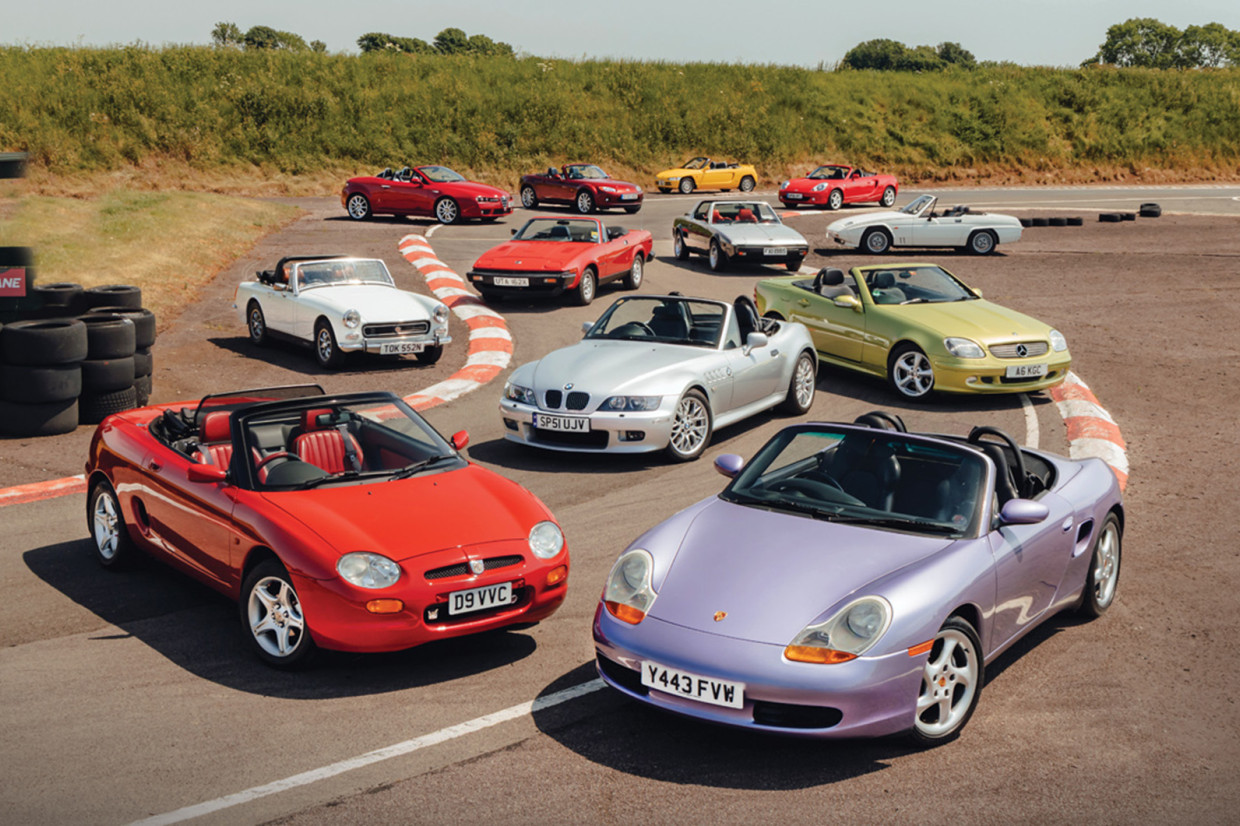
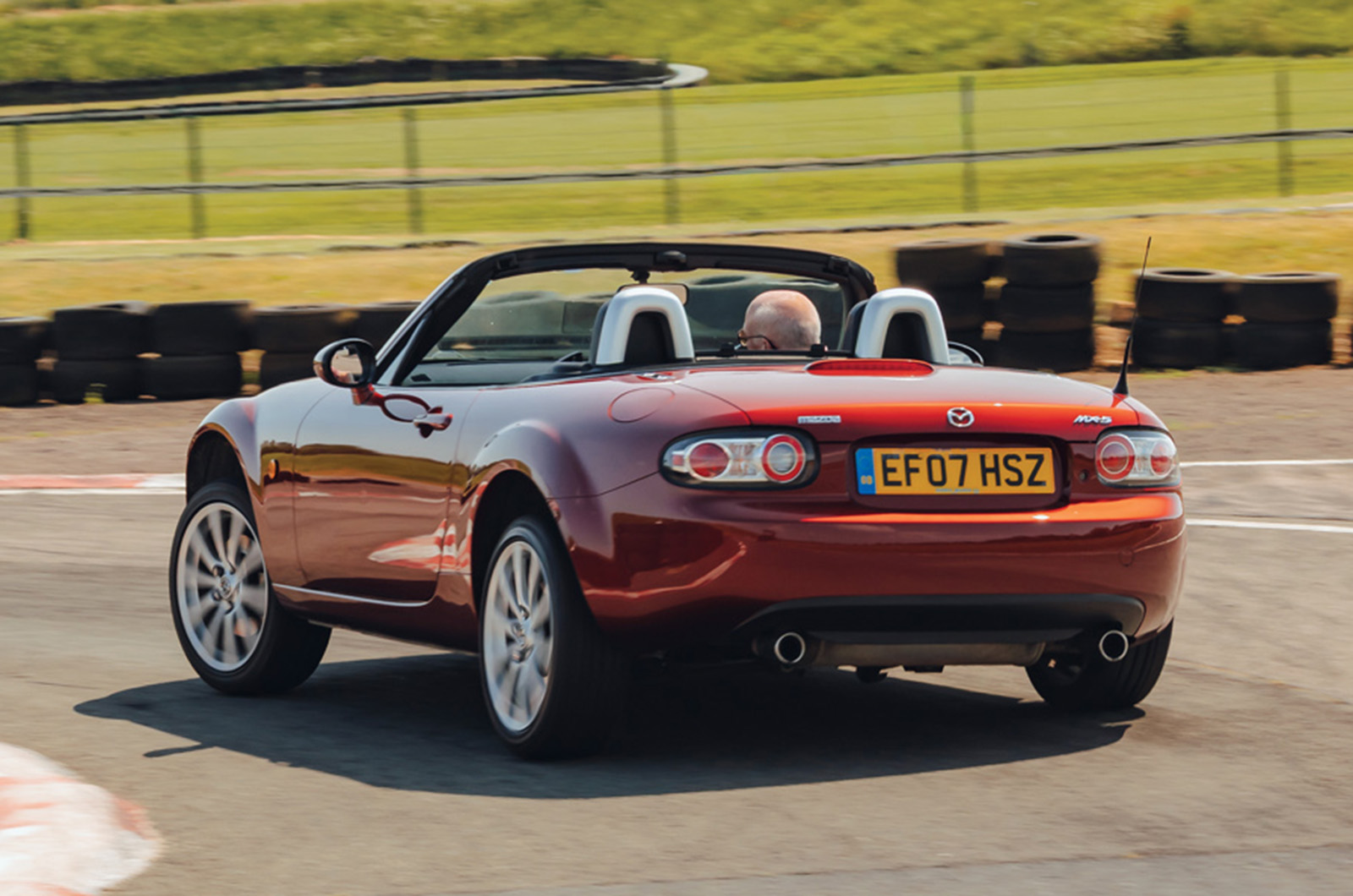
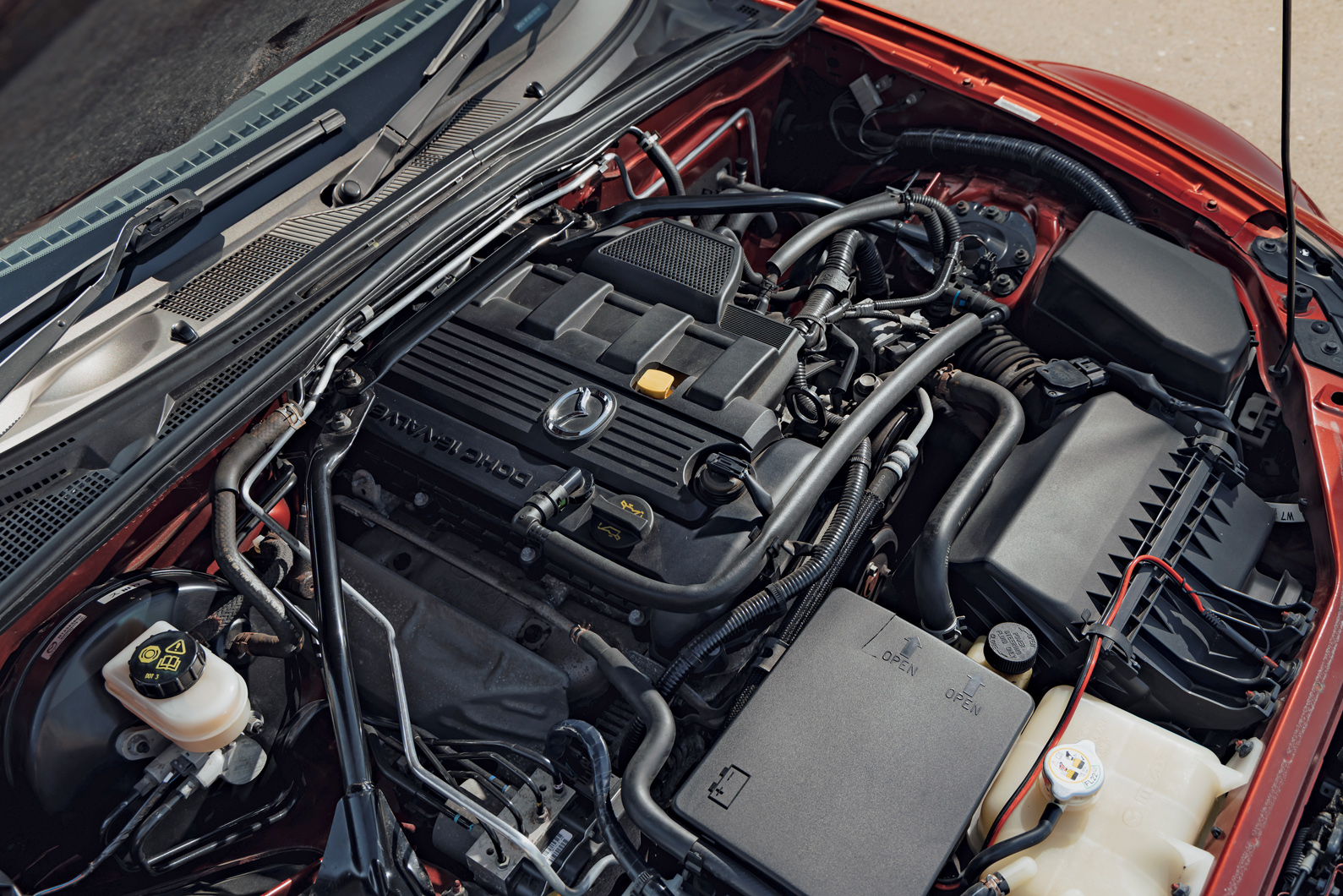
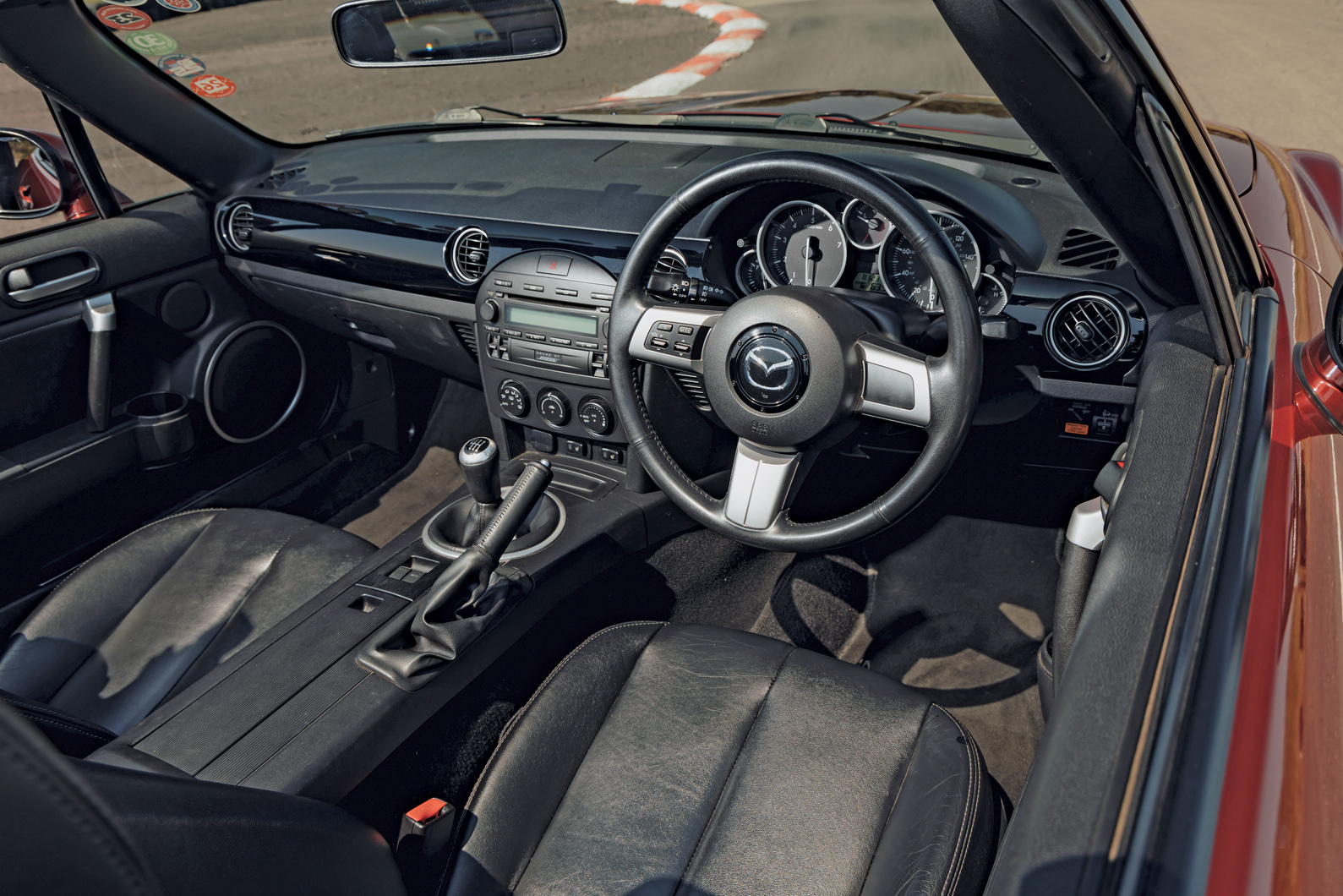
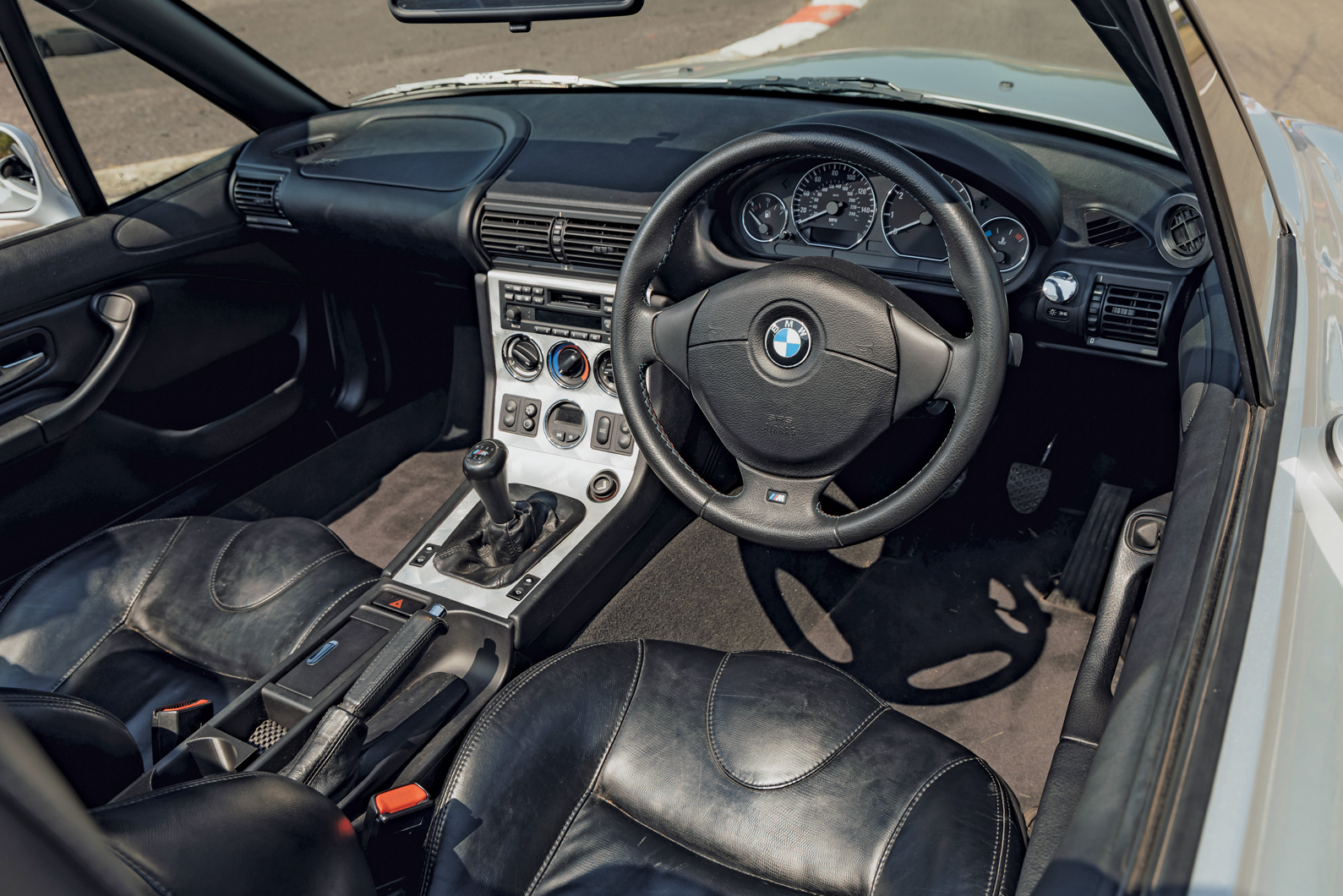
While the steering wheel is a little bloated by the airbag it packs, the rim is an ideal thickness. The seats are supportive, with a small hump in the middle of the squab that’s less intrusive than the crotch-killer on current M cars.
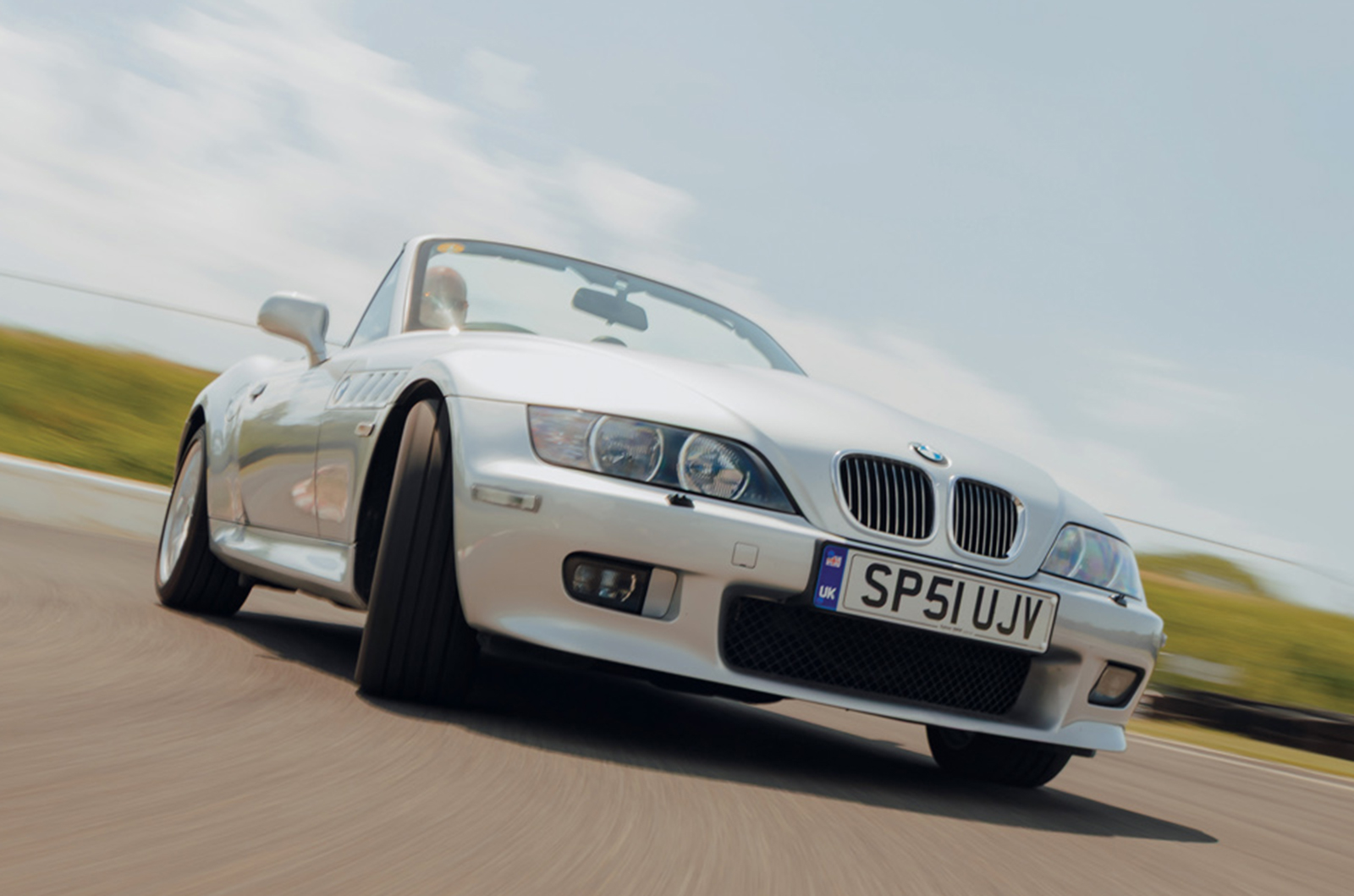
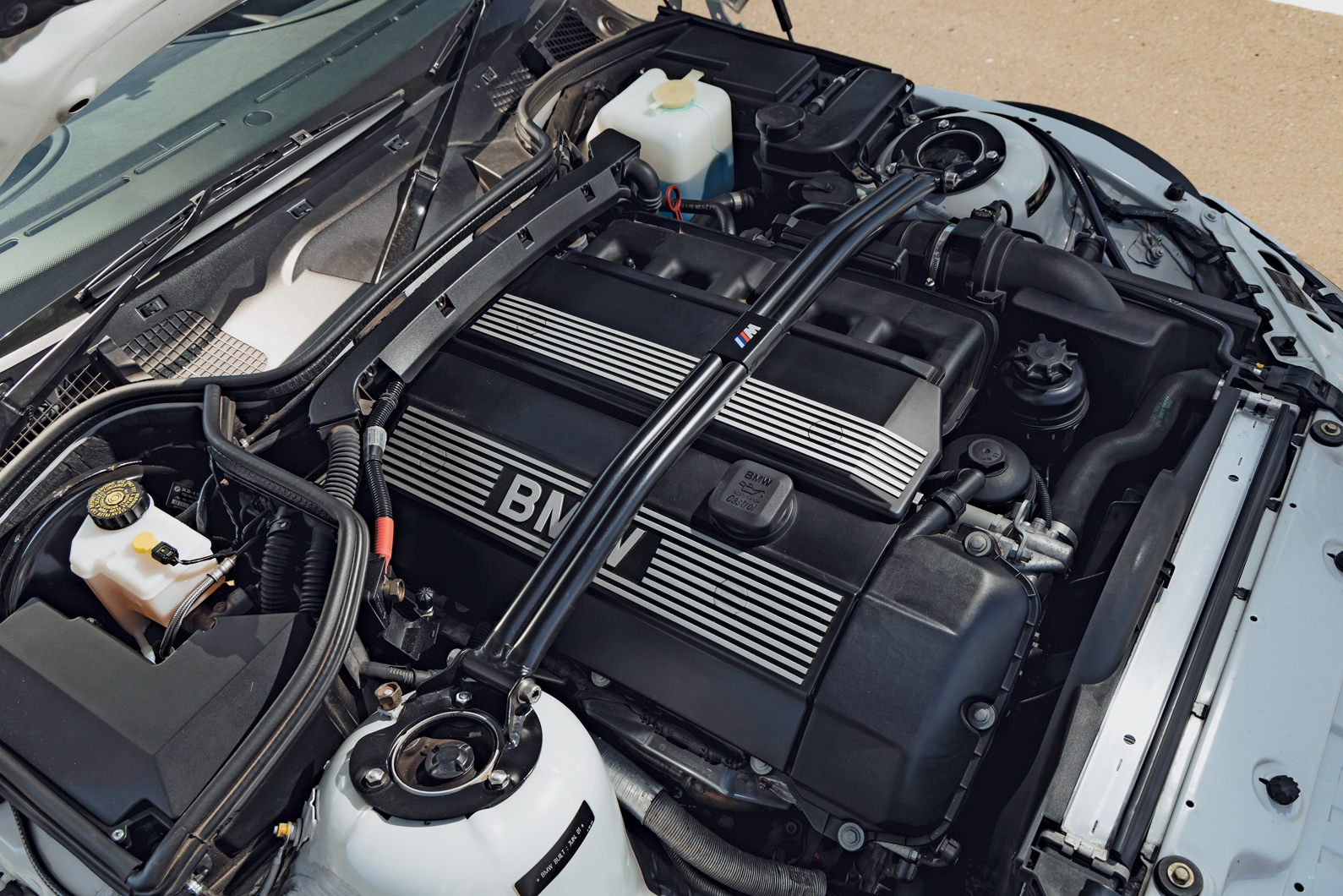
The BMW Z3’s straight-six engine dominates the driving experience
The BMW’s design was divisive when it was new, but to my eyes the Joji Nagashima-penned Z3 was always striking in the best way.
Before 1999, the wide body was exclusive to the 2.8-litre, but it was bestowed on the rest of the range when the facelift arrived.
If you’re considering the later, big-hipped cars, the view of the bulging flanks in the door mirror alone is worth the price of admission. They cover the Z3’s chunky tyres, which, despite their 245mm width, feel as if they would quickly give up in a fight against your right foot and 221lb ft of torque.
The ‘six’ is refined but sounds properly racy near the 6500rpm redline, with every prod of the floor-mounted throttle eliciting a gurgle from the twin pipes.
Period tests took offence at the soft suspension and scuttle shake; I can’t comment on the latter after a blast on a pebble-smooth circuit, but the set-up feels supple, not mushy, as the pleasingly old-school BMW rolls into corners and squats under acceleration.
No matter how you slice it, the Z3 is a lot of car for the money: open-top thrills, six-cylinder power and a BMW badge for less than £6000.
It won’t cost the earth to run, either: ignoring the 3.2-litre M, this is the biggest-engined Z3 you can buy, but Stuart managed a respectable 30mpg on his 150-mile journey to Shenington Kart Racing Club.
Admittedly, this mint 3.0i would stretch our budget, but you can find high-milers and earlier 2.8s for around £5000, and there are plenty of decent 2- and 2.2-litre examples for as little as £3k.
If you’re just after a snazzy-looking drop-top, don’t discount the four-pot models, which you can find for even less.
If I were handed £6000, though, I’d be on the lookout for a ‘six’. The bigger the better.
Words: Ryan Standen
Thanks to: Lee Lane from BMW Car Club GB
The BMW Z3 3.0i feels more upmarket than the Mazda MX-5
Buying tips
- Check the cooling system: thermostats tend to give up the ghost after 60,000 miles. It’s sensible to inspect the radiator and hoses, too
- The mounts for the Z3’s differential were spot-welded to the boot floor. These are known to fail, so lift the trim and look for cracks and damaged welds
- If the car has a powered soft-top, make sure it works as it should because controller modules can fail. Tired hoods are leaky
Or you could have...
Audi TT Roadster The TT was a cutting-edge shape for the turn of the millennium – albeit one whose principles came from the Bauhaus school of design. You can pick up a 1.8-litre (making 148-225bhp) for less than £4k, but you’ll need more for a 3.2 V6. Four-wheel-drive cars are sharp handlers and a different experience to the rather lairy Z3.
Triumph TR7
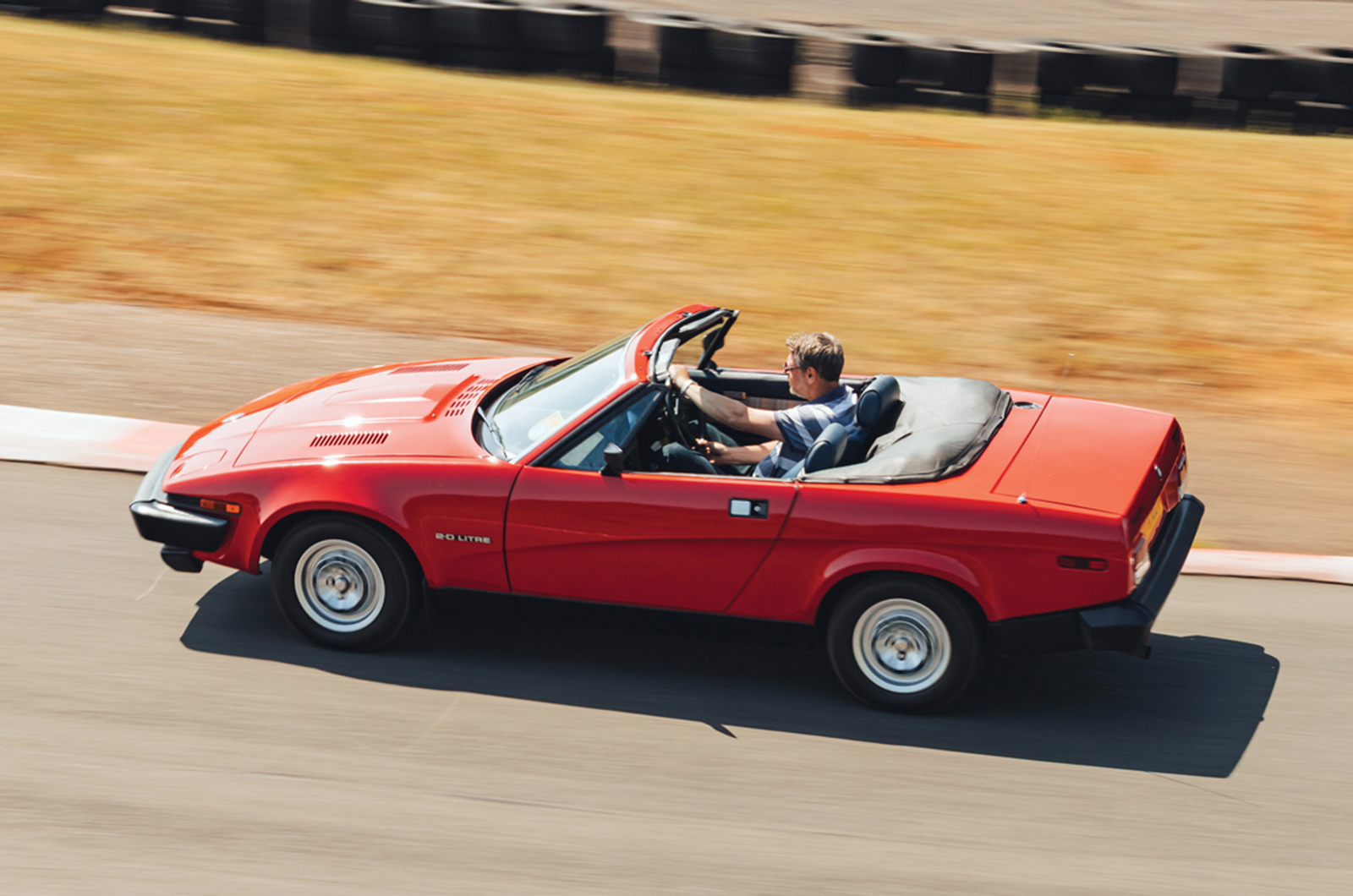
The Triumph TR7’s scalloped flanks are a memorable characteristic of designer Harris Mann’s wedge shape
Two things hit the Triumph TR7 hard when it was launched (initially for the US market) in 1975.
First, it was only available as a coupé, and second it suffered in comparison with the raw thrills of the TR2-6 that came before.
Had it not been such a departure, you suspect that Harris Mann’s fresh, clean-sheet design would have been far better received.
Throw in the usual British Leyland brickbats around cost-cutting, shoddy build quality and rampant corrosion, and the poor old TR7 never stood a chance.
“To own a 7 you’ve got to be slightly rebellious – and thick-skinned,” says Mike Watson-Smith. “I’ve heard all the jokes, but it’s a fantastic car.” He should know, having owned this December 1981 car since April ’83.
“That’s what I nearly bought,” he exclaims, pointing at Steve Farrall’s Fiat X1/9. “I was an Alfa guy, I’d owned two Suds before this, but my sister told me I should get a convertible.
“I refused to have an MGB, then went to look at this and did what I was told! By the time I got my first company car a few years later it wasn’t worth anything, so I just kept it.”
It’s very rare to find a TR7 as original and unmolested as this 65,000-mile Convertible, and you won’t get one this nice within our £6k limit, either.
Good 7s are few and far between, but a bit of patience should land a solid and usable example that you can look to improve.
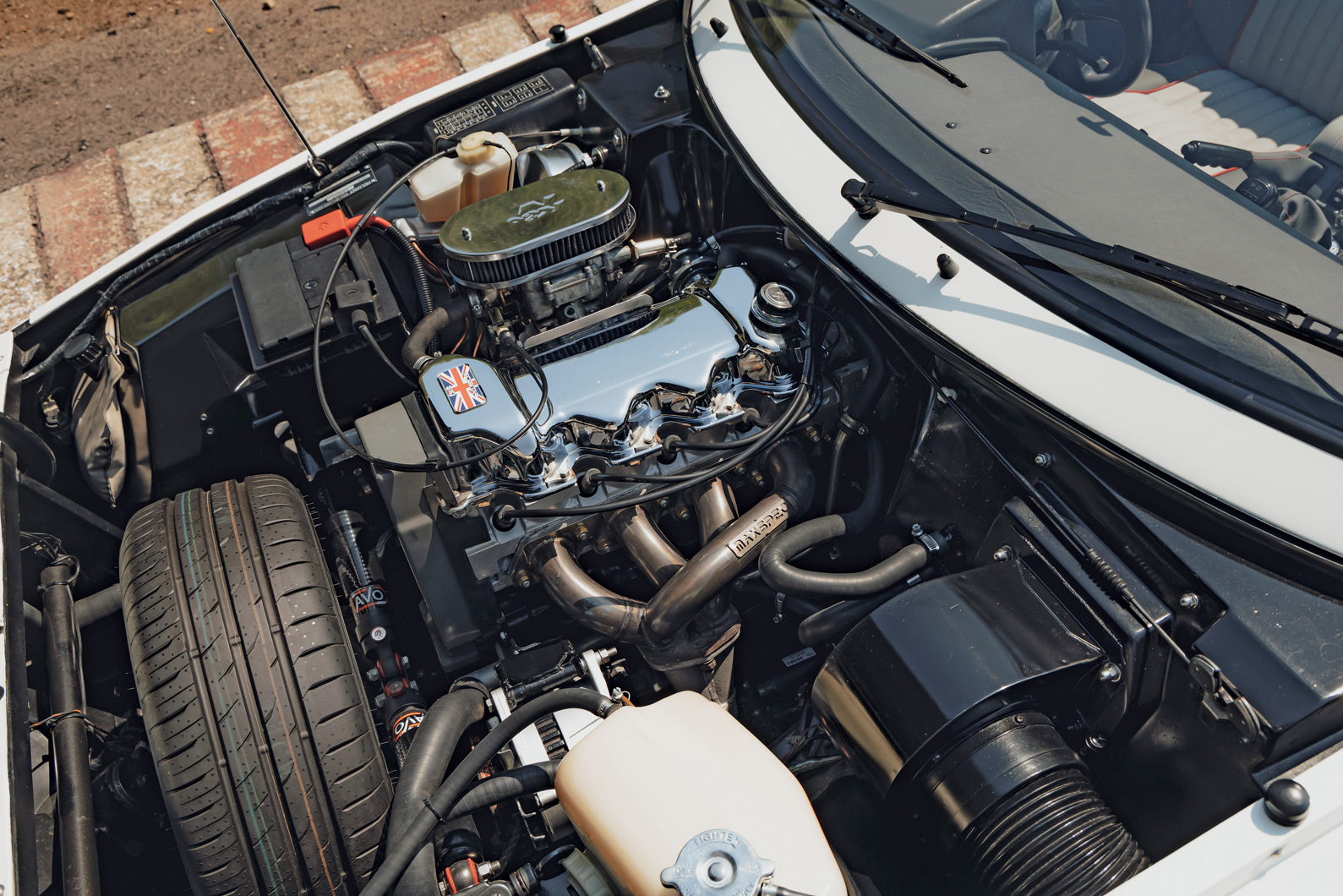
Mike’s very late car is Canley-built, but with some Solihull bits, and features the improved steel and five-speed Rover SD1 gearbox that arrived in the fixed-head for 1978.
He’s still wary of the dreaded rot, however. “The number one thing is the body,” Mike confirms. “You’ve got to get a solid car because you’ll struggle to get the bits for a rusty one. The problem was the primer – once repainted properly, they are fine.”
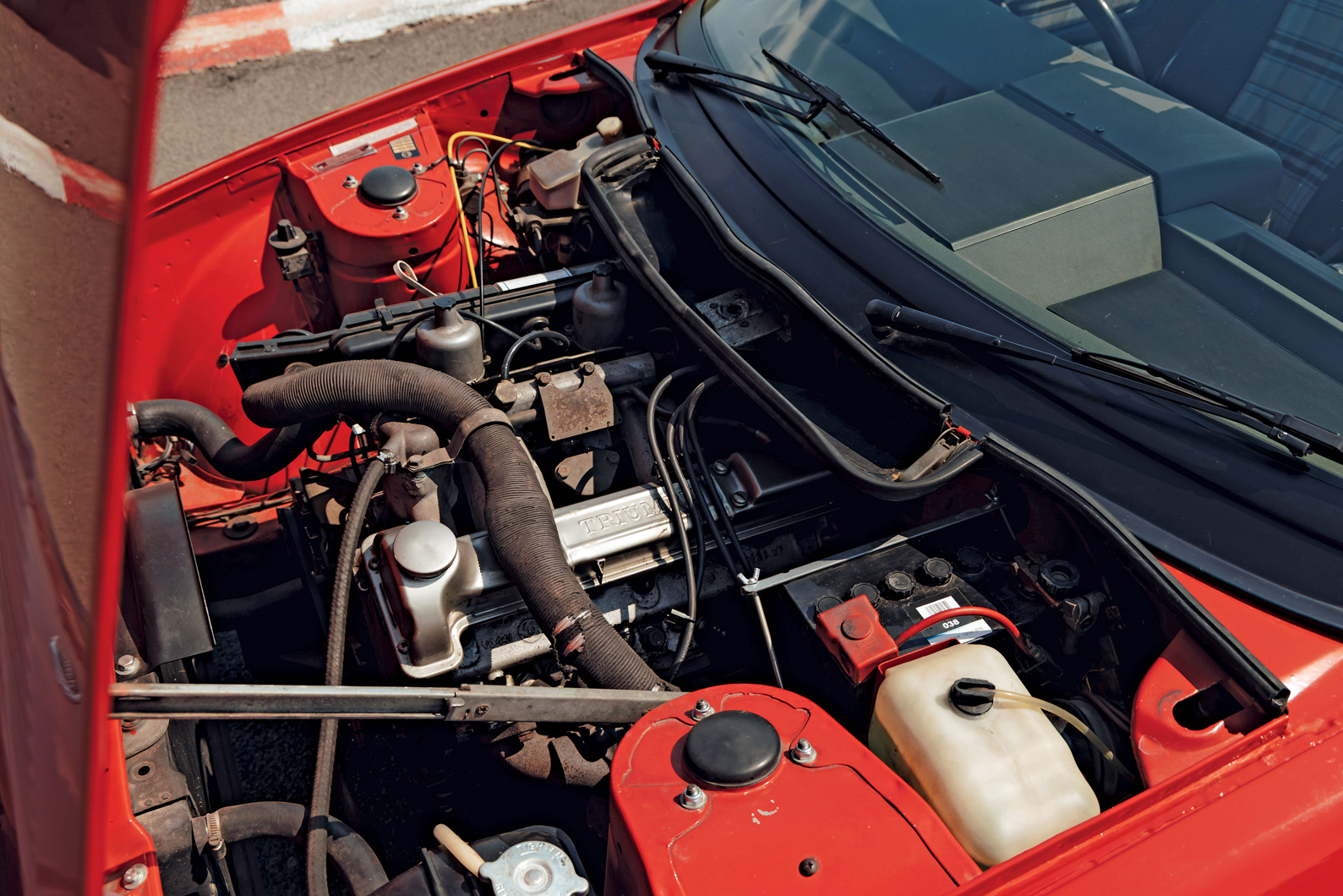
The Triumph TR7’s overhead-cam ‘four’ was shared with the Dolomite
Fears over US safety legislation delayed the launch of the drop-top until 1979, but when it arrived it looked sharp – both literally and figuratively.
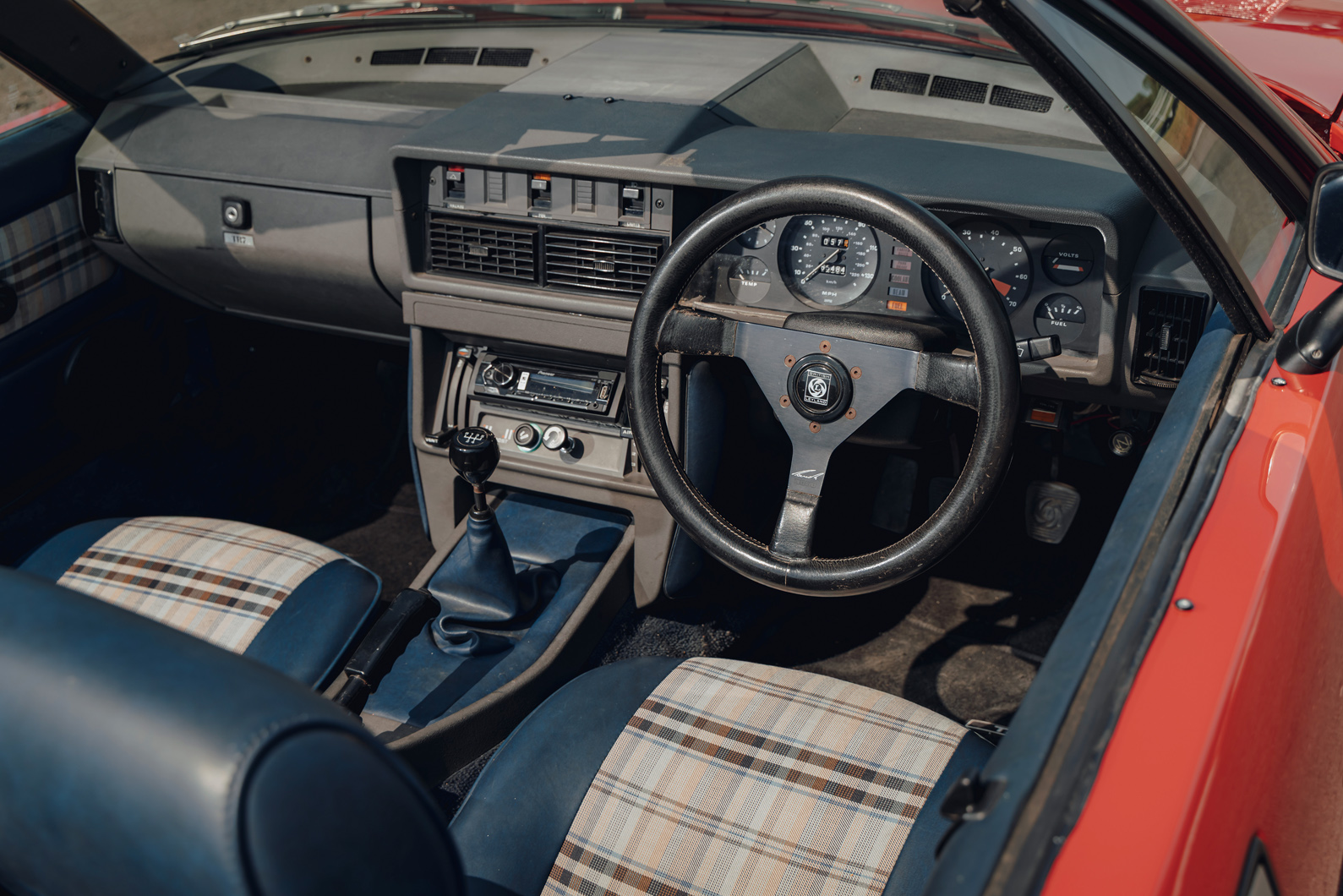
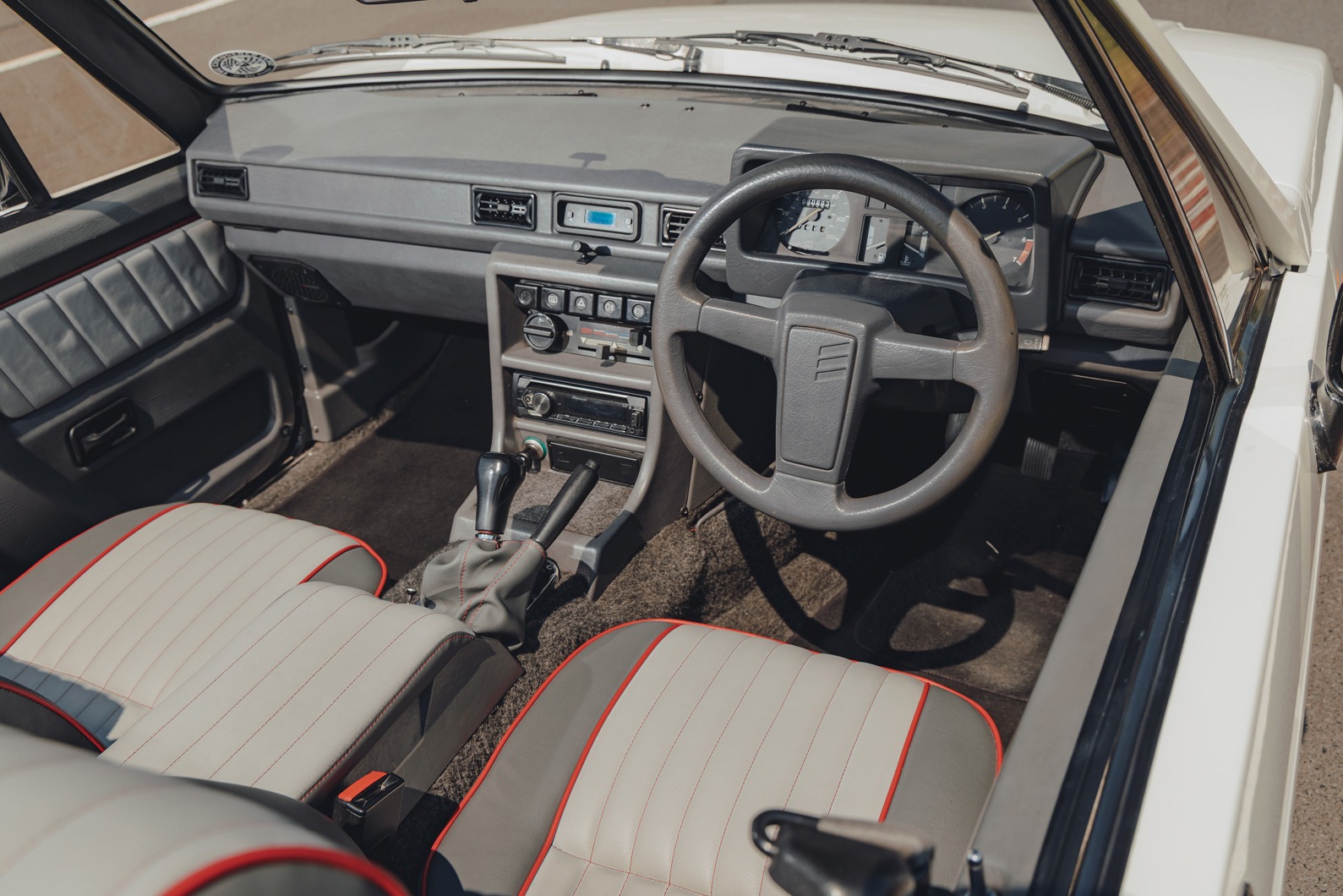
Compared to TRs of old, the interior is modern and inviting, particularly those wonderfully ’70s tartan seats.
Comfort is an undervalued commodity in a sports car – there’s always been the sense that suffering is acceptable as long as you can take the roof off – but it’s the TR7’s greatest asset: you can stretch out, with the car’s shoulderline at your own, facing that slab of creaking plastic dash.
On the track you do start to see where some of the criticism came from. Switching from the TR6’s independent rear to a live axle – albeit suspended by coils and radius arms rather than cart springs – was hardly likely to set a dynamic benchmark.
The gearbox is slick and positive, the controls hefty and the engine reluctant to spin: the 6500rpm redline feels cruel, and the temptation is to change up a couple of thousand revs earlier and use the 2-litre slant-four’s torque instead.
Through tight turns it’s roly-poly, with plenty of understeer. But this is a kart track, and while that suits some of the tiddlers, the big, refined TR7 is the furthest from a racer in our set.
And when owners of its more agile rivals struggle to find somewhere to stow a pair of pants for a weekend away, you’ll be chucking suitcases into the big boot and settling snugly into that reclined driving position as you point the angular snout towards the (English) Riviera.
Words: Alastair Clements
Thanks to: Beech Hill Garage
This Triumph TR7’s Momo Lauda steering wheel came from owner Mike’s Alfasud
Buying tips
- Rust is the biggest problem with any TR7: inspect wheelarches, inner wings, chassis rails, subframe and suspension mounts, scuttle, bulkhead, A-posts, footwells and sills
- Radiators clog up, leading to head-gasket failure and warped heads; look for signs of overheating, and check for rattles and leaks
- Engine swaps, particularly for V8s, are common; ensure it has been done properly with brake/suspension upgrades to suit
Or you could have...
TVR Tasmin 2.8i Another from the origami school of car design, the muscular and fine-handling Tasmin offers the first rung on the TVR ladder from as little as £5k for a usable car. The Capri-sourced Ford V6 (or a less desirable 2-litre Pinto) is rugged and the glassfibre bodywork rot-free, but beware chassis corrosion that will be costly to rectify.
Alfa Romeo Spider
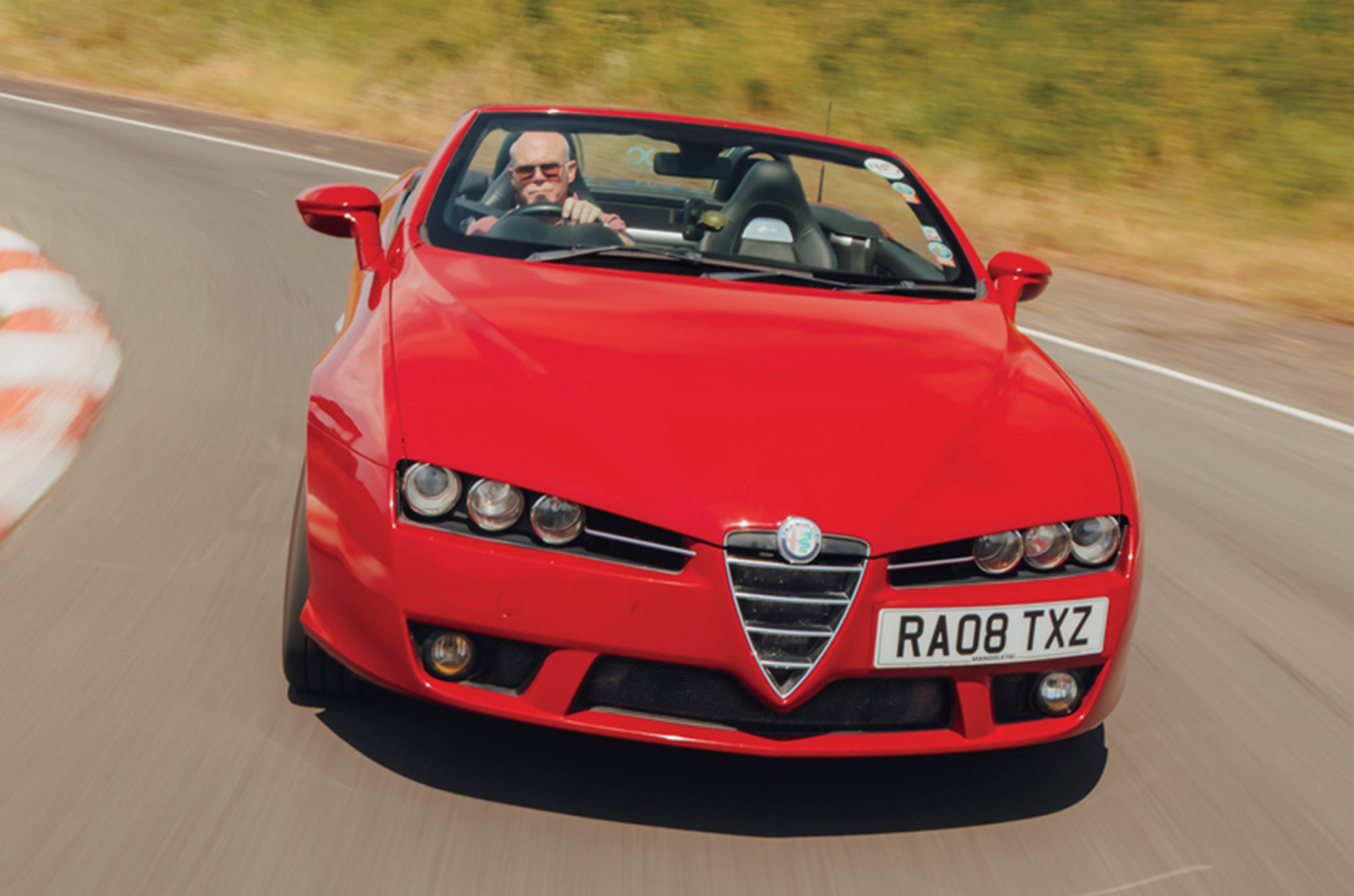
The Alfa Romeo Spider shares its handsome ‘face’ with the Brera coupé
It’s a shame we didn’t hold a straw poll at our shoot, because I’d wager that even the staunchest Alfa Romeo cynics would admit that our Pininfarina-built Spider 2.2 JTS was by far the most glamorous motor present.
With its vibrant red coachwork, deeply contoured bonnet, steeply raked windscreen and elegant rump, it is the embodiment of la dolce vita.
Those thoroughbred styling cues suggest that the Spider should fall outside our lowly budget, too, but not a bit of it: a quick Google will find plenty of smart and healthy examples at around the £5500 mark.
No surprise, then, that the Spider received such a warm reception when new.
First shown with the Brera when both cars were launched at Geneva in 2005, the Spider shared the coupé’s platform, front end and doors, but was 27mm shorter and 23mm lower, and only a two-seater.
The design was a collaboration between Alfa Centro Stile and Pininfarina (whose badging adorns its flanks) and, unlike the Brera, the Spider was also built by the Turin carrozzeria.
The car’s party-piece was its sophisticated, fully electric roof mechanism, which elegantly folded/erected the five-layer fabric hood at the press of a button, in just 25 secs.
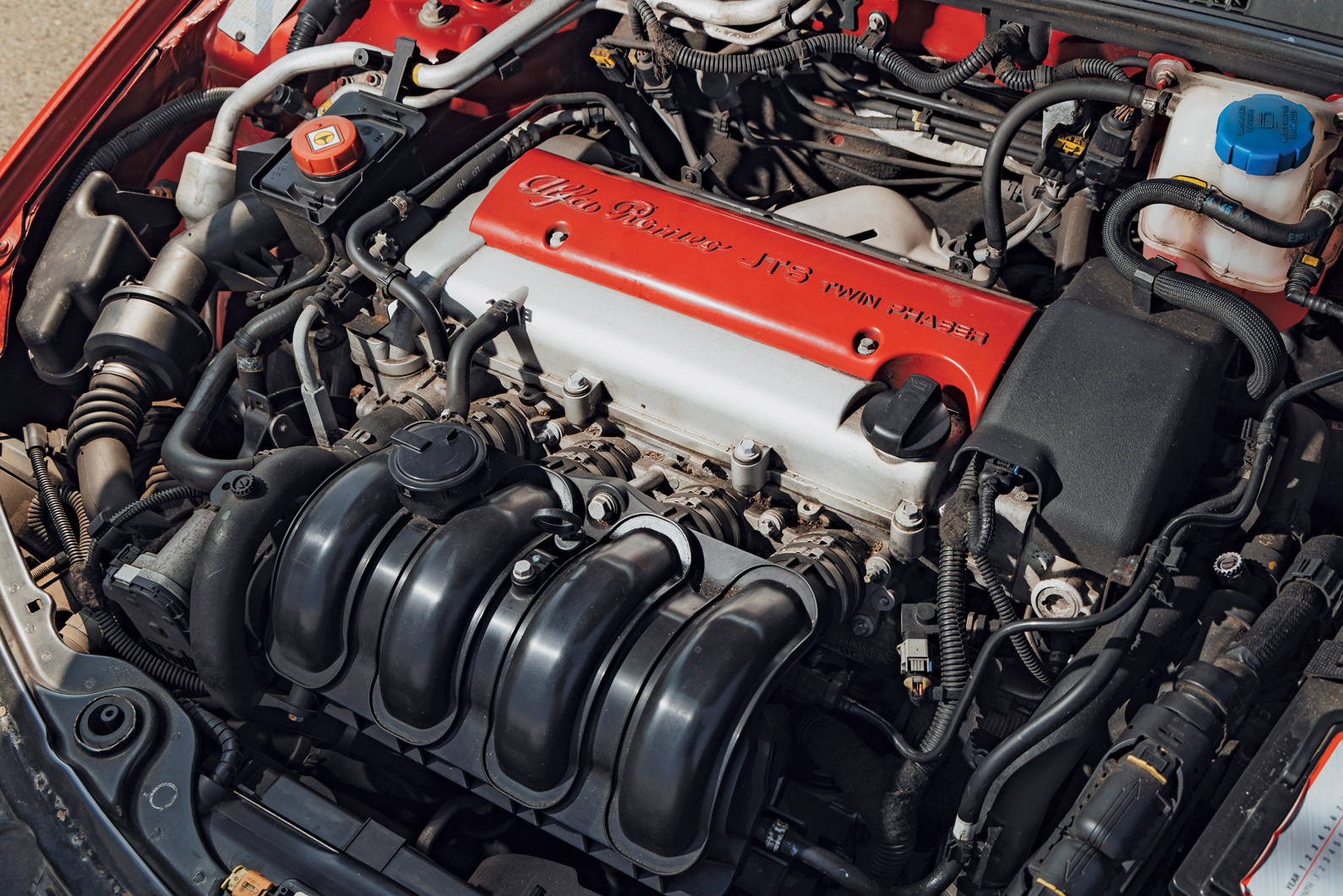
We’ve chosen the entry-level, 2.2-litre JTS petrol powertrain (a 3.2-litre V6 and a 2.4-litre, five-cylinder diesel were also available), but its ‘Jet Thrust Stoichiometric’ moniker is something of a misnomer.
The in-line ‘four’ was of all-alloy construction, with double overhead cams, variable valve timing and a respectable 182bhp. And while 169lb ft of torque sounds quite tepid to haul along a car weighing 1670kg, Alfa claimed that 90% was available from just 2000rpm.
Underpinning the Spider was the Brera’s double-wishbone front and multi-link rear end, tuned to cater for the additional 60kg courtesy of some essential chassis reinforcement and the roof mechanism.
Dave Atkins’ pristine 2008 Spider – one of four Alfas currently in his fleet – has covered just 47,000 miles from new, and was originally part of the Alfa Romeo UK press fleet.
The Alfa Romeo Spider’s twin-cam ‘four’ is less characterful than the Italian marque’s older engines
In the 14 years that Dave has owned the car, the only time it let him down was during a trip to Italy when the gear linkage broke (although when the roof failed to erect during our shoot, Dave admitted that the complicated electrics that operate this system are sometimes temperamental).
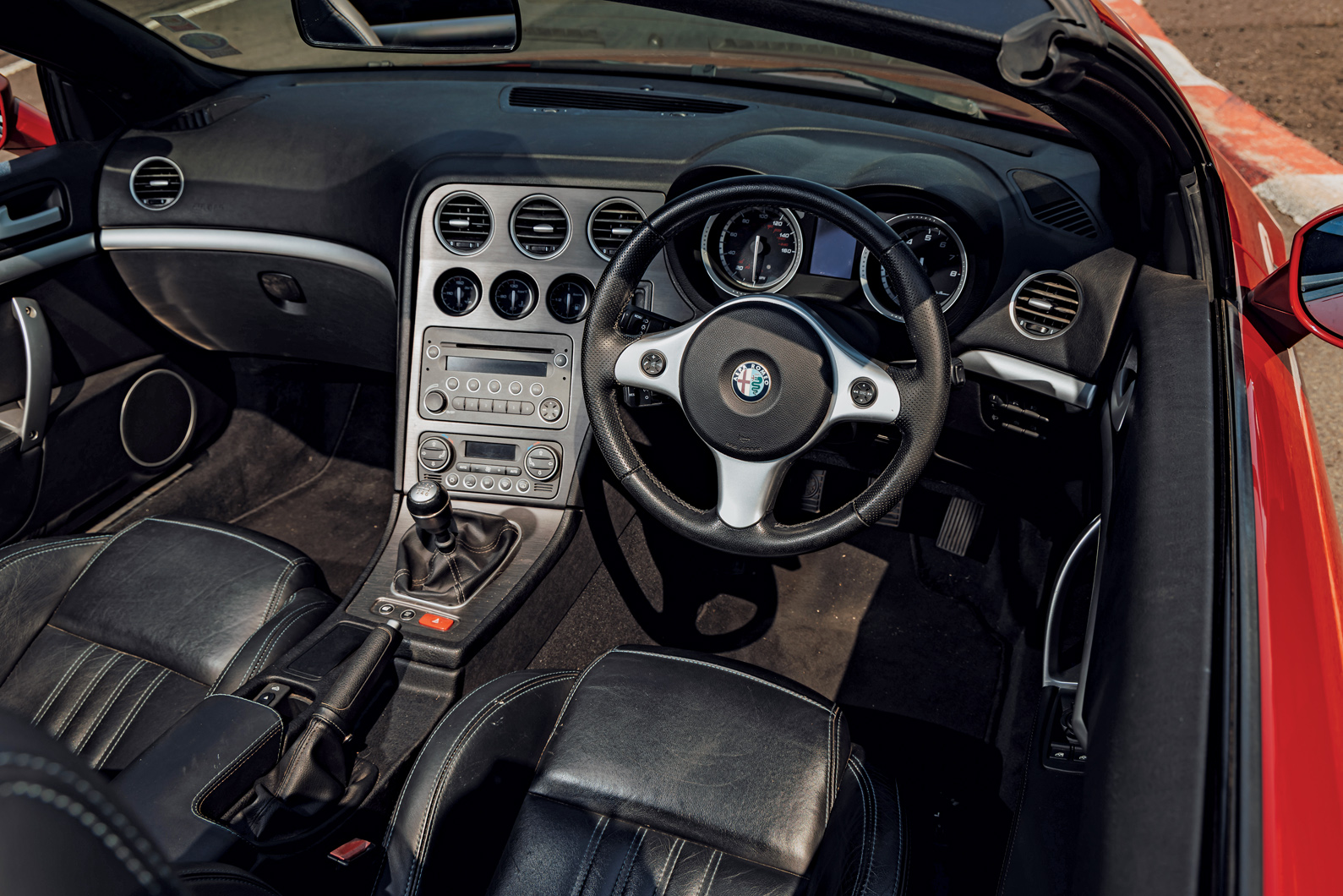
The impression of a premium sports car hits you as soon as you plonk yourself in the Alfa’s cabin: deeply bolstered leather chairs offering plenty of adjustment to avoid an Italianesque driving position; an attractive dash with two main clocks before you and three smaller dials for oil/water/fuel angled from the centre stack; and plenty of kit, including dual-zone climate control, cruise control and rear parking sensors, which were all standard for UK cars.
It’s not quite the sports car I had imagined, though. Out on the road, the Spider is a little under-damped, hitting its bump-stops on some undulating surfaces, although overall ride quality is impressive, making this a fine car for cruising.
The steering is relatively quick-geared and accurate, but the power-assisted system provides little in the way of real engagement; there’s also plenty of column shake over secondary surfaces, along with regular shimmies through the body on all but very smooth roads.
The 2.2-litre engine is no firecracker, either in the way it performs or sounds, meaning that you really need to work the excellent six-speed ’box for best effect.
It is a refined unit, though, and – as with the rest of the car’s many attributes – makes the Spider a fine long-distance tourer with more than enough space, practicality and savoir-faire for that 1000-mile blast down to Monaco.
Words: Simon Hucknall
The Alfa Romeo Spider’s elegant cabin offers the most mod-cons here
Buying tips
- ECUs and hydraulic pumps are no longer available for the electric roof: beware if it is noisy to operate, the pumps are leaking or there’s evidence of water ingress
- Bearing wear in the 2.2’s manual M32 gearbox will reveal itself as whining noises and crunching gears; a rebuild is around £1000
- Listen out for top-end chatter from higher-mileage engines, which may be caused by a stretched timing chain
Or you could have...
Alfa Romeo Spider (916) You could save yourself a couple of grand by plumping for ‘our’ Spider’s predecessor, the 916 series, sold from 1994 to 2004. Its most popular engine, the 2.0 TS (Twin Spark) was arguably a more charismatic unit than the direct-injection JTS, and while down on power, the 916 weighed c200kg less than its successor.
Porsche Boxster
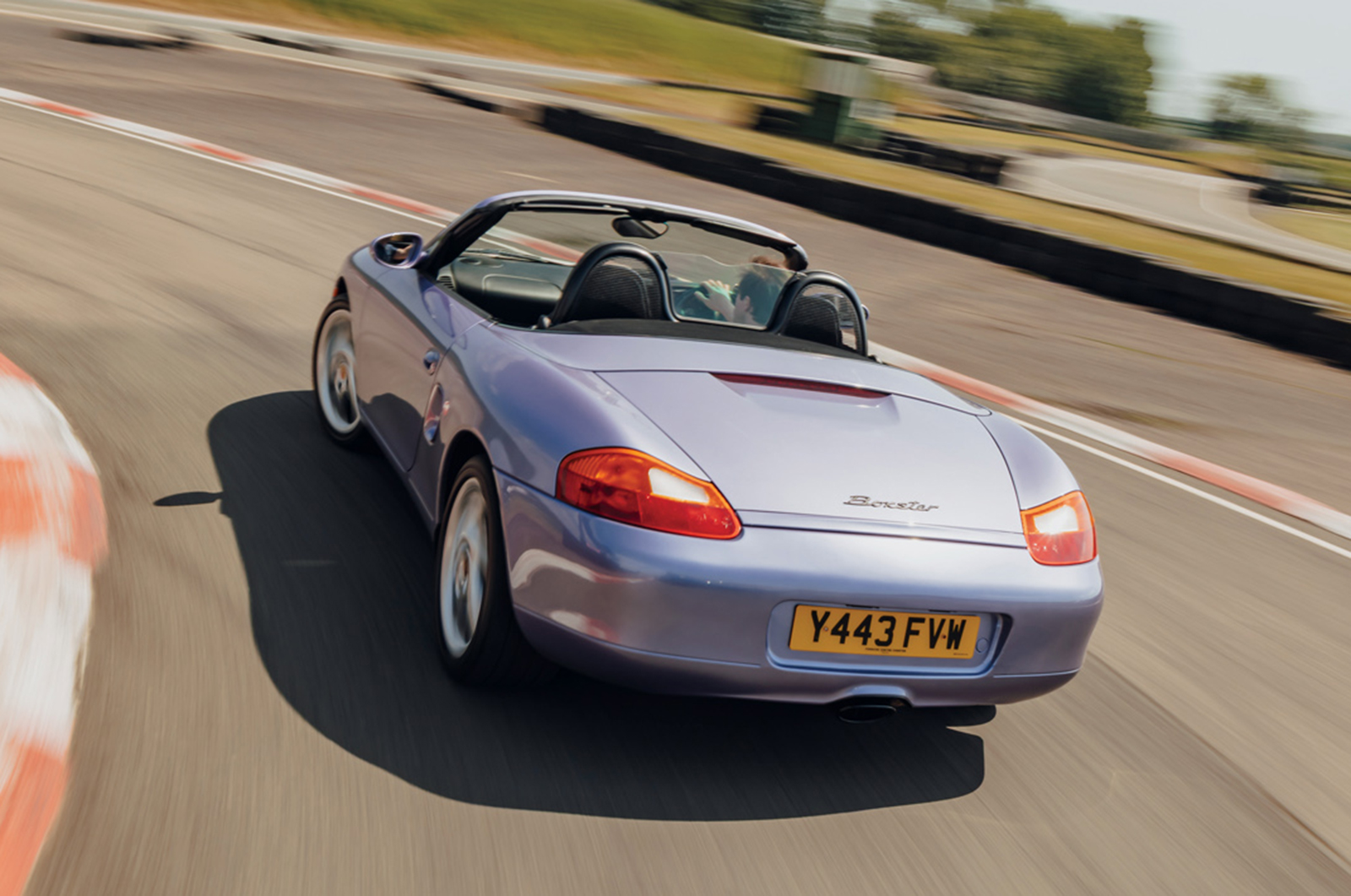
This Porsche Boxster’s special-order purple paintwork makes the most of its Pushmi-Pullyu shape
Equipped with a four-cam flat-six, aluminium suspension and brake components, and clever aero that incorporates a flat floor, the Porsche Boxster was much more of a serious sports car than its roadster rivals, even if it’s likely that most buyers forked out their £34k – and were willing to wait patiently in line for as long as 12 months in the UK – for the sheer prestige of this cleverly positioned car.
Either way, this is a Porsche, after all.
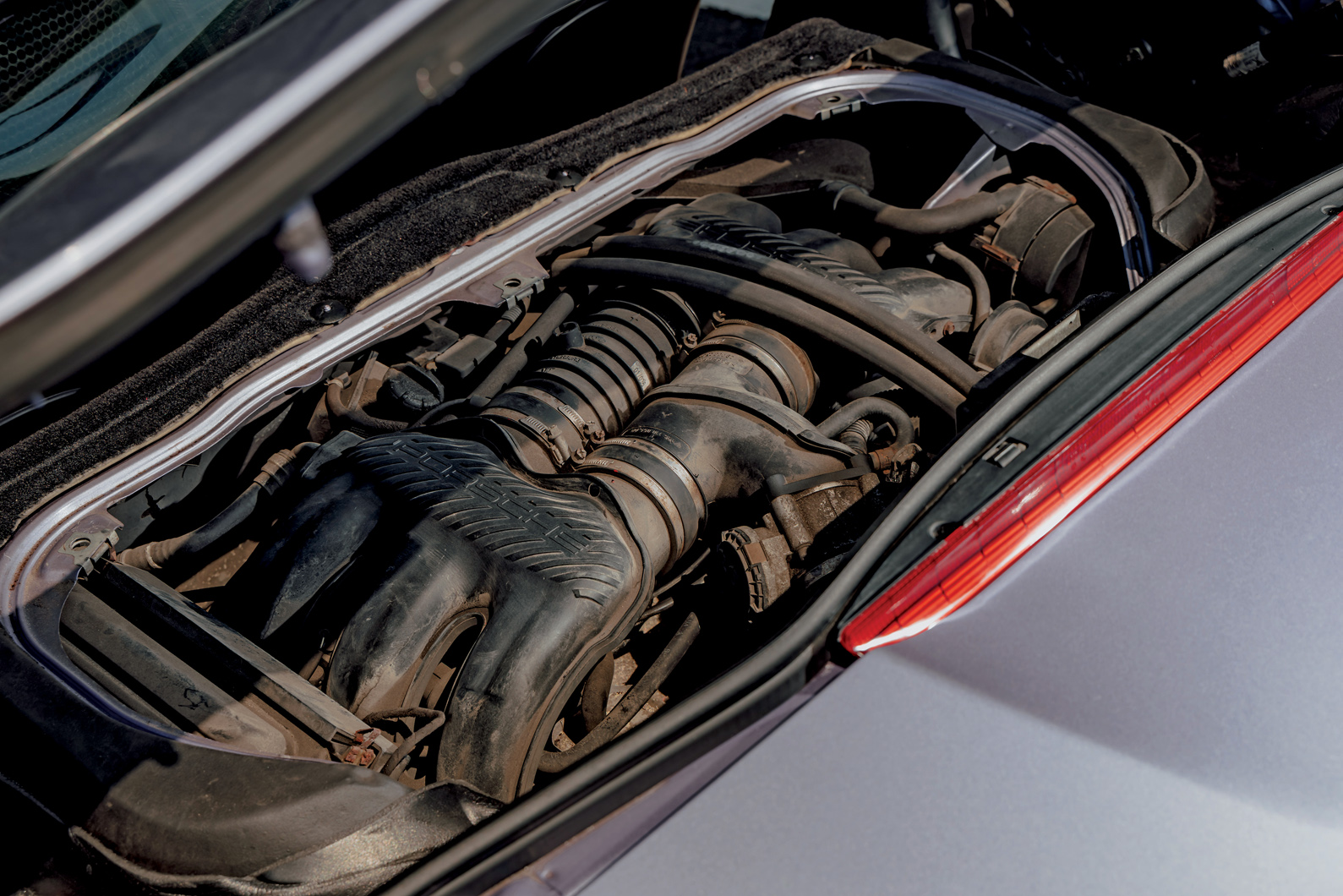
The ultimate product of the Stuttgart firm’s rush to rationalise its way into profitability, the 986 Boxster helped to justify the approaching all-new, 996-generation 911 by sharing much of its DNA, including the heart of its water-cooled flat-six.
Initially 2.5 litres, this was upped to 2.7 in 1999, with widely appreciated bumps in output, while the range-topping 3.2-litre Boxster S surged to 246bhp (for £8000 more).
The general consensus is that the 2.7 is the sweet spot, although the keenest of drivers will make arguments for the full-fat S and the firmer M030 suspension package – the higher-spec cars certainly do command a premium.
Extended leather, rare colours and sports seats are also highly prized options, and with many Boxsters racking up big mileages or simply being neglected, there is a wide spread of values.
Fortunately, our nominal £6000 budget places us right in the middle, affording an early, perhaps collectible 2.5-litre or a more usable 2.7-litre in nice condition with a few choice options – although rare shades such as Ocean Jade, Meridian Silver or the paint-to-sample purple of our featured car might push it over.
A Boxster S is possible, but the best are now closer to £10,000 and maintenance costs can quickly add to that.
The Porsche Boxster’s 2.7-litre, flat-six engine is crammed in amidships
“It was a purple one at a show that caught my attention, and then this car appeared for sale not long afterwards,” says Annika Kumar, who has now owned her 2.7-litre Boxster for a year.
“It needed a new clutch, so while that was done we also replaced the IMS bearing, added all-new brakes and took care of some more minor details including a door seal. It’s huge fun to drive and pretty comfortable – we’re planning to take it to Germany soon.”
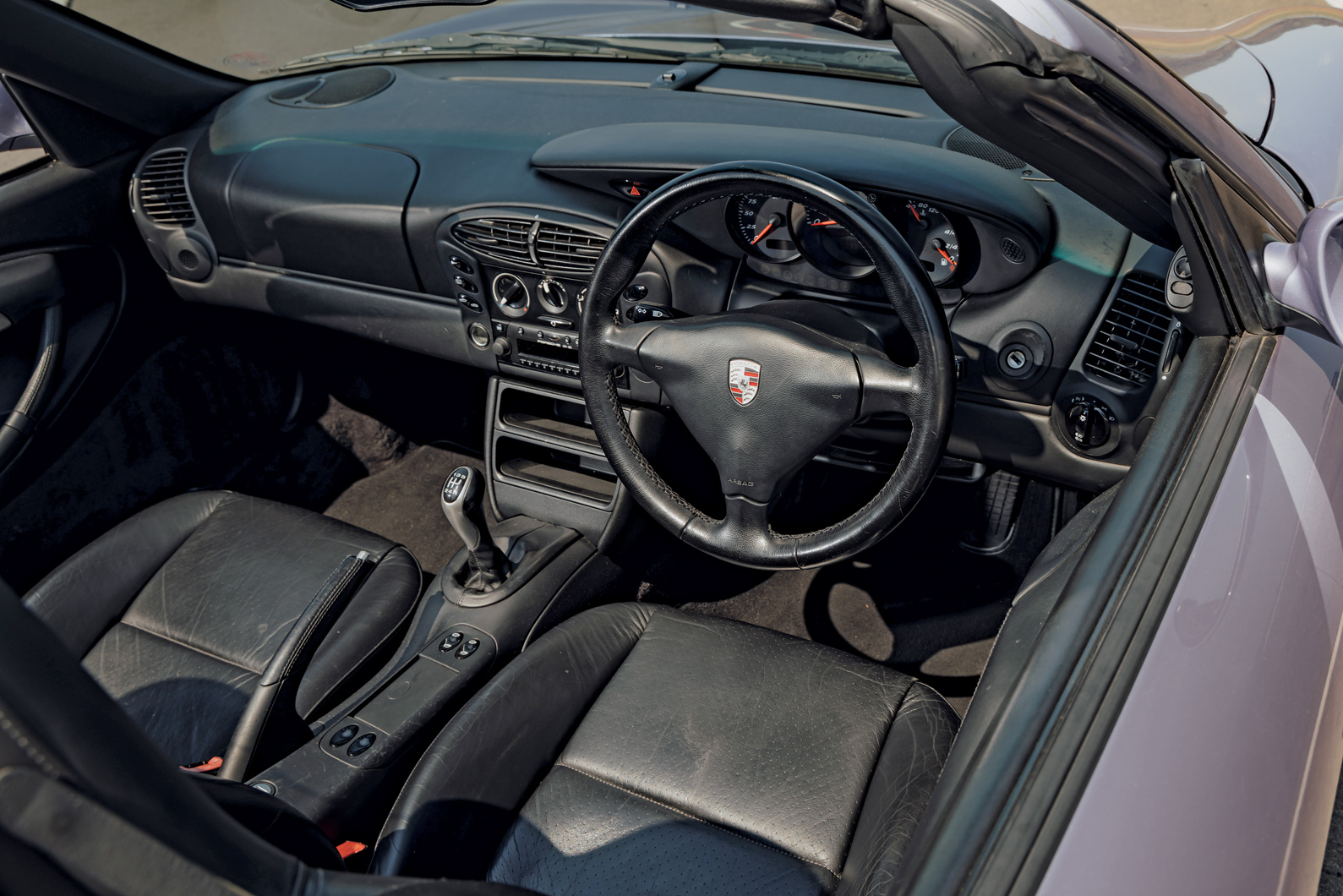
Annika’s car has optional 18in ‘turbo twist’ alloys and wingback sports seats, so it feels particularly taut from the off, with the weighty steering at no risk of losing any detail with a misplaced slide in the chair.
Under a sprung, long-travel pedal, the flat-six takes a moment to stir from its rustling idle before its torque urges the sonic thrum of intakes to harmonise into a spine-tingling howl towards 7200rpm.
The brakes are prodigious, but even applying full anchors with the faint trembling of ABS fails to upset the fundamental stability and solidity of the Boxster’s chassis, which pivots where its fine steering bids it.
Traction is just as impressive, hauling its 265mm-section rear tyres out of tight turns with only a hint of playful yaw. Turn the pace down and it still rewards with neat, suggestive responses that make any countryside cruise a joy.
There’s a sense of breeding inherent in the Boxster, although it’s still quite a serious car with priorities very much from the ground up.
There is real quality to its drivetrain and chassis, and it feels solidly put together, but the shine fades a little at the surface, with uninspiring interior plastics playing into the ‘poor man’s Porsche’ jibes. But I always felt that lazy insult was more of a hidden compliment – or at least an opportunity.
For the driver wanting a spectacular engine, the comforts of a thoroughly engineered car of the ’90s and fine handling that even dares to better the 911, the Boxster may well be the most expensive here but is, in many ways, in another league.
Words: Aaron McKay
The Porsche Boxster’s quality cabin and upright steering wheel
Buying tips
- Intermediate-shaft bearings that knock or rattle at the rear can mean an expensive engine rebuild, while rattling cam chains at idle also require urgent attention
- As with many Boxster parts, the brakes are costly, so make sure the aluminium calipers aren’t seized and discs are in good condition
- Suspension wears quickly, with rubber bushes in the lower arms and Rose joints in the trailing arms needing regular replacement
Or you could have...
BMW Z4 Sharper than its Z3 predecessor, both in its angular, ‘flame-surfacing’ styling and firmer-riding chassis, the Z4 is a worthy Boxster rival, especially in 3.0Si and 338bhp M forms – both of which lie outside our limit. Lowlier models are hugely affordable, while club support and parts availability are good, too, so it can be just as usable as the Porsche.
Honda Beat
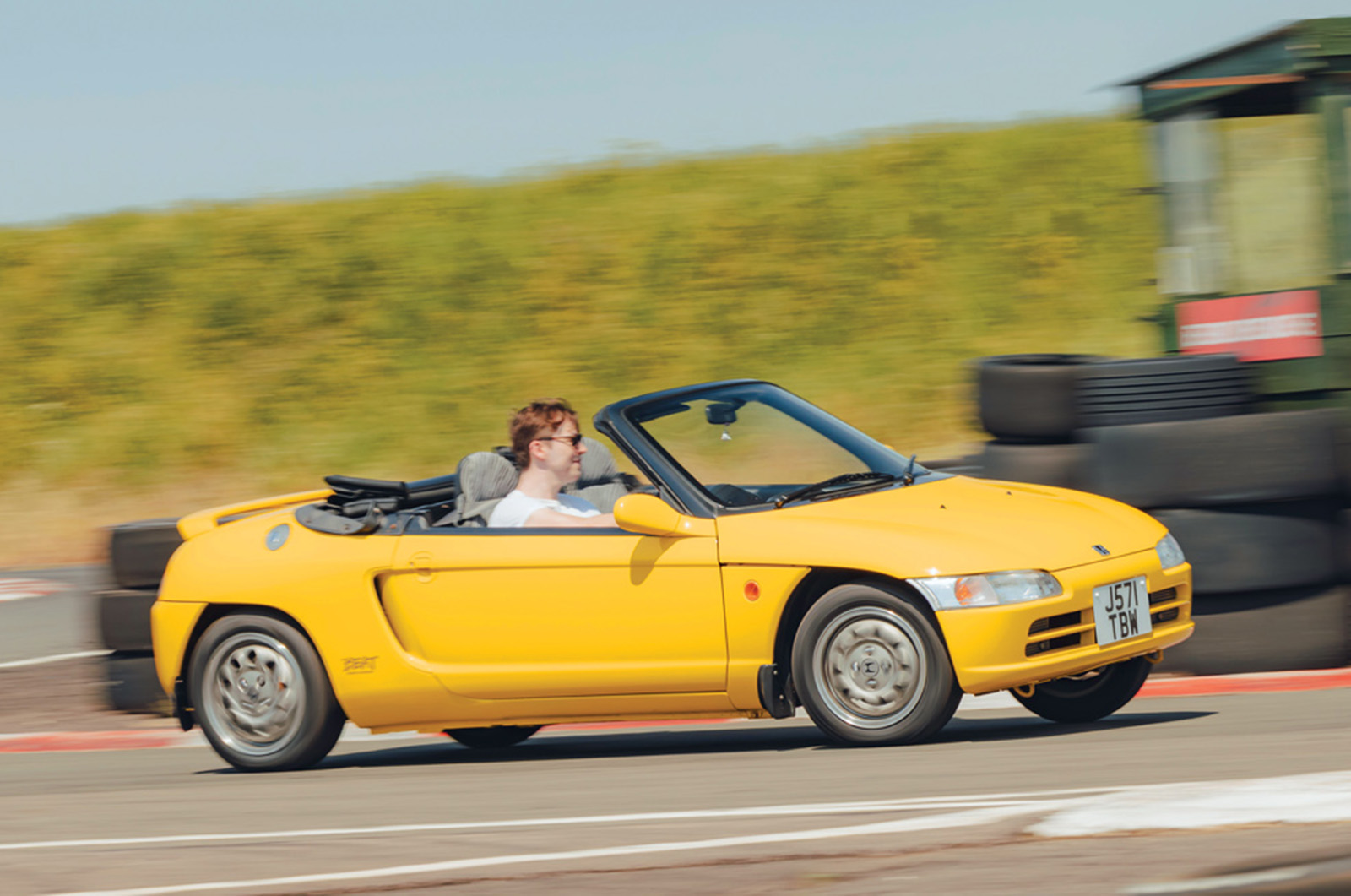
The Honda Beat’s diminutive dimensions are perfect for our go-kart test track
It’s quite something for a car from the early 1990s to turn up to a photoshoot including a Fiat X1/9 and an MG Midget and look utterly tiny, but trust the Japanese to come up with it.
Yet the most fantastic thing about Tony Fong’s Honda Beat is not its size, or even its shrunken-supercar looks, but that it absolutely nails the sports-car fundamentals.
Excellent steering, a fizzing, rev-happy engine, one of the all-time-great gearchanges and agile handling make this little yellow car one of the most fun ways of spending £6000 – as long as high-speed cruising isn’t on the agenda.
While a dog’s bark is often worse than its bite, that’s not usually the case with cars. And yet the roadster with by far the smallest engine at this gathering is the most ferocious-sounding of them all.
Just trying to get to 50mph, the Beat smacks of a swarm of angry bees inside an oil drum – in a family car it would be hugely annoying, but in a sports car it’s a thrill.
Other sporting kei cars – Japan’s microcar tax class – use turbocharging to get the most out of engines limited to 700cc in capacity, but the Beat employed a very Honda solution focusing on engineering purity.
The final car signed off by Soichiro Honda features a clever 12-valve, twin-cam triple fed by individual throttle bodies, which drew influence from the maker’s motorcycle experience in revving to a heady 9000rpm.
It’s a gem of an engine. Not torquey, naturally, but a motor that makes burning every millilitre of gasoline an occasion.
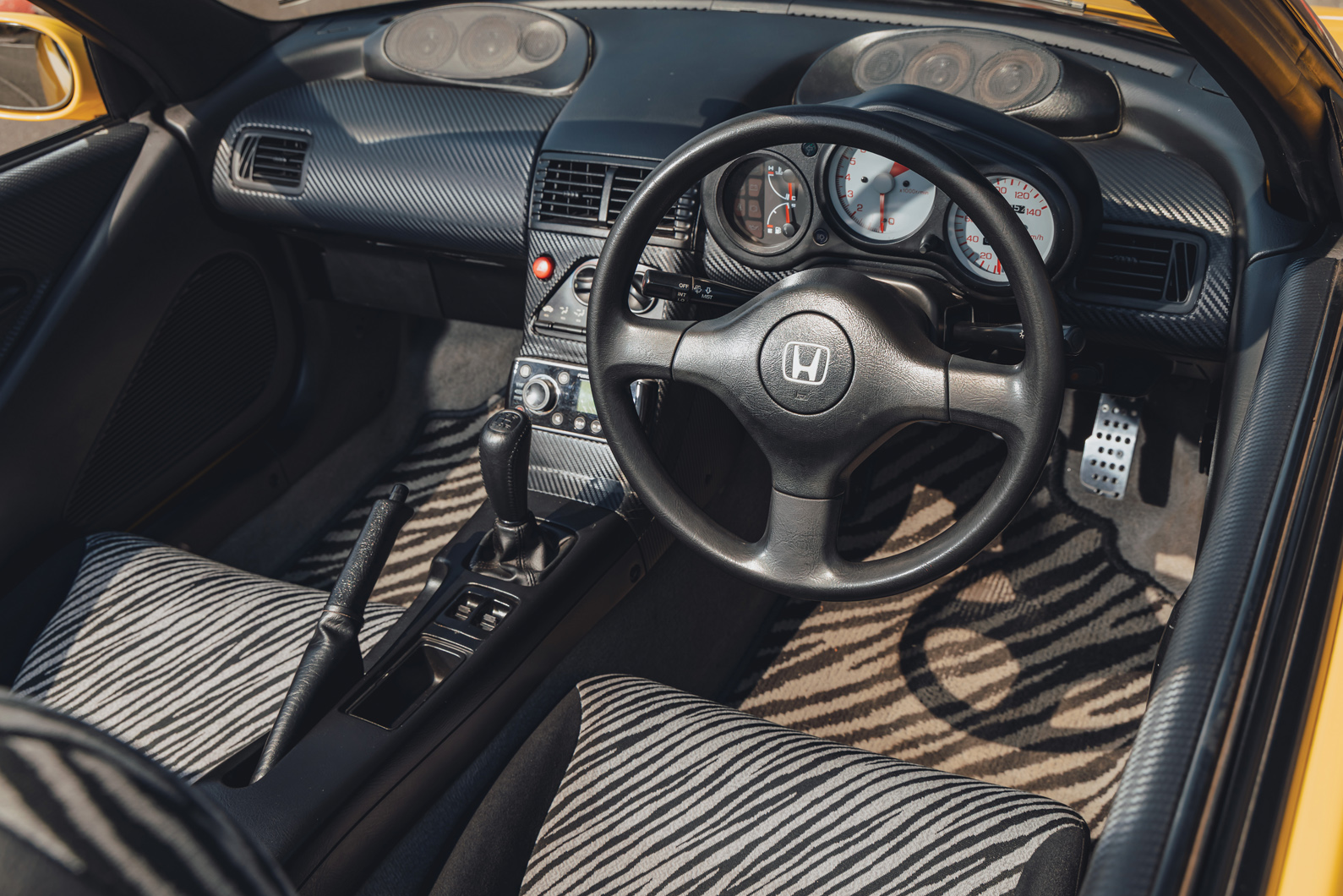
As if the highly strung engine and mandatory zebra-stripe interior didn’t make it obvious, Honda’s plan to build a micro-supercar was made clear by the decision to fit the engine behind the driver.
The Honda Beat’s tiny, mid-mounted, three-cylinder motor is a screamer
Released on the domestic market in 1991, a year after the Ferrari-beating NSX, this was its second mid-engined car.
MacPherson struts all round, though not the most sophisticated solution, are essential for saving space.
The Beat’s cockpit is tight, though not even our tallest drivers found their scalps poking above the header rail.
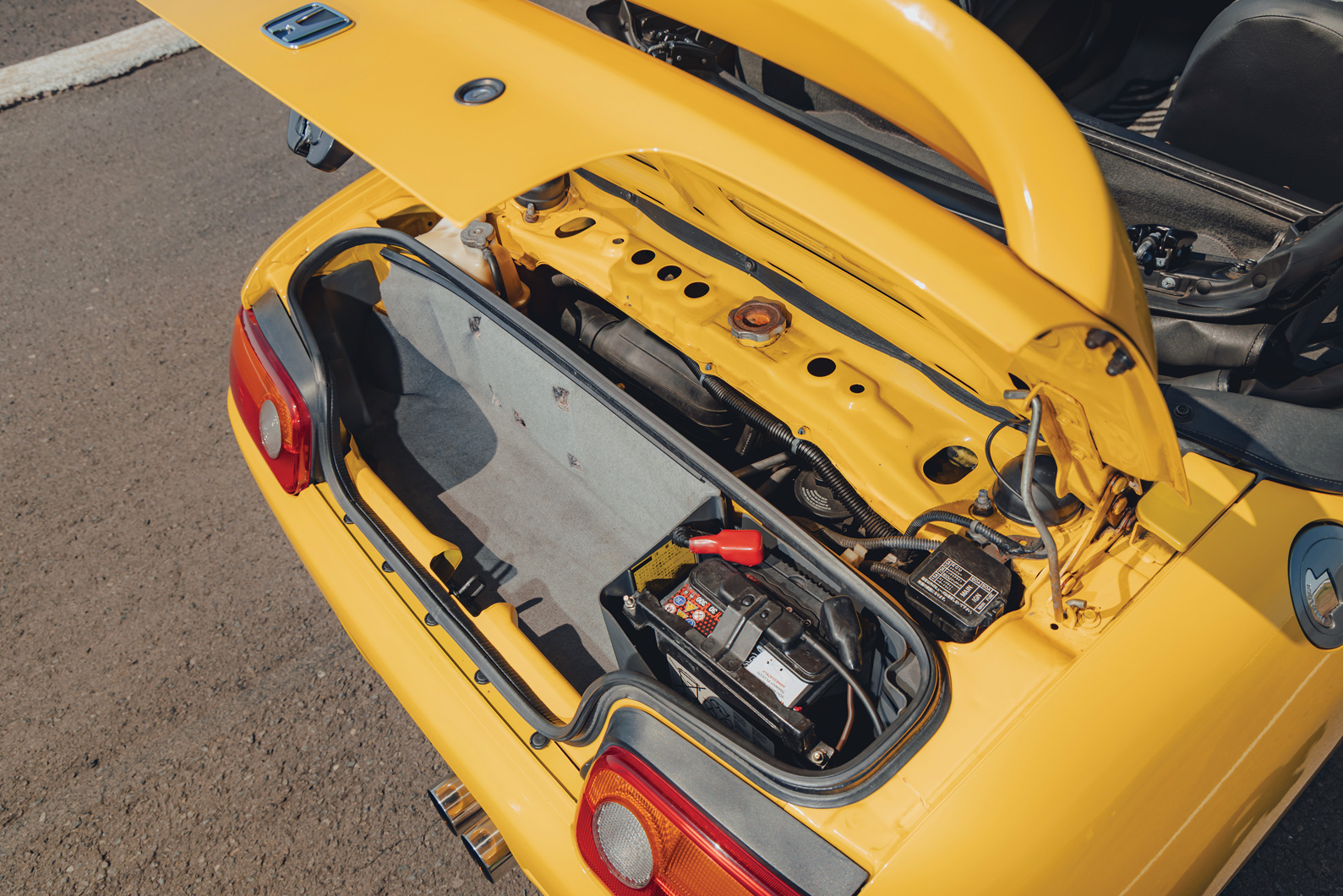
The sacrifice is virtually no cargo space – a quarter of the tiny rear boot is taken up by the relatively small battery required to crank a 656cc engine. The reward is lightness.
On this titchy track it is electric, diving through the corners with flickable ease. The steering is feelsome and direct and it doesn’t pitch.
Some roll is evident – there is a bit of compliance in the suspension – but it’s minimal, and only adds to the speed-heightening sensations.
This isn’t a quick car, and progress is only achieved by keeping the engine on the boil, but thankfully it has a glorious gearshift. Tight, quick and precise, it sums up the entire car: two-thirds the size of most competitors, but all the better for it.
Never officially sold outside Japan, Beats have nonetheless made their way to the UK in decent numbers, such is their appeal.
There’s usually a couple for sale, and £5-6000 should land a tidy car. Mechanically they are all identical, bar the PP1-110 variant with a limited-slip diff and ABS.
Factory options included alloys, a stereo upgrade and a rear spoiler (as here), but all had electric windows and air conditioning. There aren’t enough in the UK to be choosy, however, and with just 63bhp the necessity of an LSD is debatable.
I’d just grab the first good car I could find – and trust me, after driving one, I’m looking.
Words: Charlie Calderwood
Zebra-print trim lifts the Honda Beat’s black cabin
Buying tips
- Rustproofing was always minimal. Cars that have been in the UK for many years should be treated with particular suspicion. External panels are the priority, but check everywhere
- The high-revving engine will burn oil via worn piston rings if neglected. Look out for blue smoke when driving under load
- Parts availability is poor and items from abroad will be a long wait. A tear in the hood or a broken piece of trim is not an easy fix
Or you could have...
Suzuki Cappuccino The Cappuccino uses a tiny turbocharger to get the most out of its mandated 657cc engine, almost certainly producing more power than the claimed 63bhp. Equipped with a clever, multi-piece hardtop, the Suzuki is faster and more refined than the similarly priced Honda, though it doesn’t sound as good and its styling is a bit jelly mould.
Toyota MR2
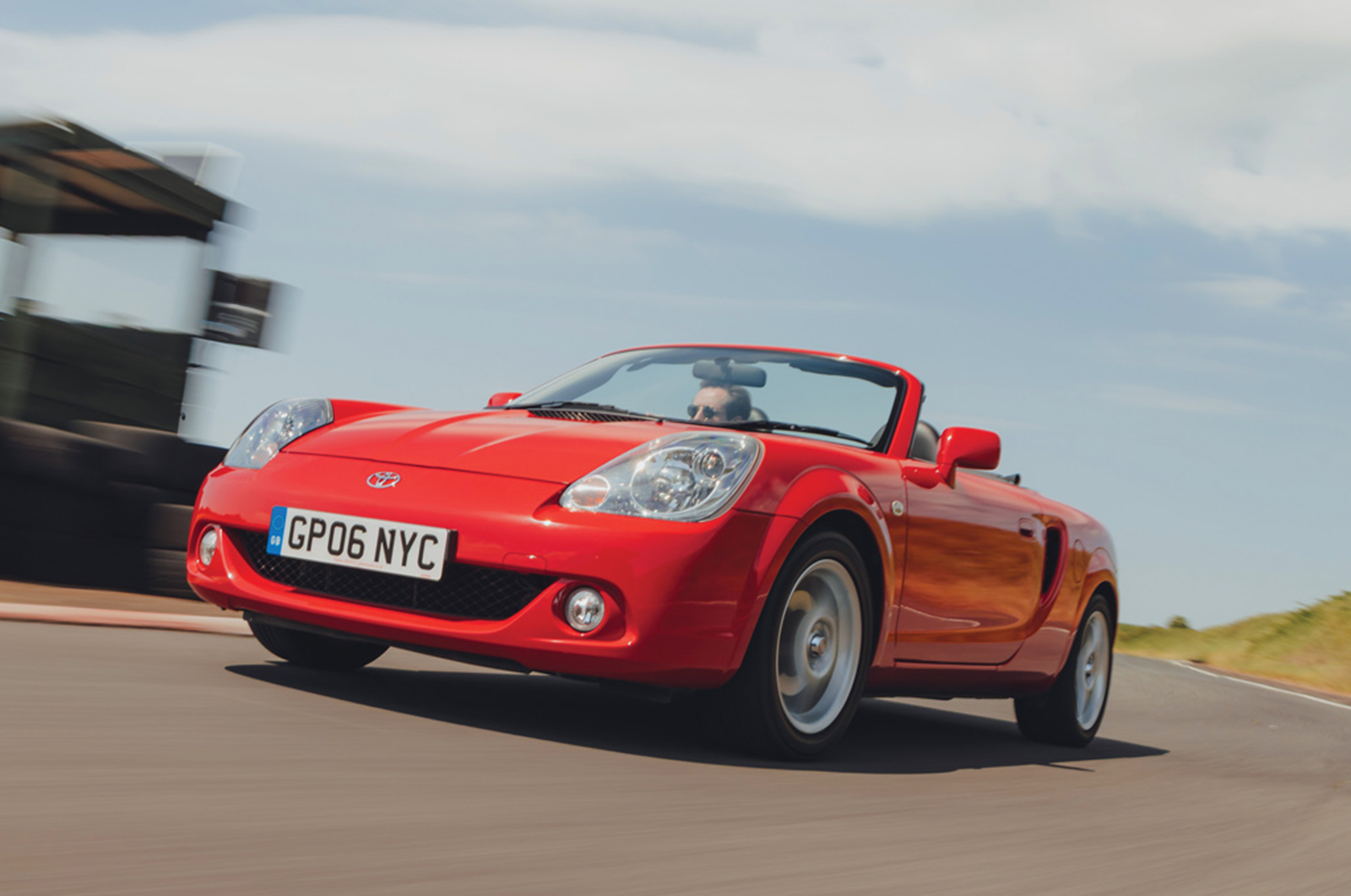
This Toyota MR2’s ‘smiley face’ grille came with the facelift in November 2002
Only when you begin trawling through the classified adverts do you realise what a steal the third-generation Toyota MR2 has now become.
Prices have been creeping up of late, but it’s still fair to say that you can buy a nice example for around £4000 and a really great one for £6000.
And it’s got just about everything going for it – apart from startlingly good looks, some might argue, with a shape more akin to a melted Porsche Boxster than the wedge-like profiles of its predecessors.
Launched in 1999 on the Japanese Domestic Market as the MR-S, it landed in the UK a year later as the MR2 Roadster, in both five-speed manual or semi-automatic ‘SMT’ forms.
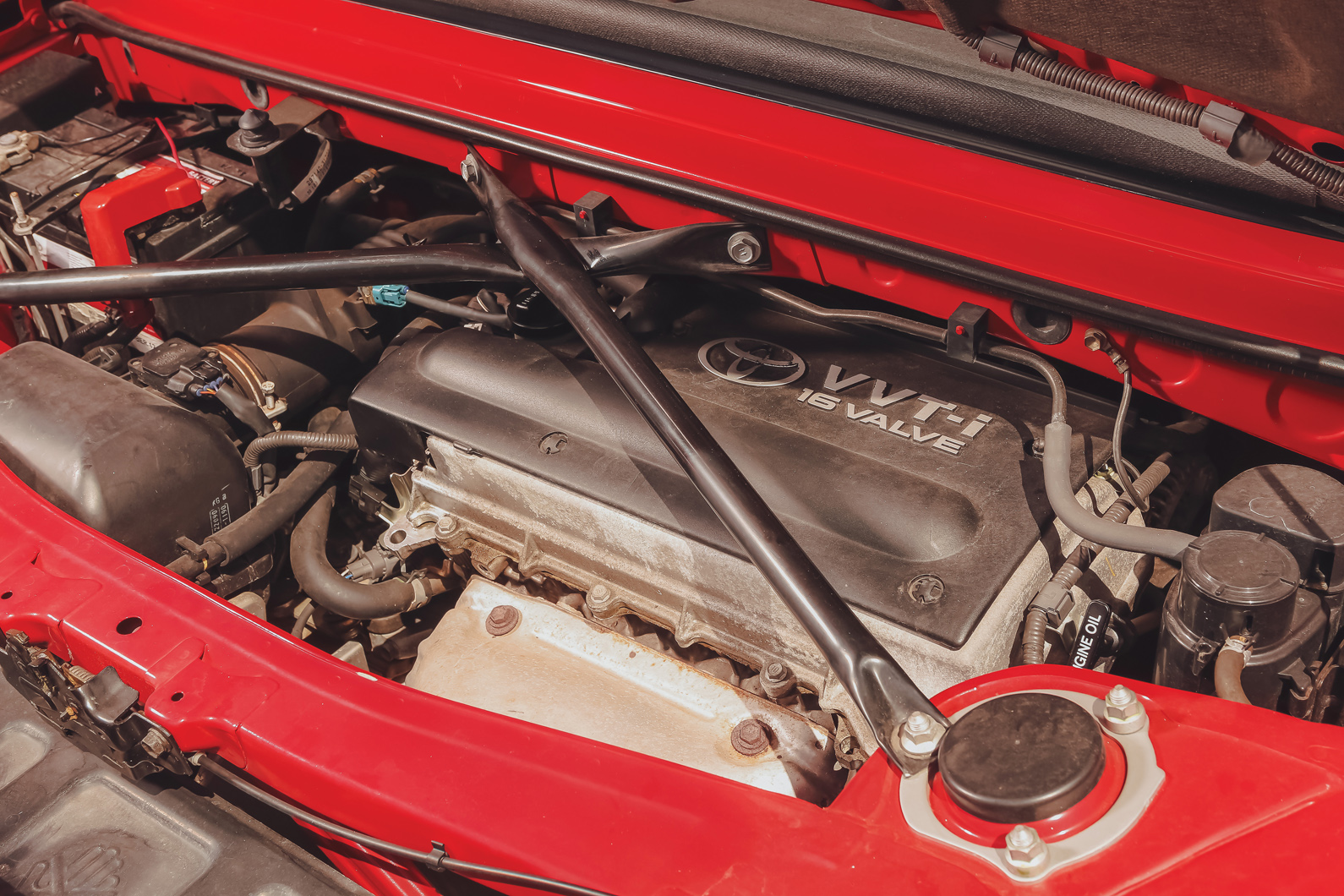
With a mid-mounted, twin-cam, 1.9-litre four-pot engine producing a whisker under 140bhp, and weighing little more than a tonne – lighter than the revered Mk1, with a healthy dose more power – it gave punchy performance, racing from 0-60mph in 7.5 secs and on to a 126mph top speed.
The latter was increased by 5mph with the late-2002 facelift, which also brought a sweet-shifting six-speed transmission, stiffer suspension, electronic stability control and less propensity for the pre-cat failures that are the greatest concern with these impressively reliable roadsters (though none are immune, so ask if they’ve been replaced or removed).
This superb example, now part of the Toyota UK heritage fleet, is one of the final 300 British cars, sold as the TF300 with excellent leather-and-Alcantara seats, a pair of fruity-sounding twin exhausts and the car’s build number stitched into the seatbacks.
These models tend to fetch a premium, but plenty of cars have had those desirable extras retrofitted.
Options on UK-supplied cars were relatively limited, but can have a big influence on values: air-con and the snug hardtop are particularly desirable.
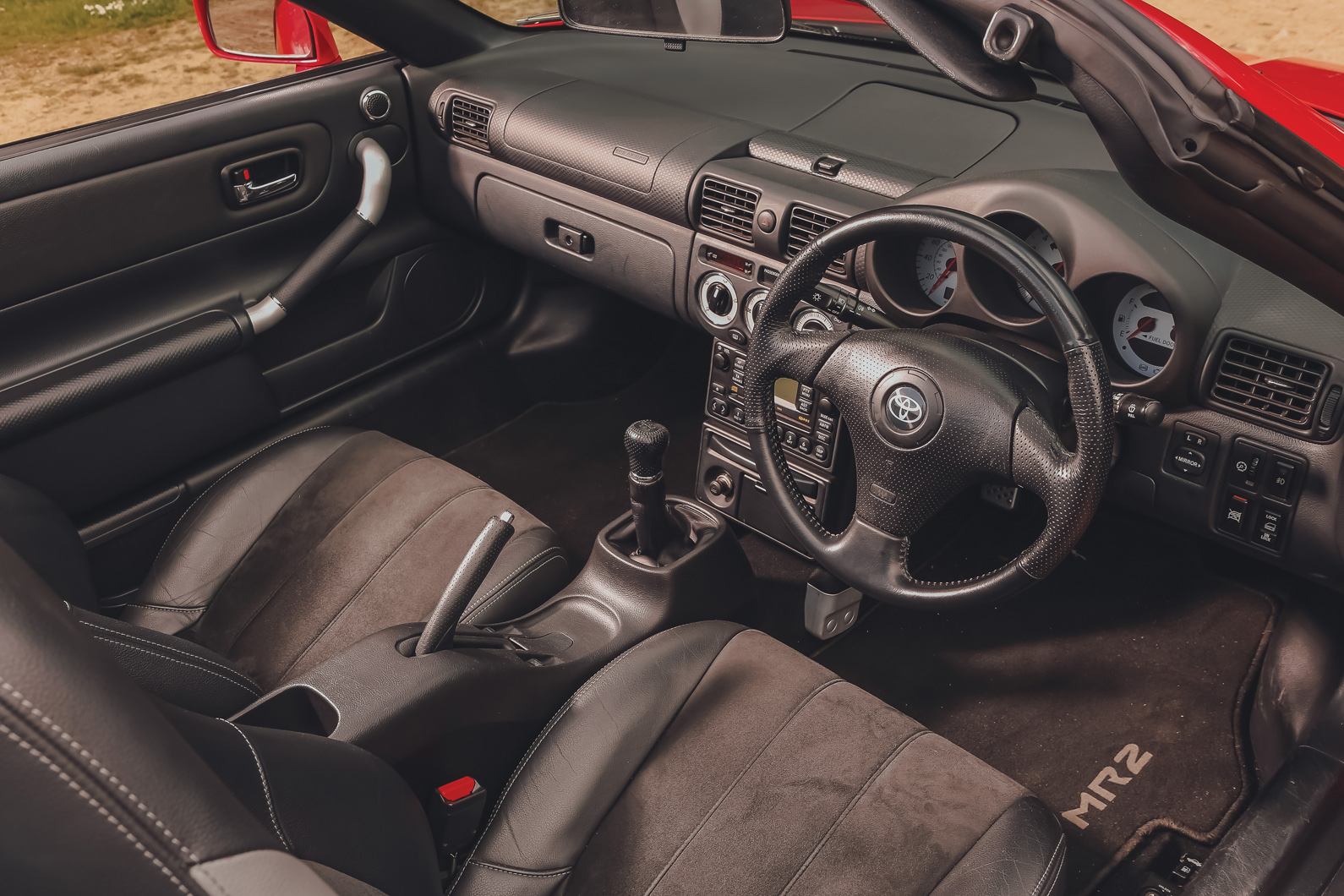
All are very agreeable on the inside, however, with supportive seats, a great driving position and a roomy cabin that doesn’t feel too short, like many compact mid-engined sports cars can.
The Toyota MR2’s sparkling 1ZZ-FED engine
Before you there is an upright dash fronted by the large, vertical three-spoke wheel with the surprisingly long gearlever a short reach away.
The intuitive controls feel light and responsive, the build quality superbly solid, and it doesn’t take more than a few minutes behind the wheel of the little Toyota to feel totally at home.
Full-size automobiles should fall to pieces on a go-kart track, but the MR2 feels so tight, compact and darty that it thrives.
The brakes are powerful, the gearbox quick and there’s fantastic front-end bite, allowing you to alter its attitude on the throttle with ease, yet it doesn’t feel as if it wants to snap.
Struts all round give a degree of body roll, but the reward for that is a compliant ride after you have left the track behind. And though performance is lively rather than muscular, the zingy engine makes for the perfect match, spinning eagerly to its 7000rpm redline with a lovely twin-cam rasp.
The only criticism consistently levelled at this gifted all-rounder is the lack of luggage space, but in the classic context that’s less of a concern.
Sure, there’s more room in the boot of an MX-5 or an MGF, but the lockers behind the seats will take a couple of soft bags and you shouldn’t need a toolkit – it’s a Toyota, after all.
Perhaps the defining small sports car of the late 1990s and early 2000s is the Lotus Elise.
It is priced well out of our list, but if you’ve always liked the idea of having one and either can’t afford it or can’t give the level of commitment that ownership of the spartan, ultra-focused Hethel flyweight requires, this talented Toyota makes a very good second best.
Words: Alastair Clements
Thanks to: Toyota UK
The Toyota MR2’s cabin features plenty of black plastic, but it’s well screwed together
Buying tips
- The ceramic pre-cats in the exhaust manifold can break up and cause major engine damage (especially pre-’03 cars); they are best replaced or removed
- If you want a hardtop, make sure one comes with the car – they aren’t cheap to buy and also require a costly fitting kit
- Look for rot in the rear subframe (remove the undertray), floors, sills, lower bulkhead, inner arches and suspension mounts
Or you could have...
Nissan 350Z Roadster The drop-top Z was launched in 2004, two years after the retro coupé. The lower end of the market just sneaks under our £6k bar so you can expect plenty of miles for that money, but these are well-engineered cars that provide punchy performance from a 276bhp (later 306bhp) V6 and fun, tail-happy rear-drive handling.
Mercedes-Benz SLK
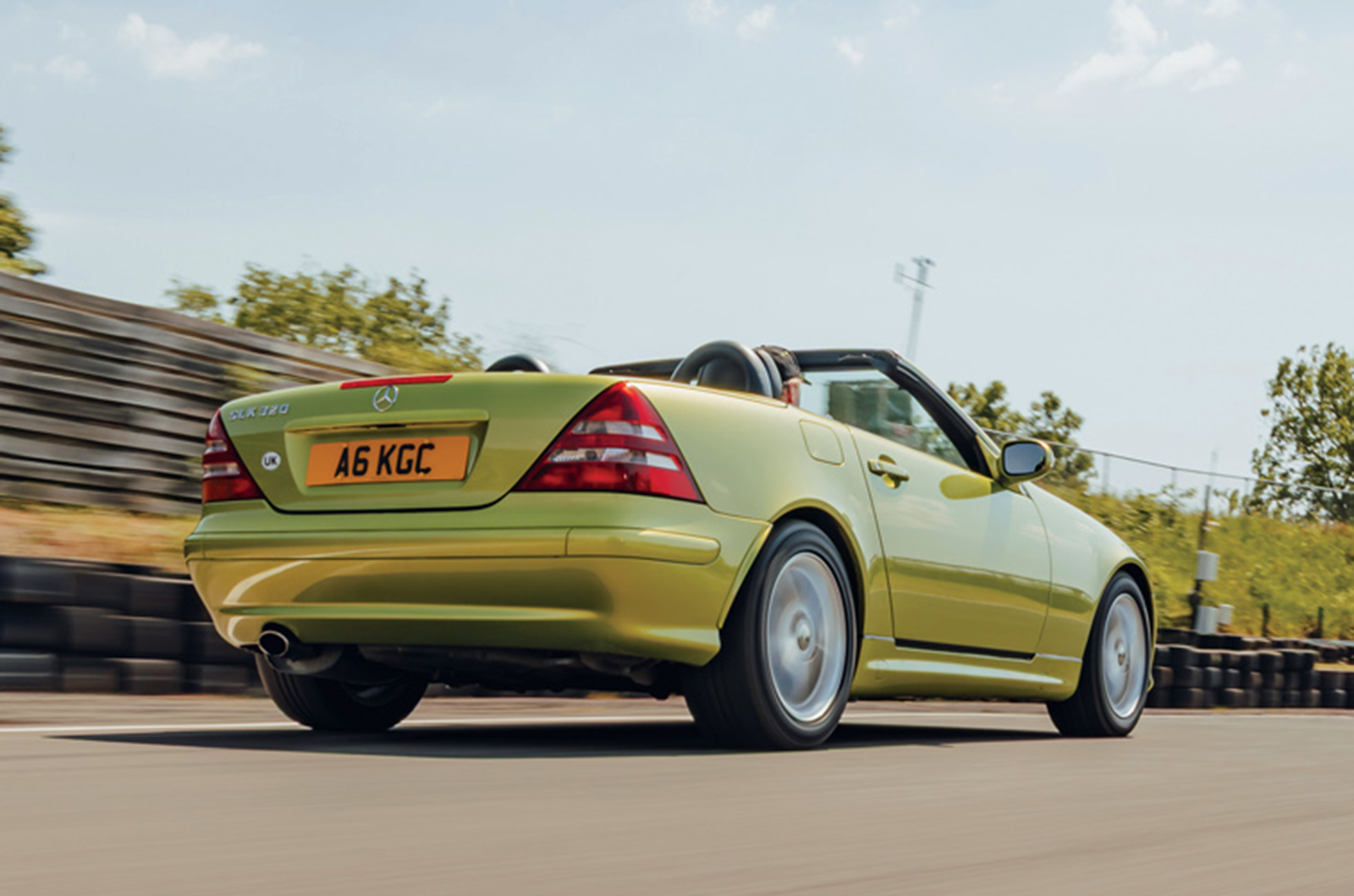
The Mercedes-Benz SLK’s SL-in-miniature looks ensured its success
Mercedes-Benz knew just what it was doing. Building anticipation for a new roadster was a lengthy process for the German maker: a teaser appeared in 1994, then a second version a few months later.
Not until April 1996 was the fully fledged SLK (sportlich, leicht, kurz or sporty, light, short) launched to a rapturous public. The order book soon filled and waiting lists stretched to more than a year.
Quite apart from the technical innovations under the skin, all anyone talked about was the engineering marvel of the steel ‘Vario-roof’, which only took a press of a button and 25 secs to let the sunshine in. Undoubtedly a cute party trick, but one that keeps on delivering.
The UK only got the 230K initially, but this went on to be the biggest seller worldwide with its supercharged 193bhp ‘four’ providing an excellent blend of traditional Mercedes power and refinement.
But the world of classy cabrios was moving quickly, as BMW launched its Z3 rival with more powerful engines including its lauded straight-six. Mercedes needed to respond to maintain its share of the lucrative roadster market, and the SLK320 was born.
When the 320 hit the streets three and a half years after the original launch, 170,000 Mercedes-Benz SLKs had already been sold – strong work for a niche model.
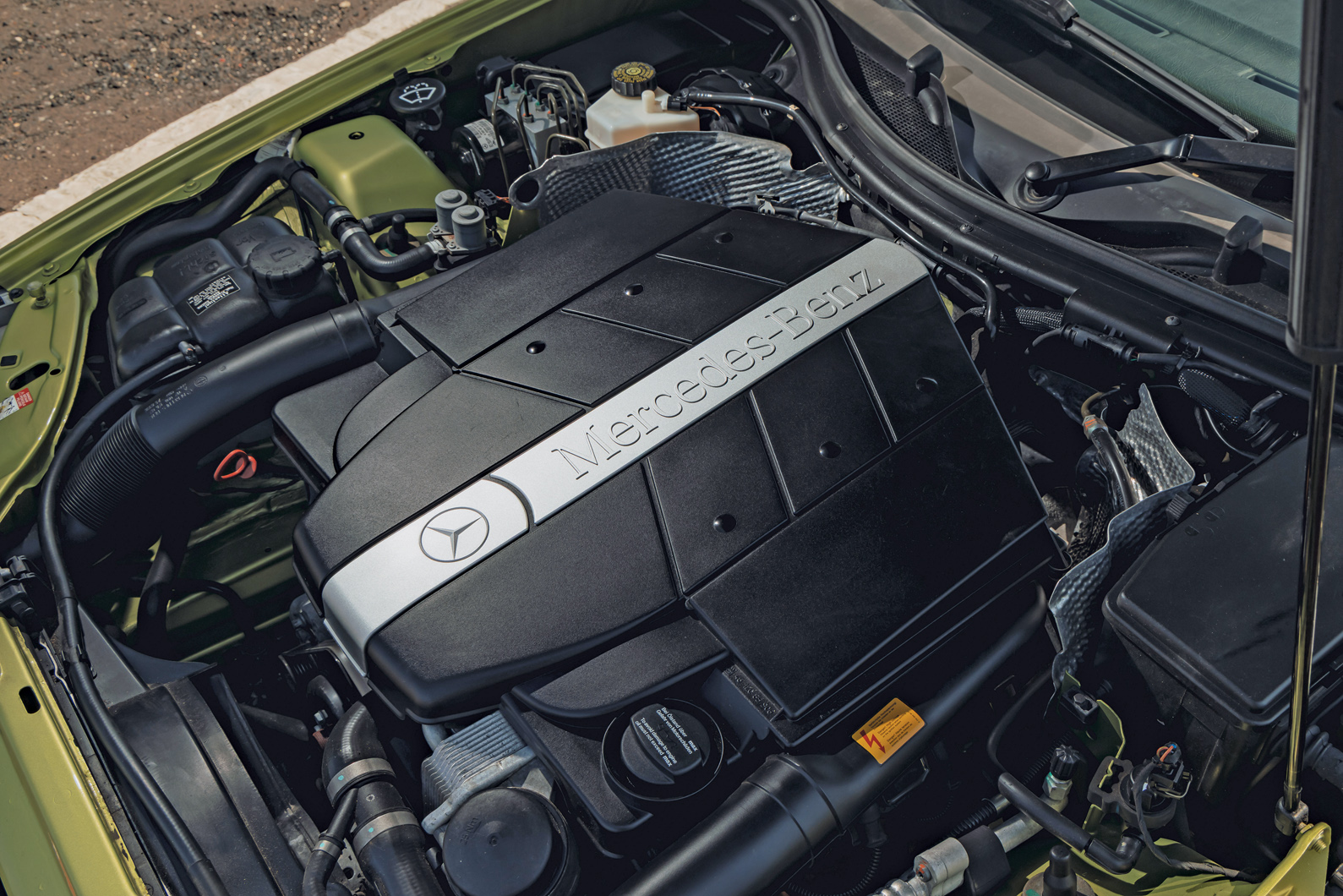
Bestowing upon the SLK the engine it should have had from the start, the 214bhp V6 gave the range a new lease of life and turned out to be a much better sports car all round.
Lowered suspension featured a rear anti-roll bar and a thicker item at the front, with other improvements including bigger brakes and a relocated steering box all adding up to a more purposeful driving experience.
The Mercedes-Benz SLK320’s automatic gearbox is the perfect partner for the torquey V6
The woofly soundtrack of the ‘six’ only encourages you to lean into the throttle, although it doesn’t play such a sonorous tune as its Z3 counterpart.
Charging around a tight, twisty track is not the SLK’s natural arena; it’s much more suited to country lanes and trans-European breaks.
This impressively refined middleweight pulls strongly down the straights, however, demonstrating the forceful all-alloy fist within the gentle silk glove of its elegant coachwork.
Four-cylinder R170 Mercedes-Benz SLKs are good and the lairy 32 AMG has more oomph, but the 320 is the sweet spot – as perfectly demonstrated by the gorgeous Electric Green 2001 car brought along by Bev Lee and Chris Lancaster.
Built to showcase the marque’s Designo programme, whereby its customers could personalise their cars, this SLK’s premium paintwork and upgraded interior made it the star of London’s Piccadilly showroom when new.
This is the duo’s third SLK, starting with a 200 that succumbed to rust, followed by a 230K that soon made way for the 320 when it popped up on Facebook Marketplace.
“It’s the ultimate R170 for me,” says Bev. “The right spec and the perfect colour – much better than all those shades of grey everyone else has.”
In three years of ownership it has been all over Europe, the highlight being a 2500-mile Alpine tour with the Mercedes-Benz Club.
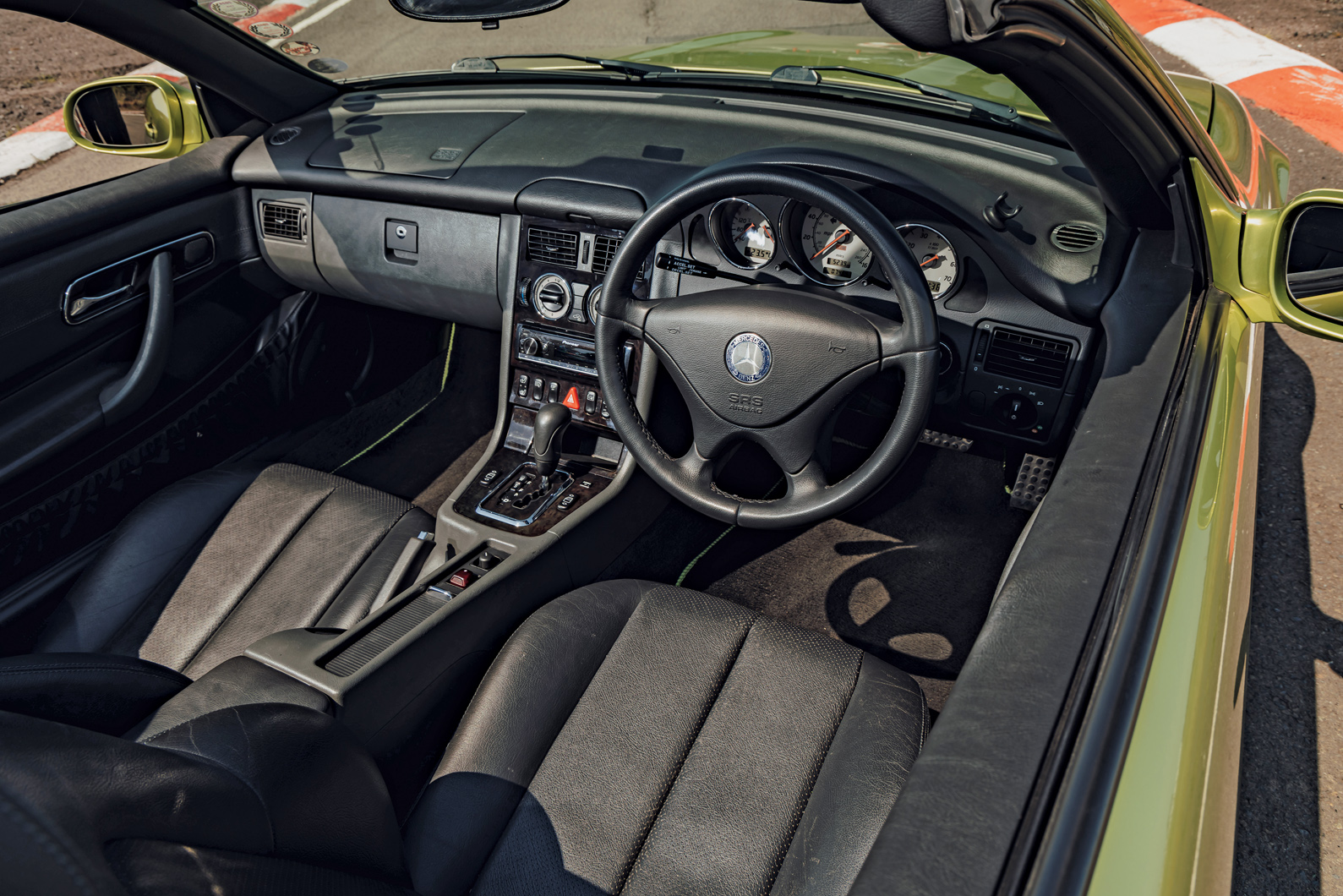
“It’s such a comfortable place to be,” Bev continues. “It gets parked on the street, used all the time and never misses a beat – I can’t think of anything that’s gone wrong. We love the classic look of the first-generation SLK: it’s just like an old car, but with heated electric seats!”
Words: Damon Cogman
The Mercedes-Benz SLK320’s interior is spacious and comfortable
Buying tips
- Electrical issues are common on many ’90s cars, and SLKs are no different. The K40 relay module famously breaks down, but can usually be re-soldered for a cheap fix
- The complex folding steel roof can be pricey if it goes awry, with countless microswitches and hydraulic systems involved
- A surprising number of SLKs rusted badly: sills and wheelarches, including their support brackets, are hot spots for corrosion
Or you could have...
Chrysler Crossfire Roadster A product of the 1998 Daimler/Chrysler merger, the Mercedes SLK and Chrysler Crossfire are effectively the same beneath. The Benz comfortably outsold its cheaper Stateside sibling, whose floppy handling made it more of a cruiser than a sports car, but it’s ideal for posing and a steal today with prices starting from as little as £1500.
MGF
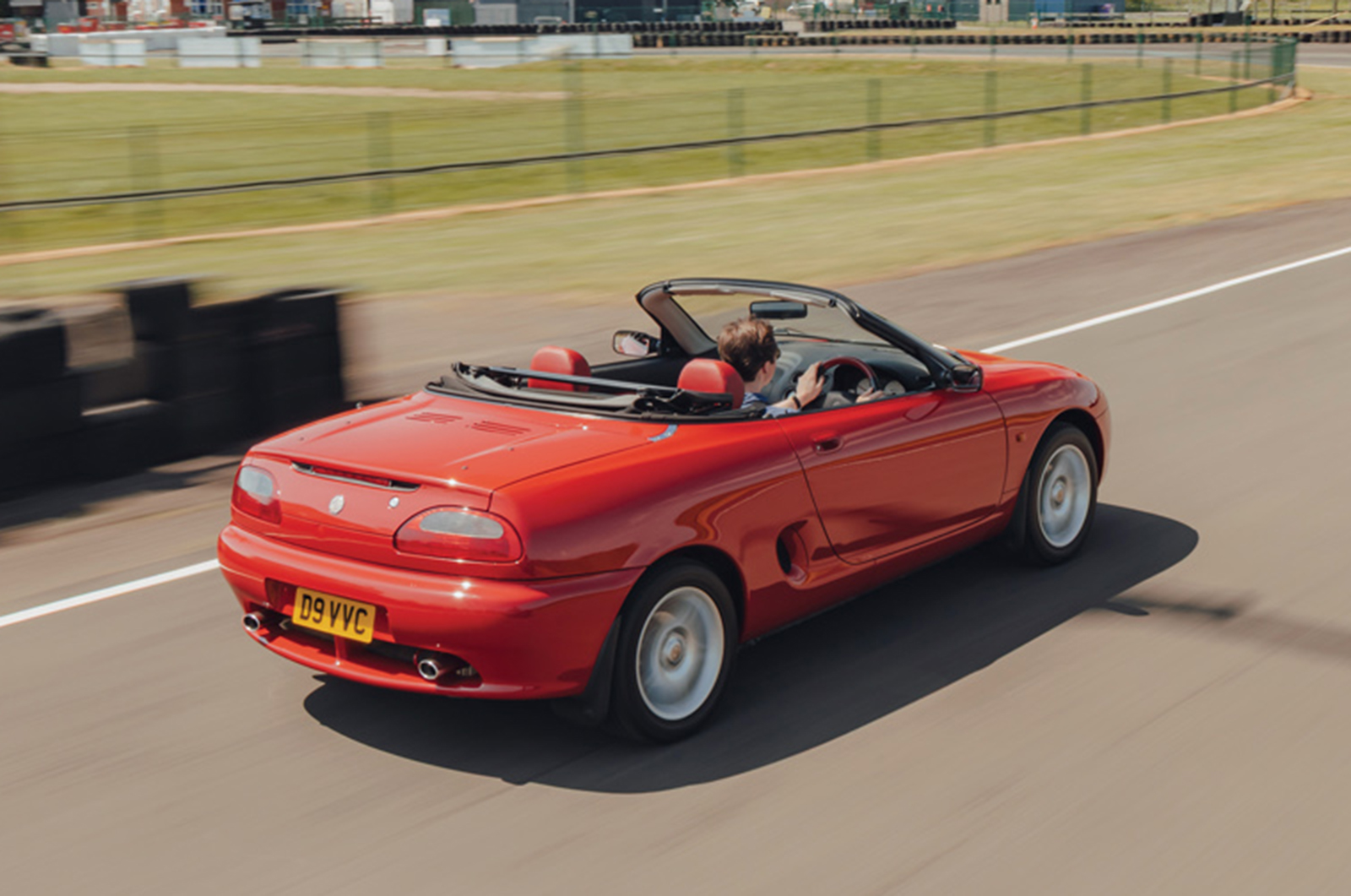
The MGF’s rear has hints of the MG EX-E mid-engined supercar concept
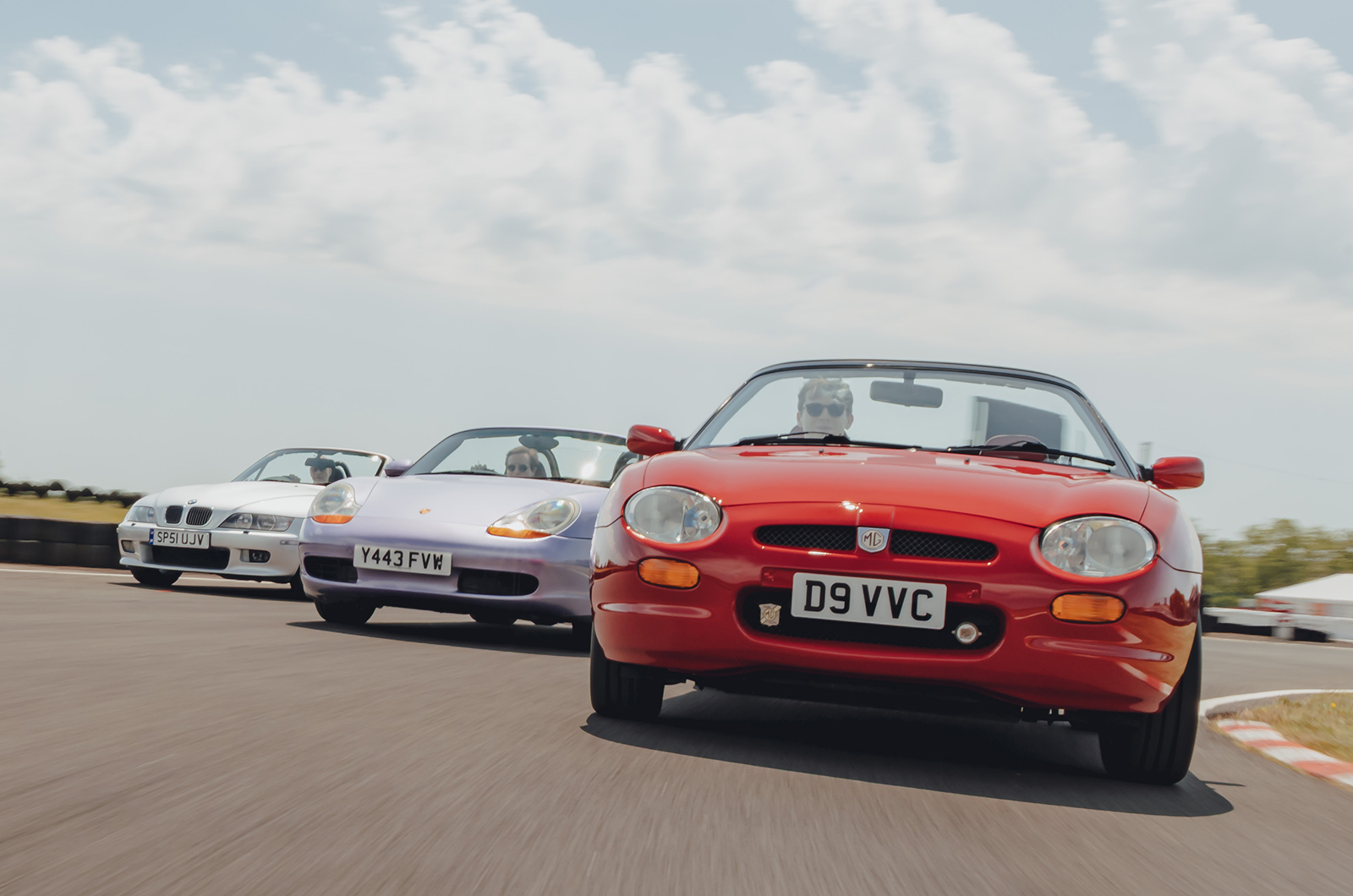
Lively, bursting with personality and remarkably easy to live with, the MGF hit the 1995 sports-car market in full colour – Volcano Orange, Amaranth, ‘our’ car’s Flame Red and the classic British Racing Green.
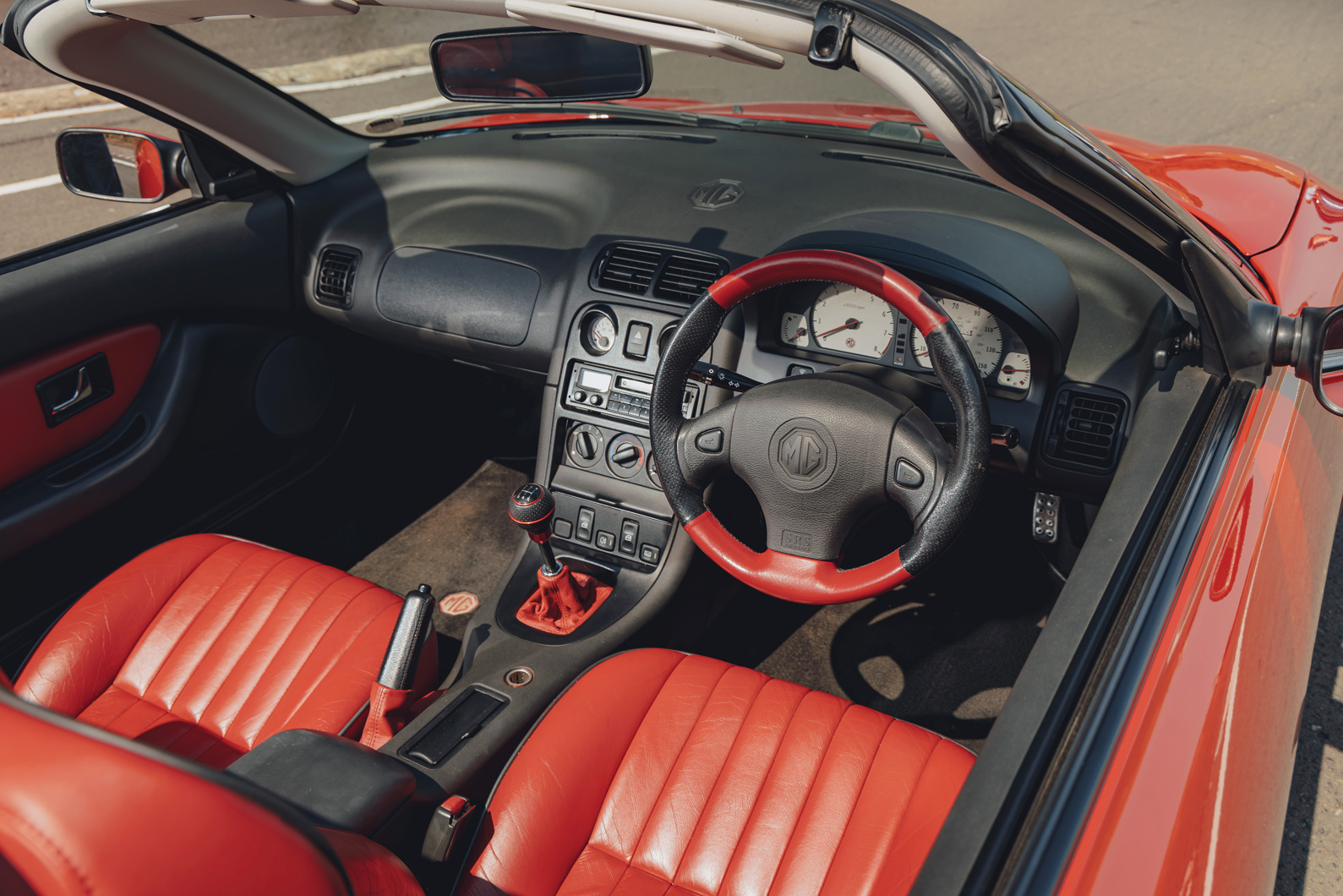
Much more would follow, as this mid-engined confection revived MG’s glory days at a sales pace: for a remarkable £15,995, you got a lightweight jewel of an engine behind you, trick Hydragas suspension and an interior reaching above its station.
Revving irresistibly to a 7200rpm cutout, with a sharp-edged zing in your ears as it enthusiastically dips and growls at the next gear, the sporting drama of this top-spec VVC model feels much higher than the modest outlay that buys you one of these cars today.
From as little as £1000 for a decent runner to £7500 for the very best, it feels like a truly outrageous bargain, especially in the light of £10k Mazda MX-5s and Fiat Barchettas.
With many of the 77,269 built to 2002 sold in the UK and an instant fan following from the inimitable MG community, the huge number of MGFs and its overhauled, 2002-’10 TF successor still around goes some way to explaining its amazing value for money.
It also means you can pick and choose by colour, spec and condition.
A fascination for an early car can be indulged just as easily as a better-equipped, 1999-on facelifted example can be found, and likewise those with tastes more for the sharper-edged, post-millennium style of the firmer-riding TF will need little adjustment to their budgets.
“Some said that I paid too much for mine,” says Denis Chick, who bought this 30,000-mile VVC for £4000 in 2019, “but to me it feels like a new car for a fraction of the cost. The only major thing I had to do was to refill the Hydragas spheres with Nitron. It felt like a totally different car after that.”
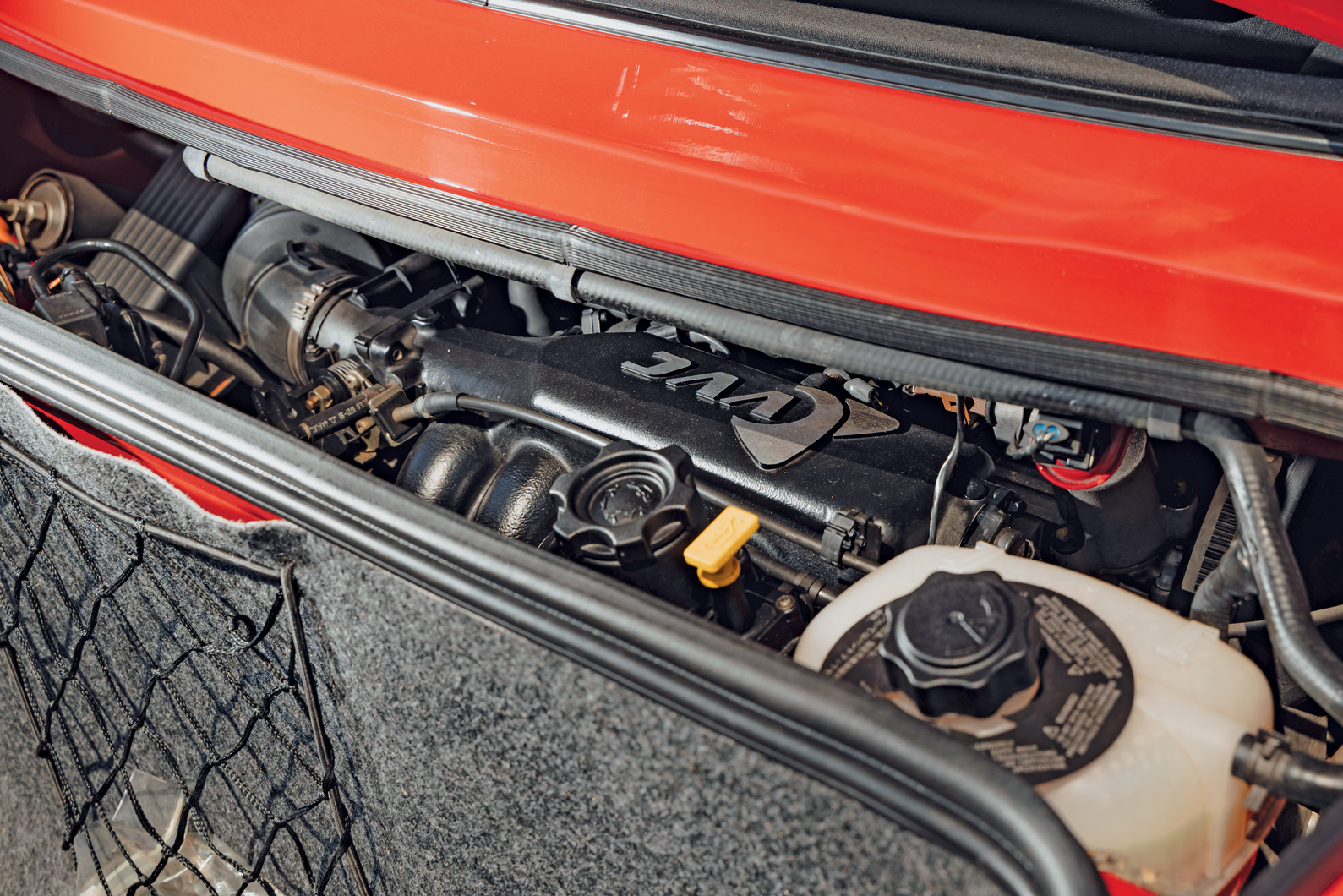
The MGF’s K-series engine is light yet punchy
It fits in a collection that bookends his career at MG Rover, from an apprentice-era Rover P6 to a 75 dating from his time as the firm’s communications director: “The MGF was a challenging project done with so little money, a real testament to the designers and engineers.
“I’d highly recommend joining one of the clubs, there’s great technical support and lots of meetings with friendly, like-minded people.”
There is endless wisdom available on what to look out for and what specs to choose, but the headline option of the range is Variable Valve Control. It increased the standard car’s 115bhp to 143bhp, and went up to 158bhp for the later Trophy and TF160.
Dynamically advancing the profile of the camshafts depending on throttle inputs, it gives the already energetic K-series motor extra verve throughout the rev range and although there is no explosive moment like a VTEC Honda shifting its cams, there is a noticeable keenness above 5000rpm.
All MGFs deliver sparkling response and a soaring exhaust note, with a surprisingly slick gearchange and keen turn-in, and while a hint of understeer is noticeable beneath less balletic handling than the Mazda MX-5, its uncannily compliant Hydragas-and-telescopic-damper suspension gives cat-like composure over all sorts of surfaces.
It also provides unrivalled ride comfort that, together with a tall fifth gear, comfortable seats and remarkably large luggage compartments (front and rear), makes the MGF an excellent touring car.
Its versatility is extended by an incredibly generous aftermarket industry that can boost performance, solve almost any niggling issue – even lowering the infamously high-set seats – and retrofit any features that you might have missed out on.
Whether it’s a track-day toy, weekend getaway car or concours showpiece, the MGF can be tailored to suit, and for very little money. Just pick your colour.
Words: Aaron McKay
The MGF has an awkward seating position for tall drivers
Buying tips
- Head-gasket worries stem from coolant leaks; check condition of underbody pipes for rust – replacement stainless-steel items and thermostat upgrades solve the issue
- Not as rot-prone as some rivals, MGFs can suffer, usually on the rear sills, arches and subframe, and leading edge of front wings
- The twin-chamber Hydragas spheres leak over time, so will need to be refilled properly if the car has a brittle ride or sits too low
Or you could have...
Smart Roadster The rear-engined Roadster and Roadster Coupé were a daring experiment in reimagining core sports-car principles for the new millennium, with a wacky roof design and a turbocharged triple, but were criticised for electrical gremlins and a recalcitrant semi-auto ’box. Rare but still fine value today, with good cars available for £3-7000.
Reliant Scimitar SS1
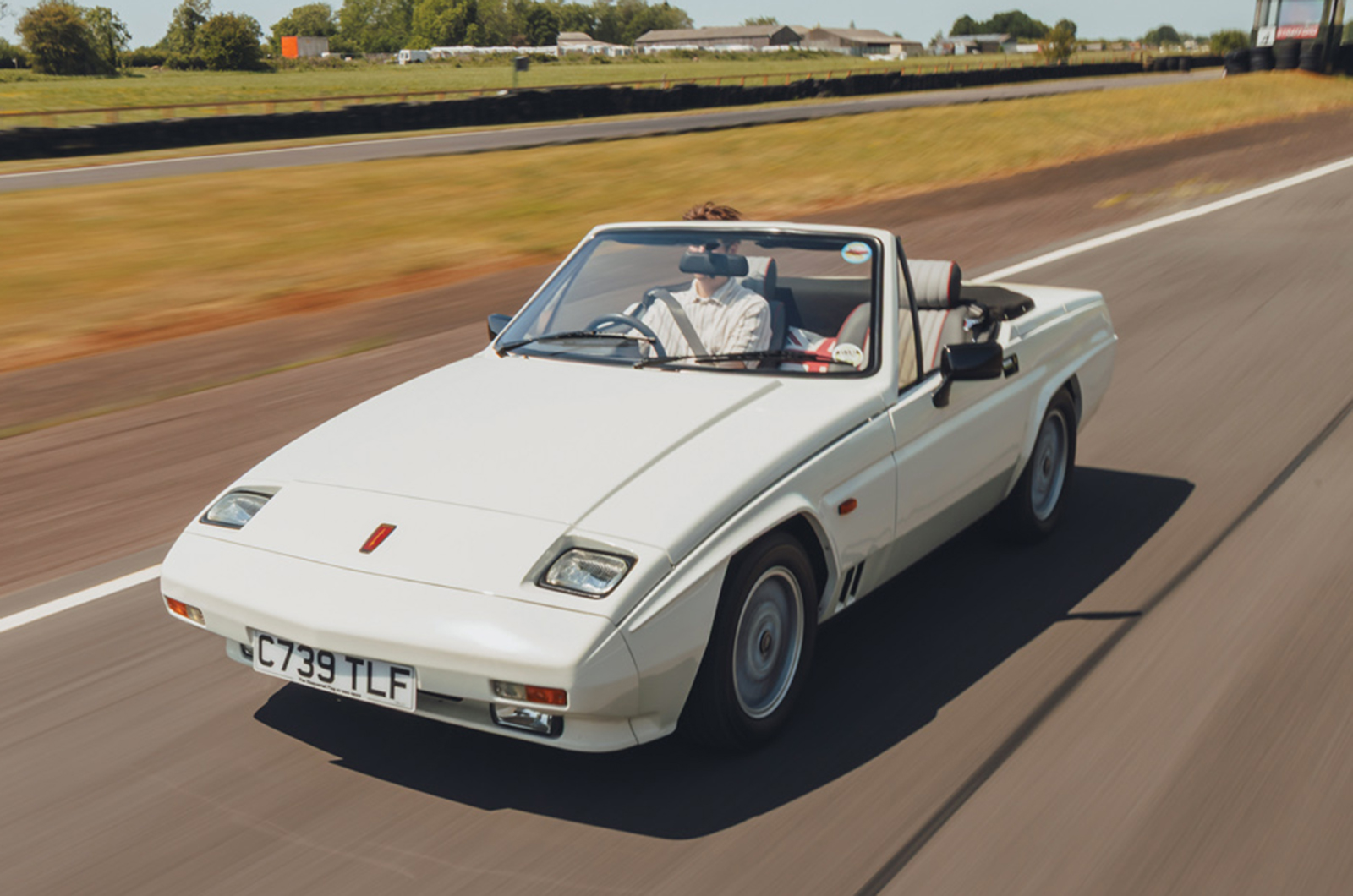
The Reliant Scimitar SS1’s headlights lie back, Porsche 928-style, when not in use
If I had asked which roadster in our set Motor Sport called ‘wonderfully precise’ and Autocar suggested ‘put the fun back into motoring’, would you have said the Scimitar SS1?
Stories of crevasse-like panel gaps and underwhelming sales have muddied our collective psyche. Perhaps it’s time we pulled the Reliant out of the drawer labelled ‘Automotive disasters’ and gave this seldom-seen sports car another chance.
Reliant labelled it ‘The Getaway Car’, and most buyers decided to do just that – and stay away. Boss Ritchie Spencer had hoped to shift 2000 a year, but just 1507 left the Tamworth works from 1984-’90.
What went wrong? All signs pointed towards the Small Sports 1 being a winner: MG and Triumph had left the cheap roadster market, Reliant created a Lotus Elan-inspired chassis and Giovanni Michelotti was hired to style it.
The Italian set out to create a pint-sized Ferrari, so hopes were high that the author of the Spitfire would deliver a knockout shape. Ultimately, it was a let-down – like Mary Berry baking a quiche Lorraine, only for it to arrive with a soggy bottom and a hair in it.
And the shocking shutlines? Intriguingly, these weren’t the result of poor quality control on Reliant’s part. In the interests of safety, the two-seater used a mix of traditional hand-laid glassfibre, injection-moulded polyurethane and sandwich panels.
The firm’s inexperience with the latter and different shrinkage rates were to blame. At times, it was producing more than two bonnets for every SS1 built, such was the challenge of making them fit properly.
Owner Steve Phipps is well aware of the Reliant Scimitar SS1’s shortcomings – he even points out the line on his own car’s bonnet, where two panels were joined together – but he’s hell-bent on changing the perceptions of this maligned model. “I love an ugly duckling that’s a bit different,” he says.
The Reliant Scimitar SS1’s superbly presented Ford CVH with Weber carburettor
Rarity is one reason to consider the Reliant – its curio appeal is matched only by the little-known Honda Beat – but it’s not the only one.
For a small drop-top, the SS1 is very accessible. There’s no sill to step over (thank the backbone chassis for that), the cabin is spacious and the boot is huge – even without the secret compartment under the floor.
It has some ergonomic quirks: the non-adjustable steering wheel sits in your lap, obscuring the dash; the throttle pedal is an inch higher than the brake, so you can forget about heel-and-toe gearchanges; and the cranked-forward gearlever takes some getting used to.
But the five-speed ’box is a peach, its short, notchy throw not that dissimilar to an MX-5’s. The 1596cc ‘four’ demands revs and the gearing is close (you’ll need third to top 60mph), but you’re rewarded with terrific induction noise when you bury the throttle.
Acceleration from this Ford CVH-engined car isn’t eye-opening, yet there’s enough poke to put a smile on your face.
The Scimitar’s reputation makes you think it will rattle and shudder, but the opposite is true: the strong chassis is hardly bothered by rough surfaces and the handling is a delight. You barely even think about changing direction before it’s scurrying towards the next bend.
Amazingly, you can pick up a usable Reliant Scimitar SS1 1600 for little more than £1000, while £4000 will buy the best. If you’re after more power, there’s the turbocharged 1800Ti, while the 69bhp 1300 is a bargain MX-5 alternative for a young buyer.
It was the Mazda’s arrival that twisted the knife in the SS1’s back, but it returned as William Towns’ reworked SST and Sabre, which arrived in 1990 and ’92 respectively.
Sadly, in only remembering the Reliant’s flaws, it seems we’ve forgotten that it was actually a rather brilliant car.
Words: Ryan Standen
Thanks to: Kevin Osborne of the Reliant Sabre and Scimitar Owners’ Club
The Reliant Scimitar SS1’s snug cabin borrows from various parts bins
Buying tips
- Most SS1s got a galvanised chassis from 1986, but look out for rust on early cars (twin windscreen wipers – later cars had one)
- Deformable nose/tail sidestepped the need for Federal bumpers Stateside. They are designed to absorb low-speed impact without cracking, but be wary of damaged panels
- Most parts are easy to source, if you can work out where they’re from: donors included the MG Metro, Rover SD1, Ford Capri and more
Or you could have...
Mazda MX-5 (NA) With rear-wheel drive and Lotus Elan-inspired thrills, the MX-5 rules the roost in the small sports-car market. Mazda’s 1.6- and 1.8-litre twin-cams offer more pace than the Ford CVH-powered Reliants, but a turbocharged SS1 would show both a clean pair of heels. ‘Pop-up-headlight tax’ means NAs are not as cheap as they once were.
Fiat X1/9
The Fiat X1/9’s crisp wedge profile lasted nearly two decades largely unchanged
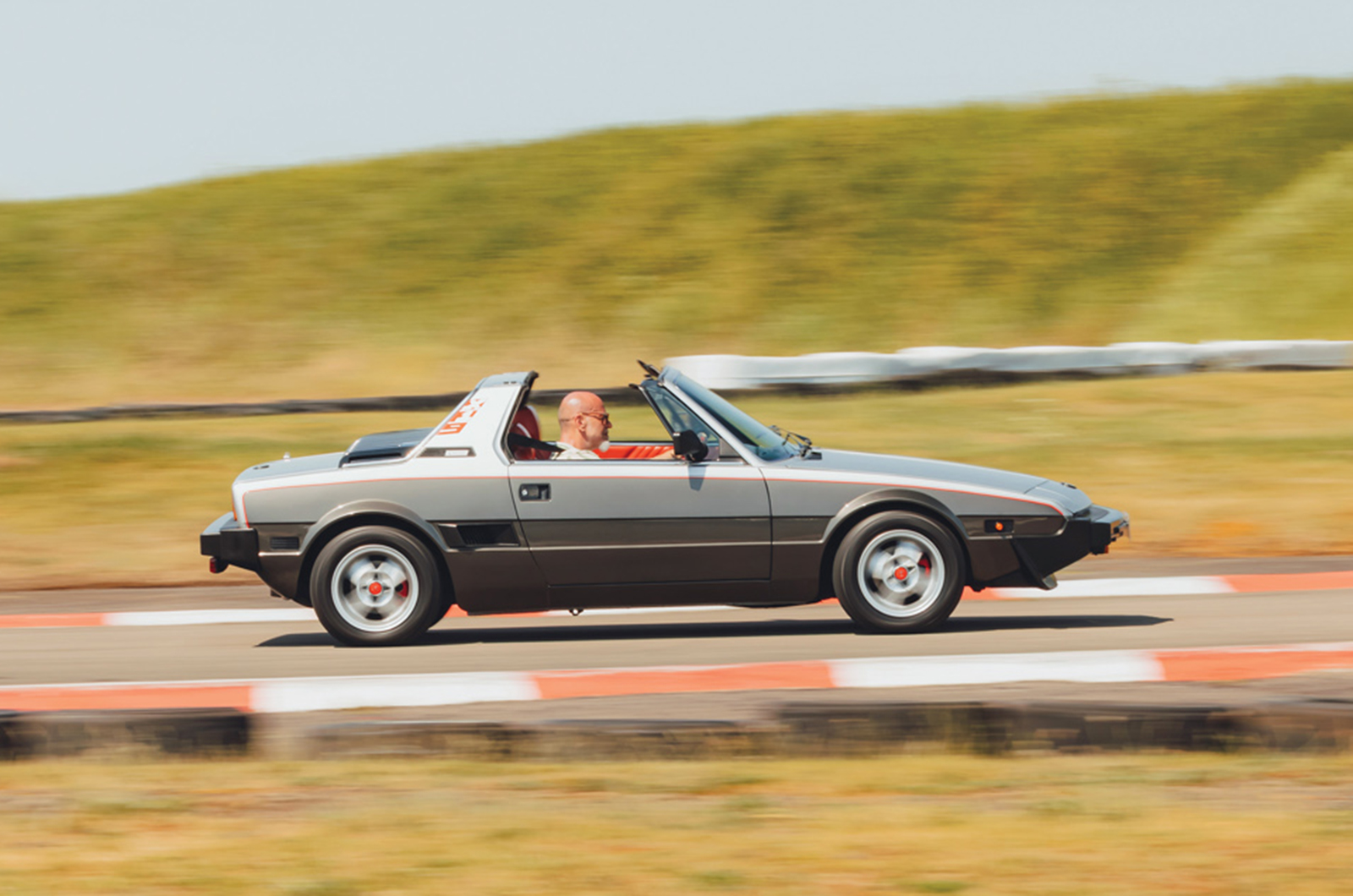
Fiat had the ideal sports car for the ’70s in the cheeky form of the X1/9. Here was a fashionably wedge-profiled two-seater, its engine placed ahead of the rear wheels and driving through a four-speed gearbox.
At last, a mid-engined sports car for masses – widely postulated on but not, before now, committed to production.
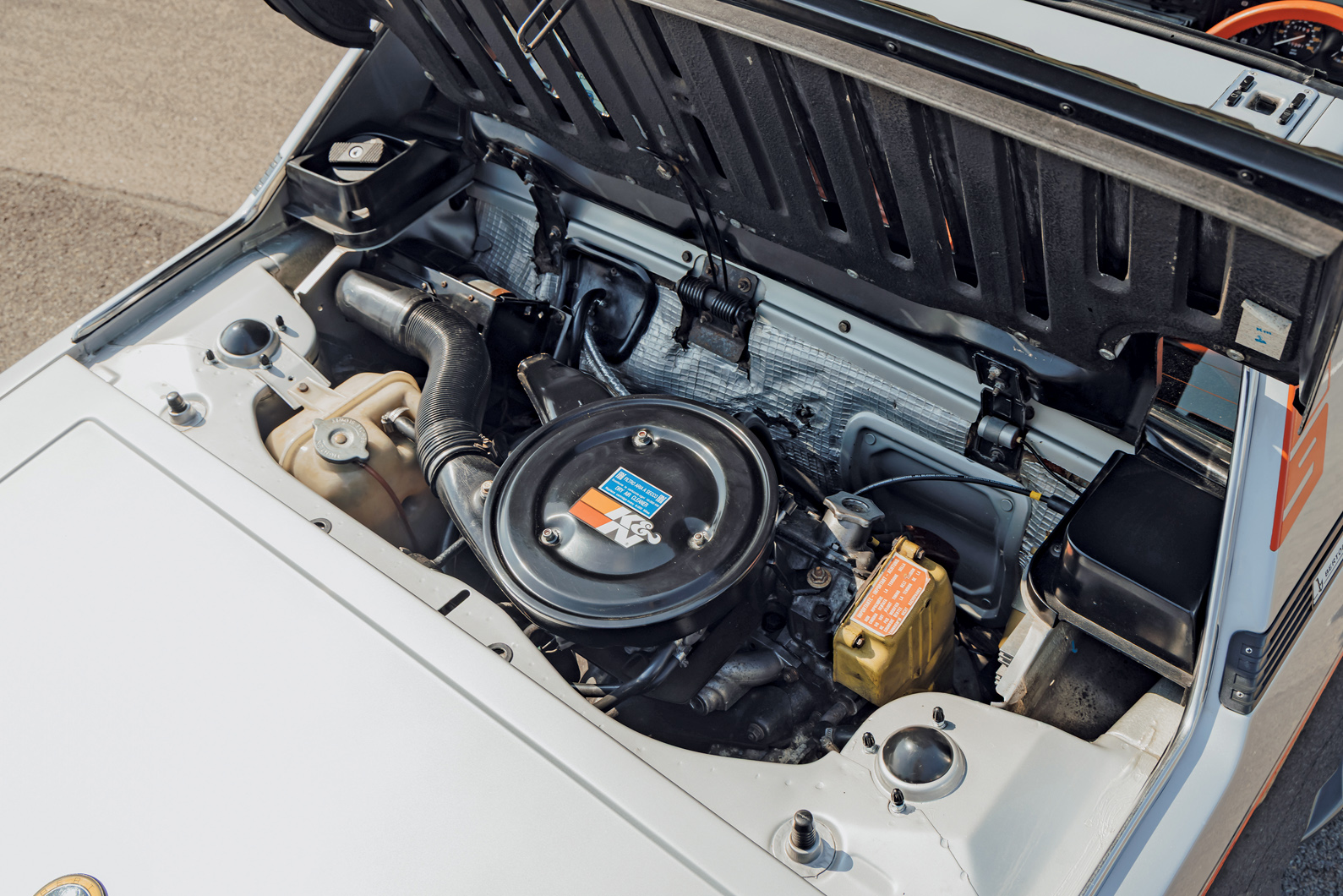
The Aurelio Lampredi-designed, sohc 1290cc unit from the Fiat 128 was cunningly modified to fit amidships in a Bertone-styled and built body that featured pop-up headlamps, a targa-style roof and a triple-skinned roll-over bar.
Built at the rate of 100 a day, these all-steel bodies were shipped to Fiat for drivetrains, MacPherson-strut suspension and four-wheel disc brakes.
Launched in 1972, the X1/9 was created to replace the 850 Sport Spider. It was designed by Marcello Gandini, inspired by his 1969 Autobianchi Runabout show car, and named, enigmatically, after its internal designation.
This thoroughly modern sports car was crash-safe yet fun to drive, if not especially fast, and became a familiar sight on UK roads from the late ’70s, when factory right-hand-drive examples appeared.
(Dealer Radbourne Racing had previously converted a handful of imports for those who couldn’t wait and were committed to paying £2500 for this 104mph, 74bhp ‘baby Ferrari’.)
By that stage the Fiat X1/9 faced a marketing open goal: with no other affordable middie available new, it made the MG Midget/Triumph Spitfire opposition look hopelessly outdated.
Buyers agreed: by 1977, 44,000 had been sold in the USA alone. The following year, the 85bhp, 1498cc engine from the Strada arrived, along with a five-speed ’box, unflattering impact bumpers and a revised interior.
From 1982, Bertone started to produce the cars under its own branding for export, with the last Gran Finale models built in ’89.
This Fiat X1/9’s 1500 ‘four’ breathes through a K&N filter
The Fiat X1/9 looks tiny, yet is only 2in shorter than an MGB.
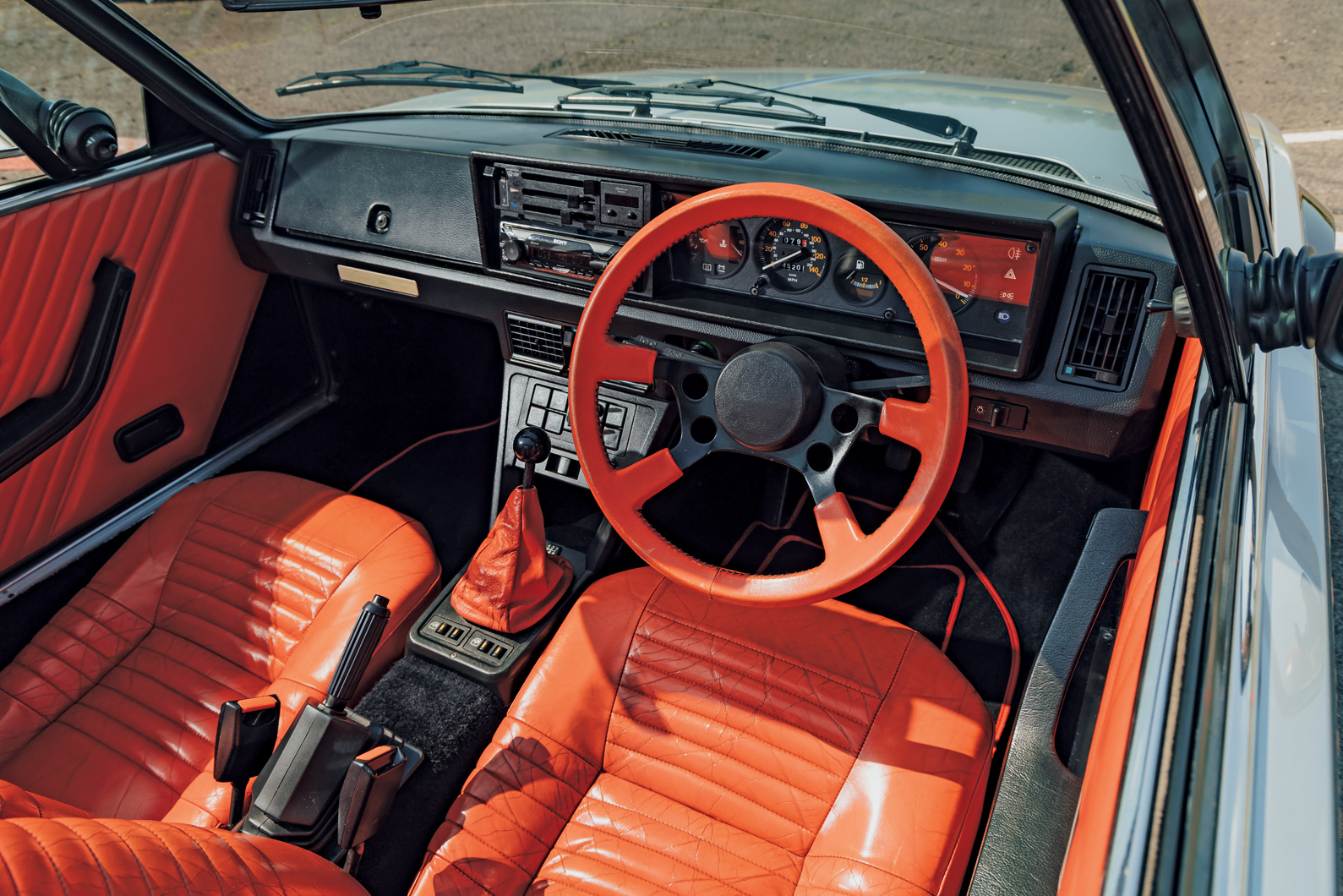
Like most UK cars, Steve Farrall’s 1985 X1/9 is a VS (Versione Speciale), with its loud, lipstick-red leather interior that contrasts with the grey-on-grey outside livery.
With the top stowed, it’s easy to get into: if this compact cabin was made for snake-hipped aspiring playboys, then at least most people under 6ft tall can get comfortable behind the boxy dash, with its clear instruments and a plaque signed by Nuccio Bertone under the glovebox.
The X1/9 got rave reviews in period for its thoroughbred handling, ride, clever packaging and economy. Others have since moved the game on significantly, but the Fiat still holds its own dynamically.
It feels neutral most of the time, has remarkable steering feel and hangs on gamely at both ends up to limits you would never find on the road in the dry.
The Fiat X1/9’s steering is light and positive, the brakes powerful but progressive and the gear ratios well spaced to extract the best from the small but willing engine, which feels pokey enough to keep things interesting at the very least, revving freely to 7000rpm.
Mid-engined layouts raise more problems than they solve in road cars, particularly if you need to appeal to a mass audience rather than the sometimes more forgiving supercar crowd.
Where others shied away, this true example of everyman 1970s exotica showed how it could – and should – be done.
Words: Martin Buckley
Thanks to: Fiat Motor Club GB
The Fiat X1/9’s tachometer spins anticlockwise
Buying tips
- Rust attacks wheelarches, strut tops, around the windscreens, floors, sills and the wells on either side of the rear luggage area
- Electrical problems are common, particularly on little-used cars. Do the headlamps pop up? Fuseboxes get damp, too, which doesn’t help
- Many cars have been updated in search of more power: check what has been done and to what standard. Overheating can be a problem, leading to blown head gaskets
Or you could have...
Toyota MR2 Mk1 The looks divide opinion, but impressive balance and the twin-cam, 16-valve ‘four’ has all the urge the X1/9 lacks. Lotus helped to develop the chassis and a T-bar roof added appeal, but this generation of MR2 was always criticised for lack of cabin room – cured on the longer-wheelbase Mk2 at the expense, at first, of the handling.
Factfiles
Mazda MX-5
- Sold/number built 2005-‘15/244,276
- Engine all-alloy, dohc 1999cc ‘four’, electronic fuel injection
- Max power 158bhp @ 6700rpm
- Max torque 139lb ft @ 5000rpm
- Transmission six-speed manual, RWD
- Weight 2394lb (1086kg)
- 0-60mph 7.1 secs
- Top speed 130mph
- Mpg 34.5
- Price new £18,900 (2006)
- Price now £3-7,000*
MG Midget
- Sold/number built 1961-’79/224,817
- Engine all-iron, ohv 1275cc ‘four’, twin SU carburettors
- Max power 62bhp @ 5800rpm
- Max torque 72lb ft @ 3000rpm
- Transmission four-speed manual, RWD
- Weight 1636lb (742kg)
- 0-60mph 11.9 secs
- Top speed 96mph
- Mpg 35
- Price new £724 (1968)
- Price now £4-10,000*
BMW Z3
- Sold/number built 2000-’02/14,525 (3.0i)
- Engine all-alloy, dohc 2979cc ‘six’, electronic fuel injection
- Max power 231bhp @ 5900rpm
- Max torque 221lb ft @ 3500rpm
- Transmission five-speed manual, RWD
- Weight 2910lb (1320kg)
- 0-60mph 5.9 secs
- Top speed 149mph
- Mpg 29.7
- Price new £26,930 (2001)
- Price now £5-10,000*
Triumph TR7
- Sold/number built 1975-’81/112,375 (all)
- Engine iron-block, alloy-head, sohc 1998cc ‘four’, twin Stromberg/SU carburettors
- Max power 105bhp @ 5500rpm
- Max torque 119lb ft @ 3500rpm
- Transmission five-speed manual, RWD
- Weight 2157lb (980kg)
- 0-60mph 9.6 secs
- Top speed 111mph
- Mpg 25-35
- Price new £5959 (1980)
- Price now £5-12,000*
Alfa Romeo Spider
- Sold/number built 2006-‘10/12,363
- Engine all-alloy, dohc 2198cc ‘four’, variable valve timing, electronic fuel injection
- Max power 182bhp @ 6500rpm
- Max torque 169lb ft @ 4500rpm
- Transmission six-speed manual, FWD
- Weight 3681lb (1670kg)
- 0-60mph 9.1 secs
- Top speed 134mph
- Mpg 24.8
- Price new £25,374 (2008)
- Price now £5500-10,500*
Porsche Boxster
- Sold/number built 1996-2004/160,578
- Engine all-alloy, dohc-per-bank 2687cc flat-six, fuel injection
- Max power 220bhp @ 6400rpm
- Max torque 192lb ft @ 4750rpm
- Transmission five-speed manual, RWD
- Weight 2756lb (1250kg)
- 0-60mph 6.4 secs
- Top speed 149mph
- Mpg 28.5
- Price new £34,232 (1999)
- Price now £1500-17,500*
Honda Beat
- Sold/number built 1991-’96/33,635
- Engine all-alloy, dohc 656cc triple, electronic fuel injection
- Max power 63bhp @ 8100rpm
- Max torque 44lb ft @ 7000rpm
- Transmission five-speed manual, RWD
- Weight 1675lb (759kg)
- 0-60mph 12.1 secs
- Top speed 87mph (ltd)
- Mpg 45
- Price new ¥1,266,000 (1991)
- Price now £4500-8000*
Toyota MR2
- Sold/number built 1999-’07/c13,500 (UK)
- Engine all-alloy, dohc 1794cc ‘four’, variable valve timing, electronic injection
- Max power 138bhp @ 6400rpm
- Max torque 125lb ft @ 4400rpm
- Transmission six-speed manual, RWD
- Weight 2372lb (1076kg)
- 0-60mph 7.5 secs
- Top speed 131mph
- Mpg 30-40
- Price new £17,980 (2001)
- Price now £3-9000*
Mercedes-Benz SLK
- Sold/number built 1996-2004/311,222 (all)
- Engine all-alloy, sohc-per-bank 3199cc V6, fuel injection
- Max power 214bhp @ 5700rpm
- Max torque 229lb ft @ 3-4600rpm
- Transmission five-speed automatic, RWD
- Weight 2974lb (1349kg)
- 0-60mph 6.9 secs
- Top speed 152mph
- Mpg 25.4
- Price new £31,240 (2001)
- Price now £2500-12,000*
MGF
- Sold/number built 1995-2002/77,269
- Engine all-alloy, dohc 1796cc ‘four’, variable valve timing, fuel injection
- Max power 143bhp @ 7000rpm
- Max torque 128lb ft @ 4500rpm
- Transmission five-speed manual, RWD
- Weight 2466lb (1121kg)
- 0-60mph 7.6 secs
- Top speed 126mph
- Mpg 26-36
- Price new £17,995 (1996)
- Price now £1-7500*
Reliant Scimitar SS1
- Sold/number built 1984-’90/1507 (all)
- Engine iron-block, alloy-head, sohc 1596cc ‘four’, twin-choke Weber carburettor
- Max power 96bhp @ 6000rpm
- Max torque 98lb ft @ 4000rpm
- Transmission five-speed manual, RWD
- Weight 1850lb (839kg)
- 0-60mph 9.6 secs
- Top speed 110mph
- Mpg 36.2
- Price new £7990 (1985)
- Price now £1500-6000*
Fiat X1/9
- Sold/number built 1972-’89/180,000
- Engine iron-block, alloy-head, ohc 1498cc ‘four’, Weber twin-choke carburettor
- Max power 85bhp @ 6000rpm
- Max torque 87lb ft @ 3200rpm
- Transmission five-speed manual, RWD
- Weight 2028lb (920kg)
- 0-60mph 10.3 secs
- Top speed 111mph
- Mpg 29-34
- Price new £4575 (1979)
- Price now £2-15,000*
*Prices correct at date of original publication
Enjoy more of the world’s best classic car content every month when you subscribe to C&SC – get our latest deals here
READ MORE
MGB vs rivals: six alternatives take on Abingdon’s classic champion
Aston Martin DB9: the V12 super-GT you can buy from £20k
Baby classic sports cars do battle: Honda S800 vs Fiat Sport Spider vs MG Midget